Chinese Journal of Tissue Engineering Research ›› 2026, Vol. 30 ›› Issue (21): 5460-5467.doi: 10.12307/2026.622
Previous Articles Next Articles
InterTAN versus proximal femoral nail anti-rotation for intertrochanteric fractures in the elderly: a comparison of joint function and stability
He Yun, Yiliyaer · Abudusimu, Xu Bin, Wang Guosheng
- Sixth Affiliated Hospital of Xinjiang Medical University, Urumqi 830063, Xinjiang Uygur Autonomous Region, China
-
Accepted:2025-04-16Online:2026-07-28Published:2026-03-04 -
Contact:王国胜,主任医师,新疆医科大学第六附属医院,新疆维吾尔自治区乌鲁木齐市 830063 -
About author:何云,男,1987年生,四川省南部县人,汉族,2015年新疆医科大学毕业,硕士,主治医师,主要从事四肢创伤方面的研究。

CLC Number:
Cite this article
He Yun, Yiliyaer · Abudusimu, Xu Bin, Wang Guosheng. InterTAN versus proximal femoral nail anti-rotation for intertrochanteric fractures in the elderly: a comparison of joint function and stability[J]. Chinese Journal of Tissue Engineering Research, 2026, 30(21): 5460-5467.
share this article
Add to citation manager EndNote|Reference Manager|ProCite|BibTeX|RefWorks
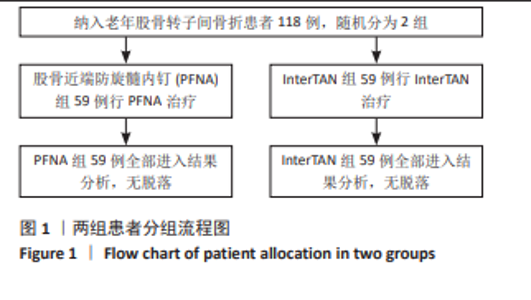
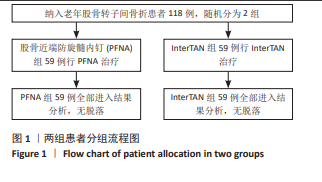
2.1 参与者数量分析 按意向性处理分析,纳入118例老年股骨转子间骨折患者,随机分为2组,全部进入结果分析,无脱落。 2.2 试验流程图 见图1。"
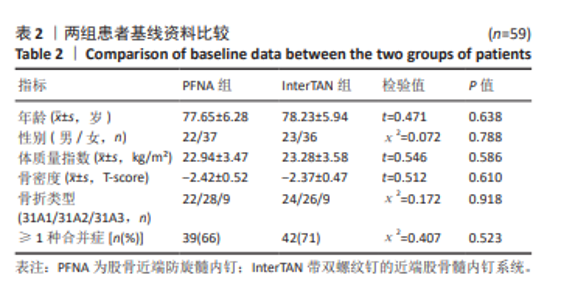
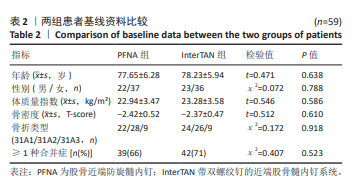
2.3 患者基线特征比较 对两组患者的基线资料统计分析后发现,年龄、体质量指数、骨密度经t检验,P > 0.05;性别、骨折类型与合并症按χ2检验,P > 0.05。结果表明两组间基线资料相比差异无显著性意义(P > 0.05),见表2。"
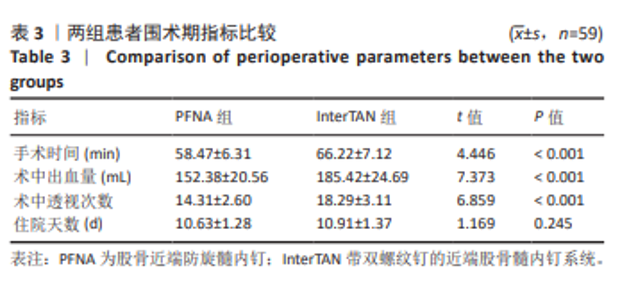
2.4 围术期结果 采用独立样本t检验,结果显示PFNA组手术时间、出血量、透视次数均显著低于PFNA组(P < 0.001);两组住院天数相比差异无显著性意义(P > 0.05),提示PFNA组围术期创伤更小,见表3。"
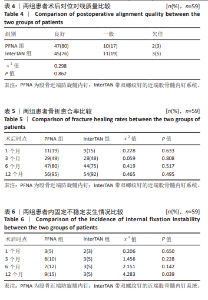
2.5 影像学评估与骨折愈合结果 术后即刻评估结果显示,两组患者对位对线质量相比差异无显著性意义(P > 0.05)。术后随访显示,骨折愈合率在各时间点两组差异均无显著性意义(P > 0.05)。术后12个月,InterTAN组内固定不稳定发生率显著低于PFNA组 (P < 0.05)。见表4-6。"
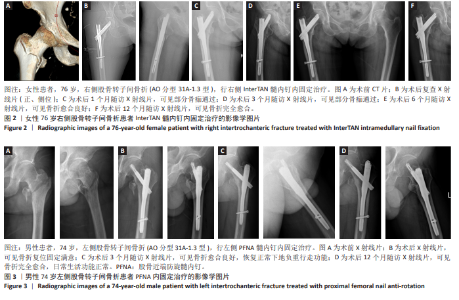
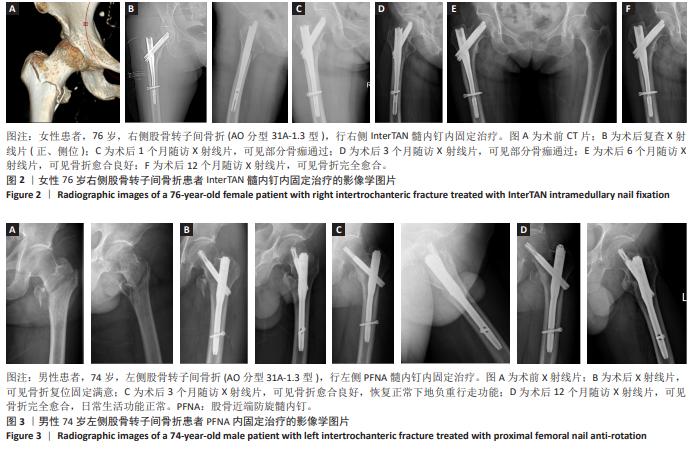
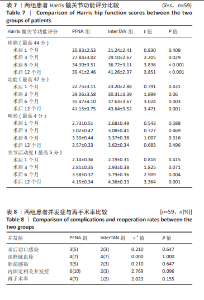
2.6 典型病例 术前影像显示两组患者均存在转子间骨折移位明显的情况,提示为不稳定性骨折。术后 6 个月影像显示,InterTAN 组固定位置理想,骨折线模糊,均匀骨痂形成显著,骨折端完全愈合,内固定无松动或断裂,患者疼痛明显缓解,功能恢复良好(图2);PFNA 组固定位置良好,骨痂逐渐形成,骨折基本愈合,内固定无明显松动或断裂,患者功能恢复较好,但部分患者仍可能存在轻微疼痛(图3)。 "
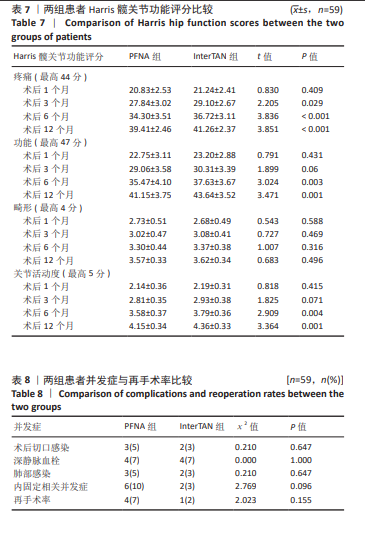
2.7 功能恢复结果 术后随访结果显示,两组患者的Harris疼痛、功能及关节活动度评分均随时间延长显著提高(重复测量方差分析,F=58.276,62.385,18.859,P < 0.001),但在畸形评分方面两组间差异无显著性意义(F=2.162,P=0.103)。独立样本t检验结果表明,InterTAN组术后6,12个月的Harris疼痛、功能、关节活动度评分均显著优于PFNA组(P < 0.05)。见表7。 2.8 并发症与再手术情况 两组患者术后切口感染、深静脉血栓、肺部感染发生率、内固定相关并发症与再手术率相比差异无显著性意义(P > 0.05),但 InterTAN组的并发症发生率均略低于PFNA 组,见表8。"
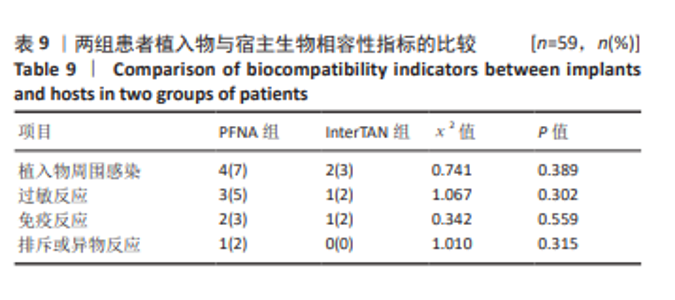
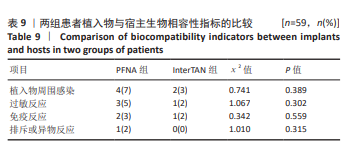
2.9 植入物与宿主的生物相容性 如表9所示,两组患者在植入物周围感染、过敏反应、免疫反应及排斥或异物反应方面差异均无显著性意义(P均> 0.05),表明两种内固定物均具有良好的生物相容性。"
| [1] SIVRO M, OMEROVIĆ Đ, LAZOVIĆ F, et al. The effect of intravenous vitamin C administration on postoperative pain and intraoperative blood loss in older patients after intramedullary nailing of trochanteric fractures. Eur Geriatr Med. 2025;16(1):237-243. [2] ROY S, MOAIYADI A, SALUNKHE P, et al. A Comparative Study Evaluating the Outcomes of Primary Cemented Bipolar Hemiarthroplasty Versus Proximal Femoral Nail Osteosynthesis for Unstable Intertrochanteric Femur Fractures in the Elderly Patient. J Orthop Case Rep. 2024;14(11): 225-231. [3] WAN Q, WU HC, YIN DH, et al. [Comparison of two surgical methods for the treatment of intertrochanteric fractures of the femur in elderly patients with knee osteoarthritis]. Zhongguo Gushing. 2024;37(10): 985-990. [4] DAHUJA A, KHATRI K, KAUR R, et al. Comparative outcomes of PFN vs PFNA2 nailing for osteoporotic unstable intertrochanteric fractures in the elderly. Acta Ortopedica Mexicana. 2024;38(5):298-306. [5] WANG W, NI B, SHEN H, et al. Meta-analysis of InterTan, PFNA and PFNA-II internal fixation for the treatment of unstable intertrochanteric fractures in elderly individuals. Acta Orthop Belg. 2023;89(1):51-58. [6] 张生志,王文庆,宋江润,等. 股骨头置换与髓内钉固定老年股骨转子间骨折比较[J]. 中国矫形外科杂志,2024,32(16):1441-1447. [7] LI L, WU W. Comparison of clinical effects of PFNA, APFLP and InterTan intramedullary nail in the treatment of unstable intertrochanteric fractures in elderly patients. Minerva Surg. 2025;80(1):97-100. [8] LI L, FANG X, GAO J, et al. Comparison of InterTAN and PFNA internal fixation for elderly patients with intertrochanteric fracture: A retrospective cohort study. Pak J Med Sci. 2024;40(4):589-594. [9] PARDO SI, CRUZ VAJ, SÁNCHEZ DS, et al. Is immediate weight bearing safe for subtrochanteric femur fractures in elderly patients treated by cephalomedullary nailing? A multicentric study in one hundred eighty-two patients. Eur J Orthop Surg Traumatol. 2024;34(5):2595-2603. [10] 张乾龙,王继荣,宋晨辉,等. 两种髓内钉固定A3.1粗隆间骨折的有限元分析:增强型PFNA与InterTan[J]. 中华老年骨科与康复电子杂志,2023,9(4):209-217. [11] 宋宝东,浦瑶瑶,李贵宾,等. 髓内钉固定与髋关节置换治疗老年股骨粗隆间骨折的效果比较[J]. 中国老年学杂志,2023,43(22): 5470-5472. [12] ALTERNATIVE MEDICINE EC. Retracted: Treatment of Elderly Femoral Intertrochanteric Fracture by InterTan Intramedullary Nail and PFNA. Evid Based Complement Alternat Med. 2023;2023:9780150. [13] WILLIAM AVP, JAMES TH, BLAKE DR, et al. Technical Trick: Traction Table Assisted Lateral Decubitus Patient Positioning in Cephalomedullary Nailing of Geriatric Intertrochanteric Femur Fractures. J Orthop Trauma. 2023;38(2):e71-e77. [14] HARRIS WH. Traumatic arthritis of the hip after dislocation and acetabular fractures: treatment by mold arthroplasty. An end-result study using a new method of result evaluation. J Bone Joint Surg Am. 1969;51(4):737-755. [15] BI C, ZHAO Y, MA Z, et al. Comparison of Proximal Anti-Rotation Intramedullary Nail and Femoral Head Replacement for the Treatment of Femoral Intertrochanteric Fractures in Elderly Patients. Altern Ther Health Med. 2023;29(5):268-273. [16] COMPLEMENTARY EMAA. Retracted: Treatment of Elderly Femoral Intertrochanteric Fracture by InterTan Intramedullary Nail and PFNA. Evid Based Complement Alternat Med. 2023;2023:9780150. [17] 傅宏沛,周云烽,贾俊杰,等. PFBN、InterTan、PFNA髓内钉内固定治疗老年股骨粗隆间骨折早期疗效比较[J]. 中国骨与关节损伤杂志,2023,38(10):1058-1061. [18] ZHENGBING S, MINGHUI Y, GANG L, et al. Treatment of Elderly Femoral Intertrochanteric Fracture by InterTan Intramedullary Nail and PFNA. Evid Based Complement Alternat Med. 2022;2022:5020960. [19] 胡靖,王林,陈义,等. 防旋股骨近端髓内钉治疗老年股骨粗隆间骨折的效果及对髋关节功能、生活质量和日常生活能力的影响[J]. 中国老年学杂志,2022,42(12):2918-2920. [20] BASANT R, JASPAL S, VIKRAMJIT S, et al. Evaluation of the Outcomes of Proximal Femoral Nail Antirotation II in the Treatment of Trochanteric Fracture in Elderly Patients. Cureus. 2022;14(5):e24896-e24896. [21] 莫玉富,顾兴科,陈永洪,等. 两种内固定治疗老年不稳定型股骨转子间骨折的疗效比较[J]. 临床骨科杂志,2022,25(5):702-706. [22] 蔡鹏飞,赵巍,王金华,等. 不同髓内钉对老年股骨转子间骨折手术及预后的影响[J]. 浙江创伤外科,2023,28(3):448-450. [23] FURKAN Y, HANIFI Ü, VOLKAN G, et al. Functional and radiological comparison of three cephalomedullary nails with different designs used in the treatment of unstable intertrochanteric femur fractures of elderly. Ulus Travma Acil Cerrahi Derg. 2022;28(5):668-677. [24] 汪胜,李军,左才红,等. PFNA与InterTAN内固定治疗老年不稳定性股骨转子间骨折效果的对比[J]. 中国老年学杂志,2023, 43(19):4700-4703. [25] CHEN WH, GUO WX, GAO SH, et al. Arthroplasty vs proximal femoral nails for unstable intertrochanteric femoral fractures in elderly patients: A systematic review and meta-analysis. World J Clin Cases. 2021;9(32):9878-9888. [26] 刘英科,陈柯,陈勤,等. 股骨近端髓内钉内固定术后主钉断裂2例报道并文献复习[J]. 中国骨与关节损伤杂志,2023,38(12): 1328-1330. [27] MADBOH ESM, YONIS EAML, KABBASH AI, et al. Proximal Femoral Plate, Intramedullary Nail Fixation Versus Hip Arthroplasty for Unstable Intertrochanteric Femoral Fracture in the Elderly: A Meta-analysis. Indian Orthop. 2021;56(1):1-7. [28] NHERERA L, TRUEMAN P, HORNER A, et al. In reply to the letter to the editor regarding “Comparison of a twin interlocking derotation and compression screw cephalomedullary nail (InterTAN) with a single screw derotation cephalomedullary nail (proximal femoral nail antirotation): a systematic review and meta-analysis for intertrochanteric fractures”. J Orthop Surg Res. 2022;17(1):354. [29] TÜZÜN YH, BILEKLI BA, ERŞEN Ö. The factors that affect blood loss in intertrochanteric fractures treated with proximal femoral nail in the elderly. Eur J Trauma Emerg Surg. 2021;48(3): 1-6. [30] 王超群. InterTan髓内钉与PFNA内固定治疗对老年股骨粗隆间骨折患者围术期指标及髋关节功能的影响[J]. 反射疗法与康复医学, 2024,5(22):98-101. [31] VARMIŞ HO, GÖKMEN MY, TAN İ. A retrospective comparative study of the clinical and radiological outcomes of intertrochanteric fractures treated with proximal femoral nail antirotation (PFN-A) and INTERTAN nail. PLoS One. 2025;20(1):e0316954. [32] SONG M, YU H, SUN T. Comment on the article “Proximal femoral nailing is superior to hemiarthroplasty in AO/OTA A2 and A3 intertrochanteric femur fractures in the elderly: a systematic literature review and meta-analysis”. Int Orthop. 2021;45(3):1-2. [33] 刘建斌,刘敏,马林,等. 防旋髓内钉和InterTan固定A3型股骨转子间骨折:生物力学变化的有限元分析[J]. 中国组织工程研究, 2015,19(26):4242-4246. [34] Yang Y, Tong Y, Cheng X, et al. Comparative study of a novel proximal femoral bionic nail and three conventional cephalomedullary nails for reverse obliquity intertrochanteric fractures: a finite element analysis. Front Bioeng Biotechnol. 2024;12:1393154. [35] 陈健,马剑雄,卢斌,等.解剖髓内钉ZNN、髓内钉Gamma3和联合加压交锁髓内钉InterTan置入内固定治疗老年反转子间骨折的生物力学特点[J]. 中国组织工程研究,2021,25(27):4271-4276. [36] Noratep K, Paphon S, Norachart S, et al. Predicting Factors for Return to Prefracture Ambulatory Level in High Surgical Risk Elderly Patients Sustained Intertrochanteric Fracture and Treated With Proximal Femoral Nail Antirotation (PFNA) With and Without Cement Augmentation. Geriatr Orthop Surg Rehabil. 2020;11: 2151459320912121. [37] KASHA S, YALAMANCHILI RK, ROHIT GPRK. Design innovation and rationale of the intramedullary implants for treating Intertrochanteric fractures: A review. J Clin Orthop Trauma. 2024;56:102525. [38] DATE A, PANTHULA M, BOLINA A. Comparison of clinical and radiological outcomes in intertrochanteric fractures treated with InterTAN nail against conventional cephalomedullary nails: a systematic review. Future Sci OA. 2020;7(1):FSO668. [39] HASMAT A, BHARTIYA KH, PRAKASH O, et al. A Prospective Comparative Study of Unstable Inter Trochanteric Fracture by Proximal Femoral Nail and Proximal Femoral Nail Antirotation in Elderly Patients in Terms of Functional and Radiological Outcomes. J Evol Med Dent Sci. 2020;9(12): 909-912. [40] NGUYEN TA, HOANG AQ, PHAN TN, et al. The retrospective analysis of trigen intertan nail in the treatment of unstable intertrochanteric femoral fractures at hospital for traumatology and orthopaedics. Orthop Rev (Pavia). 2024;16:94277. |
| [1] | Guo Jiachen, Gao Jun, Dai Wenhao, Liao Huayuan, Jiang You, Zhang Xi . Effect of compressive stress microenvironment on cytokines during fracture healing [J]. Chinese Journal of Tissue Engineering Research, 2026, 30(4): 908-916. |
| [2] | Shi Tengbo, Tang Yanfeng, Zhang Mengyu, Wang Xingfei, Li Chenyang, Shi Jinyu, Guo Chaowei, Li Yanzhou, He Zike, Wang Shangzeng. Effect of high-dose low molecular weight heparin on the healing of femoral shaft fractures [J]. Chinese Journal of Tissue Engineering Research, 2026, 30(12): 2957-2964. |
| [3] | Zhao Jiyu, Wang Shaowei. Forkhead box transcription factor O1 signaling pathway in bone metabolism [J]. Chinese Journal of Tissue Engineering Research, 2025, 29(9): 1923-1930. |
| [4] | Bu Xianmin, Liang Di, Zhang Bin, Xu Yingjie, Ding Hao, Wu Bin, Tian Ronghua. Exosomes derived from human umbilical cord mesenchymal stem cells in treatment of osteoporotic femoral fractures in SD rats [J]. Chinese Journal of Tissue Engineering Research, 2025, 29(31): 6634-6641. |
| [5] | Liu Hanfei, Cai Zhencun, Zhou Xueting, Wen Hang, Chen Zhenjun. Mechanisms by which traumatic brain injury promotes bone callus formation and fracture healing [J]. Chinese Journal of Tissue Engineering Research, 2025, 29(29): 6260-6268. |
| [6] | Zheng Li, Ding Yiheng, Li Xinhao, Wen Zekai, Jiang Bingzheng, Lin Xuexia. Role of neuropilin 1 in promoting angiogenesis-osteogenesis coupling during fracture healing [J]. Chinese Journal of Tissue Engineering Research, 2025, 29(21): 4576-4583. |
| [7] | Cheng Chaoran, Zhang Junxia, Jia Jun. Finite element analysis of muscle loading effect on biomechanics of early healing of femoral stem fractures [J]. Chinese Journal of Tissue Engineering Research, 2025, 29(21): 4413-4420. |
| [8] | Gu Xinbo, Liu Zemin, Sun Haiyu. Role of neutrophils in fracture healing and the promoting effect on healing after intervention [J]. Chinese Journal of Tissue Engineering Research, 2025, 29(15): 3235-3243. |
| [9] | Lu Fei, Zhou Jing, Jin Tao. Alpinetin promotes fracture healing in rats with osteoporotic fracture by regulating the cAMP/PKA/CREB signaling pathway [J]. Chinese Journal of Tissue Engineering Research, 2025, 29(12): 2438-2443. |
| [10] | Yan Huadong, Zhang Zhong, Zhao Gang, Li Jie, Song Hua, Sun Jianhua, Liu Zhi, Wang Mingming. Biomechanical difference of different fixation methods in bone healing of distal tibial comminuted fractures analyzed by finite element method [J]. Chinese Journal of Tissue Engineering Research, 2024, 28(24): 3814-3821. |
| [11] | Zhang Qiang, Li Dawei, Liu Ninghao, Li Qianru, Zheng Yingjie, Zhang Zhifeng. Establishment of a nutritional risk prediction model for femoral intertrochanteric fractures treated with intramedullary nails [J]. Chinese Journal of Tissue Engineering Research, 2024, 28(21): 3380-3384. |
| [12] | Zheng Xuejing, Mei Wei, Zhu Yanyu, Bao Xiaoxiao, Zhang Zhenhui, Wang Qingde. Stage III Kümmell’s disease treated with injured-vertebra screw placement combined with transpedicular impaction bone grafting: quick restoration of spinal stability [J]. Chinese Journal of Tissue Engineering Research, 2024, 28(18): 2865-2870. |
| [13] | Bai Jiangbo, Gao Ruijiao, Zhang Aru, Yu Kunlun, Zhang Chunhuan, Tian Dehu. Percutaneous screw fixation with a novel guide for the treatment of scaphoid fractures [J]. Chinese Journal of Tissue Engineering Research, 2024, 28(12): 1885-1889. |
| [14] | Wang Zhongqing, Xiong Xianmei, Zhang Yan, Li Shijie, Ma Liqiong, Lu Zesheng, Gao Yijia. Panax notoginseng saponin promotes fracture healing by upregulating concentrated growth factors in rats [J]. Chinese Journal of Tissue Engineering Research, 2024, 28(11): 1678-1683. |
| [15] | Zheng Hongrui, Zhang Wenjie, Wang Yunhua, He Bin, Shen Yajun, Fan Lei. Femoral neck system combined with platelet-rich plasma in the treatment of femoral neck fracture [J]. Chinese Journal of Tissue Engineering Research, 2023, 27(9): 1390-1395. |
| Viewed | ||||||
|
Full text |
|
|||||
|
Abstract |
|
|||||