Chinese Journal of Tissue Engineering Research ›› 2026, Vol. 30 ›› Issue (19): 5066-5071.doi: 10.12307/2026.115
Previous Articles Next Articles
Effects of human umbilical cord blood mesenchymal stem cells on pain and function in patients with knee osteoarthritis: a meta-analysis
Liu Yanzhe1, Liu Hua1, Yang Tubao2, 3, Liu Yupeng1
- 1Department of Orthopedics, Xiangya Hospital, Central South University, Changsha 410008, Hunan Province, China; 2Department of Epidemiology and Biostatistics, Xiangya School of Public Health, Central South University, Changsha 410013, Hunan Province, China; 3Key Laboratory of Clinical Epidemiology of Hunan Province, Changsha 410013, Hunan Province, China
-
Received:2025-04-03Accepted:2025-06-24Online:2026-07-08Published:2026-02-24 -
Contact:Liu Yupeng, MD, Associate professor, Department of Orthopedics, Xiangya Hospital, Central South University, Changsha 410008, Hunan Province, China -
About author:Liu Yanzhe, MS, Teaching assistant, Department of Orthopedics, Xiangya Hospital, Central South University, Changsha 410008, Hunan Province, China -
Supported by:Hunan Natural Science Foundation (General Project), No. 2021JJ31085 (to LYP); Ministry of Education Industry-University Cooperation Collaborative Education Project (2023 Batch), No. 230824582607228 (to LYZ)

CLC Number:
Cite this article
Liu Yanzhe, Liu Hua, Yang Tubao, Liu Yupeng. Effects of human umbilical cord blood mesenchymal stem cells on pain and function in patients with knee osteoarthritis: a meta-analysis[J]. Chinese Journal of Tissue Engineering Research, 2026, 30(19): 5066-5071.
share this article
Add to citation manager EndNote|Reference Manager|ProCite|BibTeX|RefWorks

2.1 文献检索结果 初检共获得5 536篇文献,所检索的数据库及检出文献数(n=5 536)分布为:中国知网(n=1 728)、万方(n=578)、维普(n=333)、PubMed(n=68)、Elsevier(n=1 986)、Web of Science(n=843)。剔重后获得2 208篇文献,阅读文题和摘要后剔除1 837篇文献(不相关文献1 803篇、综述或者系统评价34篇),阅读文章全文后剔除365篇文献(非膝骨关节病44篇、非随机对照试验和病例-对照研究4篇、无法获取数据3篇、无法获取全文2篇、研究目的设计不符286篇、结局指标不符合17篇、研究多次发表3篇以及低质量研究6篇)。最终获得3篇随机对照试验文献和3篇病例-对照研究文献(合计248例研究对象)进行Meta分析,见图1。 "

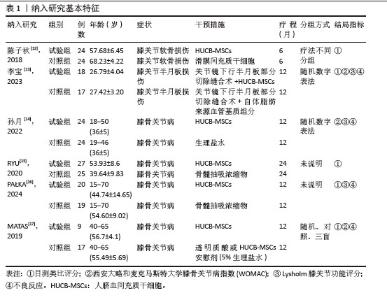
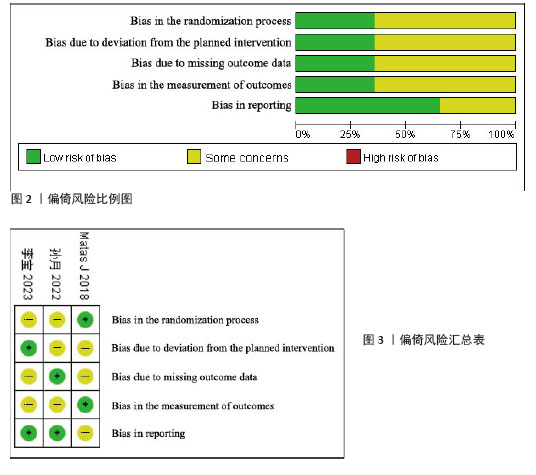
2.2 纳入研究的文献基本特征及方法学质量评价 该研究纳入了3篇随机对照试验文献和3篇病例-对照研究文献[12-17],其中包括中文文献3篇,英文文献3篇,共计研究对象248例,其中试验组122例,对照组126例,发表年份为2018-2024年,年龄范围为15-84岁,病程最短为1年,最长为8年。纳入研究的文献基本特征见表1。对纳入的6篇文献进行了详细的方法学特征评估及偏倚风险分析。结果显示,随机对照研究文献的质量评价均为B级[13-14,17]。纳入的随机对照试验文献中,有2篇文献明确描述了随机分配的具体方法[13-14],低风险2篇[13-14]。所有文献均未对分配隐藏方法和盲法进行描述,选择性报告的完整性被评估为低风险,其他潜在的偏倚因素在文献中未被提及。纳入的病例-对照研究文献中[12,15,16],陈子秋等[12]研究对象选择偏倚为中等风险,其余均为低风险;RYU等[15]和PALKA等[16]研究除了混杂偏倚和研究对象选择偏倚为中等风险,其余均为低风险。综合评估,该研究纳入文献的整体质量评价为中等,风险偏倚情况见图2,3和表2。 "


"

"


2.3 Meta分析结果 2.3.1 HUCB-MSCs对膝骨关节病患者目测类比评分的影响 纳入的5篇文献均采用目测类比评分作为结局指标[12-13,15-17],以评估HUCB-MSCs治疗膝骨关节病的临床疗效。研究共涉及200例患者,其中试验组98例,对照组102例。异质性检验结果显示,χ2=44.98,自由度为4,P < 0.000 01,I2=91%,表明研究间存在高度异质性,且数据为连续性变量,故采用倒方差法(inverse variance method,IV)合并数据,并采用随机效应模型进行分析。经HUCB-MSCs治疗后,试验组的目测类比评分均低于对照组[MD=-1.33,95%CI(-2.53,-0.13)],差异有显著性意义(Z=2.16,P=0.03),见图4。采用逐一排除纳入研究的方法进行敏感性分析,结果显示,各研究对合并结果无显著影响,表明研究结果稳定。 "

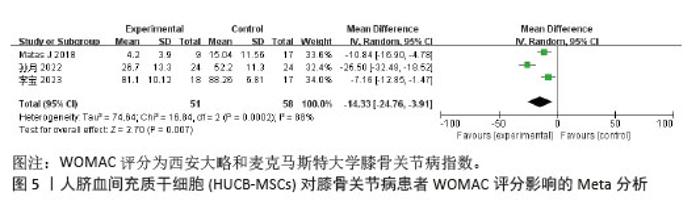
2.3.2 HUCB-MSCs对膝骨关节病患者WOMAC评分的影响 纳入的3篇文献均采用WOMAC评分作为结局指标[13-14,17],以评估HUCB-MSCs治疗膝骨关节病的临床疗效。研究共涉及109例患者,其中试验组51例,对照组58例。异质性检验结果显示,χ2=16.84,自由度为2,P=0.000 2,I2=88%,表明研究间存在高度异质性,且数据为连续性变量,故采用倒方差法、随机效应模型进行分析。经HUCB-MSCs治疗后,试验组的WOMAC评分均低于对照组[MD=-14.33,95%CI (-24.76,-3.91)],差异有显著性意义(Z=2.70,P=0.007),见图5。采用逐一排除纳入研究的方法进行敏感性分析,结果显示,各研究对合并结果无显著影响,表明研究结果稳定。 "

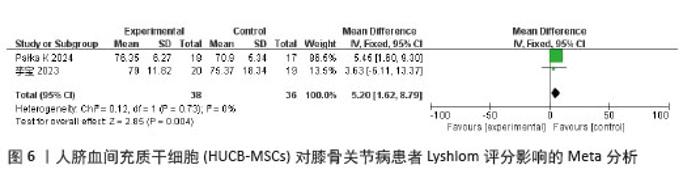
2.3.3 HUCB-MSCs对膝骨关节病患者Lyshlom评分的影响 纳入的2篇文献均采用Lyshlom评分作为结局指标[13,16],以评估HUCB-MSCs治疗膝骨关节病的临床疗效。研究共涉及74例患者,其中试验组38例,对照组36例。异质性检验结果显示,χ2=0.12,自由度为1,P=0.73,I2=0%,表明研究间的异质性可以忽略,且数据为连续性变量,故采用倒方差法、固定效应模型进行分析。经HUCB-MSCs治疗后,试验组的Lyshlom评分均高于对照组[MD=5.20,95%CI(1.62,8.79)],差异有显著性意义(Z=2.85,P=0.004),见图6。"


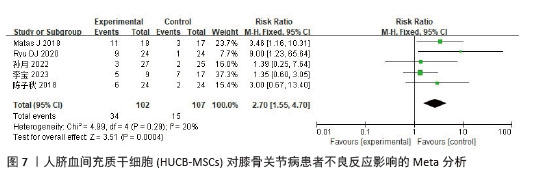
2.3.4 HUCB-MSCs对膝骨关节病患者不良反应的影响 纳入的4篇文献均采用不良反应作为结局指标[13-14,16-17],以此评估HUCB-MSCs治疗膝骨关节病的安全性。研究共涉及209例患者,其中试验组102例,对照组107例。异质性检验结果显示,χ2=4.99,自由度为4,P=0.29,I2=20%,表明研究间存在中度异质性,且数据为二分类变量,故采用曼特尔-汉塞尔法、固定效应模型进行分析,效应量为RR=2.70,95%CI(1.55,4.70),差异有显著性意义(Z=3.51,P=0.000 4)。合并风险差(pooled risk difference,RD)为0.21(0.11,0.32),转换成所需治疗人数为5,即每5例膝骨关节病患者接受HUCB-MSCs治疗,就有1例出现不良反应,见图7。 "
| [1] 徐溢明,胡明玮,朱威,等.人工全膝关节置换术治疗膝骨关节病的长期临床疗效:一项20年以上随访的队列研究[J].协和医学杂志, 2025,16(1):35-41. [2] 姚梁怡,陈静,李靖,等.膝骨关节病病人术前期望评估工具的研究进展[J].护理研究, 2024,38(2):319-322. [3] 黄铝,宗颖,胡思彦,等.正清风痛宁注射液联合甲氨蝶呤治疗膝骨关节炎并积液(风寒湿痹型)临床观察[J].亚太传统医药,2023, 19(8):94-96. [4] ZHAO J, LIANG G, ZHOU G, et al. Efficacy and safety of curcumin therapy for knee osteoarthritis: A Bayesian network meta-analysis. J Ethnopharmacol. 2024;321:117493. [5] LUO D, ZHU H, LI S, et al. Mesenchymal stem cell-derived exosomes as a promising cell-free therapy for knee osteoarthritis. Front Bioeng Biotechnol. 2024;12:1309946. [6] MATAS J, GARCÍA C, POBLETE D, et al. A Phase I Dose-Escalation Clinical Trial to Assess the Safety and Efficacy of Umbilical Cord-Derived Mesenchymal Stromal Cells in Knee Osteoarthritis. Stem Cells Transl Med. 2024;13(3):193-203. [7] CHEN X, ZHENG J, YIN L, et al. Transplantation of three mesenchymal stem cells for knee osteoarthritis, which cell and type are more beneficial? a systematic review and network meta-analysis. J Orthop Surg Res. 2024;19(1):366. [8] MUTHU S, PATIL SC, JEYARAMAN N, et al. Comparative effectiveness of adipose-derived mesenchymal stromal cells in the management of knee osteoarthritis: A meta-analysis. World J Orthop. 2023;14(1):23-41. [9] JUNG SH, PARK H, JUNG M, et al. Implantation of hUCB-MSCs generates greater hyaline-type cartilage than microdrilling combined with high tibial osteotomy. Knee Surg Sports Traumatol Arthrosc. 2024;32(4):829-842. [10] LI X, DENG Z, LU W. Chondrogenic commitment of human umbilical cord blood and umbilical cord-derived mesenchymal stem cells induced by the supernatant of chondrocytes: A comparison study. Animal Model Exp Med. 2024;7(6):793-801. [11] STERNE JA, HERNÁN MA, REEVES BC, et al. ROBINS-I: a tool for assessing risk of bias in non-randomised studies of interventions. BMJ. 2016;355:i4919. [12] 陈子秋,刘顺贵,刘义,等.关节腔内注射滑膜源间充质干细胞对膝关节软骨损伤的疗效[J].中国临床研究,2018,31(9):1232-1235. [13] 李宝,田竞,金文铭,等.人脐带血间充质干细胞与自体脂肪来源血管基质组分应用于膝关节创伤性关节炎的疗效[J]. 慢性病学杂志, 2023,24(3):386-389. [14] 孙月,刘欣伟,向杜磊,等.人脐带血间充质干细胞治疗膝关节骨关节炎疗效研究[J].创伤与急危重病医学,2022,10(1):7-10. [15] RYU DJ, JEON YS, PARK JS, et al. Comparison of Bone Marrow Aspirate Concentrate and Allogenic Human Umbilical Cord Blood Derived Mesenchymal Stem Cell Implantation on Chondral Defect of Knee: Assessment of Clinical and Magnetic Resonance Imaging Outcomes at 2-Year Follow-Up. Cell Transplant. 2020;29: 963689720943581. [16] PAŁKA K, SADLIK B, KAMIŃSKI P, et al. Comparison of the Efficacy of Human Umbilical Cord-Derived and Bone Marrow Aspirate Concentrate Mesenchymal Stem Cells for Cartilage Repair Defects of the Knee via Arthroscopic Implementation on Scaffolds in a Retrospective Study. J Pers Med. 2024;14(3):220. [17] MATAS J, ORREGO M, AMENABAR D, et al. Umbilical Cord-Derived Mesenchymal Stromal Cells (MSCs) for Knee Osteoarthritis: Repeated MSC Dosing Is Superior to a Single MSC Dose and to Hyaluronic Acid in a Controlled Randomized Phase I/II Trial. Stem Cells Transl Med. 2019; 8(3):215-224. [18] 廖建钊,夏天.细胞外基质在骨关节炎发生、发展中的作用及临床研究价值[J].中国组织工程研究,2022,26(12):1937-1943. [19] CHEN L, ZHANG Z, LIU X. Role and Mechanism of Mechanical Load in the Homeostasis of the Subchondral Bone in Knee Osteoarthritis: A Comprehensive Review. J Inflamm Res. 2024; 17:9359-9378. [20] 谢保城,吴佳欢,吴巧玲,等.间充质干细胞移植治疗膝关节骨关节炎疗效的系统评价与Meta分析[J].赣南医学院学报,2018,38(9): 862-867. [21] RODRÍGUEZ-MERCHÁN EC. Molecular Mechanisms of Cartilage Repair and Their Possible Clinical Uses: A Review of Recent Developments. Int J Mol Sci. 2022; 23(22):14272. [22] KVIATKOVSKY SA, HICKNER RC, CABRE HE, et al. Collagen peptides supplementation improves function, pain, and physical and mental outcomes in active adults. J Int Soc Sports Nutr. 2023;20(1):2243252. [23] WANG PF, XING J. The clinical outcomes of intra-articular injection of human umbilical cord blood-derived mesenchymal stem cells vs. bone marrow aspirate concentrate in cartilage regeneration: a systematic review. Eur Rev Med Pharmacol Sci. 2023;27(16):7533-7543. [24] PARK D, CHOI YH, KANG SH, et al. Bone Marrow Aspirate Concentrate versus Human Umbilical Cord Blood-Derived Mesenchymal Stem Cells for Combined Cartilage Regeneration Procedure in Patients Undergoing High Tibial Osteotomy: A Systematic Review and Meta-Analysis. Medicina (Kaunas). 2023;59(3):634. [25] LEE DH, KIM SA, SONG JS, et al. Cartilage Regeneration Using Human Umbilical Cord Blood Derived Mesenchymal Stem Cells: A Systematic Review and Meta-Analysis. Medicina (Kaunas). 2022;58(12):1801. [26] HUANG Z, ZHANG S, CAO M, et al. What is the optimal dose of adipose-derived mesenchymal stem cells treatment for knee osteoarthritis? A conventional and network meta-analysis of randomized controlled trials. Stem Cell Res Ther. 2023;14(1):245. [27] ZHAO J, LIANG G, HAN Y, et al. Combination of mesenchymal stem cells (MSCs) and platelet-rich plasma (PRP) in the treatment of knee osteoarthritis: a meta-analysis of randomised controlled trials. BMJ Open. 2022;12(11):e061008. [28] SONG JS, HONG KT, SONG KJ, et al. Repair of a large patellar cartilage defect using human umbilical cord blood-derived mesenchymal stem cells: A case report. World J Clin Cases. 2022;10(34):12665-12670. [29] FREITAG J, SHAH K, WICKHAM J, et al. The effect of autologous adipose derived mesenchymal stem cell therapy in the treatment of a large osteochondral defect of the knee following unsuccessful surgical intervention of osteochondritis dissecans - a case study. BMC Musculoskelet Disord. 2017;18(1):298. [30] 万丽,赵晴,陈军,等.疼痛评估量表应用的中国专家共识(2020版)[J].中华疼痛学杂志,2020, 16(3):11. [31] ZHU Y, CHEN X, LIAO Y. Mesenchymal Stem Cells-Derived Apoptotic Extracellular Vesicles (ApoEVs): Mechanism and Application in Tissue Regeneration. Stem Cells. 2023;41(9): 837-849. [32] WANG W, LONG F, WU X, et al. Clinical Efficacy of Mechanical Traction as Physical Therapy for Lumbar Disc Herniation: A Meta-Analysis. Comput Math Methods Med. 2022; 2022:5670303. [33] KHALID S, ALI A, DEEPAK F, et al. Comparative effectiveness of intra-articular therapies in knee osteoarthritis: a meta-analysis comparing platelet-rich plasma (PRP) with other treatment modalities. Ann Med Surg (Lond). 2023;86(1): 361-372. [34] CONAGHAN PG, DWORKIN RH, SCHNITZER TJ, et al. WOMAC Meaningful Within-patient Change: Results From 3 Studies of Tanezumab in Patients With Moderate-to-severe Osteoarthritis of the Hip or Knee. J Rheumatol. 2022;49(6):615-621. [35] ZHANG X, CUI C, LIN F. Efficacy and safety of mesenchymal stem cell injections for knee osteoarthritis: A systematic review and meta-analysis. J Res Med Sci. 2024;29:55. [36] BIDESHKI MV, JOURABCHI-GHADIM N, RADKHAH N, et al. The efficacy of curcumin in relieving osteoarthritis: A meta-analysis of meta-analyses. Phytother Res. 2024;38(6): 2875-2891. [37] PERRUCCIO AV, YOUNG JJ, WILFONG JM, et al. Osteoarthritis year in review 2023: Epidemiology & therapy. Osteoarthritis Cartilage. 2024;32(2):159-165. [38] ABED V, KAPP S, NICHOLS M, et al. Lysholm and KOOS QoL Demonstrate High Responsiveness in Patients Undergoing Anterior Cruciate Ligament Reconstruction: A Systematic Review and Meta-analysis of Randomized Clinical Trials. Am J Sports Med. 2024;52(12):3161-3166. [39] ITTHIPANICHPONG T, MOONWONG S, THAMRONGSKULSIRI N, et al. Validity and Reliability of the Thai Versions of the Lysholm Knee Scoring Scale and Tegner Activity Scale. Orthop J Sports Med. 2023;11(2):23259671221149785. [40] JIN L, YANG G, MEN X, et al. Intra-articular Injection of Mesenchymal Stem Cells After High Tibial Osteotomy: A Systematic Review and Meta-analysis. Orthop J Sports Med. 2022;10(11): 23259671221133784. [41] LI Z, WENG X. Platelet-rich plasma use in meniscus repair treatment: a systematic review and meta-analysis of clinical studies. J Orthop Surg Res. 2022;17(1):446. [42] PAN H, ZHANG P, ZHANG Z, et al. Arthroscopic partial meniscectomy combined with medical exercise therapy versus isolated medical exercise therapy for degenerative meniscal tear: A meta-analysis of randomized controlled trials. Int J Surg. 2020;79:222-232. [43] RAO SS, MANABE N, KARASAWA Y, et al. Comparative profiles of lubiprostone, linaclotide, and elobixibat for chronic constipation: a systematic literature review with meta-analysis and number needed to treat/harm. BMC Gastroenterol. 2024;24(1):12. [44] 李东东,陈光友,李晓明,等.骨痹散干预膝骨关节炎兔软骨组织相关信号通路的变化[J].中国组织工程研究,2023,27(35):5622-5627. [45] 朱文辉,陈世益.外用非甾体抗炎药(NSAIDs)治疗肌肉骨骼系统疼痛的研究进展[J].中国运动医学杂志,2016,35(5):506-508. [46] BELK JW, LIM JJ, KEETER C, et al. Patients With Knee Osteoarthritis Who Receive Platelet-Rich Plasma or Bone Marrow Aspirate Concentrate Injections Have Better Outcomes Than Patients Who Receive Hyaluronic Acid: Systematic Review and Meta-analysis. Arthroscopy. 2023;39(7): 1714-1734. [47] DE PIERI E, NÜESCH C, PAGENSTERT G, et al. High tibial osteotomy effectively redistributes compressive knee loads during walking. J Orthop Res. 2023;41(3):591-600. |
| [1] | Yu Cenqi, Liu Yang, Yu Jiangfeng, Kang Kang, Deng Yaoge, Xia Xiaowei, Zhang Yijian, Zhu Xuesong. Biomimetic Black Phosphorus Nanosystem Regulates Synovial Macrophage Polarization for Osteoarthritis Treatment [J]. Chinese Journal of Tissue Engineering Research, 2026, 30(在线): 1-13. |
| [2] | Chen Qiuhan, Yang Long, Yuan Daizhu, Wu Zhanyu, Zou Zihao, Ye Chuan. Peri-knee osteotomy for treatment of knee osteoarthritis: optimization of treatment strategies [J]. Chinese Journal of Tissue Engineering Research, 2026, 30(9): 2303-2312. |
| [3] | Zhang Zizheng, Luo Wang, Liu Changlu. Application value of finite element analysis on unicompartmental knee arthroplasty for medial knee compartmental osteoarthritis [J]. Chinese Journal of Tissue Engineering Research, 2026, 30(9): 2313-2322. |
| [4] | Zhang Nan, Meng Qinghua, Bao Chunyu. Characteristics and clinical application of ankle joint finite element models [J]. Chinese Journal of Tissue Engineering Research, 2026, 30(9): 2343-2349. |
| [5] | He Yixiang, Qiao Wanjia, Wang Wenji. Effectiveness and safety of tranexamic acid versus epsilon-aminocaproic acid in total hip and knee arthroplasties: a meta-analysis [J]. Chinese Journal of Tissue Engineering Research, 2026, 30(9): 2361-2369. |
| [6] | Liu Jinlong, Abuduwupuer·Haibier, Bai Zhen, Su Danyang, Miao Xin, Li Fei, Yang Xiaopeng. Efficacy of different nonsurgical treatments for adolescent idiopathic scoliosis: a systematic review and network meta-analysis [J]. Chinese Journal of Tissue Engineering Research, 2026, 30(9): 2370-2379. |
| [7] | Li Qingbin, Lin Jianhui, Huang Wenjie, Wang Mingshuang, Du Jiankai, Lao Yongqiang. Bone cement filling after enlarged curettage of giant cell tumor around the knee joint: a comparison of subchondral bone grafting and non-grafting [J]. Chinese Journal of Tissue Engineering Research, 2026, 30(8): 1896-1902. |
| [8] | Gao Feng, Zhang Jun, Yu Wenjun, Chanyu Yujing, Zhao Le, Hu Yuting, Wang Junhua, Liu Yongfu. Effects of wrist-hand orthosis on hand dysfunction in stroke patients: a meta-analysis [J]. Chinese Journal of Tissue Engineering Research, 2026, 30(8): 2124-2131. |
| [9] | Wang Zhenze, Liu Fende, Zhang Rui, Li Wujun. Mesenchymal stem cells in treatment of arteriosclerosis obliterans of lower extremities: systematic review and meta-analysis [J]. Chinese Journal of Tissue Engineering Research, 2026, 30(7): 1869-1876. |
| [10] | Li Linzhen, Jiao Hongzhuo, Chen Weinan, Zhang Mingzhe, Wang Jianlong, Zhang Juntao. Effect of icariin-containing serum on lipopolysaccharide-induced inflammatory damage in human chondrocytes [J]. Chinese Journal of Tissue Engineering Research, 2026, 30(6): 1368-1374. |
| [11] | Chen Ju, Zheng Jinchang, Liang Zhen, Huang Chengshuo, Lin Hao, Zeng Li. Effect and mechanism of beta-caryophyllene in mice with osteoarthritis [J]. Chinese Journal of Tissue Engineering Research, 2026, 30(6): 1341-1347. |
| [12] | Lyu Guoqing, Aizimaitijiang·Rouzi, Xiong Daohai. Irisin inhibits ferroptosis in human articular chondrocytes: roles and mechanisms [J]. Chinese Journal of Tissue Engineering Research, 2026, 30(6): 1359-1367. |
| [13] | Li Hao, Tao Hongcheng, Zeng Ping, Liu Jinfu, Ding Qiang, Niu Chicheng, Huang Kai, Kang Hongyu. Mitogen-activated protein kinase signaling pathway regulates the development of osteoarthritis: guiding targeted therapy with traditional Chinese medicine [J]. Chinese Journal of Tissue Engineering Research, 2026, 30(6): 1476-1485. |
| [14] | Zhang Qian, Huang Dongfeng. Weighted gene co-expression network analysis combined with machine learning to screen and validate biomarkers for osteoarthritis [J]. Chinese Journal of Tissue Engineering Research, 2026, 30(5): 1096-1105. |
| [15] | Bu Yangyang, Ning Xinli, Zhao Chen. Intra-articular injections for the treatment of osteoarthritis of the temporomandibular joint: different drugs with multiple combined treatment options [J]. Chinese Journal of Tissue Engineering Research, 2026, 30(5): 1215-1224. |
| Viewed | ||||||
|
Full text |
|
|||||
|
Abstract |
|
|||||