Chinese Journal of Tissue Engineering Research ›› 2026, Vol. 30 ›› Issue (16): 4265-4277.doi: 10.12307/2026.689
Previous Articles Next Articles
Application trends of eye-tracking technology in rehabilitation: a visualization analysis based on CiteSpace and VOSviewer
Wei Jingyi1, Wang Xiaojing1, Liu Xihua2
- 1Shandong University of Traditional Chinese Medicine, Jinan 250355, Shandong Province, China; 2The Affiliated Hospital of Shandong University of Traditional Chinese Medicine, Jinan 250014, Shandong Province, China
-
Received:2025-05-26Accepted:2025-08-27Online:2026-06-08Published:2025-11-29 -
Contact:Liu Xihua, MD, Chief physician, Doctoral supervisor, The Affiliated Hospital of Shandong University of Traditional Chinese Medicine, Jinan 250014, Shandong Province, China -
About author:Wei Jingyi, MS candidate, Shandong University of Traditional Chinese Medicine, Jinan 250355, Shandong Province, China -
Supported by:National Natural Science Foundation of China (Youth Program), No. 81802239 (to LXH); Shandong Province Traditional Chinese Medicine Science & Technology Project, No. M-2023142 (to LXH)

CLC Number:
Cite this article
Wei Jingyi, Wang Xiaojing, Liu Xihua. Application trends of eye-tracking technology in rehabilitation: a visualization analysis based on CiteSpace and VOSviewer[J]. Chinese Journal of Tissue Engineering Research, 2026, 30(16): 4265-4277.
share this article
Add to citation manager EndNote|Reference Manager|ProCite|BibTeX|RefWorks
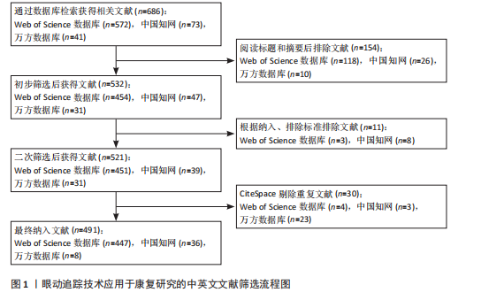
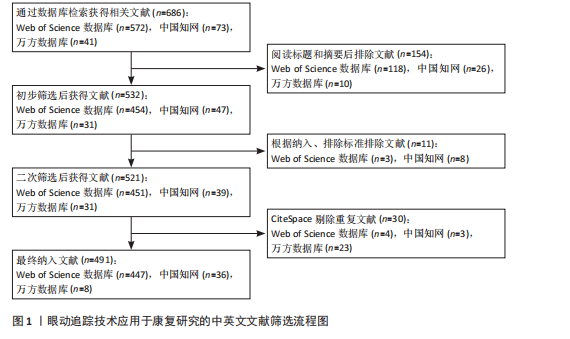
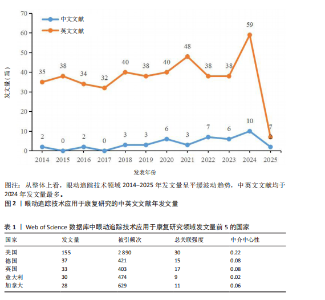
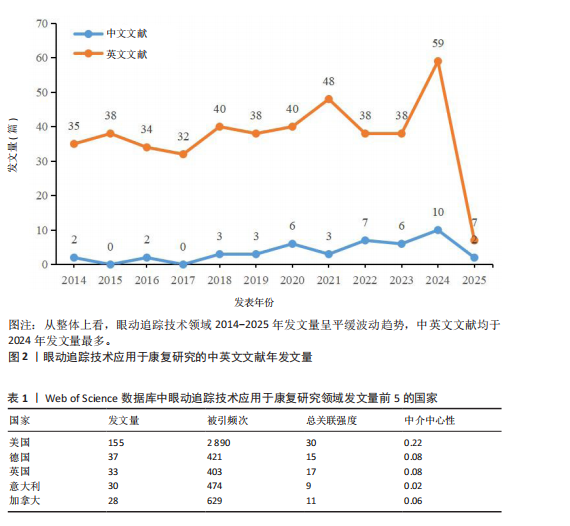
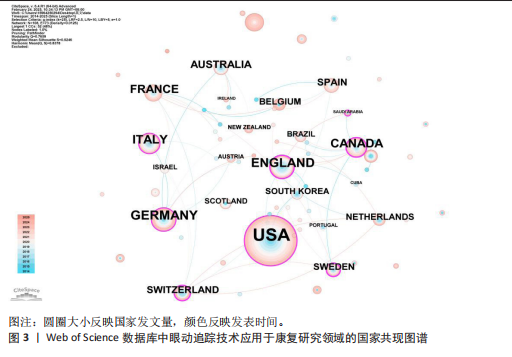
2.1 文献筛选结果 中国知网共检索出73篇文献,万方数据库共检索出41篇文献,Web of Science共检索出572篇文献。剔除重复文献、会议摘要、新闻报道、信息不全和相关性不大的文献,共纳入中国知网文献36篇,万方数据库文献8篇,Web of Science数据库文献447篇。筛选过程详见图1。 2.2 年发文量分析 运用CiteSpace分析中英文文献年发文量,将数据导入Microsoft Excel中绘制折线图,得到中英文文献年发文量的趋势图。如图2所示,英文文献年发文量显著高于中文。中文发文量从2018年起呈稳步增长趋势,而英文发文量自2014年起基本呈增长趋势,于2024年突增。中英文文献年发文量均于2024年达到峰值(分别为10篇、59篇)。 2.3 国家分析 节点类型选择“国家”,运用CiteSpace对眼动追踪技术研究领域发表英文文献的国家进行统计,国家共现图谱如图3所示,共纳入108个节点,73条连线,网络密度为 0.012 6,节点间形成连线较少,表示各国间合作交流不密切。英文文献发文量前5的国家见表1。值得一提的是,虽然法国以发文量26篇跻身第六,但其中心性0.1排名第二,这表明法国在跨国合作网络中发挥了显著的“桥梁”作用,这可能因为法国国家科学研究中心、法国国家健康与医"
"
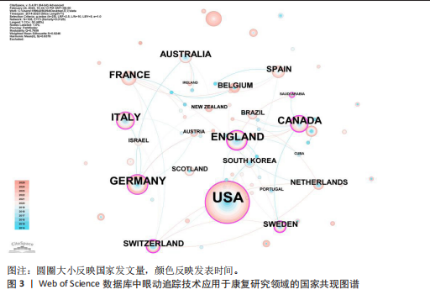
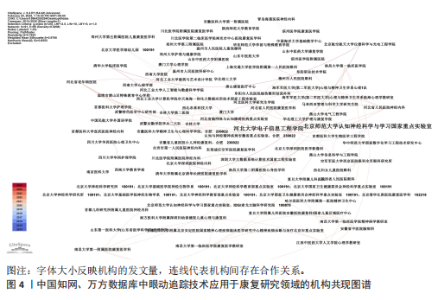
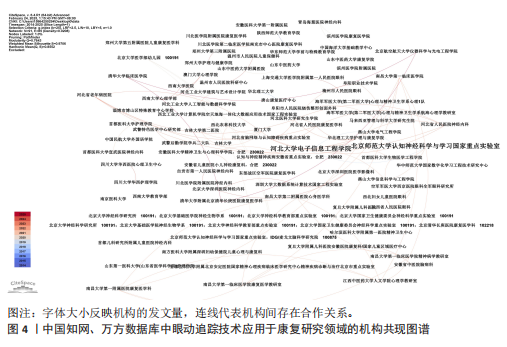
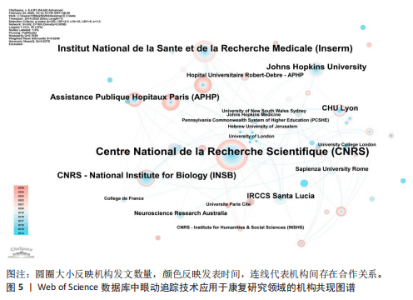
学研究院(英文文献发文量前2的机构)深度参与了国际合作的枢纽性项目,成为不同国家间知识流动的关键中介。而德国、英国等国家虽然发文量较多但是研究多局限于其国内,未重视跨国合作。 2.4 机构分析 节点类型选择“机构”,运用CiteSpace对眼动追踪技术研究领域发表中英文文献的机构进行统计,中英文共现图谱如图4,5所示。中文文献共纳入91个节点,85条连线,网络密度为0.020 8,英文文献共纳入242个节点,169条连线,网络密度为0.005 8,国内外机构间合作网络密度均较低。中、英文文献发文量排名前5的机构见表2。除法国国家"
"
"
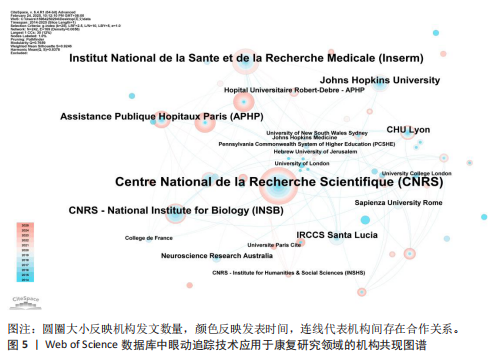
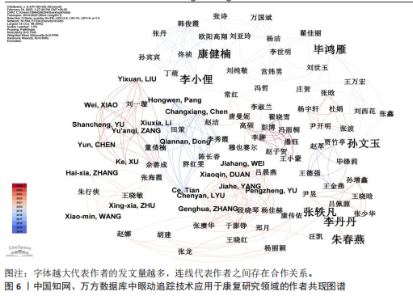
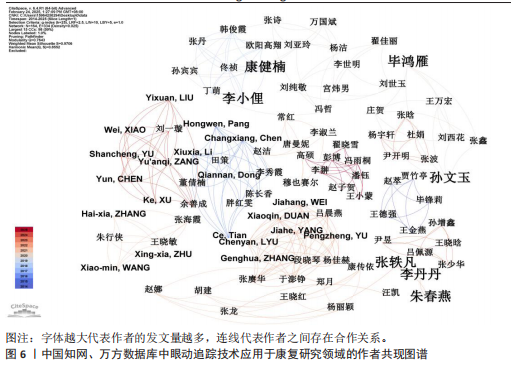
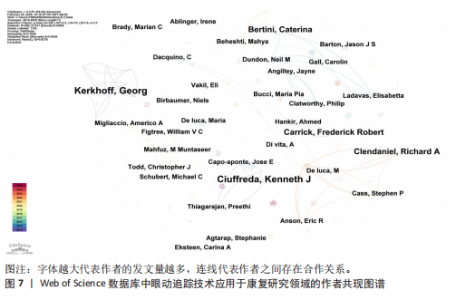
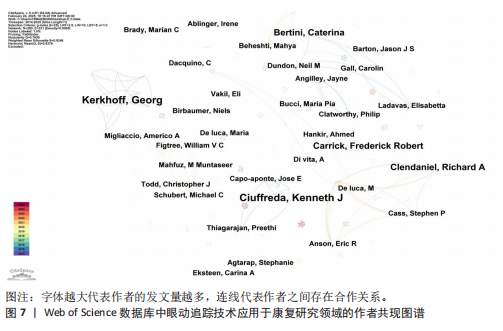
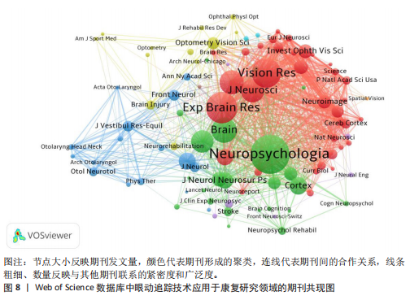
科学研究中心(0.01),国内外其他机构中介中心性均为0,这提示各机构仅参与单一合作群体,未与其他研究团队或机构建立联系,这可能与领域内研究方向高度专业化或早期合作尚未成熟有关,如果有机构能发挥带头作用,推动与其他国家机构的合作,将有助于眼动追踪技术的开发与推广。另外,国内机构合作网络呈高度碎片化,大部分机构仅发文1篇且各机构间形成连线数量较少。国内机构可加大对眼动追踪技术的投入,从增加发文量开始逐渐拓展其影响力。 2.5 作者分析 节点类型选择“合作作者”,运用CiteSpace对眼动追踪技术研究领域发表中英文文献的作者进行统计,中英文共现图谱如图6,7所示。中文文献共纳入164个节点,334条连线,网络密度为0.025,英文文献共纳入280个节点,331条连线,网络密度为0.008 5,国内外作者均未形成密切的合作关系。中文文献发文量前5的作者分别为张轶凡、毕鸿雁、李丹丹、孙文玉、朱春燕,均为2篇;英文文献发文量前5的作者分别为Ciuffreda Kenneth Joseph(4篇)、Kerkhoff Georg(4篇)、Carrick Frederick Robert(3篇)、Bertini Caterina(3篇)、Barton Jason Jeremy Sinclair(2篇)。中英文文献作者间合作连线均较少,说明合作频次低或合作范围局限,这可能是因为眼动追踪技术尚未成熟且大规模应用于临床实践或研究方向高度细分导致合作需求低,未来需通过构建开放协作平台、鼓励跨学科项目等方式促进知识流动。 2.6 期刊可视化分析 运用VOSviewer软件中“ bibliographic coupling-Sources”模块对眼动追踪技术研究领域出版英文文献的期刊进行可视化分析,共统计出140家期刊,发文量≥2篇的有62家期刊,最小阈值选择2可得到有效连接条目为40、聚类为7的共现图谱,见图8。节点代表期刊发文数量,节点颜色代表期刊形成的聚类,节点连线代表期刊间的协作关系,线条粗且多的期刊处于相对核心的位置,影响力高。分析结果显示:"
"
"

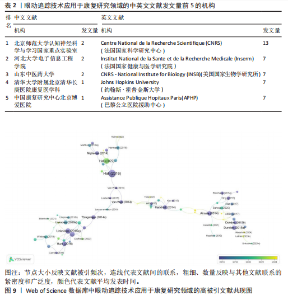
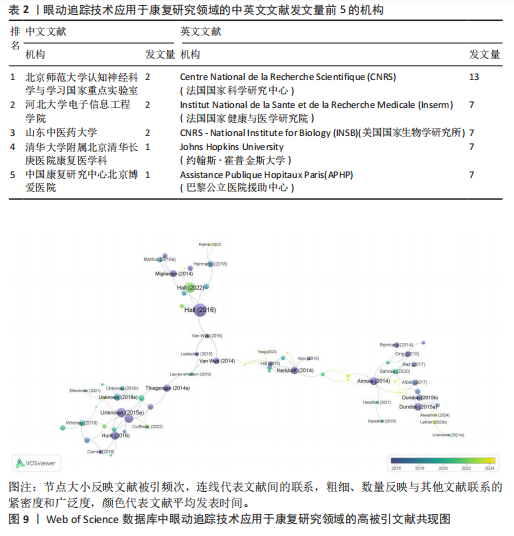
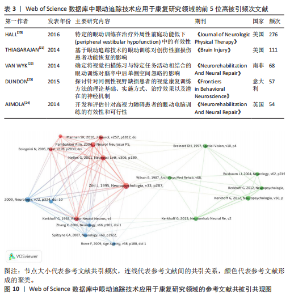
刊登眼动追踪技术应用于康复领域相关文章的期刊众多,涵盖神经科学、眼科学、脑科学、行为科学等学科分支。《Neuropsychologia》(连接数27)和《Neurorehabilitation and Neural Repair》(连接数27)与其他期刊关联最为密切,提示其影响力较大。其次是《Brain Sciences》(连接数26)、《Journal Of Neuroengineering And Rehabilitation》(连接数23)、《Vision Research》(连接数23)、《Cortex》(连接数23)。在发文量方面,《Journal Of Neuroengineering And Rehabilitation》(16篇)最多,其次是《Brain Sciences》 (12篇)、《Neuropsychologia》(8篇)、《Vision Research》(7篇)、《Cortex》(7篇)。 2.7 高被引文献结果分析 运用VOSviewer软件中“ bibliographic coupling-Documents”模块对眼动追踪技术研究领域的英文文献进行可视化分析,统计出447篇文章,被引频次≥40次的有31篇文章,最小阈值选择10可得到有效连接条目为58、聚类为5的共现图谱,见图9。节点越大提示文献被引频次越多,节点颜色代表文献平均出版时间,颜色越浅发表时间越晚,节点连线代表文献间的关联,线条粗且多的文献处于相对核心的位置,学术价值较高。统计结果显示:被引频次第一的是Hall(2016),高达276次,其次为Thiagarajan(2014)、Van Wyk(2014)、Dundon(2015)、Aimola(2014)[20-24],具体研究内容见表3。 2.8 参考文献共被引结果 运用VOSviewer软件中“Co-citation-Cited references”模块对眼动追踪技术研究领域的参考文献共被引情况进行可视化分析,共有8 259条共被引的参考文献,共被引频次≥8次的有20条,最小阈值选择8可得到有效连接条目为18、聚类为3的共现图谱,见图10。节点越大参考文献共引频次越多,节点颜色代表参考文献形成的聚类,节点连线代表参考文献间的共引关系,线条粗且多的参考文献具有更高的开创性贡献与影响力。分析结果"
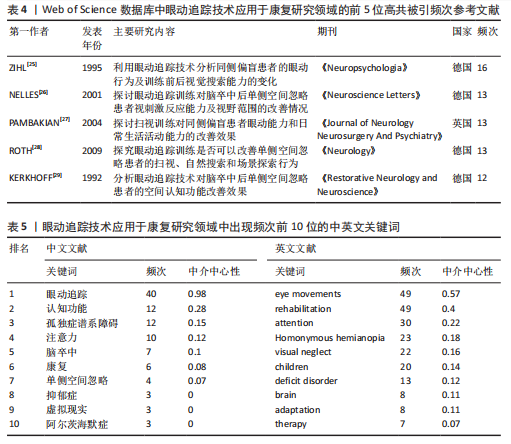
"
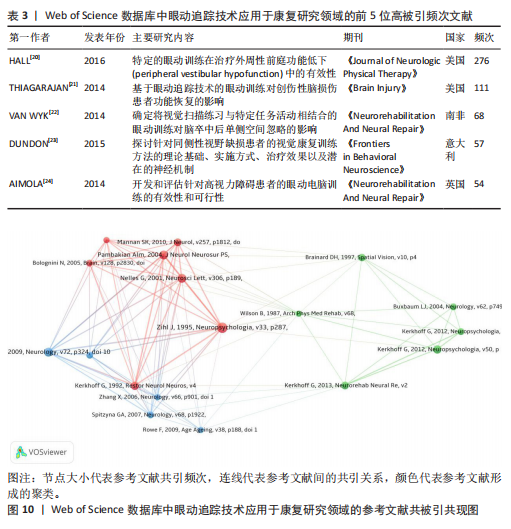
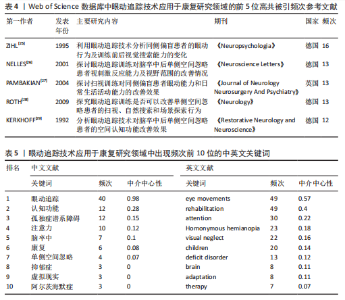
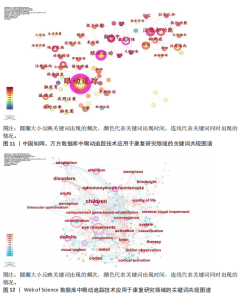
显示:关于眼动追踪技术应用于康复领域的共被引参考文献数量较多,参考文献之间的共被引关系较为活跃,尤其以脑卒中后单侧空间忽略的眼动研究最为广泛,且德国在此研究方面的文献数量较多,见表4。 2.9 关键词 2.9.1 共现分析 节点类型选择“关键词”,运用CiteSpace软件绘制中英文文献关键词共现图谱,见图11,12。中文文献共纳入80个节点,140条连线,网络密度为0.044 3;英文文献共纳入304个节点,674条连线,网络密度为0.014 6,英文文献关键词分布较中文文献分散,这可能是由于发表的英文文章对眼动追踪技术开发利用的更广泛,而中文文献的研究方向较集中,如国内多聚焦于认知功能的眼动研究。 表5为中英文文献出现频次和中介中心性排名前10的关键词。中文文献代表性关键词有认知功能、孤独症谱系障碍、注意力等;英文文献代表性关键词有attention(注意力)、homonymous hemianopia(同向偏盲)、visual neglect(视觉忽略)等。排除与检索策略相关的主题词,中介中心性最高的中英文文献关键词分别为认知功能(0.28)、注意力(0.22),而注意力也属于认知功能的其中一个维度,因此可知,国内外康复领域对眼动追踪技术的主要研究方向一致,均为利用可追踪眼动行为的设备对患者进行认知功能评估与训练并探究可行性。 2.9.2 聚类和时间线分析 聚类分析(Cluster Analysis)可以将关键词按相似性划分为若干主题群组,每个聚类代表一个研究子领域或热点方向,有助于研究者更直观地理解研究领域的知识结构、热点主题和发展趋势。在CiteSpace中,聚类通常基于对数似然比 (log-likelihood ratio,LLR)、潜在语义索引(latent semantic indexing,LSI)、互信息(mutual information,MI)3种算法,LLR是基于假设检验的文本聚类方法,用来衡量某个词语(或特征)是否在某个聚类中出现比预期更频繁,LLR更强调词之间上下文依"
"
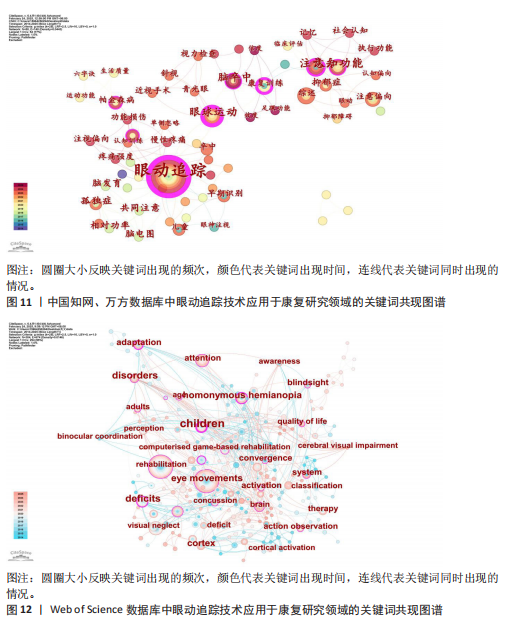
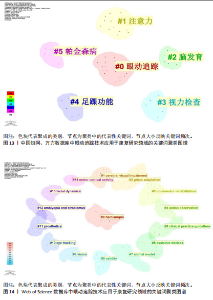
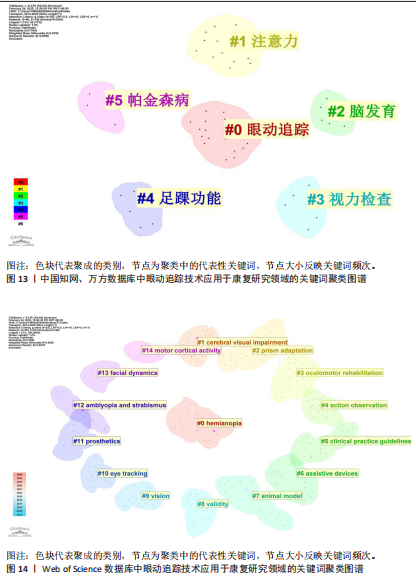
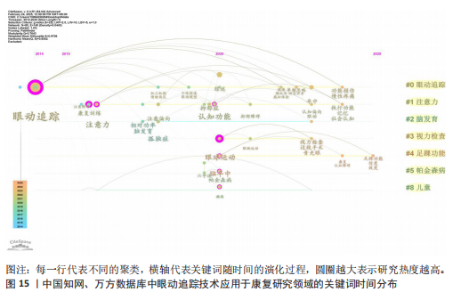
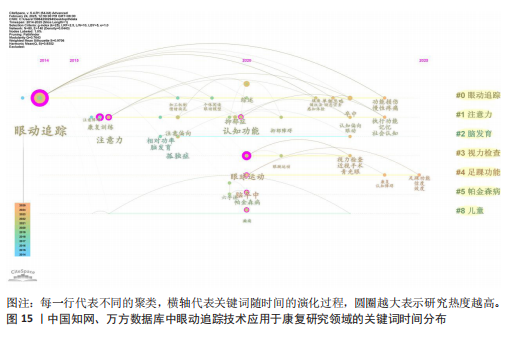
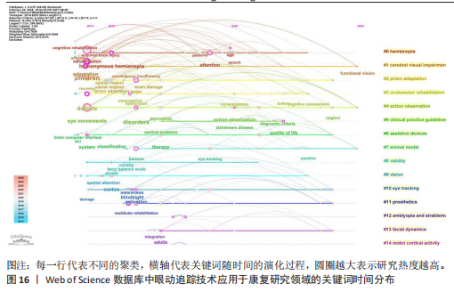
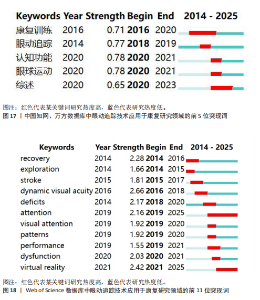
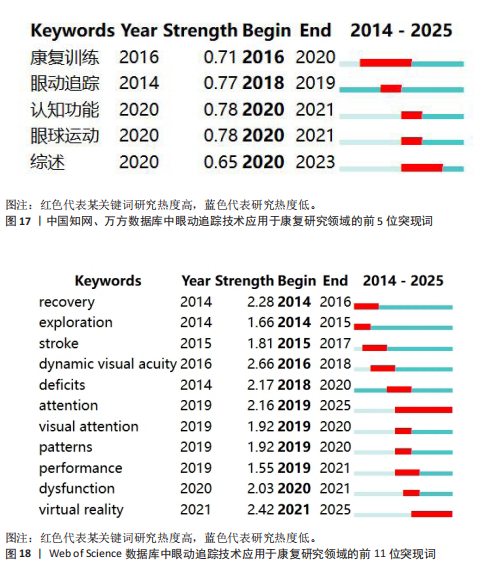
赖强度(共现显著性)且更稳定,因此选用CiteSpace中的LLR算法对关键词进行聚类分析,中英文文献分别得到6个聚类群(模块值Q=0.764 3 > 0.3,平均轮廓值S=0.970 6 > 0.7)和15个聚类群(模块值Q=0.765 9 > 0.3,平均轮廓值S=0.924 6 > 0.7),聚类结果均可信,见图13,14。 时间线图是在聚类的基础上将时间维度可视化,可展示不同研究主题(聚类)随时间演变的动态过程,有助于预测未来趋势或跨阶段对比分析。运用CiteSpace软件中的“timeline”板块绘制中英文文献关键词时间线图,见图15,16。时间线图中,横轴表示时间(年份),反映研究主题的时序发展;纵轴表示聚类编号,每个水平条带对应一个聚类(研究主题);每个节点为关键词,节点越大代表越重要,节点间连线表示关键词之间的共现关系。中英文文献中关键词时间跨度最广的分别是注意力和单侧空间忽略,这表明它们是科研人员长时间关注且研究的内容。 2.9.3 突现分析 运用CiteSpace软件中的“热点”板块绘制中英文文献关键词突现图谱,见图17,18。“Year”表示关键词出现的年份,“Strength”代表突现强度,数值越大代表某一时间段受到的关注度越大,“Begin”和“End”分别为关键词突现的起止年份,红线代表突现持续时间,蓝线表示该阶段虽然有相关研究但总体活跃度不高。中文文献共分析出5条突现关键词,突现强度最高的是认知功能(0.78),这与共现和聚类分析结果一致,说明认知功能是康复领域中应用眼动追踪技术研究的热点方向。突现时间最长的是“康复训练”,一定程度上说明临床科研工作者比较关注眼动追踪训练的疗效并对其进行深度研究与探索。英文文献共分析出11条突现关键词,突现强度最高的是动态视觉敏感度(2.66),眼动仪可以量化受试者的动态视敏度,并通过相应指标反映出受试者对视刺激的反应能力等。突现时间最长的是“注意力”,且一直持续到现在,说明运用眼动追"
"
踪技术对注意力进行评估与训练是一直以来的研究热点,并且未来将会持续对其进行探究。除此之外,虚拟现实技术与眼动追踪技术相结合也是近年来的热点。虚拟现实技术作为一种新兴技术可以渗透入临床康复训练中,拓宽康复思路,研究者可以把握当下人工智能技术范式快速演进的时代趋势,多维度思考切入点,探索新型临床干预路径,最终形成循证医学支持的精准化、个体化康复治疗方案,推动临床转化研究向纵深发展。"

"
| [1] 卓瑜,严凯,孙瑜,等.眼动追踪技术在认知功能中的研究进展[J].实用医院临床杂志,2024,21(4):188-191. [2] TAO L, WANG Q, LIU D, et al. Eye tracking metrics to screen and assess cognitive impairment in patients with neurological disorders. Neurol Sci. 2020;41(7):1697-1704. [3] KELLER J, GORGES M, HORN HT, et al. Eye-tracking controlled cognitive function tests in patients with amyotrophic lateral sclerosis: a controlled proof-of-principle study. J Neurol. 2015;262(8):1918-1926. [4] 尤佳璐,惠延年,张乐.眼球运动及眼动追踪技术的临床应用进展[J].国际眼科杂志,2023,23(1):90-95. [5] 刘革平,冉文妍,杨瑜颖,等.VR环境下认知追踪关键技术综述[J].人工智能科学与工程,2024(2):1-17. [6] GODFROID A, HUI B. Five common pitfalls in eye-tracking research. Second Lang Res. 2020;36(3):277-305. [7] 杨宇轩,张晗,杜娟,等.眼动追踪的动态任务评估脑卒中后单侧空间忽略的价值研究[J].中国全科医学,2023,26(32): 4020-4025. [8] 韦卓男,樊响,余可妍,等.结构MRI联合基于VR眼动追踪技术的计算机化认知评估在阿尔茨海默病早期诊断中的应用价值[J].磁共振成像,2024,15(6):49-53. [9] SKARAMAGKAS V, GIANNAKAKIS G, KTISTAKIS E, et al. Review of Eye Tracking Metrics Involved in Emotional and Cognitive Processes. IEEE Rev Biomed Eng. 2023;16:260-277. [10] TAYLOR G, HERBERT JS. Eye tracking infants: investigating the role of attention during learning on recognition memory. Scand J Psychol. 2013;54(1):14-19. [11] 李进,尹兵兵,杨颖,等.基于游戏为主的康复干预对脑瘫患儿精细运动功能及依从性的影响[J].中国当代医药,2021, 28(34):90-93. [12] 李慧,赵玲,徐晓娅.眼动追踪技术在神经退行性疾病认知功能障碍中的研究进展[J].中国神经精神疾病杂志,2024, 50(10):608-614. [13] 王烽,赖江峰,蓝诚红,等.眼动追踪技术在神经退行性疾病中的应用研究进展[J].眼科新进展,2024,44(11):908-913. [14] CHEN C. Searching for intellectual turning points: progressive knowledge domain visualization. Proc Natl Acad Sci U S A. 2004;101(Suppl 1):5303-5310. [15] CHEN C. CiteSpace II: Detecting and visualizing emerging trends and transient patterns in scientific literature. J Am Soc Inf Sci Technol. 2006;57(3):359-377. [16] ARRUDA H, SILVA ER, LESSA M, et al. VOSviewer and Bibliometrix. J Med Libr Assoc. 2022;110(3):392-395. [17] VAN ECK NJ, WALTMAN L. Citation-based clustering of publications using CitNetExplorer and VOSviewer. Scientometrics. 2017;111(2):1053-1070. [18] DONTHU N, KUMAR S, PATTNAIK D. Forty-five years of Journal of Business Research: A bibliometric analysis. J Bus Res. 2020;109:1-14. [19] VAN ECK NJ, WALTMAN L. Software survey: VOSviewer, a computer program for bibliometric mapping. Scientometrics. 2010;84(2):523-538. [20] HALL CD, HERDMAN SJ, WHITNEY SL, et al. Vestibular Rehabilitation for Peripheral Vestibular Hypofunction: An Evidence-Based Clinical Practice Guideline: From the american physical therapy association neurology section. J Neurol Phys Ther. 2016; 40(2):124-155. [21] THIAGARAJAN P, CIUFFREDA KJ. Versional eye tracking in mild traumatic brain injury (mTBI): effects of oculomotor training (OMT). Brain Inj. 2014;28(7):930-943. [22] VAN WYK A, EKSTEEN CA, RHEEDER P. The effect of visual scanning exercises integrated into physiotherapy in patients with unilateral spatial neglect poststroke: a matched-pair randomized control trial. Neurorehabil Neural Repair. 2014;28(9):856-873. [23] DUNDON NM, BERTINI C, LÀDAVAS E, et al. Visual rehabilitation: visual scanning, multisensory stimulation and vision restoration trainings. Front Behav Neurosci. 2015;9:192. [24] AIMOLA L, LANE AR, SMITH DT, et al. Efficacy and feasibility of home-based training for individuals with homonymous visual field defects. Neurorehabil Neural Repair. 2014;28(3):207-218. [25] ZIHL J. Visual scanning behavior in patients with homonymous hemianopia. Neuropsychologia. 1995;33(3):287-303. [26] NELLES G, ESSER J, ECKSTEIN A, et al. Compensatory visual field training for patients with hemianopia after stroke. Neurosci Lett. 2001;306(3):189-192. [27] PAMBAKIAN AL, MANNAN SK, HODGSON TL, et al. Saccadic visual search training: a treatment for patients with homonymous hemianopia. J Neurol Neurosurg Psychiatry. 2004;75(10):1443-1448. [28] ROTH T, SOKOLOV AN, MESSIAS A, et al. Comparing explorative saccade and flicker training in hemianopia: a randomized controlled study. Neurology. 2009;72(4): 324-331. [29] KERKHOFF G, MÜNßINGER U, HAAF E, et al. Rehabilitation of homonymous scotomata in patients with postgeniculate damage of the visual system: saccadic compensation training. Restor Neurol Neurosci. 1992; 4(4):245-254. [30] 赵生美,黄鹏,陈立艳,等.国内外医学伦理学教育可视化比较分析及启示[J].中国医学伦理学,2023,36(1):95-101. [31] LIU Z, YANG Z, GU Y, et al. The effectiveness of eye tracking in the diagnosis of cognitive disorders: A systematic review and meta-analysis. PLoS One. 2021;16(7):e0254059. [32] PRZYBYSZEWSKI AW, ŚLEDZIANOWSKI A, CHUDZIK A, et al. Machine Learning and Eye Movements Give Insights into Neurodegenerative Disease Mechanisms. Sensors (Basel). 2023;23(4):2145. [33] 张慧,陆媛,刘文斌,等.眼动检查在轻度认知功能障碍筛查中的应用[J].同济大学学报(医学版),2024,45(4):543-549. [34] JOHKURA K, KAWABATA Y, AMANO Y, et al. Bedside evaluation of smooth pursuit eye movements in acute sensory stroke patients. J Neurol Sci.2015;348(1-2):269-271. [35] RIEK HC, BRIEN DC, COE BC, et al. Cognitive correlates of antisaccade behaviour across multiple neurodegenerative diseases. Brain Commun. 2023;5(2):fcad049. [36] SINGH T, FRIDRIKSSON J, PERRY CM, et al. A novel computational model to probe visual search deficits during motor performance. J Neurophysiol. 2017;117(1):79-92. [37] KAUFMANN BC, CAZZOLI D, PFLUGSHAUPT T, et al. Eyetracking during free visual exploration detects neglect more reliably than paper-pencil tests. Cortex. 2020;129: 223-235. [38] 王佳佳,刘博文,林蓓蕾,等.眼动追踪技术在脑卒中患者康复中的应用进展[J].中国实用神经疾病杂志,2024,27(4):514-518. [39] NEGIN C, MAHSHID F, MAHDIEH E, et al. 317-Behavioural markers of mild cognitive impairment: diagnostic value of eye-tracking study. Int Psychogeriatr. 2020;32(S1):75-75. [40] 龚翔,赵若欣,杨云,等.垂直感知在脑卒中患者姿势控制障碍中的研究进展[J].中国康复,2022,37(8):504-508. [41] 王万宏,毕鸿雁,邱振刚,等.视觉追踪训练联合六字诀对帕金森病患者运动功能和生活质量的影响[J].康复学报,2020, 30(6):474-478. [42] CHASTE P, LEBOYER M. Autism risk factors: genes, environment, and gene-environment interactions. Dialogues Clin Neurosci. 2012; 14(3):281-292. [43] 许金波,韩辉,施磊,等.眼动追踪技术在儿童孤独症谱系障碍中的研究进展[J].中华全科医学,2023,21(9):1571-1575. [44] LAI MC, LOMBARDO MV, Baron-Cohen S. Autism. Lancet. 2014;383(9920):896-910. [45] 张轶凡,李丹丹,张龙,等.孤独症谱系障碍患者社会注意缺陷的眼动追踪研究[J].中华行为医学与脑科学杂志,2022, 31(1):89-94. [46] 孙宾宾,韦臻,冯哲,等.眼动追踪技术在孤独症谱系障碍临床诊断中的应用研究[J].中国儿童保健杂志,2020,28(1):10-14. [47] GUAN DX, PETERS ME, PIKE GB, et al. Cognitive, Behavioral, and Functional Outcomes of Suspected Mild Traumatic Brain Injury in Community-Dwelling Older Persons Without Mild Cognitive Impairment or Dementia. J Acad Consult Liaison Psychiatry. 2025;66(2):118-129. [48] 魏家航,吕晨燕,张赓华,等.眼动仪在神经康复中的应用现状及研究进展[J].机器人外科学杂志,2022,3(3):229-234. [49] CADE A, TURNBULL PR. Clinical testing of mild traumatic brain injury using computerised eye-tracking tests. Clin Exp Optom. 2022;105(7):680-686. [50] RATIU I, FISSEL-BRANNICK S, WHITING M, et al. The Impact of Mild Traumatic Brain Injury on Reading Comprehension and Eye Movements: Preliminary Results. J Commun Disord. 2022;96:106197. [51] STUART S, PARRINGTON L, MARTINI D, et al. The Measurement of Eye Movements in Mild Traumatic Brain Injury: A Structured Review of an Emerging Area. Front Sports Act Living. 2020;2:5. [52] BERRYMAN A, RASAVAGE K, POLITZER T, et al. Oculomotor Treatment in Traumatic Brain Injury Rehabilitation: A Randomized Controlled Pilot Trial. Am J Occup Ther. 2020;74(1):7401185050p1-7401185050p7. [53] 高文艳,郑兆燕,潘尚,等.Theta爆发式经颅磁刺激的文献计量学和可视化分析[J].中国组织工程研究,2025,29(20):4389-4400. [54] ORLOSKY J, ITOH Y, RANCHET M, et al. Emulation of Physician Tasks in Eye-Tracked Virtual Reality for Remote Diagnosis of Neurodegenerative Disease. IEEE Trans Vis Comput Graph. 2017;23(4):1302-1311. [55] 林宜杰,张利,徐琳峰,等.基于眼动技术的VR认知训练在卒中后右脑半球损伤注意障碍患者中的康复应用[J].中国康复,2024,39(2):72-75. [56] WIEBE A, SELASKOWSKI B, PASKIN M, et al. Virtual reality-assisted prediction of adult ADHD based on eye tracking, EEG, actigraphy and behavioral indices: a machine learning analysis of independent training and test samples. Transl Psychiatry. 2024;14(1):508. [57] PULAY MÁ. Eye-tracking and EMG supported 3D Virtual Reality - an integrated tool for perceptual and motor development of children with severe physical disabilities: a research concept. Stud Health Technol Inform. 2015;217:840-846. [58] ADHANOM IB, MACNEILAGE P, FOLMER E. Eye Tracking in Virtual Reality: a Broad Review of Applications and Challenges. Virtual Real. 2023;27(2):1481-1505. |
| [1] | Xu Canli, He Wenxing, Wang Yuping, Ba Yinying, Chi Li, Wang Wenjuan, Wang Jiajia. Research context and trend of TBK1 in autoimmunity, signaling pathways, gene expression, tumor prevention and treatment [J]. Chinese Journal of Tissue Engineering Research, 2026, 30(在线): 1-11. |
| [2] | Zhu Xiaolong, Zhang Wei, Yang Yang. Visualization analysis of research hotspots and cutting-edge information in the field of intervertebral disc regeneration and repair [J]. Chinese Journal of Tissue Engineering Research, 2026, 30(9): 2391-2402. |
| [3] | Wen Fayan, Li Yan, Qiang Tianming, Yang Chen, Shen Linming, Li Yadong, Liu Yongming. Unilateral biportal endoscopic technology for treatment of lumbar degenerative diseases: global research status and changing trends [J]. Chinese Journal of Tissue Engineering Research, 2026, 30(9): 2380-2390. |
| [4] | Wang Zheng, Cheng Ji, Yu Jinlong, Liu Wenhong, Wang Zhaohong, Zhou Luxing. Progress and future perspectives on the application of hydrogel materials in stroke therapy [J]. Chinese Journal of Tissue Engineering Research, 2026, 30(8): 2081-2090. |
| [5] | Gao Feng, Zhang Jun, Yu Wenjun, Chanyu Yujing, Zhao Le, Hu Yuting, Wang Junhua, Liu Yongfu. Effects of wrist-hand orthosis on hand dysfunction in stroke patients: a meta-analysis [J]. Chinese Journal of Tissue Engineering Research, 2026, 30(8): 2124-2131. |
| [6] | Lai Yu, Chen Yueping, Zhang Xiaoyun. Research hotspots and frontier trends of bioactive materials in treating bone infections [J]. Chinese Journal of Tissue Engineering Research, 2026, 30(8): 2132-2144. |
| [7] | Tao Daiju, Su Haiyu, Wang Yuqi, Shen Zhiqiang, He Bo . Construction and identification of stable PC12 cell lines with high/low expression of miR-122-5p [J]. Chinese Journal of Tissue Engineering Research, 2026, 30(7): 1790-1799. |
| [8] | Zhang Haiwen, Zhang Xian, Xu Taichuan, Li Chao. Bibliometric and visual analysis of the research status and trends of senescence in osteoporosis [J]. Chinese Journal of Tissue Engineering Research, 2026, 30(6): 1580-1591. |
| [9] | Cao Xinyan, Yu Zifu, Leng Xiaoxuan, Gao Shiai, Chen Jinhui, Liu Xihua. Effect of repetitive transcranial magnetic stimulation and transcranial direct current stimulation on motor function and gait in children with cerebral palsy: a network meta-analysis [J]. Chinese Journal of Tissue Engineering Research, 2026, 30(6): 1539-1548. |
| [10] | Huang Jie, Zeng Hao, Wang Wenchi, Lyu Zhucheng, Cui Wei. Visualization analysis of literature on the effect of lipid metabolism on osteoporosis [J]. Chinese Journal of Tissue Engineering Research, 2026, 30(6): 1558-1568. |
| [11] | Zhou Jian, Zhang Tao, Zhou Weili, Zhao Xingcheng, Wang Jun, Shen Jie, Qian Li, Lu Ming. Effects of resistance training on quadriceps mass and knee joint function in patients with osteoporosis and sarcopenia [J]. Chinese Journal of Tissue Engineering Research, 2026, 30(5): 1081-1088. |
| [12] | Chen Qiang, Wu Wenjuan, Jiang Shuhua, Huang Da. Physical exercise improves physical function in burn patients: a systematic review and meta-analysis [J]. Chinese Journal of Tissue Engineering Research, 2026, 30(5): 1269-1281. |
| [13] | Yang Zeyu, Zhi Liang, Wang Jia, Zhang Jingyi, Zhang Qingfang, Wang Yulong, Long Jianjun. A visualized analysis of research hotspots in high-frequency repetitive transcranial magnetic stimulation from the macroscopic perspective [J]. Chinese Journal of Tissue Engineering Research, 2026, 30(5): 1320-1330. |
| [14] | Yang Yuanyuan, Zhou Shanshan, Cheng Xiaofei, Feng Luye, Tang Jiqin. Network meta-analysis of non-invasive brain stimulation in the treatment of lower limb motor dysfunction after stroke [J]. Chinese Journal of Tissue Engineering Research, 2026, 30(4): 1008-1018. |
| [15] | Liao Guangtao, Feng Ziyu, Fu Xiaoyong, Zhao Qinglan, Chen Chao, Hong Jinsong. Subtalar arthroereisis for treatment of pediatric flexible flatfoot: relationship between radiographic indicators and clinical efficacy [J]. Chinese Journal of Tissue Engineering Research, 2026, 30(3): 661-670. |
| Viewed | ||||||
|
Full text |
|
|||||
|
Abstract |
|
|||||