Chinese Journal of Tissue Engineering Research ›› 2026, Vol. 30 ›› Issue (33): 8735-8743.doi: 10.12307/2026.474
Previous Articles Next Articles
Mechanism of exercise in regulating the function of vascular endothelial progenitor cells in hypertensive rats
Zhu Jing1, Wang Hexia1, Pi Yihua2, Wang Qingbo2
- 1China University of Petroleum (Beijing), Beijing 102249, China; 2Guangxi University of Chinese Medicine, Nanning 530021, Guangxi Zhuang Autonomous Region, China
-
Received:2025-10-17Revised:2026-03-05Online:2026-11-28Published:2026-06-15 -
Contact:Wang Qingbo, MS, Lecturer, Guangxi University of Chinese Medicine, Nanning 530021, Guangxi Zhuang Autonomous Region, China -
About author:Zhu Jing, MS, Associate professor, China University of Petroleum (Beijing), Beijing 102249, China -
Supported by:Guangxi Education Science “14th Five-Year Plan” Special Project, No. 2023ZJY1397 (to WQB); Guangxi University of Chinese Medicine Key Project, No. 2022B055 (to WQB)

CLC Number:
Cite this article
Zhu Jing, Wang Hexia, Pi Yihua, Wang Qingbo. Mechanism of exercise in regulating the function of vascular endothelial progenitor cells in hypertensive rats[J]. Chinese Journal of Tissue Engineering Research, 2026, 30(33): 8735-8743.
share this article
Add to citation manager EndNote|Reference Manager|ProCite|BibTeX|RefWorks
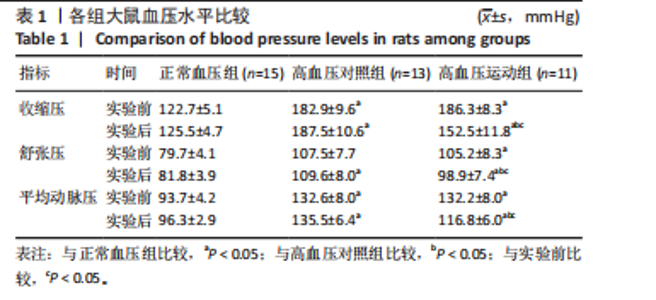
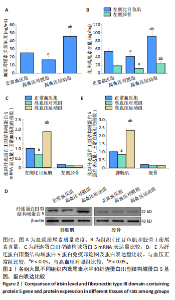
2.1 样本量分析及高血压运动组大鼠运动表现 实验过程中,由于感染、意外死亡、无法坚持完成训练以及训练损伤等原因,数据统计时共剔除6只动物(脱落率=6/45=13.3%),最终样本量n=39,其中:正常血压组n=15、高血压对照组n=13、高血压运动组n=11。自愿跑轮系统传感器记录显示,大鼠运动较为活跃的时间为晚8点至次日晨8点。8周运动期间,高血压运动组大鼠运动距离为(45.7±5.5) km/周,运动速度为(2.35±0.56) km/h,运动时间为(18.9±3.2) h/周。 2.2 运动降低血压水平 实验前,与正常血压组比较,高血压对照组和高血压运动组大鼠收缩压、舒张压、平均动脉压均升高(P < 0.05)。实验后,与正常血压组比较,高血压对照组大鼠血压水平升高(P < 0.05);与高血压对照组比较,高血压运动组大鼠血压水平降低(P < 0.05)。实验后,与实验前比较,高血压运动组大鼠血压水平降低(P < 0.05),正常血压组和高血压对照组大鼠血压水平差异无显著性意义(P > 0.05),见表1。 2.3 运动改善血管内皮功能和毛细血管密度 内皮依赖性血管舒张剂乙酰胆碱介导的内皮依赖性血管舒张反应是评价血管内皮功能的重要指标。结果显示,各组大鼠胸主动脉对乙酰胆碱均有浓度依赖性舒张作用;正常血压组大鼠血管环舒张功能良好,最大舒张率达(91.2±4.7)%,高血压对照组大鼠最大舒张率仅为"
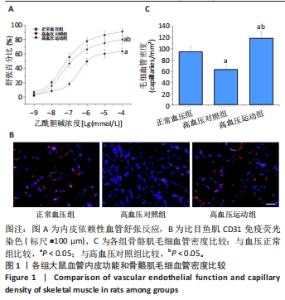
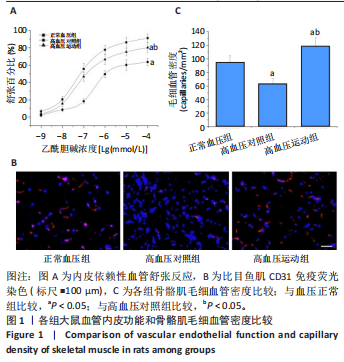
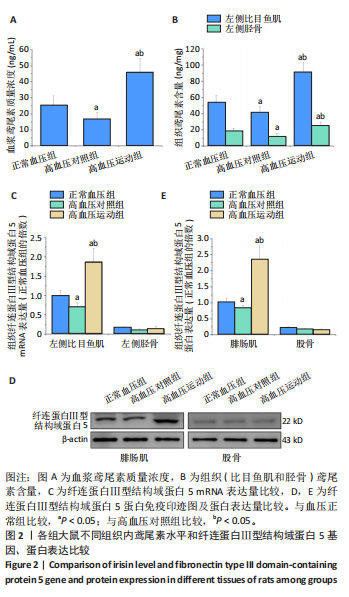
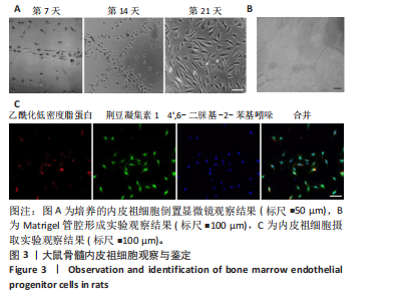
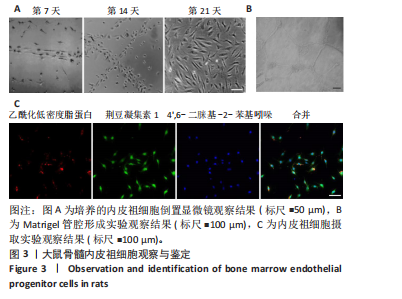
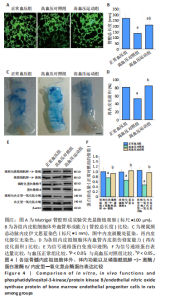
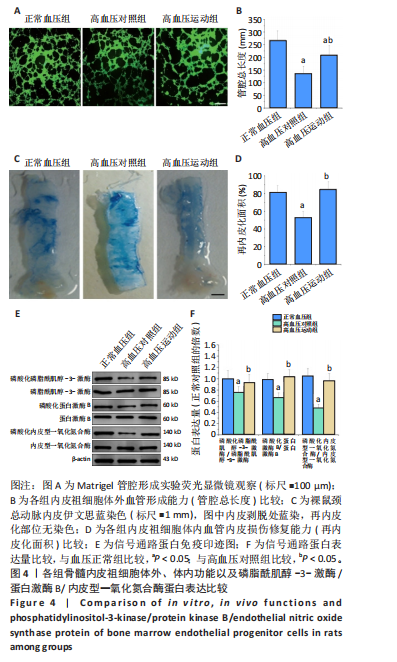
(63.6±4.5)%,较正常血压组明显下降(P < 0.05);高血压运动组大鼠内皮依赖性血管舒张反应较高血压对照组明显改善,最大舒张率达(80.2±5.6)%(P < 0.05),见图1A。 骨骼肌免疫荧光染色显示,CD31标记的血管内皮细胞呈现红色荧光,4’,6-二脒基-2-苯基吲哚标记细胞核呈现蓝色荧光,见图1B。与正常血压组比较,高血压对照组大鼠毛细血管密度下降(P < 0.05);与高血压对照组比较,高血压运动组大鼠毛细血管密度升高(P < 0.05),见图1C。 2.4 运动提升鸢尾素水平并促进纤连蛋白Ⅲ型结构域蛋白5基因表达 与血压正常组比较,高血压对照组大鼠血浆、比目鱼肌和胫骨鸢尾素水平降低(P < 0.05);与正常血压组和高血压对照组比较,高血压运动组大鼠各组织鸢尾素水平升高(P < 0.05)。骨中纤连蛋白Ⅲ型结构域蛋白5 mRNA和蛋白均呈低表达(明显低于左侧比目鱼肌,P < 0.05)且不受高血压和运动的调控。与正常血压组比较,高血压对照组大鼠骨骼肌纤连蛋白Ⅲ型结构域蛋白5 mRNA和蛋白表达量下调(P < 0.05);与正常血压组和高血压对照组比较,高血压运动组大鼠骨骼肌纤连蛋白Ⅲ型结构域蛋白5 mRNA和蛋白表达量上调(P < 0.05),见图2。 2.5 骨髓内皮祖细胞形态观察与鉴定 倒置显微镜观察,培养至第7天的贴壁细胞呈圆形或纺锤形,数量较少,分布稀疏;第14天细胞数量增多,出现聚集生长趋势,部分细胞开始相互连接,呈现出初步的网络状结构;第21天细胞密度进一步增加,呈现出典型的 “鹅卵石” 样形态,细胞排列紧密规则,相互之间形成完整的连接结构,这是内皮细胞成熟的形态学标志,见图3A。Matrigel管腔形成实验显示,内皮祖细胞分化为血管状结构,见图3B。内皮祖细胞摄取实验观察显示,细胞浆摄取乙酰化低密度脂蛋白呈现红色荧光,细胞膜结合荆豆凝集素1呈现绿色荧光,双阳性细胞呈现黄色[即为正在分化的内皮祖细胞,占(87.5±6.1)%,n=5],见图3C。 2.6 运动改善骨髓内皮祖细胞体外、体内功能并激活磷脂酰肌醇-3-激酶/蛋白激酶B/内皮型一氧化氮合酶信号通路 与正常血压组比较,高血压对照组内皮祖细胞体外、体内功能下降(P < 0.05),磷酸化磷脂酰肌醇-3-激酶/磷脂酰肌醇-3-激酶、磷酸化蛋白激酶B/蛋白激酶B、磷酸化内皮型一氧化氮合酶/内皮型一氧化氮合酶下调(P < 0.05);与高血压对照组比较,高血压运动组内皮祖细胞体外、体内功能升高(P < 0.05),磷酸化磷脂酰肌醇-3-激酶/磷脂酰肌醇-3-激酶、磷酸化蛋白激酶B/蛋白激酶B、磷酸化内皮型一氧化氮合酶/内皮型一氧化氮合酶上调(P < 0.05),见图4。"
"
"
"
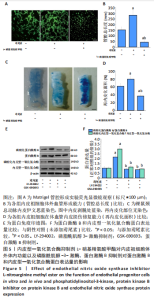
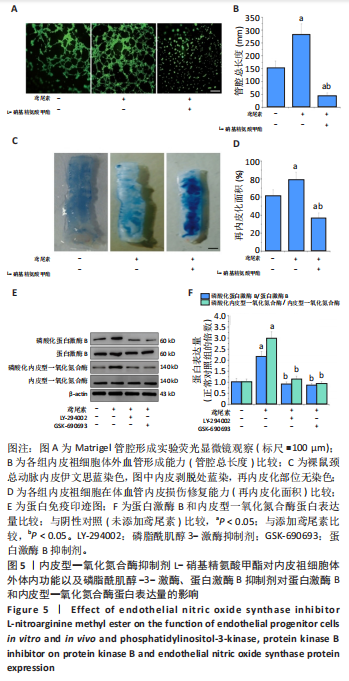
2.7 鸢尾素通过磷脂酰肌醇-3-激酶/蛋白激酶B/内皮型一氧化氮合酶信号通路调控骨髓内皮祖细胞功能 在重组人鸢尾素与骨髓内皮祖细胞共孵育实验中,与阴性对照(未添加鸢尾素)比较,添加鸢尾素后高血压对照组内皮祖细胞体内体外功能改善 (P < 0.05),磷酸化蛋白激酶B/蛋白激酶B和磷酸化内皮型一氧化氮合酶/内皮型一氧化氮合酶蛋白上调(P < 0.05)。给予内皮型一氧化氮合酶抑制剂L-硝基精氨酸甲酯后鸢尾素对内皮祖细胞的作用被抵消(P < 0.05),给予磷脂酰肌醇-3-激酶或蛋白激酶B抑制剂后磷酸化蛋白激酶B/蛋白激酶B和磷酸化内皮型一氧化氮合酶/内皮型一氧化氮合酶蛋白下调(P < 0.05),见图5。"
| [1] DEVESA A, DELGADO V, VALKOVIC L, et al. Multiorgan imaging for interorgan crosstalk in cardiometabolic diseases. Circ Res. 2025;136(11):1454-1475. [2] CAPONE F, VACCA A, BIDAULT G, et al. Decoding the liver-heart axis in cardiometabolic diseases. Circ Res. 2025;136(11):1335-1362. [3] YANG S, ZENG Z, YUAN Q, et al. Vascular calcification: from the perspective of crosstalk. Mol Biomed. 2023;4(1):e35. [4] GENG L, PING J, WU R, et al. Systematic profiling reveals betaine as an exercise mimetic for geroprotection. Cell. 2025;188(19):5426-5428. [5] NOGUCHI I, MAEDA H, KOBAYASHI K, et al. Carbon monoxide-loaded cell therapy as an exercise mimetic for sarcopenia treatment. Free Radic Biol Med. 2024;220:67-77. [6] DROŻDŻ D, DROŻDŻ M, WÓJCIK M. Endothelial dysfunction as a factor leading to arterial hypertension. Pediatr Nephrol. 2023;38(9):2973-2985. [7] 邓林华, 温玉, 张运娇, 等. 血管内皮功能障碍与高血压关系的研究进展[J].中华高血压杂志,2021,29(10):935-940. [8] COBOS-SEGARRA L, LOPEZ-JARAMILLO P, PONTE-NEGRETTI CI C, et al. Pharmacological treatment of hypertension: Effects in endothelial function. Curr Hypertens Rev. 2018;14(2):123-127. [9] 陈凤娇, 左朝艳, 吕佳荟, 等. mESC衍生内皮祖细胞定向分化为血管内皮细胞促伤口愈合[J]. 中国生物化学与分子生物学报,2022,38(3):320-332. [10] MAK A, CHAN J. Endothelial function and endothelial progenitor cells in systemic lupus erythematosus. Nat Rev Rheumatol. 2022;18(5):286-300. [11] LUO S, XIA W, CHEN C, et al. Endothelial progenitor cells and hypertension: current concepts and future implications. Clin Sci (Lond). 2016;130(22):2029-2042. [12] VASA M, FICHTLSCHERER S, AICHER A, et al. Number and migratory activity of circulating endothelial progenitor cells inversely correlate with risk factors for coronary artery disease. Circ Res. 2001;89(1):e1-7. [13] SUN N, WANG H, WANG L. Vaspin alleviates dysfunction of endothelial progenitor cells induced by high glucose via PI3K/Akt/eNOS pathway. Int J Clin Exp Pathol. 2015;8(1):482-489. [14] OLIVEIRA GF, MARIN TC, FORJAZ C, et al. Exercise training and endothelial function in hypertension: Effects of aerobic and resistance training. Arq Bras Cardiol. 2021;116(5):948-949. [15] FERENTINOS P, TSAKIRIDES C, SWAINSON M, et al. The impact of different forms of exercise on circulating endothelial progenitor cells in cardiovascular and metabolic disease. Eur J Appl Physiol. 2022;122(4):815-860. [16] 陈晓可, 何辉, 王文荣. 12周有氧运动对绝经女性血管内皮功能和内皮祖细胞的影响[J].中国体育科技,2022,58(6):67-73. [17] 江信宏, 方敏, 陈清法, 等. 早期运动训练对高血压合并急性脑梗死患者血压水平、内皮祖细胞、血管内皮生长因子含量及临床疗效的影响[J].中华高血压杂志,2021,29(9):867-872. [18] MAAK S, NORHEIM F, DREVON CA, et al. Progress and challenges in the biology of FNDC5 and irisin. Endocr Rev. 2021;42(4):436-456. [19] LI RL, ZHUO CL, YAN X, et al. Irisin attenuates vascular remodeling in hypertensive mice induced by Ang II by suppressing Ca2+-dependent endoplasmic reticulum stress in VSMCs. Int J Biol Sci. 2024;20(2):680-700. [20] 张径遂, 杨坡, 张跃耀, 等. 肌肉因子irisin:改善高血压血管功能的新靶点[J].公共卫生与预防医学,2025,36(2):110-115. [21] ZHU G, WANG J, SONG M, et al. Irisin increased the number and improved the function of endothelial progenitor cells in diabetes mellitus mice. J Cardiovasc Pharmacol. 2016;68(1):67-73. [22] GODBOUT C, RYAN G, RAMNARAIGN DJ, et al. Optimal delivery of endothelial progenitor cells in a rat model of critical-size bone defects. J Orthop Res. 2024; 42(1):193-201. [23] XIE J, LIAO Y, WANG D. Baicalin promotes migration and angiogenesis of endothelial progenitor cells but impedes thrombus formation via SIRT1/NF-κB signaling in a rat model of deep vein thrombosis. Histol Histopathol. 2025;40(4):547-554. [24] YEH JN, YIP HK, SHAO PL, et al. Combination of melatonin-delivered endothelial progenitor cells with S-nitroso-N-acetyl-DL-penicillamine for improving critical limb ischemia in the rat. Am J Transl Res. 2024;16(9):5020-5037. [25] LIANG J, CHU H, RAN Y, et al. Linc-ROR Modulates the endothelial-mesenchymal transition of endothelial progenitor cells through the miR-145/Smad3 signaling pathway. Physiol Res. 2024;73(4):565-576. [26] WANG M, LI J, HU X, et al. Tilianin attenuates inflammasome activation in endothelial progenitor cells to mitigate myocardial ischemia-reperfusion injury. PLoS One. 2024;19(10):e0311624. [27] MANZANARES G, BRITO-DA-SILVA G, GANDRA PG. Voluntary wheel running: patterns and physiological effects in mice. Braz J Med Biol Res. 2018;52(1):e7830. [28] KARADEDELI MS, SCHRECKENBERG R, KUTSCHE HS, et al. Effects of voluntary exercise on the expression of browning markers in visceral and subcutaneous fat tissue of normotensive and spontaneously hypertensive rats. Pflugers Arch. 2022;474(2):205-215. [29] SCHULTZ RL, KULLMAN EL, WATERS RP, et al. Metabolic adaptations of skeletal muscle to voluntary wheel running exercise in hypertensive heart failure rats. Physiol Res. 2013;62(4):361-369. [30] 诸国华, 孙希鹏, 唐桦, 等. 初发轻度高血压患者内皮功能与左心室肥厚的相关性研究[J].首都医科大学学报,2019,40(3):369-373. [31] 孙莉莉, 李文东, 李晓强, 等. 内皮祖细胞在血管新生及相关疾病中的作用[J].中国普通外科杂志,2020,29(6):759-764. [32] 刘子铭, 于亮. Irisin:新的运动因子?[J]. 生理科学进展,2018,49(3): 207-211. [33] 孔祥波, 王坤, 彭锦程. 高血压患者血清Betatrophin、Irisin与尿微量白蛋白的相关性[J].实验与检验医学,2020,38(6):1159-1161. [34] FU J, HAN Y, WANG J, et al. Irisin lowers blood pressure by improvement of endothelial dysfunction via AMPK-Akt-eNOS-NO pathway in the spontaneously hypertensive rat. J Am Heart Assoc. 2016;5(11):e003433. [35] HO MY, WANG CY. Role of irisin in myocardial infarction, heart failure, and cardiac hypertrophy. Cells. 2021;10(8):2103. [36] WANG S, HU S, PAN Y. The emerging roles of irisin in vascular calcification. Front Endocrinol (Lausanne). 2024;15:1337995. [37] DENG J, ZHANG T, LI M, et al. Irisin-pretreated BMMSCs secrete exosomes to alleviate cardiomyocytes pyroptosis and oxidative stress to hypoxia/reoxygenation injury. Curr Stem Cell Res Ther. 2023;18(6):843-852. [38] XUE F, BAI Y, JIANG Y, et al. Construction and a preliminary study of paracrine effect of bone marrow-derived endothelial progenitor cell sheet. Cell Tissue Bank. 2022;23(1):185-197. [39] HAMED S, BRENNER B, ABASSI Z, et al. Hyperglycemia and oxidized-LDL exert a deleterious effect on endothelial progenitor cell migration in type 2 diabetes mellitus. Thromb Res. 2010;126(3):166-174. [40] CHENG XW, KUZUYA M, KIM W, et al. Exercise training stimulates ischemia-induced neovascularization via phosphatidylinositol 3-kinase/Akt-dependent hypoxia-induced factor-1 alpha reactivation in mice of advanced age. Circulation. 2010;122(7):707-716. [41] AICHER A, HEESCHEN C, MILDNER-RIHM C, et al. Essential role of endothelial nitric oxide synthase for mobilization of stem and progenitor cells. Nat Med. 2003;9(11):1370-1376. [42] BEHERA J, GOVINDAN S, RAMASAMY MS. Nitric oxide promotes cell-matrix adhesion of endothelial progenitor cells under hypoxia condition via ITGA5 CpG promoter demethylation. Biochem Biophys Res Commun. 2023;644:162-170. [43] LAUFS U, WERNER N, LINK A, et al. Physical training increases endothelial progenitor cells, inhibits neointima formation, and enhances angiogenesis. Circulation. 2004;109(2):220-226. [44] HAN F, ZHANG S, HOU N, et al. Irisin improves endothelial function in obese mice through the AMPK-eNOS pathway. Am J Physiol Heart Circ Physiol. 2015;309(9): H1501-1508. [45] SONG H, WU F, ZHANG Y, et al. Irisin promotes human umbilical vein endothelial cell proliferation through the ERK signaling pathway and partly suppresses high glucose-induced apoptosis. PLoS One. 2014;9(10):e110273. [46] LI G, CAO N, SHANG P, et al. What the discovery of irisin receptor means to bone. Arch Physiol Biochem. 2022;128(5):1137-1139. [47] GRZESZCZUK M, DZIĘGIEL P, NOWIńSKA K. The role of FNDC5/irisin in cardiovascular disease. Cells. 2024;13(3):e277. [48] GUO W, ZHANG B, WANG X. Lower irisin levels in coronary artery disease: A meta-analysis. Minerva Endocrinol. 2020;45(1):61-69. [49] WASEEM R, SHAMSI A, MOHAMMAD T, et al. FNDC5/irisin: Physiology and pathophysiology. Molecules. 2022;27(3):e1118. [50] 张艺萍, 丁璟, 张祎, 等. 鸢尾素在糖脂代谢及肥胖中的作用[J].中国医科大学学报,2024,53(7):646-650. [51] JIN L, DIAZ-CANESTRO C, WANG Y, et al. Exerkines and cardiometabolic benefits of exercise: from bench to clinic. EMBO Mol Med. 2024;16(3):432-444. |
| [1] | Chen Haojie, Wang Dai, Shen Shan. Immune inflammatory microenvironment mechanisms in peri-implantitis [J]. Chinese Journal of Tissue Engineering Research, 2026, 30(8): 2054-2062. |
| [2] | Hu Xiongke, Liu Shaohua, Tan Qian, Liu Kun, Zhu Guanghui. Shikonin intervention with bone marrow mesenchymal stem cells improves microstructure of femur in aged mice [J]. Chinese Journal of Tissue Engineering Research, 2026, 30(7): 1609-1615. |
| [3] | Han Nianrong, Huang Yifei, Akram · Osman, Liu Yanlu, Hu Wei . Programmed cell death receptor-1 suppresses osteogenic differentiation of rat bone marrow mesenchymal stem cells in a high-glucose microenvironment [J]. Chinese Journal of Tissue Engineering Research, 2026, 30(7): 1649-1657. |
| [4] | Liu Anting, Lu Jiangtao, Zhang Wenjie, He Ling, Tang Zongsheng, Chen Xiaoling. Regulation of AMP-activated protein kinase by platelet lysate inhibits cadmium-induced neuronal apoptosis [J]. Chinese Journal of Tissue Engineering Research, 2026, 30(7): 1800-1807. |
| [5] | Peng Zhiwei, Chen Lei, Tong Lei. Luteolin promotes wound healing in diabetic mice: roles and mechanisms [J]. Chinese Journal of Tissue Engineering Research, 2026, 30(6): 1398-1406. |
| [6] | Zhu Kuicheng, Du Chunyan, Zhang Jintao. Mechanism by which hairless gene mutation promotes white adipose tissue browning in hairless mice [J]. Chinese Journal of Tissue Engineering Research, 2026, 30(6): 1424-1430. |
| [7] | Li Hao, Tao Hongcheng, Zeng Ping, Liu Jinfu, Ding Qiang, Niu Chicheng, Huang Kai, Kang Hongyu. Mitogen-activated protein kinase signaling pathway regulates the development of osteoarthritis: guiding targeted therapy with traditional Chinese medicine [J]. Chinese Journal of Tissue Engineering Research, 2026, 30(6): 1476-1485. |
| [8] | Sun Yaotian, Xu Kai, Wang Peiyun. Potential mechanisms by which exercise regulates iron metabolism in immune inflammatory diseases [J]. Chinese Journal of Tissue Engineering Research, 2026, 30(6): 1486-1498. |
| [9] | Wang Jingfeng, Xia Fan, Mao Sujie, Li Xiaolin. Potential target values of low temperature and cold receptor transient receptor potential M8 and glutamate receptor-3/glutamate receptor ionotropic, kainate 2 in the treatment of hypertension [J]. Chinese Journal of Tissue Engineering Research, 2026, 30(6): 1499-1507. |
| [10] | Chen Ju, Zheng Jinchang, Liang Zhen, Huang Chengshuo, Lin Hao, Zeng Li. Effect and mechanism of beta-caryophyllene in mice with osteoarthritis [J]. Chinese Journal of Tissue Engineering Research, 2026, 30(6): 1341-1347. |
| [11] | Lyu Guoqing, Aizimaitijiang·Rouzi, Xiong Daohai. Irisin inhibits ferroptosis in human articular chondrocytes: roles and mechanisms [J]. Chinese Journal of Tissue Engineering Research, 2026, 30(6): 1359-1367. |
| [12] | Wen Fan, Xiang Yang, Zhu Huan, Tuo Yanfang, Li Feng. Exercise improves microvascular function in patients with type 2 diabetes [J]. Chinese Journal of Tissue Engineering Research, 2026, 30(5): 1225-1235. |
| [13] | Zhang Cuicui, Chen Huanyu, Yu Qiao, Huang Yuxuan, Yao Gengzhen, Zou Xu. Relationship between plasma proteins and pulmonary arterial hypertension and potential therapeutic targets [J]. Chinese Journal of Tissue Engineering Research, 2026, 30(5): 1331-1340. |
| [14] | Chen Yixian, Chen Chen, Lu Liheng, Tang Jinpeng, Yu Xiaowei. Triptolide in the treatment of osteoarthritis: network pharmacology analysis and animal model validation [J]. Chinese Journal of Tissue Engineering Research, 2026, 30(4): 805-815. |
| [15] | Jiang Yang, Peng Hao, Song Yanping, Yao Na, Song Yueyu, Yin Xingxiao, Li Yanqi, Chen Qigang. Isometric exercise reduces resting blood pressure: a meta-analysis of moderating factors and dose effects [J]. Chinese Journal of Tissue Engineering Research, 2026, 30(4): 975-986. |
| Viewed | ||||||
|
Full text |
|
|||||
|
Abstract |
|
|||||