Chinese Journal of Tissue Engineering Research ›› 2026, Vol. 30 ›› Issue (33): 8721-8734.doi: 10.12307/2026.280
Previous Articles Next Articles
Effects of different flavors on neurobehaviors and cellular molecular networks of mice: high-throughput transcriptome sequencing analysis
Gao Yang1, Zhang Lina1, Zhao Zhihuang2, Wang Hui1, Liu Chongsheng1, Xie Yongheng1, Xu Liping1, Chen Peixian3, Yang Wei2, Hua Ning2, Zhao Xuming3
- 1Technical Center, Zhejiang Tobacco Industry Co., Ltd., Hangzhou 310000, Zhejiang Province, China; 2Department of Neurology, Fourth Affiliated Hospital of Zhejiang University School of Medicine, Yiwu 322000, Zhejiang Province, China; 3Department of Nephrology, Sir Run Run Shaw Hospital, Zhejiang University School of Medicine, Hangzhou 310000, Zhejiang Province, China
-
Received:2025-09-01Revised:2026-01-21Online:2026-11-28Published:2026-06-15 -
Contact:Zhao Xuming, PhD, Attending physician, Department of Nephrology, Sir Run Run Shaw Hospital, Zhejiang University School of Medicine, Hangzhou 310000, Zhejiang Province, China -
About author:Gao Yang, MS, Senior engineer, Technical Center, Zhejiang Tobacco Industry Co., Ltd., Hangzhou 310000, Zhejiang Province, China -
Supported by:National Natural Science Foundation of China (Key Program), No. 82030108 (to YW); Zhejiang China Tobacco Science and Technology Project, No. ZJZY2023C025 (to GY)

CLC Number:
Cite this article
Gao Yang, Zhang Lina, Zhao Zhihuang, Wang Hui, Liu Chongsheng, Xie Yongheng, Xu Liping, Chen Peixian, Yang Wei, Hua Ning, Zhao Xuming. Effects of different flavors on neurobehaviors and cellular molecular networks of mice: high-throughput transcriptome sequencing analysis[J]. Chinese Journal of Tissue Engineering Research, 2026, 30(33): 8721-8734.
share this article
Add to citation manager EndNote|Reference Manager|ProCite|BibTeX|RefWorks
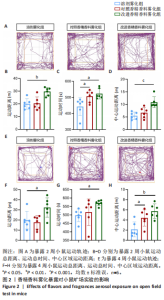
2.1 香精香料雾化暴露对小鼠自主活动行为的影响 通过旷场实验评估小鼠的自发活动水平和探索行为,以探讨不同香精香料雾化暴露对小鼠运动功能状态及自主活动水平的影响。与溶剂雾化组相比,对照香精香料雾化组与改进香精香料雾化组小鼠在暴露第2,4周的运动轨迹显著增加,见图2A,E;对照香精香料雾化组小鼠在第2周表现出运动时间显著延长(P < 0.05),见图2C,并在第4周显示出中心区域运动距离的显著增加(P < 0.05),见图2H。进一步分析发现,与溶剂雾化组相比,改进香精香料雾化组的小鼠运动总距离、运动时间及中心区域运动距离在第2,4周均显著增加(P < 0.05),见图2B-D,F-H;与对照香精香料雾化组相比,改进香精香料雾化组小鼠运动总距离、运动时间及中心区域运动距离差异无显著性意义(P > 0.05)。这些结果表明,改进香精香料的雾化暴露在中期和后期均能显著"

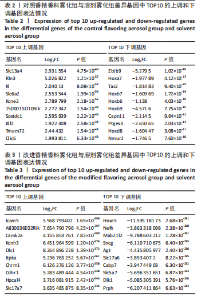
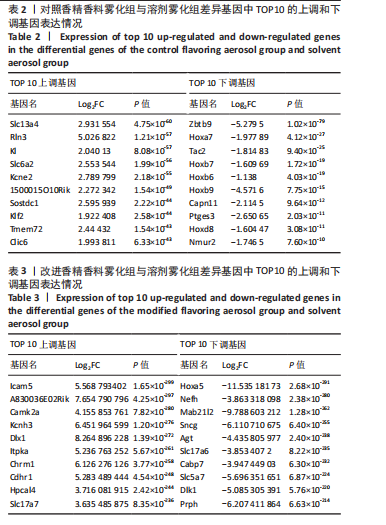
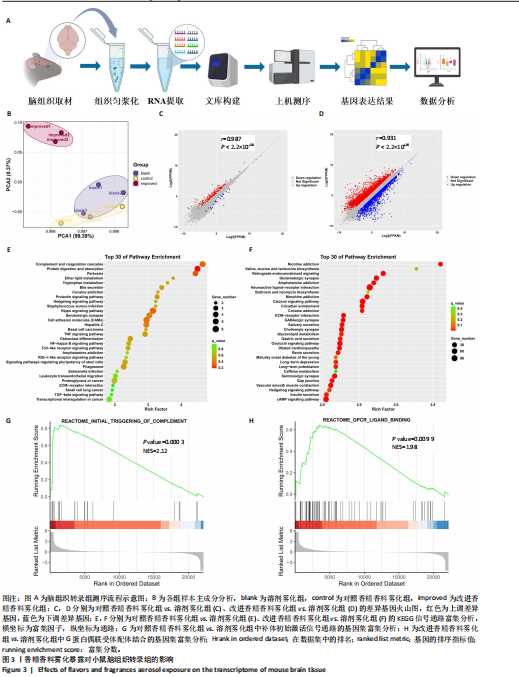
提升小鼠的自主活动能力,并表现出较强的中枢兴奋性或探索行为增强的趋势。 2.2 香精香料雾化暴露对小鼠脑组织转录组的调控 为了进一步探讨不同香精香料雾化暴露对小鼠脑组织转录水平的影响,进行了转录组测序分析,实验流程见图3A。 2.2.1 主成分分析结果 溶剂雾化组与对照香精香料雾化组在空间位置上较为接近,而改进香精香料雾化组则明显与溶剂雾化组及对照香精香料雾化组分布较远(图3B),提示改进香精香料雾化组对小鼠的影响更加显著。 2.2.2 差异基因表达分析结果 与溶剂雾化组相比,对照香精香料雾化组共鉴定出240个差异表达基因,其中207个基因上调,33个基因下调;改进香精香料雾化组共鉴定出4 722个差异表达基因,其中1 548个基因上调,3 174个基因下调(图3C),其中对照香精香料雾化组差异基因中TOP10的上调和下调基因表达情况详细见表2,改进香精香料雾化组差异基因中TOP10的上调和下调基因表达情况详细见表3。"
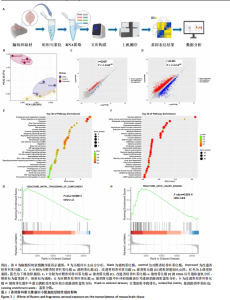
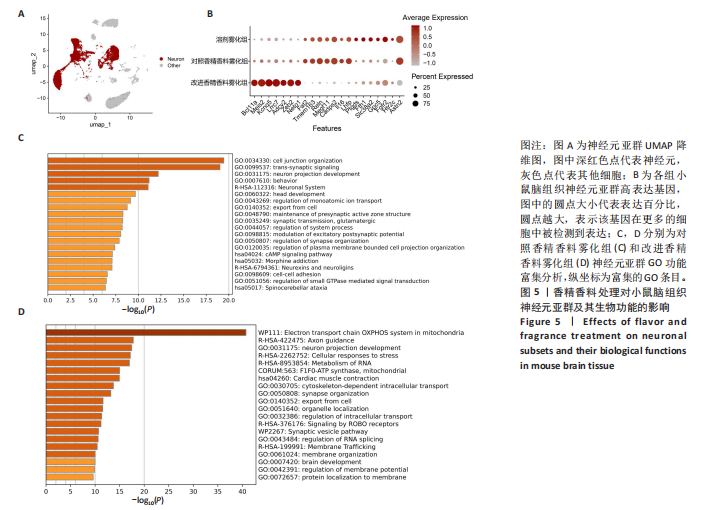
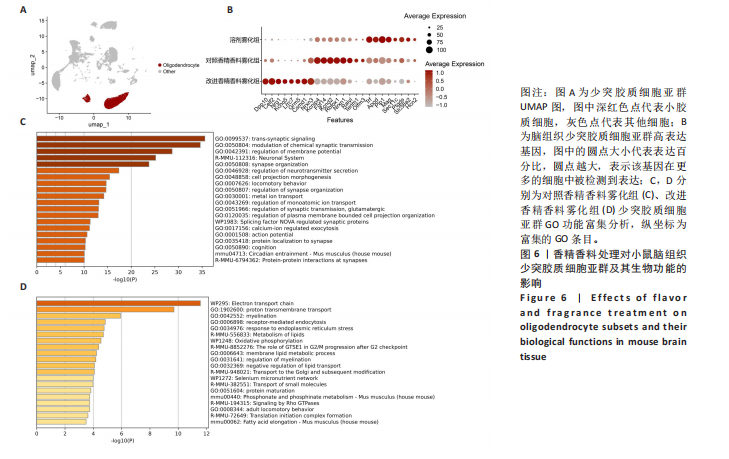
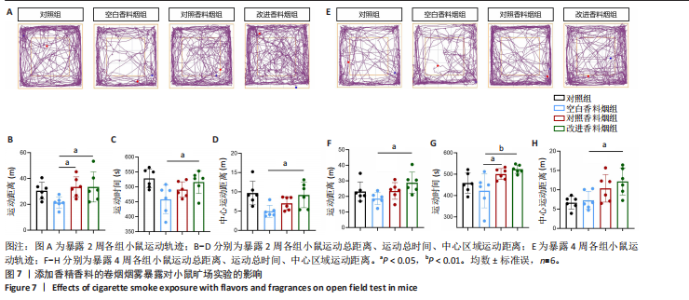
2.2.3 差异基因通路富集分析结果 对照香精香料雾化组的差异基因主要富集于补体与凝血级联反应、色氨酸代谢、Hedgehog信号通路、Hippo信号通路、5-羟色胺能突触及转化生长因子β信号通路等(图3D);改进香精香料雾化组的差异基因主要富集在谷氨酸能突触、苯丙胺成瘾、神经活性配体-受体相互作用、γ-氨基丁酸能突触、5-羟色胺能突触等(图3E,F)。 2.2.4 基因集富集分析结果 与溶剂雾化组相比,对照香精香料雾化组的补体初始激活信号通路显著上调[标准化富集分数(normalized enrichment score,NES)= 2.12,P < 0.05](图3G),改进香精香料雾化组的G蛋白偶联受体配体结合通路显著上调(标准化富集分数= 1.98,P < 0.05)(图3H)。 上述结果表明,不同香精香料雾化暴露对脑组织的差异基因产生显著变化,相较于溶剂雾化组,改进香精香料雾化组的差异表达基因数量明显高于对照香精香料雾化组,其差异表达基因显著富集于谷氨酸能突触、苯丙胺成瘾、神经活性配体-受体相互作用信号通路,且对照香精香料雾化组在补体初始激活信号通路中表现出显著的上调,改进香精香料雾化组在G蛋白偶联受体配体结合通路中表现出显著的上调。 2.3 香精香料雾化暴露对小鼠脑组织snRNA-seq的影响 为了探究香精香料对小鼠脑组织中细胞类型组成及其特异性基因表达调控的影响,对小鼠脑组织样本进行了snRNA-seq分析,实验流程见图4A。"
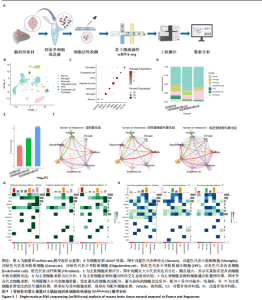
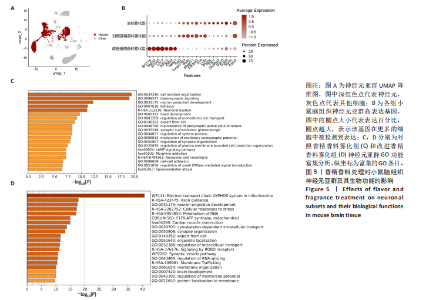
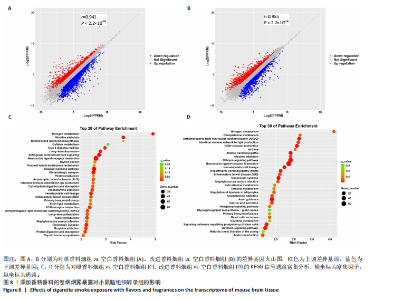
2.3.1 细胞聚类分群结果 在数据处理中,通过质量控制剔除低质量、线粒体比例及核糖体基因异常的细胞后,共选取了38 456个高质量细胞用于分析。经过数据预处理以及降维聚类后,依据特征分子的表达水平,进一步将数据集注释得到7种主要细胞类型,包括神经元(Camk2a)、小胶质细胞(Cx3cr1)、星形胶质细胞(Sc1a3)、少突胶质细胞(Mbp)、少突胶质前体细胞(Pdgfra)、内皮细胞(Pecam1)和成纤维细胞(Col1a2),各亚群细胞呈均匀散在分布,批次效应整合较好,提示可以进行进一步的分析,见图4B,C。 2.3.2 细胞亚群占比分析结果 不同香精香料对脑组织中各个细胞亚群的组成有较大的差异。相比于溶剂雾化组,对照香精香料雾化组和改进香精香料雾化组的神经元亚群和少突胶质细胞亚群明显增加,见图4D。这些结果提示,神经元亚群和少突胶质细胞亚群在小鼠暴露于香精香料过程中发挥了重要作用。 2.3.3 细胞间通讯分析结果 细胞间通讯网络的可视化分析发现,与溶剂雾化组相比,对照香精香料雾化组和改进香精香料雾化组的细胞亚群间的通讯交互总数显著增加,见图4E。在对照香精香料雾化组中,神经元、少突胶质细胞前体细胞和星形胶质细胞亚群的通讯状态活跃;而在改进香精香料雾化组中,成纤维细胞、突胶质细胞前体细胞和星形胶质细胞亚群的通讯状态同样表现出活跃性,见图4F。进一步对细胞亚群的通讯模式进行识别,比较各细胞亚群在作为信号发出者(outgoing)和接收者(incoming)时与其他细胞亚群的相互作用,结果显示神经调节蛋白(neuregulin,NRG)和成纤维细胞生长因子(fibroblast growth factor,FGF)通路在改进香精香料雾化组的小鼠神经元中被显著激活,这表明香精香料的暴露对神经元的功能产生了改变和适应,见图4G,H。 2.3.4 神经元亚群分类、差异表达基因及GO功能富集分析结果 研究进一步将溶剂雾化组、对照香精香料雾化组和改进香精香料雾化组神经元亚群进一步进行分析,见图5A。通过分析各组神经元亚群的差异表达基因,结果显示各组神经元亚群的基因表达模式存在显著差异。其中溶剂雾化组高表达神经发育相关基因(Bcl11a、Meis2)、离子通道基因(Kcnq5)及突触功能基因(Lrrc7、Adcy2、Neto1、Zeb2),对照香精香料雾化组高表达细胞黏附分子(Fat2、Megf11)、突触可塑性相关基因(Reln、Cadps2、Astn2)及信号转导基因(Tmem163、Il16、Lhfp),改进香精香料雾化组除了Tmem163、Reln、Megf11、Cadps2、Lhfp、Astn2基因高表达,还包括铁代谢(Fth1)、神经保护(Ptgds)及营养转运相关基因(Slc38a2、Gpc5、Fgfr2),见图5B。进一步的GO功能富集分析结果显示,对照香精香料雾化组神经元亚群差异基因的功能主要富集在跨突触信号传递、神经元投射发育、突触前活性区结构的维持、谷氨酸能突触传递、调节兴奋性突触后电位、突触组织的调节、cAMP信号通路等生物过程,见图5C;改进香精香料雾化组神经元亚群差异基因的功能主要富集在线粒体电子传递链与氧化磷酸化系统、轴突导向、神经元投射发育、细胞对应激的反应、细胞骨架依赖的细胞内转运等生物过程,见图5D。 2.3.5 少突胶质细胞亚群分类、差异表达基因分析及GO功能富集分析 通过对少突胶质细胞亚群单独分析(图6A),差异表达基因分析结果显示,溶剂雾化组高表达突触调控基因(Dpp10、Celf2、Nrg1、Grm5)、离子通道基因(Kcnq5)及细胞骨架相关基因(Lrrc7、Csmd1、Nrxn3),对照香精香料雾化组高表达突触形成基因(Nrxn3、Nrxn1)、钾通道调控基因(Kcnip4、Kcnd2、Fgf14)及RNA结合蛋白(Rbfox1、Ralyl),改进香精香料雾化组高表达髓鞘形成标志物(Plp1、Mag、Apod)、铁转运基因(Trf)及能量代谢相关基因(Sec11c、Ptgds、Slc38a2、Hcn2)(图6B)。GO功能富集分析结果显示,对照香精香料雾化组少突胶质细胞亚群差异表达基因功能主要涉及跨突触信号、化学突触传递的调节、膜电位的调控、调节神经递质的分泌、细胞投射形态发生、突触组织的调节等生物过程(图6C);改进香精香料雾化组少突胶质细胞亚群差异表达基因功能主要涉及电子传递链、髓鞘形成、氧化磷酸化、髓鞘化的调控等生物过程(图6D)。 综上所述,此次研究发现香精香料对小鼠脑组织的影响涉及多个细胞亚群,并在神经元亚群和少突胶质细胞亚群中存在显著差异。在神经元亚群中,对照香精香料雾化组主要调控突触结构相关基因的表达,影响神经信号传递过程;而改进香精香料雾化组则显著激活能量代谢相关通路,同时提升神经信号传递效率。在少突胶质细胞亚群中,对照香精香料雾化组通过调节突触信号传递相关基因的表达,促进突触结构优化和神经可塑性增强;相比之下,改进香精香料雾化组更倾向于促进髓鞘形成相关基因的表达,并显著优化能量代谢过程。这些发现揭示了香精香料通过不同机制调控神经元和少突胶质细胞功能,从而影响脑组织神经系统的整体功能状态。 2.4 添加香精香料卷烟暴露对小鼠自主活动行为的影响 前述研究已系统揭示香精香料对脑组织神经系统神经元亚群功能的特异性调控,但卷烟作为其重要递送载体,其混合烟气成分能否介导相似的神经调控作用尚需明确。为探讨添加改进香精香料的卷烟烟气对小鼠行为的影响,通过旷场实验对小鼠的运动表现进行了评估,见图7。结果显示,与空白香料烟组相比,对照香料烟组与改进香料烟组小鼠在暴露第2,4周的运动轨迹显著增加(图7A,E),对照香料烟组小鼠在第2周的运动总距离和第4周的运动时间均显著增加(P < 0.05,图7B,G)。此外,改进香料烟组的小鼠运动总距离、运动时间以及中心区域运动距离在第2,4周均显著高于空白香料烟组(P < 0.05,图B-D,F-H),与对照香料烟组相比,改进香料烟组小鼠在运动总距离、运动时间及中心区域运动距离上无显著差异(P > 0.05)。上述结果表明,暴露于添加改进香精香料的卷烟烟气在中期和后期可显著增强小鼠的自主活动能力,提示该类香精香料在卷烟递送体系下仍具备一定的神经调节潜力。 2.5 添加香精香料卷烟暴露对小鼠脑组织转录组的影响 2.5.1 差异表达基因筛选结果 通过对照香料烟组和改进香料烟组小鼠脑组织进行转录组测序分析差异表达基因筛选,结果发现,与空白香料烟组相比,对照香料烟组共鉴定出3 601个差异表达基因,其中1 240个基因显著上调,2 361个基因显著下调(图"
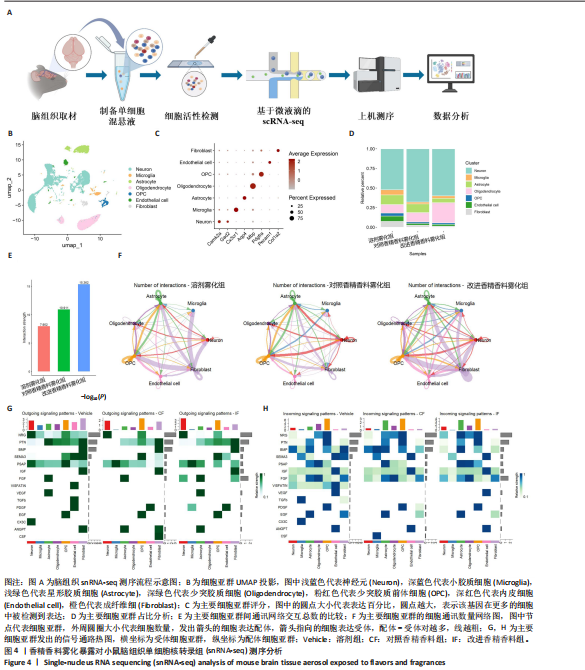
8A);改进香料烟组共鉴定出2 392个差异表达基因,其中1 230个基因显著上调,1 162个基因显著下调(图8B)。 2.5.2 KEGG通路富集分析结果 进一步对两组的差异表达基因进行了KEGG通路富集分析,结果显示,对照香料烟组的差异基因主要富集于尼古丁成瘾、咖啡因代谢、逆向内源性大麻素信号传导、神经活性配体-受体相互作用、谷氨酸能突出、胆碱能突触等通路(图8C);改进香料烟组的差异基因主要富集于苯丙氨酸代谢、神经活性配体-受体相互作用、胆碱能突触、酪"
"
"

"
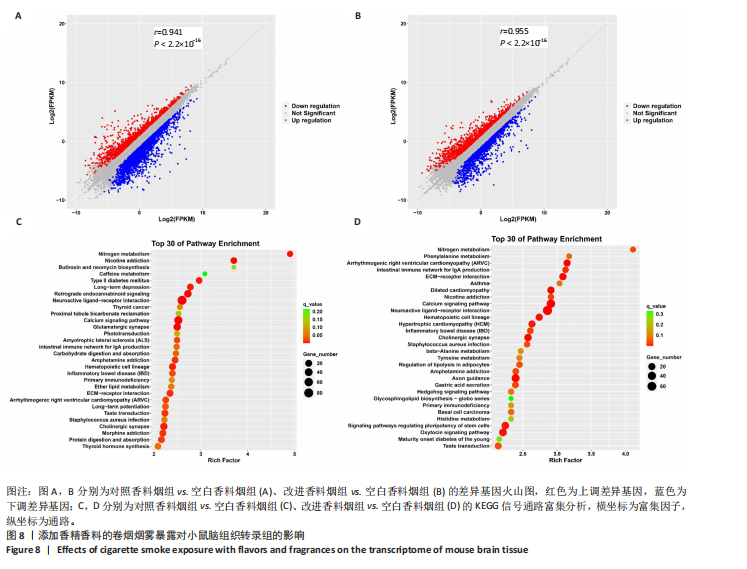
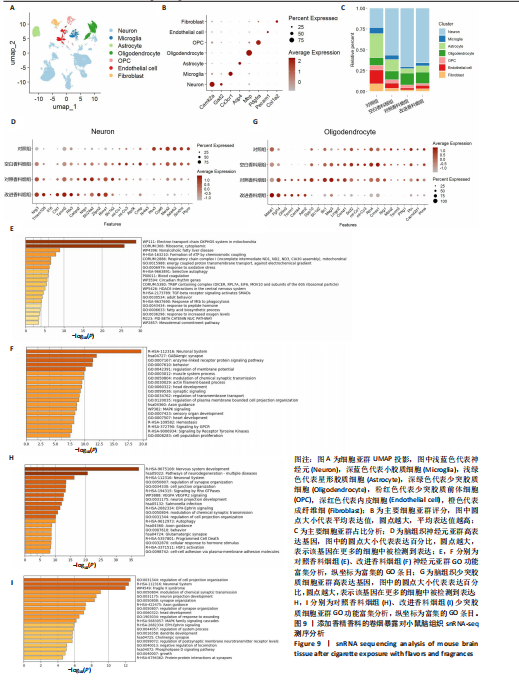
氨酸代谢、轴突导向、组氨酸代谢等通路(图8D)。 以上结果表明,与空白香料烟组相比,对照香料烟组的差异表达基因主要富集于调控神经系统信号传导、突触功能和成瘾机制的相关通路上,而改进香料烟组的差异表达基因则主要富集于影响神经递质平衡、调节神经系统兴奋性和代谢活动的相关通路上,表明添加香精香料可能通过不同的分子机制对神经功能产生影响。 2.6 添加香精香料卷烟暴露对小鼠脑组织snRNA-seq的影响 为了探究添加香精香料的卷烟暴露对小鼠脑组织中细胞类型组成及其特异性基因表达调控的影响,对小鼠脑组织进行了snRNA-seq测序分析。 2.6.1 细胞聚类分群结果 经过数据预处理、降维聚类和数据集注释,共识别出7种主要细胞类型,包括神经元、小胶质细胞、星形胶质细胞、少突胶质细胞、少突胶质前体细胞、内皮细胞和成纤维细胞(图9A,B)。 2.6.2 细胞亚群占比、差异表达基因分析及GO功能富集分析 相比于空白香料烟组,对照香料烟组和改进香料烟组的神经元亚群及少突胶质细胞亚群显著增加(图9C)。在对神经元亚群的差异基因进行分析时发现,对照组与空白香料烟组、对照香料烟组均高表达神经发育与突触功能相关基因(Nrg3、Tenm2和Rims1),而对照香料烟组与改进香料烟组则高表达转录调控相关基因(Pbx3、Meis2、Sox2ot)和细胞骨架重构与信号转导相关基因(Cmip、Adarb2、Ptpro)(图9D)。GO功能富集分析表明,对照香料烟组的差异基因主要富集于线粒体电子传递链OxPHoS系统、能量耦合质子跨膜运输、对氧化应激的响应、选择性自噬以及转化生长因子β受体信号等生物过程(图9E),而改进香料烟组的差异基因则主要富集于γ-氨基丁酸能突触、膜电位调控、化学突触传递调节和跨膜转运等生物过程(图9F)。 2.6.3 少突胶质细胞亚群分类及GO功能富集分析结果 在少突胶质细胞亚群中,空白香料烟组、对照香料烟组和改进香料烟组均高表达膜蛋白与细胞骨架相关基因(Dpp10、Rtn4、Cmss1)和神经保护相关基因等基因(Sod2、Ptn)(图9G)。GO功能富集分析表明,对照香料烟组的差异基因主要富集于神经系统发育、突触组织调节、VEGFA-VEGFR2信号通路、化学突触传递调节以及谷氨酸能突触等生物过程(图9H),而改进香料烟组的差异基因则主要富集于化学突触传递调节、突触组织调节、MAPK家族信号级联、树突发育以及调节突触后膜神经递质受体水平等生物过程(图9I)。这些发现提示,不同香精香料可能通过调控神经元能量代谢和氧化应激响应,以及调节少突胶质细胞介导的突触传递与重塑相关信号通路,进而影响神经系统的可塑性与功能稳态。"
| [1] 汪婷, 杜薇. 近二十年香文化研究的热点及趋势:基于CiteSpace文献计量可视化分析[J]. 贵州民族大学学报(哲学社会科学版),2024(5):81-98. [2] LEE JW, TRINH CT. Towards renewable flavors, fragrances, and beyond. Curr Opin Biotechnol. 2020;61:168-180. [3] JIA Y, YIN X, YANG H, et al. Transcriptome analyses reveal the aroma terpenoids biosynthesis pathways of Primula forbesii Franch. and the functional characterization of the PfDXS2 gene. Int J Mol Sci. 2023;24(16):12730. [4] 覃灏, 周自宇, 张禹, 等. 基于VOSViewer文献及incoPat专利调研香料香精产业发展现状与天然香料研究进展[J]. 香料香精化妆品,2024(5): 24-30+109. [5] 李旺. 香叶天竺葵和清香木的化学成分及抗氧化活性研究[D]. 昆明:云南农业大学,2024. [6] 刘夏磊, 张莉莉, 梁莉, 等. 天然食用香料及其活性成分的功能研究进展[J].食品科学,2025,46(10):10299-10314. [7] WESTON-GREEN K, CLUNAS H, JIMENEZ NARANJO C. A review of the potential use of pinene and linalool as terpene-based medicines for brain health: discovering novel therapeutics in the flavours and fragrances of cannabis. Front Psychiatry. 2021;12:583211. [8] 余丽丽, 姚琳, 刘少静. 护肤化妆品原料及配方实例[M]. 北京:化学工业出版社,2023:571. [9] 穆旻, 刘华, 梁彦会, 等. 我国食品用香料香精管理现状、问题与对策[J]. 食品科学技术学报,2022,40(5):36-42. [10] LI YS, HE RR, CHEN HM, et al. Respiratory depression as antibacterial mechanism of linalool against Pseudomonas fragi based on metabolomics. Int J Mol Sci. 2022;23(19):11586. [11] ZUO K, LI H, CHEN J, et al. Effective biotransformation of variety of guaiacyl lignin monomers into vanillin by Bacillus pumilus. Front Microbiol. 2022;13:901690. [12] JUGREET BS, LALL N, LAMBRECHTS AI, et al. In vitro and in silico pharmacological and cosmeceutical potential of ten essential oils from aromatic medicinal plants from the Mascarene Islands. Molecules. 2022;27(24):8705. [13] SINGH R, GOBROGGE K. Aggression unleashed: neural circuits from scent to brain. Brain Sci. 2024;14(8):794. [14] VOZZI A, MARTINEZ LEVY A, RONCA V, et al. Time-dependent analysis of human neurophysiological activities during an ecological olfactory experience. Brain Sci. 2023;13(9):1242. [15] MASUO Y, SATOU T, TAKEMOTO H, et al. Smell and stress response in the brain: review of the connection between chemistry and neuropharmacology. Molecules. 2021;26(9):2571. [16] 程焕, 赵前, 刘东红, 等. 基于脑电图(EEG)技术探究大脑对柑橘风味的感知反应[J]. 中国食品学报,2025,25(3):1-11. [17] BATIHA GE, TEIBO JO, WASEF L, et al. A review of the bioactive components and pharmacological properties of Lavandula species. Naunyn Schmiedebergs Arch Pharmacol. 2023;396(5):877-900. [18] 陈细钦. 沉香精油香薫改善LPS诱导的小鼠抑郁样行为及其作用机制与药效成分研究[D]. 北京:北京协和医学院,2023. [19] TANG Y, LV X, LIU Y, et al. Metabonomics study in mice with learning and memory impairment on the intervention of essential oil extracted from Cinnamomum camphora chvar. Borneol Front Pharmacol. 2022;13:770411. [20] 卢小倩, 董秋伶, 李安琪, 等. 桂花精油在延缓衰老中的作用探究[J]. 广西师范大学学报(自然科学版),2025,43(1):75-84. [21] UEDA K, SAKAI C, ISHIDA T, et al. Cigarette smoke induces mitochondrial DNA damage and activates cGAS-STING pathway: application to a biomarker for atherosclerosis. Clin Sci. 2023;137(2):163-180. [22] MATSUMURA S, YASUDA J, NOTOMI T, et al. Direct toxicity of cigarette smoke extract on cardiac function mediated by mitochondrial dysfunction in Sprague-Dawley rat ventricular myocytes and human induced pluripotent stem cell-derived cardiomyocytes. PLoS One. 2024;19(1):e0295737. [23] CARDONA-ALBERICH A, TOURBEZ M, PEARCE SF, et al. Elucidating the cellular dynamics of the brain with single-cell RNA sequencing. RNA Biol. 2021;18(7): 1063-1084. [24] KENIGSBUCH M, BOST P, HALEVI S, et al. A shared disease-associated oligodendrocyte signature among multiple CNS pathologies. Nat Neurosci. 2022; 25(7):876-886. [25] HE J, LIN L, CHEN J. Practical bioinformatics pipelines for single-cell RNA-seq data analysis. Biophys Rep. 2022;8(3):158-169. [26] LIU G, HAW TJ, STARKEY MR, et al. TLR7 promotes smoke-induced experimental lung damage through the activity of mast cell tryptase. Nat Commun. 2023;14(1): 7349. [27] MATSUBAYASHI S, ITO S, ARAYA J, et al. Drugs against metabolic diseases as potential senotherapeutics for aging-related respiratory diseases. Front Endocrinol. 2023;14:1079626. [28] XU J, TAO L, SHI Y, et al. BPIFB4 rs4339026 A > G polymorphism impacts COPD susceptibility in the Kashi population, China. Sci Rep. 2025;15(1):14515. [29] LI D, WANG T, MA Q, et al. IL-17A promotes epithelial ADAM9 expression in cigarette smoke-related COPD. J Chron Obstruct Pulmon Dis. 2022;17:2589-2602. [30] QIU SL, SUN QX, ZHOU JP, et al. IL-27 mediates anti-inflammatory effect in cigarette smoke induced emphysema by negatively regulating IFN-γ producing cytotoxic CD8+ T cells in mice. Eur J Immunol. 2022;52(2):222-236. [31] NOËL A, PERVEEN Z, XIAO R, et al. Mmp12 is upregulated by in utero second-hand smoke exposures and is a key factor contributing to aggravated lung responses in adult emphysema, asthma, and lung cancer mouse models. Front Physiol. 2021;12:704401. [32] ZHANG JQ, LI L Y, LIU Q, et al. Gastrodin programs an Arg-1⁺ microglial phenotype in hippocampus to ameliorate depression- and anxiety-like behaviors via the Nrf2 pathway in mice. Phytomedicine. 2023;113:154725. [33] KONTARIS I, EAST BS, WILSON DA. Behavioral and neurobiological convergence of odor, mood and emotion: A review. Front Behav Neurosci. 2020;14:35. [34] 李亚倩. 甘草叶发酵工艺优化及多糖、多酚抗氧化活性研究[D]. 呼和浩特:内蒙古农业大学,2024. [35] 杨玲, 马玉静, 肖定福, 等. 葫芦巴生物学功能研究进展及其应用[J]. 动物营养学报,2020,32(1):62-70. [36] 胡冰冰. 麦芽酚对阿尔兹海默症相关神经炎症的改善作用与机制[D]. 长春:吉林农业大学,2024. [37] 贾婧静, 胡倩, 贺婵婷, 等. IGF2/JAK2/STAT3通路在麦芽酚铝致大鼠学习记忆损伤的作用[J]. 现代预防医学,2024,51(10):1865-1871. [38] MA S, CHONG Y, ZHANG R, et al. Glycyrrhizic acid treatment ameliorates anxiety-like behaviour via GLT1 and Per1/2-dependent pathways. J Ethnopharmacol. 2024;328:118013. [39] WILLS L, ABLES JL, BRAUNSCHEIDEL KM, et al. Neurobiological mechanisms of nicotine reward and aversion. Pharmacol Rev. 2022;74(1):271-310. [40] 王建成. 葫芦巴黄酮对慢性束缚诱导神经应激的防护作用[D]. 哈尔滨:哈尔滨工业大学,2019. [41] DU L, XIAO L, ZOU C, et al.Vanillin attenuates the ethanol withdrawal syndrome and ethanol withdrawal induced anxiety by regulating the neurochemical balance. Folia Neuropathol. 2022;60(3):316-323. [42] 王馨婧. 苹果多酚提取物通过脑肠轴调节食欲控制体重的研究[D]. 苏州: 苏州大学,2021. [43] WELLMAN SM, CAMBI F, KOZAI TD. The role of oligodendrocytes and their progenitors on neural interface technology: A novel perspective on tissue regeneration and repair. Biomaterials. 2018;183:200-217. [44] JANG M, GOULD E, XU J, et al. Oligodendrocytes regulate presynaptic properties and neurotransmission through BDNF signaling in the mouse brainstem. Elife. 2019;8:e42156. [45] 刘思航, 杜智庆, 杨民, 等. 脑源性神经营养因子在脊髓损伤治疗中的研究进展[J]. 创伤外科杂志,2025,27(2):153-158. [46] SIDDIQUI S, KAMAL A, KHAN F, et al. Gallic and vanillic acid suppress inflammation and promote myelination in an in vitro mouse model of neurodegeneration. Mol Biol Rep. 2019;46(1):997-1011. [47] YANG L C, REN Z J, SONG P, et al. Effects of curcumin on axon growth and myelin sheath formation in an in vitro model. Neurochem Res. 2023;48(9):2826-2834. [48] FRANKLIN RJM, BODINI B, GOLDMAN SA. Remyelination in the central nervous system. Cold Spring Harb Perspect Biol. 2024;16(3):a041371. [49] 张士维. NETO1、MBP基因多态性与中国汉族强迫症家系内关联研究[D]. 青岛:青岛大学,2023. [50] 宋堂堂. 黄芩茎叶黄酮对Aβ1-42引起少突胶质细胞焦亡的抑制作用及其机制[D]. 承德:承德医学院,2024. [51] 程越. α-突触核蛋白诱导的帕金森病前驱期大鼠模型迷走神经功能损害的机制研究[D]. 南京:南京医科大学,2023. [52] STADELMANN C, TIMMLER S, BARRANTES-FREER A, et al. Myelin in the central nervous system: structure, function, and pathology. Physiol Rev. 2019;99(3): 1381–1431. [53] ALBERTI TB, BARBOSA WLR, VIEIRA JLF, et al. (–)-β-Caryophyllene, a CB2 receptor-selective phytocannabinoid, suppresses motor paralysis and neuroinflammation in a murine model of multiple sclerosis. Int J Mol Sci. 2017;18(4):691. [54] LEE J, HONG S, AHN M, et al. Eugenol alleviates the symptoms of experimental autoimmune encephalomyelitis in mice by suppressing inflammatory responses.Int Immunopharmacol. 2024;128:111479. |
| [1] | Guo Feng, Li Qian, Hou Chaowen, Guo Chengji. Exercise improves neuropathic pain: precision exercise prescription and multimodal synergy advance clinical applications [J]. Chinese Journal of Tissue Engineering Research, 2026, 30(35): 9269-9280. |
| [2] | Li Wenhui, Fan Weijing, Liu Guobin. Impact of Zi-Zhu ointment on the miRNA expression profile in mouse models of diabetic ulcers: a high-throughput sequencing analysis [J]. Chinese Journal of Tissue Engineering Research, 2026, 30(17): 4337-4346. |
| [3] | Chen Yixin, Lu Yan, Zhang Xuan, Chen Xiaoli, Tan Liangyuan, Xu Zhangjie, Chen Wanglong, Su Shaoting, Liang Jiyao, Zhou Honghai. Mechanism by which Tongan Decoction regulates synovial macrophage polarization in rats with knee osteoarthritis [J]. Chinese Journal of Tissue Engineering Research, 2025, 29(26): 5621-5631. |
| [4] | Liu Zhaofeng, Yang Xuejun. Targeted biomarkers of single-cell RNA sequencing in intervertebral disc degeneration [J]. Chinese Journal of Tissue Engineering Research, 2025, 29(20): 4351-4360. |
| [5] | Luo Jing, Yong Min, Chen Qi, Yang Changyi, Zhao Tian, Ma Jing, Mei Donglan, Hu Jinpeng, Yang Zhaojun, Wang Yuran, Liu Bo. Effect of oxymatrine on expression of stem markers and osteogenic differentiation of periodontal ligament stem cells [J]. Chinese Journal of Tissue Engineering Research, 2025, 29(19): 3992-3999. |
| [6] | Liu Hongwen, Li Jiao, Xu Wenhao, Nie Hua, Liu Shaojiang, Xu Jie, Yin Li. Differential expression profiles of microRNAs in muscle tissue of denervated skeletal muscle atrophy rats [J]. Chinese Journal of Tissue Engineering Research, 2023, 27(5): 732-737. |
| [7] | Wang Lina, Zhang Rong, Kang Lan, Lei Xiaoping, He Hongxia, Dong Wenbin. Hyperoxia-induced differential expression of microRNAs mediates lung injury in neonatal rats [J]. Chinese Journal of Tissue Engineering Research, 2023, 27(11): 1692-1700. |
| [8] | Wang Hailong, Li Long, Wang Jianyuan, Yan Bin, Xier Aili, Chen Hongtao, Yilihamu · Tuoheti. High-throughput sequencing-based osteoporotic circRNA-miRNA-mRNA network construction and Has_ circ_0076906 functional verification [J]. Chinese Journal of Tissue Engineering Research, 2022, 26(11): 1705-1713. |
| [9] | Liu Guanjuan, Song Na, An Zheqing, Sun Jing, Liao Jian. Metagenomics and peri-implantitis [J]. Chinese Journal of Tissue Engineering Research, 2021, 25(34): 5511-5516. |
| [10] | Zhan Xiaoshu, Luo Huina, Luo Dongzhang, Chen Shengfeng, Wang Bingyun, Bai Yinshan, Chen Zhisheng, Liu Canying, Ji Huiqin. Effects of exosomes derived from canine umbilical cord mesenchymal stem cells on proliferation, migration and apoptosis of vascular endothelial cells [J]. Chinese Journal of Tissue Engineering Research, 2019, 23(29): 4637-4643. |
| [11] | Cui Lei, Lei Xin, Niu Yu-hu, Chen Yan, Niu Bo, Liu Zhuo-la. Human umbilical cord-derived mesenchymal stem cell transplantation for the treatment of acute lung injury in rats [J]. Chinese Journal of Tissue Engineering Research, 2013, 17(14): 2563-2569. |
| Viewed | ||||||
|
Full text |
|
|||||
|
Abstract |
|
|||||