Chinese Journal of Tissue Engineering Research ›› 2026, Vol. 30 ›› Issue (29): 7555-7564.doi: 10.12307/2026.332
Previous Articles Next Articles
Effect of magnetic field mitochondrial regulation technology combined with low-load blood flow restriction on the strength of lower limb muscle groups
Li Wenhao1, Yang Xi1, Du Xinran1, Bai Shi2, 3, Li Zhongshan1, 4
- 1Department of Physical Education, Northeastern University, Shenyang 110819, Liaoning Province, China; 2College of Information Science and Engineering, Shenyang University of Technology, Shenyang 111003, Liaoning Province, China; 3Liaoning Provincial Innovation Center for Magnetic Medicine Detection and Treatment, Shenyang 110034, Liaoning Province, China; 4College of Sports Science, Fujian Normal University, Fuzhou 350117, Fujian Province, China
-
Received:2025-04-09Revised:2025-07-29Online:2026-10-18Published:2026-03-03 -
Contact:Li Zhongshan, Associate professor, Master’s supervisor, Department of Physical Education, Northeastern University, Shenyang 110819, Liaoning Province, China; College of Sports Science, Fujian Normal University, Fuzhou 350117, Fujian Province, China -
About author:Li Wenhao, Department of Physical Education, Northeastern University, Shenyang 110819, Liaoning Province, China -
Supported by:Liaoning Provincial Science and Technology Program Joint Program (Technology Tackling Program Project), No. 2024JH2/102600124 (to LZS); Liaoning Provincial International Cooperation Project, No. 2023JH2/10700004 (to BS); National Natural Science Foundation of China, No. 62471320 (to BS); Xingliao Talent Program Project, No. XLYC2203046 (to BS)

CLC Number:
Cite this article
Li Wenhao, Yang Xi, Du Xinran, Bai Shi, Li Zhongshan. Effect of magnetic field mitochondrial regulation technology combined with low-load blood flow restriction on the strength of lower limb muscle groups[J]. Chinese Journal of Tissue Engineering Research, 2026, 30(29): 7555-7564.
share this article
Add to citation manager EndNote|Reference Manager|ProCite|BibTeX|RefWorks
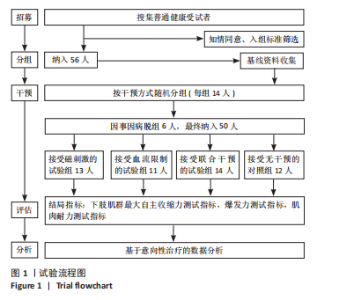
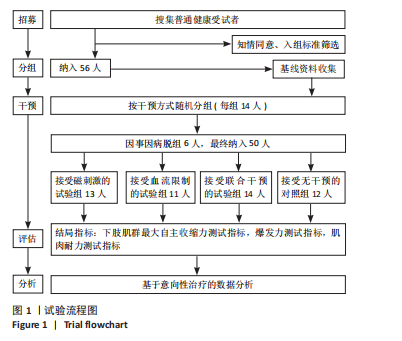
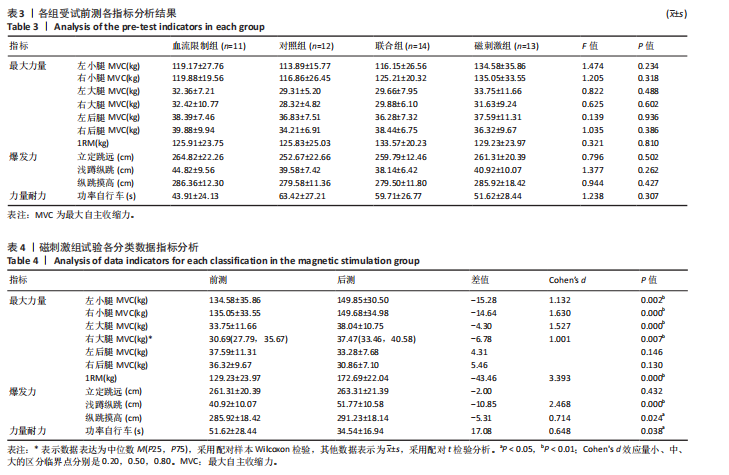
2.1 试验对象数量分析 纳入56名受试者在试验中共有6人因事因病脱组,其中磁刺激组脱离1人,血流限制组脱离3人,对照组脱离2人,最终50人纳入试验数据分析。 2.2 试验流程图 具体的试验流程,见图1。"
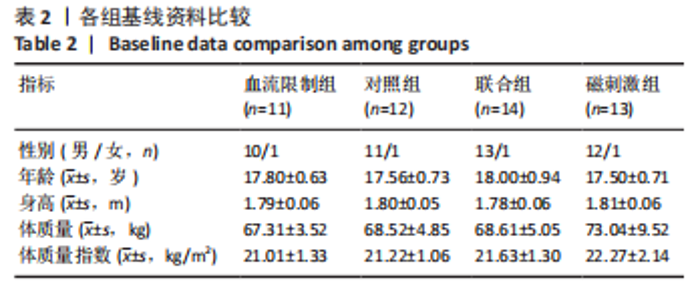
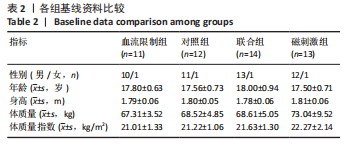
2.3 各组基线资料比较 各组受试者年龄、性别、身高、体质量比较差异无显著性意义(P > 0.05),有可比性,见表2。各组受"
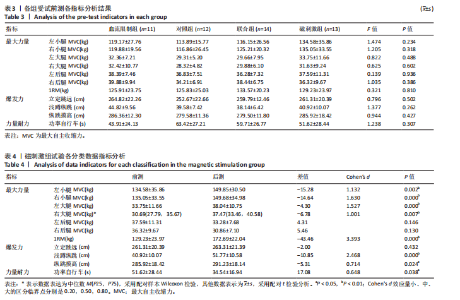
试下肢局部肌群、爆发力、力量耐力相关指标无显著性差异,说明各组受试不同指标所测试水平一致,组间具有可比性,可很好地进行试验方案对比,见表3。 2.4 磁刺激组试验各分类数据指标分析 通过对磁刺激组试验前测与后测数据各分类指标采集观察发现,最大力量指标中,左小腿(P=0.002,d=1.132),右小腿(P=0.000,d=1.630),左大腿(P=0.000,d=1.527),右大腿(P=0.007,d=1.001),1RM(P=0.000,d=3.393),相比试验前测呈现显著性增长。爆发力指标中,浅蹲纵跳(P=0.000,d=2.468),纵跳摸高(P=0.024,d=0.714)试验后测数据相比试验前测数据呈现显著性增长,立定跳远试验后测与前测数据无显著性差异。体现耐力水平的功率自行车指标(P=0.038,d=0.648)后测数据相比前测数据出现显著性增长。见表4。 2.5 血流限制组试验各分类数据指标分析 通过对血流限制组试验前测与后测数据各分类指标采集观察发现,最大力量指标中,左小腿(P=0.003,d=1.457)、右小腿(P=0.038,d=0.721)、右大腿(P= 0.007,d=1.021)、右后腿(P=0.018,d=0.852),1RM (P=0.000,d=3.363)相比试验前测呈现显著性差异;爆发力指标中,立定跳远(P=0.005,d=1.155)与浅蹲纵跳(P=0.000,d=1.585)试验后测数据相比试验前测数据呈现显著性增长,纵跳摸高试验后测与前测数据无显著性差异;体现耐力水平的功率自行车指标后测数据相比前测数据无显著性差异。见表5。 2.6 联合组试验各分类数据指标分析 通过对联合组试验前测与后测数据各分类指标采集观察发现,最大力量指标中,左小腿(P=0.002,d=1.059),右小腿(P=0.001,d=1.211),左大腿(P=0.001,d=1.936),右大腿(P=0.001,d=1.309),右后腿(P=0.004,d=0.928),1RM(P=0.000,d=2.343)相比试验前测呈现显著性差异;爆发力指标中,立定跳远(P=0.001,d=1.197)与浅蹲纵跳(P=0.001,d=2.259)试验后测数据相比试验前测数据呈现显著性增长,纵跳摸高试验后测与前测数据无显著性差异;体现耐力水平的功率自行车指标(P=0.028,d=0.678)后测数据相比前测数据出现显著性增长。见表6。 2.7 对照组试验各分类数据指标分析 通过对对照组试验前测与后测数据各分类指标采集观察发现,最大力量指标中,左后腿(P=0.049,d=0.639),右后腿(P=0.001,d=1.375),1RM(P=0.002,d=2.953)相比试验前测呈现显著性差异,其他肌群试验后测与试验前测无显著性差异;爆发力指标中,浅蹲纵跳(P=0.000,d=2.531)与纵跳摸高(P=0.048,d=0.644)试验后测数据相比试验前测数据呈现显著性增长,立定跳远试验后测与前测数据无显著性差异;体现耐力水平的功率自行车指标"
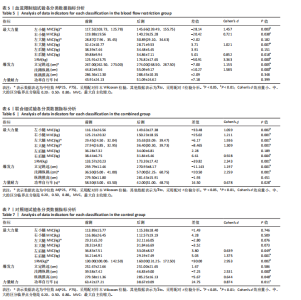
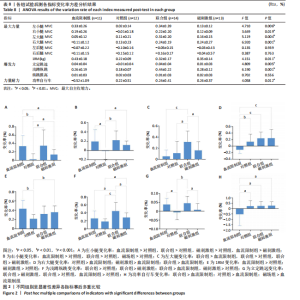
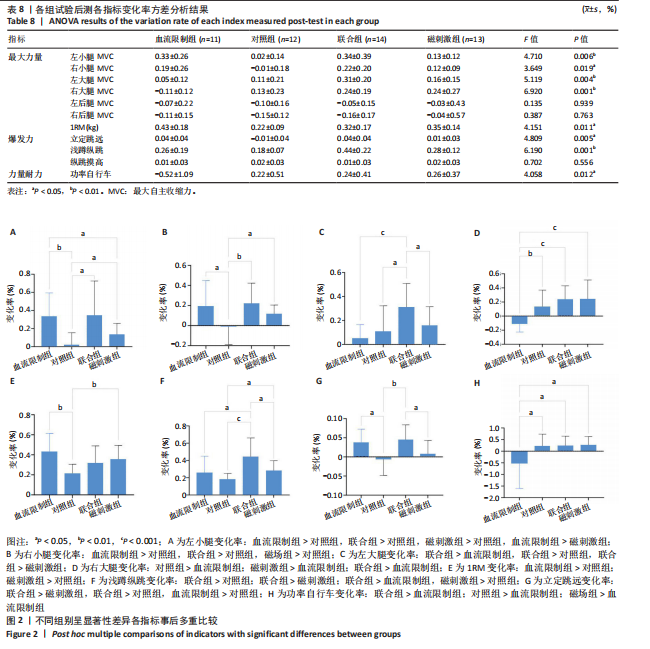
(P=0.011,d=0.874)后测数据相比前测数据出现显著性增长。见表7。 2.8 受试者各指标试验前测与后测组间数据变化 2.8.1 试验后测各指标数据变化 对试验前测与后测指标变化率分析发现,不同分组样本对于体现局部肌力的左小腿(P=0.006)、右小腿(P=0.019)、左大腿(P=0.004)、右大腿(P=0.001) 4个指标变化率组间均存在显著性差异,而不同分组样本对于受试者爆发力指标的1RM(P=0.011)、浅蹲纵跳(P=0.001)、立定跳远(P=0.005) 3个指标变化率存在组间显著性差异。体现耐力水平的功率自行车指标(P=0.012)测试变化率指标存在组间显著性差异,见表8。以上各出现显著性差异的变化率指标需事后多重比较后再做进一步分析,以探明不同组别之间的差异变化。 2.8.2 不同组别组间各指标事后多重比较结果分析 通过上述组间单因素方差分析可知,试验后测各指标中左小腿变化率、左大腿变化率、右小腿变化率、右大腿变化率、1RM变化率、浅蹲纵跳变化率、立定跳远变化率、功率自行车变化率8个指标在不同组别中具有显著差异,为了探明各组之间的具体差异对上述指标进行事后多重比较分析,见图2。"
"
| [1] VISSER M, GOODPASTER BH, KRITCHEVSKY SB, et al. Muscle mass, muscle strength, and muscle fat infiltration as predictors of incident mobility limitations in well-functioning older persons. J Gerontol A Biol Sci Med Sci. 2005;60(3): 324-333. [2] LI ZS, LI WH, BAI S, et al. Effects of chronic low-frequency pulsed magnetic fields exposure on the contractility and morphology of biceps brachii in healthy adults–a randomized controlled, double-blind trial. Front Med. 2025; https://doi.org/10.3389/fmed.2025.1614054. [3] WONG CJK, TAI YK, YAP JLY, et al. Brief exposure to directionally-specific pulsed electromagnetic fields stimulates extracellular vesicle release and is antagonized by streptomycin: A potential regenerative medicine and food industry paradigm. Biomaterials. 2022:287:121658. [4] FRANCO-OBREGÓN A. Magnetic mitohormesis: A non-invasive therapy for inflammatory disorders? BIOCELL. 2023;47(2):239-244. [5] STEPHENSON MC, KRISHNA L, PANNIR SELVAN RM, et al. Magnetic field therapy enhances muscle mitochondrial bioenergetics and attenuates systemic ceramide levels following ACL reconstruction: Southeast Asian randomized-controlled pilot trial. J Orthop Translat. 2022;35:99-112. [6] VENUGOBAL S, TAI YK, GOH J, et al. Brief, weekly magnetic muscle therapy improves mobility and lean body mass in older adults: a Southeast Asia community case study. Aging (Albany NY). 2023;15(6):1768-1790. [7] TAI YK, NG C, PURNAMAWATI K, et al. Magnetic fields modulate metabolism and gut microbiome in correlation with Pgc-1αexpression: Follow-up to an in vitro magnetic mitohormetic study. FASEB J. 2020;34(8):11143-11167. [8] 厉中山,包义君,刘洁,等.低频脉冲磁场诱导TRPC1改善COVID-19患者康复期下肢的肌肉无力症状[J].中国组织工程研究,2024,28(16):2605-2612. [9] 厉中山,王春露,刘洁,等.短期低频脉冲磁场诱导经典瞬时感受器电位通道1对肱二头肌最大自主收缩力与力量耐力的影响[J].中国组织工程研究, 2023,27(11):1796-1804. [10] 厉中山,白石,刘洁,等.短期低频脉冲磁场诱导经典瞬时感受器电位通道1对局部肌肉肌力提升后的保持与衰减变化轨迹[J].中国组织工程研究, 2023,27(23):3721-3727. [11] GARDINER B, DEVEREUX G, BEATO M. Injury risk and injury incidence rates in CrossFit. J Sports Med Phys Fitness. 2020;60(7):1005-1013. [12] ZHUAN S, ZHU Y, ZHOU J, et al. Enhancing lower limb and core muscle activation with blood flow restriction training: a randomized crossover study on high-intensity squat exercises. Front Physiol. 2024;15:1436441. [13] LORENZ DS, BAILEY L, WILK KE, et al. Blood Flow Restriction Training. J Athl Train. 2021;56(9):937-944. [14] 魏佳,李博,冯连世,等.血流限制训练的方法学因素及潜在安全性问题[J].中国体育科技,2019,55(3):3-12. [15] YAP JLY, TAI YK, FRÖHLICH J, et al. Ambient and supplemental magnetic fields promote myogenesis via a TRPC1-mitochondrial axis: evidence of a magnetic mitohormetic mechanism. FASEB J. 2019;33(11):12853-12872. [16] PARATE D, FRANCO-OBREGÓN A, FRÖHLICH J, et al. Enhancement of mesenchymal stem cell chondrogenesis with short-term low intensity pulsed electromagnetic fields. Sci Rep. 2017;7(1):9421. [17] SARITAS EU, GOODWILL PW, ZHANG GZ, et al. Magnetostimulation limits in magnetic particle imaging. IEEE Trans Med Imaging. 2013;32(9):1600-1610. [18] GRAESER M, THIEBEN F, SZWARGULSKI P, et al. Human-sized magnetic particle imaging for brain applications. Nat Commun. 2019;10(1):1936. [19] SCOTT BR, PEIFFER JJ, GOODS PSR. The Effects of Supplementary Low-Load Blood Flow Restriction Training on Morphological and Performance-Based Adaptations in Team Sport Athletes. J Strength Cond Res. 2017;31(8):2147-2154. [20] LOENNEKE JP, KIM D, FAHS CA, et al. Effects of exercise with and without different degrees of blood flow restriction on torque and muscle activation. Muscle Nerve. 2015;51(5):713-721. [21] KONRAD P. The ABC of EMG. Noraxon USA, Inc. 2005. [22] GRGIC J, LAZINICA B, SCHOENFELD BJ, et al. Test-Retest Reliability of the One-Repetition Maximum (1RM) Strength Assessment: a Systematic Review. Sports Med Open. 2020;6(1):31. [23] 陈龙.负重快速伸缩复合训练对高校足球运动员下肢力量的影响研究[D]. 南昌:江西师范大学,2024. [24] 王选强,张文洋,李阳,等.低频脉冲磁场慢性暴露对健康成年股四头肌收缩力及形态的影响[J].中国组织工程研究,2025,29(8):1634-1642. [25] 车同同,李志远,杨铁黎,等. 6周低强度加压组合高强度抗阻训练对青少年女子摔跤运动员身体核心区和下肢肌肉力量的影响[J].首都体育学院学报,2022,34(3):333-341. [26] 魏佳,李博,杨威,等.血流限制训练的应用效果与作用机制[J].体育科学, 2019,39(4):71-80. [27] 雷森林,张明辉,马春莲,等.加压抗阻训练的肌肉效应、量效关系及生理机制[J].中国组织工程研究,2023,27(26):4254-4264. [28] BALCAVAGE WX, ALVAGER T, SWEZ J, et al. A mechanism for action of extremely low frequency electromagnetic fields on biological systems. Biochem Biophys Res Commun. 1996;222(2):374-378. [29] RODILES-GUERRERO L, CORNEJO-DAZA PJ, SÁNCHEZ-VALDEPEÑAS J, et al. Specific Adaptations to 0%, 15%, 25%, and 50% Velocity-Loss Thresholds During Bench Press Training. Int J Sports Physiol Perform. 2022;17(8):1231-1241. [30] 焦明克,胡劼,焦琳,等.低频脉冲电磁场对冻伤组织血液循环的影响[J].中国医学物理学杂志,2013,30(1):3946-3949. [31] STEPHENSON MC, KRISHNA L, PANNIR SELVAN RM, et al. Magnetic field therapy enhances muscle mitochondrial bioenergetics and attenuates systemic ceramide levels following ACL reconstruction: Southeast Asian randomized-controlled pilot trial. J Orthop Translat. 2022;35:99-112. [32] 晁敏,梁丰,王尊,等.单次高强度抗阻训练与间歇有氧运动对中年人基础代谢率的影响[J].中国康复医学杂志,2015,30(10):1021-1024. [33] LORENZ DS, BAILEY L, WILK KE, et al. Blood Flow Restriction Training. J Athl Train. 2021;56(9):937-944. [34] 李志远.加压抗阻训练对男子手球运动员下肢肌肉激活和力量增益效果的影响[D].福州:福建师范大学,2020. [35] SUN D, YANG T. Semi-Squat Exercises with Varying Levels of Arterial Occlusion Pressure during Blood Flow Restriction Training Induce a Post-Activation Performance Enhancement and Improve Vertical Height Jump in Female Football Players. J Sports Sci Med. 2023;22(2):212-225. [36] HeGEDUS A, TRZASKOMA L, SOLDOS P, et al. Adaptation of Fatigue Affected Changes in Muscle EMG Frequency Characteristics for the Determination of Training Load in Physical Therapy for Cancer Patients. Pathol Oncol Res. 2020; 26(2):1129-1135. [37] 臧峰,汪军,鲁杰明,等.有氧和力量同期训练的干扰效应及可能机制[J]. 体育科学,2021,41(9):72-79. [38] 孔维签,厉中山,白石.低频脉冲磁场生物促进效应在我国运动领域的研究进展及应用展望[J].体育科技文献通报,2023,31(2):262-265. [39] FOLLAND JP, BUCKTHORPE MW, HANNAH R. Human capacity for explosive force production: neural and contractile determinants. Scand J Med Sci Sports. 2014;24(6):894-906. [40] AAGAARD P, SIMONSEN EB, ANDERSEN JL, et al. Increased rate of force development and neural drive of human skeletal muscle following resistance training. J Appl Physiol (1985). 2002;93(4):1318-1326. [41] BOUCHIBA M, BRAGAZZI NL, ZARZISSI S, et al. Cold Water Immersion Improves the Recovery of Both Central and Peripheral Fatigue Following Simulated Soccer Match-Play. Front Physiol. 2022;13:860709. [42] YAMAUCHI J, KOYAMA K. The mechanical role of the metatarsophalangeal joint in human jumping. PLoS One. 2022;17(5):e0268634. [43] WATANABE K, YOSHIMURA A, HOLOBAR A, et al. Neuromuscular characteristics of front and back legs in junior fencers. Exp Brain Res. 2022;240(7-8):2085-2096. [44] 卢鼎厚,韩世真.提高浅蹲纵跳起跳能力的肌肉工作分析: 蹲起和浅蹲纵跳时某些下肢肌的积分肌电图研究[J].北京体育大学学报,1995(2):20-25. [45] 张洋,赵金戈,阮棉芳.关于纵跳比立定跳远更能准确评定下肢爆发力的研究[J].浙江体育科学,2015,37(2):100-102. [46] 孙佳雯,厉中山,白石.技术应用视域下低频脉冲磁场生物效应在体育领域的研究进展及发展展望[J]. 体育科技文献通报,2023, 31(5):222-224,265. [47] 厉中山,白石,王春露,等.低频脉冲磁场诱导TRPC1技术对力量素质影响及训练应用展望[G]. 2022年全国第七届“中国体能训练科学大会” . 2022:1642-1648. [48] ZHANG J, ZHOU R, ZHAO N, et al. Acute effects of blood flow restriction with whole-body vibration on sprint, muscle activation and metabolic accumulation in male sprinters. Front Physiol. 2023;14:1149400. [49] HUGHES DC, ELLEFSEN S, BAAR K. Adaptations to Endurance and Strength Training. Cold Spring Harb Perspect Med. 2018;8(6):a029769. [50] 王明强,马丽,卢海霞.低强度抗阻训练结合血流限制在老年肌少症病人中的应用进展[J].护理研究,2024,3(10):1780-1783. [51] 李新通,潘玮敏,覃华生,等.血流限制训练:加速肌肉骨骼康复的新方法[J].中国组织工程研究,2019,23(15):2415-2420. [52] 宋淑华,熊开宇.离子浓度改变对骨骼肌膜电位和骨骼肌疲劳的研究进展[J]. 北京体育大学学报,2009,32(1):84-87. |
| [1] | Liu Anting, Lu Jiangtao, Zhang Wenjie, He Ling, Tang Zongsheng, Chen Xiaoling. Regulation of AMP-activated protein kinase by platelet lysate inhibits cadmium-induced neuronal apoptosis [J]. Chinese Journal of Tissue Engineering Research, 2026, 30(7): 1800-1807. |
| [2] | Hou Chaowen, Li Zhaojin, Kong Jianda, Zhang Shuli. Main physiological changes in skeletal muscle aging and the multimechanism regulatory role of exercise [J]. Chinese Journal of Tissue Engineering Research, 2026, 30(6): 1464-1475. |
| [3] | Lyu Xiaofan, Huang Yi, Ding Liucheng . Mitochondrial mechanism and intervention therapy in diabetic cystopathy [J]. Chinese Journal of Tissue Engineering Research, 2026, 30(6): 1508-1515. |
| [4] | Zhang Zhilong, Wang Haiying, Ma Fenghua, Hou Yanjie. Regulating mitochondrial dynamics balance in nucleus pulposus cells inhibits cell apoptosis [J]. Chinese Journal of Tissue Engineering Research, 2026, 30(29): 7520-7528. |
| [5] | Chen Ziang, Li Qinlong, Wu Xue, Zhou Yue. Meta-analysis of blood flow restriction training to improve knee function and muscle strength in patients after anterior cruciate ligament reconstruction [J]. Chinese Journal of Tissue Engineering Research, 2026, 30(29): 7680-7687. |
| [6] | Wang Lei, Hu Baoyang, Fang Fang. Bibliometric analysis of research hotspots on mitochondria and spinal cord injury treatment [J]. Chinese Journal of Tissue Engineering Research, 2026, 30(29): 7764-7772. |
| [7] | Xia Tiange, Zhou Yi, Li Shaoshuo, Wang Jianwei, Shao Yang. Signaling pathways related to active ingredients of ginseng in the treatment of musculoskeletal degenerative diseases [J]. Chinese Journal of Tissue Engineering Research, 2026, 30(29): 7639-7647. |
| [8] | Yuan Min, Han Yu, Liu Jinhong, Zhang Jingyu, Cao Jimin, Sun Teng . Role and mechanism of ABL1 in myocardial necroptosis and cardiac ischemia/reperfusion injury [J]. Chinese Journal of Tissue Engineering Research, 2026, 30(24): 6247-6258. |
| [9] | Zhou Fada, Long Zhisheng. Roles and mechanisms of mitochondrial dynamics in bone defect repair [J]. Chinese Journal of Tissue Engineering Research, 2026, 30(23): 5906-5914. |
| [10] | Yang Zijiang, Guo Chenggen, Deng Ziao, Xue Xinxuan. Postbiotic targeting muscle aging: mechanistic insights and application prospects of urolithin A [J]. Chinese Journal of Tissue Engineering Research, 2026, 30(22): 5804-5813. |
| [11] | Wei Wei, Liu Hongfei, Qi Xiaonan, Liu Yantong, Wang Deyu, Yu Zhitong, Qiao Chunlin, Wang Shixuan, Teng Hai. Gushukang Granule-containing drug serum improves dexamethasone-induced atrophy of C2C12 myotubes via regulating mitochondrial homeostasis [J]. Chinese Journal of Tissue Engineering Research, 2026, 30(22): 5682-5693. |
| [12] | Tao Xiangyu, Wang Shuang, Li Yuhan, Cao Jimin, Sun Teng. Effects of piRNA CFAPIR in doxorubicin-induced ferroptosis models of rat and human cardiomyocytes [J]. Chinese Journal of Tissue Engineering Research, 2026, 30(22): 5756-5769. |
| [13] | Cui Shuo, Li Xiujuan, Wang Wenting, Yang Lihong, He Sheng, Lei Lijian, Xie Jun. Human umbilical cord mesenchymal stem cell transplantation protects against reproductive damage induced by high-altitude hypoxia exposure in male mice [J]. Chinese Journal of Tissue Engineering Research, 2026, 30(19): 4882-4889. |
| [14] | Pan Li, Zhu Zhou, Yan Zhaobo, Zhang Ning, Yang Zhihong, Xiong Jiaojiao, Yang Xiaofang. Moxibustion improves endothelial function in atherosclerotic mice by regulating fatty acid oxidation through mediating mitochondrial autophagy [J]. Chinese Journal of Tissue Engineering Research, 2026, 30(11): 2764-2773. |
| [15] | Yu Manya, Cui Xing. Protective effect and mechanism of Zhigancao Decoction on doxorubicin-induced myocardial injury [J]. Chinese Journal of Tissue Engineering Research, 2026, 30(11): 2795-2805. |
| Viewed | ||||||
|
Full text |
|
|||||
|
Abstract |
|
|||||