Chinese Journal of Tissue Engineering Research ›› 2026, Vol. 30 ›› Issue (29): 7520-7528.doi: 10.12307/2026.216
Previous Articles Next Articles
Regulating mitochondrial dynamics balance in nucleus pulposus cells inhibits cell apoptosis
Zhang Zhilong, Wang Haiying, Ma Fenghua, Hou Yanjie
- Department of Spine Surgery, The Second Affiliated Hospital of Xinjiang Medical University, Urumqi 830000, Xinjiang Uygur Autonomous Region, China
-
Received:2025-11-25Revised:2025-12-23Online:2026-10-18Published:2026-03-03 -
Contact:Hou Yanjie, MD, Chief physician, Department of Spine Surgery, The Second Affiliated Hospital of Xinjiang Medical University, Urumqi 830000, Xinjiang Uygur Autonomous Region, China -
About author:Zhang Zhilong, MS, Department of Spine Surgery, The Second Affiliated Hospital of Xinjiang Medical University, Urumqi 830000, Xinjiang Uygur Autonomous Region, China -
Supported by:Xinjiang Tianshan Elite Medical and Health High-Level Talent Cultivation Program Project, No. TSYC202301B124 (to HYJ)

CLC Number:
Cite this article
Zhang Zhilong, Wang Haiying, Ma Fenghua, Hou Yanjie. Regulating mitochondrial dynamics balance in nucleus pulposus cells inhibits cell apoptosis[J]. Chinese Journal of Tissue Engineering Research, 2026, 30(29): 7520-7528.
share this article
Add to citation manager EndNote|Reference Manager|ProCite|BibTeX|RefWorks
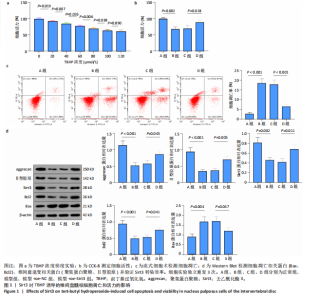
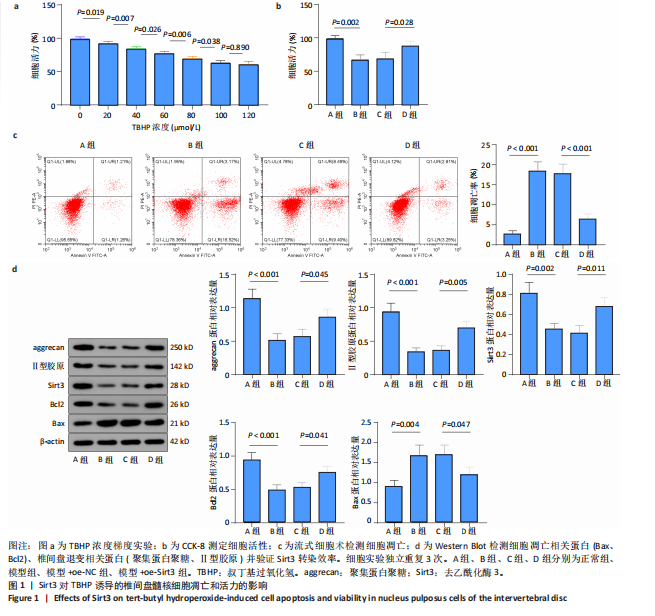
2.1 Sirt3对TBHP诱导的椎间盘髓核细胞凋亡和活力的影响 2.1.1 TBHP浓度梯度实验结果 随着TBHP浓度升高,椎间盘髓核细胞活力显著下降,且呈剂量依赖性(均P < 0.05),但100 μmol/L和120 μmol/L的TBHP对髓核细胞活力的影响比较差异无显著性意义(均P > 0.05),见图1a。提示100 μmol/L的TBHP处理髓核细胞既显著激活退变表型又保留足够活性细胞以维持实验可行性,故后续实验采用100 μmol/L的TBHP进行。 2.1.2 髓核细胞凋亡和活力 相比正常组,模型组细胞活力显著降低,流式细胞仪检测细胞凋亡率显著升高(均P < 0.05);相比模型+oe-NC组,模型+oe-Sirt3组细胞活力显著升高,细胞凋亡率显著降低(均P < 0.05),见图1b,c。Western Blot结果显示:与正常组相比,模型组Bax表达水平显著上升,Bcl2、聚集蛋白聚糖、Ⅱ型胶原及Sirt3表达水平明显降低(均P < 0.05);与模型+oe-NC组相比,模型+oe-Sirt3组Bax表达水平降低,Bcl2、聚集蛋白聚糖、Ⅱ型胶原及Sirt3表达水平明显升高(均P < 0.05),见图1d。结果表明,过表达Sirt3能抑制TBHP诱导的椎间盘髓核细胞凋亡,提高细胞活力。"
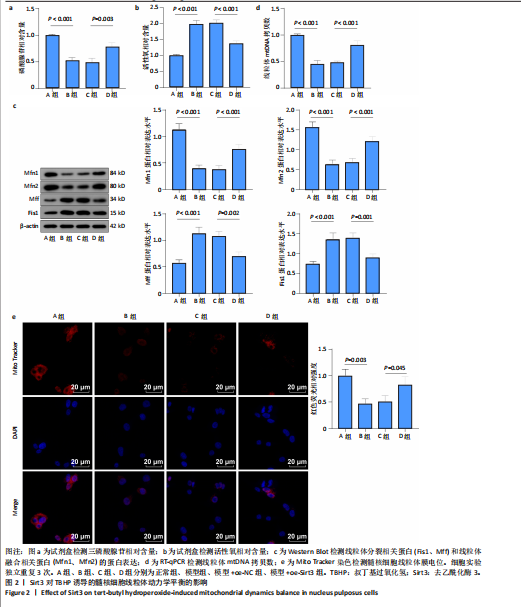
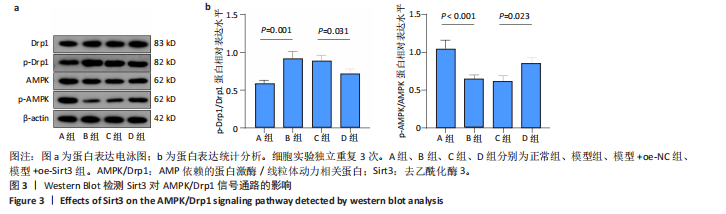
2.2 Sirt3对TBHP诱导的髓核细胞线粒体动力学平衡的影响 2.2.1 细胞ATP和活性氧水平 相比正常组,模型组ATP相对含量显著降低,活性氧相对含量升高(均P < 0.05);相比模型+oe-NC组,模型+oe-Sirt3组ATP相对含量显著升高,活性氧相对含量降低(均P < 0.05),见图2a,b。 2.2.2 Western Blot结果 相比正常组,模型组Fis1、Mff表达显著升高,Mfn1、Mfn2表达降低(均P < 0.05);相比模型+oe-NC组,模型+oe-Sirt3组Fis1、Mff表达显著降低,Mfn1、Mfn2表达升高(均P < 0.05),见图2c。 2.2.3 RT-qPCR结果 相比正常组,模型组线粒体mtDNA拷贝数降低(P < 0.05);相比模型+oe-NC组,模型+oe-Sirt3组线粒体mtDNA拷贝数增加(P < 0.05);见图2d。 2.2.4 Mito Tracker染色结果 相比正常组,模型组线粒体膜电位显著降低(P < 0.05);相比模型+oe-NC组,模型+oe-Sirt3组线粒体膜电位增加(P < 0.05);见图2e。 上述结果表明,过表达Sirt3可抑制TBHP诱导的髓核细胞线粒体功能障碍。 2.3 Sirt3对AMPK/Drp1信号通路的影响 Western Blot检测AMPK/Drp1信号通路相关蛋白表达水平,结果显示:相比正常组,模型组p-AMPK/AMPK显著降低,p-Drp1/Drp1升高(均P < 0.05);相比模型+ oe-NC组,模型+oe-Sirt3组p-AMPK/AMPK显著升高,p-Drp1/Drp1降低(均P < 0.05),见图3。 2.4 Sirt3可介导AMPK/Drp1通路调控TBHP诱导的髓核细胞线粒体动力学平衡和凋亡 2.4.1 CCK-8检测细胞毒性结果 10 μmol/L的Compound C抑制剂无细胞毒性,两组髓核细胞活力比较,差异无显著性意义"
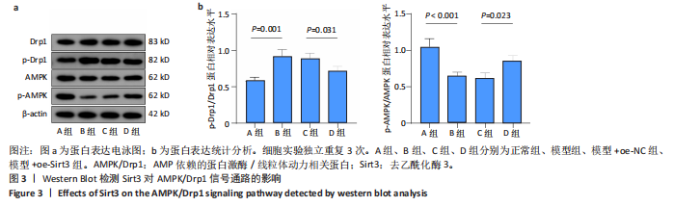
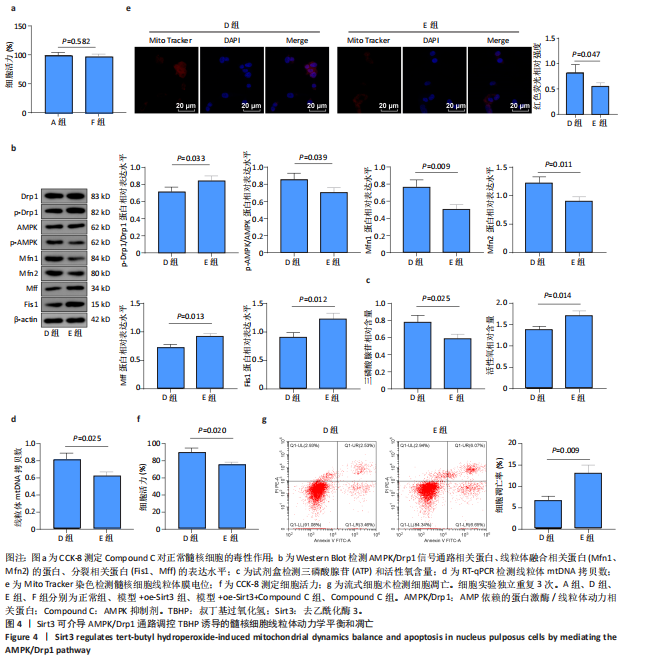
(P > 0.05),见图4a。 2.4.2 Western Blot检测结果 相比模型+oe-Sirt3组,模型+oe-Sirt3+Compound C组p-AMPK/AMPK、Mfn1、Mfn2表达水平显著降低,p-Drp1/Drp1、Fis1、Mff表达水平显著升高(均P < 0.05),见图4b。 2.4.3 细胞ATP和活性氧水平 相比模型+oe-Sirt3组,模型+oe-Sirt3+Compound C组ATP相对含量显著降低,活性氧相对含量升高(均P < 0.05),见图4c。"
2.4.4 RT-qPCR检测和Mito Tracker染色结果 相比模型+oe-Sirt3组,模型+oe-Sirt3+Compound C组线粒体mtDNA拷贝数及线粒体膜电位显著降低(P < 0.05),见图4d,e。 2.4.5 CCK-8测定细胞活力及流式细胞术检测结果 经AMPK抑制剂Compound C处理后细胞活力降低,细胞凋亡率升高(均P < 0.05),见图4f,g。"
| [1] DING Z, DU W, HUANG J, et al. Allogeneic platelet lysate activates the SIRT1-PINK1/Parkin pathway: A promising approach for improving mitochondrial function in an in vitro model of intervertebral disc degeneration. Int Immunopharmacol. 2025;144(10):113700. [2] 潘成,江华. 线粒体稳态在椎间盘退变中的作用[J].中国矫形外科杂志,2023,31(12):1102-1105,1110. [3] 曾锦全,柯俊杰. 线粒体自噬调控椎间盘退变的分子机制研究进展[J].中国细胞生物学学报,2023,45(2):266-273. [4] JIN Y, WU O, CHEN Q, et al. Hypoxia-Preconditioned BMSC-Derived Exosomes Induce Mitophagy via the BNIP3-ANAX2 Axis to Alleviate Intervertebral Disc Degeneration. Adv Sci (Weinh). 2024;11(34): e2404275. [5] LIN Z, WANG H, SONG J, et al. The role of mitochondrial fission in intervertebral disc degeneration. Osteoarthritis Cartilage. 2023;31(2): 158-166. [6] WANG DK, ZHENG HL, ZHOU WS, et al. Mitochondrial Dysfunction in Oxidative Stress-Mediated Intervertebral Disc Degeneration. Orthop Surg. 2022;14(8):1569-1582. [7] 姚娟,丁芮,李向阳,等. 苓桂术甘汤对心梗后慢性心衰大鼠线粒体分裂-融合及Sirt3/AMPK信号通路的影响[J]. 中国实验方剂学杂志, 2024,30(3):1-9. [8] WANG H, LI Y, CAO X, et al. Melatonin attenuates renal ischemia-reperfusion injury by regulating mitochondrial dynamics and autophagy through Ampk/Drp1. Shock. 2024;62(1):74-84. [9] LIU J, YAN W, ZHAO X, et al. Sirt3 attenuates post-infarction cardiac injury via inhibiting mitochondrial fission and normalization of AMPK-Drp1 pathways. Cell Signal. 2019;53(7):1-13. [10] WANG M, DING Y, HU Y, et al. SIRT3 improved peroxisomes-mitochondria interplay and prevented cardiac hypertrophy via preserving PEX5 expression. Redox Biol. 2023;62(7):102652. [11] ZHANG GZ, DENG YJ, XIE QQ, et al. Sirtuins and intervertebral disc degeneration: Roles in inflammation, oxidative stress, and mitochondrial function. Clin Chim Acta. 2020;508(9):33-42. [12] LIN J, DU J, WU X, et al. SIRT3 mitigates intervertebral disc degeneration by delaying oxidative stress-induced senescence of nucleus pulposus cells. J Cell Physiol. 2021;236(9):6441-6456. [13] ZHOU TY, WU YG, ZHANG YZ, et al. SIRT3 retards intervertebral disc degeneration by anti-oxidative stress by activating the SIRT3/FOXO3/SOD2 signaling pathway. Eur Rev Med Pharmacol Sci. 2019;23(21):9180-9188. [14] 杨雷,李兆勇,马露,等. 基于TLR4/NF-κB通路研究桃叶珊瑚苷联合ADSCs-exos对TBHP诱导的髓核细胞保护作用[J]. 中国中药杂志, 2023,48(19):5294-5303. [15] 杨少锋,朱立国,李兆勇,等. miR-483/CREB1轴介导桃叶珊瑚苷抑制髓核细胞胞外基质降解的研究[J]. 湖南中医药大学学报,2020,40(5): 550-554. [16] BAHAR ME, HWANG JS, LAI TH, et al. The Survival of Human Intervertebral Disc Nucleus Pulposus Cells under Oxidative Stress Relies on the Autophagy Triggered by Delphinidin. Antioxidants (Basel). 2024;13(7):759. [17] 王振,胡峻铮,范卫民. 脂联素通过AMPK/mTOR通路抑制H2O2诱导的大鼠髓核细胞凋亡及细胞外基质退变[J]. 南京医科大学学报(自然科学版),2018,38(7):928-933,961. [18] ZHANG Z, WU J, TENG C, et al. Orientin downregulating oxidative stress-mediated endoplasmic reticulum stress and mitochondrial dysfunction through AMPK/SIRT1 pathway in rat nucleus pulposus cells in vitro and attenuated intervertebral disc degeneration in vivo. Apoptosis. 2022; 27(11-12):1031-1048. [19] ZHAN S, WANG K, XIANG Q, et al. lncRNA HOTAIR upregulates autophagy to promote apoptosis and senescence of nucleus pulposus cells. J Cell Physiol. 2020;235(3):2195-2208. [20] HOU H, LI J, WANG J, et al. ITGA9 Inhibits Proliferation and Migration of Dermal Microvascular Endothelial Cells in Psoriasis. Clin Cosmet Investig Dermatol. 2022;20(15):2795-2806. [21] DONG Q, LUO Y, YIN Y, et al. RhoA/ROCK1 regulates the mitochondrial dysfunction through Drp1 induced by Porphyromonas gingivalis in endothelial cells. J Cell Mol Med. 2023;27(15):2123-2135. [22] LU P, ZHENG H, MENG H, et al. Mitochondrial DNA induces nucleus pulposus cell pyroptosis via the TLR9-NF-κB-NLRP3 axis. J Transl Med. 2023;21(1):389. [23] ZHANG Y, LIU S, MA JL, et al. Apocynum venetum leaf extract alleviated doxorubicin-induced cardiotoxicity through the AKT/Bcl-2 signaling pathway. Phytomedicine. 2022;94(1):153815. [24] XIA K, JIN Z, QIU Q, et al. Ligustilide alleviates oxidative stress during renal ischemia-reperfusion injury through maintaining Sirt3-dependent mitochondrial homeostasis.Phytomedicine. 2024;134(11):155975. [25] SHI P, GAO H, CHENG Z, et al. Static magnetic field-modulated mesenchymal stem cell-derived mitochondria-containing microvesicles for enhanced intervertebral disc degeneration therapy. J Nanobiotechnology. 2024; 22(1):457. [26] LIN S, LI T, ZHANG B, et al. Taurine rescues intervertebral disc degeneration by activating mitophagy through the PINK1/Parkin pathway. Biochem Biophys Res Commun. 2024;739(20):150587. [27] LIM S, AN SB, JUNG M, et al. Local Delivery of Senolytic Drug Inhibits Intervertebral Disc Degeneration and Restores Intervertebral Disc Structure. Adv Healthc Mater. 2022;11(2):e2101483. [28] DISTEFANO TJ, VASO K, DANIAS G, et al. Extracellular Vesicles as an Emerging Treatment Option for Intervertebral Disc Degeneration: Therapeutic Potential, Translational Pathways, and Regulatory Considerations. Adv Healthc Mater. 2022;11(5):e2100596. [29] HUANG Y, SUN J, LI S, et al. Isoliquiritigenin mitigates intervertebral disc degeneration induced by oxidative stress and mitochondrial impairment through a PPARγ-dependent pathway. Free Radic Biol Med. 2024;20(11);225:98-111. [30] WANG J, NISAR M, HUANG C, et al. Small molecule natural compound agonist of SIRT3 as a therapeutic target for the treatment of intervertebral disc degeneration. Exp Mol Med. 2018;50(11):1-14. [31] WANG PW, PANG Q, ZHOU T, et al. Irisin alleviates vascular calcification by inhibiting VSMC osteoblastic transformation and mitochondria dysfunction via AMPK/Drp1 signaling pathway in chronic kidney disease. Atherosclerosis. 2022;346(4):36-45. [32] GAO J, HUANG C, KONG L, et al. SIRT3 Regulates Clearance of Apoptotic Cardiomyocytes by Deacetylating Frataxin. Circ Res. 2023;133(7):631-647. [33] GENG K, FU N, YANG X, et al.Adjudin delays cellular senescence through Sirt3‑mediated attenuation of ROS production. Int J Mol Med. 2018; 42(6):3522-3529. [34] DENU RA. SIRT3 Enhances Mesenchymal Stem Cell Longevity and Differentiation. Oxid Med Cell Longev. 2017;2017:5841716. [35] HE R, WANG Z, CUI M, et al. HIF1A Alleviates compression-induced apoptosis of nucleus pulposus derived stem cells via upregulating autophagy. Autophagy. 2021;17(11):3338-3360. [36] ZHANG C, LI Z, LI L, et al. Achyranthoside D (AD) improve intervertebral disc degeneration through affect the autophagy and the activation of PI3K/Akt/mTOR pathway. J Orthop Surg (Hong Kong). 2022;30(3):10225536221135474. [37] HU S, ZHANG C, QIAN T, et al. Promoting Nrf2/Sirt3-Dependent Mitophagy Suppresses Apoptosis in Nucleus Pulposus Cells and Protects against Intervertebral Disc Degeneration. Oxid Med Cell Longev. 2021; 9(7):6694964. [38] HU B, WANG P, ZHANG S, et al. HSP70 attenuates compression-induced apoptosis of nucleus pulposus cells by suppressing mitochondrial fission via upregulating the expression of SIRT3. Exp Mol Med. 2022;54(3):309-323. [39] LIU W, ZHAO X, WU X. Duhuo Jisheng Decoction suppresses apoptosis and mitochondrial dysfunction in human nucleus pulposus cells by miR-494/SIRT3/mitophagy signal axis. J Orthop Surg Res. 2023;18(1):177. [40] WANG X, SHEN T, LIAN J, et al. Resveratrol reduces ROS-induced ferroptosis by activating SIRT3 and compensating the GSH/GPX4 pathway. Mol Med. 2023;29(1):137. [41] HE L, WANG J, YANG Y, et al. Mitochondrial Sirtuins in Parkinson’s Disease. Neurochem Res. 2022;47(6):1491-1502. [42] WANG L, CHEN C, ZHOU H, et al. Nicotinamide Riboside-Driven Modulation of SIRT3/mtROS/JNK Signaling Pathways Alleviates Myocardial Ischemia-Reperfusion Injury. Int J Med Sci. 2024;21(11):2139-2148. [43] HUANG C, JIANG S, GAO S, et al. Sirtuins: Research advances on the therapeutic role in acute kidney injury. Phytomedicine. 2022;101(7):154122. [44] ZHENG M, BAI Y, SUN X, et al. Resveratrol Reestablishes Mitochondrial Quality Control in Myocardial Ischemia/Reperfusion Injury through Sirt1/Sirt3-Mfn2-Parkin-PGC-1α Pathway. Molecules. 2022;27(17):5545. [45] PEOPLES JN, SARAF A, GHAZAL N, et al. Mitochondrial dysfunction and oxidative stress in heart disease. Exp Mol Med. 2019;51(12):1-13. [46] SU ZD, LI CQ, WANG HW, et al. Inhibition of DRP1-dependent mitochondrial fission by Mdivi-1 alleviates atherosclerosis through the modulation of M1 polarization. J Transl Med. 2023;21(1):427. [47] HAN D, JIANG L, GU X, et al.SIRT3 deficiency is resistant to autophagy-dependent ferroptosis by inhibiting the AMPK/mTOR pathway and promoting GPX4 levels. J Cell Physiol. 2020;235(11):8839-8851. |
| [1] | Zhu Xiaolong, Zhang Wei, Yang Yang. Visualization analysis of research hotspots and cutting-edge information in the field of intervertebral disc regeneration and repair [J]. Chinese Journal of Tissue Engineering Research, 2026, 30(9): 2391-2402. |
| [2] | Cai Ziming, Yu Qinghe, Ma Pengfei, Zhang Xin, Zhou Longqian, Zhang Chongyang, Lin Wenping. Heme oxygenase-1 alleviates lipopolysaccharide-induced inflammatory response in nucleus pulposus mesenchymal stem cells [J]. Chinese Journal of Tissue Engineering Research, 2026, 30(7): 1624-1631. |
| [3] | Wang Peng, Li Zhijun, Zhang Shaojie, Wu Yimin. Intervertebral disc rehydration after posterior lumbar dynamic internal fixation [J]. Chinese Journal of Tissue Engineering Research, 2026, 30(3): 711-720. |
| [4] | Du Yaxin, Zhao Xiaojuan, Wu Ruixia, Dong Yizhi, Song Xinyue, Fu Hongyang, She Yitong, Zhang Jialin, Zhu Yong. Interaction between vascular-lymphatic system imbalance and immune microenvironment in intervertebral disc degeneration [J]. Chinese Journal of Tissue Engineering Research, 2026, 30(29): 7612-7618. |
| [5] | He Long, Gao Shuang, Chen Chao, Qin Guozhong, Ran Qingsen, Wang Zhengchun, Yang Yafeng, Ren Hang, Qiu Yunkai, Yang Yang, Li Wei. A new strategy for preventing and treating orthopedic diseases by regulating ferroptosis through signaling pathways [J]. Chinese Journal of Tissue Engineering Research, 2026, 30(29): 7619-7631. |
| [6] | Wang Chenmoji, Wu Yadong, Gao Di, Wang Hao, Li Nianhu. Mechanism by which kaempferol inhibits intervertebral disc degeneration in rats by regulating mitophagy levels [J]. Chinese Journal of Tissue Engineering Research, 2026, 30(29): 7529-7538. |
| [7] | You Chenyang, Jiang Chao, Che Yanjun. Synergistic imbalance in lumbar core muscles and novel targeted interventions for intervertebral disc degeneration [J]. Chinese Journal of Tissue Engineering Research, 2026, 30(28): 7323-7331. |
| [8] | Wang Zhengye, Liu Wanlin, Zhao Zhenqun. Mechanisms of miRNAs involved in cartilage development: new strategies and targets [J]. Chinese Journal of Tissue Engineering Research, 2026, 30(24): 6289-6296. |
| [9] | Zhong Haotian, Li Jianwen, Han Weichao, Li Songbo. Traditional Chinese Medicine compound formula and effective ingredients for treating intervertebral disc degeneration: a multi-targeted and holistic regulation concept [J]. Chinese Journal of Tissue Engineering Research, 2026, 30(24): 6316-6327. |
| [10] | Zhou Fada, Long Zhisheng. Roles and mechanisms of mitochondrial dynamics in bone defect repair [J]. Chinese Journal of Tissue Engineering Research, 2026, 30(23): 5906-5914. |
| [11] | Jiang Chao, Che Yanjun. Biological mechanisms and future research trends of cartilaginous endplate degeneration [J]. Chinese Journal of Tissue Engineering Research, 2026, 30(23): 5915-5924. |
| [12] | Zhou Tianle, Wang Wei, Zhang Zhiwen, Liu Ximing. Application and progress of transcriptomics and proteomics techniques in the study of intervertebral disc degeneration [J]. Chinese Journal of Tissue Engineering Research, 2026, 30(23): 5925-5933. |
| [13] | Xie Ziying, Li Songbo, Li Jianwen, Yin Yuchao, Zheng Baichuan, Hu Chengshang. Animal experimental study on the treatment of lumbar intervertebral disc degeneration with Chinese herbal compound: species selection, modeling method and drug administration [J]. Chinese Journal of Tissue Engineering Research, 2026, 30(23): 5934-5942. |
| [14] | Huang Xuecheng, Cai Qirui, Weng Rui, Chen Cairui, Yang Geng, Lin Dongxin. Biomechanical evaluation of oblique pulling manipulation on C5/6 intervertebral discs with different levels of degeneration [J]. Chinese Journal of Tissue Engineering Research, 2026, 30(21): 5396-5402. |
| [15] | Yang Junjie, Zhang Hao, Chen Zhike, Chen Yao, Jia Bingxu, Wang Qing, Li Guangzhou, Wang Gaoju. Impact of disease duration on lumbar curvature correction in patients with rigid post-traumatic thoracolumbar kyphosis [J]. Chinese Journal of Tissue Engineering Research, 2026, 30(21): 5534-5540. |
| Viewed | ||||||
|
Full text |
|
|||||
|
Abstract |
|
|||||