Chinese Journal of Tissue Engineering Research ›› 2026, Vol. 30 ›› Issue (28): 7251-7259.doi: 10.12307/2026.833
Previous Articles Next Articles
Shaoyang Shenggu Fang inhibits oxidative stress and delays cartilage aging in rats with knee osteoarthritis
Yong Qiao1, 2, Sun Xin1, 2, Wang Guoyou1, Zhang Lei1, Shen Huarui1, Liu Huan1, Guan Taiyuan1#br#
- 1Southwest Medical University Affiliated Hospital of Traditional Chinese Medicine, Luzhou 646000, Sichuan Province, China; 2College of Integrated Traditional Chinese and Western Medicine, Southwest Medical University, Luzhou 646000, Sichuan Province, China
-
Received:2025-08-04Revised:2025-12-31Online:2026-10-08Published:2026-02-09 -
Contact:Guan Taiyuan, PhD, Associate professor, Southwest Medical University Affiliated Hospital of Traditional Chinese Medicine, Luzhou 646000, Sichuan Province, China -
About author:Yong Qiao, MS candidate, Southwest Medical University Affiliated Hospital of Traditional Chinese Medicine, Luzhou 646000, Sichuan Province, China; College of Integrated Traditional Chinese and Western Medicine, Southwest Medical University, Luzhou 646000, Sichuan Province, China -
Supported by:a grant from Sichuan Provincial Administration of Traditional Chinese Medicine, No. 2020JC0148 (to GTY); Luzhou Municipal Science and Technology Bureau Project, No. 2022-SYF-68 (to GTY)

CLC Number:
Cite this article
Yong Qiao, Sun Xin, Wang Guoyou, Zhang Lei, Shen Huarui, Liu Huan, Guan Taiyuan. Shaoyang Shenggu Fang inhibits oxidative stress and delays cartilage aging in rats with knee osteoarthritis[J]. Chinese Journal of Tissue Engineering Research, 2026, 30(28): 7251-7259.
share this article
Add to citation manager EndNote|Reference Manager|ProCite|BibTeX|RefWorks
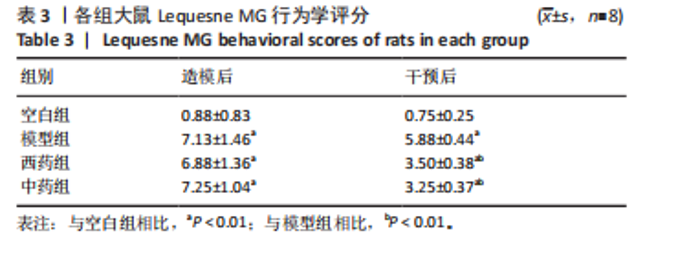
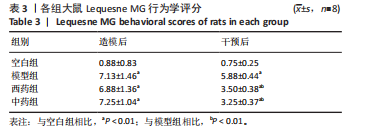
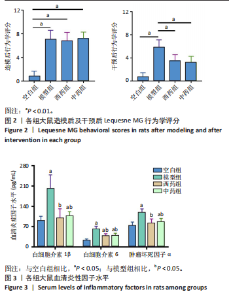
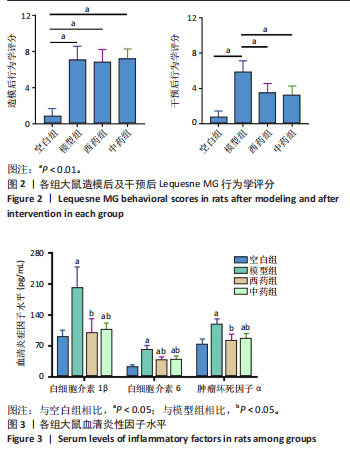
2.1 实验动物数量分析及一般状况 一共纳入32只大鼠,24只造模组大鼠精神状况明显萎靡,多数大鼠食量锐减,少部分未进食进水,活动量大幅下降,部分大鼠出现造模部位保护性蜷缩,无法蹬地。造模后1周,造模组大鼠精神状态较前逐渐好转,食量恢复,活动量增加,大部分活动正常,少部分大鼠仍有跛行姿态。灌胃干预后,所有大鼠精神、进食和活动逐渐恢复正常。整个实验期间,各组大鼠均未出现术口感染和死亡情况。 2.2 少阳生骨方对膝骨关节炎大鼠行为状态的影响 分别对造模完成及灌胃干预完成后的大鼠进行Lequesne MG评分。造模28 d后造模大鼠Lequesne MG行为学评分均≥6分,较空白组显著提高(P < 0.01),造模成功率为100%。经灌胃干预后,模型组大鼠评分仍显著高于空白组(P < 0.01),而相比于模型组,西药组及中药组大鼠Lequesne MG评分则有显著降低(P < 0.01),见表3,图2。 2.3 少阳生骨方对膝骨关节炎大鼠血清炎症因子与相关氧化应激指标的影响 2.3.1 血清中相关炎症因子水平 ELISA检测结果显示,与空白"
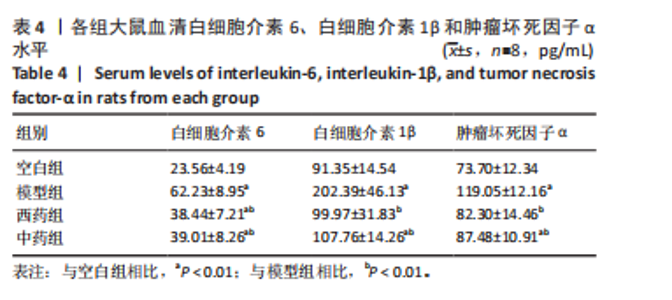
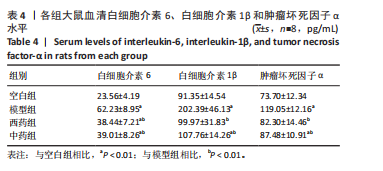
组比较,模型组白细胞介素6、白细胞介素1β和肿瘤坏死因子α 的水平显著升高(P < 0.05);西药组及中药组干预后炎症因子水平较模型组均出现一定程度下降(P < 0.05),见表4,图3。"
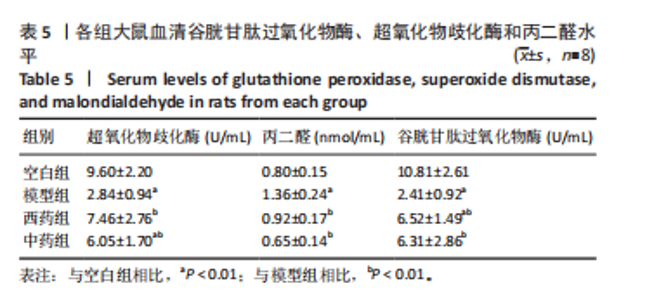
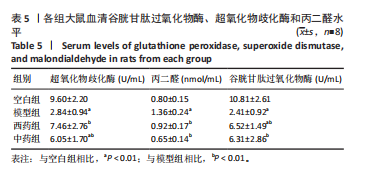
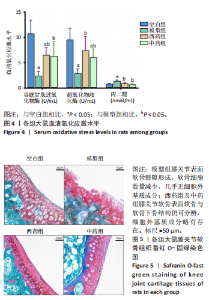
2.3.2 血清相关氧化应激指标水平 ELISA检测结果显示,与空白组比较,模型组大鼠血清中超氧化物歧化酶和谷胱甘肽过氧化物酶水平较低(P < 0.05),丙二醛水平显著升高 (P < 0.05)。经灌胃干预后,西药组及中药组大鼠的超氧化物歧化酶和谷胱甘肽过氧化物酶水平均显著高于模型组,而丙二醛浓度则显著低于模型组(P < 0.05),见表5,图4。"
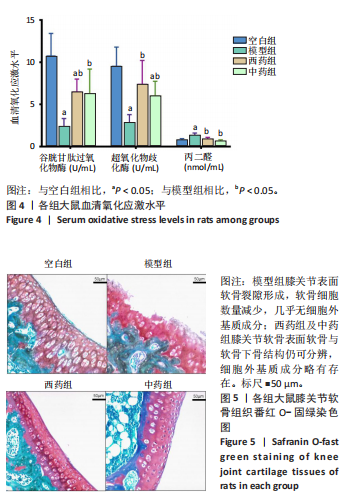
2.4 少阳生骨方对膝骨关节炎大鼠软骨组织病理变化的影响 2.4.1 番红O-固绿染色结果 空白组关节软骨及软骨下骨结构完整,染色均匀,细胞外基质丰富。模型组膝关节表面软骨则观察到裂隙形成,软骨细胞数量减少,染色不均匀,几乎无细胞外基质成分。经灌胃干预后,西药组及中药组膝关节软骨表面总体较为平整,软骨与软骨下骨结构仍可分辨,细胞外基质成分略有存在,但含量较少,见图5。 2.4.2 苏木精-伊红染色 空白组软骨展现出正常组织学特点,其表面光滑平整,软骨细胞排列规则有序,细胞密度高,潮线清晰连续,无软骨破坏;模型组关节软骨出现病理性变化,表面可见糜烂、缺损,软骨细胞密度较正常降低,排列紊乱,软骨层与软骨下骨的界限模糊不清;西药组和中药组软骨较模型"
"
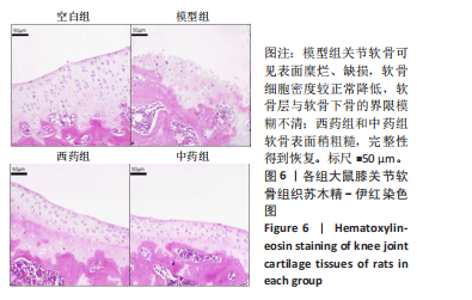
组出现不同程度的改善,软骨表面稍粗糙,完整性得到恢复,细胞排列稍紊乱,见图6。"
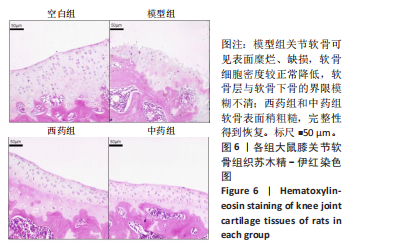
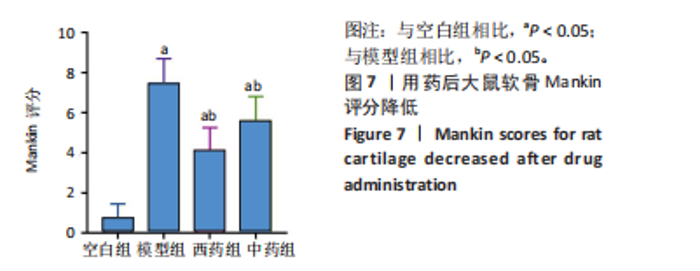
灌胃干预结束后,对苏木精-伊红染色切片进行Mankin评分,经对比分析发现与空白组相比,模型组Mankin评分显著升高(P < 0.05),出现骨关节炎表现;西药组和中药组评分均出现一定程度降低(P < 0.05),见图7。"
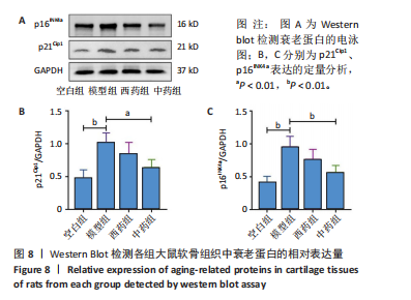
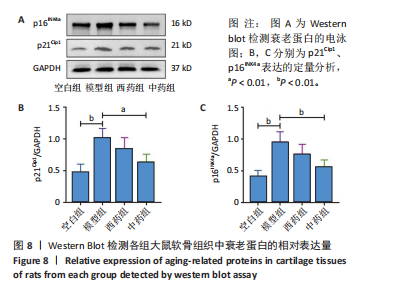
2.5 少阳生骨方对膝骨关节炎大鼠软骨组织衰老蛋白以及Wnt信号通路相关蛋白表达的影响 2.5.1 软骨组织中p21Cip1、p16INK4a蛋白的表达 Western blot检测结果显示,模型组软骨组织p21Cip1、p16INK4a蛋白表达量高于空白组(P < 0.05);与模型组相比,中药组2种蛋白表达水平下降(P < 0.05),而西药组2种蛋白表达虽有所降低,但差异无显著性意义(P > 0.05),见图8。"
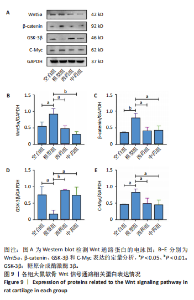
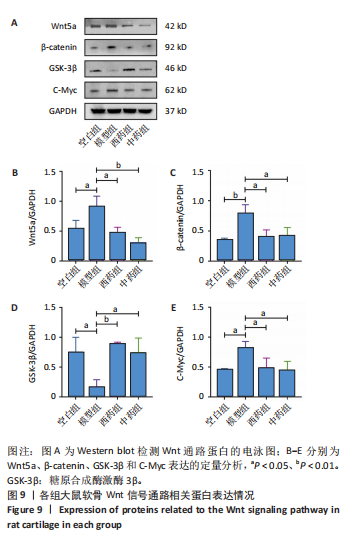
2.5.2 软骨中Wnt信号通路相关蛋白的表达 Western blot检测结果显示,相较于空白组,模型组软骨Wnt5a蛋白表达水平显著增加(P < 0.05);中药组Wnt5a蛋白表达水平较模型组明显降低(P < 0.01),而与西药组相比,未见明显差异(P=0.15)。模型组软骨β-catenin和C-Myc蛋白的相对表达水平较空白组显著升高(P < 0.01);中药组和西药组软骨中β-catenin和C-Myc蛋白表达水平出现一定程度的下降,且与模型组相比差异有显著性意义(P < 0.05),但两组之间差异不显著(P=0.23)。模型组GSK-3β表达水平较空白组显著降低(P < 0.05),中药组和西药组GSK-3β表达水平均显著提升(P < 0.05),见图9。"
| [1] QUICKE JG, CONAGHAN PG, CORP N, et al. Osteoarthritis year in review 2021: epidemiology & therapy. Osteoarthritis Cartilage. 2022;30(2):196-206. [2] YUAN M, LING T, SU Q, et al. Safety and effectiveness of robotic‐arm assisted total knee arthroplasty. Orthop Surg. 2024;16(4):882-893. [3] JANG S, LEE K, JU JH. Recent updates of diagnosis, pathophysiology, and treatment on osteoarthritis of the knee. Int J Mol Sci. 2021;22(5):2619-2619. [4] RIM YA, NAM Y, JU JH. The role of chondrocyte hypertrophy and senescence in osteoarthritis initiation and progression. Int J Mol Sci. 2020;21(7):2358. [5] LIANG X, JIN Q, YANG X, et al. Dickkopf 3 and β catenin play opposite roles in the wnt/β catenin pathway during the abnormal subchondral bone formation of human knee osteoarthritis. Int J Mol Med. 2022;49(4):48. [6] LI W, XIONG Y, CHEN W, et al. Wnt/β catenin signaling may induce senescence of chondrocytes in osteoarthritis. Exp Ther Med. 2020;20:2631-2638. [7] LEE YT, YUNUS MHM, UGUSMAN A, et al. Natural compounds affecting inflammatory pathways of osteoarthritis. Antioxidants. 2022;11(9):1722. [8] 周震.从“肾主骨”与“少阳主骨”的关系谈骨之体用[J]. 天津中医药, 2014,31(1):20-22. [9] 关钛元, 祁冀, 张磊, 等. 少阳生骨方调节C518大鼠膝关节退变软骨细胞Ⅱ型胶原和基质金属蛋白酶13的表达 [J]. 中国组织工程研究,2018,22(20): 3144-3149. [10] 周鑫, 张磊, 扶世杰, 等.少阳主骨方介导p19Arf-p53-p21Cip1信号通路调控食蟹猴关节软骨退变的机制[J]. 南方医科大学学报,2018,38(3):346-352. [11] 汪国友.少阳生骨方对SD大鼠体外软骨细胞培养及在体软骨损伤影响的实验研究[D]. 成都:成都中医药大学,2014. [12] 刘宇涵, 樊渝江, 王启光. 早期创伤性膝骨关节炎动物模型构建方案的比较[J]. 中国组织工程研究,2024,28(4):542-549. [13] 郭润涛, 姬昌彬, 孙天宇, 等.鼠曲草提取物通过抑制PERK/eif2α/chop通路改善aclt诱导的大鼠骨关节炎[J]. 医学分子生物学杂志,2022,19(5):374-380. [14] 郭文帆, 杨学钰, 郑雪君, 等. 茶黄素调节AMPK/sirt1/nf-κb信号通路对膝骨关节炎大鼠的治疗作用[J]. 河北医学,2023,29(1):42-49. [15] 范晓, 潘恩. 药品质量检验方法及标准化管理方式的探究[J].中国质量监管, 2024(3):190-191. [16] 邱礼国. 基于TGF/β-smad信号通路研究独活寄生汤干预大鼠膝骨关节炎的作用机制[D]. 长沙:湖南中医药大学,2024. [17] 朱涵婷. 脑缺血再灌注损伤中补体C3、HMGB1、GPX4表达变化[D].南昌:南昌大学,2024. [18] 陈琳. 体外冲击波减轻膝骨关节炎大鼠软骨下骨成骨细胞衰老及促进软骨修复的研究[D].沈阳:中国医科大学,2024. [19] ZHAO X, LIN J, LIU M, et al. Targeting fap-positive chondrocytes in osteoarthritis: a novel lipid nanoparticle sirna approach to mitigate cartilage degeneration.J Nanobiotechnology. 2024;22(1):659. [20] ZHOU Y, WANG W, TODOROV P, et al. RNA transcripts in human ovarian cells: two-time cryopreservation does not affect developmental potential. Int J Mol Sci. 2023;24(8):6880. [21] ENGELAND K. Cell cycle regulation: p53-p21-rb signaling. Cell Death Differ. 2022; 29(5):946-960. [22] LIANG X, ZHANG J, YU J, et al. Quercetin ameliorates ox-ldl-induced cellular senescence of aortic endothelial cells and macrophages by p16/p21, p53/serpine1, and ampk/mtor pathways. Eur J Med Res. 2025;30(1):359. [23] SHARPLESS NE, SHERR CJ. Forging a signature of in vivo senescence. Nat Rev Cancer. 2015;15(7):397-408. [24] PHILIPOT D, GUÉRIT D, PLATANO D, et al. P16INK4a and its regulator mir-24 link senescence and chondrocyte terminal differentiation-associated matrix remodeling in osteoarthritis. Arthritis Res Ther. 2014;16(1):R58-R58. [25] LI J, LI Y, SHANG X, et al. Therapeutic framework nucleic acid complexes targeting oxidative stress and pyroptosis for the treatment of osteoarthritis. Mater Today Bio. 2024;28:101202. [26] 曹娟, 李玲玲, 姚瑶, 等. 氧化应激相关细胞衰老指标与骨关节炎的相关性探讨[J]. 中华全科医学,2023,21(3):396-400. [27] PAN D, YIN P, LI L, et al. Holomycin, a novel nlrp3 inhibitor, attenuates cartilage degeneration and inflammation in osteoarthritis. Biochem Biophys Res Commun. 2023:657:59-68. [28] WANG D, ZHENG H, ZHOU W, et al. Mitochondrial dysfunction in oxidative stress‐mediated intervertebral disc degeneration. Orthop Surg. 2022;14(8):1569-1582. [29] 曾佳, 黄颂雅, 杜方雪, 等. 纳米酶在关节疾病中的应用进展[J]. 四川大学学报(医学版),2024,55(4):800-806. [30] 李振伟, 侯靖宇, 林宇泽, 等. 软骨细胞线粒体损伤对骨关节炎的影响[J]. 生物化学与生物物理进展,2024,51(7):1576-1588. [31] 董家赫, 田勇, 王孝辉, 等. 独活寄生汤调控软骨细胞氧化应激延缓大鼠膝骨关节炎软骨退变 [J]. 中国中医骨伤科杂志,2024,32(5):9-13+17. [32] SAHIN K, KUCUK O, ORHAN C, et al. Niacinamide and undenatured type ii collagen modulates the inflammatory response in rats with monoiodoacetate-induced osteoarthritis. Sci Rep. 2021;11(1):14724. [33] 罗枭, 程义, 吴骋, 等. 预测重症缺血性脑卒中死亡风险的模型:基于内在可解释性机器学习方法 [J]. 南方医科大学学报,2023,43(7):1241-1247. [34] 沈展, 卞晓波, 黄莺, 等. 利用机器学习算法初步构建基于常规检验项目的脑卒中复发预测模型[J]. 检验医学,2024,39(12):1190-1195. [35] 褚云峰, 于红燕, 杨琪, 等. Wnt5a基因在骨关节炎中作用机制的研究进展 [J]. 中国骨质疏松杂志,2022,28(10):1518-1521+1555. [36] MAHMOUD DE, KAABACHI W, SASSI N, et al. SFRP5 enhances wnt5a induced-inflammation in rheumatoid arthritis fibroblast-like synoviocytes. Front Immunol. 2021:12:663683. [37] 武义钞, 张盛庭, 郭澳, 等. 人工虎骨粉通过Wnt/β-catenin通路治疗膝骨关节炎的疗效 [J]. 中国现代医生,2025,63(16):62-68+98. [38] SAFWAN-ZAITER H, WAGNER N, WAGNER KD. P16INK4A—more than a senescence marker. Life. 2022;12(9):1332-1332. [39] 郭伟, 魏亚哲, 李鑫. P16INK4A调控wnt/β-catenin信号通路对结肠腺癌细胞生物学行为的影响 [J]. 中华实用诊断与治疗杂志,2024,38(10):1006-1012. [40] 陈瑞雪, 庞淑瑾, 陈鑫, 等. SIRT1通过Wnt/β-catenin通路抑制d-半乳糖诱导的心肌细胞衰老和凋亡[J]. 中国病理生理杂志,2025,41(3):463-471. [41] 薛玉满, 徐西林, 韩巍, 等. 芪芍通痹胶囊对腰椎间盘退行性改变模型大鼠Wnt/β-catenin通路的影响 [J]. 中医杂志,2025,66(1):79-88. [42] LU J, ZHANG T, SUN H, et al. Protective effects of dioscin against cartilage destruction in a monosodium iodoacetate (mia)-indcued osteoarthritis rat model.Biomed Pharmacother. 2018;108:1029-1038. [43] YANG F, HOU Z, ZHU H, et al. Catalpol protects against pulmonary fibrosis through inhibiting tgf-β1/smad3 and wnt/β-catenin signaling pathways. Front Pharmacol. 2021:11:594139. [44] LOU J, HAN D, YU H, et al.Cytoprotective effect of taurine against hydrogen peroxide-induced oxidative stress in umr-106 cells through the wnt/&beta;-catenin signaling pathway. Biomol Ther. 2018;26(6):584-590. [45] ZHOU T, ZHOU KK, LEE K, et al. The role of lipid peroxidation products and oxidative stress in activation of the canonical wingless-type mmtv integration site (wnt) pathway in a rat model of diabetic retinopathy. Diabetologia. 2010;54(2): 459-468. [46] 张晓贝, 李传明. 医用几丁糖膝关节内注射联合康复训练治疗中期膝骨关节炎的临床效果 [J]. 临床合理用药,2023,16(32):92-95. [47] 徐昌财, 李才平. 关节镜下清理术联合关节腔内注射玻璃酸钠对膝骨关节炎患者膝关节功能的影响[J]. 哈尔滨医药,2023,43(6):26-28. [48] 徐溢明, 胡明玮, 朱威, 等. 人工全膝关节置换术治疗膝骨关节病的长期临床疗效:一项20年以上随访的队列研究[J]. 协和医学杂志,2025,16(1):35-41. [49] 罗梦琦, 郑晖. 管窥“少阳主骨”与“肾主骨”理论联系 [J]. 按摩与康复医学, 2022,13(11):31-32+35. [50] 董雪妮, 王岩. 中医外治法治疗膝骨关节炎的研究进展[J]. 临床医学研究与实践,2025,10(9):195-198. [51] 王红伟, 于宗东. 骨伤膏药粉热奄包治疗对气滞血瘀型急性踝关节扭伤患者疼痛程度及踝关节肿胀程度的影响[J]. 反射疗法与康复医学,2025,6(1):63-66. [52] 苏程. 探讨中医整体康复疗法对膝关节炎患者关节功能改善的作用[J]. 黑龙江医药,2024,37(5):1195-1197. [53] 贾瑾尧, 谷敏, 王丽娟. 激痛点推拿对肩周炎患者肩部疼痛及肩关节功能的改善效果观察及其对血清5-ht、pge2水平的影响[J]. 新疆中医药,2025,43(1): 39-42. |
| [1] |
Dong Chunyang, Zhou Tianen, Mo Mengxue, Lyu Wenquan, Gao Ming, Zhu Ruikai, Gao Zhiwei.
Action mechanism of metformin combined with Eomecon chionantha Hance dressing in treatment of deep second-degree burn wounds#br#
#br#
[J]. Chinese Journal of Tissue Engineering Research, 2026, 30(8): 2001-2013.
|
| [2] | Yang Xuetao, Zhu Menghan, Zhang Chenxi, Sun Yimin, Ye Ling. Applications and limitations of antioxidant nanomaterials in oral cavity [J]. Chinese Journal of Tissue Engineering Research, 2026, 30(8): 2044-2053. |
| [3] | Liu Anting, Lu Jiangtao, Zhang Wenjie, He Ling, Tang Zongsheng, Chen Xiaoling. Regulation of AMP-activated protein kinase by platelet lysate inhibits cadmium-induced neuronal apoptosis [J]. Chinese Journal of Tissue Engineering Research, 2026, 30(7): 1800-1807. |
| [4] | Pan Hongfei, Zhuang Zhenbing, Xu Baiyun, Yang Zhangyang, Lin Kairui, Zhan Bingqing, Lan Jinghan, Gao Heng, Zhang Nanbo, Lin Jiayu. Inhibitory effects of different concentrations of auranofin on M1 macrophage function and its therapeutic potential in diabetic wound healing [J]. Chinese Journal of Tissue Engineering Research, 2026, 30(6): 1390-1397. |
| [5] | Yang Xiao, Bai Yuehui, Zhao Tiantian, Wang Donghao, Zhao Chen, Yuan Shuo. Cartilage degeneration in temporomandibular joint osteoarthritis: mechanisms and regenerative challenges [J]. Chinese Journal of Tissue Engineering Research, 2026, 30(4): 926-935. |
| [6] | Xu Jiamu, Yang Cheng, Li Weimin, Wang Chunqing. Role and pathogenesis of pyroptosis and inflammatory factors in osteoporosis [J]. Chinese Journal of Tissue Engineering Research, 2026, 30(3): 691-700. |
| [7] | Guo Jun, Lu Zheng, Yu Jinling, Hao Yuanyuan, Liu Kaishun, Liu Xuexia, Huang Yourong. Oxidative stress and osteoporosis: a bibliometric analysis of literature from SCI core database [J]. Chinese Journal of Tissue Engineering Research, 2026, 30(28): 7428-7436. |
| [8] | Bai Xue, Tian Yukui, Guo Lei, Shi Mengni, Cui Xiaofeng, Wang Cheng, Li Jingxian, Zhu Qingguang, Liu Junchang. Construction of an early knee osteoarthritis rat model: CatWalk-based gait analysis and evaluation [J]. Chinese Journal of Tissue Engineering Research, 2026, 30(28): 7280-7286. |
| [9] | Shao Yunbo, Guo Jiayi, Li Feng. Characteristics of lower limb muscle motor activation in patients with unilateral knee osteoarthritis [J]. Chinese Journal of Tissue Engineering Research, 2026, 30(24): 6174-6181. |
| [10] | Yuan Min, Han Yu, Liu Jinhong, Zhang Jingyu, Cao Jimin, Sun Teng . Role and mechanism of ABL1 in myocardial necroptosis and cardiac ischemia/reperfusion injury [J]. Chinese Journal of Tissue Engineering Research, 2026, 30(24): 6247-6258. |
| [11] | Zhang Xiaoxu, Tian Zhenli, Xie Tingting. Roles of pregnane X receptor in sodium arsenite-induced oxidative stress and inflammatory injury in human normal hepatocytes [J]. Chinese Journal of Tissue Engineering Research, 2026, 30(24): 6259-6266. |
| [12] | Li Huaying, Li Hao, Peng Wuxun, Dong Wentao. Mechanism of cuproptosis in the diagnosis and treatment of orthopedic-related diseases [J]. Chinese Journal of Tissue Engineering Research, 2026, 30(24): 6275-6281. |
| [13] | Xia Caigui, Li Wei, Su Yuying, Shi Yu, Yang Zhonghe. Effects of antioxidant pretreatment on skeletal muscle damage and oxidative stress following acute high-intensity exercise: a meta-analysis [J]. Chinese Journal of Tissue Engineering Research, 2026, 30(24): 6345-6353. |
| [14] | Gao Minyi, Liu Pinghong, Lin Haixiong. Burn and multi-omic biomarkers: causal relationships with 41 inflammatory factors and 35 blood and urine markers [J]. Chinese Journal of Tissue Engineering Research, 2026, 30(23): 6062-6070. |
| [15] | Yang Zijiang, Guo Chenggen, Deng Ziao, Xue Xinxuan. Postbiotic targeting muscle aging: mechanistic insights and application prospects of urolithin A [J]. Chinese Journal of Tissue Engineering Research, 2026, 30(22): 5804-5813. |
| Viewed | ||||||
|
Full text |
|
|||||
|
Abstract |
|
|||||