Chinese Journal of Tissue Engineering Research ›› 2026, Vol. 30 ›› Issue (22): 5859-5866.doi: 10.12307/2026.186
Previous Articles Next Articles
Visualization analysis of dynamic evolution of hot topics in the field of physical activity and neural plasticity
Deng Qing 1, 2, Zhang Yeting 3, Mou Xiangqian 4, Wang Qingjun 4
- 1School of Physical Education, Nanjing Xiaozhuang University, Nanjing 211171, Jiangsu Province, China; 2School of Sports Science and Physical Education, Nanjing Normal University, Nanjing 210023, Jiangsu Province, China; 3Civil Aviation Security College, Civil Aviation Flight University of China, Guanghan 618307, Sichuan Province, China; 4School of Journalism and Communication, Nanjing Normal University, Nanjing 210097, Jiangsu Province, China
-
Received:2025-08-01Accepted:2025-08-23Online:2026-08-08Published:2025-12-29 -
Contact:Wang Qingjun, MD, Professor, School of Journalism and Communication, Nanjing Normal University, Nanjing 210097, Jiangsu Province, China -
About author:Deng Qing, MD, Lecturer, School of Physical Education, Nanjing Xiaozhuang University, Nanjing 211171, Jiangsu Province, China; School of Sports Science and Physical Education, Nanjing Normal University, Nanjing 210023, Jiangsu Province, China

CLC Number:
Cite this article
Deng Qing , Zhang Yeting , Mou Xiangqian , Wang Qingjun. Visualization analysis of dynamic evolution of hot topics in the field of physical activity and neural plasticity[J]. Chinese Journal of Tissue Engineering Research, 2026, 30(22): 5859-5866.
share this article
Add to citation manager EndNote|Reference Manager|ProCite|BibTeX|RefWorks
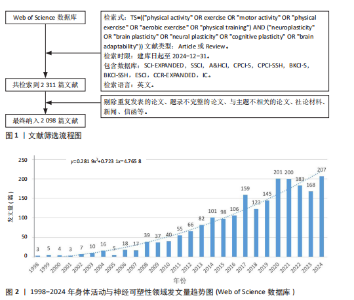
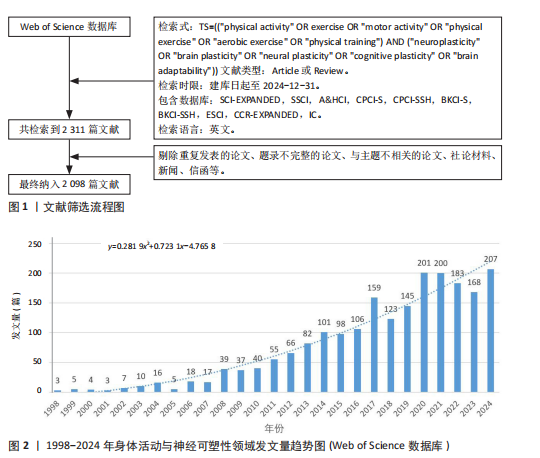
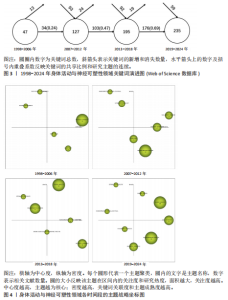
2.1 发文量分布 图2是“身体活动与神经可塑性”领域1998-2024年发文量趋势图,数据分析结果显示,该领域发文量呈显著增长趋势。该趋势拟合模型为:y=?0.281 9x2+ 0.723 1x?4.765 8。该拟合模型同样代表了该领域发文量不断增长的特征。其中,在1998-2005年,该领域每年发文量较低,为3-10篇。2006年后,发文量开始不断增长,2017年发文量达到159篇。此后,该领域发文量有波动但总体维持在较高发文水平,2022年与2023年的发文量分别为201篇与200篇。通过这一趋势可以看出,该领域研究所受关注度不断增长,研究文献数量也不断增加。特别到了2024年该领域发文量达到最高值(207篇),显示领域研究热度可能会持续升高。 2.2 关键词分析 在当前的研究中,分析论文中的关键词已成为反映文献重点及主要主题的基本方式[13]。由于身体活动与神经可塑性领域的关键词较多,在此领域简单分析关键词有可能会出现信息饱和的状况。为了避免该情况出现,借助于SciMAT软件,设置合理的数据精简和网络精简,剔除非重点内容,突出重点信息,便可清晰地形成图谱,为研究提供有效的支撑[14]。 2.2.1 关键词主题覆盖图 关键词主题覆盖图用关键词的数量来表征主题的丰富程度,并借助数据流来呈现研究主题在不同阶段的演变与稳定性特征[15]。图3为关键词主题覆盖图:圆圈内数字为关键词总数,斜箭头表示关键词的新增和消失数量,水平箭头上的数字及括号内重叠系数反映关键词的共享比例和研究主题的连续性[12]。如图所示,图中从左至右依"
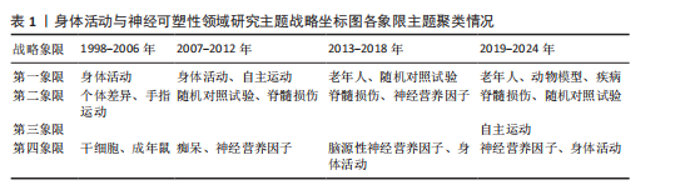
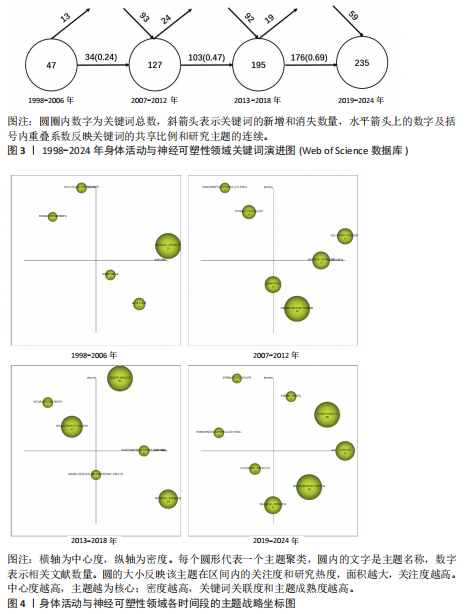
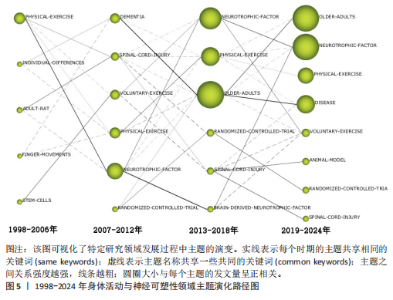
次代表身体活动与神经可塑性领域6个时期关键词的变化趋势。4个时期关键词数量分别为47,127,195和235,呈增长态势,显示出研究范围的拓宽和主题的丰富。共享关键词数量依次为34,103,176,重叠系数分别为0.24,0.47,0.69,均呈增长趋势,表明研究继承性增强,方向稳定。在各阶段演变中,新生和消亡关键词数量如下:1998-2006年至2007-2012年,消亡13个,新生93个;2007-2012年至2013-2018年,消亡24个,新生92个;2013-2018年至2019-2024年,消亡19个,新生59个。总体上看,各演变时期新生关键词数量都多于消亡数量,说明新旧研究主题有较好的交替现象,研究此领域非常活跃。但近些年新生关键词数量明显减少,这可能与研究领域知识体系趋于完善、研究方向聚焦深化、范式稳定以及资源集中等有关,说明此领域研究日趋成熟,但同时存在缺乏新的创新突破点的问题。综上所述,身体活动与神经可塑性领域的整体研究呈现强劲的发展势头,不断地深耕,未来发展空间广阔。 2.2.2 研究主题演化状态分析 图4展现了1998-2006年、2007-2012年、2013-2018年和2019-2024年4个阶段身体活动与神经可塑性领域研究主题的发展趋势。在战略坐标图中,每一时期4个象限的主题聚类表现出了不同特点 [16]。1象限的主题聚类为发动机主题(Motor themes),中心度和密度均较高,说明此主题对该领域的发展十分重要,且对学术结构的发展起到了重要的奠基作用;2象限的主题聚类为基础和横向主题(Basic and transversal themes),中心性高,密度值低,说明此主题对该领域的研究与建设十分重要,且有一定的相关性和基础,日后有可能成为主要的研究领域;3象限的主题聚类为新生或衰败主题(Emerging or declining themes),中心度和密度值均低,说明该主题对该领域的发展贡献很少且不明显,大多数处于次要和边缘位置;4象限的主题聚类是高度发达孤立的主题(Highly developed and isolated themes),中心性较低而密度值较高,说明这些主题高度专业化处于所在主题域之内,虽然发展较成熟,但因为与该领域核心的理论不够紧密,发展水平较为边缘[17]。通过对25个有关研究主题的聚类划分,划分成不同的战略方向,具体分析结果见表1。 (1)传统主题演化状态:在身体活动与神经发生研究领域发展的第一个时间段,也就是1998-2006年期间,共有PHYSICAL-EXERCISE(身体活动)、INDIVIDUAL-DIFFERENCES(个体差异)和FINGER-MOVEMENT(手指运动)、STEM-CELLS(干细胞)和ADULT-RAT(成年鼠)5个主题聚类,通过分析这5个主题聚类的走向,可以理清传统主题演化的状态。 身体活动是整个网络中的核心主题之一,该主题位于第一象限,中心度和密度均较高,表明其在网络中的连接程度和内部关联性均较强,其发展潜力大,是该时期的引擎主题。在随后的演化过程中,该主题分裂并细化,产生了神经营养因子聚类和脊髓损伤聚类,并且身体活动这一主题存在于每个时期,其研究内容由“运动对神经可塑性及相关机制的影响”转化为“运动对神经可塑性、神经保护和认知功能的影响及其机制”及“神经可塑性与康复治疗机制的研究”等领域。个体差异位于第二象限,具有较高的密度,但中心度偏低,该主题最终演化为痴呆主题,其研究内容由“认知储备与大脑衰老过程中的神经生物学机制”转化为“认知训练、身体活动与神经可塑性对阿尔茨海默病及相关认知障碍的影响”等领域。手指运动同样位于第二象限,其密度较高但中心度最低,其在未来的演化过程中并未演变为其他主体,而是融入到了痴呆和身体活动主题中去了。在四象限中,中心度高但密度小的干细胞,该主题演化到自发行为聚类,研究内容从“运动与神经发生以及阿尔茨海默病的影响”演化到“运动、神经可塑性以及神经精神疾病的神经生物学机制”等。第四象限中密度最小中心度最高的成年鼠,该主题演化到与身体活动主题共同的脊髓损伤聚类,研究内容从“神经损伤后功能恢复以及神经可塑性机制”演化到“神经可塑性与康复的机制研究”等。 (2)现代主题演化现状:在身体活动与神经发生研究领域发展的最近一个时间段,也就是2021-2024年期间,共有PHYSICAL-EXERCISE(身体活动)、ANIMAL-MODEL(动物模型)、SPINAL-CORD-INJURY(脊髓损伤)、NEUROTROPHIC-FACTOR(神经营养因子)、VOLUNTARY-EXERCISE(自主运动)、OLDER-ADULES(老年人)、DISEASE(疾病)和RANDOMIZED-CONTROLLED-TRAIL(随机对照试验)8个主题聚类,通过分析这8个主题聚类的走向,可以理清现代主题演化的现状。 位于第一象限的主题词有老年人、动物模型、疾病,主题内部连接和外部连接程度都较大,稳定性和扩散能力也强,说明这些主题研究方向上比较成熟,是该领域的发动机主题,也是该领域今后要继续深入研究的方向。就老年人主题而言,对于运动、脑力训练和其他干预措施对老年人认知功能、脑功能可塑性、生活质量的影响进行广泛研究,这些措施能明显改善老年人认知功能退化、神经可塑性和精神状况,尤其对帕金森病、轻度认知障碍、阿尔茨海默病等神经退化性疾病患者,运动(包括有氧运动、舞动疗法、太极拳、运动游戏)能够显著改善老年人认知功能、神经可塑"
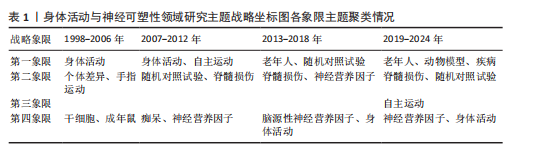
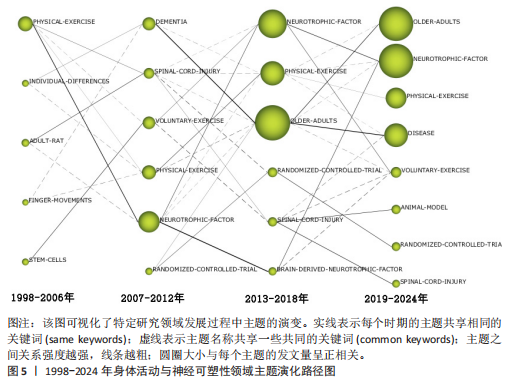
性和情绪状态 [18-19];脑力训练、第二语言训练、数字技术干预均显示具有提高老年人认知储备和脑部活动性连通的积极影响 [20];减少久坐、增加社交活动及环境丰富有益于老年人的认知健康[21-22]。总体而言,该主题的研究为通过多模式干预(结合身体活动、认知训练和社交参与)预防和延缓老年人认知衰退提供了科学依据。就动物模型主题而言,研究更多是从运动、环境干预、神经损伤等,用动物模型探讨如何影响认知功能、脑功能可塑性、行为表现[23-24]。动物模型包括了缺少皮质脊髓束的小鼠、阿尔茨海默病小鼠、高血压大鼠、抑郁小鼠等。在疾病主题中,研究重点集中在运动、认知训练和其他干预措施对疾病(阿尔茨海默病、帕金森病、多发性硬化症、抑郁症和代谢疾病)的预防、治疗和机制的研究中。研究表明,运动能够显著改善认知功能、神经可塑性和疾病症状,此外,环境干预和正念训练等也被证明对疾病有积极的影响 [25-27]。由此可见,这些引擎主题已经构建出了一个涵盖“基础研究” “临床验证”以及“社会应用”的完整研究链条。 第二象限主题是脊髓损伤和随机对照试验。在第二象限主题中具有较高外部连度和较低内部连度特征,研究内部紧密度较低而与其他的主题外部联系紧密。该象限主题动态性较强,常常漂移或转化为其他相关内容的集群。脊髓损伤主题中的相关研究均是围绕脊髓损伤后运动功能的改善干预措施与作用机制展开,包括自主跑步运动、重复经颅磁刺激、神经根磁刺激以及5-羟色胺受体药物治疗等可以改善脊髓损伤后运动功能[28-31]。其干预的作用机制在于,减少腰椎周围神经元网络的损伤、重建皮质的突触结构、提升皮质神经可塑性以及改善患者的电生理功能。在随机对照试验主题中,主要通过随机对照试验探讨了不同干预措施对认知功能、神经可塑性和运动功能的改善作用,包括舞蹈运动对老年人认知功能的改善作用、拳击运动训练对帕金森患者运动功能改善的潜在作用、音乐训练对老年人脑可塑性和认知功能的影响、早期双上肢强化训练对脑瘫患儿的功能及神经可塑性影响[32-34]。总之,该象限主题研究边沿松散而跨界融通可能性很大,容易与其他学科领域发生交叉。 自主运动为第三象限主题词。自主运动主题词的内在联接程度低,外在联接程度也很低,表明自主运动作为新兴的研究方向,目前是该领域2019-2024年的边沿研究方向,研究深度不高,与领域外的联系较少,潜在的研究扩展及领域融合能力较强。自主运动主题词的最密切相关的研究方向聚焦于自主运动促进神经可塑性和促进脑健康及疾病预防的积极效应及其作用机制的研究。研究结果显示,通过改变表观遗传学、神经营养因子、内源性大麻素系统等自主运动能够促进大脑重塑、促进神经再生、促进功能的恢复,尤其在缺血性脑卒中、抑郁症、神经退行性疾病中表现出强大的神经保护作用[35-36]。综上可知,第三象限主题属于新兴的边沿主题,但还有很大的扩展能力。 第四象限内主题词为神经营养因子和运动。主题词的内联系指数较高,外联系指数较低,说明当前研究领域针对这两者在2019-2024年间属于单独研究主题,目前外联系性小,但是由于其内联系性较强,有可能成为未来该领域内的重要研究主题。神经营养因子主题的研究主要聚焦于探究神经营养因子在神经可塑性、认知和疾病康复过程中的作用及其调控。在此主题内,相关的神经营养因子包括脑源性神经营养因子、胰岛素样生长因子1、神经生长因子、血管内皮生长因子和胶质细胞源性神经营养因子等。研究发现,有氧运动、高强度间歇训练和抗阻训练等运动方式,均可有效提高神经营养因子的表达,从而促进神经再生、突触可塑性和大脑重塑等过程,其在脑卒中、帕金森病、阿尔茨海默病和脊髓损伤等神经系统疾病中具有显著的神经保护作用[37-39]。在身体活动主题中,重点聚焦于身体活动对大脑健康和认知功能的影响上,揭示了运动增强神经可塑性、调节神经生物学标志物、改善认知灵活性以及缓解神经退行性疾病症状的潜在机制。研究还强调了身体活动与认知训练的协同效应,以及在老年人、帕金森病患者、久坐人群等特定群体中的综合干预效果[40-41]。此外,身体活动对心理健康、情绪调节、睡眠质量和基因表达的积极影响同样得到了广泛关注[42]。整体来说,此象限的主题为独立主题,有往中心发展的趋势。 2.2.3 主题演化路径分析 图5描绘了1998-2024年的主题演化路径。图中节点代表聚类主题,其大小与相关文献量成正比。相邻时期节点间的实线表示主题的延续关系,虚线则显示主题的分化。连线的颜色深浅和粗细程度与主题相似度成正比,颜色越深且越粗,表明2个主题之间的关联强度越高,演化能力越强。孤立点则代表发展成熟且专业性强的主题。从图中可以看出,随着时间推移,身体活动与神经可塑性研究领域的节点数量呈现增长趋势,各时期节点数量分别为5,6,6和8。总体而言,各时期节点的路径逐渐增多且广泛交叉,演化关系较为复杂。进一步分析发现,该研究领域可分为5个主要演化方向:“身体活动”“成年鼠”“干细胞”“个体差异”和“随机对照试验”,并形成了15条子演化路径。 一是“身体活动”演化路径,该演化路径包括6条子路径:①身体活动→身体活动;②身体活动→脊髓损伤;③身体活动→脊髓损伤→动物模型;④身体活动→神经营养因子;⑤身体活动→神经营养因子→自主运动;⑥身体活动→神经营养因子→脑源性神经营养因子→神经营养因子。其中路径①可以视作基础研究路径,主要聚焦于身体活动类型对神经可塑性的基础调控机制,强调了运动频率、强度与神经保护效应的剂量-反应关系[37,43]。路径②和路径③可以视作疾病干预路径,其主要关注?身体活动对脊髓损伤后神经再生和功能恢复的促进作用以及利用啮齿类动物模型验证运动干预的分子机制[44-45]。路径④、路径⑤和路径⑥可以视做功能调控路径,主要关注于神经营养因子介导的运动功能改善,以及身体活动如何通过调节神经营养因子的表达,从而实现神经保护与神经功能的重塑? [46-47]。这些子路径均强调了身体活动通过调节神经营养因子表达,能够实现神经保护与重塑?神经功能的作用。未来可能需要通过量化运动干预对特定脑区的动态影响,来进一步明确相关机制。 第二是“成年鼠”演化路径,该演化路径包括2条子路径:⑦成年鼠→脊髓损伤;⑧成年鼠→脊髓损伤→动物模型。路径⑦关注的是通过成年鼠脊髓损伤模型,研究运动干预对神经可塑性的调控作用,例如运动通过激活神经营养因子从而促进损伤后轴突再生与突触重塑 [48]?。路径⑦与路径②在2007-2012年间进行了融合重叠。路径⑧关注的是利用动物模型验证脊髓损伤修复的分子机制[49]。路径⑧与路径③在2007-2012年间进行了融合重叠。这2条路径均依赖动物模型揭示了身体活动通过神经可塑性改善脊髓损伤的机制。 第三为“干细胞”演化路径,其涉及2条子路径:⑨干细胞→自主运动→神经营养因子;⑩干细胞→自主运动→神经营养因子→自主运动。在2013-2024年间,这2条子路径与路径⑤和路径⑥进行了融合重叠。2条路径均揭示了自主运动与神经营养因子双向调控干细胞的机制,推动了神经再生与神经功能重塑?的研究。 第四是“个体差异”演化路径,该路径包含了2条子路径:?个体差异→痴呆→老年人;?个体差异→痴呆→老年人→疾病。个体差异主要体现在基因多态性和生活方式等的不同上,这些差异通过调节海马体可塑性及神经营养因子表达水平,能够显著影响老年人的痴呆发生风险,其中运动干预可有效降低风险因素[50]。这2条路径都强调了个体差异是痴呆发生发展的核心驱动因素。 第五是“随机对照试验”演化路径,其涉及3条子路径:?随机对照试验→老年人;?随机对照试验→老年人→疾病;?随机对照试验→随机对照试验。路径?和路径?在2013-2018年期间与路径?和?发生融合重叠。这两条路径关注于采用随机对照试验,探究身体活动等干预方式对海马体神经发生、神经营养因子表达的影响,以及对认知功能改善和降低痴呆风险的作用[51-52]。路径?聚焦于随机对照试验方法学的优化上,例如,采用双盲交叉设计、样本量自适应算法等,从而有助于降低运动干预的异质性对结果可重复性的影响? [53]。在未来,可能需要深入跨学科理论应用,提升随机对照试验在神经可塑性研究中的精准性与临床转化价值。 主题演化路径结果显示5条演化路径和15条子路径,主要包括运动、成年小鼠、干细胞、个体差异性、随机对照试验在神经营养因子介导神经保护和功能重组中的作用、动物模型研究探索运动干预对神经营养和神经再生、可塑性的调节机制、影响痴呆症风险因素的基因多态性及生活方式和个体差异,有效降低风险的运动干预以及研究方法学的优化提高临床干预的精确性和转化价值等方面。"
"
| [1] GALVÁN A. Neural plasticity of development and learning. Hum Brain Mapp. 2010;31(6): 879-890. [2] STILES J. Neural plasticity and cognitive development. Dev Neuropsychol. 2000; 18(2):237-272. [3] DE SOUSA FERNANDES MS, ORDÔNIO TF, SANTOS GCJ, et al. Effects of Physical Exercise on Neuroplasticity and Brain Function: A Systematic Review in Human and Animal Studies. Neural Plast. 2020; 2020:8856621. [4] MORA F. Successful brain aging: plasticity, environmental enrichment, and lifestyle. Dialogues Clin Neurosci. 2013;15(1):45-52. [5] VECCHIARELLI HA, LOPES LT, PAOLICELLI RC, et al. Synapse Regulation. Adv Neurobiol. 2024;37:179-208. [6] KOWIAŃSKI P, LIETZAU G, CZUBA E, et al. BDNF: A Key Factor with Multipotent Impact on Brain Signaling and Synaptic Plasticity. Cell Mol Neurobiol. 2018;38(3):579-593. [7] KIRK IE, MICHELLE WV, RUCHIKA SHAURYA P, et al. Exercise training increases size of hippocampus and improves memory. Proc Natl Acad Sci U S A. 2011;108(7):3017-3022. [8] MURAWSKA-CIAŁOWICZ E, WIATR M, CIAŁOWICZ M, et al. BDNF Impact on Biological Markers of Depression-Role of Physical Exercise and Training. Int J Environ Res Public Health. 2021;18(14):7553. [9] RAMPASSO IS, SANTANA M, SERAFIM MP, et al. Trends in remote work: A science mapping study. Work. 2022;71(2):441-450. [10] COBO MJ, LÓPEZ-HERRERA AG, HERRERA-VIEDMA E, et al. SciMAT: A new science mapping analysis software tool. J Am Soc Inf Sci Technol. 2012;63(8):1609-1630. [11] 陈晓鹏,严晓燕,孙洋,等.基于SciMAT的防护服装研究动态演进分析[J].服装学报,2023,8(6):521-528. [12] 夏洋,李文梅. 近20年国际学业情绪研究主题动态演化路径分析[J].当代外语研究,2023(5):94-102+32. [13] 李丽霞,任卓明,张子柯.基于关键词的知识图谱挖掘信息技术学科演化趋势[J].电子科技大学学报,2020,49(5):780-787. [14] 陶文兵,金海.一种新的基于图谱理论的图像阈值分割方法[J].计算机学报, 2007(1):110-119. [15] 董雪季,王晓慧.国际科学计量学研究主题动态演化路径分析[J].数字图书馆论坛,2018(10):9-17. [16] CARRASCO-GARRIDO C, DE-PABLOS-HEREDERO C, RODRíGUEZ-SÁNCHEZ J. Exploring hybrid telework: A bibliometric analysis. Heliyon. 2023;9(12):e22472. [17] TÜLÜBAŞ T, KARAKOSE T, PAPADAKIS S. A Holistic Investigation of the Relationship between Digital Addiction and Academic Achievement among Students. Eur J Investig Health Psychol Educ. 2023;13(10):2006-2034. [18] BLISS ES, WONG RH, HOWE PR, et al. Benefits of exercise training on cerebrovascular and cognitive function in ageing. J Cereb Blood Flow Metab. 2021; 41(3):447-470. [19] ARIDA RM, TEIXEIRA-MACHADO L. The Contribution of Physical Exercise to Brain Resilience. Front Behav Neurosci. 2020;14: 626769. [20] BUBBICO G, CHIACCHIARETTA P, PARENTI M, et al. Effects of Second Language Learning on the Plastic Aging Brain: Functional Connectivity, Cognitive Decline, and Reorganization. Front Neurosci. 2019;13: 423. [21] CHANDRASEKARAN B, PESOLA AJ, RAO CR, et al. Does breaking up prolonged sitting improve cognitive functions in sedentary adults? A mapping review and hypothesis formulation on the potential physiological mechanisms. BMC Musculoskelet Disord. 2021;22(1):274. [22] QUIALHEIRO A, BOBINSKI F, HAEFLIGER JG, et al. A comprehensive program of cognitive stimulation with digital inclusion, physical activity and social interaction can modify BDNF levels and improve cognition in adults over 50: a randomized controlled pilot study. Aging Ment Health. 2022;26(10): 1979-1987. [23] COLAVITTA MF, GRASSO L, BARRANTES FJ. Environmental Enrichment in Murine Models and Its Translation to Human Factors Improving Conditions in Alzheimer Disease. J Prev Alzheimers Dis. 2023;10(2): 287-300. [24] TENDILLA-BELTRÁN H, GARCÉS-RAMÍREZ L, MARTÍNEZ-VÁSQUEZ E, et al. Differential Effects of Neonatal Ventral Hippocampus Lesion on Behavior and Corticolimbic Plasticity in Wistar-Kyoto and Spontaneously Hypertensive Rats. Neurochem Res. 2024; 49(4): 959-979. [25] MAHALAKSHMI B, MAURYA N, LEE SD, et al. Possible Neuroprotective Mechanisms of Physical Exercise in Neurodegeneration. Int J Mol Sci. 2020;21(16):5895. [26] GOMUTBUTRA P, YINGCHANKUL N, CHATTIPAKORN N, et al. The Effect of Mindfulness-Based Intervention on Brain-Derived Neurotrophic Factor (BDNF): A Systematic Review and Meta-Analysis of Controlled Trials. Front Psychol. 2020;11:2209. [27] FERRUSOLA-PASTRANA A, FULLERTON CL, MEADOWS SN. Group-based exercise for Parkinson’s: a qualitative study of participants and partners’ perceptions of an exercise class delivered through a community-university collaboration. BMC Geriatr. 2024;24(1):488. [28] SÁNCHEZ-VENTURA J, GIMÉNEZ-LLORT L, PENAS C, et al. Voluntary wheel running preserves lumbar perineuronal nets, enhances motor functions and prevents hyperreflexia after spinal cord injury. Exp Neurol. 2021;336:113533. [29] WANG P, YIN R, WANG S, et al. Effects of Repetitive Transcranial Magnetic Stimulation (rTMS) and Treadmill Training on Recovery of Motor Function in a Rat Model of Partial Spinal Cord Injury. Med Sci Monit. 2021;27:e931601. [30] ZHENG Y, ZHAO D, XUE DD, et al. Nerve root magnetic stimulation improves locomotor function following spinal cord injury with electrophysiological improvements and cortical synaptic reconstruction. Neural Regen Res. 2022;17(9):2036-2042. [31] BAJJIG A, CAYETANOT F, TAYLOR JA, et al. Serotonin 1A Receptor Pharmacotherapy and Neuroplasticity in Spinal Cord Injury. Pharmaceuticals (Basel). 2022;15(4):460. [32] JAMES CE, ALTENMÜLLER E, KLIEGEL M, et al. Train the brain with music (TBM): brain plasticity and cognitive benefits induced by musical training in elderly people in Germany and Switzerland, a study protocol for an RCT comparing musical instrumental practice to sensitization to music. BMC Geriatr. 2020;20(1):418. [33] ATTARHA M, DE FIGUEIREDO PELEGRINO AC, TOUSSAINT PJ, et al. Improving Neurological Health in Aging Via Neuroplasticity-Based Computerized Exercise: Protocol for a Randomized Controlled Trial. JMIR Res Protoc. 2024;13:e59705. [34] HEWSTON P, KENNEDY CC, BORHAN S, et al. Effects of dance on cognitive function in older adults: a systematic review and meta-analysis. Age Ageing. 2021;50(4):1084-1092. [35] LIANG J, WANG H, ZENG Y, et al. Physical exercise promotes brain remodeling by regulating epigenetics, neuroplasticity and neurotrophins. Rev Neurosci. 2021;32(6): 615-629. [36] MAÑAS-PADILLA MC, TEZANOS P, CINTADO E, et al. Environmental enrichment alleviates cognitive and psychomotor alterations and increases adult hippocampal neurogenesis in cocaine withdrawn mice. Addict Biol. 2023;28(1):e13244. [37] VINTS WAJ, LEVIN O, FUJIYAMA H, et al. Exerkines and long-term synaptic potentiation: Mechanisms of exercise-induced neuroplasticity. Front Neuroendocrinol. 2022;66:100993. [38] ZHANG R, LIU S, MOUSAVI SM. Cognitive Dysfunction and Exercise: From Epigenetic to Genetic Molecular Mechanisms. Mol Neurobiol. 2024;61(9):6279-6299. [39] VILLAMIL-PARRA W, MOSCOSO-LOAIZA L. Effects of physical exercise on Irisin and BDNF concentrations, and their relationship with cardiometabolic and mental health of individuals with Metabolic Syndrome: A Systematic Review. Exp Gerontol. 2024;198: 112640. [40] ELCE V, DEL PIZZO A, NIGRO E, et al. Impact of Physical Activity on Cognitive Functions: A New Field for Research and Management of Cystic Fibrosis. Diagnostics (Basel). 2020; 10(7):489. [41] ÁVILA-GÁMIZ F, PÉREZ-CANO AM, PÉREZ-BERLANGA JM, et al. Sequential treadmill exercise and cognitive training synergistically increase adult hippocampal neurogenesis in mice. Physiol Behav. 2023;266:114184. [42] ROBBERECHTS R, ALBOUY G, HESPEL P, et al. Exogenous Ketosis Improves Sleep Efficiency and Counteracts the Decline in REM Sleep after Strenuous Exercise. Med Sci Sports Exerc. 2023;55(11):2064-2074. [43] VOSS MW, VIVAR C, KRAMER AF, et al. Bridging animal and human models of exercise-induced brain plasticity. Trends Cogn Sci. 2013;17(10):525-544. [44] DUAN R, QU M, YUAN Y, et al. Clinical Benefit of Rehabilitation Training in Spinal Cord Injury: A Systematic Review and Meta-Analysis. Spine (Phila Pa 1976). 2021;46(6): E398-E410. [45] TANG Y, ZHANG Y, ZHENG M, et al. Effects of treadmill exercise on cerebral angiogenesis and MT1-MMP expression after cerebral ischemia in rats. Brain Behav. 2018;8(8):e01079. [46] SANAEIFAR F, POURRANJBAR S, POURRANJBAR M, et al. Beneficial effects of physical exercise on cognitive-behavioral impairments and brain-derived neurotrophic factor alteration in the limbic system induced by neurodegeneration. Exp Gerontol. 2024;195:112539. [47] VERONESE N, SOLMI M, BASSO C, et al. Role of physical activity in ameliorating neuropsychiatric symptoms in Alzheimer disease: A narrative review. Int J Geriatr Psychiatry. 2019;34(9):1316-1325. [48] HE QR, CONG M, YU FH, et al. Peripheral nerve fibroblasts secrete neurotrophic factors to promote axon growth of motoneurons. Neural Regen Res. 2022; 17(8):1833-1840. [49] ZHOU R, CHEN J, TANG Y, et al. Multi-omics uncovers immune-modulatory molecules in plasma contributing to resistance exercise-ameliorated locomotor disability after incomplete spinal cord injury. Genome Med. 2025;17(1):10. [50] LI C, HU J, LIU W, et al. Exercise Intervention Modulates Synaptic Plasticity by Inhibiting Excessive Microglial Activation via Exosomes . Front Cell Neurosci. 2022;16:953640. [51] ZHANG Q, ZHU M, HUANG L, et al. A Study on the Effect of Traditional Chinese Exercise Combined With Rhythm Training on the Intervention of Older Adults With Mild Cognitive Impairment. Am J Alzheimers Dis Other Demen. 2023;38: 15333175231190626. [52] VINTS WAJ, ŠEIKINAITĖ J, GÖKÇE E, et al. Resistance exercise effects on hippocampus subfield volumes and biomarkers of neuroplasticity and neuroinflammation in older adults with low and high risk of mild cognitive impairment: a randomized controlled trial. Geroscience. 2024;46(4): 3971-3991. [53] YU J, CHEN W, CHEN S, et al. Design, Conduct, and Analysis of Surgical Randomized Controlled Trials: A Cross-sectional Survey. Ann Surg. 2019;270(6):1065-1069. |
| [1] | Zhu Xiaolong, Zhang Wei, Yang Yang. Visualization analysis of research hotspots and cutting-edge information in the field of intervertebral disc regeneration and repair [J]. Chinese Journal of Tissue Engineering Research, 2026, 30(9): 2391-2402. |
| [2] | Lai Yu, Chen Yueping, Zhang Xiaoyun. Research hotspots and frontier trends of bioactive materials in treating bone infections [J]. Chinese Journal of Tissue Engineering Research, 2026, 30(8): 2132-2144. |
| [3] | Zhao Qiang, Zhou Yuehui, Dong Hong, Mao Anheng, Wang Longteng, Jiang Mingfei. The basic theory, methods, and applications of proprioceptive neuromuscular facilitation [J]. Chinese Journal of Tissue Engineering Research, 2026, 30(17): 4407-4416. |
| [4] | Cao Lifang, Chen Tao, Shou Jiayin, Fan Fangfang. Hot spot and current status of single-cell RNA sequencing in stroke field [J]. Chinese Journal of Tissue Engineering Research, 2026, 30(13): 3446-3457. |
| [5] | Ma Shanxin, Zheng Jianling, Cheng Jian, Lin Xi, Li Qiuyuan, Wang Li, Zeng Yangkang, Song Luping. Early intelligent active assistance in walking for hemiplegic patients under suspension protection: #br# a randomized controlled trial [J]. Chinese Journal of Tissue Engineering Research, 2026, 30(12): 3075-3082. |
| [6] | Li Kanglin, Jiang Yongdong, Wu Yufeng. Visualization analysis of piriformis syndrome: research trends and hotspots [J]. Chinese Journal of Tissue Engineering Research, 2026, 30(11): 2886-2895. |
| [7] | Huang Hailun, Wei Yatao, Liu Yongai, Wu Junzhe, Gao Heng, Sun Kui, Cao Zhenwen. Visualization analysis of lumbar spondylolisthesis treatment research from a bibliometric perspective [J]. Chinese Journal of Tissue Engineering Research, 2026, 30(10): 2618-2628. |
| [8] | Jiao Jingya, Zhang Yeting. Analysis of thematic evolution pathways in the field of physical activity and neurogenesis [J]. Chinese Journal of Tissue Engineering Research, 2026, 30(10): 2653-2661. |
| [9] | Wang Xuesong, Wang Yue, Xu Yan, Zeng Wenhui, Lu Wenming, Tang Xingkun, Chen Wenjie, Ye Junsong. Brain-computer interface combined with different therapies for limb dysfunction in stroke patients: effectiveness and mechanism analysis [J]. Chinese Journal of Tissue Engineering Research, 2025, 29(30): 6538-6546. |
| [10] | Song Haoran, Zhang Yuqiang, Gu Na, Zhi Xiaodong, Wang Wei. Visualization analysis of artificial intelligence in bone trauma research based on Citespace [J]. Chinese Journal of Tissue Engineering Research, 2025, 29(3): 493-502. |
| [11] | Wu Wangxiang, Ran Dongcheng, Xu Jiamu, Xu Jiafu, Chen Jingjing, Wang Chunqing. Long noncoding RNAs related to osteoporosis: current research status and developmental trends [J]. Chinese Journal of Tissue Engineering Research, 2025, 29(29): 6360-6368. |
| [12] | Sun Yukang, Song Lijuan, Wen Chunli, Ding Zhibin, Tian Hao, Ma Dong, Ma Cungen, Zhai Xiaoyan. Visualization analysis of stem cell therapy for myocardial infarction based on Web of Science in recent ten years [J]. Chinese Journal of Tissue Engineering Research, 2024, 28(7): 1143-1148. |
| [13] | Xu Yi, Deng Yubin. Exoskeleton-assisted walking rehabilitation for spinal cord injury: CiteSpace analysis of research hotspots [J]. Chinese Journal of Tissue Engineering Research, 2024, 28(33): 5403-5412. |
| [14] | Liao Shuaixiong, Deng Kai, Bai Nan, Yang Wenliang, Wang Feng, Hao Zongji, Li Xueying. Mechanism by which exercise improves inhibitory control and drug craving in methamphetamine abstinent patients [J]. Chinese Journal of Tissue Engineering Research, 2024, 28(27): 4390-4396. |
| [15] | Li Jialu, Li Xiaomeng. Hot spots in study of vascular stent effect and problems in medical quality management: health economics evaluation [J]. Chinese Journal of Tissue Engineering Research, 2024, 28(22): 3490-3495. |
| Viewed | ||||||
|
Full text |
|
|||||
|
Abstract |
|
|||||