Chinese Journal of Tissue Engineering Research ›› 2026, Vol. 30 ›› Issue (27): 7151-7159.doi: 10.12307/2026.861
Previous Articles Next Articles
Pain, inflammation, and stress response of fascia iliaca compartment block and femoral nerve block in hip fracture surgery
Guo Dongdong, Gu Yongfu, Zhang Kairan
- Nanjing Jiangbei Hospital, Nanjing 210048, Jiangsu Province, China
-
Received:2025-09-20Accepted:2026-01-24Online:2026-09-28Published:2026-05-22 -
About author:Guo Dongdong, Attending physician, Nanjing Jiangbei Hospital, Nanjing 210048, Jiangsu Province, China

CLC Number:
Cite this article
Guo Dongdong, Gu Yongfu, Zhang Kairan. Pain, inflammation, and stress response of fascia iliaca compartment block and femoral nerve block in hip fracture surgery[J]. Chinese Journal of Tissue Engineering Research, 2026, 30(27): 7151-7159.
share this article
Add to citation manager EndNote|Reference Manager|ProCite|BibTeX|RefWorks
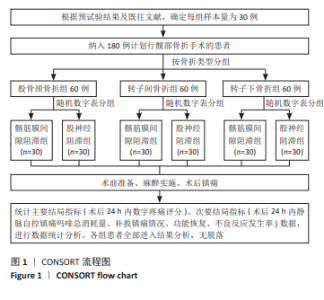
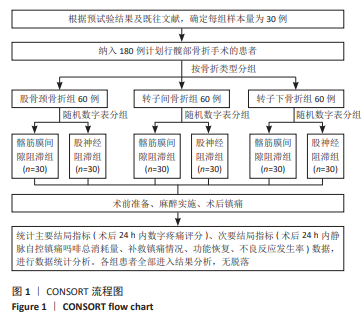
2.1 参与者数量分析 此次研究共筛选了196例髋部骨折患者,其中16例不符合纳入标准被排除(年龄< 65岁5例,ASA分级Ⅳ级3例,凝血功能异常4例,认知功能障碍4例)。最终纳入180例患者进行研究,按骨折类型分为股骨颈骨折组、转子间骨折组和转子下骨折组,每组60例。每组患者再随机分为髂筋膜间隙阻滞组和股神经阻滞组,每组各30例,共形成6个研究组。 研究期间无患者退出或失访,所有180例患者均完成了术后24 h的随访观察,数据完整性为100%。所有患者均按照最初分配的治疗方案完成研究,符合意向性分析原则。最终进入结果分析的患者数量为180例,分为6组,每组30例。 髂筋膜间隙阻滞组阻滞成功率为97%(87/90),股神经阻滞组为96%(86/90),两组间无显著性差异(P=0.702)。阻滞失败病例(髂筋膜间隙阻滞组3例,股神经阻滞组4例)均通过增加术中镇痛药物完成手术,未进行交叉干预,仍纳入原组分析。 2.2 试验流程图 见图1。"
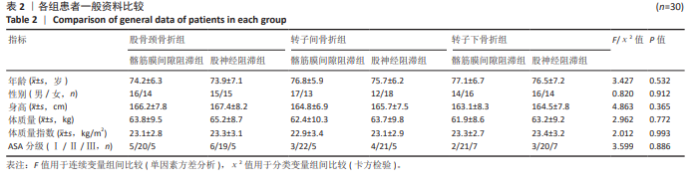
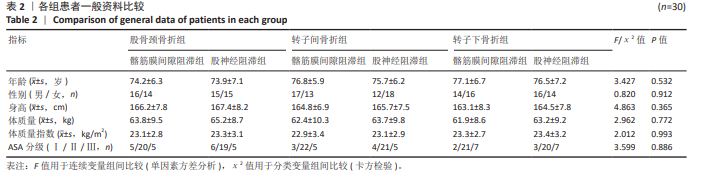
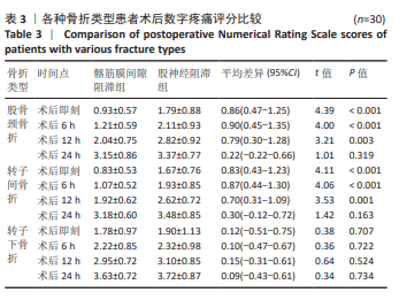
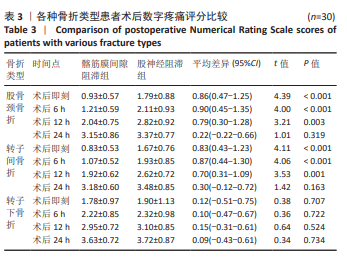
2.3 基线资料比较 术前基线数字疼痛评分髂筋膜间隙阻滞组为(7.2±1.3)分,股神经阻滞组为(7.4±1.2)分,两组间比较差异无显著性意义(t=1.03,P=0.412)。6组患者的年龄、性别、身高、体质量、ASA分级等基线资料相比差异均无显著性意义(P > 0.05),见表2。 2.4 各类骨折患者镇痛效果比较 如表3所示,在股骨颈骨折组和转子间骨折组中,髂筋膜间隙阻滞亚组患者在术后即刻及术后6,12 h的数字疼痛评分均显著低于股神经阻滞亚组(均P < 0.01);在股骨颈骨折组中,髂筋膜间隙阻滞亚组、股神经阻滞亚组术后即刻及术后6,12 h的数字疼痛评分平均差异分别为0.86分(95%CI:0.47-1.25)、0.90分(95%CI:0.45-1.35)和0.79分(95%CI:0.30-1.28);在转子间骨折组中,平均差异分别为0.83分(95%CI:0.43-1.23)、0.87分(95%CI:0.44-1.30)和0.70分(95%CI:0.31-1.09)。然而,在转子下骨折组中,髂筋膜间隙阻滞亚组与股神经阻滞亚组在所有时间点(术后即刻及术后6,12,24 h)的数字疼痛评分差异均无显著性意义(均P > 0.05)。此外,在所有3个骨折组中,术后24 h时髂筋膜间隙阻滞亚组与股神经阻滞亚组的疼痛评分相比差异均无显著性意义。"
"
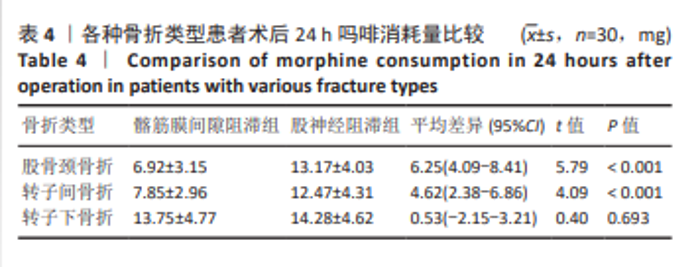
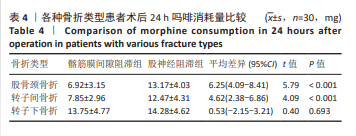
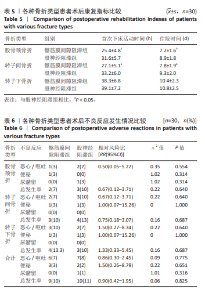
比较不同类型骨折组,术后即刻及术后6,12 h时,3个骨折组间差异均有显著性意义(P < 0.05);而在术后24 h时,差异无显著性意义(P=0.071)。多重比较结果显示,在术后即刻及术后6,12 h,转子下骨折组的数字疼痛评分均显著高于股骨颈骨折组和转子间骨折组(P < 0.05),而股骨颈骨折组与转子间骨折组之间差异无显著性意义(P > 0.05)。 2.5 术后24 h内镇痛用药总量比较 各组术后24 h吗啡消耗量比较见表4。在股骨颈骨折组和转子间骨折组中,髂筋膜间隙阻滞亚组的吗啡消耗量均显著少于股神经阻滞亚组(P < 0.001);而在转子下骨折组中,两组之间差异无显著性意义(P=0.693)。 2.6 术后康复指标比较 表5展示了不同骨折类型患者的术后康复指标。在股骨颈骨折组和转子间骨折组中,髂筋膜间隙阻滞亚组的首次下床活动时间显著早于股神经阻滞亚组(P < 0.05),住院天数也显著短于股神经阻滞亚组(P < 0.05)。而在转子下骨折组中,两种阻滞技术在这些康复指标上无显著性差异(P > 0.05)。 2.7 术后不良反应发生情况比较 表6呈现了3种骨折类型患者的术后不良反应情况。各亚组中髂筋膜间隙阻滞与股神经阻滞技术在不良反应总发生率方面均无显著性差异(P > 0.05)。合并所有患者数据后,两种阻滞技术的不良反应总发生率分别为10%和11%(RR=0.90,95%CI:0.42-1.95,P=0.825)。各类不良反应的发生率在两组间也无显著性差异(P > 0.05)。此次研究观察期内(术后24 h),两组患者均未发生深静脉血栓、肺部感染、谵妄等严重并发症。由于观察时间较短,这些并发症的真实发生率可能被低估。"
"
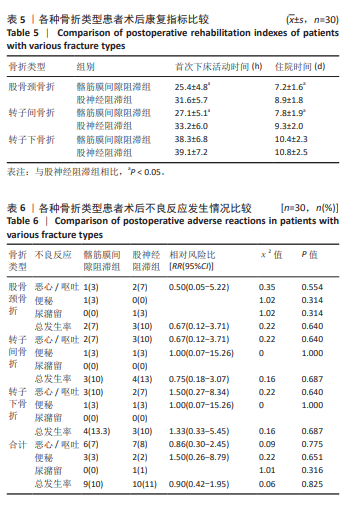
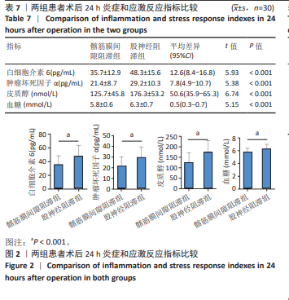
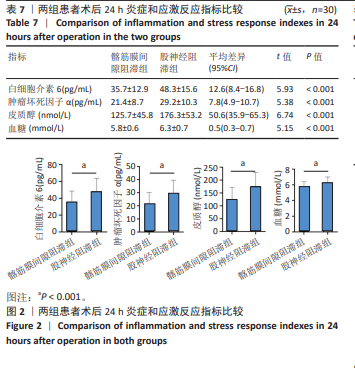
2.8 炎症与应激反应指标比较 表7及图2显示了两组患者术后24 h的炎症和应激反应指标表达水平。髂筋膜间隙阻滞组的炎症指标(白细胞介素6、肿瘤坏死因子α)和应激反应指标(皮质醇、血糖)表达水平均显著低于股神经阻滞组(P < 0.001),表明髂筋膜间隙阻滞技术可能更有效地抑制手术相关炎症反应和应激反应。"
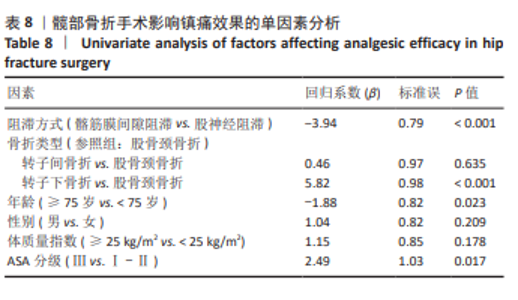
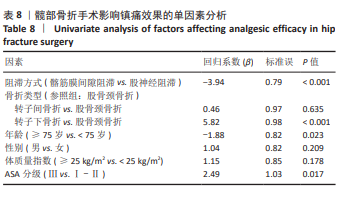
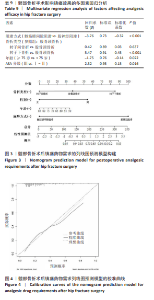
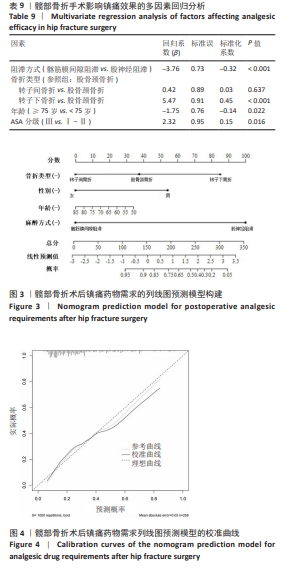
2.9 镇痛效果影响因素分析及预测模型 2.9.1 影响镇痛效果的单因素分析 为确定影响镇痛效果的因素,以术后24 h内静脉自控镇痛吗啡总消耗量为因变量,对可能影响镇痛效果的因素进行了单因素分析,见表8。结果显示,阻滞方式(P < 0.001)、骨折类型(P < 0.001)、年龄(P=0.023)和ASA分级(P=0.017)与镇痛药物消耗量显著相关,而性别(P=0.209)和体质量指数(P=0.178)未显示出显著影响。 2.9.2 多因素回归分析 将单因素分析中P < 0.05的因素纳入多因素回归模型,见表9。多因素分析结果确认,阻滞方式、骨折类型、年龄和ASA分级是影响术后镇痛药物需求的独立预测因素。 2.9.3 列线图预测模型的构建与验证 基于多因素回归分析结果,构建了预测术后镇痛药物需求的列线图模型(图3)。该模型整合了阻滞方式、骨折类型、年龄和ASA分级4个独立预测因素,可直观预测患者术后24 h吗啡消耗量。 此次研究绘制了校准曲线来评估模型的校准性,校准性反映了预测概率与实际观察结果的一致程度,理想情况下,校准曲线应接近于45°对角线。从图4可以看出,此次研究的模型校准曲线与对角线吻合良好,表明预测概率与实际观察到的发生率高度一致。这意味着模型不仅能够区分高风险和低风险患者,而且能够准确估计个体患者的风险。"
"
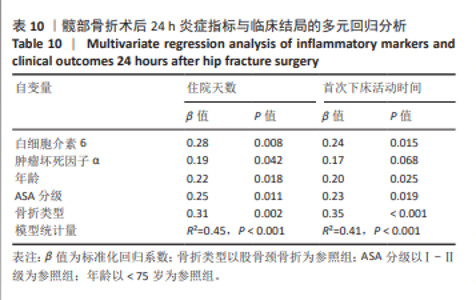
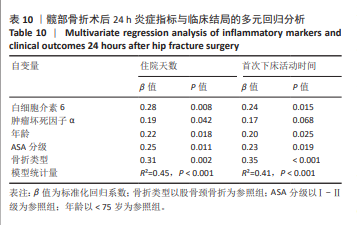
2.9.4 炎症指标与临床结局的相关性分析 Pearson相关分析显示,术后24 h白细胞介素6水平与住院天数(r=0.42,P < 0.001)及首次下床活动时间呈正相关(r=0.38,P < 0.001);肿瘤坏死因子α水平与住院天数(r=0.35,P < 0.001)及首次下床活动时间呈正相关(r=0.31,P=0.002)。多元线性回归分析显示,控制年龄、ASA分级和骨折类型后,白细胞介素6水平仍是住院天数( β=0.28,P=0.008)和首次下床活动时间( β=0.24,P=0.015)的独立预测因素;肿瘤坏死因子α水平也与住院天数独立相关( β=0.19,P=0.042),但与首次下床活动时间的相关性在多因素分析中未达到统计学意义( β=0.17,P=0.068)。这些结果提示术后炎症反应水平,特别是白细胞介素6,不仅反映了组织损伤程度,更是影响患者康复进程的重要因素。白细胞介素6作为急性期反应的中心调节因子,其持续升高可能通过多种机制延缓康复:包括抑制肌肉蛋白合成、加重全身代谢紊乱、影响疼痛敏化等。肿瘤坏死因子α虽然在单因素分析中与两个临床结局均相关,但在校正混杂因素后,其对首次下床活动时间的独立预测作用减弱,这可能与肿瘤坏死因子α的半衰期较短、作用时间窗较窄有关,见表10。"
| [1] HEBBARD P, IVANUSIC J, SHA S. Ultrasound-guided supra-inguinal fascia iliaca block: a cadaveric evaluation of a novel approach. Anaesthesia. 2011;66(4): 300-305. [2] SWENSON JD, DAVIS JJ, STREAM JO, et al. Local anesthetic injection deep to the fascia iliaca at the level of the inguinal ligament: the pattern of distribution and effects on the obturator nerve. J Clin Anesth. 2015;27(8):652-657. [3] PETCHARA S, PAPHON SA, VANLAPA A, et al. Fascia iliaca compartment block for perioperative pain management of geriatric patients with hip fractures: a randomized controlled trial. BMC Anesthesiol. 2021;21(1):166. [4] BANG S, CHUNG J, JEONG J, et al. Efficacy of ultrasound-guided fascia iliaca compartment block after hip hemiarthroplasty: a prospective, randomized trial. Medicine (Baltimore). 2016;95(39):e5018. [5] DIAKOMI M, PAPAIOANNOU M, MELA A, et al. Preoperative fascia iliaca compartment block for positioning patients with hip fractures for central nervous blockade: a randomized trial. Reg Anesth Pain Med. 2014;39(5):394-398. [6] DANGLE J, KUKREJA P, KALAGARA H. Review of current practices of peripheral nerve blocks for hip fracture and surgery. Curr Anesthesiol Rep. 2020;10:259-266. [7] FOSS NB, KRISTENSEN BB, BUNDGAARD M, et al. Fascia iliaca compartment blockade for acute pain control in hip fracture patients: a randomized, placebo-controlled trial. Anesthesiology. 2007;106(4):773-778. [8] HUANG F, QIAN H, GAO F, et al. Effect of ultrasound-guided fascia iliac compartment block with nalbuphine and ropivacaine on preoperative pain in older patients with hip fractures: a multicenter, triple-blinded, randomized, controlled trial. Pain Ther. 2022;11(3):923-935. [9] GODOY MONZÓN D, VAZQUEZ J, JAUREGUI JR, et al. Pain treatment in post-traumatic hip fracture in the elderly: regional block vs. systemic non-steroidal analgesics. Int J Emerg Med. 2010;3(4):321-325. [10] HAINES L, DICKMAN E, AYVAZYAN S, et al. Ultrasound-guided fascia iliaca compartment block for hip fractures in the emergency department. J Emerg Med. 2012;43(4):692-697. [11] HØGH A, DREMSTRUP L, JENSEN SS, et al. Fascia iliaca compartment block performed by junior registrars as a supplement to pre-operative analgesia for patients with hip fracture. Strategies Trauma Limb Reconstr. 2008;3(2):65-70. [12] IAMAROON A, RAKSAKIETISAK M, HALILAMIEN P, et al. Femoral nerve block versus fentanyl: analgesia for positioning patients with fractured femur. Local Reg Anesth. 2010;3:21-26. [13] DESMET M, VERMEYLEN K, VAN HERREWEGHE I, et al. A longitudinal supra-inguinal fascia iliaca compartment block reduces morphine consumption after total hip arthroplasty. Reg Anesth Pain Med. 2017;42(3):327-333. [14] CASTILLÓN P, VELOSO M, GÓMEZ O, et al. Fascia iliaca block for pain control in hip fracture patients. Rev Esp Cir Ortop Traumatol. 2017;61(6):383-389. [15] LEES D, HARRISON WD, ANKERS T, et al. Fascia iliaca compartment block for hip fractures: experience of integrating a new protocol across two hospital sites. Eur J Emerg Med. 2016;23(1):12-17. [16] PERLAS A, KIRKHAM KR, BILLING R, et al. The impact of analgesic modality on early ambulation following total knee arthroplasty. Reg Anesth Pain Med. 2013;38(4):334-339. [17] JOHNSTON DF, SONDEKOPPAM RV, GIFFIN R, et al. Determination of ED50 and ED95 of 0.5% ropivacaine in ultrasound-guided femoral nerve block for knee surgery: a prospective, double-blind dose-finding study. Reg Anesth Pain Med. 2017;42(6):731-736. [18] JOHNSON RL, KOPP SL, BURKLE CM, et al. Neuraxial vs general anaesthesia for total hip and total knee arthroplasty: a systematic review of comparative-effectiveness research. Br J Anaesth. 2016;116(2):163-176. [19] BENDTSEN TF, PEDERSEN EM, MORIGGL B, et al. Anatomical considerations for obturator nerve block with fascia iliaca compartment block. Reg Anesth Pain Med. 2021;46(9):806-812. [20] ZHENG T, HU B, ZHENG CY, et al. Improvement of analgesic efficacy for total hip arthroplasty by a modified ultrasound-guided supra-inguinal fascia iliaca compartment block. BMC Anesthesiol. 2021;21(1):75. [21] KACHA NJ, JADEJA CA, PATEL PJ, et al. Comparative study for evaluating efficacy of fascia iliaca compartment block for alleviating pain of positioning for spinal anesthesia in patients with hip and proximal femur fractures. Indian J Orthop. 2018;52(2):147-153. [22] KEARNS RJ, MACFARLANE AJ, ANDERSON KJ, et al. Intrathecal opioid versus ultrasound guided fascia iliaca plane block for analgesia after primary hip arthroplasty: study protocol for a randomised, blinded, noninferiority controlled trial. Trials. 2011;12:51. [23] KUMAR K, PANDEY RK, BHALLA AP, et al. Comparison of conventional infrainguinal versus modified proximal suprainguinal approach of fascia iliaca compartment block for postoperative analgesia in total hip arthroplasty. Acta Anaesthesiol Scand. 2015;59(10):1329-1339. [24] KUMAR D, HOODA S, KIRAN S, et al. Analgesic efficacy of ultrasound guided FICB in patients with hip fracture. J Clin Diagn Res. 2016;10(7):UC13-UC16. [25] KUMAR NS, RADHA N, JEYAVELRAJAN P, et al. Dexmedetomidine as an additive to 0.35% ropivacaine in fascia iliaca compartment block for post-operative analgesia following total hip replacement: a prospective randomized study. IOSR J Dent Med Sci. 2014;13(11):78-82. [26] KUMIE FT, GEBREMEDHN EG, TAWUYE HY. Efficacy of fascia iliaca compartment nerve block as part of multimodal analgesia after surgery for femoral bone fracture. World J Emerg Med. 2015;6(2):142-146. [27] LAI Y, ZHU L, YIN H, et al. Ultrasound-guided continuous fascia iliaca compartment block for analgesia after total hip replacement: a randomized controlled trial. Medicine (Baltimore). 2023;102(8):e33029. [28] LEVENTE BZ, ZOLTÁN GY, ALMOS SZ. Fascia iliaca compartment block for perioperative pain management of geriatric patients with hip fractures. Orv Hetil. 2020;161(37):1575-1580. [29] MEMTSOUDIS SG, SUN X, CHIU YL, et al. Perioperative comparative effectiveness of anesthetic technique in orthopedic patients. Anesthesiology. 2013;118(5): 1046-1058. [30] MORAU D, LOPEZ S, BIBOULET P, et al. Comparison of continuous 3-in-1 and fascia iliaca compartment blocks for postoperative analgesia: feasibility, catheter migration, distribution of sensory block, and analgesic efficacy. Reg Anesth Pain Med. 2003;28(4):309-314. [31] NEUMAN MD, SILBER JH, ELKASSABANY NM, et al. Comparative effectiveness of regional versus general anesthesia for hip fracture surgery in adults. Anesthesiology. 2012;117(1):72-92. [32] NEWMAN B, MCCARTHY L, THOMAS PW, et al. A comparison of pre-operative nerve stimulator-guided femoral nerve block and fascia iliaca compartment block in patients with a femoral neck fracture. Anaesthesia. 2013;68(9):899-903. [33] O’DONNELL BD, MANNION S. Ultrasound-guided axillary brachial plexus block with 20 milliliters local anesthetic mixture versus general anesthesia for upper limb trauma surgery: an observer-blinded, prospective, randomized, controlled trial. Anesth Analg. 2009;109(1):279-283. [34] VERMEYLEN K, SOETENS F, LEUNEN I, et al. The effect of the volume of supra-inguinal injected solution on the spread of the injectate under the fascia iliaca: a preliminary study. J Anesth. 2014;28(1):95-98. [35] COLLINS GS, REITSMA JB, ALTMAN DG, et al. Transparent reporting of a multivariable prediction model for individual prognosis or diagnosis (TRIPOD): the TRIPOD statement. BMJ. 2015;350:g7594. [36] PENG L, REN L, QIAN W, et al. Perineural dexamethasone as an adjuvant for single injection femoral nerve block in hip fracture patients: a randomized, controlled trial. Can J Anaesth. 2015;62(10):1022-1029. [37] RASHIQ S, VANDERMEER B, ABOU-SETTA AM, et al. Efficacy of supplemental peripheral nerve blockade for hip fracture surgery: multiple treatment comparison. Can J Anaesth. 2013;60(3):230-243. [38] REID N, STELLA J, RYAN M, et al. Use of ultrasound to facilitate accurate femoral nerve block in the emergency department. Emerg Med Australas. 2009;21(2): 124-130. [39] SAHOTA O, ROWLANDS M, BRADLEY S, et al. Femoral nerve block intervention in neck of femur fracture (FINOF): study protocol for a randomized controlled trial. Trials. 2014;15:189. [40] SCURRAH A, SHINER CT, STEVENS JA, et al. Regional nerve blockade for early analgesic management of elderly patients with hip fracture - a narrative review. Anaesthesia. 2018;73(6):769-783. [41] SHARIAT AN, HADZIC A, XU D, et al. Fascia lliaca block for analgesia after hip arthroplasty: a randomized double-blind, placebo-controlled trial. Reg Anesth Pain Med. 2013;38(3):201-205. [42] SHORT AJ, BARNETT JJG, GOFELD M, et al. Anatomic study of innervation of the anterior hip capsule: implication for image-guided intervention. Reg Anesth Pain Med. 2018;43(2):186-192. [43] STEENBERG J, MØLLER AM. Systematic review of the effects of fascia iliaca compartment block on hip fracture patients before operation. Br J Anaesth. 2018;120(6):1368-1380. [44] STEVENS M, HARRISON G, MCGRAIL M. A modified fascia iliaca compartment block has significant morphine-sparing effect after total hip arthroplasty. Anaesth Intensive Care. 2007;35(6):949-952. [45] SHARIAT AN, HADZIC A, XU D, et al. Fascia iliaca block for analgesia after hip arthroplasty: a randomized double-blind, placebo-controlled trial. Reg Anesth Pain Med. 2013;38(3):201-205. [46] THOMPSON J, LONG M, ROGERS E, et al. Fascia iliaca block decreases hip fracture postoperative opioid consumption: a prospective randomized controlled trial. J Orthop Trauma. 2020;34(1):49-54. [47] TOURAY ST, DE LEEUW MA, ZUURMOND WW, et al. Psoas compartment block for lower extremity surgery: a meta-analysis. Br J Anaesth. 2008;101(6):750-760. [48] UNNEBY A, SVENSSON PO, GUSTAFSON PY, et al. Complications with focus on delirium during hospital stay related to femoral nerve block compared to conventional pain management among patients with hip fracture-a randomised controlled trial. Injury. 2020;51(7):1634-1641. [49] WENNBERG P, MÖLLER M, HERLITZ J, et al. Fascia iliaca compartment block as a preoperative analgesic in elderly patients with hip fractures - effects on cognition. BMC Geriatr. 2019;19(1):252. [50] YUN MJ, KIM YH, HAN MK, et al. Analgesia before a spinal block for femoral neck fracture: fascia iliaca compartment block. Acta Anaesthesiol Scand. 2009; 53(10):1282-1287. |
| [1] | Zhao Feifan, Cao Yujing. Risk factors and coping strategies of internal fixation failure in treatment of intertrochanteric fracture with proximal femoral nail antirotation [J]. Chinese Journal of Tissue Engineering Research, 2026, 30(9): 2323-2333. |
| [2] | Rao Jingcheng, Li Yuwan, Zheng Hongbing, Xu Zhi, Zhu Aixiang, Shi Ce, Wang Bing, Yang Chun, Kong Xiangru, Zhu Dawei. Biomechanical differences between the new proximal femoral stable intramedullary nail and traditional intramedullary nail#br# [J]. Chinese Journal of Tissue Engineering Research, 2026, 30(9): 2217-2225. |
| [3] | Xu Xinbao, Chen Feiyang, Chen Yinbing, Zhang Feixiang, Lyu Shujun, Cui Haidong, Chen Zhigang. Univariate and multivariate regression analysis of femoral neck shortening after cannulated screw fixation in femoral neck fractures [J]. Chinese Journal of Tissue Engineering Research, 2026, 30(3): 620-625. |
| [4] | Liao Long, Zhao Zepeng, Li Zongyuan, Yu Qinglong, Zhang Tao, Tang Jinyuan, Ye Nan, Xu Han, Shi Bo. Establishment and validation of a model for femoral head necrosis after internal fixation of femoral neck fracture using logistic regression and SHAP analysis [J]. Chinese Journal of Tissue Engineering Research, 2026, 30(3): 626-633. |
| [5] | Wang Yijun, Zhang Weicheng, Wu Xiaoyang, Ju Zhengye, Zhu Feng, Zhou Jun, Li Rongqun, Xu Yaozeng, Zhang Lianfang. Supercapsular percutaneously assisted total hip approach combined with local and intravenous tranexamic acid reduces perioperative hidden blood loss in hemiarthroplasty [J]. Chinese Journal of Tissue Engineering Research, 2026, 30(27): 7095-7100. |
| [6] | Peng Guofei, Zhai Yifa, Lu Shuang, Jiang Kundou, Zhang Bin, Zhang Yi, She Rongfeng. Impact of lesser trochanter displacement on hip function following minimally invasive intramedullary nailing for geriatric intertrochanteric fractures [J]. Chinese Journal of Tissue Engineering Research, 2026, 30(27): 7160-7166. |
| [7] | Qu Aili, Yu Junhui, Sun Jianbin, Ye Peng, An Weijun. Finite element analysis of biomechanics of two internal fixation methods for Pauwels type III fractures based on fatigue life calculation [J]. Chinese Journal of Tissue Engineering Research, 2026, 30(21): 5411-5420. |
| [8] | He Yun, Yiliyaer · Abudusimu, Xu Bin, Wang Guosheng. InterTAN versus proximal femoral nail anti-rotation for intertrochanteric fractures in the elderly: a comparison of joint function and stability [J]. Chinese Journal of Tissue Engineering Research, 2026, 30(21): 5460-5467. |
| [9] | Wang Shufang, Kang Xiaoqin, Liu Zhi, Shen Bing, Zhang Feng, Song Yuanzheng, Zhang Shuaigong. Application of a novel femoral neck anteversion angle measurement device in intramedullary nailing fixation for intertrochanteric fractures [J]. Chinese Journal of Tissue Engineering Research, 2026, 30(15): 3885-3896. |
| [10] | La Rui, Wu Qian, Zhang Zhongtai, Xu Wu, Ding Qingfeng, Zhang Zhigang, Jiang Dinghua, Huang Lixin, Wang Shenghao. Analysis of risk factors for secondary fractures after hip fracture surgery in the elderly [J]. Chinese Journal of Tissue Engineering Research, 2026, 30(15): 3920-3928. |
| [11] | Tang Yuntao, Wu Zhonghan, Wang Jingkun, Li Tao, Lu Jingtao, Mao Shitan, Tang Jian, Xu Xinzhong. Relationship of femoral artery, vein and nerve projections with femoral head positions in patients with femoral neck fracture [J]. Chinese Journal of Tissue Engineering Research, 2026, 30(15): 3953-3959. |
| [12] | Feng Tao, Yin Zhaoyang. Biomechanical function and clinical significance of the lateral wall integrity in intertrochanteric fractures of the femur [J]. Chinese Journal of Tissue Engineering Research, 2026, 30(15): 3960-3970. |
| [13] | Yusufu·Reheman , Mutalipu·Silamujiang , Alimujiang·Yusufu , Zhang Ziyi , Ran Jian. Finite element analysis of combined fixation of Pauwels type III femoral neck fracture with posteromedial bone defects of varying degrees using a medial support plate [J]. Chinese Journal of Tissue Engineering Research, 2026, 30(15): 3760-3771. |
| [14] | Chen Xi, Tang Tao, Chen Tongbing, Li Qing, Zhang Wen. Mechanical stability of intertrochanteric fracture of femur with different internal fixation systems [J]. Chinese Journal of Tissue Engineering Research, 2025, 29(9): 1783-1788. |
| [15] | Song Xubin, Wu Dou, Zhao Enzhe, Zhang Xingyu, Zhang Xiaolun, Wang Chuheng. Finite element analysis of a new femoral neck spiral blade system to treat femoral intertrochanteric fractures [J]. Chinese Journal of Tissue Engineering Research, 2025, 29(33): 7041-7047. |
| Viewed | ||||||
|
Full text |
|
|||||
|
Abstract |
|
|||||