Chinese Journal of Tissue Engineering Research ›› 2026, Vol. 30 ›› Issue (27): 7142-7150.doi: 10.12307/2026.758
Previous Articles Next Articles
Healing characteristics and influencing factors of large-segment infectious bone defect of tibia repaired by bone transfer
Bu Jianwen, Xie Zengru, Ma Chuang
- Department of Trauma Orthopedics, The First Affiliated Hospital of Xinjiang Medical University, Urumqi 830054, Xinjiang Uyghur Autonomous Region, China
-
Received:2025-08-04Accepted:2025-09-30Online:2026-09-28Published:2026-05-22 -
About author:Bu Jianwen, MS, Attending physician, Department of Trauma Orthopedics, The First Affiliated Hospital of Xinjiang Medical University, Urumqi 830054, Xinjiang Uyghur Autonomous Region, China -
Supported by:Natural Science Foundation of Xinjiang Uygur Autonomous Region, No. 2021D01C113 (to BJW)

CLC Number:
Cite this article
Bu Jianwen, Xie Zengru, Ma Chuang. Healing characteristics and influencing factors of large-segment infectious bone defect of tibia repaired by bone transfer[J]. Chinese Journal of Tissue Engineering Research, 2026, 30(27): 7142-7150.
share this article
Add to citation manager EndNote|Reference Manager|ProCite|BibTeX|RefWorks
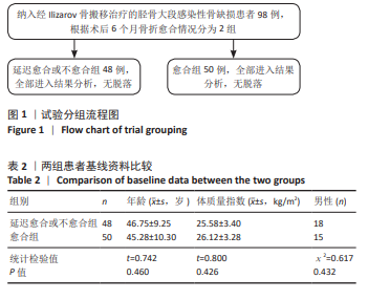
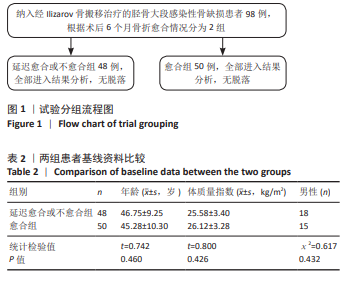
2.1 参与者数量分析 根据98例患者术后6个月骨折愈合情况,48例纳入延迟愈合或不愈合组,50例纳入愈合组,全部进入结果分析,无脱落。 2.2 试验流程图 见图1。 2.3 一般资料比较 纳入研究的患者共98例,其中延迟愈合或不愈合组48例,男18例,女30例,年龄(46.75±9.25)岁,体质量指数(25.58±3.40) kg/m2;愈合组50例,男15例,女35例,年龄(45.28±10.30)岁,体质量指数为(26.12±3.28) kg/m2。两组患者的基线资料相比差异无显著性意义(P > 0.05),具有可比性,见表2。"
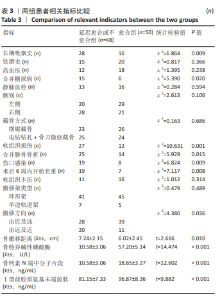
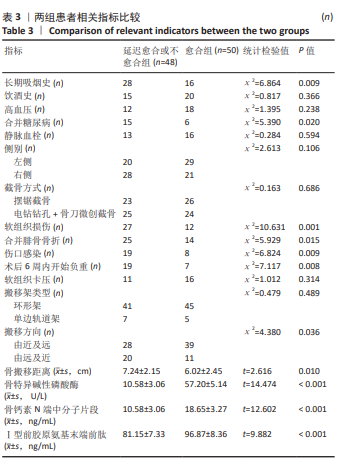
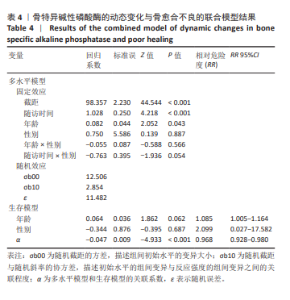
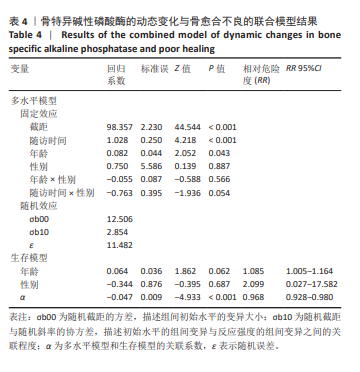
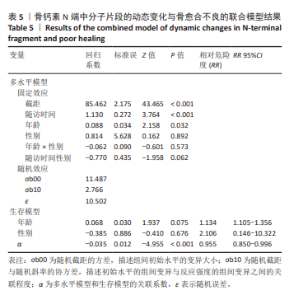
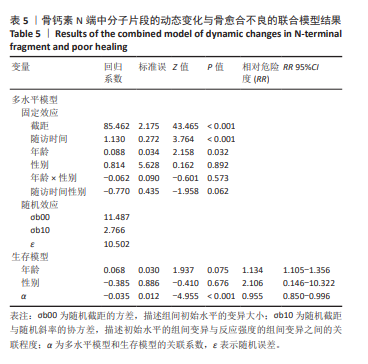
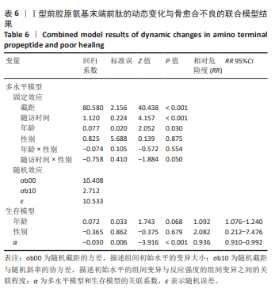
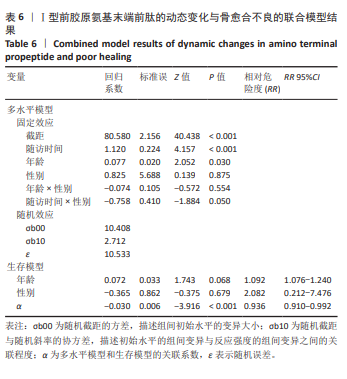
2.4 两组患者相关指标比较 两组患者在长期吸烟史、合并糖尿病、软组织损伤、合并腓骨骨折、伤口感染、术后6周内开始负重、搬移方向、骨搬移距离、骨特异碱性磷酸酶、骨钙素N端中分子片段、Ⅰ型前胶原氨基末端前肽水平之间差异均有显著性意义(P < 0.05),两组患者其余指标相比差异均无显著性意义(P > 0.05),见表3。 2.5 构建血清骨转化标志物动态变化与骨愈合情况的联合模型 2.5.1 血清骨特异碱性磷酸酶动态变化与骨愈合情况的联合模型 Cox生存模型引入的变量包括年龄、性别及骨特异碱性磷酸酶的纵向变化。α有统计学意义(P < 0.05),即骨特异碱性磷酸酶每纵向下降1 U/L,愈合不良的风险增加3%,见表4。 2.5.2 血清骨钙素N端中分子片段动态变化与骨愈合情况的联合模型 Cox生存模型引入的变量包括年龄、性别及骨钙素N端中分子片段的纵向变化。α有统计学意义(P < 0.05),即骨钙素N端中分子片段每纵向下降1 ng/mL,愈合不良的风险增加2%,见表5。2.5.3 血清Ⅰ型前胶原氨基末端前肽动态变化与骨愈合情况的联合模型 Cox生存模型引入的变量包括年龄、性别及Ⅰ型前胶原氨基末端前肽的纵向变化。α有统计学意义(P < 0.05),即Ⅰ型前胶原氨基末端前肽每纵向下降1 ng/mL,愈合不良的风险增加4%,见表6。"
"
"
"
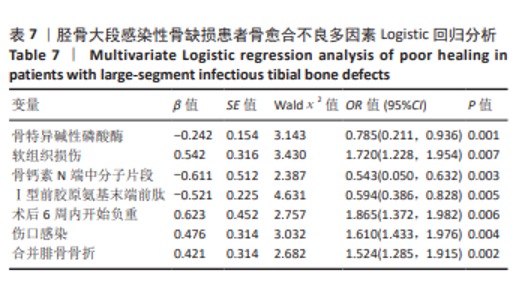
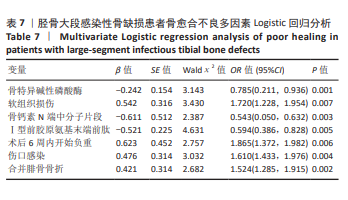
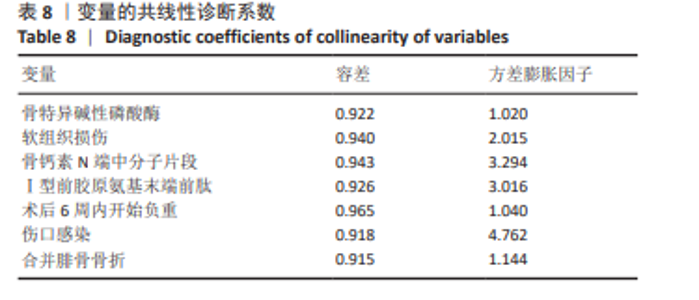
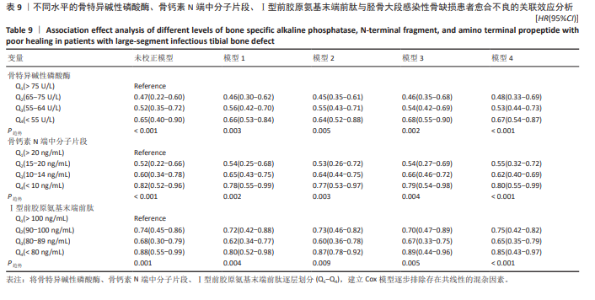
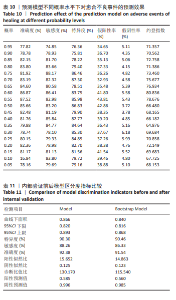
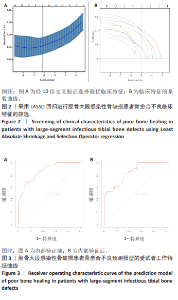
2.6 影响患者骨愈合的危险因素分析 以表1中两组差异显著(P < 0.05)的指标为自变量,以是否发生骨愈合不良为因变量,纳入LASSO回归分析模型,见图2。初始纳入的自变量系数随惩罚系数λ的变化逐步减小,采用最小准则10倍交叉验证最优惩罚系数λ,并将λ+1作为模型最优值,最终筛选出的指标为:骨特异碱性磷酸酶、软组织损伤、骨钙素N端中分子片段、Ⅰ型前胶原氨基末端前肽、术后6周内开始负重、伤口感染、合并腓骨骨折。将筛选后的变量纳入多因素Logistic回归分析,结果显示,软组织损伤、术后6周内开始负重、伤口感染、合并腓骨骨折及骨特异碱性磷酸酶、骨钙素N端中分子片段、Ⅰ型前胶原氨基末端前肽水平降低均为影响患者愈合的独立危险因素(P < 0.05),见表7。以上变量经共线性诊断,结果显示方差膨胀因子均小于10,提示各相关因素间不存在共线性,见表8。 2.7 不同水平骨特异碱性磷酸酶、骨钙素N端中分子片段、Ⅰ型前胶原氨基末端前肽与胫骨大段感染性骨缺损患者愈合不良的关联效应分析 将骨特异碱性磷酸酶、骨钙素N端中分子片段、Ⅰ型前胶原氨基末端前肽逐层划分(Q1-Q4),建立Cox模型逐步排除存在共线性的混杂因素。校正患者性别、年龄、体质量指数、饮酒史、文化程度等指标,消除混杂因素的影响。 在未经调整的Cox比例风险模型(未校正模型)中,骨特异碱性磷酸酶、骨钙素N端中分子片段及Ⅰ型前胶原氨基末端前肽和胫骨大段感染性骨缺损患者愈合不良风险显著相关(P < 0.001),调整后(模型4),骨特异碱性磷酸酶(HR=0.67,95%CI:0.54-0.87,P < 0.001)、骨钙素N端中分子片段(HR=0.80,95%CI:0.55-0.99,P < 0.001)、Ⅰ型前胶原氨基末端前肽(HR=0.85,95%CI:0.43-0.97,P < 0.001)仍是胫骨大段感染性骨缺损患者愈合不良的重要因素。随着骨特异碱性磷酸酶、骨钙素N端中分子片段及Ⅰ型前胶原氨基末端前肽水平的降低(Q2-Q4),其关联效应也相应增高,趋势性检验差异均有显著性意义(P趋势< 0.05),见表9。 2.8 建立预测模型并验证 构建愈合不良事件发生的预测模型。多因素Logistic回归模型进行预测,将上述结果放入到回归方程y=1-1/(1+e-z)中,得到愈合不良事件预测的公式: P=1-1/(1+e0.355a-0.240b-0.552c-0.610d+1.132e+2.005f+0.654g)。 其中a为软组织损伤,b为骨特异碱性磷酸酶,c为骨钙素N端中分子片段,d为Ⅰ型前胶原氨基末端前肽,e为术后6周内开始负重,f为伤口感染,g为合并腓骨骨折。利用回归方程计算愈合不良事件发生的可能性。结果可知:P=0.60时,约登指数数值最大,为80.836。表明模型预测效果较好。当P > 0.55时,表示胫骨大段感染性骨缺损患者可能会出现愈合不良事件。此模型预测准确度为86.87%,敏感度、特异度为86.41%,83.75%。见表10。"
"
"
"
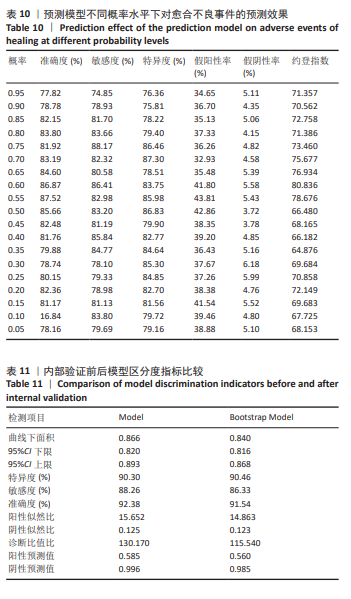
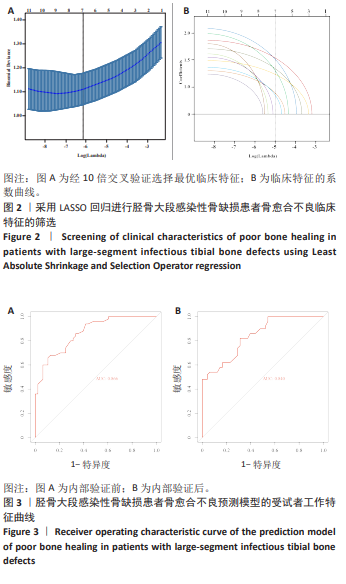
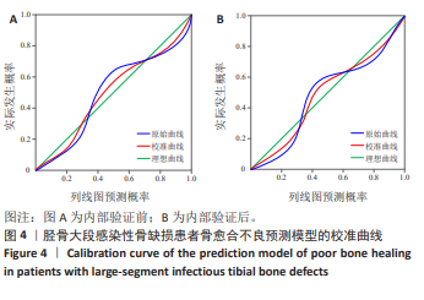
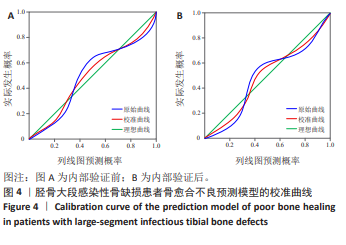
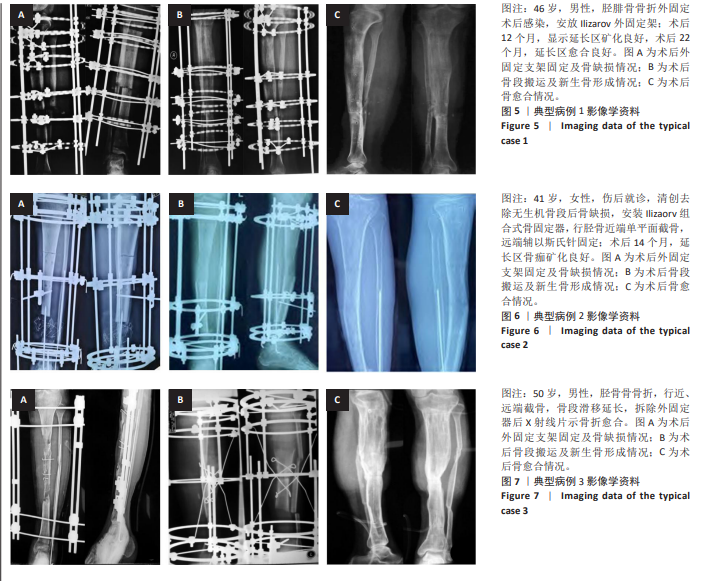
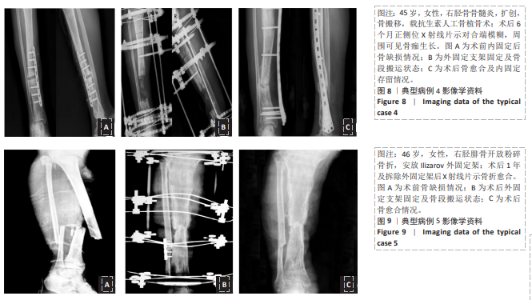
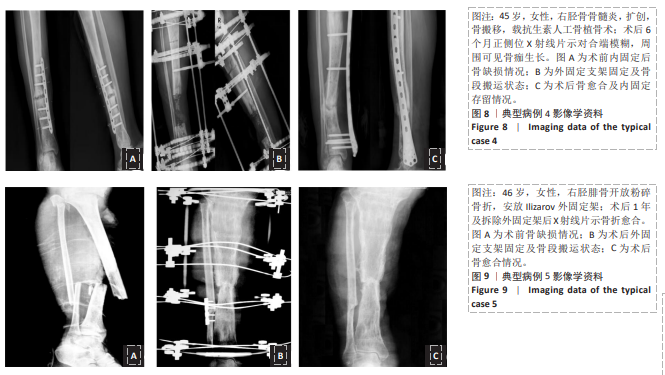
2.9 模型评价 验证上述预测模型的准确度。以患者实际是否发生愈合不良事件为状态变量,构建受试者工作特征曲线及校准曲线,并计算曲线下面积、预测概率及愈合不良的平均绝对误差,结果显示,内部验证前后的曲线下面积分别为0.866(95%CI:0.820-0.893)和0.840(95%CI:0.816-0.868),敏感度分别为88.26%,86.33%,特异度分别为90.30%,90.46%,平均绝对误差均为0.009,说明该模型有较高的区分度和校准度,且灵敏度和特异度良好,见图3,4及表11。 2.10 典型病例 典型病例见图5-9。"
"

"
"
| [1] 焦振华, 刘飞, 范文浩, 等. 胫腓骨感染性骨缺损治疗的研究现状[J]. 中国矫形外科杂志,2024,32(6):541-546. [2] CHEN Z, YANG Y, LIU B, et al. Application of 3D-printed porous prosthesis for the reconstruction of infectious bone defect with concomitant severe soft tissue lesion: a case series of 13 cases. BMC Musculoskelet Disord. 2024;25(1):1090. [3] YANG J, WANG Z, JIANG L, et al. Nomogram construction and validation of axial deviation in patients with tibial defects treated with the Ilizarov bone transport technique. BMC Musculoskelet Disord. 2024;25(1):483. [4] 秦延杰, 吕松峰, 王磊, 等. Ilizarov技术治疗胫骨骨缺损后发生踝关节骨关节炎的影响因素分析[J]. 中国骨与关节损伤杂志,2024,39(12):1317-1321. [5] KUKREJA K, REYAZ S, KUMAR MN. Outcome of bone transport using ilizarov external fixator in infected non-union of tibia with large bone defects: Comparison of those with 5-10 cm bone defect with those having ≥ 11 cm bone defect. Indian J Orthop. 2024;58(4):345-353. [6] 程康, 王斌, 涂振兴, 等. 胫骨骨搬移术后延长区3种骨痂形态与骨愈合的关系[J]. 中国组织工程研究,2023,27(27):4373-4378. [7] BAE E, SIM SY, PARK SJ, et al. Bone-specific alkaline phosphatase as a complementary diagnostic marker for the assessment of children and adolescents with secondary osteoporosis. Diagnostics (Basel). 2025;15(5):630. [8] CAO Z, OU Y, WANG Y, et al. Correlation between dental fluorosis risk and bone-specific alkaline phosphatase, osteocalcin, matrix metalloproteinase and parathyroid hormone in children. J Med Biochem. 2024;43(6):890-896. [9] GUO X, SHEN Y, DU T, et al. Elevations of n-terminal mid-fragment of osteocalcin and cystatin C levels are associated with disorders of glycolipid metabolism and abnormal bone metabolism in patients with type 2 diabetes mellitus complicated with osteoporosis. J Physiol Investig. 2024;67(6):335-343. [10] ZHANG D, WANG B, SUN X, et al. N-MID, P1NP, β-CTX, and phosphorus in adolescents with condylar resorption. Oral Surg Oral Med Oral Pathol Oral Radiol. 2023;135(6):724-731. [11] HAERI NS, PERERA S, GREENSPAN SL. The association of bone turnover markers with muscle function, falls, and frailty in older women in long-term care. J Frailty Aging. 2023;12(4):284-290. [12] WANG S, YU EW, HIVERT MF, et al. Associations of AMH in midreproductive years with bone mineral density and turnover markers in midlife. J Clin Endocrinol Metab. 2025;110(7):1836-1845. [13] 陈伟, 李鹏, 万永建, 等. 创伤性骨折延迟愈合患者血清骨转化标志物的表达水平及意义[J]. 东南大学学报(医学版),2021,40(2): 225-229. [14] 中国医师协会骨科医师分会显微修复工作委员会, 中国康复医学会修复重建外科专业委员会骨缺损及骨坏死学组. 胫骨骨缺损循证临床诊疗指南(2016年版)[J]. 中华显微外科杂志,2016,39(6):521-523. [15] 刘晓旭, 杨晨瑗, 杨胜松, 等. 骨搬移治疗严重创伤性胫骨缺损[J]. 中国矫形外科杂志,2024,32(4):372-376. [16] 谭新欢, 蓝仁佳, 毕宏政, 等. 开放性胫骨骨缺损的治疗进展[J]. 国际骨科学杂志,2025,46(1):13-17. [17] LI Z, LIU J, LI C, et al. Advances in the application of bone transport techniques in the treatment of bone nonunion and bone defects. Orthop Surg. 2023; 15(12):3046-3054. [18] SHARMA PK, LALCHANDANI T. Outcome of bone transport using ilizarov external fixator in infected non-union of tibia with large bone defects: Comparison of those with 5-10 cm bone defect with those having ≥ 11 cm bone defect. Indian J Orthop. 2024;58(12):1888-1889. [19] JERJES W, RAMSAY D, STEVENSON H, et al. Effect of chronic heavy tobacco smoking on ankle fracture healing. Foot Ankle Surg. 2024;30(4):343-348. [20] MARTINIAKOVA M, BIRO R, PENZES N, et al. Links among obesity, type 2 diabetes mellitus, and osteoporosis: Bone as a target. Int J Mol Sci. 2024;25(9):4827. [21] 钱泳全, 韩庆林. 胫骨横向骨搬移术治疗糖尿病足的研究进展[J]. 江苏医药, 2023,49(12):1277-1280. [22] 李祖涛, 石守印, 蔡昱, 等. 胫骨横向骨搬移技术治疗下肢血栓闭塞性脉管炎疗效观察[J]. 中国骨与关节损伤杂志,2023,38(4):412-414. [23] CICI H, ZEYBEK H, IBRAHIM HS. Management of gunshot-related forearm bone defect by sequential internal fixation and deferred bone grafting: experience from a tertiary hospital in Mogadishu. Hand Surg Rehabil. 2023;42(1):28-33. [24] LICHTE P, BLÄSIUS FM, GANSE B, et al. Intraoperative pneumatic tourniquet application reduces soft-tissue microcirculation, but without affecting wound healing in calcaneal fractures. Eur J Med Res. 2024;29(1):462. [25] 何忠, 梁周, 刘敬旺, 等. Ilizarov压缩延长技术治疗胫骨大段感染性骨缺损[J]. 中国骨与关节损伤杂志,2022,37(10):1095-1098. [26] LEWIS SR, PRITCHARD MW, PARKER R, et al. Rehabilitation for ankle fractures in adults. Cochrane Database Syst Rev. 2024;9(9):CD005595. [27] 杨华清, 章耀华, 李强, 等. NRD辅助Ilizarov技术治疗胫骨感染性骨与软组织缺损[J]. 中国骨伤,2022,35(10):921-926. [28] VESELY B, SIKORA RR, DIAL D. Partial excision of a tibial sesamoid fracture nonunion in a patient with congenital absence of fibular sesamoid: A case study. J Am Podiatr Med Assoc. 2023;113(2):21-043. [29] PALM VF, HOOGENDOORN JM, VERHAGE SM. The role of fibula fixation in combined distal-third tibia and fibula fractures: a systematic literature review. Arch Orthop Trauma Surg. 2024;144(1):219-228. [30] CHANG LS, KIM DK, PARK JA, et al. Reconstruction of a severe open tibiofibular fracture using an ipsilateral vascularized fractured fibula with a thoracodorsal artery perforator free flap. Arch Plast Surg. 2023;50(5):523-528. [31] 吴郁锐, 郑臣校, 陈文峰, 等. 胫骨横向骨搬移技术治疗老年糖尿病足29例[J]. 中国中医骨伤科杂志,2022,30(2):52-56. [32] BRIDGES CS, TAYLOR TN, PANG LK, et al. Infection and nonunion following operative treatment of lateral humeral condyle fractures. J Pediatr Orthop. 2023;43(7):502-507. [33] MERRELL LA, ADAMS JC, KINGERY MT, et al. Fracture related infection (FRI) of the upper extremity correlates with poor bone and soft tissue healing. Eur J Orthop Surg Traumatol. 2024;34(2):1201-1207. [34] 王旭, 徐魁伟, 冯殿发, 等. 血清BMP-9,PGC-1α,BSAP水平与创伤性骨折延迟愈合的关系[J]. 山东医药,2024,64(10):80-83. [35] 王津, 张云, 陈实, 等. β-CTX,t-P1NP及N-MID-OT在绝经后女性骨质疏松性骨折风险评估中的应用[J]. 中国骨质疏松杂志,2024,30(2):176-180. [36] VASILEVA R, CHAPRAZOV T, MILANOVA A. Effects of erythropoietin-promoted fracture healing on bone turnover markers in cats. J Funct Biomater. 2024; 15(4):106. [37] 曲晓勇, 朱康, 王晓桐, 等. 血清PGC-1α,VCAM-1,BSAP与创伤性股骨粗隆骨折术后骨折愈合,骨代谢的关系分析[J]. 临床和实验医学杂志,2023, 22(20):2189-2192. [38] WANG S, SUN L, HU J, et al. Effects of asfotase alfa on fracture healing of adult patient with hypophosphatasia and literature review. Orphanet J Rare Dis. 2025;20(1):162. [39] 郝素平, 王伟, 李生文. 血清总Ⅰ型前胶原氨基端前肽和β-Ⅰ型胶原交联羧基末端肽联合检测对早期预测四肢长骨骨折延迟愈合的临床价值[J]. 实用医学杂志,2024,40(8):1148-1152. [40] 秦华, 李中锋, 李霭, 等. 创伤性骨折患者骨折愈合延迟及影响因素研究[J]. 华南预防医学,2023,49(1):86-89. [41] 谭国威, 于青禾, 顾虹. 肺癌骨转移患者SPECT/CT最大标准化摄取值及血清ALP N-MID TPINP水平及意义分析[J].河北医学,2023,29(5):808-814. |
| [1] | Fang Fengchao, Yang Wenwu, Wu Hongtao, Peng Peng, Liang Zhiye, Jiang Tao, Chen Weijian, Liu Wengang, Zhao Chuanxi. Association between mitochondrial dynamics imbalance and cartilage degeneration in osteoarthritis [J]. Chinese Journal of Tissue Engineering Research, 2026, 30(在线): 1-8. |
| [2] | Li Zhifei, Han Bin, Liu Qiuli, Zhang Zhanming, Wei Haokai, Zuo Kuangshi, Zhang Yisheng. Cervical motion characteristics in patients with cervical spondylotic radiculopathy based on motion capture technology [J]. Chinese Journal of Tissue Engineering Research, 2026, 30(9): 2286-2293. |
| [3] | Zhu Xiaolong, Zhang Wei, Yang Yang. Visualization analysis of research hotspots and cutting-edge information in the field of intervertebral disc regeneration and repair [J]. Chinese Journal of Tissue Engineering Research, 2026, 30(9): 2391-2402. |
| [4] | Wang Nan, Chen Shuang, Xi Zhipeng, Qian Yuzhang, Zhang Xiaoyu, Gu Jun, Kang Ran, Xie Lin. MRI evaluation of nerve root subsidence sign affecting efficacy of percutaneous endoscopic decompression in lumbar spinal stenosis [J]. Chinese Journal of Tissue Engineering Research, 2026, 30(9): 2262-2268. |
| [5] | Wen Fayan, Li Yan, Qiang Tianming, Yang Chen, Shen Linming, Li Yadong, Liu Yongming. Unilateral biportal endoscopic technology for treatment of lumbar degenerative diseases: global research status and changing trends [J]. Chinese Journal of Tissue Engineering Research, 2026, 30(9): 2380-2390. |
| [6] | Xinjiang Branch of China Trauma Rescue & Treatment Association. Expert consensus on diagnosis and treatment of brucellar osteoarthritis [J]. Chinese Journal of Tissue Engineering Research, 2026, 30(9): 2403-2412. |
| [7] | Wang Qisa, Lu Yuzheng, Han Xiufeng, Zhao Wenling, Shi Haitao, Xu Zhe. Cytocompatibility of 3D printed methyl acrylated hyaluronic acid/decellularized skin hydrogel scaffolds [J]. Chinese Journal of Tissue Engineering Research, 2026, 30(8): 1912-1920. |
| [8] | Gao Yanguo, Guo Xu, Li Xiaohan, Chen Shiqi, Zhu Haitao, Huang Liangyong, Ye Fang, Lu Wei Wang Qibin, Zheng Tao, Chen Li. Optimization of prescription ratio of “Honghuangbai” gel by orthogonal test in diabetic skin wound mouse models [J]. Chinese Journal of Tissue Engineering Research, 2026, 30(8): 1921-1928. |
| [9] | Liu Hongjie, Mu Qiuju, Shen Yuxue, Liang Fei, Zhu Lili. Metal organic framework/carboxymethyl chitosan-oxidized sodium alginate/platelet-rich plasma hydrogel promotes healing of diabetic infected wounds [J]. Chinese Journal of Tissue Engineering Research, 2026, 30(8): 1929-1939. |
| [10] | Min Changqin, Huang Ying. Construction of pH/near-infrared laser stimuli-responsive drug delivery system and its application in treatment of oral squamous cell carcinoma [J]. Chinese Journal of Tissue Engineering Research, 2026, 30(8): 1940-1951. |
| [11] | Shao Ziyu, Li Qian, Qumanguli·Abudukelimu, Han Youjun, Hu Yang. Preparation and characterization properties of three different ratios of biphasic calcium phosphate [J]. Chinese Journal of Tissue Engineering Research, 2026, 30(8): 1952-1961. |
| [12] | Zheng Xuying, Hu Hongcheng, Xu Libing, Han Jianmin, Di Ping. Stress magnitude and distribution in two-piece cement-retained zirconia implants under different loading conditions and with varying internal connection shapes [J]. Chinese Journal of Tissue Engineering Research, 2026, 30(8): 1979-1987. |
| [13] | Zhou Hongli, Wang Xiaolong, Guo Rui, Yao Xuanxuan, Guo Ru, Zhou Xiongtao, He Xiangyi. Fabrication and characterization of nanohydroxyapatite/sodium alginate/polycaprolactone/alendronate scaffold [J]. Chinese Journal of Tissue Engineering Research, 2026, 30(8): 1962-1970. |
| [14] | Yang Lixia, Diao Liqin, Li Hua, Feng Yachan, Liu Xin, Yu Yuexin, Dou Xixi, Gu Huifeng, Xu Lanju. Regulatory mechanism of recombinant type III humanized collagen protein improving photoaging skin in rats [J]. Chinese Journal of Tissue Engineering Research, 2026, 30(8): 1988-2000. |
| [15] |
Dong Chunyang, Zhou Tianen, Mo Mengxue, Lyu Wenquan, Gao Ming, Zhu Ruikai, Gao Zhiwei.
Action mechanism of metformin combined with Eomecon chionantha Hance dressing in treatment of deep second-degree burn wounds#br#
#br#
[J]. Chinese Journal of Tissue Engineering Research, 2026, 30(8): 2001-2013.
|
| Viewed | ||||||
|
Full text |
|
|||||
|
Abstract |
|
|||||