Chinese Journal of Tissue Engineering Research ›› 2026, Vol. 30 ›› Issue (27): 7135-7141.doi: 10.12307/2026.445
Previous Articles Next Articles
Relationship between range of motion during distal femoral fracture release surgery and postoperative knee joint function: validation of a multivariate prediction model
Dong Ruibo, Tang Dongming, Fei Fenglong, Chen Fengming, Tang Yongnan
- Department of Lower Limb Orthopedics, Guangzhou Hospital of Integrated Traditional Chinese and Western Medicine, Guangzhou 510800, Guangdong Province, China
-
Received:2025-10-29Accepted:2026-01-22Online:2026-09-28Published:2026-05-22 -
Contact:Dong Ruibo, MS, Attending physician, Department of Lower Limb Orthopedics, Guangzhou Hospital of Integrated Traditional Chinese and Western Medicine, Guangzhou 510800, Guangdong Province, China -
About author:Dong Ruibo, MS, Attending physician, Department of Lower Limb Orthopedics, Guangzhou Hospital of Integrated Traditional Chinese and Western Medicine, Guangzhou 510800, Guangdong Province, China

CLC Number:
Cite this article
Dong Ruibo, Tang Dongming, Fei Fenglong, Chen Fengming, Tang Yongnan. Relationship between range of motion during distal femoral fracture release surgery and postoperative knee joint function: validation of a multivariate prediction model[J]. Chinese Journal of Tissue Engineering Research, 2026, 30(27): 7135-7141.
share this article
Add to citation manager EndNote|Reference Manager|ProCite|BibTeX|RefWorks
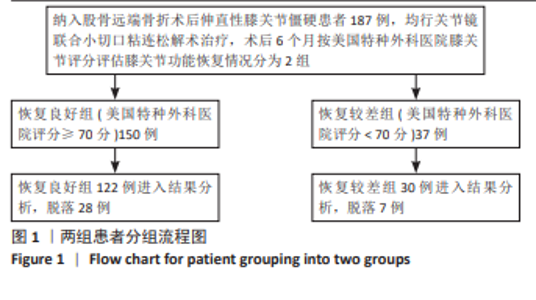
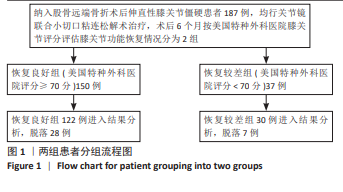
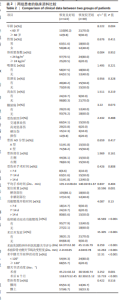
2.1 参与者数量分析 此次研究纳入股骨远端骨折术后伸直性膝关节僵硬患者187例,中途转院及随访资料不完整者脱落35例,最终152例患者进入结果分析,其中恢复良好组122例、恢复较差组30例。 2.2 试验流程图 见图1。 2.3 两组患者的临床资料比较 与恢复良好组相比,恢复较差组年龄≥60岁、非解剖复位、无连续被动运动功能锻炼、术后有并发症、术中膝关节屈伸活动度< 120°的患者比例以及术前胫骨内侧关节线改变程度均更高(P < 0.05),术前美国特种外科医院膝关节评分、手术前后膝关节活动度均更低(P < 0.05)。两组其余指标比较均无统计学差异(P > 0.05)。见表2。"
"
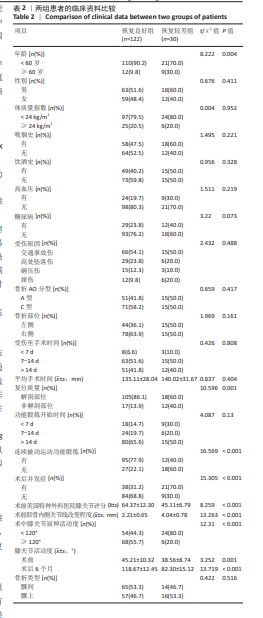
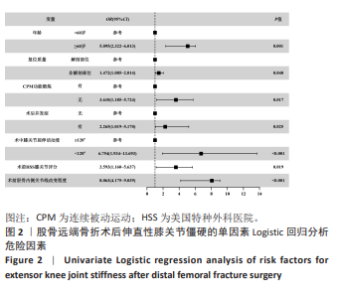
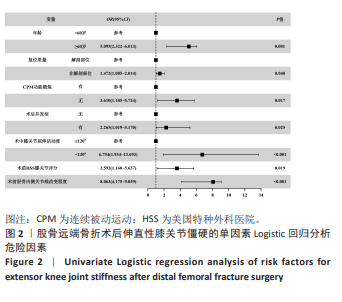
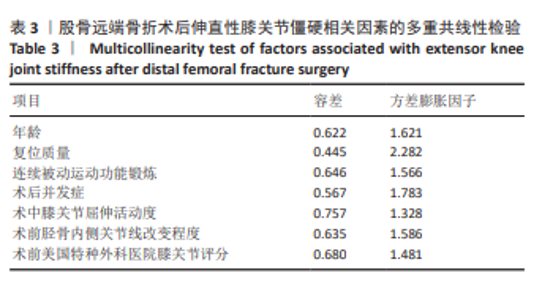
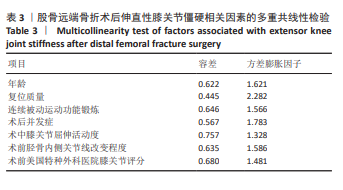
2.4 单因素Logistic回归分析危险因素 将年龄、复位质量、连续被动运动功能锻炼、术后并发症、术中膝关节屈伸活动度、术前胫骨内侧关节线改变程度、术前美国特种外科医院膝关节评分等7个可能与膝关节屈伸功能恢复相关的因素作为自变量纳入单因素Logistic回归分析是,上述7个因素的单因素分析结果显示均有统计学意义(P < 0.05),见图2。 2.5 相关因素的多重共线性检验 多重共线性检验结果显示,纳入的年龄、复位质量、连续被动运动功能锻炼、术后并发症、术中膝关节屈伸活动度、术前胫骨内侧关节线改变程度、术前美国特种外科医院膝关节评分等7个因素容差为0.445-0.757,方差膨胀因子为1.328-2.282,认为多重共线性可能低,见表3。"
"
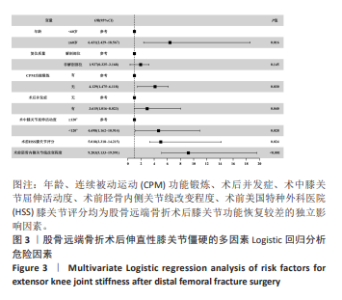
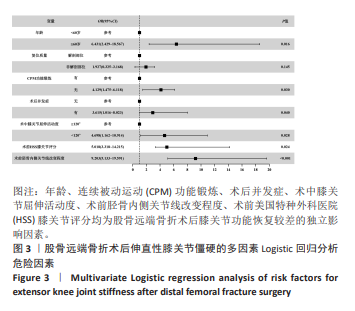
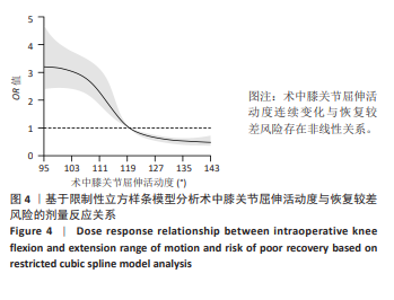
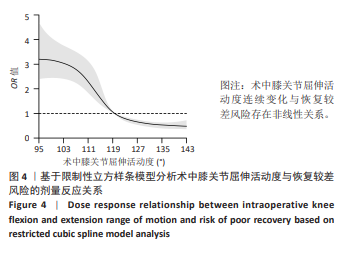
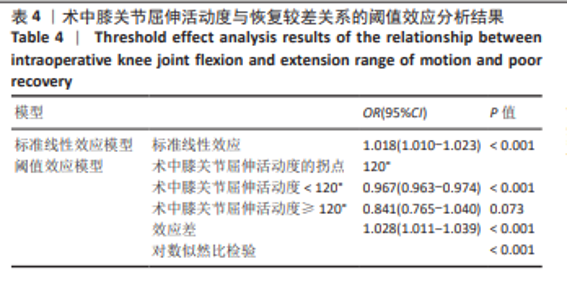
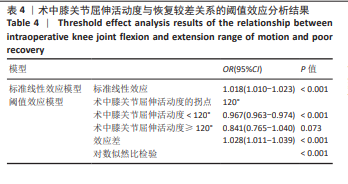
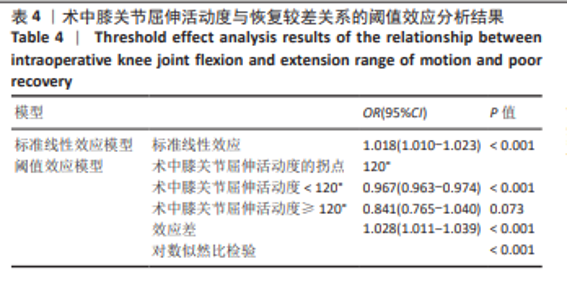
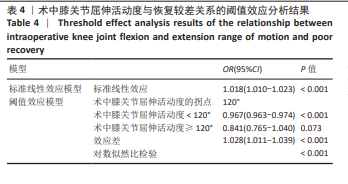
2.6 多因素Logistic回归分析危险因素 通过单因素分析及多重共线性检验,可纳入多因素Logistic回归分析的因素包括年龄、复位质量、连续被动运动功能锻炼、术后并发症、术中膝关节屈伸活动度、术前胫骨内侧关节线改变程度、术前美国特种外科医院膝关节评分,其中复位质量为混杂因素(P > 0.05),年龄、连续被动运动功能锻炼、术后并发症、术中膝关节屈伸活动度、术前胫骨内侧关节线改变程度、术前美国特种外科医院膝关节评分均为恢复较差的独立影响因素(P < 0.05),见图3。上述独立影响因素通过Logistic回归进行模型拟合,得到二元回归方程:Logit(p)=1.657+1.861×年龄+1.418×连续被动运动功能锻炼+1.285×术后并发症+1.547×术中膝关节屈伸活动度+1.613×术前美国特种外科医院膝关节评分+2.220×术前胫骨内侧关节线改变程度。 2.7 术中膝关节屈伸活动度与膝关节屈伸功能恢复较差风险的限制性立方样条分析 限制性立方样条模型横坐标为术中膝关节屈伸活动度的连续变化,纵坐标为预测值(OR),阴影为95%CI,限制性立方样条分析显示,术中膝关节屈伸活动度连续变化与恢复较差风险存在非线性关系(非线性检验P < 0.001),见图4。进一步采用阈值效应分析显示,术中膝关节屈伸活动度影响膝关节屈伸功能恢复较差的折点为120°,即术中膝关节屈伸活动度< 120°时,随着其增大,恢复较差风险显著降低;但当术中膝关节屈伸活动度≥120°时,恢复较差风险几乎不再随其增大而降低,见表4。"
"
"
"
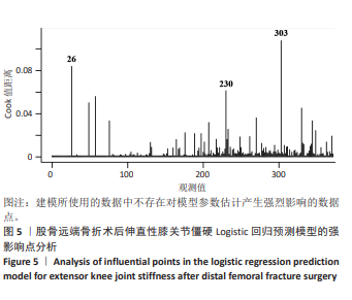
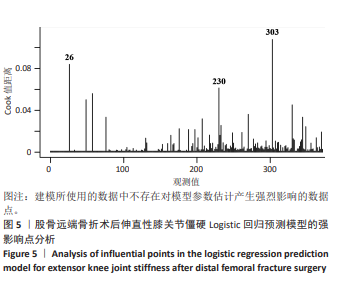
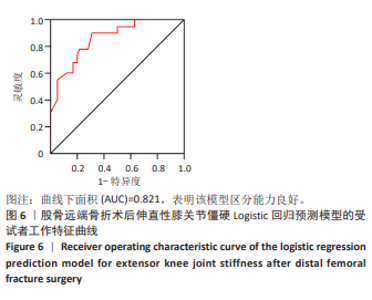
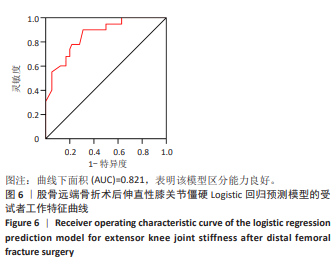
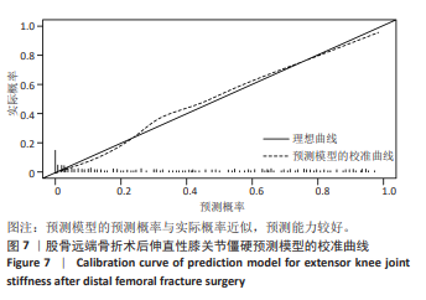
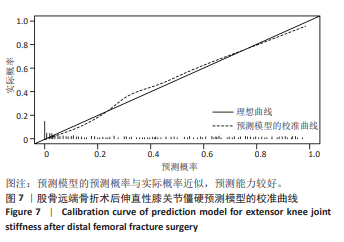
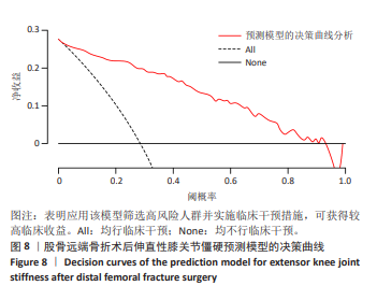
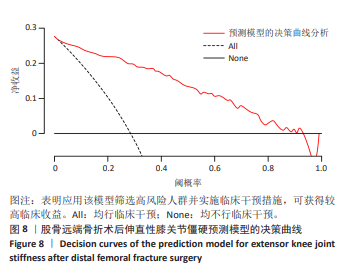
2.8 Logistic回归预测模型的诊断与评价 2.8.1 强影响点分析 对回归模型行强影响点分析,结果显示,Cook距离均< 1,表明建模所使用的数据中不存在对模型参数估计产生强烈影响的数据点,见图5。 2.8.2 评价模型区分度 受试者工作特征曲线分析显示,预测模型的曲线下面积为0.821(95%CI:0.760-0.953),表明其区分能力良好,灵敏度为0.875,特异度为0.764,见图6。 2.8.3 评价模型的预测精度 校准曲线分析显示,预测模型的预测概率与实际概率近似,Brier值=0.097,表明预测能力较好,见图7。 2.8.4 模型的临床可用性评价 决策曲线分析显示,阈概率在0.1-0.9范围内,预测模型的净收益较高。结果表明应用该模型筛选高风险人群并实施临床干预措施,可获得较高的临床收益,见图8。"
"
"
"
| [1] HIDAYAT AY, RIFARDI D, PRIBADI BPP. Surgical options for improving the ipsilateral femoral neck, shaft, and distal femoral fracture: a case report and literature review. Int J Surg Case Rep. 2024;116:109367. [2] LI J, RAI S, ZE R, et al. Pediatric physeal slide-traction plate fixation for pathological distal femoral fracture caused by unicameral bone cyst in adolescents. BMC Musculoskelet Disord. 2020;21(1):503. [3] YEUNG T, AGRAWAL R, SEESAHAI J, et al. A spontaneously healed distal femoral fracture in an infant born preterm: a case report and review of the literature. J Clin Ultrasound. 2024;52(9):1467-1472. [4] FUJITA K, FUJITA K, KAMATA D, et al. Simultaneous osteosynthesis and distal femoral osteotomy in a patient with distal femoral fracture combined with valgus knee deformity: a case report. Cureus. 2024;16(7):e65006. [5] 武文潇, 李勇, 赵跃江, 等. 关节镜联合小切口粘连松解术治疗股骨远端骨折术后伸直性膝关节僵硬疗效观察[J]. 生物医学工程与临床,2018,22(2): 168-173. [6] 刘俊洪, 李彪, 杨毅, 等. 全膝关节置换治疗创伤与非创伤性伸直僵硬膝的疗效对比[J]. 实用骨科杂志,2023,29(1):65-69. [7] 金旭, 金铭亮, 梁西超, 等. 器械辅助软组织松解技术在创伤后膝关节僵硬患者康复治疗中的应用效果[J]. 广西医学,2023,45(18):2196-2200. [8] 井贵龙, 张杨梅, 李书钢, 等. 关节镜松解联合康复训练治疗前交叉韧带重建术后伸直型膝关节僵硬的疗效观察[J]. 中国骨与关节损伤杂志,2022, 37(6):631-633. [9] 陈一鑫, 陈小莉, 王开龙, 等. 伸直型膝关节僵硬外治方法研究进展[J]. 辽宁中医药大学学报,2020,22(2):111-114. [10] 唐兴, 李正刚, 段于平, 等. CR假体在TKA治疗伸直型膝关节僵硬的中短期疗效观察[J]. 昆明医科大学学报,2020,41(10):85-90. [11] ZHONG H, JIN Y, LIU X, et al. Short-term effectiveness of high tibial osteotomy combined with arthroscopic surgery for knee varus arthritis and the results of secondary arthroscopic exploration. Zhongguo Xiu Fu Chong Jian Wai Ke Za Zhi. 2022;36(8):969-975. [12] XU J, BIAN F. Pain-related risk factors after arthroscopic minimally invasive treatment of meniscus injury of knee joints. Exp Ther Med. 2020;20(3):2317-2324. [13] 范步新, 杜尧, 孟繁星, 等. 关节镜下松解术联合关节腔“鸡尾酒”注射治疗糖尿病并粘连性肩关节囊炎的临床效果[J]. 临床误诊误治,2025,38(13): 52-56. [14] 崔志刚, 刘四海, 王飞, 等. 特发性和继发性肩关节僵硬关节镜下松解手术疗效及其影响因素分析[J]. 中国骨与关节损伤杂志,2025,40(1):38-45. [15] NATOUR A, DOYLE E, DEDIO R, et al. Temporal bone fracture related facial palsy: efficacy of decompression with and without grafting. Curr Opin Otolaryngol Head Neck Surg. 2024;32(5):294-300. [16] 崔志刚, 晋陶然, 刘四海, 等. 创伤后膝关节松解术后关节活动度反弹现象及其影响因素[J]. 中国康复理论与实践,2024,30(5):565-569. [17] 丁韶龙, 康波, 李志军. 膝骨关节炎患者全膝关节置换后关节功能恢复影响因素分析[J]. 新乡医学院学报,2020,37(6):563-565. [18] 洪顾麒, 吕天润, 张宇, 等. 可变体位下双入路,双平台内固定治疗“Schatzker IV型过中线”胫骨平台骨折的疗效[J]. 中华创伤杂志,2025,41(6):580-586. [19] 周明敏, 谢敏, 何军, 等. 微创经皮钢板固定技术结合微创内固定系统钢板治疗股骨远端骨折后膝关节功能疗效观察[J]. 中国临床医生杂志, 2020, 48(11):1339-1342. [20] 赵洪波, 徐志强, 曹成明, 等. 非接触锁定钢板(NCB)结合MotionLoc螺钉内固定治疗股骨下段骨折31例[J]. 生物骨科材料与临床研究,2022,19(2):77-81. [21] 侍朋举, 孙柏山, 张瑞杰, 等. 髓内外联合固定治疗股骨干骨折合并股骨远端C型骨折[J]. 实用骨科杂志,2020,26(4):364-367. [22] BLISS J, DAN BI, NITHYANANTH M, et al. Quadriceps-splitting midline approach in the treatment of distal femur infected nonunion with stiff knee and severely scarred soft tissues. Int J Res Orthop. 2020;6(2):1-5. [23] ENDO N, AOYAMA T, YAMAMOTO S, et al. Factors associated with stiff knee gait in patients with knee osteoarthritis. J Orthop. 2024;64:81-85. [24] PUTMAN S, ANDRÉ PA, PASQUIER G, et al. Revision for stiff knee after knee replacement. Orthop Traumatol Surg Res. 2025;111(1S):104060. [25] STOWERS JA, DAY DS, JOW S, et al. The relationship between stiff knee gait runner’s dystonia and musculoskeletal knee pathology: a case series. Toxins (Basel). 2025;17(3):121. [26] 郭明霞. 胫骨平台骨折术后膝关节僵硬危险因素分析[J]. 河南外科学杂志, 2021,27(6):87-89. [27] 王浩然, 王晗, 纪振钢, 等. CT囊性征在高能量损伤致股骨干骨折并发同侧隐匿性股骨颈骨折的诊断价值研究[J]. 生物骨科材料与临床研究,2023, 20(5):55-58. [28] 郝治龙, 樊俊俊, 张少宁, 等. 股骨干骨折术后骨不连的相关危险因素分析[J]. 中华创伤骨科杂志,2022,24(9):824-828. [29] 杨金松, 向明, 张清, 等. 关节镜联合切开松解术治疗创伤后肘关节重度及极重度僵硬[J]. 中华骨科杂志,2022,42(4):236-243. [30] 崔志刚, 晋陶然, 刘四海, 等. 创伤后膝关节松解术后关节活动度反弹现象及其影响因素[J]. 中国康复理论与实践,2024,30(5):565-569. [31] 方平, 张也, 郁诗阳, 等. 上肢康复机器人对关节镜下肘关节松解术后肘部功能恢复的作用[J]. 中华骨科杂志,2025,45(13): 872-878. [32] 李虎, 李儒军, 陶可, 等. 股四头肌V-Y成形技术在僵直或强直膝TKA术中的应用[J]. 生物骨科材料与临床研究,2021,18(1):91-94. [33] 刘霄阳, 陈绪明, 赵恩泽, 等. 初次全膝关节置换中应用股四头肌V-Y成形术暴露强直或僵硬膝关节[J]. 中华骨科杂志,2024,44(9):587-593. [34] SAHOO PK, DEB S, SINGH DK, et al. Outcomes of V-Y quadricepsplasty for the management of genu recurvatum deformity in congenital dislocation knee. Indian J Phys Med Rehabil. 2024;34(2):107-111. [35] 邓盼, 徐云钦. 创伤后膝关节僵硬治疗时机与治疗方式选择[J]. 中国骨与关节损伤杂志,2021,36(12):1258-1261. [36] 马佳, 张磊, 朱立国, 等. 肩袖缝合同期关节镜下360°松解治疗肩袖损伤合并全方位肩关节粘连[J]. 中国骨伤,2020,33(4):348-352. [37] POLAT B, GURPINAR T, POLAT AE, et al. Factors influencing the functional outcomes of tibia plateau fractures after surgical fixation. Niger J Clin Pract. 2019; 22(12):1715-1721. [38] 何心蕊, 胡冲, 邵先舫. 健脾益气汤联合持续被动运动对膝关节前交叉韧带重建术后功能锻炼的影响[J]. 山西医药杂志,2022,51(22):2540-2543. [39] 曹力, 张斌, 沈权虎, 等. 股骨骨折康复中持续被动运动机训练联合持续被动运动锻炼的效果[J]. 中国临床医生杂志,2025,53(6):764-767. [40] HASSANABAD AF, ZARZYCKI AN, JEON K, et al. Prevention of post-operative adhesions: a comprehensive review of present and emerging strategies. Biomolecules. 2021;11(7):1027. [41] 黄淑明, 兰树华, 郑荣宗, 等. 股骨远端骨折术后伸直性膝关节僵硬的治疗及影响因素分析[J]. 中国骨与关节损伤杂志,2013,28(7):644-646. [42] 杨赞礼, 袁跃群, 谢剑新, 等. 胫骨内侧关节线改变程度对单髁置换术患者膝关节屈伸功能的影响[J]. 中国骨与关节损伤杂志,2020,35(2):134-136. [43] 杨伶俐, 廖淑梅, 任辉. 单侧人工全膝关节置换术后患者的功能性活动能力及影响因素分析[J]. 第三军医大学学报,2021,43(6):560-566. [44] CLAES A, VERBORGT O, DIJCK EV, et al. A dutch translation of the hospital for special surgery shoulder expectation survey (HSS-ES) for preoperative assessment in total shoulder arthroplasty patients. Acta Orthop Belg. 2024; 90(4):645-650. [45] MIRGHADERI P, AZARBOO A, GHASEMINEJAD-RAEINI A, et al. Translation, cross-cultural adaptation, and validation of the Persian version of the Hospital for Special Surgery Anterior Cruciate Ligament Postoperative Satisfaction Survey. Knee. 2024;49:17-26. [46] DENISOV A, ZABOROVSKII N, SOLOVYOV V, et al. Reliability and validity of adapted russian version of hospital for special surgery lumbar spine surgery expectations survey. HSS J. 2022;18(3):351-357. [47] 吴海琴, 邱名耀, 鄞晓斌, 等. 基于Logistic回归模型分析急性类鼻疽脓毒症患者预后不良的危险因素[J]. 临床和实验医学杂志,2023,22(5):469-473. [48] LI Y, WANG QY, TIAN QH, et al. Prediction of renal function by urinary lead and cadmium-based on classification decision tree and Logistic regression model. Biomed Environ Sci. 2024;37(3):331-335. [49] LU F. Online shopping consumer perception analysis and future network security service technology using logistic regression model. PeerJ Comput Sci. 2024;10: e1777. [50] QIN X, HUNG J, KNUIMAN MW, et al. Comparison of medication adherence measures derived from linked administrative data and associations with mortality using restricted cubic splines in heart failure patients. Pharmacoepidemiol Drug Saf. 2020;29(2):208-218. [51] DISCACCIATI A, PALAZZOLO MG, PARK JG, et al. Estimating and presenting non-linear associations with restricted cubic splines. Int J Epidemiol. 2025;54(4): dyaf088. [52] AUSTIN PC, FANG J, LEE DS. Using fractional polynomials and restricted cubic splines to model non-proportional hazards or time-varying covariate effects in the Cox regression model. Stat Med. 2022;41(3):612-624. [53] XU Y, HAN D, XU F, et al. Using restricted cubic splines to study the duration of antibiotic use in the prognosis of ventilator-associated pneumonia. Front Pharmacol. 2022;13:898630. |
| [1] | Zhou Jian, Zhang Tao, Zhou Weili, Zhao Xingcheng, Wang Jun, Shen Jie, Qian Li, Lu Ming. Effects of resistance training on quadriceps mass and knee joint function in patients with osteoporosis and sarcopenia [J]. Chinese Journal of Tissue Engineering Research, 2026, 30(5): 1081-1088. |
| [2] | Yu Xinlin, Chen Huiyu, Wang Yingying, Guo Weizhong, Feng Bin Lin Chengshou, Lin Wang. Finite element analysis of internal fixation with new retrograde intramedullary nail on lateral femur condyle for distal type A2 femur fractures [J]. Chinese Journal of Tissue Engineering Research, 2026, 30(3): 546-552. |
| [3] | Wang Zhipeng, Zhang Xiaogang, Zhang Hongwei, Zhao Xiyun, Li Yuanzhen, Guo Chenglong, Qin Daping, Ren Zhen. A systematic review of application value of machine learning to prognostic prediction models for patients with lumbar disc herniation [J]. Chinese Journal of Tissue Engineering Research, 2026, 30(3): 740-748. |
| [4] | Qu Bolin, Ciren Lunzhu, Guo Jinyang, Meng Hanlu, Ding Guanxiang, Sang Hongpeng. Osteoporotic vertebral compression fractures: a visual analysis of current status and emerging trends [J]. Chinese Journal of Tissue Engineering Research, 2026, 30(23): 6040-6050. |
| [5] | Cui Pengfei, Wen Zhangkun, Chen Fengjiang, Wang Zhen, Wang Changyao. Unicompartmental knee arthroplasty for severe medial compartment osteoarthritis with moderate lateral involvement: clinical outcomes [J]. Chinese Journal of Tissue Engineering Research, 2026, 30(21): 5452-5459. |
| [6] | He Zhiyu, Wan Zhihong, Huang Yu, Liu Anming, Wu Jiaqi, Wang Guoyou, Zhang Lei, Chen Xiaojun. Application of correction leverage technique in primary failure of distal locking screw during antegrade femoral intramedullary nailing [J]. Chinese Journal of Tissue Engineering Research, 2026, 30(21): 5503-5509. |
| [7] | Chen Feijun, Chen Yingguo, Li Zhengyang, Hu Yuan, Li Fang. Predictive efficacy of machine learning models for postoperative prognosis in older adult patients with acute intracerebral hemorrhage [J]. Chinese Journal of Tissue Engineering Research, 2026, 30(16): 4045-4053. |
| [8] | Liu Haoyang, Li Hongxu, Zhou Yu, Yue Debo, Wang Bailiang, Ma Jinhui. Differences in clinical function and imaging between robot-assisted and conventional total knee arthroplasty [J]. Chinese Journal of Tissue Engineering Research, 2026, 30(15): 3936-3945. |
| [9] | Sun Meilan, Zhao Xiaoliang, Yan Tianyuan, Zhang Shizhe, Niu Guochang, Guan Yulong, Li Hua. Correlation between quantitative indicators of three-dimensional deformity of the first metatarsal bone and functional prognosis after osteotomy and orthopedic treatment in patients with hallux valgus deformity [J]. Chinese Journal of Tissue Engineering Research, 2026, 30(15): 3855-3861. |
| [10] | Wang Juan, Wang Guanglan, Zuo Huiwu. Efficacy of exercise therapy in the treatment of anterior cruciate ligament reconstruction patients: #br# a network meta-analysis #br# [J]. Chinese Journal of Tissue Engineering Research, 2025, 29(8): 1714-1726. |
| [11] | Yang Bo, Pan Xinfang, Chang Liuhui, Ni Yong. Correlation of echocardiographic parameters with disability at 3 months after acute ischemic stroke [J]. Chinese Journal of Tissue Engineering Research, 2025, 29(35): 7544-7551. |
| [12] | Wang Rongqiang, Yang Liu, Wu Xiangkun, Shang Lilin. Analysis of factors associated with prognosis of osteoporosis patients after hip arthroplasty and construction of Nomogram prediction model [J]. Chinese Journal of Tissue Engineering Research, 2025, 29(33): 7137-7142. |
| [13] | Jiang Tao, Zhang Chuankai, Hao Liang, Liu Yong. MAKO robot- and navigation-assisted knee replacement: comparison of lower limb force alignment and prosthesis position accuracy [J]. Chinese Journal of Tissue Engineering Research, 2025, 29(33): 7150-7157. |
| [14] | Wang Jiaru, Zhang Ying, Yang Yong, Qi Wen, Xiao Huaye, Ma Qiuping, Yang Lianzhao, Luo Ziwei, He Yaqing, Zhang Jiangyin, Wei Jiawen, Meng Yuan, Tan Silian. Systematic review of machine learning models for predicting functional recovery and prognosis in stroke [J]. Chinese Journal of Tissue Engineering Research, 2025, 29(29): 6317-6325. |
| [15] | Lin Rongqin, Pan Xiuxie, Bian Lihong. Bioinformatic analysis on expression of Foxp3 in tumor microenvironment of ovarian cancer and its relationship with survival prognosis [J]. Chinese Journal of Tissue Engineering Research, 2025, 29(29): 6343-6350. |
| Viewed | ||||||
|
Full text |
|
|||||
|
Abstract |
|
|||||