Chinese Journal of Tissue Engineering Research ›› 2026, Vol. 30 ›› Issue (27): 7160-7166.doi: 10.12307/2026.408
Previous Articles Next Articles
Impact of lesser trochanter displacement on hip function following minimally invasive intramedullary nailing for geriatric intertrochanteric fractures
Peng Guofei1, Zhai Yifa2, Lu Shuang1, Jiang Kundou3, Zhang Bin3, Zhang Yi3, She Rongfeng3
- 1Guizhou University of Traditional Chinese Medicine, Guiyang 550025, Guizhou Province, China; 2Department of Orthopedics and Traumatology, Liupanshui Hospital of Traditional Chinese Medicine, Liupanshui 553001, Guizhou Province, China; 3Department of Emergency Surgery, Guizhou Provincial People's Hospital, Guiyang 550002, Guizhou Province, China
-
Received:2025-09-25Accepted:2025-11-14Online:2026-09-28Published:2026-05-22 -
Contact:She Rongfeng, Associate chief physician, Master’s supervisor, Department of Emergency Surgery, Guizhou Provincial People’s Hospital, Guiyang 550002, Guizhou Province, China -
About author:Peng Guofei, MS candidate, Guizhou University of Traditional Chinese Medicine, Guiyang 550025, Guizhou Province, China -
Supported by:Guizhou Provincial Science and Technology Project, No. LC[2024]015 (to SRF); Guizhou Provincial Science and Technology Project, No. LC[2025]028 (to ZY); Guizhou Provincial Health Commission Science and Technology Fund Project, No. gzwkj2024-167 (to ZB)

CLC Number:
Cite this article
Peng Guofei, Zhai Yifa, Lu Shuang, Jiang Kundou, Zhang Bin, Zhang Yi, She Rongfeng. Impact of lesser trochanter displacement on hip function following minimally invasive intramedullary nailing for geriatric intertrochanteric fractures[J]. Chinese Journal of Tissue Engineering Research, 2026, 30(27): 7160-7166.
share this article
Add to citation manager EndNote|Reference Manager|ProCite|BibTeX|RefWorks
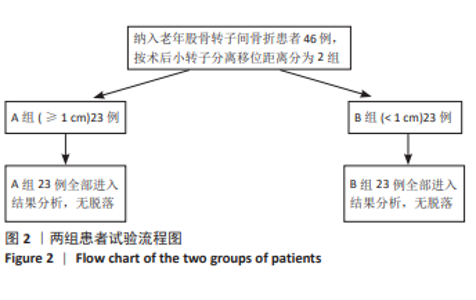
2.1 参与者数量分析 观察期内共筛查52例老年股骨转子间骨折髓内钉内固定患者的病历资料,46例患者符合要求。46例患者根据术后X射线片小转子分离移位距离分为≥1 cm组(A组)和< 1 cm组(B组),每组23例。所有入组患者都完成了为期12个月的随访。 2.2 试验流程图 见图2。 "
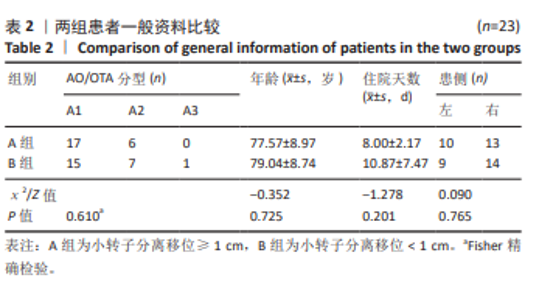
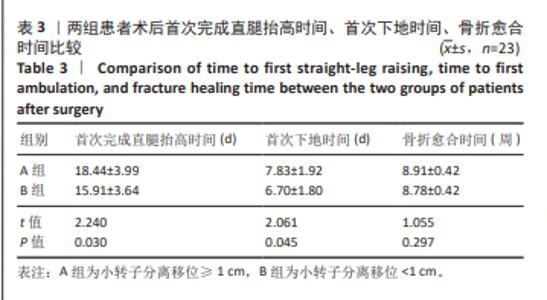
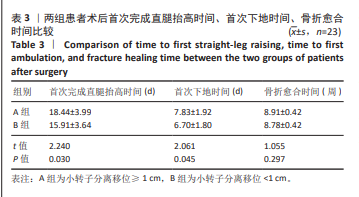
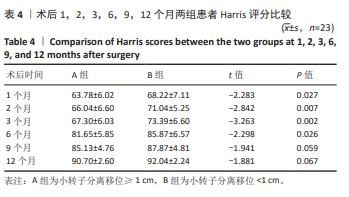
2.3 基线资料比较 两组患者AO/OTA分型、年龄、住院天数、患侧等一般资料比较,差异均无显著性意义(P > 0.05),组间具有可比性,见表2。 2.4 两组患者首次完成直腿抬高时间、首次下地时间、骨折愈合时间比较 术后首次完成直腿抬高时间A组为(18.44±3.99) d,B组为(15.91±3.64) d,差异有显著性意义(P=0.030);术后首次下地时间A组为(7.83±1.92) d,B组为(6.70±1.80) d,差异有显著性意义(P=0.045)。骨折愈合时间A组为(8.91±0.42)周,B组为(8.78±0.42)周,差异无显著性意义(P=0.297)。具体数据分析见表3。 2.5 两组患者Harris评分比较 术后1,2,3,6个月,两组Harris功能评分比较差异均有显著性意义(P < 0.05),术后9,12个月两组Harris功能评分无明显差异(P > 0.05),数据分析见表4。"
"

"
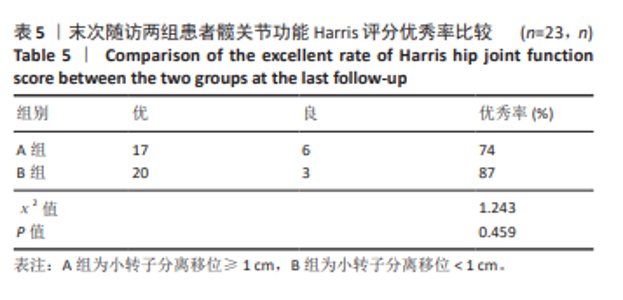
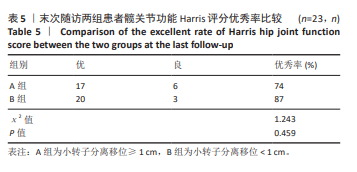
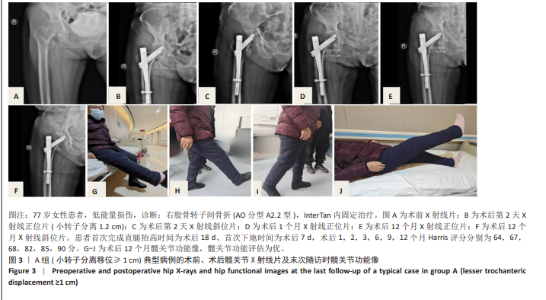
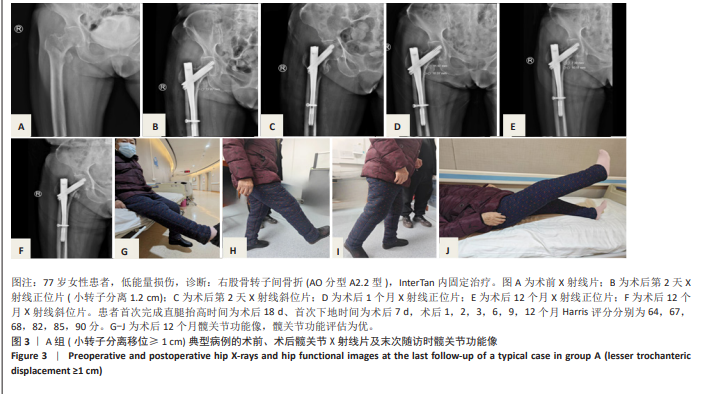
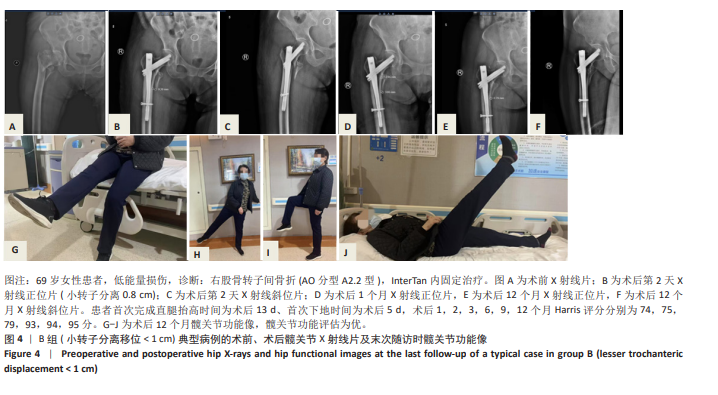
末次随访时评估髋关节Harris评分,A组优17例(90-100分),良6例(80-89分),优秀率为74%;B组优20例(90-100分),3例(80-89分),优秀率为87%,两组差异无显著性意义(P > 0.05),见表5。 2.6 典型病例 两组典型病例见图3,4。 2.7 不良事件 此次试验所使用的髓内钉的生物相容性良好,观察期内所有患者未发现植入物周围感染、过敏反应、免疫反应及排斥反应等。"
"

"
| [1] 李宁, 李新萍, 杨明辉, 等. 老年髋部骨折的骨质疏松症诊疗专家共识[J]. 中华骨与关节外科杂志,2021,14(8):657-663. [2] SAMBANDAM SN, CHANDRASEKHARAN J, MOUNASAMY V, et al. Intertrochanteric fractures: a review of fixation methods. Eur J Orthop Surg Traumatol. 2016;26: 339-353. [3] CHEUNG CL, ANG SB, CHADHA M, et al. An updated hip fracture projection in Asia: The Asian Federation of Osteoporosis Societies study. Osteoporos Sarcopenia. 2018;4(1):16-21. [4] 中华人民共和国国家卫生健康委员会医政司.老年髋部骨折诊疗与管理指南(2022年版)[J].骨科临床与研究杂志,2023,8(2):77-83. [5] MAHESHWARI K, PLANCHARD J, YOU J, et al. Early Surgery Confers 1-Year Mortality Benefit in Hip-Fracture Patients. J Orthop Trauma. 2018;32(3):105-110. [6] 郭金超,曹源,黄俊灵,等.股骨转子间骨折618例患者的流行病学分析[J].中国组织工程研究,2019,23(12):1840-1845. [7] 翁友林,蔡昱,李祖涛,等.老年股骨转子间骨折术后严重并发症预测模型的构建及验证[J].中国组织工程研究,2023,27(18):2915-2920. [8] 姚金龙,李益亮,冯海波,等.股骨近端防旋髓内钉联合补肾活血方治疗老年股骨不稳定型转子间骨折的临床观察[J].湖南中医药大学学报,2023, 43(1):143-147. [9] MEDDA S, SULLIVAN RJ, MARQUEZ-LARA A, et al. Treatment of Peritrochanteric Femur Fractures With Proximal Femur Locked Plating. J Orthop Trauma. 2019; 33(7):341-345. [10] PARKER MJ, CAWLEY S. Sliding hip screw versus the Targon PFT nail for trochanteric hip fractures: a randomised trial of 400 patients. Bone Joint J. 2017; 99-B(9):1210-1215. [11] 中国脆性骨折联盟, 中国老年医学学会骨与关节分会创伤骨科学术工作委员会, 白求恩骨科加速康复联盟, 等. 老年股骨转子间骨折诊疗指南[J]. 中华创伤骨科杂志,2020,22(2):93-99. [12] HUI Y, ZENG G, LIU P, et al. Application of lesser trochanteric reduction fixator in the treatment of unstable intertrochanteric fractures. World J Clin Cases. 2023;11(25): 5863-5869. [13] YANG AL, MAO W, WU JG, et al. When to Reduce and Fix Displaced Lesser Trochanter in Treatment of Trochanteric Fracture: A Systematic Review. Front Surg. 2022;9:855851. [14] EHRNTHALLER C, OLIVIER AC, GEBHARD F, et al. The role of lesser trochanter fragment in unstable pertrochanteric A2 proximal femur fractures - is refixation of the lesser trochanter worth the effort? Clin Biomech (Bristol). 2017;42:31-37. [15] YAM M, CHAWLA A, KWEK E. Rewriting the tip apex distance for the proximal femoral nail anti-rotation. Injury. 2017;48(8):1843-1847. [16] YANG X, WU Q, WANG X. Investigation of perioperative hidden blood loss of unstable intertrochanteric fracture in the elderly treated with different intramedullary fixations. Injury. 2017;48(8):1848-1852. [17] REDDY AVG, EACHEMPATI KK, MUGALUR A, et al. Undisplaced Intraoperative Fracture Presenting as Early Dislocation with Tapered Wedge Stems in Total Hip Arthroplasty - Case Series and Review of Literature. J Orthop Case Rep. 2017; 7(3):31-34. [18] 王晓伟,郭永智,征华勇,等.对Inter-TAN治疗老年股骨转子间骨折的失效原因分析[J].骨科临床与研究杂志,2022,7(6):323-327,333. [19] OH S, KIM YS, KWON SY, et al. Additional use of anti-rotation U-blade (RC) decreases lag screw sliding and limb length inequality in the treatment of intertrochanteric fractures. Sci Rep. 2021;11(1):17417. [20] KANWAT H, TRIKHA V, MITTAL S, et al. Risk Factors Associated With Cephalomedullary Nail Cutout in the Treatment of Trochanteric Hip Fractures. J Orthop Trauma. 2018;32(9):e385-e386. [21] 赵晓涛,张殿英,郁凯,等.股骨近端防旋髓内钉固定治疗股骨转子间骨折的失效原因分析[J].中华创伤骨科杂志,2021,23(3):202-208. [22] 征华勇,高杰,刘智,等.髓内钉治疗老年股骨转子间骨折失效原因及危险因素分析[J].创伤外科杂志,2025,27(5):353-358. [23] LI P, LV Y, ZHOU F, et al. Medial wall fragment involving large posterior cortex in pertrochanteric femur fractures: a notable preoperative risk factor for implant failure. Injury. 2020;51(3):683-687. [24] SCHENKEL M, KANIEWSKA M, BÜHLER T, et al. No difference in flexion power despite iliopsoas fatty degeneration in healed hip fractures with large lesser trochanter displacement. Eur J Orthop Surg Traumatol. 2018;28(7):1313-1319. [25] NISHIDA T, FUJIKAWA Y, NAGAMUNE Y. The Impact of Lesser Trochanter Displacement on Hip Flexor Strength Recovery in Patients With Trochanteric Fracture. Cureus. 2024;16(11):e73095. [26] KANIEWSKA M, SCHENKEL M, EID K, et al. Anatomy-based MRI assessment of the iliopsoas muscle complex after pertrochanteric femoral fracture. Skeletal Radiol. 2019;48(3):421-428. [27] REN H, AO R, WU L, et al. Effect of lesser trochanter posteromedial wall defect on the stability of femoral intertrochanteric fracture using 3D simulation. J Orthop Surg Res. 2020;15(1):242. [28] 马瑞, 葛莹, 王坤正, 等. 小转子重建人工股骨头置换治疗高龄Evans-Ⅲ型股骨转子间骨折[J]. 中国组织工程研究,2024,28(12):1880-1884. [29] 郭晓泽, 章莹, 肖进, 等. 股骨小转子复位固定器的设计与临床应用[J]. 中国修复重建外科杂志,2015,29(2):133-137. [30] CHO SH, LEE SH, CHO HL, et al. Additional fixations for sliding hip screws in treating unstable pertrochanteric femoral fractures (AO Type 31-A2): short-term clinical results. Clin Orthop Surg. 2011;3(2):107-113. [31] PURAM C, PRADHAN C, PATIL A, et al.Outcomes of dynamic hip screw augmented with trochanteric wiring for treatment of unstable type A2 intertrochanteric femur fractures. Injury. 2017;48 Suppl 2:S72-S77. [32] YE KF, XING Y, SUN C, et al. Loss of the posteromedial support: a risk factor for implant failure after fixation of AO 31-A2 intertrochanteric fractures. Chin Med J (Engl). 2020;133(1):41-48. [33] 储传兵, 王铜善, 宋体忠. 股骨近端防旋髓内钉联合钢丝固定小转子治疗老年转子间骨折的效果及对患者下床时间和术后并发症发生率的影响[J]. 当代医学,2023,22(29):80-83. [34] HUI YM, ZENG G, LIU PY, et al. Application of lesser trochanteric reduction fixator in the treatment of unstable intertrochanteric fractures. World J Clin Cases. 2023;11(25):5863-5869. [35] 黄显锋. 小转子复位固定在股骨转子间骨折治疗中的临床意义[J]. 世界最新医学信息文摘,2018,18(87):49-57. [36] 薛鸣丰, 戴加平, 陈刚. 后外侧人路解剖复位固定小转子在老年人股骨转子间骨折治疗中的应用[J]. 中华老年医学杂志,2019,9(38):1028-1032. [37] 林贞桦, 贺嘉男, 刘兴漠. 动力髋螺钉联合复位固定小转子预防股骨转子间骨折髋内翻的Meta分析[J]. 中国组织工程研究,2015,31(19):5065-5071. [38] SCHOPPER C, FASCHINGBAUER M, MOELLER RT, et al. Modified Candy-Package technique vs Cerclage technique for refixation of the lesser trochanteric fragment in pertrochanteric femoral fractures. A biomechanical comparison of 10 specimens. Injury. 2020;51(8):1763-1768. [39] KIM GM, NAM KW, SEO KB, et al. Wiring technique for lesser trochanter fixation in proximal IM nailing of unstable intertrochanteric fractures: A modified candy-package wiring technique. Injury. 2017;48(2):406-413. [40] USAMI T, TAKADA N, NISHIDA K, et al. Banding with lesser trochanter fragment using nonabsorbable tape in trochanteric femoral fractures. SICOT J. 2021;7:33. [41] 吕发明,程国杰,陈平波,等.老年股骨转子间骨折伴小转子移位大于2cm行小转子复位固定对髋关节功能的影响:前瞻随机对照[J].中国组织工程研究与临床康复,2011,15(52):9750-9755. [42] 张雪鹏, 杨金锁. 小转子未固定的PFNA治疗Evans-Jensen Ⅲ型转子间骨折的有限元分析[J]. 科学技术与工程,2016,16(15):144-148. [43] APRATO A, LO BAIDO R, CROSIO A, et al. Does lesser trochanter implication affect hip flexion strength in proximal femur fracture? Eur J Trauma Emerg Surg. 2015;41(5):523-529. [44] LIU X, LIU Y, PAN S, et al. Does integrity of the lesser trochanter influence the surgical outcome of intertrochanteric fracture in elderly patients?. BMC Musculoskelet Disord. 2015;16:47. [45] NORCROSS KN, PEARSON JR. Movement of the lesser trochanter in pertrochanteric fracture. Postgrad Med J. 1966;42(483):16-19. [46] SUN Q, GE W, HU H, et al. The Influence of Position of the Displaced Lesser Trochanter on Clinical Outcome of Unstable Trochanteric Femur Fractures in the Elderly. Biomed Res Int. 2018;2018:5013646. [47] SCHENKEL M, KANIEWSKA M, BÜHLER T, et al. No difference in flexion power despite iliopsoas fatty degeneration in healed hip fractures with large lesser trochanter displacement. Eur J Orthop Surg Traumatol. 2018;28(7):1313-1319. [48] VAN DER SIJP MPL, MOONEN L, SCHIPPER IB, et al. The functional effect of lesser trochanter involvement in hip fractures: A prospective cohort study. Injury. 2020;51(11):2634-2639. [49] NISHIDA T, FUJIKAWA Y, NAGAMUNE Y. The Impact of Lesser Trochanter Displacement on Hip Flexor Strength Recovery in Patients With Trochanteric Fracture. Cureus. 2024;16(11):e73095. [50] SUN D, PARK BS, JANG GI, et al. The Fixation Method according to the Fracture Type of the Greater Trochanter in Unstable Intertrochanteric Fractures Undergoing Arthroplasty. Hip Pelvis. 2017;29(1):62-67. [51] GAO F, ZHOU W, XIE M, et al. Proximal femoral nail antirotation combined with normalized anti-osteoporosis drugs in treatment of elderly patients with osteoporotic femoral intertrochanteric fractures. Zhonghua Wai Ke Za Zhi. 2017; 38(4):437-442. |
| [1] | Cheng Qisheng, Julaiti·Maitirouzi, Xiao Yang, Zhang Chenwei, Paerhati·Rexiti. Finite element analysis of novel variable-diameter screws in modified cortical bone trajectory of lumbar vertebrae [J]. Chinese Journal of Tissue Engineering Research, 2026, 30(9): 2162-2171. |
| [2] | Rao Jingcheng, Li Yuwan, Zheng Hongbing, Xu Zhi, Zhu Aixiang, Shi Ce, Wang Bing, Yang Chun, Kong Xiangru, Zhu Dawei. Biomechanical differences between the new proximal femoral stable intramedullary nail and traditional intramedullary nail#br# [J]. Chinese Journal of Tissue Engineering Research, 2026, 30(9): 2217-2225. |
| [3] | Zhao Feifan, Cao Yujing. Risk factors and coping strategies of internal fixation failure in treatment of intertrochanteric fracture with proximal femoral nail antirotation [J]. Chinese Journal of Tissue Engineering Research, 2026, 30(9): 2323-2333. |
| [4] | Yu Xinlin, Chen Huiyu, Wang Yingying, Guo Weizhong, Feng Bin Lin Chengshou, Lin Wang. Finite element analysis of internal fixation with new retrograde intramedullary nail on lateral femur condyle for distal type A2 femur fractures [J]. Chinese Journal of Tissue Engineering Research, 2026, 30(3): 546-552. |
| [5] | Xu Xinbao, Chen Feiyang, Chen Yinbing, Zhang Feixiang, Lyu Shujun, Cui Haidong, Chen Zhigang. Univariate and multivariate regression analysis of femoral neck shortening after cannulated screw fixation in femoral neck fractures [J]. Chinese Journal of Tissue Engineering Research, 2026, 30(3): 620-625. |
| [6] | Liao Long, Zhao Zepeng, Li Zongyuan, Yu Qinglong, Zhang Tao, Tang Jinyuan, Ye Nan, Xu Han, Shi Bo. Establishment and validation of a model for femoral head necrosis after internal fixation of femoral neck fracture using logistic regression and SHAP analysis [J]. Chinese Journal of Tissue Engineering Research, 2026, 30(3): 626-633. |
| [7] | Wang Peng, Li Zhijun, Zhang Shaojie, Wu Yimin. Intervertebral disc rehydration after posterior lumbar dynamic internal fixation [J]. Chinese Journal of Tissue Engineering Research, 2026, 30(3): 711-720. |
| [8] | Chen Ping, Lu Hongxu, Xilinbaoleri. Finite element analysis of effects of opening wedge high tibial osteotomy on knee joint and internal fixation stress [J]. Chinese Journal of Tissue Engineering Research, 2026, 30(27): 6969-6977. |
| [9] | Zhang Le, Julaiti·Maitirouzi, Xie Xuechen, Li Chunchao, Wang Yixi, Parhat·Rexiti. Finite element analysis of biomechanical performance of a novel double-screw technique in lumbar revision of the original fixed segment [J]. Chinese Journal of Tissue Engineering Research, 2026, 30(27): 6985-6994. |
| [10] | Liu Mingxiang, Zhou Zulong, Fang Run, Kong Lingchao, Wu Chaofan, Wu Chaoqun, Zhang Chengnan, Ning Rende. Finite element analysis of five internal fixation strategies for Schatzker IV tibial plateau fractures [J]. Chinese Journal of Tissue Engineering Research, 2026, 30(27): 7002-7008. |
| [11] | Zhou Yunfan, Meng Xiangqi, Shen Chenxiao. Finite element analysis of two fixation methods for Salter-Harris type II distal radius epiphyseal fracture in children [J]. Chinese Journal of Tissue Engineering Research, 2026, 30(27): 7009-7014. |
| [12] | Xie Xuechen, Julaiti·Maitirouzi, Li Chunchao, Zhang Le, Wang Yixi, Paerhati·Rexiti. Mechanical analysis of a bone cement-augmented cortical bone trajectory screw versus a new variable-diameter all-cortical bone screw [J]. Chinese Journal of Tissue Engineering Research, 2026, 30(21): 5403-5410. |
| [13] | Qu Aili, Yu Junhui, Sun Jianbin, Ye Peng, An Weijun. Finite element analysis of biomechanics of two internal fixation methods for Pauwels type III fractures based on fatigue life calculation [J]. Chinese Journal of Tissue Engineering Research, 2026, 30(21): 5411-5420. |
| [14] | He Zhiyu, Wan Zhihong, Huang Yu, Liu Anming, Wu Jiaqi, Wang Guoyou, Zhang Lei, Chen Xiaojun. Application of correction leverage technique in primary failure of distal locking screw during antegrade femoral intramedullary nailing [J]. Chinese Journal of Tissue Engineering Research, 2026, 30(21): 5503-5509. |
| [15] | Zhang Ping, Zhou Dafang, Chen Hui, Zhang Ying, Liu Qing, Shi Ce. Application of a modified rectangular locking device in the treatment of femoral shaft fractures with intramedullary nailing [J]. Chinese Journal of Tissue Engineering Research, 2026, 30(21): 5510-5516. |
| Viewed | ||||||
|
Full text |
|
|||||
|
Abstract |
|
|||||