Chinese Journal of Tissue Engineering Research ›› 2026, Vol. 30 ›› Issue (27): 7023-7029.doi: 10.12307/2026.839
Previous Articles Next Articles
Correlation between lower limb biomechanics during single-leg landing and hip joint muscle strength in patients with anterior cruciate ligament reconstruction
Yang Zimeng1, 2, Zheng Hongrong2, Yu Hao2, Gao Peng1, 3, Sun Lezhong1, Sheng Xiangmei1
- 1Shandong Vocational University of Foreign Affairs, Weihai 264500, Shandong Province, China; 2Chosun University, Gwangju Metropolitan 61271, Jeollanam do, Republic of Korea; 3Dongshin University, Lohju 58245, Jeollanam do, Republic of Korea
-
Received:2025-09-25Accepted:2026-01-19Online:2026-09-28Published:2026-04-17 -
Contact:Sheng Xiangmei, MS, Lecturer, Shandong Vocational University of Foreign Affairs, Weihai 264500, Shandong Province, China -
About author:Yang Zimeng, Doctoral candidate, Lecturer, Shandong Vocational University of Foreign Affairs, Weihai 264500, Shandong Province, China; Chosun University, Gwangju Metropolitan 61271, Jeollanam do, Republic of Korea -
Supported by:Shandong Education Special Project, No. L2024Y10280078 (to SLZ)

CLC Number:
Cite this article
Yang Zimeng, Zheng Hongrong, Yu Hao, Gao Peng, Sun Lezhong, Sheng Xiangmei. Correlation between lower limb biomechanics during single-leg landing and hip joint muscle strength in patients with anterior cruciate ligament reconstruction[J]. Chinese Journal of Tissue Engineering Research, 2026, 30(27): 7023-7029.
share this article
Add to citation manager EndNote|Reference Manager|ProCite|BibTeX|RefWorks
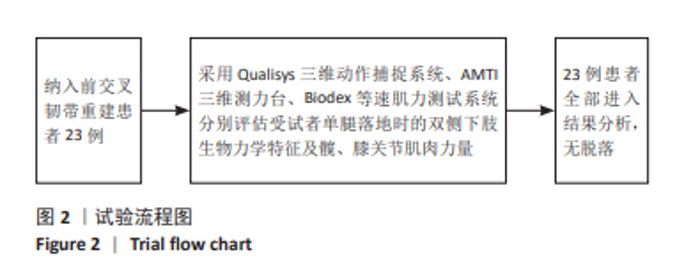
2.1 参与者数量分析 共23例前交叉韧带重建受试者纳入此次研究,全部进入结果分析,无脱落。 2.2 试验流程图 见图2。"
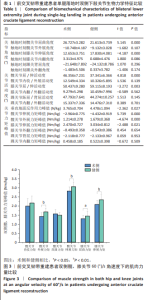
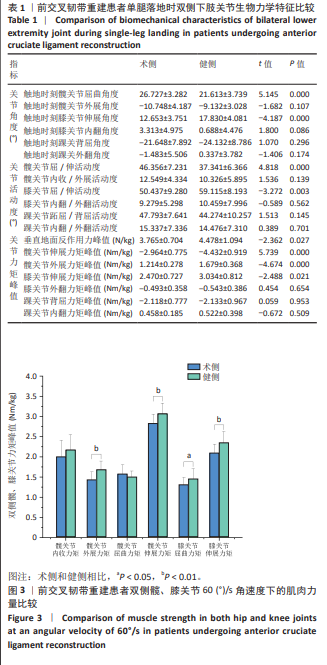
2.3 前交叉韧带重建患者单腿落地时双侧下肢关节生物力学特征比较 与术侧相比,健侧触地时刻髋关节屈曲角度(P=0.000)、髋关节屈/伸活动度(P=0.000)显著减小,触地时刻膝关节伸展角度(P=0.000)、膝关节屈/伸活动度(P=0.003)、垂直地面反作用力峰值(P=0.027)、髋关节伸展力矩峰值(P=0.000)、髋关节外展力矩峰值(P=0.000)及膝关节伸展力矩峰值(P=0.021)均显著增大,见表1。 2.4 前交叉韧带重建患者双侧髋、膝关节60 (°)/s角速度下肌肉力量比较 与健侧相比,术侧60 (°)/s角速度下髋关节外展力矩峰值(P=0.000)、髋关节伸展力矩峰值(P=0.000)、膝关节屈曲力矩峰值(P=0.019)及膝关节伸展力矩峰值(P=0.009)均显著减小,见图3。"
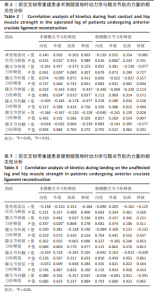
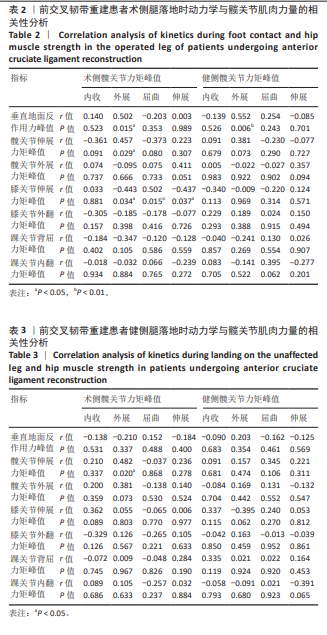
2.5 前交叉韧带重建患者单腿落地时动力学与髋关节肌肉力量的相关性分析 前交叉韧带重建患者术侧腿落地时,垂直地面反作用力峰值与术侧髋关节外展力矩峰值(r=0.502,P=0.015)、健侧髋关节外展力矩峰值(r=0.552,P=0.006)呈显著正相关,髋关节伸展力矩峰值与术侧髋关节外展力矩峰值(r=0.457,P=0.029)呈显著正相关,膝关节伸展力矩峰值与术侧髋关节外展力矩峰值(r=-0.443,P=0.034)、伸展力矩峰值(r=-0.437,P=0.037)呈显著负相关,与术侧髋关节屈曲力矩峰值(r=0.502,P=0.015)呈显著正相关,见表2。 前交叉韧带重建患者健侧腿落地时,髋关节伸展力矩峰值与术侧髋关节外展力矩峰值呈显著正相关(r=0.482,P=0.020),见表3。 2.6 不良事件 所有受试者在试验过程中均未出现不良事件。"
| [1] MAYER MA, DELISO M, HONG IS, et al. Rehabilitation and Return to Play Protocols After Anterior Cruciate Ligament Reconstruction in Soccer Players: A Systematic Review. Am J Sports Med. 2025;53(1):217-227. [2] WADDELL LM, MITCHENER DP, FRIER KC, et al. Patient Perceptions of Medication Therapy for Prevention of Post-Traumatic Osteoarthritis Following Anterior Cruciate Ligament Injury: A Qualitative Content Analysis. Arthritis Care Res. 2025;2(1):1-10. [3] CARTER HM, LEWIS GN, SMITH BE. Preoperative predictors for return to physical activity following anterior cruciate ligament reconstruction(ACLR): a systematic review. BMC Musculoskelet Disord. 2023;24(1):471-478. [4] PATERNO MV, KIEFER AW, BONNETTE S, et al. Prospectively identified deficits in sagittal plane hip-ankle coordination in female athletes who sustain a second anterior cruciate ligament injury after anterior cruciate ligament reconstruction and return to sport. Clin Biomech. 2015;30(10):1094-1101. [5] ITHURBURN MP, PATERNO MV, THOMAS S, et al. Clinical measures associated with knee function over two years in young athletes after ACL reconstruction. Knee. 2019;26(2):355-363. [6] PATERNO MV, SCHMITT LC, FORD KR, et al. Biomechanical measures during landing and postural stability predict second anterior cruciate ligament injury after anterior cruciate ligament reconstruction and return to sport. Am J Sports Med. 2010;38(10):1968-1978. [7] CAPIN JJ, FAILLA M, ZARZYCKI R, et al. Superior 2-Year Functional Outcomes Among Young Female Athletes After ACL Reconstruction in 10 Return-to-Sport Training Sessions: Comparison of ACL-SPORTS Randomized Controlled Trial With Delaware-Oslo and MOON Cohorts. Orthop J Sports Med. 2019;7(8):232-237. [8] KYRITSIS P, BAHR R, LANDREAU P, et al. Likelihood of ACL graft rupture: not meeting six clinical discharge criteria before return to sport is associated with a four times greater risk of rupture. Br J Sports Med. 2016;50(15):946-951. [9] HEWETT TE, MYER GD, FORD KR, et al. Biomechanical measures of neuromuscular control and valgus loading of the knee predict anterior cruciate ligament injury risk in female athletes: a prospective study. Am J Sports Med. 2005;33(4):492-501. [10] OBERLÄNDER KD, BRÜGGEMANN GP, HÖHER J, et al. Altered landing mechanics in ACL-reconstructed patients. Med Sci Sports Exerc. 2013;45(3):506-513. [11] KELLIS E, KONSTANTOPOULOS A, SALONIKIOS G, et al. Does Pelvic Tilt Angle Influence the Isokinetic Strength of the Hip and Knee Flexors and Extensors? J Funct Morphol Kinesiol. 2024; 9(2):1-10. [12] LU Y, ZHAO F, KUAI S, et al. Lower limb joint kinetics during level walking in patients two years after anterior cruciate ligament reconstruction. Sports Med Health Sci. 2025;3(1):1-8. [13] LEE SP, SOUZA RB, POWERS CM. The influence of hip abductor muscle performance on dynamic postural stability in females with patellofemoral pain. Gait Posture. 2012;36(3):425-429. [14] LEE H, LISEE C, BÜTTNER C, et al. Lower Extremity Mechanical Energetics During Walking 6 Months Following Anterior Cruciate Ligament Reconstruction. Scand J Med Sci Sports. 2025;35(7):701-713. [15] POZZI F, DI STASI S, ZENI JAJ, et al. Single-limb drop landing biomechanics in active individuals with and without a history of anterior cruciate ligament reconstruction: A total support analysis. Clin Biomech. 2017;43(12):28-33. [16] KHAYAMBASHI K, GHODDOSI N, STRAUB RK, et al. Hip Muscle Strength Predicts Noncontact Anterior Cruciate Ligament Injury in Male and Female Athletes: A Prospective Study. Am J Sports Med. 2016;44(2):355-361. [17] LI X, LI J, QING L, et al. Effect of quadriceps training at different levels of blood flow restriction on quadriceps strength and thickness in the mid-term postoperative period after anterior cruciate ligament reconstruction: a randomized controlled external pilot study. BMC Musculoskelet Disord. 2023;24(1):360-369. [18] OGURA A, MIYAZAKI T, IDA H, et al. Postural Control During Single-Leg Landing in Female Athletes After Anterior Cruciate Ligament Reconstruction. Int J Sports Phys Ther. 2024;19(6):681-691. [19] SAKI F, SHAFIEE H, TAHAYORI B, et al. The effects of core stabilization exercises on the neuromuscular function of athletes with ACL reconstruction. Sci Rep. 2023;13(1):2202-2209. [20] TUOMINEN J, LEPPÄNEN M, JARSKE H, et al. Test-Retest Reliability of Isokinetic Ankle, Knee and Hip Strength in Physically Active Adults Using Biodex System 4 Pro. Methods Protoc. 2023;6(2):1-10. [21] SASAKI S, NAGANO Y, ICHIKAWA H. Differences in high trunk acceleration during single-leg landing after an overhead stroke between junior and adolescent badminton athletes. Sports Biomech. 2022;21(10):1160-1175. [22] KISHI S, FUJIWARA K, KIMURA Y. Dynamic balance ability in single-leg drop jump landing in junior female athletes after shin splints-assessment from a preventive perspective. J Phys Ther Sci. 2021;33(10):758-760. [23] JOHNSTON PT, MCCLELLAND JA, WEBSTER KE. Lower Limb Biomechanics During Single-Leg Landings Following Anterior Cruciate Ligament Reconstruction: A Systematic Review and Meta-Analysis. Sports Med. 2018;48(9):2103-2126. [24] LARWA J, STOY C, CHAFETZ RS, et al. Stiff Landings, Core Stability, and Dynamic Knee Valgus: A Systematic Review on Documented Anterior Cruciate Ligament Ruptures in Male and Female Athletes. Int J Environ Res Public Health. 2021; 18(7):1-10. [25] HASHEMI J, BREIGHNER R, CHANDRASHEKAR N, et al. Hip extension, knee flexion paradox: a new mechanism for non-contact ACL injury. J Biomech. 2011;44(4):577-585. [26] GHADERI M, LETAFATKAR A, THOMAS AC, et al. Effects of a neuromuscular training program using external focus attention cues in male athletes with anterior cruciate ligament reconstruction: a randomized clinical trial. BMC Sports Sci Med Rehabil. 2021;13(1):49-58. [27] LEPLEY AS, KUENZE CM. Hip and Knee Kinematics and Kinetics During Landing Tasks After Anterior Cruciate Ligament Reconstruction: A Systematic Review and Meta-Analysis. J Athl Train. 2018;53(2):144-159. [28] HOVEY S, WANG H, JUDGE LW, et al. The effect of landing type on kinematics and kinetics during single-leg landings. Sports Biomech. 2021;20(5):543-559. [29] NAGELLI C, DI STASI S, TATARSKI R, et al. Neuromuscular Training Improves Self-Reported Function and Single-Leg Landing Hip Biomechanics in Athletes After Anterior Cruciate Ligament Reconstruction. Orthop J Sports Med. 2020;8(10): 232-239. [30] HUGHES G, MUSCO P, CAINE S, et al. Lower Limb Asymmetry After Anterior Cruciate Ligament Reconstruction in Adolescent Athletes: A Systematic Review and Meta-Analysis. J Athl Train. 2020;55(8):811-825. [31] ITHURBURN MP, PATERNO MV, FORD KR, et al. Young Athletes With Quadriceps Femoris Strength Asymmetry at Return to Sport After Anterior Cruciate Ligament Reconstruction Demonstrate Asymmetric Single-Leg Drop-Landing Mechanics. Am J Sports Med. 2015;43(11):2727-2737. [32] THOMAS AC, VILLWOCK M, WOJTYS EM, et al. Lower extremity muscle strength after anterior cruciate ligament injury and reconstruction. J Athl Train. 2013;48(5):610-620. [33] FRYER C, ITHURBURN MP, MCNALLY MP, et al. The relationship between frontal plane trunk control during landing and lower extremity muscle strength in young athletes after anterior cruciate ligament reconstruction. Clin Biomech. 2019;62(3):58-65. [34] SHIMOZAKI K, NAKASE J, TAKATA Y, et al. Greater body mass index and hip abduction muscle strength predict noncontact anterior cruciate ligament injury in female Japanese high school basketball players. Knee Surg Sports Traumatol Arthrosc. 2018;26(10):3004-3011. [35] HANNON JP, WANG-PRICE S, GARRISON JC, et al. Normalized Hip and Knee Strength in Two Age Groups of Adolescent Female Soccer Players. J Strength Cond Res. 2022;36(1):207-211. [36] NOEHREN B, ABRAHAM A, CURRY M, et al. Evaluation of proximal joint kinematics and muscle strength following ACL reconstruction surgery in female athletes. J Orthop Res. 2014;32(10):1305-1310. [37] SINSURIN K, KIRATISIN P, IRAWAN DS, et al. Residual deficits of knee and hip joint coordination and clinical performance after return to sports in athletes with anterior cruciate ligament reconstruction. Knee Surg Relat Res. 2024;36(1):22-30. [38] SIGWARD S, POLLARD C. Proximal Risk Factors for ACL Injury: Role of the Hip Joint and Musculature. Spring Berlin Heidelb. 2018;11(8):207-223. [39] STEARNS KM, POWERS CM. Improvements in hip muscle performance result in increased use of the hip extensors and abductors during a landing task. Am J Sports Med. 2014;42(3):602-609. [40] MIZNER RL, KAWAGUCHI JK, CHMIELEWSKI TL. Muscle strength in the lower extremity does not predict postinstruction improvements in the landing patterns of female athletes. J Orthop Sports Phys Ther. 2008;38(6):353-361. |
| [1] | Zhu Xiaolong, Zhang Wei, Yang Yang. Visualization analysis of research hotspots and cutting-edge information in the field of intervertebral disc regeneration and repair [J]. Chinese Journal of Tissue Engineering Research, 2026, 30(9): 2391-2402. |
| [2] | Wen Fayan, Li Yan, Qiang Tianming, Yang Chen, Shen Linming, Li Yadong, Liu Yongming. Unilateral biportal endoscopic technology for treatment of lumbar degenerative diseases: global research status and changing trends [J]. Chinese Journal of Tissue Engineering Research, 2026, 30(9): 2380-2390. |
| [3] | Xinjiang Branch of China Trauma Rescue & Treatment Association. Expert consensus on diagnosis and treatment of brucellar osteoarthritis [J]. Chinese Journal of Tissue Engineering Research, 2026, 30(9): 2403-2412. |
| [4] | Li Zhifei, Han Bin, Liu Qiuli, Zhang Zhanming, Wei Haokai, Zuo Kuangshi, Zhang Yisheng. Cervical motion characteristics in patients with cervical spondylotic radiculopathy based on motion capture technology [J]. Chinese Journal of Tissue Engineering Research, 2026, 30(9): 2286-2293. |
| [5] | Wang Nan, Chen Shuang, Xi Zhipeng, Qian Yuzhang, Zhang Xiaoyu, Gu Jun, Kang Ran, Xie Lin. MRI evaluation of nerve root subsidence sign affecting efficacy of percutaneous endoscopic decompression in lumbar spinal stenosis [J]. Chinese Journal of Tissue Engineering Research, 2026, 30(9): 2262-2268. |
| [6] | Sun Lei, Zhang Qi, Zhang Yu. Pro-osteoblastic effect of chlorogenic acid protein microsphere/polycaprolactone electrospinning membrane [J]. Chinese Journal of Tissue Engineering Research, 2026, 30(8): 1877-1884. |
| [7] | Wu Yanting, Li Yu, Liao Jinfeng. Magnesium oxide nanoparticles regulate osteogenesis- and angiogenesis-related gene expressions to promote bone defect healing [J]. Chinese Journal of Tissue Engineering Research, 2026, 30(8): 1885-1895. |
| [8] | Li Qingbin, Lin Jianhui, Huang Wenjie, Wang Mingshuang, Du Jiankai, Lao Yongqiang. Bone cement filling after enlarged curettage of giant cell tumor around the knee joint: a comparison of subchondral bone grafting and non-grafting [J]. Chinese Journal of Tissue Engineering Research, 2026, 30(8): 1896-1902. |
| [9] | Jiang Xinghai, Song Yulin, Li Dejin, Shao Jianmin, Xu Junzhi, Liu Huakai, Wu Yingguo, Shen Yuehui, Feng Sicheng. Vascular endothelial growth factor 165 genes transfected into bone marrow mesenchymal stem cells to construct a vascularized amphiphilic peptide gel module [J]. Chinese Journal of Tissue Engineering Research, 2026, 30(8): 1903-1911. |
| [10] | Wang Qisa, Lu Yuzheng, Han Xiufeng, Zhao Wenling, Shi Haitao, Xu Zhe. Cytocompatibility of 3D printed methyl acrylated hyaluronic acid/decellularized skin hydrogel scaffolds [J]. Chinese Journal of Tissue Engineering Research, 2026, 30(8): 1912-1920. |
| [11] | Gao Yanguo, Guo Xu, Li Xiaohan, Chen Shiqi, Zhu Haitao, Huang Liangyong, Ye Fang, Lu Wei Wang Qibin, Zheng Tao, Chen Li. Optimization of prescription ratio of “Honghuangbai” gel by orthogonal test in diabetic skin wound mouse models [J]. Chinese Journal of Tissue Engineering Research, 2026, 30(8): 1921-1928. |
| [12] | Liu Hongjie, Mu Qiuju, Shen Yuxue, Liang Fei, Zhu Lili. Metal organic framework/carboxymethyl chitosan-oxidized sodium alginate/platelet-rich plasma hydrogel promotes healing of diabetic infected wounds [J]. Chinese Journal of Tissue Engineering Research, 2026, 30(8): 1929-1939. |
| [13] | Min Changqin, Huang Ying. Construction of pH/near-infrared laser stimuli-responsive drug delivery system and its application in treatment of oral squamous cell carcinoma [J]. Chinese Journal of Tissue Engineering Research, 2026, 30(8): 1940-1951. |
| [14] | Shao Ziyu, Li Qian, Qumanguli·Abudukelimu, Han Youjun, Hu Yang. Preparation and characterization properties of three different ratios of biphasic calcium phosphate [J]. Chinese Journal of Tissue Engineering Research, 2026, 30(8): 1952-1961. |
| [15] | Zheng Xuying, Hu Hongcheng, Xu Libing, Han Jianmin, Di Ping. Stress magnitude and distribution in two-piece cement-retained zirconia implants under different loading conditions and with varying internal connection shapes [J]. Chinese Journal of Tissue Engineering Research, 2026, 30(8): 1979-1987. |
| Viewed | ||||||
|
Full text |
|
|||||
|
Abstract |
|
|||||