Chinese Journal of Tissue Engineering Research ›› 2026, Vol. 30 ›› Issue (27): 7229-7236.doi: 10.12307/2026.406
Bibliometric analysis of development of precision, minimally invasive and intelligent robot-assisted spinal surgery
Wan Ronghao1, 2, Shi Zhan1, Jiang Jile1, Han Xiao1, He Da1, Wu Jingye1
- 1Department of Spine Surgery, Beijing Jishuitan Hospital, Capital Medical University, Beijing 100035, China; 2Department of Orthopedics, Longchang People’s Hospital, Longchang 642150, Sichuan Province, China
-
Received:2025-09-10Accepted:2025-11-08Online:2026-09-28Published:2026-05-27 -
Contact:Wu Jingye, MD, Associate chief physician, Associate professor, Department of Spine Surgery, Beijing Jishuitan Hospital, Capital Medical University, Beijing 100035, China -
About author:Wan Ronghao, MS, Attending physician, Department of Spine Surgery, Beijing Jishuitan Hospital, Capital Medical University, Beijing 100035, China; Department of Orthopedics, Longchang People’s Hospital, Longchang 642150, Sichuan Province, China -
Supported by:National Key Research and Development Program of China, No. 2022YFC2407200 (to WJY), No. 2022YFC2407204 (to WJY)

CLC Number:
Cite this article
Wan Ronghao, Shi Zhan, Jiang Jile, Han Xiao, He Da, Wu Jingye. Bibliometric analysis of development of precision, minimally invasive and intelligent robot-assisted spinal surgery[J]. Chinese Journal of Tissue Engineering Research, 2026, 30(27): 7229-7236.
share this article
Add to citation manager EndNote|Reference Manager|ProCite|BibTeX|RefWorks
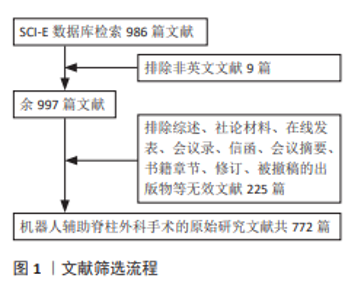
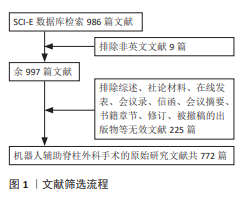
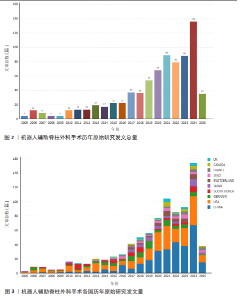
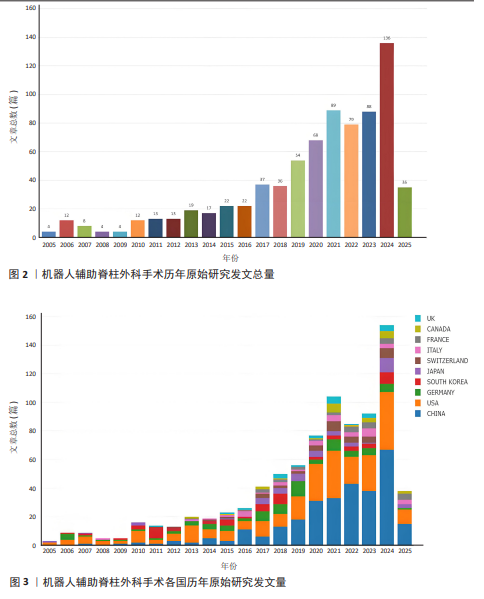
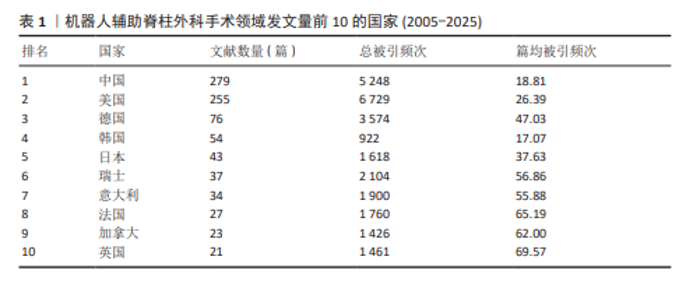
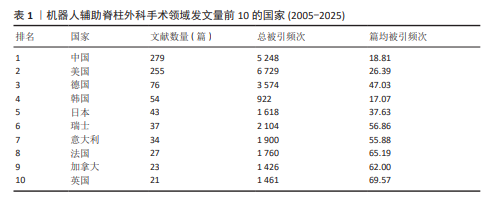
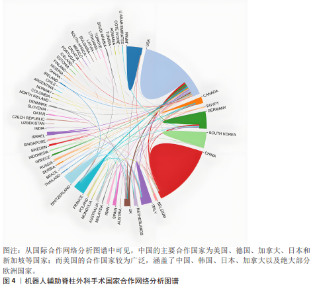
2.1 基本情况分析 初次检索共获得机器人辅助脊柱外科手术相关研究文献986篇。经过此次研究纳入与排除标准的筛选,最终纳入符合标准的原始研究文献772篇(图1)。纳入文献的总被引频次为14 808次,篇均被引频次为19.18次。 2.2 文献发表时间趋势 纳入的文献中,近5年发表495篇,占总量的64.12%(图2)。以中国、美国为代表的发文量排名前10国家的发文量也主要集中在近5年(图3)。自2019年起,每年发文量均大于50篇。2024年为机器人辅助脊柱外科手术研究领域原始研究成果产出最丰富的一年,全年发文量达到历史最高峰,共发表研究文献136篇,相比2023年增长约54.55%(图2,3)。 2.3 文献发表的国家和地区分布 在机器人辅助脊柱外科手术研究领域,中国(36.14%,279/772)、美国(33.03%,255/722)和德国(9.84%,76/772)为发文量排名前3的国家(图3,表1)。英国学者所发表文献的篇均被引频次为全球最高,达69.57次(表1)。根据各个国家年度发文数据分析得出,中国学者和美国学者在机器人辅助脊柱外科研究领域的研究成果产出均呈稳中有升的态势(图3)。"
"
"
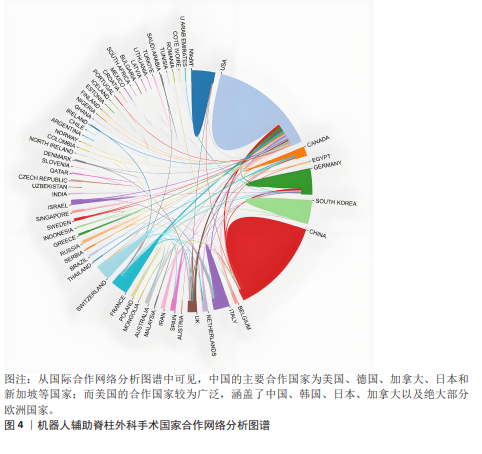
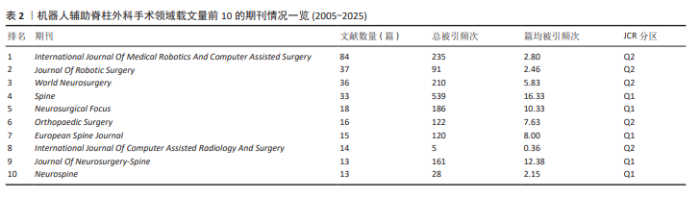
2.4 载文期刊分析 所有符合纳排标准的原始研究文献分别发表于233本专业学术期刊。十大载文期刊均为JCR 2区以上期刊,其中Q1期刊和Q2期刊各5本。International Journal Of Medical Robotics And Computer Assisted Surgery是发文量最大的期刊,累计发表84篇原始研究文献,占比10.88%,所有文献总被引频次为235次,篇均被引频次为2.80次。Journal Of Robotic Surgery和World Neurosurgery分别以37篇(4.80%)和36篇(4.66%)的发文量排名第2和第3。Spine 虽然以33篇(4.27%)的发文量排名第4,但是其所发文献的总被引频次高达539次,为机器人辅助脊柱外科手术研究领域总被引频次最高的载文期刊(表2)。Neurosurgery仅发表了8篇(1.04%)原始研究文献,总被引频次为167次,篇均被引频次为20.88次,其篇均被引频次为机器人辅助脊柱外科手术研究领域最高的载文期刊。 2.5 国家和地区合作网络分析 纳入此次研究的772篇原始研究文献来源于59个国家。从国际合作网络分析图谱中可见,中国的主要合作国家为美国、德国、加拿大、日本和新加坡等国家;而美国的合作国家较为广泛,涵盖了中国、韩国、日本、加拿大以及绝大部分欧洲国家(图4)。由此可见,在机器人辅助脊柱外科手术研究领域已经建立了高度协同的跨国科研网络,呈现出多边合作框架下深度互联的国际化特征。"
"
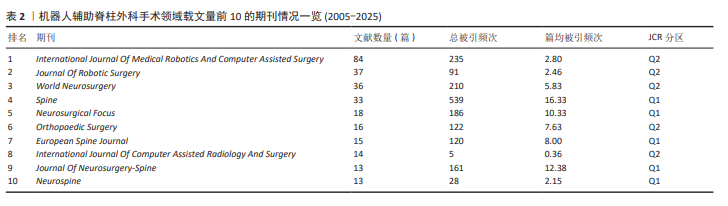
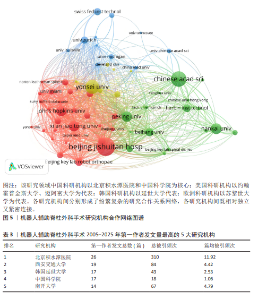
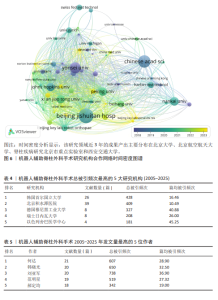
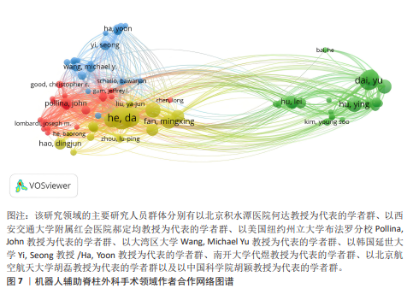
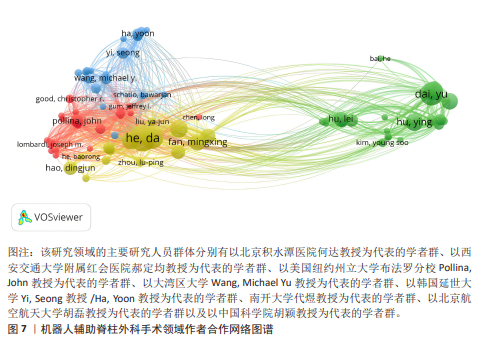
2.6 研究机构合作网络分析 北京积水潭医院(26篇)、西安交通大学(19篇)、韩国延世大学(17篇)、中国科学院(17篇)和南开大学(14篇)为全球第一作者发文量排名前5的研究机构,累计发文量占比12.05%(93/772)(表3)。韩国首尔国立大学(428次)、北京积水潭医院(409次)、德国慕尼黑工业大学(327次)、瑞士日内瓦大学(208次)和以色列舍巴医学中心(181次)为全球发文总被引频次排名前5名的研究机构(表4)。使用 VOSviewer 软件选择文献耦合分析-发文机构分析,计数方式选择全计数统计,设置研究机构最小发文量为5篇,筛选出符合条件的研究机构64所,初步绘图显示出日本筑波大学及其附属医院虽然在机器人辅助脊柱外科手术研究领域发文量大,但其与发文量5篇及其以上的研究机构合作较少,绘图时呈现为远离核心集群的边缘异常节点,故予以排除后得出最终的研究机构合作网络图谱及研究机构合作网络时间密度图谱(图5,6)[13]。分析得出在机器人辅助脊柱外科手术研究领域中国科研机构以北京积水潭医院和中国科学院为核心;美国科研机构以约翰霍普金斯大学、迈阿密大学为代表;韩国科研机构以延世大学代表;欧洲科研机构以苏黎世大学为代表。各研究机构间分别形成了纷繁复杂的研究合作关系网络,各研究机构间既相对独立又紧密连接(图5)。时间密度分析显示,该研究领域近3年的成果产出主要分布在北京大学、北京航空航天大学、脊柱疾病研究北京市重点实验室和西安交通大学(图6)。 2.7 作者合作网络分析 Web of Science平台通过显示研究人员个人信息的方式提取研究人员发文量及引文数据,发现发文量排名前5名的在职作者中,前4名均在北京积水潭医院,分别是何达教授(21篇)、韩晓光教授(20篇)、刘亚军教授(20篇)、范明星教授(19篇);西安交通大学附属红会医院的郝定均教授,发文18篇,排名第5(表5)。前5名作者累计发文占总发文量的12.70%(98/772)。使用VOSviewer软件选择引文分析-作者分析,设置作者最小发文量为5篇,筛选出符合条件的作者100人,剔除非在职研究人员后得出最终的作者合作网络图谱及作者合作网络时间密度图谱(图7,8)。分析得出在机器人辅助脊柱外科手术研究领域的主要研究人员群体分别有:以北京积水潭医院何达教授为代表的学者群、以西安交通大学附属红会医院郝定均教授为代表的学者群、以美国纽约州立大学布法罗分校Pollina, John教授为代表的学者群、以大湾区大学Wang, Michael Yu教授为代表的学者群、以韩国延世大学Yi, Seong教授/Ha, Yoon教授为代表的学者群、南开大学代煜教授为代表的学者群、以北京航空航天大学胡磊教授为代表的学者群以及以中国科学院胡颖教授为代表的学者群(图7)。各个学者群体间的合作关系网络与各机构间合作关系网络类似,同样形成了既相对独立又紧密连接的复杂关系网。时间密度分析显示,中国和美国作者群体为该研究领域最近 3年成果产出的主要群体(图8)。"

"

"
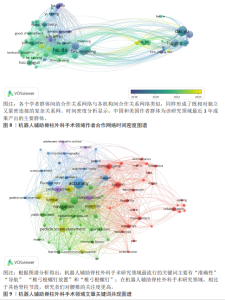
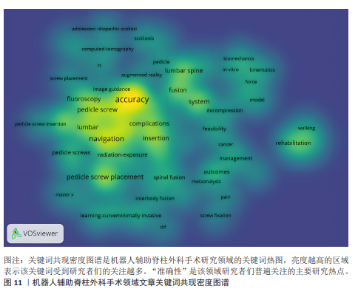
2.8 研究热点及关键词共现分析 使用VOSviewer软件分析纳入此次研究的相关文献的关键词,以关键词出现阈值≥10次为前提进行初步筛选,同时为了筛选出机器人辅助脊柱外科手术研究主题下的细分热点,在初筛结果中删去出现频率较高但不具有分析价值的主题关键词,如“robot” “robots”“robotic”“robotics”“robotic surgery”“spine”“surgery”“spine surgery”“spinal surgery”“surgical technique”“surgical robot”“robotic spine surgery”“neurosurgery”等,最终得出关键词共现分析图谱(图9-11)[13]。根据图谱分析得出:机器人辅助脊柱外科手术研究领域最流行的关键词主要有“准确性” “导航” “椎弓根螺钉放置”和“椎弓根螺钉”,脊柱手术中机器人辅助椎弓根螺钉放置的准确性为主要研究热点;关键词如“脊柱手术机器人Mazor X” “TLIT” “Force”是最近出现的高频关键词;在机器人辅助脊柱外科手术研究领域,相比于其他脊柱节段,研究者们对腰椎的关注度更高。 2.9 高被引文献分析 10篇高被引文献分别发表于2010-2019年(表6),其中被引频次最高的文献发表于Q1期刊Spine;10篇文献总被引频次为1 825次,平均被引频次为182.50次。这10篇文献的第一作者所属研究机构分别是:美国亚特兰大儿童保健中心、德国美因茨大学神经外科学系、阿联酋克利夫兰诊所基金会神经外科、美国宾夕法尼亚州立大学医学院、法国蒙彼利埃大学医学院、瑞士日内瓦大学、首都医科大学附属北京积水潭医院、韩国高丽大学安岩医院、瑞士日内瓦大学医院以及荷兰麦兹沃勒伊萨拉医院。10篇文献均主要围绕机器人辅助脊柱椎弓根螺钉置入的准确性与安全性这一主题开展研究。上述文献中,包含了4项前瞻性研究。2012年RINGEL教授等[15]报道了一项涵盖60例患者的SpineAssist手术机器人螺钉置入技术与传统徒手螺钉置入技术的前瞻性随机比较试验,结果显示传统徒手椎弓根螺钉置入的准确性优于SpineAssist手术机器人。2013年ROSER教授等[16]公布了一项涵盖37例单节段退行性腰椎不稳定患者椎弓根螺钉置入的随机前瞻性研究,该研究分为3个组别:徒手内固定组(10例患者)、BrainLab导航组(9例患者)以及SpineAssist机器人辅助导航组(18例患者),然后对手术的准确性、手术时间以及术中辐射剂量进行了全面的总结分析,结果显示导航手术在准确性方面与徒手操作相当,但导航手术所需的时间及患者的辐射时间均较短。2017年KIM教授等[17]公布了一项涵盖78例患者的前瞻性、随机、对照试验,他们把拟接受经椎间孔腰椎椎间融合术的患者随机分为机器人辅助经椎间孔腰椎椎间融合组(37 例患者)和徒手经椎间孔腰椎椎间融合组(41例患者),然后对比机器人辅助置钉与徒手置钉的准确性与安全性,结果显示对于置入螺钉的准确性,两组之间无显著差异,但是机器人辅助下的椎弓根螺钉置入术在减少近端关节突损伤方面效果更佳。2019年HAN教授等[18]公布了一项涵盖234例患者的前瞻性随机对照试验,他们将患有退行性或创伤性胸腰椎脊柱疾病且需要进行脊柱内固定手术的患者以1∶1的比例随机分配到天玑机器人辅助组(119例患者)和徒手操作透视辅助组(115例患者),结果显示234例患者共置入了椎弓根螺钉1 116枚,临床可接受的螺钉置入比例在机器人组明显高于徒手操作组,且机器人组未出现螺钉翻修及螺钉侵犯近端关节面等情况;天玑机器人辅助组患者的失血量和平均累积辐射时间显著低于徒手操作透视辅助组;另外,天玑机器人辅助组中外科医生进行手术操作期间的辐射暴露量同样显著低于徒手操作透视辅助组。"


"

"

| [1] YU L, CHEN X, MARGALIT A, et al. Robot-assisted vs freehand pedicle screw fixation in spine surgery - a systematic review and a meta-analysis of comparative studies. Int J Med Robot. 2018;14(3):e1892. [2] DEVITO DP, KAPLAN L, DIETL R, et al. Clinical acceptance and accuracy assessment of spinal implants guided with SpineAssist surgical robot: retrospective study. Spine (Phila Pa 1976). 2010;35(24):2109-2115. [3] SHOHAM M, LIEBERMAN IH, BENZEL EC, et al. Robotic assisted spinal surgery--from concept to clinical practice. Computer Aided Surg. 2007;12(2):105-115. [4] CAHILL KS, WANG MY. Evaluating the accuracy of robotic assistance in spine surgery. Neurosurgery. 2012;71(2):N20-21. [5] HAIK NV, BURGESS AE, TALBOT NC, et al. Robotic Systems in Spinal Surgery: A Review of Accuracy, Radiation Exposure, Hospital Readmission Rate, Cost, and Adverse Events. World Neurosurgery. 2025;195:123721. [6] D’SOUZA M, GENDREAU J, FENG A, et al. Robotic-Assisted Spine Surgery: History, Efficacy, Cost, And Future Trends. Robot Surg. 2019;6:9-23. [7] FIANI B, QUADRI SA, FAROOQUI M, et al. Impact of robot-assisted spine surgery on health care quality and neurosurgical economics: A systemic review. Neurosurg Rev. 2020;43(1):17-25. [8] LIEBERMAN IH, KISINDE S, HESSELBACHER S. Robotic-Assisted Pedicle Screw Placement During Spine Surgery. JBJS Essent Surg Tech. 2020;10(2):e0020. [9] 保毅, 罗浩天, 李维朝, 等. 机器人辅助脊柱外科手术的应用进展[J]. 中华骨科杂志, 2024,44(13):900-905. [10] HICKS D, WOUTERS P, WALTMAN L, et al. Bibliometrics: The Leiden Manifesto for research metrics. Nature. 2015;520(7548): 429-431. [11] THOMPSON DF, WALKER CK. A descriptive and historical review of bibliometrics with applications to medical sciences. Pharmacotherapy. 2015;35(6):551-559. [12] VAN ECK NJ, WALTMAN L. Software survey: VOSviewer, a computer program for bibliometric mapping. Scientometrics. 2010; 84(2):523-538. [13] 张跃川, 彭越, 惠尚懿, 等. 3D打印技术在脊柱外科手术中应用的可视化文献计量学分析[J]. 中华骨与关节外科杂志,2024, 17(6):485-496. [14] XIE M, WU Q, WANG Y, et al. Publication trends of research on uveal melanoma during 2000-2020: a 20-year bibliometric study. Ann Transl Med. 2020;8(21):1463. [15] RINGEL F, STÜER C, REINKE A, et al. Accuracy of Robot-Assisted Placement of Lumbar and Sacral Pedicle Screws. Spine. 2012;37(8): E496-E501. [16] ROSER F, TATAGIBA M, MAIER G. Spinal Robotics. Neurosurgery. 2013;72(Supplement 1): A12-A18. [17] KIM HJ, JUNG WI, CHANG BS, et al. A prospective, randomized, controlled trial of robot‐assisted vs freehand pedicle screw fixation in spine surgery. Int J Med Robot. 2017;13(3). doi: 10.1002/rcs.1779. [18] HAN X, TIAN W, LIU Y, et al. Safety and accuracy of robot-assisted versus fluoroscopy-assisted pedicle screw insertion in thoracolumbar spinal surgery: a prospective randomized controlled trial. J Neurosurg Spine. 2019;30(5):615-622. [19] GALETTA MS, LEIDER JD, DIVI SN, et al. Robotics in spinal surgery. Ann Trans Med. 2019;7(Suppl 5): S165. [20] KIM SSY, DOHLER M, DASGUPTA P. The Internet of Skills: use of fifth-generation telecommunications, haptics and artificial intelligence in robotic surgery. BJU Int. 2018;122(3):356-358. [21] LOPEZ IB, BENZAKOUR A, MAVROGENIS A, et al. Robotics in spine surgery: systematic review of literature. Int Orthop. 2023;47(2):447-456. [22] BARZILAY Y, SCHROEDER JE, HILLER N, et al. Robot-assisted vertebral body augmentation: a radiation reduction tool. Spine (Phila Pa 1976). 2014;39(2):153-157. [23] LEE YS, CHO DC, KIM KT. Navigation-Guided/Robot-Assisted Spinal Surgery: A Review Article. Neurospine. 2024;21(1):8-17. [24] LI Z, YU G, JIANG S, et al. Robot-assisted laminectomy in spinal surgery: a systematic review. Ann Transl Med. 2021;9(8):715. [25] BEYER RS, NGUYEN A, BROWN NJ, et al. Spinal robotics in cervical spine surgery: a systematic review with key concepts and technical considerations. J Neurosurg Spine. 2023;38(1): 66-74. [26] NEUMANN N, MEYLHEUC L, BARBE L, et al. Robot-Assisted Bone Cement Injection. IEEE Trans Biomed Eng. 2022;69(1):138-147. [27] KOTANI Y, ABUMI K, ITO M, et al. Improved accuracy of computer-assisted cervical pedicle screw insertion. J Neurosurg. 2003; 99(3 Suppl):257-263. [28] RAJASEKARAN S, VIDYADHARA S, RAMESH P, et al. Randomized clinical study to compare the accuracy of navigated and non-navigated thoracic pedicle screws in deformity correction surgeries. Spine (Phila Pa 1976). 2007;32(2):E56-64. [29] KANTELHARDT SR, MARTINEZ R, BAERWINKEL S, et al. Perioperative course and accuracy of screw positioning in conventional, open robotic-guided and percutaneous robotic-guided, pedicle screw placement. Eur Spine J. 2011;20(6):860-868. [30] LE X, TIAN W, SHI Z, et al. Robot-Assisted Versus Fluoroscopy-Assisted Cortical Bone Trajectory Screw Instrumentation in Lumbar Spinal Surgery: A Matched-Cohort Comparison. World Neurosurg. 2018;120: e745-e751. [31] WANG JQ, WANG Y, FENG Y, et al. Percutaneous Sacroiliac Screw Placement: A Prospective Randomized Comparison of Robot-assisted Navigation Procedures with a Conventional Technique. Chin Med J. 2017; 130(21): 2527-2534. [32] ROSER F, TATAGIBA M, MAIER G. Spinal robotics: current applications and future perspectives. Neurosurgery. 2013;72 Suppl 1: 12-18. [33] ŁAJCZAK P, ŻERDZIŃSKI K, JÓŹWIK K, et al. Enhancing Precision and Safety in Spinal Surgery: A Comprehensive Review of Robotic Assistance Technologies. World Neurosurg. 2024;191:109-116. [34] MACLEAN L, HERSH AM, BHIMREDDY M, et al. Comparison of accuracy, revision, and perioperative outcomes in robot-assisted spine surgeries: systematic review and meta-analysis. J Neurosurg Spine. 2024;41(4): 519-531. [35] JIANG B, AZAD TD, COTTRILL E, et al. New spinal robotic technologies. Front Med. 2019; 13(6):723-729. [36] ZHANG JG, DU Y, ZHANG HR, et al. [Current status and future of application of spinal surgery robot in spinal deformity surgery]. Zhonghua yi xue za zhi. 2024;104(37): 3465-3470. [37] PARK C, SHABANI S, AGARWAL N, et al. Robotic-Assisted Surgery and Navigation in Deformity Surgery. Neurosurg Clin North Am. 2023;34(4): 659-664. [38] SHWEIKEH F, AMADIO JP, ARNELL M, et al. Robotics and the spine: a review of current and ongoing applications. Neurosurg Focus. 2014;36(3): E10. [39] DAVIDAR AD, JIANG K, WEBER-LEVINE C, et al. Advancements in Robotic-Assisted Spine Surgery. Neurosurg Clin North Am. 2024;35(2): 263-272. [40] KHALSA SSS, MUMMANENI PV, CHOU D, et al. Present and Future Spinal Robotic and Enabling Technologies. Oper Neurosurg. 2021; 21(Suppl 1):S48-S56. [41] ELSWICK CM, STRONG MJ, JOSEPH JR, et al. Robotic-Assisted Spinal Surgery: Current Generation Instrumentation and New Applications. Neurosurg Clin North Am. 2020; 31(1):103-110. [42] MAO JZ, AGYEI JO, KHAN A, et al. Technologic Evolution of Navigation and Robotics in Spine Surgery: A Historical Perspective. World Neurosurg. 2021;145:159-167. |
| [1] | Xu Canli, He Wenxing, Wang Yuping, Ba Yinying, Chi Li, Wang Wenjuan, Wang Jiajia. Research context and trend of TBK1 in autoimmunity, signaling pathways, gene expression, tumor prevention and treatment [J]. Chinese Journal of Tissue Engineering Research, 2026, 30(在线): 1-11. |
| [2] | Zhu Xiaolong, Zhang Wei, Yang Yang. Visualization analysis of research hotspots and cutting-edge information in the field of intervertebral disc regeneration and repair [J]. Chinese Journal of Tissue Engineering Research, 2026, 30(9): 2391-2402. |
| [3] | Wen Fayan, Li Yan, Qiang Tianming, Yang Chen, Shen Linming, Li Yadong, Liu Yongming. Unilateral biportal endoscopic technology for treatment of lumbar degenerative diseases: global research status and changing trends [J]. Chinese Journal of Tissue Engineering Research, 2026, 30(9): 2380-2390. |
| [4] | Lai Yu, Chen Yueping, Zhang Xiaoyun. Research hotspots and frontier trends of bioactive materials in treating bone infections [J]. Chinese Journal of Tissue Engineering Research, 2026, 30(8): 2132-2144. |
| [5] | Huang Jie, Zeng Hao, Wang Wenchi, Lyu Zhucheng, Cui Wei. Visualization analysis of literature on the effect of lipid metabolism on osteoporosis [J]. Chinese Journal of Tissue Engineering Research, 2026, 30(6): 1558-1568. |
| [6] | Bei Chaoyong, Zhu Jialin, Yu Zhengze, Shi Niujin, Li Huarui, Peng Fenglin. Visualization analysis of research hotspots and trends in the treatment of knee osteoarthritis [J]. Chinese Journal of Tissue Engineering Research, 2026, 30(36): 9632-9639. |
| [7] | Wang Quan, Tang Zhenglong. Visualization analysis of literature on medication-related osteonecrosis of the jaw [J]. Chinese Journal of Tissue Engineering Research, 2026, 30(35): 9327-9335. |
| [8] | Chen Xiaoxia, Zhao Lihua, Li Taowen, Qin Yimei, Liang Jinyu. Postmenopausal cognitive impairment: a bibliometric analysis of developmental context and hot trends [J]. Chinese Journal of Tissue Engineering Research, 2026, 30(35): 9336-9344. |
| [9] | He Renda, Ma Wei, Sun Yongsi, Mo Xueni. Future medical research on brain organoids: interdisciplinary training, bioengineering technologies, and optimized model maturity [J]. Chinese Journal of Tissue Engineering Research, 2026, 30(34): 9088-9094. |
| [10] | Bu Fanchen, Hua Zhen, , Li Xiaolong, Lyu Jinye, Man Hao, Wang Jianwei, . Triangular fibrocartilage complex injuries: a visualization analysis of treatment hotspots and frontiers [J]. Chinese Journal of Tissue Engineering Research, 2026, 30(34): 9095-9102. |
| [11] | Xia Jinyan, Su Meifang, Yang Wenyu, Hu Qilan, Gong Li. Application of novel materials in tissue repair of diabetic foot wounds [J]. Chinese Journal of Tissue Engineering Research, 2026, 30(32): 8563-8568. |
| [12] | Zhang Zhanyue, Zhao Lijun, Zhang Chunyang, Zhang Zhongqi, Fu Kang, Zhang Zhihong. Application and development of polyetheretherketone material in skull defect repair [J]. Chinese Journal of Tissue Engineering Research, 2026, 30(32): 8569-8576. |
| [13] | Tong Man, Wang Yue, Wang Ruoyu, Wang Zhe, Fang Yanhua, Liang Shanshan . Bibliometric analysis of studies on organoid air-liquid interface culture [J]. Chinese Journal of Tissue Engineering Research, 2026, 30(31): 8302-8308. |
| [14] | Shi Liupeng, Xie Liangyu, Dan Yuqin, Li Wang, Wang Jie, Shi Liang, Shi Bin, Cao Shengnan, Sun Guodong. Bibliometric analysis of soft robotic rehabilitation applications: a multidisciplinary perspective and trend insight in the context of greater health [J]. Chinese Journal of Tissue Engineering Research, 2026, 30(31): 8272-8281. |
| [15] | Huang Jie, Zeng Hao, Zhang Zhenhao, Wang Wenchi, Cui Xianqin, Zhu Lifeng, Cui Wei. Body mass index and knee osteoarthritis: a bibliometric analysis based on the Web of Science Core Collection database [J]. Chinese Journal of Tissue Engineering Research, 2026, 30(31): 8282-8292. |
| Viewed | ||||||
|
Full text |
|
|||||
|
Abstract |
|
|||||