Chinese Journal of Tissue Engineering Research ›› 2026, Vol. 30 ›› Issue (27): 7219-7228.doi: 10.12307/2026.145
Previous Articles Next Articles
Total knee arthroplasty alignment technology: visual analysis of the latest research hotspots
Lin Haishan1, Wang Wei2, Ding Xuming1, Wang Jindong1, Wang Yaohua1
- 1First Department of Orthopedics, Zhangye People's Hospital Affiliated to Hexi University, Zhangye 734000, Gansu Province, China; 2Joint Geriatrics Department, Orthopedic Center, People's Hospital of Xinjiang Uygur Autonomous Region, Urumqi 830000, Xinjiang Uygur Autonomous Region, China
-
Received:2025-07-09Accepted:2025-08-05Online:2026-09-28Published:2026-05-27 -
Contact:Wang Yaohua, Associate chief physician, First Department of Orthopedics, Zhangye People's Hospital Affiliated to Hexi University, Zhangye 734000, Gansu Province, China -
About author:Lin Haishan, MS, Attending physician, First Department of Orthopedics, Zhangye People's Hospital Affiliated to Hexi University, Zhangye 734000, Gansu Province, China

CLC Number:
Cite this article
Lin Haishan, Wang Wei, Ding Xuming, Wang Jindong, Wang Yaohua. Total knee arthroplasty alignment technology: visual analysis of the latest research hotspots[J]. Chinese Journal of Tissue Engineering Research, 2026, 30(27): 7219-7228.
share this article
Add to citation manager EndNote|Reference Manager|ProCite|BibTeX|RefWorks
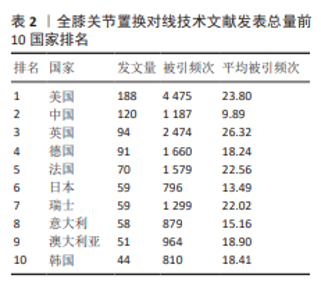
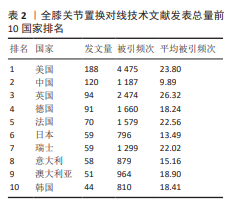
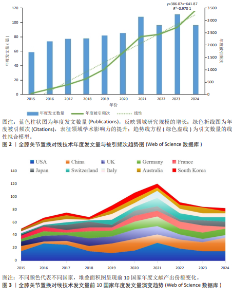
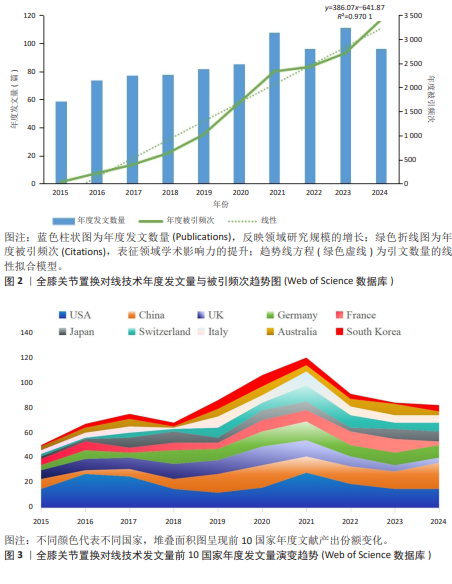
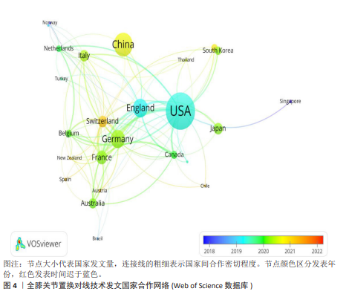
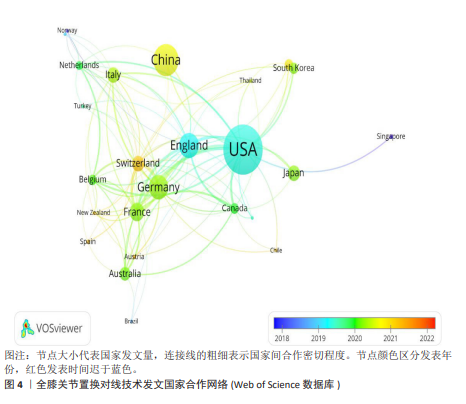
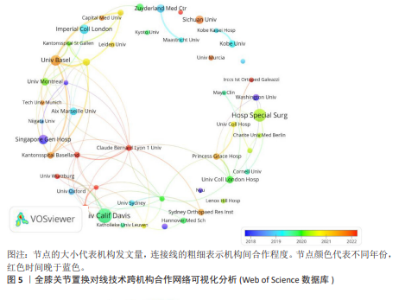
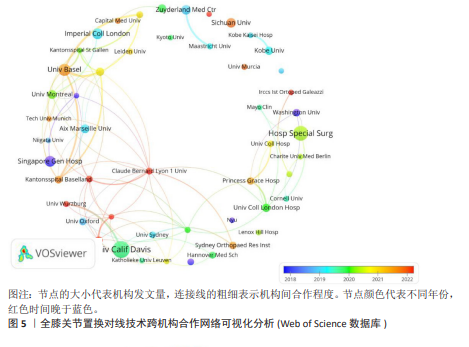
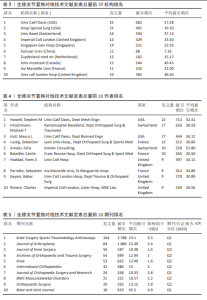
2.1 文献发表趋势 根据Web of Science数据库检索及筛选结果,在2015-2024年10年期间,有866篇论文与全膝关节置换对线技术相关,其中论著792篇(91.45%),综述74篇(8.55%),共计被引用16 533次,平均被引频次为18.1/项。全膝关节置换对线技术的H指数为57。2015-2021年全膝关节置换对线技术的年度发文数量呈上升趋势(图2),至2021年,达到发文数量峰值(130篇);2022下降至86篇。此外,引文量每年稳步增加,2024年达到16 533次引文峰值。其中线性拟合模型:y = 386.07x–641.87(y为引文量,x为年份),拟合优度 R2=0.970 1,表明引文增长呈稳定的高增长趋势(年均增幅约386次)。 2.2 国家及机构分析 共有49个国家和200个机构参与全膝关节置换对线技术相关文献发表。发文量前10国家年度发文量及被引量详见图3及表2。发文量前10欧洲国家5个、亚洲国家3个、北美国家1个、澳洲国家1个。发文量前3的国家以美国为首(n=1,21.71%),中国第二(n=2,13.86%),英国第三(n=4,10.85%)。平均引用率贡献最大的国家是英国,其次是美国和法国,尽管中国发文量排名第二,但其平均引用率相对较低,排名靠后,这可能是由于中国文献发表时间段主要集中在2018年以后。发文国家合作关系可视化分析见图4,节点的大小代表每个国家发表的文章数量,连接线的粗细表示国家之间的合作程度。节点颜色不同,代表不同的平均出版年份。红色节点发布时间迟于蓝色节点,设置至少发表5篇文献为最低标准,纳入了25个国家,该领域文献耦合强度排名前3位的国家是美国、英国、中国。 表3列出了发文数量排名前10的机构。美国加利福尼亚大学发表文献最多(25篇),其次是美国纽约特种外科医院(21篇出版物)和瑞士巴塞尔大学(16篇)。平均引用率加拿大蒙特利尔大学位居第一(49.45次/篇),瑞士巴塞尔大学位居第二(37.23次/篇),伦敦大学学院医院位居第三(36.50次/篇)。来自亚洲国家的机构只有2所,分别是新加坡中央医院、四川大学。跨机构合作网络可视化分析见图5。"
"
"
"
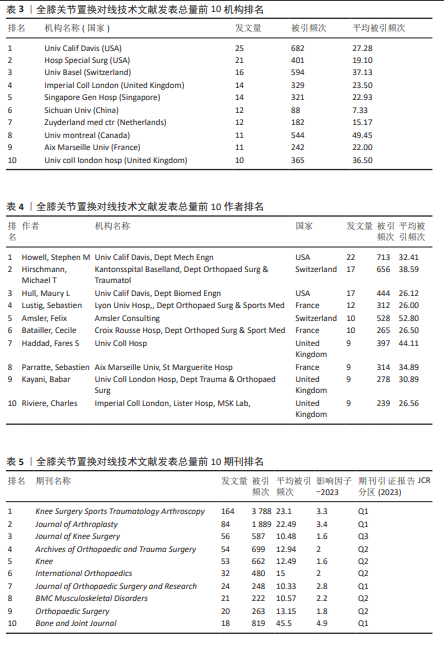
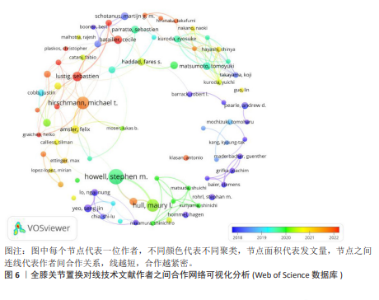
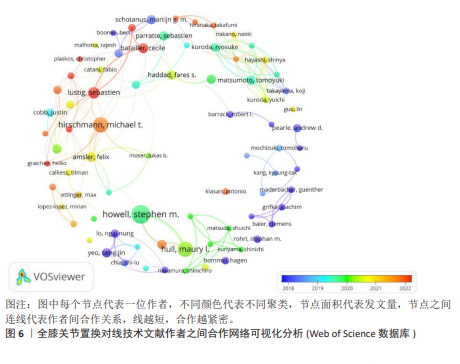
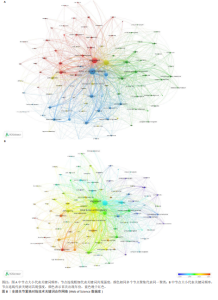
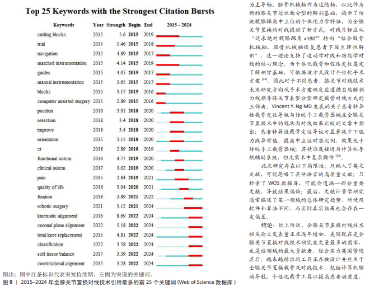
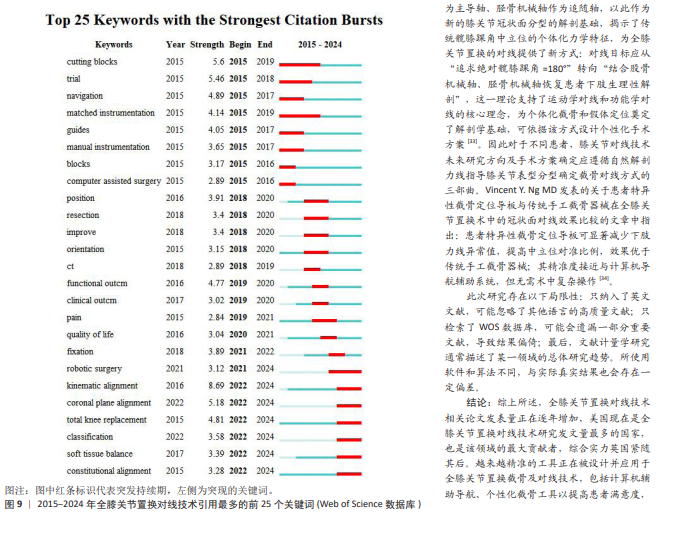
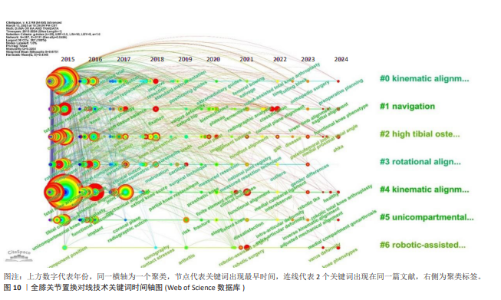
2.3 作者贡献及合作分析 共有3 661名作者在全膝关节置换对线技术领域发表文章,表4列出了前10位最多产的作者。美国加利福尼亚大学的Howell, Stephen M以22篇发文量位居榜首,其次是瑞士巴塞尔州立医院的Hirschmann, Michael T与美国加利福尼亚大学的Hull, Maury L发文量均为17篇,并列第二。亚洲学者并没有入选前10排名。在被引频次方面,前3名分别是Howell, Stephen M,有713次引用;Hirschmann, Michael T,有656次引用;Amsler, Felix,有528次引用;由此可见Howell, Stephen M的发文量、引用量、均引频次排名靠前,表明他的研究在同行学者中获得极大认可。此外,根据图6所示的作者合作网络,Howell, Stephen M与Hull, Maury L的研究合作关系最密切。从作者间合作网络可以看出Hull, Maury L与Howell, Stephen M之间的合作关系最密切。 2.4 期刊分析 共有110种期刊发表了关于全膝关节置换对线技术主题的相关文献。排名前10的期刊共发表了526篇文章,占总发文量的60.74%,其中《Knee Surgery Sports Traumatology Arthroscopy》最多,发表了164篇文章。其次是《Journal of Arthroplasty》(84篇)和《Journal of Knee Surgery》(56篇),详见表5。总被引频次最多的前3名期刊是《Knee Surgery Sports Traumatology Arthroscopy》,引用次数为3 788次;其次是《Journal of Arthroplasty》,引用次数为1 889次;排名第3的期刊是《Bone and Joint Journal》,引用次数为819次。排名前10名期刊中有4本期刊JCR分区属于Q1(最高质量)类别。影响因子排名前3的期刊分别是《Bone and Joint Journal》(影响因子=4.9)、《Journal of Arthroplasty》(影响因子 =3.4)和《Knee Surgery Sports Traumatology Arthroscopy》(影响因子=3.3)。 引用的期刊在左边,被引用的期刊在右边,颜色路径指示引用关系,期刊双图叠加可视化分析显示了2个主要的引文路径(图7)。值得注意的是,在全膝关节置换对线技术研究背景下,医学/临床医学期刊主要引用外科学、运动医学期刊发表的文献。 2.5 关键词分析 使用VOSviewer对关键词进行分析,将关键词最小出现次数设置为15,可以得到103个关键词进行分析。在图8A中,第1组红色聚类主要与全膝关节置换对线技术所涉及的解剖标志或解剖学研究相关;第2组绿色聚类主要与全膝关节置换对线技术截骨方式或工具、导航技术研究相关;第3组蓝色聚类重点关注全膝关节置换术后手术疗效及临床随访结果;第4组黄色聚类重点关注全膝关节置换治疗骨关节炎的替代方案。按频率排名的前5个关键词是全膝关节置换、对齐技术、关节成形术、临床结果、生存率,强调了全膝关节置换对线技术与临床疗效及假体生存率是相关研究关注的重点。 图8B中,不同颜色代表不同出版年份,蓝色关键词出现时间早于黄色关键词。由此可见,与传统中立位对线截骨相似的标准化机械对线、传统截骨工具、可匹配的截骨工具等技术工具出现时间早于运动学对线、功能学对线、机器人导航辅助对等技术。此外,图9列出了引用爆发最重要的前25个关键词,揭示了“cutting blocks”是引用爆发中最早的关键词,其也是机械对线对线方式中普遍使用的截骨工具。表明全膝关节置换对线技术目前的研究前沿热点依旧是更符合运动学、解剖学的个性化对线方案,如功能对线、运动学对线、个体化对线是最近几年较为流行的新词。 图10展示了关键词的演变时间轴,突出了研究人员对全膝关节置换术中个性化截骨、旋转对线、运动力学对线、机器人辅助手术的研究兴趣。"
"

"

"

"
"


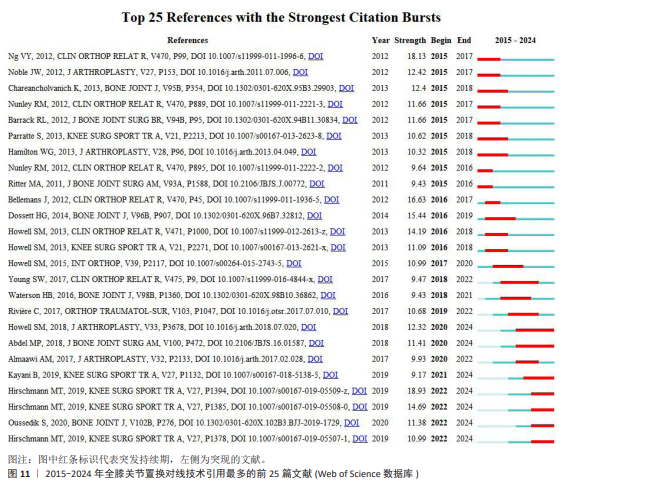
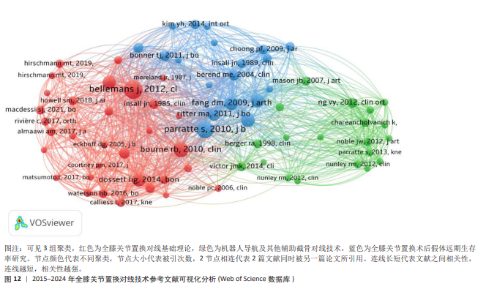
2.6 参考文献分析 图11显示了前25篇引用最多的参考文献,包括20篇文章和5篇综述或Meta分析。发表年份集中:高爆发文献发表多集中于2012-2013年。文献引用爆发集中于2015-2018年,部分文献持续至2024年,揭示了全膝关节置换对线技术研究在此期间活跃度较高,其中Michael T. Hirschmann于2019发表在《Knee Surgery, Sports Traumatology, Arthroscopy》关于膝关节冠状位对位、对线分类及分型新方法的文章爆发强度最高;其次是作者Ng VY发表在《Clinical Orthopaedics and Related Research》有关个性化截骨工具优化冠状面对位、对线的文章爆发强度次之。上述参考文献中没有一个在其引用爆发后保持持续影响超过5年,持续影响为4年的文章有3篇。期刊《Knee Surgery, Sports Traumatology, Arthroscopy》与《Clinical Orthopaedics and Related Research》的发表数量最多,同为6篇,期刊《Journal of Arthroplasty》和《The Bone & Joint Journal》发表数量次之,同为4篇。 文献共被引分析对于追踪该研究领域前沿基础至关重要。共被引关系表明2篇或多篇文章同时被1篇或多篇文章引用,这种方法已被广泛用作评估不同文章之间关联程度的研究手段。图12展示了参考文献共被引以及聚类分析。以最低被引次数为40次,在11 285篇被引文献中共71篇文献纳入研究。可见3组聚类:①红色为全膝关节置换对线基础理论,核心文献:Bellemans J (2012) Clin Orthop Relat Res (被引184次,链接强度1 728),Howell SM (2013) Clin Orthop Relat Res (被引111次,链接强度1 274),聚焦热点:机械对线是否适用于所有全膝关节置换手术;运动学对线理论的提出与奠基。②绿色为机器人导航及其他辅助截骨对线技术,核心文献:John W Noble (2012) j arthroplasty (被引75次,链接强度555),Vincent Y. Ng (2012) Clin Orthop Relat Res (被引77次,链接强度651),技术革新:患者匹配器械对线截骨系统的研发;患者特异性截骨定位导板技术的提出与验证。③蓝色为全膝关节置换术后假体远期生存率研究,核心文献:Parratte S (2010) J Bone Joint Surg Am (被引164次,链接强度1 684),随访研究指出,使用中立位对齐(±3°)预测假体生存率参考价值有限。 "
"

| [1] CARR AJ, ROBERTSSON O, GRAVES S, et al. Knee replacement. Lancet. 2012; 379(9823):1331-1340. [2] JAFFE WL, DUNDON JM, CAMUS T. Alignment and Balance Methods in Total Knee Arthroplasty. J Am Acad Orthop Surg. 2018;26(20):709-716. [3] MONTGOMERY SJ, SIKES JH, MELANCON DP, et al. Effect of Converting Kinematic Aligned Total Knee Arthroplasty to Mechanical Axis Revision Total Knee Arthroplasty on Gap Measurements. Cureus. 2025;17(4):e82148. [4] DEFRANCE MJ, SCUDERI GR. Are 20% of Patients Actually Dissatisfied Following Total Knee Arthroplasty? A Systematic Review of the Literature. J Arthroplasty. 2023;38(3):594-599. [5] AYERS DC, YOUSEF M, ZHENG H, et al. The Prevalence and Predictors of Patient Dissatisfaction 5-years Following Primary Total Knee Arthroplasty. J Arthroplasty. 2022;37(6S):S121-S128. [6] MATSUDA S, KAWAHARA S, OKAZAKI K, et al. Postoperative alignment and ROM affect patient satisfaction after TKA. Clin Orthop Relat Res. 2013; 471(1):127-133. [7] KLASAN A, KAPSHAMMER A, MIRON V, et al. Kinematic Alignment in Total Knee Arthroplasty Reduces Polyethylene Contact Pressure by Increasing the Contact Area, When Compared to Mechanical Alignment-A Finite Element Analysis. J Pers Med. 2022;12(8):1285. [8] DEJOUR DH, MÜLLER JH, SAFFARINI M, et al. Implant survival of 3rd-condyle and post-cam posterior-stabilised total knee arthroplasty are comparable at follow-up > 10 years: a systematic review. Knee Surg Sports Traumatol Arthrosc. 2022;30(3):1001-1024. [9] MANARA JR, STEER R, WHITEHOUSE SL, et al. Functional alignment restores native kinematics more consistently than mechanical axis alignment in total knee arthroplasty. Bone Joint J. 2025; 107-B(4):423-431. [10] AN VVG, TWIGGS J, LEIE M, et al. Kinematic alignment is bone and soft tissue preserving compared to mechanical alignment in total knee arthroplasty. Knee. 2019;26(2):466-476. [11] KOUTSERIMPAS C, ANDRIOLLO L, GREGORI P, et al. Revisiting terminology: The transition from ‘functional alignment’ to ‘functional knee positioning’. Knee Surg Sports Traumatol Arthrosc. 2025; 33(6):1948-1953. [12] VAN DE GRAAF VA, SHEN TS, WOOD JA, et al. Addressing sagittal plane imbalance in primary total knee arthroplasty. Bone Jt Open. 2024;5(8):681-687. [13] POURSALEHIAN M, EBRAHIMZADEH MH, JAVADZADE E, et al. Recent Trends and Hotspots in Knee Arthroplasty: A Bibliometric Analysis and Visualization Study of the Last Five-Year Publications. Arch Bone Jt Surg. 2023; 11(9):545-555. [14] EL EMAM K, ARBUCKLE L, JONKER E, et al. Two h-index benchmarks for evaluating the publication performance of medical informatics researchers. J Med Internet Res. 2012;14(5):e144. [15] ARRUDA H, SILVA ER, LESSA M. VOSviewer and Bibliometrix. J Med Libr Assoc. 2022;110(3): 392-395. [16] CHEN C, SONG M. Visualizing a field of research: A methodology of systematic scientometric reviews. PLoS One. 2019;14(10):e0223994. [17] HASSAN-MONTERO Y, DE-MOYA-ANEGÓN F, GUERRERO-BOTE VP. SCImago Graphica: a new tool for exploring and visually communicating data. Prof De La Inform. 2022;31(5): httis://doi.org/10.3145/epi.2022sep.02. [18] ARIA M, CUCCURULLO C. Bibliometrix: An R-tool for comprehensive science mapping analysis. J Informetr. 2017;11: 959-975. [19] ETTINGER M, TSMASSIOTIS S, NEDOPIL AJ, et al. Messschablonentechnik des kinematischen Alignments [Calipered technique for kinematic alignment]. Orthopade. 2020;49(7):593-596. [20] KIM KK, HOWELL SM, WON YY. Kinematically Aligned Total Knee Arthroplasty with Patient-Specific Instrument. Yonsei Med J. 2020;61(3): 201-209. [21] LEE YS, HOWELL SM, WON YY, et al. Kinematic alignment is a possible alternative to mechanical alignment in total knee arthroplasty. Knee Surg Sports Traumatol Arthrosc. 2017;25(11): 3467-3479. [22] HOWELL SM, HULL ML, NEDOPIL AJ, et al. Caliper-Verified Kinematically Aligned Total Knee Arthroplasty: Rationale, Targets, Accuracy, Balancing, Implant Survival, and Outcomes. Instr Course Lect. 2023;72:241-259. [23] NUNLEY RM, ELLISON BS, ZHU J, et al. Do patient-specific guides improve coronal alignment in total knee arthroplasty? Clin Orthop Relat Res. 2012;470(3):895-902. [24] SHELTON TJ, GILL M, ATHWAL G, et al. Outcomes in Patients with a Calipered Kinematically Aligned TKA That Already Had a Contralateral Mechanically Aligned TKA. J Knee Surg. 2021;34(1):87-93. [25] HESS S, MOSER LB, AMSLER F, et al. Highly variable coronal tibial and femoral alignment in osteoarthritic knees: a systematic review. Knee Surg Sports Traumatol Arthrosc. 2019;27(5): 1368-1377. [26] SCHELKER BL, NOWAKOWSKI AM, HIRSCHMANN MT. What is the “safe zone” for transition of coronal alignment from systematic to a more personalised one in total knee arthroplasty? A systematic review. Knee Surg Sports Traumatol Arthrosc. 2022;30(2):419-427. [27] WAN D, WANG R, WEI J, et al. Bibliometric and visual analysis of research on analgesia and total knee arthroplasty from 1990 to 2022. Heliyon. 2024;10(3):e25153. [28] LIU P, ZHANG C, LU Z, et al. Global research status and trends of UKA for knee osteoarthritis: a bibliometric analysis. Arthroplasty. 2020;2(1):20. [29] LUO Z, ZHOU K, PENG L, et al. Similar results with kinematic and mechanical alignment applied in total knee arthroplasty. Knee Surg Sports Traumatol Arthrosc. 2020; 28(6):1720-1735. [30] VENDITTOLI PA, MARTINOV S, BLAKENEY WG. Restricted Kinematic Alignment, the Fundamentals, and Clinical Applications. Front Surg. 2021;8:697020. [31] LEE YS, HOWELL SM, WON YY, et al. Kinematic alignment is a possible alternative to mechanical alignment in total knee arthroplasty. Knee Surg Sports Traumatol Arthrosc. 2017;25(11):3467-3479. [32] ETTINGER M, TUECKING LR, SAVOV P, et al. Higher satisfaction and function scores in restricted kinematic alignment versus mechanical alignment with medial pivot design total knee arthroplasty: A prospective randomised controlled trial. Knee Surg Sports Traumatol Arthrosc. 2024;32(5):1275-1286. [33] HIRSCHMANN MT, MOSER LB, AMSLER F, et al. Functional knee phenotypes: a novel classification for phenotyping the coronal lower limb alignment based on the native alignment in young non-osteoarthritic patients. Knee Surg Sports Traumatol Arthrosc. 2019;27(5):1394-1402. [34] NG VY, DECLAIRE JH, BEREND KR, et al. Improved accuracy of alignment with patient-specific positioning guides compared with manual instrumentation in TKA. Clin Orthop Relat Res. 2012;470(1):99-107. |
| [1] | Xu Canli, He Wenxing, Wang Yuping, Ba Yinying, Chi Li, Wang Wenjuan, Wang Jiajia. Research context and trend of TBK1 in autoimmunity, signaling pathways, gene expression, tumor prevention and treatment [J]. Chinese Journal of Tissue Engineering Research, 2026, 30(在线): 1-11. |
| [2] | He Yixiang, Qiao Wanjia, Wang Wenji. Effectiveness and safety of tranexamic acid versus epsilon-aminocaproic acid in total hip and knee arthroplasties: a meta-analysis [J]. Chinese Journal of Tissue Engineering Research, 2026, 30(9): 2361-2369. |
| [3] | Zhu Xiaolong, Zhang Wei, Yang Yang. Visualization analysis of research hotspots and cutting-edge information in the field of intervertebral disc regeneration and repair [J]. Chinese Journal of Tissue Engineering Research, 2026, 30(9): 2391-2402. |
| [4] | Wen Fayan, Li Yan, Qiang Tianming, Yang Chen, Shen Linming, Li Yadong, Liu Yongming. Unilateral biportal endoscopic technology for treatment of lumbar degenerative diseases: global research status and changing trends [J]. Chinese Journal of Tissue Engineering Research, 2026, 30(9): 2380-2390. |
| [5] | Huang Jie, Zeng Hao, Wang Wenchi, Lyu Zhucheng, Cui Wei. Visualization analysis of literature on the effect of lipid metabolism on osteoporosis [J]. Chinese Journal of Tissue Engineering Research, 2026, 30(6): 1558-1568. |
| [6] | Yang Zeyu, Zhi Liang, Wang Jia, Zhang Jingyi, Zhang Qingfang, Wang Yulong, Long Jianjun. A visualized analysis of research hotspots in high-frequency repetitive transcranial magnetic stimulation from the macroscopic perspective [J]. Chinese Journal of Tissue Engineering Research, 2026, 30(5): 1320-1330. |
| [7] | Bei Chaoyong, Zhu Jialin, Yu Zhengze, Shi Niujin, Li Huarui, Peng Fenglin. Visualization analysis of research hotspots and trends in the treatment of knee osteoarthritis [J]. Chinese Journal of Tissue Engineering Research, 2026, 30(36): 9632-9639. |
| [8] | Wang Quan, Tang Zhenglong. Visualization analysis of literature on medication-related osteonecrosis of the jaw [J]. Chinese Journal of Tissue Engineering Research, 2026, 30(35): 9327-9335. |
| [9] | Chen Xiaoxia, Zhao Lihua, Li Taowen, Qin Yimei, Liang Jinyu. Postmenopausal cognitive impairment: a bibliometric analysis of developmental context and hot trends [J]. Chinese Journal of Tissue Engineering Research, 2026, 30(35): 9336-9344. |
| [10] | He Renda, Ma Wei, Sun Yongsi, Mo Xueni. Future medical research on brain organoids: interdisciplinary training, bioengineering technologies, and optimized model maturity [J]. Chinese Journal of Tissue Engineering Research, 2026, 30(34): 9088-9094. |
| [11] | Bu Fanchen, Hua Zhen, , Li Xiaolong, Lyu Jinye, Man Hao, Wang Jianwei, . Triangular fibrocartilage complex injuries: a visualization analysis of treatment hotspots and frontiers [J]. Chinese Journal of Tissue Engineering Research, 2026, 30(34): 9095-9102. |
| [12] | Zhang Zhanyue, Zhao Lijun, Zhang Chunyang, Zhang Zhongqi, Fu Kang, Zhang Zhihong. Application and development of polyetheretherketone material in skull defect repair [J]. Chinese Journal of Tissue Engineering Research, 2026, 30(32): 8569-8576. |
| [13] | Tong Man, Wang Yue, Wang Ruoyu, Wang Zhe, Fang Yanhua, Liang Shanshan . Bibliometric analysis of studies on organoid air-liquid interface culture [J]. Chinese Journal of Tissue Engineering Research, 2026, 30(31): 8302-8308. |
| [14] | Shi Liupeng, Xie Liangyu, Dan Yuqin, Li Wang, Wang Jie, Shi Liang, Shi Bin, Cao Shengnan, Sun Guodong. Bibliometric analysis of soft robotic rehabilitation applications: a multidisciplinary perspective and trend insight in the context of greater health [J]. Chinese Journal of Tissue Engineering Research, 2026, 30(31): 8272-8281. |
| [15] | Huang Jie, Zeng Hao, Zhang Zhenhao, Wang Wenchi, Cui Xianqin, Zhu Lifeng, Cui Wei. Body mass index and knee osteoarthritis: a bibliometric analysis based on the Web of Science Core Collection database [J]. Chinese Journal of Tissue Engineering Research, 2026, 30(31): 8282-8292. |
| Viewed | ||||||
|
Full text |
|
|||||
|
Abstract |
|
|||||