Chinese Journal of Tissue Engineering Research ›› 2026, Vol. 30 ›› Issue (27): 7210-7218.doi: 10.12307/2026.798
Previous Articles Next Articles
Integration of CD4+ T cell dynamic expression of quantitative trait loci reveals immunotherapeutic targets for sarcopenia
Jin Zicheng1, Cui Kai2, Li Yuzhou1
- 1College of Physical Education, Henan Normal University, Xinxiang 453007, Henan Province, China; 2Medical School, Jinan University, Guangzhou 510632, Guangdong Province, China
-
Received:2025-09-10Accepted:2025-12-15Online:2026-09-28Published:2026-05-26 -
Contact:Li Yuzhou, PhD, Professor, College of Physical Education, Henan Normal University, Xinxiang 453007, Henan Province, China -
About author:Jin Zicheng, MS, College of Physical Education, Henan Normal University, Xinxiang 453007, Henan Province, China

CLC Number:
Cite this article
Jin Zicheng, Cui Kai, Li Yuzhou. Integration of CD4+ T cell dynamic expression of quantitative trait loci reveals immunotherapeutic targets for sarcopenia[J]. Chinese Journal of Tissue Engineering Research, 2026, 30(27): 7210-7218.
share this article
Add to citation manager EndNote|Reference Manager|ProCite|BibTeX|RefWorks
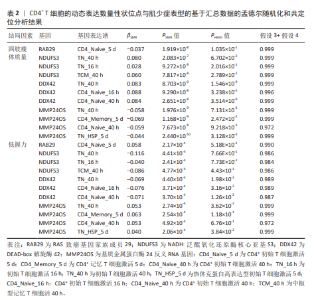
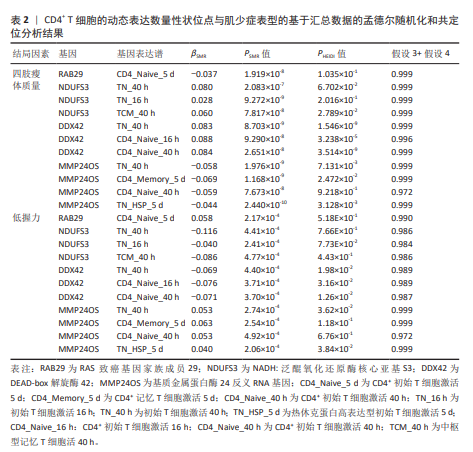
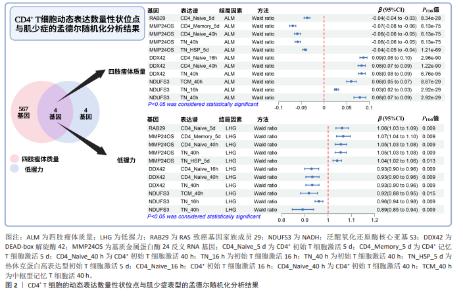
2.1 CD4+ T 细胞动态表达数量性状位点与肌少症的孟德尔随机化、基于汇总数据的孟德尔随机化和共定位分析结果 在CD4+ T细胞动态表达数量性状位点与肌少症的孟德尔随机化分析中,根据筛选标准(P < 5×10⁻⁸、r2 < 0.001、F > 10、Steiger方向过滤),以四肢瘦体质量为结局因素的孟德尔随机化分析纳入9 282 个工具变量,包括9 282个CD4+ T细胞动态表达数量性状位点;以低握力为结局因素的孟德尔随机化分析纳入9 223个工具变量,包括9 223个CD4+ T 细胞动态表达数量性状位点。 以四肢瘦体质量为结局因素的孟德尔随机化分析(Wald比率法)结果显示,共有567个基因在46个表达谱(细胞-激活状态)中表现出3 070对基因-四肢瘦体质量因果关联(PFDR < 0.05);以低握力为结局因素的Wald比率法分析结果显示,共有4个基因在8个表达谱中表现出12对基因-低握力因果关联(PFDR < 0.05)。交集结果显示,RAB29、NDUFS3、DDX42和MMP24OS与肌少症均具有因果关联,这些基因在相同的8个基因表达谱中分别表现出11对基因-四肢瘦体质量/低握力因果关联(图2)。 以四肢瘦体质量为结局因素的基于汇总数据的孟德尔随机化分析和异质性检验结果显示,DDX42与四肢瘦体质量不存在因果关联(PSMR < 0.05,PHEIDI < 0.05)。RAB29、NDUFS3和MMP24OS与四肢瘦体质量存在因果关联,这些基因在4个表达谱中表现出4对基因-四肢瘦体质量因果关联(PSMR < 0.05,PHEIDI > 0.05)。以低握力为结局因素的基于汇总数据的孟德尔随机化分析和异质性检验结果显示,DDX42与低握力不存在因果关联(PSMR < 0.05,PHEIDI < 0.05)。RAB29、NDUFS3和MMP24OS与低握力存在因果关联,这些基因在6个表达谱中表现出6对基因-低握力因果关联(PSMR < 0.05,PHEIDI > 0.05)(表2)。共定位分析结果显示,RAB29、NDUFS3、DDX42和MMP24OS在上述11个表达谱中与肌少症表型均表现出强共定位证据[(假设3+假设4) > 0.8](表2)。分别交集四肢瘦体质量和低握力的基于汇总数据的孟德尔随机化分析结果及共定位分析结果。 在孟德尔随机化(PFDR < 0.05)和基于汇总数据的孟德尔随机化分析(PSMR < 0.05,PHEIDI > 0.05)中与肌少症表型均存在因果效应,且与肌少症表型均存在强共定位证据[(假设3+假设4) > 0.8]的基因,被认为与肌少症存在因果关联。综合评估后结果显示,DDX42与肌少症不存在因果关联,RAB29、NDUFS3和MMP24OS与肌少症存在因果关联,RAB29、NDUFS3和MMP24OS在4个表达谱中表现出4对靶点-肌少症因果关联,具体为:RAB29在CD4+ 初始T细胞激活5 d时的表达水平(四肢瘦体质量:β=-0.037,95%CI:-0.044至-0.031,PFDR= 8.34×10⁻²⁸;低握力:OR=1.060,95%CI:1.034-1.087,PFDR=0.009)和MMP24OS在CD4+ 记忆T细胞激活5 d时的表达水平(四肢瘦体质量:β=-0.069,95%CI:-0.076至-0.062,PFDR= 6.13×10-75;低握力:OR=1.065,95%CI:1.036-1.095,PFDR=0.009)与肌少症的发生风险呈正向因果关联;NDUFS3在初始T细胞激活16 h(四肢瘦体质量:β=0.027,95%CI:0.023-0.032,PFDR=2.92×10⁻²⁹;低握力:OR=0.961,95%CI:0.944- 0.978,PFDR=0.009)和40 h(四肢瘦体质量:β=0.079,95%CI:0.066-0.092,PFDR=2.92×10⁻²⁹;低握力:OR=0.891,95%CI:0.846-0.938,PFDR= 0.009)时的表达水平与肌少症的发生风险呈负向因果关联。"
"
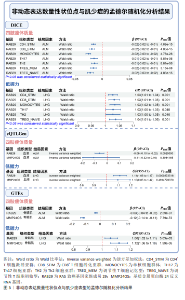
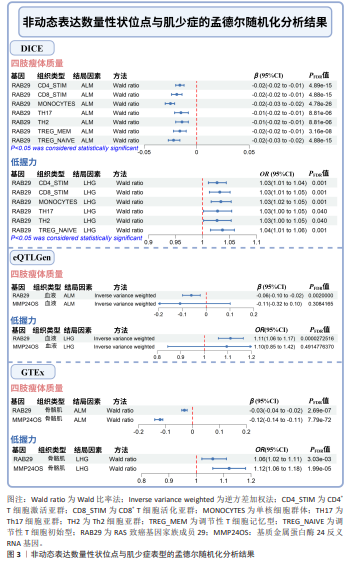
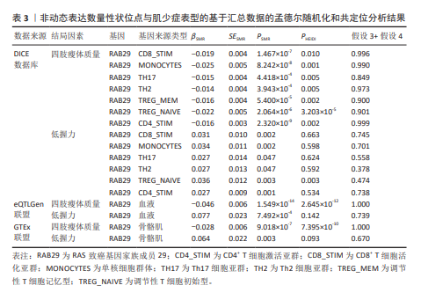
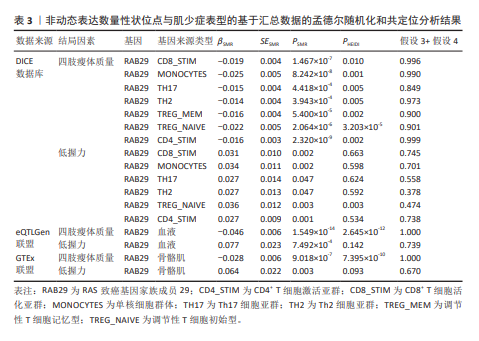
2.2 非动态表达数量性状位点与肌少症表型的孟德尔随机化、基于汇总数据的孟德尔随机化和共定位分析结果 2.2.1 免疫细胞非动态表达数量性状位点与肌少症表型的孟德尔随机化、基于汇总数据的孟德尔随机化和共定位分析结果 在Database of Immune Cell Expression,eQTLs and Epigenomics(DICE)数据库中,提取与RAB29、NDUFS3和MMP24OS相关的非动态表达数量性状位点,根据筛选标准(P < 5×10⁻⁸、r2 < 0.001、F > 10、Steiger方向过滤),以四肢瘦体质量为结局因素的孟德尔随机化分析纳入7个工具变量,包括7个非动态表达数量性状位点;以低握力为结局因素的孟德尔随机化分析纳入7个工具变量,包括7个非动态表达数量性状位点。 孟德尔随机化分析(Wald比率法)结果显示,RAB29在7种细胞类型中与四肢瘦体质量存在因果关联,RAB29在6种细胞类型中与低握力存在因果关联(PFDR < 0.05)。交集分析结果显示,RAB29在6种细胞类型中分别表现出6对RAB29-四肢瘦体质量/低握力因果关联,且与RAB29在动态表达数量性状位点-孟德尔随机化分析中的因果效应方向一致(图3)。 以四肢瘦体质量为结局因素的基于汇总数据的孟德尔随机化分析和异质性检验结果显示,RAB29在2种细胞类型中与四肢瘦体质量存在因果关联 (PSMR < 0.05且PHEIDI > 0.05);以低握力为结局因素的基于汇总数据的孟德尔随机化分析和工具变量检验结果显示,RAB29在5种细胞类型中与低握力存在因果关联(PSMR < 0.05且PHEIDI > 0.05)(表3)。共定位分析结果显示,RAB29在7种细胞类型中与四肢瘦体质量均表现出强共定位证据[(假设3+假设4) > 0.8],但在6种细胞类型中与低握力均未表现出强共定位证据(表3)。 综合上述分析结果,RAB29与四肢瘦体质量存在因果关联且表现出强共定位。RAB29与低握力存在因果关联但未表现出强共定位证据。因此,Database of Immune Cell Expression,eQTLs and Epigenomics(DICE)数据库的非动态表达数量性状位点数据与肌少症的分析中,显示RAB29、NDUFS3和MMP24OS与肌少症无因果关联。 2.2.2 血液非动态表达数量性状位点与肌少症表型的孟德尔随机化、基于汇总数据的孟德尔随机化和共定位分析结果 在eQTLGen联盟中,提取与RAB29、NDUFS3、MMP24OS相关的非动态表达数量性状位点,根据筛选标准 (P < 5×10⁻⁸、r2 < 0.001、F > 10、Steiger方向过滤),以四肢瘦体质量为结局因素的孟德尔随机化分析纳入4个工具变量,包括2个非动态表达数量性状位点;以低握力为结局因素的孟德尔随机化分析纳入4个工具变量,包括2个非动态表达数量性状位点。 孟德尔随机化分析(逆方差加权法)结果显示,RAB29与四肢瘦体质量和低握力均存在因果关联(PFDR < 0.05),且均与RAB29在动态表达数量性状位点-孟德尔随机化分析的因果效应方向一致(图3)。以四肢瘦体质量为结局因素的基于汇总数据的孟德尔随机化分析和异质性检验结果显示,RAB29与四肢瘦体质量存在因果关联,但未通过异质性检验(PSMR < 0.05,PHEIDI < 0.05)。以低握力为结局因素的基于汇总数据的孟德尔随机化分析和异质性检验结果显示,RAB29与低握力存在因果关联(PSMR < 0.05,PHEIDI > 0.05)(表3)。共定位分析结果显示,RAB29与四肢瘦体质量表现出强共定位证据[(假设3+假设4) > 0.8],但与低握力未表现出强共定位证据(表3)。 综合上述分析结果,RAB29与四肢瘦体质量的基于汇总数据的孟德尔随机化分析未通过异质性检验,且与低握力未表现出强共定位证据。因此,eQTLGen联盟的非动态表达数量性状位点数据与肌少症的分析中,显示RAB29、NDUFS3和MMP24OS与肌少症无因果关联。 2.2.3 骨骼肌非动态表达数量性状位点与肌少症表型的孟德尔随机化、基于汇总数据的孟德尔随机化和共定位分析结果 在Genotype-Tissue expression(GTEx)联盟中,提取与RAB29、NDUFS3和MMP24OS相关的非动态表达数量性状位点,根据筛选标准(P < 5×10⁻⁸、r2 < 0.001、F > 10、Steiger方向过滤),以四肢瘦体质量为结局因素的孟德尔随机化分析纳入2个工具变量,包括2个非动态表达数量性状位点;以低握力为结局因素的孟德尔随机化分析纳入2个工具变量,包括2个非动态表达数量性状位点。 孟德尔随机化分析(Wald比率法)结果显示,RAB29和MMP24OS与四肢瘦体质量和低握力均存在因果关联(PFDR < 0.05),且与RAB29和MMP24OS在动态表达数量性状位点-孟德尔随机化分析的因果效应方向一致(图3)。以四肢瘦体质量为结局因素的基于汇总数据的孟德尔随机化分析和异质性检验结果显示,MMP24OS与四肢瘦体质量不存在因果关联(PSMR > 0.05),RAB29与四肢瘦体质量存在因果关联,但未通过异质性检验(PSMR < 0.05,PHEIDI < 0.05)。以低握力为结局因素的基于汇总数据的孟德尔随机化分析和异质性检验结果显示,MMP24OS与低握力不存在因果关联(PSMR > 0.05),RAB29与低握力存在因果关联(PSMR < 0.05且PHEIDI > 0.05)(表3)。共定位分析结果显示,RAB29与四肢瘦体质量表现出强共定位证据[(假设3+假设4) > 0.8],但与低握力均未表现出强共定位证据。MMP24OS与肌少症表型均表现出强共定位证据(表3)。 综合上述分析结果,MMP24OS与四肢瘦体质量和低握力均不存在因果关联。RAB29与四肢瘦体质量的基于汇总数据的孟德尔随机化分析未通过异质性检验,且与低握力未表现出强共定位证据。因此,Genotype-Tissue expression(GTEx)联盟的非动态表达数量性状位点数据与肌少症的分析中,显示RAB29、NDUFS3和MMP24OS与肌少症无因果关联。"
"
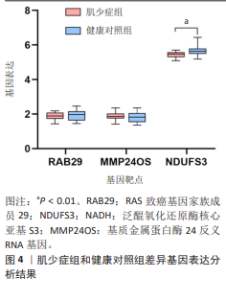
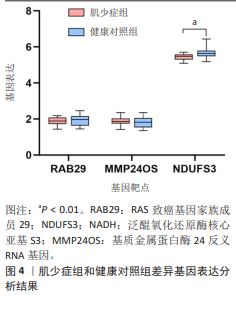
2.3 差异基因表达分析 肌少症组与健康对照组的差异基因表达分析显示(图4),NDUFS3的表达水平在两组之间存在显著差异,相较于健康对照组,肌少症组的NDUFS3平均表达水平显著下调(5.46±0.18 vs. 5.68±0.30,P=0.008)。此外,RAB29和 MMP24OS在两组之间的表达差异均无显著性意义(P > 0.05)。"
| [1] CRUZ-JENTOFT AJ, BAHAT G, BAUER J, et al. Sarcopenia: revised European consensus on definition and diagnosis. Age Ageing. 2019;48(1): 16-31. [2] 陈琳,吴钰祥,杨隽,等.运动干预肌少症与肌-脑-肠环路的研究进展[J].武汉体育学院学报,2021,55(3):70-74. [3] 段玉梅,范彩丽,王安素,等.骨性关节炎与肌少症的相关性及其运动营养干预研究进展[J].护理研究,2022,36(1):105-109. [4] IZZO A, MASSIMINO E, RICCARDI G, et al. A Narrative Review on Sarcopenia in Type 2 Diabetes Mellitus: Prevalence and Associated Factors. Nutrients. 2021;13(1):183. [5] 杨则宜,焦颖.老年肌肉减少症的认知和研究最新进展[J].北京体育大学学报,2019,42(9): 10-18. [6] 肌少症共识[J].中华骨质疏松和骨矿盐疾病杂志,2016,9(3):215-227. [7] 卢冬磊,冯展鹏,曹立全,等.老年肌少症的运动干预[J].中国组织工程研究,2024,28(35): 5723-5731. [8] 田小丽.乌鲁木齐市中老年人群膳食质量与肌肉减少症关联的病例对照研究[D].乌鲁木齐:新疆医科大学,2020. [9] 许一宁,赵洁,黄月娇,等.膝骨关节炎患者恐动症的现状及其影响因素分析[J].现代临床护理,2022,21(2):14-18. [10] CHEN LK, WOO J, ASSANTACHAI P, et al. Asian Working Group for Sarcopenia: 2019 Consensus Update on Sarcopenia Diagnosis and Treatment. J Am Med Dir Assoc. 2020;21(3):300-307.e2. [11] 高天,张勇,张丹,等.骨骼肌干细胞及其微环境调控肌少症的研究进展[J].中国医学科学院学报,2024,46(6):958-964. [12] LIU M, WANG J, HAN Y, et al. Comprehensive landscapes of the causal network between immunity and sarcopenia. Front Immunol. 2024; 15:1443885. [13] ZHOU J, LIU Y, WU J. Association between immune cells, inflammatory cytokines, and sarcopenia: Insights from a Mendelian randomization analysis. Arch Gerontol Geriatr. 2025;128:105560. [14] YIN P, CHEN M, RAO M, et al. Deciphering Immune Landscape Remodeling Unravels the Underlying Mechanism for Synchronized Muscle and Bone Aging. Adv Sci (Weinh). 2024;11(5):e2304084. [15] VILLEGAS JA, VAN WASSENHOVE J, MERRHEIM J, et al. Blocking interleukin-23 ameliorates neuromuscular and thymic defects in myasthenia gravis. J Neuroinflammation. 2023;20(1):9. [16] GREIGERT H, RAMON A, GENET C, et al. Neointimal myofibroblasts contribute to maintaining Th1/Tc1 and Th17/Tc17 inflammation in giant cell arteritis. J Autoimmun. 2024;142:103151. [17] 刘晏东,邓强,张彦军,等.调节性T细胞/Th17细胞平衡在肌骨衰减及重建中作用的研究进展[J].细胞与分子免疫学杂志,2024,40(10): 948-953. [18] 董云峰,王海,邱俊强.不同类型细胞调控骨骼肌修复再生研究进展[J].中国运动医学杂志, 2024,43(7):563-571. [19] HUANG SW, XU T, ZHANG CT, et al. Relationship of Peripheral Lymphocyte Subsets and Skeletal Muscle Mass Index in Sarcopenia: A Cross-Sectional Study. J Nutr Health Aging. 2020;24(3): 325-329. [20] HEO SJ, PARK S, JEE YS. Navigating the nexus among thigh volume, myokine, and immunocytes in older adults with sarcopenia: A retrospective analysis in a male cohort. Arch Gerontol Geriatr. 2024;117:105273. [21] KEILICH SR, CADAR AN, AHERN DT, et al. Altered T cell infiltration and enrichment of leukocyte regulating pathways within aged skeletal muscle are associated impaired muscle function following influenza infection. Geroscience. 2023;45(2): 1197-1213. [22] JIA Q, HAO RJ, LU XJ, et al. Identification of hub biomarkers and immune cell infiltration characteristics of polymyositis by bioinformatics analysis. Front Immunol. 2022;13:1002500. [23] WILFAHRT D, DELGOFFE GM. Metabolic waypoints during T cell differentiation. Nat Immunol. 2024; 25(2):206-217. [24] LIU D, WANG S, LIU S, et al. Frontiers in sarcopenia: Advancements in diagnostics, molecular mechanisms, and therapeutic strategies. Mol Aspects Med. 2024;97:101270. [25] ZHU J, PAUL WE. CD4 T cells: fates, functions, and faults. Blood. 2008;112(5):1557-1569. [26] YIN KF, CHEN T, GU XJ, et al. Systematic druggable genome-wide Mendelian randomization identifies therapeutic targets for sarcopenia. J Cachexia Sarcopenia Muscle. 2024;15(4):1324-1334. [27] JIANG W, ZHAN W, ZHOU L, et al. Potential therapeutic targets for sarcopenia identified by Mendelian randomisation. Age Ageing. 2023; 52(2):afad024. [28] WEN S, XU S, ZONG X, et al. Association Analysis of the Circulating Proteome With Sarcopenia-Related Traits Reveals Potential Drug Targets for Sarcopenia. J Cachexia Sarcopenia Muscle. 2025;16(1):e13720. [29] LUO J, LI J, WANG W, et al. Identifying the Shared Metabolite Biomarkers and Potential Intervention Targets for Multiple Sarcopenia-Related Phenotypes. Int J Mol Sci. 2024;25(22):12310. [30] WU J, CHEN X, LI R, et al. Identifying genetic determinants of sarcopenia-related traits: a Mendelian randomization study of druggable genes. Metabolism. 2024;160:155994. [31] DAVIES NM, HOLMES MV, DAVEY SMITH G. Reading Mendelian randomisation studies: a guide, glossary, and checklist for clinicians. BMJ. 2018;362:k601. [32] NELSON MR, TIPNEY H, PAINTER JL, et al. The support of human genetic evidence for approved drug indications. Nat Genet. 2015;47(8):856-860. [33] ACKERMANN M, SIKORA-WOHLFELD W, BEYER A. Impact of natural genetic variation on gene expression dynamics. PLoS Genet. 2013;9(6): e1003514. [34] QI C, BERG M, CHU X, et al. Cell-type eQTL deconvolution of bronchial epithelium through integration of single-cell and bulk RNA-seq. Allergy. 2022;77(12):3663-3666. [35] SOSKIC B, CANO-GAMEZ E, SMYTH DJ, et al. Immune disease risk variants regulate gene expression dynamics during CD4+ T cell activation. Nat Genet. 2022;54(6):817-826. [36] WU X, YING H, YANG Q, et al. Transcriptome-wide Mendelian randomization during CD4+ T cell activation reveals immune-related drug targets for cardiometabolic diseases. Nat Commun. 2024; 15(1):9302. [37] SCHMIEDEL BJ, SINGH D, MADRIGAL A, et al. Impact of Genetic Polymorphisms on Human Immune Cell Gene Expression. Cell. 2018;175(6): 1701-1715.e16. [38] VÕSA U, CLARINGBOULD A, WESTRA HJ, et al. Large-scale cis- and trans-eQTL analyses identify thousands of genetic loci and polygenic scores that regulate blood gene expression. Nat Genet. 2021;53(9):1300-1310. [39] GTEX CONSORTIUM; LABORATORY, DATA ANALYSIS &COORDINATING CENTER (LDACC)—ANALYSIS WORKING GROUP; STATISTICAL METHODS GROUPS—ANALYSIS WORKING GROUP, et al. Genetic effects on gene expression across human tissues. Nature. 2017;550(7675):204-213. [40] WANG Q, ZHAO X, WANG S, et al. Sarcopenia and immune-mediated inflammatory diseases: Evaluating causality and exploring therapeutic targets for sarcopenia through Mendelian randomization. Int Immunopharmacol. 2025;144: 113687. [41] PEI YF, LIU YZ, YANG XL, et al. The genetic architecture of appendicular lean mass characterized by association analysis in the UK Biobank study. Commun Biol. 2020;3(1):608. [42] JONES G, TRAJANOSKA K, SANTANASTO AJ, et al. Genome-wide meta-analysis of muscle weakness identifies 15 susceptibility loci in older men and women. Nat Commun. 2021;12(1):654. [43] MEMBREZ M, MIGLIAVACCA E, CHRISTEN S, et al. Trigonelline is an NAD+ precursor that improves muscle function during ageing and is reduced in human sarcopenia. Nat Metab. 2024;6(3): 433-447. [44] 1000 GENOMES PROJECT CONSORTIUM; ABECASIS GR, AUTON A, et al. An integrated map of genetic variation from 1,092 human genomes. Nature. 2012;491(7422):56-65. [45] BOWDEN J, DEL GRECO MF, MINELLI C, et al. Improving the accuracy of two-sample summary-data Mendelian randomization: moving beyond the NOME assumption. Int J Epidemiol. 2019;48(3):728-742. [46] BURGESS S, DAVEY SMITH G, DAVIES NM, et al. Guidelines for performing Mendelian randomization investigations: update for summer 2023. Wellcome Open Res. 2023;4:186. [47] DAVEY SMITH G, HEMANI G. Mendelian randomization: genetic anchors for causal inference in epidemiological studies. Hum Mol Genet. 2014;23(R1):R89-98. [48] ZHU Z, ZHANG F, HU H, et al. Integration of summary data from GWAS and eQTL studies predicts complex trait gene targets. Nat Genet. 2016;48(5):481-487. [49] WU Y, ZENG J, ZHANG F, et al. Integrative analysis of omics summary data reveals putative mechanisms underlying complex traits. Nat Commun. 2018;9(1):918. [50] GIAMBARTOLOMEI C, VUKCEVIC D, SCHADT EE, et al. Bayesian test for colocalisation between pairs of genetic association studies using summary statistics. PLoS Genet. 2014;10(5):e1004383. [51] FOLEY CN, STALEY JR, BREEN PG, et al. A fast and efficient colocalization algorithm for identifying shared genetic risk factors across multiple traits. Nat Commun. 2021;12(1):764. [52] NOVIKOVA G, KAPOOR M, TCW J, et al. Integration of Alzheimer’s disease genetics and myeloid genomics identifies disease risk regulatory elements and genes. Nat Commun. 2021;12(1):1610. [53] GIANNOS P, PROKOPIDIS K, RALEIGH SM, et al. Altered mitochondrial microenvironment at the spotlight of musculoskeletal aging and Alzheimer’s disease. Sci Rep. 2022;12(1):11290. [54] BÉNIT P, SLAMA A, CARTAULT F, et al. Mutant NDUFS3 subunit of mitochondrial complex I causes Leigh syndrome. J Med Genet. 2004;41(1):14-17. [55] HAACK TB, HABERBERGER B, FRISCH EM, et al. Molecular diagnosis in mitochondrial complex I deficiency using exome sequencing. J Med Genet. 2012;49(4):277-283. [56] DISTELMAIER F, KOOPMAN WJ, VAN DEN HEUVEL LP, et al. Mitochondrial complex I deficiency: from organelle dysfunction to clinical disease. Brain. 2009;132(Pt 4):833-842. [57] PEREIRA CV, PERALTA S, ARGUELLO T, et al. Myopathy reversion in mice after restauration of mitochondrial complex I. EMBO Mol Med. 2020;12(2):e10674. [58] VINOTHKUMAR KR, ZHU J, HIRST J. Architecture of mammalian respiratory complex I. Nature. 2014;515(7525):80-84. [59] DIETEREN CE, WILLEMS PH, VOGEL RO, et al. Subunits of mitochondrial complex I exist as part of matrix- and membrane-associated subcomplexes in living cells. J Biol Chem. 2008; 283(50):34753-34761. [60] CHANG CH, CURTIS JD, MAGGI LB JR, et al. Posttranscriptional control of T cell effector function by aerobic glycolysis. Cell. 2013;153(6): 1239-1251. [61] TAN H, YANG K, LI Y, et al. Integrative Proteomics and Phosphoproteomics Profiling Reveals Dynamic Signaling Networks and Bioenergetics Pathways Underlying T Cell Activation. Immunity. 2017;46(3):488-503. [62] BAIXAULI F, ACÍN-PÉREZ R, VILLARROYA-BELTRÍ C, et al. Mitochondrial Respiration Controls Lysosomal Function during Inflammatory T Cell Responses. Cell Metab. 2015;22(3):485-498. [63] ONNIS A, FINETTI F, PATRUSSI L, et al. The small GTPase Rab29 is a common regulator of immune synapse assembly and ciliogenesis. Cell Death Differ. 2015;22(10):1687-1699. [64] HUTAGALUNG AH, NOVICK PJ. Role of Rab GTPases in membrane traffic and cell physiology. Physiol Rev. 2011;91(1):119-149. [65] IEZZI G, KARJALAINEN K, LANZAVECCHIA A. The duration of antigenic stimulation determines the fate of naive and effector T cells. Immunity. 1998;8(1):89-95. [66] LEI T, JIANG Z, WANG J, et al. Genetic Influence of the Brain on Muscle Structure: A Mendelian Randomization Study of Sarcopenia. J Cachexia Sarcopenia Muscle. 2025;16(1):e13647. [67] RAZOOKY BS, OBERMAYER B, O’MAY JB, et al. Viral Infection Identifies Micropeptides Differentially Regulated in smORF-Containing lncRNAs. Genes (Basel). 2017;8(8):206. [68] WU Y, WANG H, XIANG W, et al. EDEM2 is a diagnostic and prognostic biomarker and associated with immune infiltration in glioma: A comprehensive analysis. Front Oncol. 2023;12: 1054012. [69] GHENEA S, CHIRITOIU M, TACUTU R, et al. Targeting EDEM protects against ER stress and improves development and survival in C. elegans. PLoS Genet. 2022;18(2):e1010069. [70] BA H, WANG Y, ZHANG L, et al. Prediction of Immune Infiltration Diagnostic Gene Biomarkers in Kawasaki Disease. J Immunol Res. 2022;2022:8739498. |
| [1] | Wu Zhilin, , He Qin, Wang Pingxi, Shi Xian, Yuan Song, Zhang Jun, Wang Hao . DYRK2: a novel therapeutic target for rheumatoid arthritis combined with osteoporosis based on East Asian and European populations [J]. Chinese Journal of Tissue Engineering Research, 2026, 30(6): 1569-1579. |
| [2] | Liu Hongtao, Wu Xin, Jiang Xinyu, Sha Fei, An Qi, Li Gaobiao. Causal relationship between age-related macular degeneration and deep vein thrombosis: analysis based on genome-wide association study data [J]. Chinese Journal of Tissue Engineering Research, 2026, 30(6): 1602-1608. |
| [3] | Guo Ying, Tian Feng, Wang Chunfang. Potential drug targets for the treatment of rheumatoid arthritis: large sample analysis from European databases [J]. Chinese Journal of Tissue Engineering Research, 2026, 30(6): 1549-1557. |
| [4] | Gao Zengjie, , Pu Xiang, Li Lailai, Chai Yihui, Huang Hua, Qin Yu. Increased risk of osteoporotic pathological fractures associated with sterol esters: evidence from IEU-GWAS and FinnGen databases [J]. Chinese Journal of Tissue Engineering Research, 2026, 30(5): 1302-1310. |
| [5] | Liu Fengzhi, Dong Yuna, Tian Wenyi, Wang Chunlei, Liang Xiaodong, Bao Lin. Gene-predicted associations between 731 immune cell phenotypes and rheumatoid arthritis [J]. Chinese Journal of Tissue Engineering Research, 2026, 30(5): 1311-1319. |
| [6] | Zhang Cuicui, Chen Huanyu, Yu Qiao, Huang Yuxuan, Yao Gengzhen, Zou Xu. Relationship between plasma proteins and pulmonary arterial hypertension and potential therapeutic targets [J]. Chinese Journal of Tissue Engineering Research, 2026, 30(5): 1331-1340. |
| [7] | Zhou Jian, Zhang Tao, Zhou Weili, Zhao Xingcheng, Wang Jun, Shen Jie, Qian Li, Lu Ming. Effects of resistance training on quadriceps mass and knee joint function in patients with osteoporosis and sarcopenia [J]. Chinese Journal of Tissue Engineering Research, 2026, 30(5): 1081-1088. |
| [8] | Li Guangzheng, Li Wei, Zhang Bochun, Ding Haoqin, Zhou Zhongqi, Li Gang, Liang Xuezhen. A prediction model for sarcopenia in postmenopausal women: information analysis based on the China Health and Retirement Longitudinal Study database [J]. Chinese Journal of Tissue Engineering Research, 2026, 30(4): 849-857. |
| [9] | Zeng Hao, Sun Pengcheng, Chai Yuan, Huang Yourong, Zhang Chi, Zhang Xiaoyun. Association between thyroid function and osteoporosis: genome-wide data analysis of European populations [J]. Chinese Journal of Tissue Engineering Research, 2026, 30(4): 1019-1027. |
| [10] | Rong Xiangbin, , Zheng Haibo, Mo Xueshen, Hou Kun, Zeng Ping, . Plasma metabolites, immune cells, and hip osteoarthritis: causal inference based on GWAS data from European populations [J]. Chinese Journal of Tissue Engineering Research, 2026, 30(4): 1028-1035. |
| [11] | He Qiwang, , , Chen Bo, Liang Fuchao, Kang Zewei, Zhou Yuan, Ji Anxu, Tang Xialin, . Relationship between Alzheimer’s disease and sarcopenia and body mass index: analysis of GWAS datasets for European populations [J]. Chinese Journal of Tissue Engineering Research, 2026, 30(4): 1036-1046. |
| [12] | Ding Yu, Chen Jingwen, Chen Xiuyan, Shi Huimin, Yang Yudie, Zhou Meiqi, Cui Shuai, . Circulating inflammatory proteins and myocardial hypertrophy: large sample analysis of European populations from GWAS Catalog and FinnGen databases [J]. Chinese Journal of Tissue Engineering Research, 2026, 30(4): 1047-1057. |
| [13] | Wang Xiaoxuan, Xiao Lu, Miao Changhong, Yuan Weijie, Guo Dengzhou, Yuan Ziwei. Causal association study between resting-state brain network functional and structural connectivity and autoimmune diseases [J]. Chinese Journal of Tissue Engineering Research, 2026, 30(36): 9640-9648. |
| [14] | Chen Cai, Hong Zhongyuan, Deng Huaidong, Zeng Qin, Chen Jiancong. Therapeutic targets for knee osteoarthritis: identification via a bioinformatics approach [J]. Chinese Journal of Tissue Engineering Research, 2026, 30(34): 8878-8888. |
| [15] | Zhao Feifan, Cao Yujing. An artificial neural network model of ankylosing spondylitis and psoriasis shared genes and machine learning-based mining and validation [J]. Chinese Journal of Tissue Engineering Research, 2026, 30(3): 770-784. |
| Viewed | ||||||
|
Full text |
|
|||||
|
Abstract |
|
|||||