Chinese Journal of Tissue Engineering Research ›› 2026, Vol. 30 ›› Issue (36): 9632-9639.doi: 10.12307/2026.369
Previous Articles Next Articles
Visualization analysis of research hotspots and trends in the treatment of knee osteoarthritis
Bei Chaoyong, Zhu Jialin, Yu Zhengze, Shi Niujin, Li Huarui, Peng Fenglin
- School of Physical Education and Health, Guangxi Normal University, Guilin 541006, Guangxi Zhuang Autonomous Region, China
-
Received:2025-07-09Revised:2025-09-10Online:2026-12-28Published:2026-05-26 -
Contact:Peng Fenglin, PhD, Professor, School of Physical Education and Health, Guangxi Normal University, Guilin 541006, Guangxi Zhuang Autonomous Region, China -
About author:Bei Chaoyong, PhD candidate, Chief physician, School of Physical Education and Health, Guangxi Normal University, Guilin 541006, Guangxi Zhuang Autonomous Region, China -
Supported by:Innovation Project of Guangxi Graduate Education, No. YCBZ2025084 (to BCY)

CLC Number:
Cite this article
Bei Chaoyong, Zhu Jialin, Yu Zhengze, Shi Niujin, Li Huarui, Peng Fenglin. Visualization analysis of research hotspots and trends in the treatment of knee osteoarthritis[J]. Chinese Journal of Tissue Engineering Research, 2026, 30(36): 9632-9639.
share this article
Add to citation manager EndNote|Reference Manager|ProCite|BibTeX|RefWorks

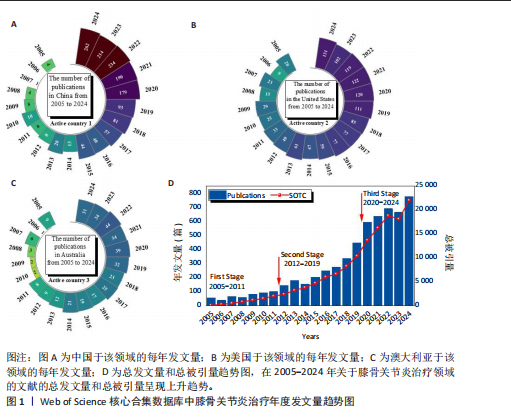
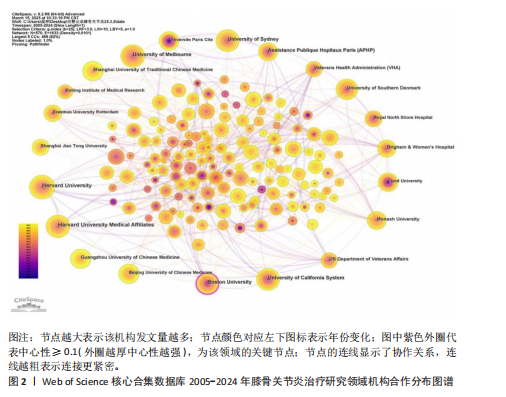
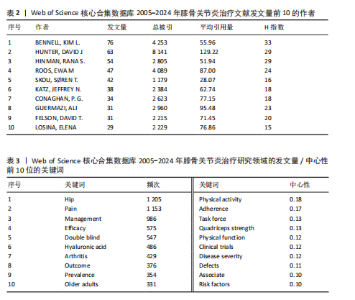
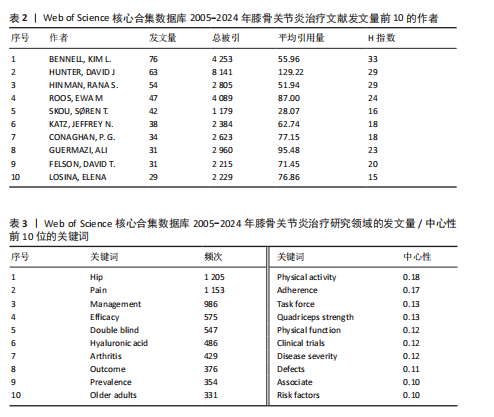
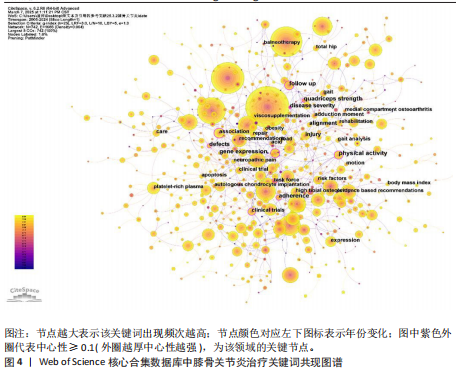
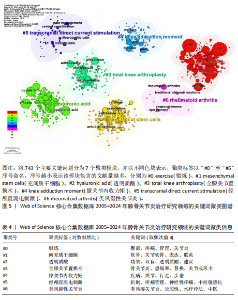
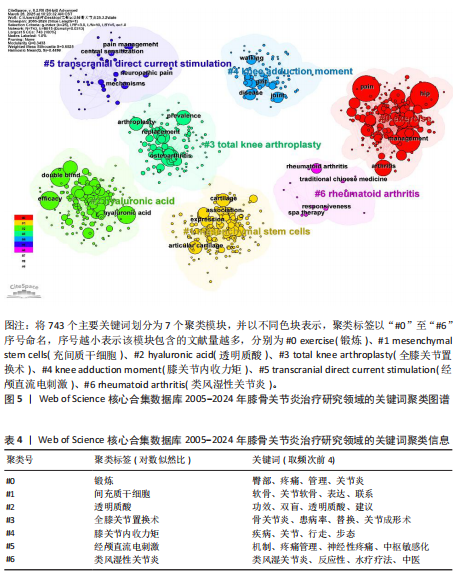
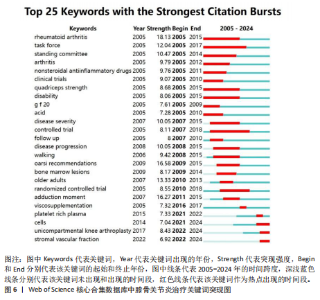
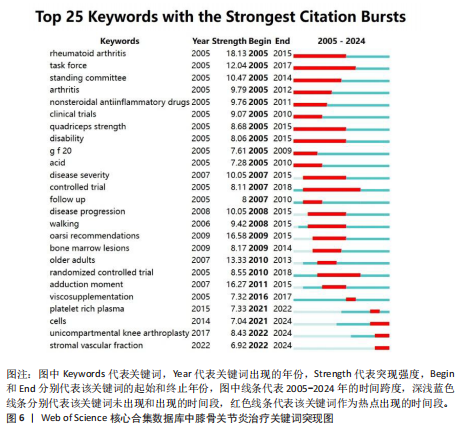
2.1 年度发文趋势分析 文献的年发文量是衡量研究领域发展现状与热度的重要指标,其动态变化客观反映阶段性研究进展,并在一定程度为预测未来趋势提供依据[15]。如图1所示,膝骨关节炎治疗领域总发文量和总被引量整体呈现出上升趋势。根据发文量的上升趋势,共可以划分出3个阶段:2005-2011年为低产稳定期,年发文量不超过100篇;2012-2019年迈入快速增长阶段,年发文量波动较大;2020年后进入高产阶段,年发文量500篇以上,为发文高峰期,见图1D。可见当前研究者对膝骨关节炎治疗领域的关注度很高,该研究方向有相当可观的研究前景和重要的学术价值。 2.2 合作分析 2.2.1 国家文献产出分析 此次研究共收集了来自全球115个国家或地区的文献。中国、美国及澳大利亚在2005-2024年期间的年发文量动态演化趋势见图1A-C。其中以中国的贡献度最大,共计发文1 465篇(25.2%),美国(1 311篇,22.6%)与澳大利亚(369篇,6.4%)分列第二、第三位,发文量排名前三的国家累计贡献率达总量的54.2%。其中,中国在2019-2020年出现显著增长拐点?,年度发文量从2019年的93篇提升至2020年的179篇,相较于2016-2018年的均值(59.3篇)增长202%,并在2020-2024年期间维持年均10.1%的增速(2024年达262篇)。美国?及澳大利亚呈现平稳增长趋势,未出现显著拐点。 2.2.2 机构合作分析 为了分析机构与机构之间的协作关系,绘制膝骨关节炎治疗机构协同合作的可视化图谱。共生成570节点和1 633条连线,图谱密度为0.010 1,见图2。每个节点为具体的研究机构,其节点及字号大小与发文量呈正比,两个节点之间的连线表示机构之间存在合作关系。其中发文量排名前3的机构分别是哈佛大学(277篇)、墨尔本大学(118篇)、加州大学(111篇)。 中介中心性是评价节点在网络中作为“桥梁”的重要性的指标[16]。中心性越高,表示其节点网络中的重要程度及相关性越高,中心性大于0.1的节点在图谱中最外圈为紫色深环,被认为是图谱的关键节点。中介中心性排名前三的机构分别为波士顿大学(0.17)、香港中文大学(0.10)、墨尔本大学(0.07),发文量及中心性排名前5的机构详见表1。 2.2.3 核心作者分析 为了研究膝骨关节炎治疗研究课题中相关文献的核心作者以及作者之间的合作关系,绘制了作者的协作的网络图,作者共现图谱共包括815名学者,形成1 055条合作关系,网络密度为0.003 2。普莱斯定律是科学计量学和文献计量学的重要理论,能够揭示科研领域中的生产力分布规律[17]。根据普莱斯定律公式,计算得出N=6.5,说明发文量大于7篇为该领域核心作者。共有327名核心作者,论文量为3 914篇,占总量的67.4%,表明该领域?学术生产力高度集中于少数高产作者?,学科整体成熟度较高。为使图谱的合作关系更加清晰,仅保留了发文总量> 7篇的核心作者节点,见图3。虽然网络密度< 0.1,说明作者之间的协作度很低,但是网络图中仍然可以看到明显的节点及团队关系。根据图谱可以看出,核心作者在科研合作网络中形成了若干组织结构相对稳定的研究团队,研究团体围绕BENNELL KL、HUNTER DJ等学者形成核心研究圈,合作网络呈现“单核-辐射”模式。各团队内部成员间保持着密切的协作关系,而跨团队合作密度显著低于组内合作水平,且存在部分孤立团队尚未与其他研究团体建立实质性合作关系。这一网络结构特征表明,不同学术团体之间的科研协同效应仍具有显著的提升空间,通过加强跨团队学术交流有望进一步优化整体合作网络的连通性。表2展示了发文量最多的10位作者,其中BENNELL KL是该领域 2005年1月至2024年12月期间发文最多的作者(76篇),HUNTER DJ是该领域被引次数最多的作者(8 141次), 同时也是这一时期平均每篇被引次数最高的作者,达到129.22次,表明其在该领域做出了相当大的贡献。 2.3 研究热点分析 2.3.1 关键词共现分析 关键词是文献中研究主题和内容的精炼概况和高度总结[18]。对文献进行关键词分析,可加深对该领域研究逻辑和理论基础的理解,有利于在一定程度上把握该领域的研究热点。选择关键词(Keyword)作为节点类型进行可视化分析,共生成742个节点,1 086条连线,图谱密度为0.004,见图4。去除与检索策略相关的检索词、合并同义关键词后,得出关于膝骨关节炎治疗的最常见的关键词为Hip(臀部)、Pain (疼痛)、 Management(管理)等,中心性最高的关键词为 Physical activity (身体活动),在共现网络中起枢纽作用。出现频次及中心度最高的10个关键词如表3所示。 2.3.2 关键词聚类分析 关键词聚类依据共现关系和语义关联将具有相似特征的术语归类,可以揭示学科领域的演进脉络、不同时期的核心研究主题及当前前沿热点[19]。运用Citespeace软件,使用经典的对数似然比(log-likelihood ratio,LLR)方法进行关键词聚类分析得到关键词聚类图,见图5。平均轮廓值S=0.652 5>0.3,聚类模块值Q=0.343 3,满足S>0.5,Q>0.3,提示得到的关键词聚类网络图结构显著且聚类同质性较高。共形成#0 exercise(锻炼)、#1 mesenchymal stem cells(充间质干细胞)、#2 hyaluronic acid(透明质酸)、#3 total knee arthroplasty(全膝关节置换术)、#4 knee adduction moment(膝关节内收力矩)、#5 transcranial direct current stimulation(经颅直"

"
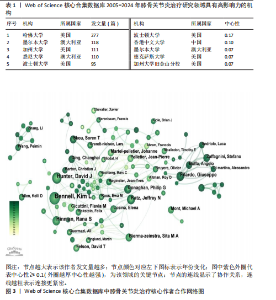
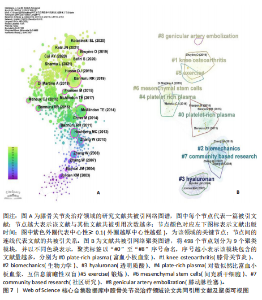
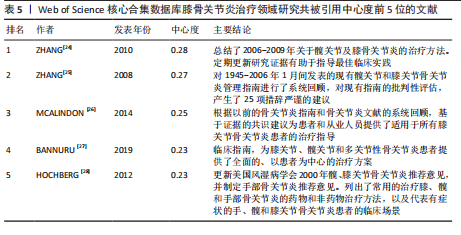
流电刺激)、#6 rheumatoid arthritis(类风湿性关节炎)等7个有意义的关键词聚类,聚类号越小,其包含的关键词数量越多。聚类的详细信息及聚类内频次前4的关键词信息见表4。其中最大聚类#0共包括186个关键词,平均轮廓值为0.541,该聚类的主要施引文章通过系统综述与网络Meta分析方法,评估了7种非药物疗法治疗膝骨关节炎的临床疗效,为膝骨关节炎非药物干预的循证决策提供了证据[20]。 2.3.3 关键词突现分析 关键词突现是指在该关键词较短的一段时间内出现频次显著增加[21]。通过对突现词进行分析,可以判断某一特定时间突然显现或是逐渐兴起的创新思路,进一步反映研究趋势[22]。使用Citespace软件对文献关键词进行突现分析,见图6。图谱展示了2005-2024年间被引爆发强度最强的前25个关键词,红色部分代表某关键词爆发的起止时间,表明研究人员在此时间段内的研究兴趣急剧增加,蓝色则表示该关键词在某些年份的关注度较低。最早突现的关键词有rheumatoid arthritis(类风湿性关节炎)、task force(工作组)、clinical trials(临床试验)、arthritis(关节炎)、nonsteroidal anti-inflammatory drug(非类固醇类抗炎药)等,其中“类风湿性关节炎”是膝骨关节炎治疗研究中突现强度最大(18.13)的关键词。从时间轴分析,“工作组”突现时间最长(10年),cells(细胞)、unicompartmental knee arthroplasty(单腔膝关节置换术)、stromal vascular fraction(基质血管分数)等关键词的突现时间较晚,且保持到最近,说明它是近年来膝骨关节炎治疗领域的新兴热点,未来可重点关注。 2.4 文献分析 2.4.1 文献共被引分析 文献共被引分析是指2篇或多篇文献同时被后续研究共同引用。通过统计共现频率并构建相应网络图谱,可以揭示文献间的相互关系[23]。在共被引网络图谱中,节点代表共被引的文献,其大小与文献共被引频次呈正相关,节点间的连线则表明文献之间存在共被引关系,紫色外圈表示该篇文献中心度> 0.1,在领域内有重要影响。从图7A中可以看出,英国萨塞克斯大学医院的Jordan KM在低产稳定期时段中心度较高(0.17),为学科的发展奠定了基础。美国塔夫茨大学的Bannuru RR共被引频次最高(465),可见他在领域具有重要的影响力。中心度前5的共被引文献详细内容见表5。 2.4.2 文献聚类分析 文献共被引聚类图谱显示9个聚类群,见图7B,分别是#0 plate-rich plasma(富血小板血浆)、#1 knee osteoarthritis(膝骨关节炎)、#2 biomechanics(生物力学)、#3 hyaluronan(透明质酸)、#4 plate-rich plasma[对数似然比富血小板血浆、互信息(mutual information,MI)前瞻性双盲)]#5 exercise(锻炼)、#6 mesenchymal stem cells(间充质干细胞)、#7 community based research(社区研究)、#8 genicular artery embolization(膝动脉栓塞)。聚类平均轮廓值S=0.899 8 > 0.3,聚类模块值Q=0.0.713 2,满足S>0.5,Q>0.3,说明文献聚类结构显著且可信。其中#0富血小板血浆为最大的聚类,包含99篇文献,轮廓值为0.851 5,该聚类的主要施引文献通过系统综述与Meta分析,评估了富血小板血浆注射治疗膝骨关节炎的临床疗效,得出富血小板血浆对膝骨关节炎的疗效随时间延长逐渐显现的结论(6-12个月)[7]。聚类#1膝骨关节炎包含74篇文献,该聚类的主要施引文献通过对2013-2021年PubMed等数据库中82项膝骨关节炎生物疗法研究(含富血小板血浆、骨髓间充质干细胞、脂肪源性干细胞、羊膜间充质干细胞4类)进行疗效分析,DELANOIS等[29]认为现有证据不足以支持生物"

"

"
"
制剂在膝骨关节炎的临床优势,仍需大样本随机对照试验验证其疗效。聚类#2生物力学包含73篇文献,该聚类的主要施引文献研究了不同运动方式对骨关节炎疼痛的疗效,认为有氧运动、力量训练、太极及水上运动均可缓解骨关节炎患者疼痛并改善其功能[30]。聚类#3透明质酸包含65篇文献,该聚类的主要施引文献研究了关节腔内注射透明质酸治疗膝骨关节炎的疗效与安全性,MAHEU等[5]认为关节内透明质酸具有中等症状改善作用且安全性良好,应作为个体化治疗选项,但需进一步研究其敏感人群和长期联合治疗效果。聚类#4被对数似然比算法标记为富血小板血浆、被互信息算法标记前瞻性双盲,由于使用对数似然比与聚类#0名称重合,故使用互信息算法命名改聚类,共包含49篇文献,该聚类的主要施引文献研究了富血小板血浆作为膝骨关节炎治疗手段的近期证据,SIMENTAL-MENDíA等[31]认为尽管多数研究显示富血小板血浆疗效优于透明质酸和安慰剂,但由于治疗方案、患者选择、长期疗效数据的不一致性,以及缺乏延缓疾病进展的确凿证据,目前主流临床指南仍不推荐富血小板血浆常规使用。聚类#5 锻炼包含35篇文献,该聚类的主要施引文献研究的是分阶段运动干预(STEP-KOA,STepped exercise program for patients with knee OsteoArthritis)对膝骨关节炎患者的治疗效果,ALLEN等[32]认为STEP-KOA为膝骨关节炎提供了一种以患者需求为导向的个性化干预路径。聚类#6 间充质干细胞包含34篇文献,该聚类的主要施引文献研究了疗效结论存在矛盾的干细胞治疗原发性膝骨关节炎的荟萃分析,SCHMITZ等[33]认为结论矛盾源于文献检索策略差异、对荟萃分析的误解及干细胞类型可比性误判,临床医生应谨慎解读现有荟萃分析结论。聚类#7社区研究包含20篇文献,该聚类的主要施引文献研究的是未经手术的半月板损伤与膝骨关节炎发展的关联,基于多中心骨关节炎观察性研究,ENGLUND等[34] 认为未经手术的半月板损伤是影像学骨关节炎发展的强风险因素(OR=5.7),需加强其机制研究及防治策略。聚类#8膝动脉栓塞包含8篇文献,该聚类的主要施引文献研究了膝动脉栓塞术治疗轻中度膝骨关节炎的疗效,HINDSO等[35]认为动脉栓塞术可显著缓解疼痛并改善功能,是安全有效的微创疗法,但需进一步研究其长期效果。"
"


"
| [1] LANGWORTHY M, DASA V, SPITZER AI. Knee osteoarthritis: Disease burden, available treatments, and emerging options. Ther Adv Musculoskelet Dis. 2024;16:1759720X241273009. [2] ZENG CY, ZHANG ZR, TANG ZM, et al. Benefits and mechanisms of exercise training for knee osteoarthritis. Front Physiol. 2021;12:794062. [3] WANG C, YAN M, LI Y, et al. Hydrogen-oxygen mixture inhalation as an adjunctive treatment to home-based exercise in older patients with knee osteoarthritis: An open-label, blinded-endpoint, randomized controlled trial. Front Pharmacol. 2025;16:1505922. [4] SUN J, LIANG Y, LUO KT, et al. Efficacy of different acupuncture techniques for pain and dysfunction in patients with knee osteoarthritis: A randomized controlled trial. Pain Ther. 2025;14(2):737-751. [5] MAHEU E, BANNURU RR, HERRERO-BEAUMONT G, et al. Why we should definitely include intra-articular hyaluronic acid as a therapeutic option in the management of knee osteoarthritis: results of an extensive critical literature review. Semin Arthritis Rheum. 2019;48(4):563-572. [6] WHITTLE SL, JOHNSTON RV, MCDONALD S, et al. Stem cell injections for osteoarthritis of the knee.Cochrane Database Syst Rev. 2025;4:CD013342. [7] FILARDO G, PREVITALI D, NAPOLI F, et al. PRP injections for the treatment of knee osteoarthritis: a meta-analysis of randomized controlled trials. Cartilage. 2021;13(1_suppl):364S-375S. [8] FUGGLE N, LASLOP A, RIZZOLI R, et al. Treatment of osteoporosis and osteoarthritis in the oldest old. Drugs. 2025;85(3):343-360. [9] XU P, YU H, BIAN H, et al. Bibliometric insight into neoadjuvant immunotherapy in non-small cell lung cancer: trends, collaborations, and future avenues. Front Immunol. 2025;16:1533651. [10] GUO W, ZANG J, LU J, et al. A bibliometric analysis of aging in COVID-19. Aging Dis. 2023;14(1):6-8. [11] 陈悦, 陈超美, 刘则渊, 等. CiteSpace知识图谱的方法论功能[J]. 科学学研究,2015,33(2):242-253. [12] XIANG F, ZHANG Y, TAN X, et al. A bibliometric analysis based on hotspots and frontier trends of positron emission tomography/computed tomography utility in bone and soft tissue sarcoma. Front Oncol. 2024;14:1344643. [13] CHEN Q, CAI K, LI S, et al. Navigating the global landscape of exercise interventions for knee osteoarthritis: exploring evolving trends and emerging frontiers from a bibliometric and visualization analysis perspective (2011-2022). J Am Med Dir Assoc. 2024;25(11)105269. [14] LU Z, XIE L, LIU W, et al. A bibliometric analysis of intra-articular injection therapy for knee osteoarthritis from 2012 to 2022. Medicine (Baltimore). 2023;102(46): e36105. [15] 高向明, 周明旺, 王晓萍, 等. 近10余年中医药治疗骨质疏松的回顾性分析[J]. 中国骨质疏松杂志,2023,29(5):724-728,738. [16] FREEMAN LC. A set of measures of centrality based on betweenness. Sociometry. 1977; 40(1):35. [17] LÓPEZ-MUÑOZ F, WEINREB RN, MOGHIMI S, et al. A bibliometric and mapping analysis of glaucoma research between 1900 and 2019. Ophthalmol Glaucoma. 2022;5(1):16-25. [18] LONG H, YUAN Z, YIN H, et al. Global research trends in tendon stem cells from 1991 to 2020: a bibliometric and visualized study. Stem Cells Int. 2022;2022:7937765. [19] LIAN Y, SUN J, YANG L, et al. A bibliometric and visualization analysis of the role of traditional chinese medicine in cancer immunotherapy. Front Immunol. 2025;16:1499026. [20] CAO S, ZAN Q, WANG B, et al. Efficacy of non-pharmacological treatments for knee osteoarthritis: a systematic review and network meta-analysis. Heliyon. 2024;10(17):e36682. [21] 王春燕, 张勰. 2018-2021年我国老年健康服务研究热点及趋势可视化分析[J]. 中国预防医学杂志,2022,23(3):196-201. [22] LIU Y, DONG Y, ZHOU W, et al. Visual analysis of emerging topics and trends in contrast agent extravasation research in medical imaging: a bibliometric study using CiteSpace and VOSviewer. Front Med (Lausanne). 2025;12:1472637. [23] SMALL H. Co‐citation in the scientific literature: a new measure of the relationship between two documents. J Am Soc Inf Sci. 1973;24(4):265-269. [24] ZHANG W, NUKI G, MOSKOWITZ RW, et al. OARSI recommendations for the management of hip and knee osteoarthritis part III: changes in evidence following systematic cumulative update of research published through january 2009. Osteoarthritis Cartilage. 2010;18(4):476-499. [25] ZHANG W, MOSKOWITZ RW, NUKI G, et al. OARSI recommendations for the management of hip and knee osteoarthritis, part II: OARSI evidence-based, expert consensus guidelines.Osteoarthritis Cartilage. 2008;16(2):137-162. [26] MCALINDON TE, BANNURU RR, SULLIVAN MC, et al. OARSI guidelines for the non-surgical management of knee osteoarthritis. Osteoarthritis Cartilage. 2014;22(3):363-388. [27] BANNURU RR, OSANI MC, VAYSBROT EE, et al. OARSI guidelines for the non-surgical management of knee, hip, and polyarticular osteoarthritis. Osteoarthritis Cartilage. 2019;27(11):1578-1589. [28] HOCHBERG MC, ALTMAN RD, APRIL KT, et al. American college of rheumatology 2012 recommendations for the use of nonpharmacologic and pharmacologic therapies in osteoarthritis of the hand, hip, and knee. Arthritis Care Res (Hoboken). 2012;64(4):465-474. [29] DELANOIS RE, SAX OC, CHEN Z, et al. Biologic therapies for the treatment of knee osteoarthritis: an updated systematic review. J Arthroplasty. 2022;37(12):2480-2506. [30] GAUGHT AMH, CARNEIRO KA. Evidence for determining the exercise prescription in patients with osteoarthritis. Phys Sportsmed. 2013;41(1): 58-65. [31] SIMENTAL-MENDIA M, ORTEGA-MATA D, ACOSTA-OLIVO CA. Platelet-rich plasma for knee osteoarthritis: what does the evidence say?. Drugs Aging. 2023;40(7):585-603. [32] ALLEN KD, BONGIORNI D, CAVES K, et al. STepped exercise program for patients with knee OsteoArthritis (STEP-KOA): protocol for a randomized controlled trial. BMC Musculoskelet Disord. 2019;20:254. [33] SCHMITZ C, ALT C, PEARCE DA, et al. Methodological flaws in meta-analyses of clinical studies on the management of knee osteoarthritis with stem cells: a systematic review. Cells. 2022; 11(6):965. [34] ENGLUND M, GUERMAZI A, ROEMER FW, et al. Meniscal tear in knees without surgery and the development of radiographic osteoarthritis among middle-aged and elderly persons the multicenter osteoarthritis study. Arthritis Rheum. 2009;60(3): 831-839. [35] HINDSO L, HOLMICH P, PETERSEN MM, et al. Transarterial embolization of geniculate arteries reduces pain and improves physical function in knee osteoarthritis-a prospective cohort study.Diagnostics (Basel). 2024;14(15):1627. [36] CHEN C, LEYDESDORFF L. Patterns of connections and movements in dual-map overlays: a new method of publication portfolio analysis. J Assoc Inf Sci Technol. 2014;65(2):334-351. [37] BORNMANN L, MUTZ R. Growth rates of modern science: a bibliometric analysis based on the number of publications and cited references. J Assoc Inf Sci Technol. 2015;66(11):2215-2222. [38] WANG Z, XU H, WANG Z, et al. Effects of externally-applied, non-pharmacological interventions on short- and long-term symptoms and inflammatory cytokine levels in patients with knee osteoarthritis: a systematic review and network meta-analysis. Front Immunol. 2023;14:1309751. [39] GUO B, QIN S, YE H. [research progress of knee-salvage treatment for knee osteoarthritis].Zhongguo Xiu Fu Chong Jian Wai Ke Za Zhi. 2018; 32(10):1292-1296. [40] REN X, HOU L, LIU S, et al. OA-MEN: a fusion deep learning approach for enhanced accuracy in knee osteoarthritis detection and classification using X-ray imaging. Front Bioeng Biotechnol. 2025;12:1437188. [41] TESTA G, GIARDINA SMC, CULMONE A, et al. Intra-articular injections in knee osteoarthritis: a review of literature. J Funct Morphol Kinesiol. 2021;6(1):15. [42] HUTYRA CA, GONZALEZ JM, YANG JC, et al. Patient preferences for surgical treatment of knee osteoarthritis: a discrete-choice experiment evaluating total and unicompartmental knee arthroplasty. J Bone Joint Surg Am. 2020;102(23): 2022-2031. [43] RANAWAT A, GUO K, PHILLIPS M, et al. Health economic assessments of hyaluronic acid treatments for knee osteoarthritis: a systematic review. Adv Ther. 2024;41(1):65-81. [44] WANG J, ZHOU L, ZHANG Y, et al. Mesenchymal stem cells - a promising strategy for treating knee osteoarthritis. Bone Joint Res. 2020;9(10):719-728. [45] WU C, SUN Z, HE C, et al. pH-dependent osteoimmunomodulation: molecular mechanisms and therapeutic targeting in bone disorders. Pharmacol Res. 2025;218:107838. [46] JIN WS, YIN LX, SUN HQ, et al. Mesenchymal stem cells injection is more effective than hyaluronic acid injection in the treatment of knee osteoarthritis with similar safety: a systematic review and meta-analysis. Arthroscopy. 2025;41(2):318-332. [47] YU D, ZHAO J, ZHAO K. The efficacy of platelet-rich plasma preparation protocols in the treatment of osteoarthritis: a network meta-analysis of randomized controlled trials. J Orthop Surg Res. 2025;20(1):614. [48] CALLESE T, CUSUMANO LR, SPARKS H, et al. Early intervention in knee osteoarthritis with genicular artery embolization is associated with improved clinical outcomes. Eur Radiol. 2025;35(12):7617-7626. [49] ABUSSA R, JEREMIC A. Bridging the gap between injections and surgery: meta-analysis of genicular artery embolization in knee osteoarthritis. Acad Radiol. 2025:S1076-6332(25)439-438. [50] BROWN JM, VANDEVEER ZT, CADORET D, et al.Genicular artery embolization: a technical review of anatomy, pathophysiology, current experiences, and future directions. J Clin Med. 2025;14(6):2106. |
| [1] | Xu Canli, He Wenxing, Wang Yuping, Ba Yinying, Chi Li, Wang Wenjuan, Wang Jiajia. Research context and trend of TBK1 in autoimmunity, signaling pathways, gene expression, tumor prevention and treatment [J]. Chinese Journal of Tissue Engineering Research, 2026, 30(在线): 1-11. |
| [2] | Zhu Xiaolong, Zhang Wei, Yang Yang. Visualization analysis of research hotspots and cutting-edge information in the field of intervertebral disc regeneration and repair [J]. Chinese Journal of Tissue Engineering Research, 2026, 30(9): 2391-2402. |
| [3] | Wen Fayan, Li Yan, Qiang Tianming, Yang Chen, Shen Linming, Li Yadong, Liu Yongming. Unilateral biportal endoscopic technology for treatment of lumbar degenerative diseases: global research status and changing trends [J]. Chinese Journal of Tissue Engineering Research, 2026, 30(9): 2380-2390. |
| [4] | Lai Yu, Chen Yueping, Zhang Xiaoyun. Research hotspots and frontier trends of bioactive materials in treating bone infections [J]. Chinese Journal of Tissue Engineering Research, 2026, 30(8): 2132-2144. |
| [5] | Zhang Haiwen, Zhang Xian, Xu Taichuan, Li Chao. Bibliometric and visual analysis of the research status and trends of senescence in osteoporosis [J]. Chinese Journal of Tissue Engineering Research, 2026, 30(6): 1580-1591. |
| [6] | Huang Jie, Zeng Hao, Wang Wenchi, Lyu Zhucheng, Cui Wei. Visualization analysis of literature on the effect of lipid metabolism on osteoporosis [J]. Chinese Journal of Tissue Engineering Research, 2026, 30(6): 1558-1568. |
| [7] | Yang Zeyu, Zhi Liang, Wang Jia, Zhang Jingyi, Zhang Qingfang, Wang Yulong, Long Jianjun. A visualized analysis of research hotspots in high-frequency repetitive transcranial magnetic stimulation from the macroscopic perspective [J]. Chinese Journal of Tissue Engineering Research, 2026, 30(5): 1320-1330. |
| [8] | Wang Xiaojing, Wei Jingyi, Liu Xihua. A visualized analysis of vagus nerve stimulation in the field of stroke rehabilitation [J]. Chinese Journal of Tissue Engineering Research, 2026, 30(35): 9316-9326. |
| [9] | Wang Quan, Tang Zhenglong. Visualization analysis of literature on medication-related osteonecrosis of the jaw [J]. Chinese Journal of Tissue Engineering Research, 2026, 30(35): 9327-9335. |
| [10] | Chen Xiaoxia, Zhao Lihua, Li Taowen, Qin Yimei, Liang Jinyu. Postmenopausal cognitive impairment: a bibliometric analysis of developmental context and hot trends [J]. Chinese Journal of Tissue Engineering Research, 2026, 30(35): 9336-9344. |
| [11] | Li Huiping, Jia Huanhuan, Zhao Weibo. Animal models of Parkinson’s disease: research status and trend analysis [J]. Chinese Journal of Tissue Engineering Research, 2026, 30(35): 9345-9354. |
| [12] | Wang Yanfei, Jin Lianhai, Li Qingya, Fu Yuanfei, Tan Huangsheng, Deng Pengwei, Gao Kun. Synovial fluid exosome-mediated crosstalk between synoviocytes and chondrocytes in development and progression of knee osteoarthritis [J]. Chinese Journal of Tissue Engineering Research, 2026, 30(34): 9032-9040. |
| [13] | Wu Ruiqi, Dong Panfeng, Zhang Hongrui, Lyu Yongbin, Peng Qinglin, Zhuo Yinghong, Chen Yueping . Different physical factor therapies for knee osteoarthritis: a network meta-analysis of efficacy and safety [J]. Chinese Journal of Tissue Engineering Research, 2026, 30(34): 9056-9066. |
| [14] | He Renda, Ma Wei, Sun Yongsi, Mo Xueni. Future medical research on brain organoids: interdisciplinary training, bioengineering technologies, and optimized model maturity [J]. Chinese Journal of Tissue Engineering Research, 2026, 30(34): 9088-9094. |
| [15] | Bu Fanchen, Hua Zhen, , Li Xiaolong, Lyu Jinye, Man Hao, Wang Jianwei, . Triangular fibrocartilage complex injuries: a visualization analysis of treatment hotspots and frontiers [J]. Chinese Journal of Tissue Engineering Research, 2026, 30(34): 9095-9102. |
| Viewed | ||||||
|
Full text |
|
|||||
|
Abstract |
|
|||||