Chinese Journal of Tissue Engineering Research ›› 2026, Vol. 30 ›› Issue (29): 7732-7738.doi: 10.12307/2026.271
Previous Articles Next Articles
Causal relationship between plasma metabolites and osteonecrosis: a large sample analysis based on genome-wide association study database and FinnGen database
Wei Qiuyu1, Yu Shaoyong2, Zhou Zheyi2, Wu Gang2
- 1Guangxi University of Chinese Medicine, Nanning 530200, Guangxi Zhuang Autonomous Region, China; 2Liuzhou Hospital of Traditional Chinese Medicine/Third Affiliated Hospital of Guangxi University of Chinese Medicine, Liuzhou 545000, Guangxi Zhuang Autonomous Region, China
-
Received:2025-07-27Revised:2025-12-19Online:2026-10-18Published:2026-03-07 -
Contact:Wu Gang, Chief physician, Master’s supervisor, Liuzhou Hospital of Traditional Chinese Medicine/Third Affiliated Hospital of Guangxi University of Chinese Medicine, Liuzhou 545000, Guangxi Zhuang Autonomous Region, China -
About author:Wei Qiuyu, MS candidate, Guangxi University of Chinese Medicine, Nanning 530200, Guangxi Zhuang Autonomous Region, China -
Supported by:Guangxi Natural Science Foundation, No. 2023GXNSFAA026431 (to ZZY)

CLC Number:
Cite this article
Wei Qiuyu, Yu Shaoyong, Zhou Zheyi, Wu Gang . Causal relationship between plasma metabolites and osteonecrosis: a large sample analysis based on genome-wide association study database and FinnGen database[J]. Chinese Journal of Tissue Engineering Research, 2026, 30(29): 7732-7738.
share this article
Add to citation manager EndNote|Reference Manager|ProCite|BibTeX|RefWorks
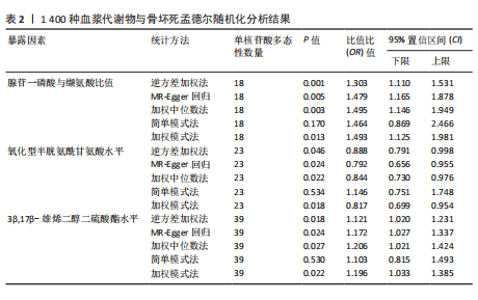
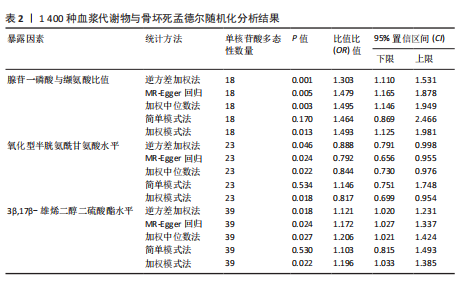
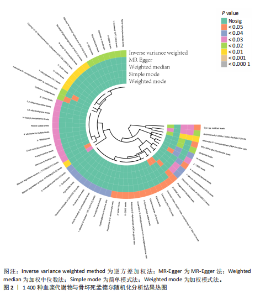
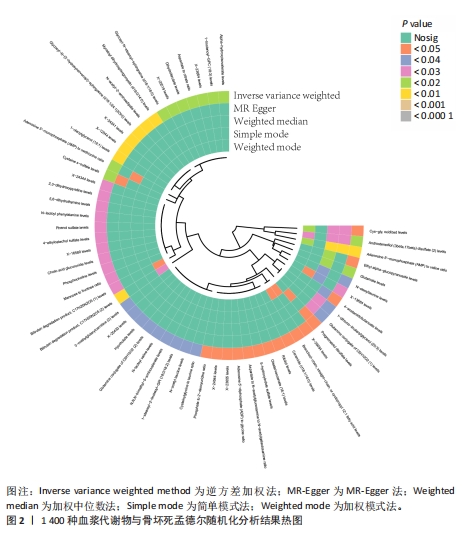
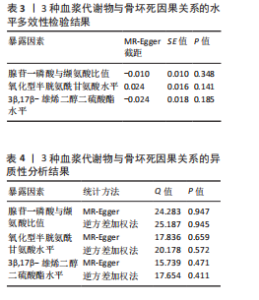
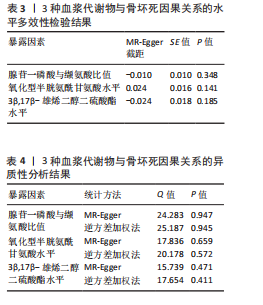
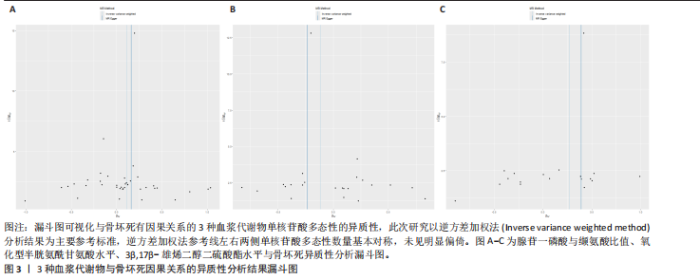
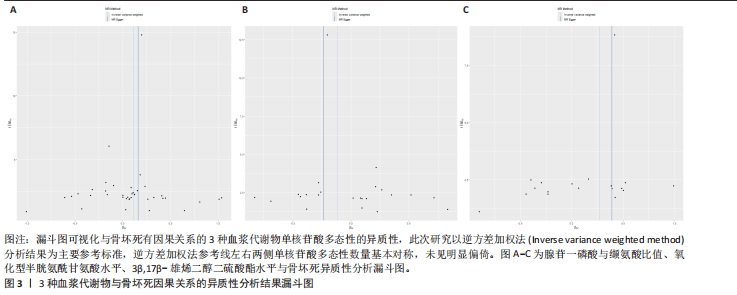
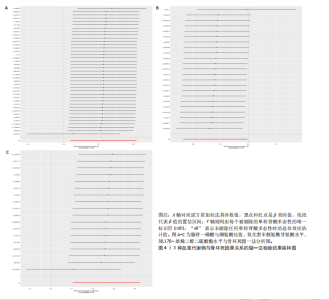
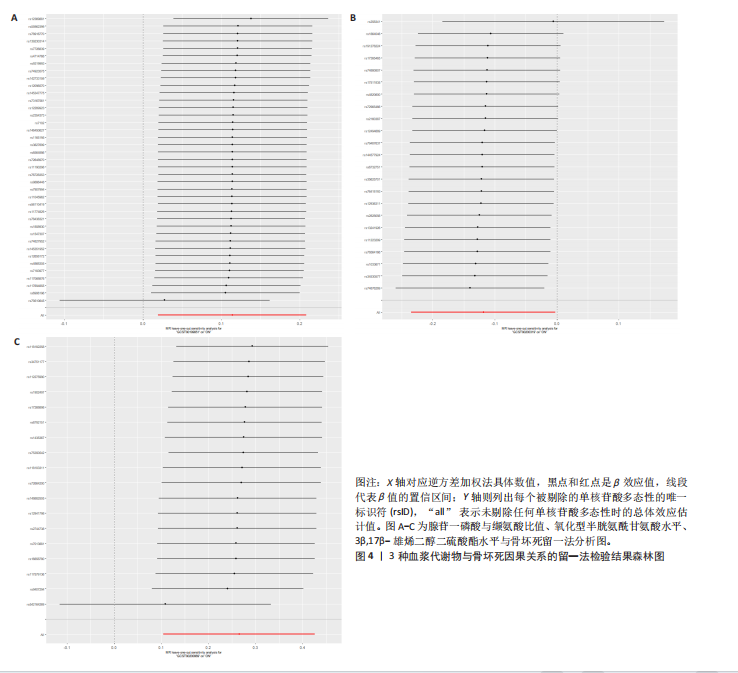
2.1 工具变量筛选结果 在1 400种血浆代谢物的遗传统计数据集中,以P < 1×10⁻⁵、F > 10为过滤条件获取与暴露因素强相关的单核苷酸多态性,设置连锁不平衡参数r2 < 0.001,kb=10 000以保证作为工具变量的独立性。从FinnGen数据库获得结局遗传信息数据集后,筛选其中与暴露因素强相关的单核苷酸多态性,删除回文单核苷酸多态性及与混杂因素相关的单核苷酸多态性,共80个单核苷酸多态性用于血浆代谢物与骨坏死间的因果关系分析,所有单核苷酸多态性均满足相关性假设、独立性假设及排他性假设要求。 2.2 孟德尔随机化分析结果 在1 400种血浆代谢物中,3种血浆代谢物与骨坏死风险之间存在因果关系(P < 0.05,PFDR < 0.1),分别为腺苷一磷酸与缬氨酸比值(OR=1.303,95%CI=1.110-1.531,P=0.001,PFDR=0.07)、氧化型半胱氨酰甘氨酸水平(OR=0.888,95%CI=0.791-0.998,P=0.046,PFDR=0.05)、3β,17β-雄烯二醇二硫酸酯水平(OR=1.121,95%CI=1.020-1.231,P=0.018,PFDR=0.06)。1 400种血浆代谢物与骨坏死的孟德尔随机化分析结果见表2以及图2。 2.3 敏感性分析结果 水平多效性检验:利用MR-Egger分析方法对3种与骨坏死有因果关系的血浆代谢物进行水平多效性检验,所有纳入分析的单核苷酸多态性均不具备水平多效性(P > 0.05),MR-Egger截距均接近于0,满足孟德尔随机化工具变量独立性和排他性的假设要求,具体检验结果见表3。 异质性分析:使用逆方差加权法和MR-Egger法中的Cochran’s Q检验对与骨坏死有因果关系的3种血浆代谢物的单核苷酸多态性进行异质性分析,P > 0.05,表明所有纳入研究的单核苷酸多态性不存在异质性,具体分析结果如表4及图3所示。"
"
"
留一法检验:为评估单个单核苷酸多态性对因果效应估计的潜在主导性影响,此研究对3种血浆代谢物进行留一法检验,结果如图4所示,逐步剔除各代谢物对应的单核苷酸多态性后,效应值和置信区间均无明显变化(即黑点和红点均在0线的一侧)。所有结果均证实不存在主导性变异干扰,支持代谢物与骨坏死因果关联的稳健性。 Steiger方向性检验:初步孟德尔随机化分析确认了3种血浆代谢物对骨坏死存在显著正向因果效应(P < 0.05)。为排除反向因果干扰,进一步实施Steiger方向性检验。结果显示:每个单核苷酸多态性的 Steiger_dir结果均为TURE,未发现骨坏死对这3种血浆代谢物有反向因果影响,进一步验证了正向因果关系的可靠性。"
"
| [1] ZHAI S, WU R, ZHAO J, et al. Effectiveness of various interventions for non-traumatic osteonecrosis: a pairwise and network meta-analysis. Front Endocrinol (Lausanne). 2024;15: 1428125. [2] XIANG XN, HE HC, HE CQ. Advances in mechanism and management of bone homeostasis in osteonecrosis: a review article from basic to clinical applications. Int J Surg. 2025;111(1):1101-1122. [3] ZHAO DW, YU M, HU K, et al. Prevalence of Nontraumatic Osteonecrosis of the Femoral Head and its Associated Risk Factors in the Chinese Population: Results from a Nationally Representative Survey. Chin Med J (Engl). 2015; 128(21):2843-2850. [4] HUANG ZQ, FU FY, LI WL, et al. Current Treatment Modalities for Osteonecrosis of Femoral Head in Mainland China: A Cross-Sectional Study. Orthop Surg. 2020;12(6):1776-1783. [5] GONCHAROV EN, KOVAL OA, NIKOLAEVICH BEZUGLOV E, et al. Conservative Treatment in Avascular Necrosis of the Femoral Head: A Systematic Review. Med Sci (Basel). 2024;12(3):32. [6] 孙伟,高福强,李子荣.股骨头坏死临床诊疗技术专家共识(2022年)[J].中国修复重建外科杂志,2022,36(11):1319-1326. [7] LI L, ZHAO S, LENG Z, et al. Pathological mechanisms and related markers of steroid-induced osteonecrosis of the femoral head. Ann Med. 2024;56(1):2416070. [8] STROIE OM, VU VH. Osteonecrosis Imaging. In: StatPearls[Internet]. Treasure Island (FL): StatPearls Publishing, 2025. [9] ZHANG A, SUN H, WANG X. Serum metabolomics as a novel diagnostic approach for disease: a systematic review. Anal Bioanal Chem. 2012; 404(4):1239-1245. [10] CHEN W, LI C, YI Z, et al. MicroRNA Expression Profile in the Patient’s Plasma Exosomes of Alcohol-Induced Osteonecrosis of Femoral Head: Potential Vascular Regulation Mechanism. J Cell Mol Med. 2025;29(4):e70382. [11] JIA D, ZHANG Y, LI H, et al. Predicting steroid-induced osteonecrosis of the femoral head: role of lipid metabolism biomarkers and radiomics in young and middle-aged adults. J Orthop Surg Res. 2024;19(1):749. [12] LAUMANN RD, PEDERSEN LL, ANDRÉS-JENSEN L, et al. Hyperlipidemia in children and adolescents with acute lymphoblastic leukemia: A systematic review and meta-analysis. Pediatr Blood Cancer. 2023;70(12):e30683. [13] LIU X, LI Q, SHENG J, et al. Unique plasma metabolomic signature of osteonecrosis of the femoral head. J Orthop Res. 2016;34(7):1158-1167. [14] YAN Y, WANG J, HUANG D, et al. Plasma lipidomics analysis reveals altered lipids signature in patients with osteonecrosis of the femoral head. Metabolomics. 2022;18(2):14. [15] NARAYANAN A, KHANCHANDANI P, BORKAR RM, et al. Avascular Necrosis of Femoral Head: A Metabolomic, Biophysical, Biochemical, Electron Microscopic and Histopathological Characterization. Sci Rep. 2017;7(1):10721. [16] SWANK KR, FURNESS JE, BAKER EA, et al. Metabolomic Profiling in the Characterization of Degenerative Bone and Joint Diseases. Metabolites. 2020;10(6):223. [17] NGUYEN K, MITCHELL BD. A Guide to Understanding Mendelian Randomization Studies. Arthritis Care Res (Hoboken). 2024; 76(11):1451-1460. [18] CHEN Y, LU T, PETTERSSON-KYMMER U, et al. Genomic atlas of the plasma metabolome prioritizes metabolites implicated in human diseases. Nat Genet. 2023;55(1):44-53. [19] YANG M, WAN X, ZHENG H, et al. No Evidence of a Genetic Causal Relationship between Ankylosing Spondylitis and Gut Microbiota: A Two-Sample Mendelian Randomization Study. Nutrients. 2023;15(4):1057. [20] BURGESS S, BUTTERWORTH A, THOMPSON SG. Mendelian randomization analysis with multiple genetic variants using summarized data. Genet Epidemiol. 2013;37(7):658-665. [21] BOWDEN J, DAVEY SMITH G, BURGESS S. Mendelian randomization with invalid instruments: effect estimation and bias detection through Egger regression. Int J Epidemiol. 2015; 44(2):512-525. [22] BOWDEN J, DAVEY SMITH G, et al. Consistent Estimation in Mendelian Randomization with Some Invalid Instruments Using a Weighted Median Estimator. Genet Epidemiol. 2016;40(4):304-314. [23] ZHU Z, ZHANG F, HU H, et al. Integration of summary data from GWAS and eQTL studies predicts complex trait gene targets. Nat Genet. 2016;48(5):481-487. [24] HARTWIG FP, DAVEY SMITH G, BOWDEN J. Robust inference in summary data Mendelian randomization via the zero modal pleiotropy assumption. Int J Epidemiol. 2017;46(6):1985-1998. [25] GRECO M FD, MINELLI C, SHEEHAN NA, et al. Detecting pleiotropy in Mendelian randomisation studies with summary data and a continuous outcome. Stat Med. 2015; 34(21):2926-2940. [26] BURGESS S, THOMPSON SG. Interpreting findings from Mendelian randomization using the MR-Egger method. Eur J Epidemiol. 2017;32(5):377-389. [27] BURGESS S, BOWDEN J, FALL T, et al. Sensitivity Analyses for Robust Causal Inference from Mendelian Randomization Analyses with Multiple Genetic Variants. Epidemiology. 2017;28(1):30-42. [28] GUO M, ZHANG J. Metabolomic analysis of bone-derived exosomes in osteonecrosis of the femoral head based on UPLC-MS/MS. Metabolomics. 2023;19(4):34. [29] PEREIRA TCS, SOUZA AR, DALTRO PB, et al. Blood plasma and bone marrow interstitial fluid metabolomics of sickle cell disease patients with osteonecrosis: An exploratory study to dissect biochemical alterations. Clin Chim Acta. 2023;539:18-25. [30] 刘楚,丘博元,童思文,等.遗传学视角揭示血液代谢物与骨坏死的关系:基于芬兰Finn Gen数据库信息分析[J].中国组织工程研究, 2026,30(3):785-794. [31] LIU JY, LIU JX, LI R, et al. AMPK, a hub for the microenvironmental regulation of bone homeostasis and diseases. J Cell Physiol. 2024; 239(11):e31393. [32] WANG J, ZHANG Y, CAO J, et al. The role of autophagy in bone metabolism and clinical significance. Autophagy. 2023;19(9):2409-2427. [33] MILLWARD DJ, LAYMAN DK, TOMÉ D, et al. Protein quality assessment: impact of expanding understanding of protein and amino acid needs for optimal health. Am J Clin Nutr. 2008;87(5):1576S-1581S. [34] VIEIRA VELOSO R, SHAMIM A, LAMARREY Y, et al. Antioxidant and anti-sickling activity of glucal-40based triazoles compounds - An in vitro and in silico study. Bioorg Chem. 2021;109:104709. [35] BANAIT S, BANAIT T, SHUKLA S, et al. Bilateral Humeral Head Avascular Necrosis: A Rare Presentation in Sickle Cell Trait. Cureus. 2023; 15(8):e44006. [36] LINDBERG MK, VANDENPUT L, MOVÈRARE SKRTIC S, et al. Androgens and the skeleton. Minerva Endocrinol. 2005;30(1):15-25. [37] CHEN JF, LIN PW, TSAI YR, et al. Androgens and Androgen Receptor Actions on Bone Health and Disease: From Androgen Deficiency to Androgen Therapy. Cells. 2019;8(11):1318. [38] ALMEIDA M, LAURENT MR, DUBOIS V, et al. Estrogens and Androgens in Skeletal Physiology and Pathophysiology. Physiol Rev. 2017;97(1):135-187. [39] ZHENG LZ, WANG JL, XU JK, et al. Magnesium and vitamin C supplementation attenuates steroid-associated osteonecrosis in a rat model. Biomaterials. 2020;238:119828. [40] 党祎,杜成砚,姚红林,等.激素型骨坏死与氧化应激[J].中国组织工程研究,2023,27(9): 1469-1476. |
| [1] | Wu Zhilin, , He Qin, Wang Pingxi, Shi Xian, Yuan Song, Zhang Jun, Wang Hao . DYRK2: a novel therapeutic target for rheumatoid arthritis combined with osteoporosis based on East Asian and European populations [J]. Chinese Journal of Tissue Engineering Research, 2026, 30(6): 1569-1579. |
| [2] | Liu Hongtao, Wu Xin, Jiang Xinyu, Sha Fei, An Qi, Li Gaobiao. Causal relationship between age-related macular degeneration and deep vein thrombosis: analysis based on genome-wide association study data [J]. Chinese Journal of Tissue Engineering Research, 2026, 30(6): 1602-1608. |
| [3] | Guo Ying, Tian Feng, Wang Chunfang. Potential drug targets for the treatment of rheumatoid arthritis: large sample analysis from European databases [J]. Chinese Journal of Tissue Engineering Research, 2026, 30(6): 1549-1557. |
| [4] | Gao Zengjie, , Pu Xiang, Li Lailai, Chai Yihui, Huang Hua, Qin Yu. Increased risk of osteoporotic pathological fractures associated with sterol esters: evidence from IEU-GWAS and FinnGen databases [J]. Chinese Journal of Tissue Engineering Research, 2026, 30(5): 1302-1310. |
| [5] | Liu Fengzhi, Dong Yuna, Tian Wenyi, Wang Chunlei, Liang Xiaodong, Bao Lin. Gene-predicted associations between 731 immune cell phenotypes and rheumatoid arthritis [J]. Chinese Journal of Tissue Engineering Research, 2026, 30(5): 1311-1319. |
| [6] | Zhang Cuicui, Chen Huanyu, Yu Qiao, Huang Yuxuan, Yao Gengzhen, Zou Xu. Relationship between plasma proteins and pulmonary arterial hypertension and potential therapeutic targets [J]. Chinese Journal of Tissue Engineering Research, 2026, 30(5): 1331-1340. |
| [7] | Zeng Hao, Sun Pengcheng, Chai Yuan, Huang Yourong, Zhang Chi, Zhang Xiaoyun. Association between thyroid function and osteoporosis: genome-wide data analysis of European populations [J]. Chinese Journal of Tissue Engineering Research, 2026, 30(4): 1019-1027. |
| [8] | Rong Xiangbin, , Zheng Haibo, Mo Xueshen, Hou Kun, Zeng Ping, . Plasma metabolites, immune cells, and hip osteoarthritis: causal inference based on GWAS data from European populations [J]. Chinese Journal of Tissue Engineering Research, 2026, 30(4): 1028-1035. |
| [9] | He Qiwang, , , Chen Bo, Liang Fuchao, Kang Zewei, Zhou Yuan, Ji Anxu, Tang Xialin, . Relationship between Alzheimer’s disease and sarcopenia and body mass index: analysis of GWAS datasets for European populations [J]. Chinese Journal of Tissue Engineering Research, 2026, 30(4): 1036-1046. |
| [10] | Ding Yu, Chen Jingwen, Chen Xiuyan, Shi Huimin, Yang Yudie, Zhou Meiqi, Cui Shuai, . Circulating inflammatory proteins and myocardial hypertrophy: large sample analysis of European populations from GWAS Catalog and FinnGen databases [J]. Chinese Journal of Tissue Engineering Research, 2026, 30(4): 1047-1057. |
| [11] | Zhao Feifan, Cao Yujing. An artificial neural network model of ankylosing spondylitis and psoriasis shared genes and machine learning-based mining and validation [J]. Chinese Journal of Tissue Engineering Research, 2026, 30(3): 770-784. |
| [12] | Liu Chu, Qiu Boyuan, Tong Siwen, He Linyuwei, Chen Haobo, Ou Zhixue. A genetic perspective reveals the relationship between blood metabolites and osteonecrosis: an analysis of information from the FinnGen database in Finland [J]. Chinese Journal of Tissue Engineering Research, 2026, 30(3): 785-794. |
| [13] | Tian Xuanhe, Tong Siyu, Teng Fei, Zhong Shuai, Zhao Xiaohu, Zhang Yuya, Liu Yuan, Jiang Ping. Potential targets and drug prediction for gout: identification of druggable genes [J]. Chinese Journal of Tissue Engineering Research, 2026, 30(29): 7706-7714. |
| [14] | Wei Bingqi, Zhang Xinyue, Ren Xingyue, Sun Jiahui, Chen Liu, Li Yijing, Qi Yifan, Wang Shangzeng. Zinc finger DHHC-type containing 2 emerges as a novel therapeutic target in osteoarthritis pathogenesis: genome-wide data analysis in European populations [J]. Chinese Journal of Tissue Engineering Research, 2026, 30(29): 7715-7723. |
| [15] | Li Zhengpeng, Shao Weigang, Zeng Hao, Xiang Kelin, Zhang Botao, Zou Shunyi, Chen Sheng, Qi Wen. Osteoarthritis characteristic genes and prediction of targeted food-medicine homology traditional Chinese medicine: bioinformatics analysis and kinetic simulation [J]. Chinese Journal of Tissue Engineering Research, 2026, 30(29): 7739-7748. |
| Viewed | ||||||
|
Full text |
|
|||||
|
Abstract |
|
|||||