[1] LI XS, LOVELL JF, YOON JY, et al. Clinical Development and Potential of Photothermal and Photodynamic Therapies for Cancer. Nat Rev Clin Oncol. 2020;17:657-674.
[2] HU DR, LI YC, LI R, et al. Recent Advances in Reactive Oxygen Species (Ros)-Responsive Drug Delivery Systems for Photodynamic Therapy of Cancer. Acta Pharm Sin B. 2024;14:5106-5131.
[3] ZHANG HC, CUI MH, TANG DS, et al. Localization of Cancer Cells for Subsequent Robust Photodynamic Therapy by Ros Responsive Polymeric Nanoparticles with Anti-Metastasis Complexes Nami-A. Adv Mater. 2024;36:2310298.
[4] DIRAK M, YENICI CM, KOLEMEN S. Recent Advances in Organelle-Targeted Organic Photosensitizers for Efficient Photodynamic Therapy. Coord Chem Rev. 2024;506:215710.
[5] WU X, FAN Y, WANG K, et al. NIR-II Imaging-Guided Precise Photodynamic Therapy for Augmenting Tumor-Starvation Therapy by Glucose Metabolism Reprogramming Interference. SCI BULL. 2024;69: 1263-1274.
[6] TANG Y, LI Y, LI B, et al. Oxygen-Independent Organic Photosensitizer with Ultralow-Power Nir Photoexcitation for Tumor-Specific Photodynamic Therapy. Nat Commun. 2024;15:2530.
[7] HU DR, PAN M, YU Y, et al. Application of Nanotechnology for Enhancing Photodynamic Therapy Via Ameliorating, Neglecting, or Exploiting Tumor Hypoxia. View. 2020;1:e6.
[8] HU DR, CHEN LJ, QU Y, et al. Oxygen-Generating Hybrid Polymeric Nanoparticles with Encapsulated Doxorubicin and Chlorin E6 for Trimodal Imaging-Guided Combined Chemo-Photodynamic Therapy. Theranostics 2018;8:1558-1574.
[9] SUN Y, ZHAO D, WANG G, et al. Recent Progress of Hypoxia-Modulated Multifunctional Nanomedicines to Enhance Photodynamic Therapy: Opportunities, Challenges, and Future Development. Acta Pharm Sin B. 2020;10: 1382-1396.
[10] HUANG L, ZHAO SJ, WU JS, et al. Photodynamic Therapy for Hypoxic Tumors: Advances and Perspectives. Coord Chem Rev.2021;438:213888.
[11] LI XT, CHEN L, HUANG MT, et al. Innovative Strategies for Photodynamic Therapy against Hypoxic Tumor. Asian J Pharm Sci. 2023;18: 100775.
[12] WAN Y, FU LH, LI C, et al. Conquering the Hypoxia Limitation for Photodynamic Therapy. Adv Mater. 2021;33:2103978.
[13] WEI JP, LI JC, SUN D, et al. A Novel Theranostic Nanoplatform Based on Pd@Pt-Peg-Ce6 for Enhanced Photodynamic Therapy by Modulating Tumor Hypoxia Microenvironment. Adv Funct Mater. 2018;28:1706310.
[14] REN Q, YU N, WANG L, et al. Nanoarchitectonics with Metal-Organic Frameworks and Platinum Nanozymes with Improved Oxygen Evolution for Enhanced Sonodynamic/Chemo-Therapy. J Colloid Interface Sci. 2022;614:147-159.
[15] CHEN H, TIAN J, HE W, et al. H2O2-Activatable and O2-Evolving Nanoparticles for Highly Efficient and Selective Photodynamic Therapy against Hypoxic Tumor Cells. J Am Chem Soc. 2015;137: 1539-1547.
[16] JIANG W, ZHANG Z, WANG Q, et al.Tumor Reoxygenation and Blood Perfusion Enhanced Photodynamic Therapy Using Ultrathin Graphdiyne Oxide Nanosheets. Nano Lett. 2019;19:
4060-4067.
[17] BROEKGAARDEN M, WEIJER R, KREKORIAN M, et al. Inhibition of Hypoxia-Inducible Factor 1 with Acriflavine Sensitizes Hypoxic Tumor Cells to Photodynamic Therapy with Zinc Phthalocyanine-Encapsulating Cationic Liposomes. Nano Res. 2016;9:1639.
[18] LIU S, FENG G, TANG BZ, et al. Recent Advances of Aie Light-up Probes for Photodynamic Therapy. Chem Sci. 2021;12: 6488-6506.
[19] HAMBLIN MR. Upconversion in Photodynamic Therapy: Plumbing the Depths. Dalton T. 2018; 47:8571-8580.
[20] ZHU H, LI J, QI X, et al. Oxygenic Hybrid Semiconducting Nanoparticles for Enhanced Photodynamic Therapy. Nano Lett. 2018;18: 586-594.
[21] LEE D, KWON S, JANG SY, et al. Overcoming the Obstacles of Current Photodynamic Therapy in Tumors Using Nanoparticles. Bioact Mater. 2022;8:20-34.
[22] TIAN J, DING L, XU HJ, et al. Cell-Specific and Ph-Activatable Rubyrin-Loaded Nanoparticles for Highly Selective near-Infrared Photodynamic Therapy against Cancer. J Am Chem Soc. 2013; 135:18850-18858.
[23] AKRAM MW, RAZIQ F, FAKHAR-E-ALAM M, et al. Tailoring of Au-Tio2 Nanoparticles Conjugated with Doxorubicin for Their Synergistic Response and Photodynamic Therapy Applications. J Photochem Photobiol A Chem. 2019;384:112040.
[24] CHEN Y, YANG Y, DU S, et al. Mitochondria-Targeting Upconversion Nanoparticles@MOF for Multiple-Enhanced Photodynamic Therapy in Hypoxic Tumor. ACS Appl Mater Interfaces. 2023;15:35884-35894.
[25] NINKOV A, FRANK JR, MAGGIO LA. Bibliometrics: Methods for Studying Academic Publishing. Perspect Med Educ. 2022;11:173-176.
[26] 高俊宽. 文献计量学方法在科学评价中的应用探讨[J]. 图书情报知识,2005(2):14-17.
[27] 崔丽丽. 基于作者-主题关联的学科知识网络中核心作者影响力研究[D]. 武汉:华中师范大学,2022.
[28] JIANG S, LIU Y, ZHENG H, et al. Evolutionary Patterns and Research Frontiers in Neoadjuvant Immunotherapy: A Bibliometric Analysis. Int J Surg. 2023;109:2774-2783.
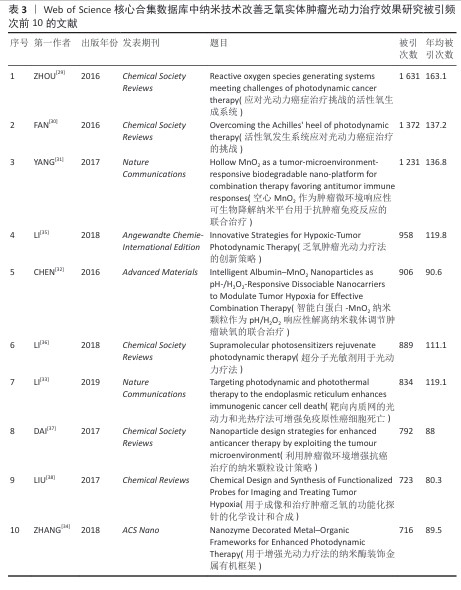
[29] ZHOU Z, SONG J, NIE L, et al. Reactive Oxygen Species Generating Systems Meeting Challenges of Photodynamic Cancer Therapy. Chem Soc Rev. 2016;45:6597-6626.
[30] FAN W, HUANG P, CHEN X. Overcoming the Achilles’ Heel of Photodynamic Therapy. Chem Soc Rev. 2016;45:6488-6519.
[31] YANG G, XU L, CHAO Y, et al. Hollow Mno2 as a Tumor-Microenvironment-Responsive Biodegradable Nano-Platform for Combination Therapy Favoring Antitumor Immune Responses. Nat Commun. 2017;8:902.
[32] CHEN Q, FENG LZ, LIU JJ, et al. Intelligent Albumin-Mno2 Nanoparticles as Ph-/H2o2-Responsive Dissociable Nanocarriers to Modulate Tumor Hypoxia for Effective Combination Therapy. Adv Mater. 2016;28:7129.
[33] LI W, YANG J, LUO L, et al. Targeting Photodynamic and Photothermal Therapy to the Endoplasmic Reticulum Enhances Immunogenic Cancer Cell Death. Nat Commun. 2019;10:3349.
[34] ZHANG Y, WANG F, LIU C, et al. Nanozyme Decorated Metal-Organic Frameworks for Enhanced Photodynamic Therapy. ACS Nano. 2018;12:651-661.
[35] LI XS, KWON N, GUO T, et al. Innovative Strategies for Hypoxic-Tumor Photodynamic Therapy. Angew Chem-Int Edit. 2018;57:11522-11531.
[36] LI X, LEE S, YOON J. Supramolecular Photosensitizers Rejuvenate Photodynamic Therapy. Chem Soc Rev. 2018;47:1174-1188.
[37] DAI Y, XU C, SUN X, et al. Nanoparticle Design Strategies for Enhanced Anticancer Therapy by Exploiting the Tumour Microenvironment. Chem Soc Rev. 2017;46:3830-3852.
[38] LIU JN, BU WB, SHI JL. Chemical Design and Synthesis of Functionalized Probes for Imaging and Treating Tumor Hypoxia. Chem Rev. 2017;117: 6160-6224.
[39] 常金霞, 刘羽飞, 牛少辉,等. 巨噬细胞极化在组织修复过程中的可视化分析[J]. 中国组织工程研究,2025,29(7):1486-1496.
[40] 黄文彬, 王冰璐, 步一,等. 关键词共引分析的科学计量方法研究[J]. 情报资料工作,2018(2): 37-42.
[41] KOLARIKOVA M, HOSIKOVA B, DILENKO H, et al. Photodynamic Therapy: Innovative Approaches for Antibacterial and Anticancer Treatments. Med Res Rev. 2023;43:717-774.
[42] JI B, WEI M, YANG B. Recent Advances in Nanomedicines for Photodynamic Therapy (Pdt)-Driven Cancer Immunotherapy. Theranostics. 2022;12:434-458.
[43] LIN T, ZHAO X, ZHAO S, et al. O2-Generating Mno2 Nanoparticles for Enhanced Photodynamic Therapy of Bladder Cancer by Ameliorating Hypoxia. Theranostics. 2018;8:990-1004.
[44] XU T, MA Y, YUAN Q, et al. Enhanced Ferroptosis by Oxygen-Boosted Phototherapy Based on a 2-in-1 Nanoplatform of Ferrous Hemoglobin for Tumor Synergistic Therapy. ACS Nano. 2020;14: 3414-3425.
[45] SEMENZA GL. Targeting Hif-1 for Cancer Therapy. Nat Rev Cancer. 2003;3:721-732.
[46] SUN B, BTE RAHMAT JN, ZHANG Y. Advanced Techniques for Performing Photodynamic Therapy in Deep-Seated Tissues. Biomaterials. 2022;291:121875.
[47] HE L, YU X, LI W. Recent Progress and Trends in X-Ray-Induced Photodynamic Therapy with Low Radiation Doses. ACS Nano.2022;16:19691-19721.
[48] CHEN JJ, ZHOU Q, CAO WW. Multifunctional Porphyrin-Based Sonosensitizers for Sonodynamic Therapy. Adv Funct Mater. 2024;34:2405844.
[49] OVERCHUK M, WEERSINK RA, WILSON BC, et al. Photodynamic and Photothermal Therapies: Synergy Opportunities for Nanomedicine. ACS Nano. 2023;17:7979-8003.
[50] YU Z, LI Q, WANG J, et al. Reactive Oxygen Species-Related Nanoparticle Toxicity in the Biomedical Field. Nanoscale Res Lett. 2020;15:115.
[51] HUA S, DE MATOS MBC, METSELAAR JM, et al. Current Trends and Challenges in the Clinical Translation of Nanoparticulate Nanomedicines: Pathways for Translational Development and Commercialization. Front Pharmacol. 2018;9:790.
[52] PARK K. The Beginning of the End of the Nanomedicine Hype. J Controlled Release. 2019; 305:221-222.
[53] ALGORRI JF, OCHOA M, ROLDÁN-VARONA P, et al.
Light Technology for Efficient and Effective Photodynamic Therapy: A Critical Review. Cancers. 2021;13:3484.
|