Chinese Journal of Tissue Engineering Research ›› 2026, Vol. 30 ›› Issue (16): 4054-4066.doi: 10.12307/2026.715
Previous Articles Next Articles
Cerebral palsy decoction improves cerebral palsy in male and female young rats: mechanisms based on the “gut-brain-muscle” axis
Zou Yuxiong1, Liu Xiaomeng1, Liu Ying2, Zhu Yue1, Li Shuming1, Guo Fangyang1, Yu Xinyu1, Nie Heyun1, Liu Qian1, 2, Ao Meiying1
- 1Discipline of Chinese and Western Integrative Medicine, Integrated Chinese and Western Medicine Institute for Children Health & Drug Innovation, Jiangxi University of Chinese Medicine, Nanchang 330004, Jiangxi Province, China; 2Affiliated Hospital of Jiangxi University of Chinese Medicine, Nanchang 330000, Jiangxi Province, China
-
Received:2025-03-27Accepted:2025-08-29Online:2026-06-08Published:2025-11-26 -
Contact:Ao Meiying, PhD, Professor, Discipline of Chinese and Western Integrative Medicine, Integrated Chinese and Western Medicine Institute for Children Health & Drug Innovation, Jiangxi University of Chinese Medicine, Nanchang 330004, Jiangxi Province, China Co-corresponding author: Liu Qian, PhD, Doctoral supervisor, Professor, Discipline of Chinese and Western Integrative Medicine, Integrated Chinese and Western Medicine Institute for Children Health & Drug Innovation, Jiangxi University of Chinese Medicine, Nanchang 330004, Jiangxi Province, China; Affiliated Hospital of Jiangxi University of Chinese Medicine, Nanchang 330000, Jiangxi Province, China -
About author:Zou Yuxiong, MS candidate, Discipline of Chinese and Western Integrative Medicine, Integrated Chinese and Western Medicine Institute for Children Health & Drug Innovation, Jiangxi University of Chinese Medicine, Nanchang 330004, Jiangxi Province, China -
Supported by:National Natural Science Foundation of China, No. 82060658 (to AMY); Key Research and Development Program of National Key Laboratories, No. 20243BCC31008 (to LQ); Jiangxi University of Chinese Medicine Scientific Research Cultivation Project, No. 2023ZDPY001 (to LQ); Innovative Research Team on Integrated Traditional Chinese and Western Medicine for Prevention and Treatment of Pediatric Diseases and Health Protection, No. CXTD22014 (to LQ); Jiangxi University of Chinese Medicine Institutional-Level Teaching Reform Project, No. 2022jzyx-2 (to AMY)

CLC Number:
Cite this article
Zou Yuxiong, Liu Xiaomeng, Liu Ying, Zhu Yue, Li Shuming, Guo Fangyang, Yu Xinyu, Nie Heyun, Liu Qian, Ao Meiying. Cerebral palsy decoction improves cerebral palsy in male and female young rats: mechanisms based on the “gut-brain-muscle” axis[J]. Chinese Journal of Tissue Engineering Research, 2026, 30(16): 4054-4066.
share this article
Add to citation manager EndNote|Reference Manager|ProCite|BibTeX|RefWorks
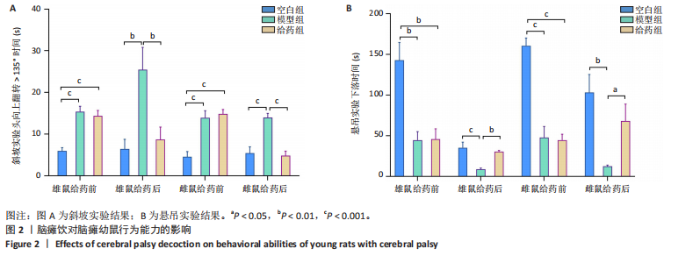
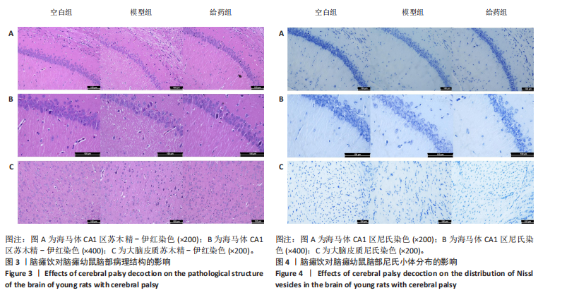
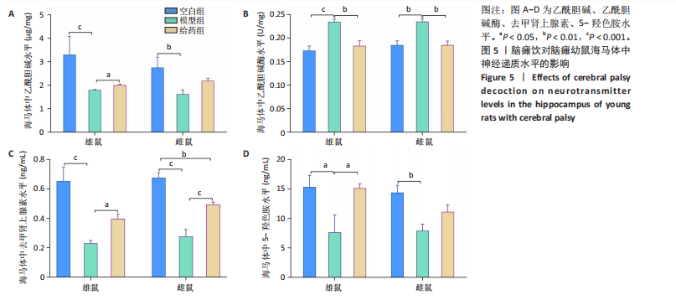
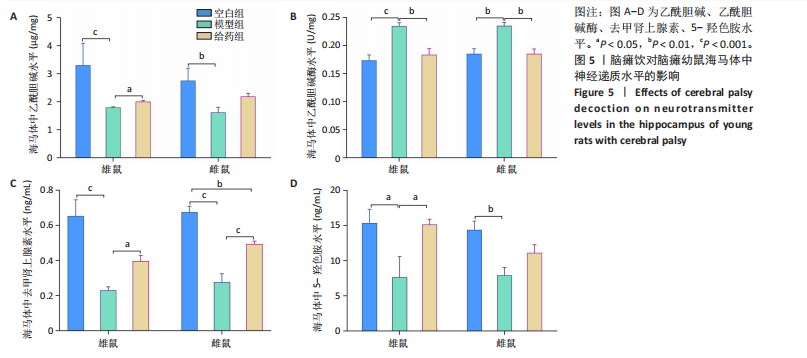
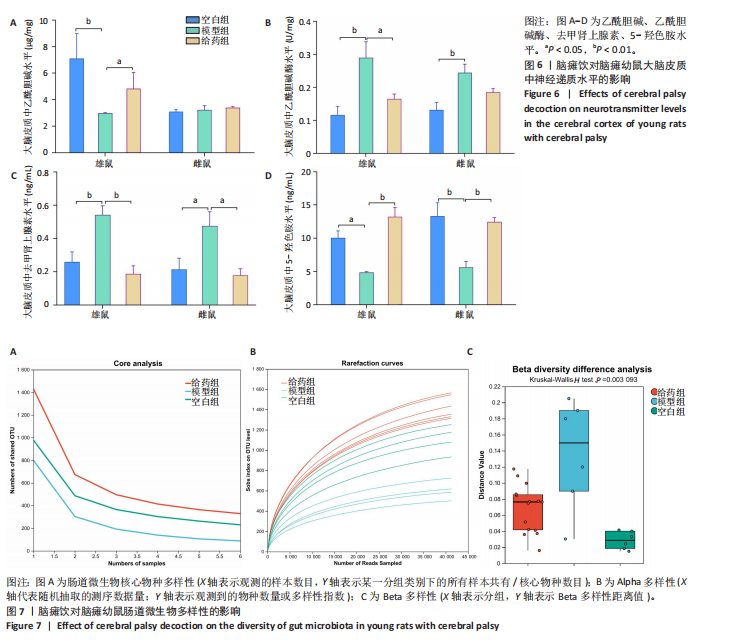
2.1 实验动物数量分析 共纳入正常与脑瘫幼鼠共54只(每组雌雄各9只),54只全部进入结果分析,无脱落。 2.2 脑瘫饮对脑瘫幼鼠行为学的影响 脑瘫疾病主要表现为四肢运动功能障碍,通过行为学评分可判断脑瘫幼鼠的运动功能状态进而判断该疾病的恢复程度。 2.2.1 斜坡实验 给药前,与空白组比较,模型组与给药组皆有显著性差异(雄鼠P < 0.001,雌鼠P < 0.001),模型组与给药组之间无显著性差异;给药后,与模型组比较,空白组与给药组皆有显著性差异(雄鼠P < 0.01,雌鼠P < 0.001),空白组与给药组之间无显著性差异(图2A)。 2.2.2 悬吊实验 给药前,与空白组比较,模型组与给药组皆有显著性差异(雄鼠P < 0.01,雌鼠P < 0.001),模型组与给药组之间无显著性差异;给药后,与模型组比较,空白组与给药组皆有显著性差异(雄鼠P < 0.001,P < 0.01,雌鼠P < 0.01,P < 0.05),空白组与给药组之间无显著性差异(图2B) 2.3 脑瘫饮对脑瘫幼鼠脑部病理结构的影响 海马体在记忆、学习、方向定位以及情绪调节等方面发挥着重要作用,大脑皮质在感觉处理、高级认知功能、运动控制以及情感和行为等方面发挥重要作用[10]。神经元则在接收与处理信息、参与感觉与运动等方面起着极其重要的作用[11]。观察海马体与大脑皮质的组织形态和神经元状态,可间接判断脑部的功能。海马体与大脑皮质苏木精-伊红染色显示:空白组海马体CA1区的神经元细胞排列整齐紧密,由四五层细胞排列组成,且层次清晰,染色均匀,细胞形态规则,核仁清晰可见,胞浆较为丰满;神经突起整齐且清晰可见;皮质区细胞的形态结构也未见异常。与空白组相比,模型组海马体CA1区神经元细胞明显减少甚至裂解消失,排列较为散乱,细胞层级显著减少且层次之间出现间隙,核固缩、核裂解现象明显;神经突起较为散乱;皮质区的神经元细胞固缩深染,且形态不规则,坏死现象明显。与模型组相比,给药组海马体CA1区的细胞数量均有不同程度增加,病理性改变减少,且排列较规整,细胞间隙减少,脱垂,核固缩坏死及溶解现象也明显减少;神经突起排列也较为整齐;皮质区神经元固缩坏死现象减少(图3)。 2.4 脑瘫饮对脑瘫幼鼠脑部尼氏小体分布的影响 尼氏小体主要分布于神经元内,是神经元胞体内的嗜碱性斑块或颗粒,由粗面内质网和游离核糖体组成,具有合成更新细胞结构蛋白、神经递质及神经激素的作用,与神经元的营养和代谢密切相关。作为神经元内合成蛋白质的主要物质,尼氏小体数量的多少间接反映神经元功能状态[12]。海马体与大脑皮质尼氏染色显示:空白组海马体CA1区的尼氏小体体积较大且数量较多,细胞染色较深,核仁清晰;神经突起较为明显且排列紧密有序;皮质区尼氏小体数量较多且排列较为紧密。与空白组相比,模型组海马体CA1区尼氏小体数量明显减少,体积小,甚至消失,且染色较浅;神经突起较紊乱;皮质区尼氏小体数量明显减少且排列稀疏。与模型组相比,给药组海马体CA1区尼氏小体数量显著增加,颗粒大且多见,排列整齐,染色较深;神经突起较为明显;皮质区尼氏小体数量显著增加(图4)。 2.5 脑瘫饮对脑瘫幼鼠海马体中神经递质水平的影响 2.5.1 海马体中乙酰胆碱水平 乙酰胆碱主要分布于中枢和外周神经系统中,起着促进腺体分泌、降低神经肌肉兴奋性、舒张血管、改善微循环以及促进神经传递和调节肌肉运动等至关重要的作用。空白组乙酰胆碱水平显著高于模型组(雄鼠P < 0.001,雌鼠P < 0.01);给药组乙酰胆碱水平高于模型组(雄鼠P < 0.05,雌鼠无显著性差异)。而空白组与给药组之间雌雄鼠乙酰胆碱水平均无显著性差异(图5A)。 2.5.2 海马体中乙酰胆碱酶水平 乙酰胆碱酶是水解乙酰胆碱的主要酶,通过影响乙酰胆碱水平进而影响多种生理功能(乙酰胆碱酶水平越高,相对而言乙酰胆碱水平越低)。空白组乙酰胆碱酶水平显著低于模型组(雄鼠P < 0.001,雌鼠P < 0.01);给药组乙酰胆碱酶水平显著低于模型组(雄鼠P < 0.01,雌鼠P < 0.01)。空白组与给药组之间雌雄鼠乙酰胆碱酶水平均无显著性差异(图5B)。 2.5.3 海马体中去甲肾上腺素水平 去甲肾上腺素主要为神经末梢释放的神经递质,对血管收缩、心脏兴奋、血压升高等产生重要的影响,同时去甲肾上腺素还起着抗休克等重要的反馈作用。空白组去甲肾上腺素水平显著高于模型组(雄鼠P < 0.001,雌鼠 P < 0.001);给药组去甲肾上腺素水平显著高于模型组(P < 0.05,雌鼠P < 0.001)。空白组去甲肾上腺素水平高于给药组(雄鼠无显著性差异,雌鼠P < 0.01)(图5C)。 2.5.4 海马体中5-羟色胺水平 5-羟色胺是一种广泛存在于大脑皮质及神经突触中的兴奋性神经递质,影响大脑活动的各个方面,主要影响情绪与精神等脑神经,同时对免疫系统、胃肠功能、心脑血管方面以及记忆功能都有着不可忽视的作用[13-14]。空白组5-羟色胺水平显著高于模型组(雄鼠P < 0.05,雌鼠P < 0.01);给药组5-羟色胺水平高于模型组(雄鼠P < 0.05,雌鼠无显著性差异)。空白组与给药组之间雌雄鼠5-羟色胺水平无显著性差异(图5D)。 2.6 脑瘫饮对脑瘫幼鼠大脑皮质(额叶)中神经递质水平的影响 2.6.1 大脑皮质中乙酰胆碱水平 空白组雄鼠大脑皮质中乙酰胆碱水平显著高于模型组(P < 0.01);给药组雄鼠大脑皮质中乙酰胆碱水平高于模型组(P < 0.05);空白组与给药组之间乙酰胆碱水平无显著性差异。而雌鼠大脑皮质中各组乙酰胆碱水平均无显著性差异(图6A)。 2.6.2 大脑皮质中乙酰胆碱酶水平 空白组乙酰胆碱酶水平显著低于模型组(雄鼠P < 0.01,雌鼠P < 0.01);给药组乙酰胆碱酶水平低于模型组(雄鼠P < 0.05,"
"

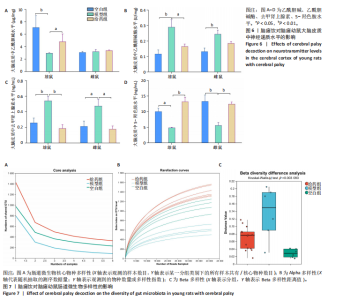
雌鼠无显著性差异);空白组与给药组之间雌雄鼠乙酰胆碱酶水平均无显著性差异(图6B)。 2.6.3 大脑皮质中去甲肾上腺素水平 空白组去甲肾上腺素水平显著低于模型组(雄鼠P < 0.01,雌鼠P < 0.05);给药组去甲肾上腺素水平显著低于模型组(P < 0.01,雌鼠P < 0.05);空白组与给药组之间雌雄鼠去甲肾上腺素水平均无显著性差异(图6C)。 2.6.4 大脑皮质中5-羟色胺水平 空白组5-羟色胺水平显著高于模型组(雄鼠P < 0.05,雌鼠P < 0.01);给药组5-羟色胺水平高于模型组(雄鼠P < 0.01,雌鼠P < 0.01)。空白组与给药组之间雌雄鼠5-羟色胺水平无显著性差异(图6D)。 2.7 脑瘫饮对脑瘫幼鼠肠道微生物多样性的影响 样本的Core注释分析表示某一分组下所有的样本核心物种数量,该研究基于OUT集对样本注释分析。给药组的核心物种数量最多,空白组次之,模型组最少(图7A)。 Alpha多样性分析可评估肠道微生物的多样性和丰富度,该研究从样本中随机抽取一定数量的序列,统计这些序列对应样本的Alpha多样性指数,以绘制Alpha多样性指数稀释曲线。与空白组对比,模型组Alpha多样性指数显著降低;与模型组相比,给药组Alpha多样性指数显著升高(图7B)。 Beta多样性是利用样本序列之间存在的进化关"
"
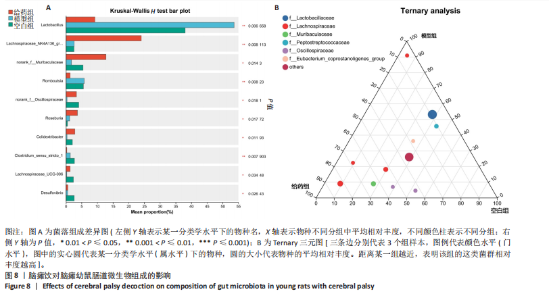
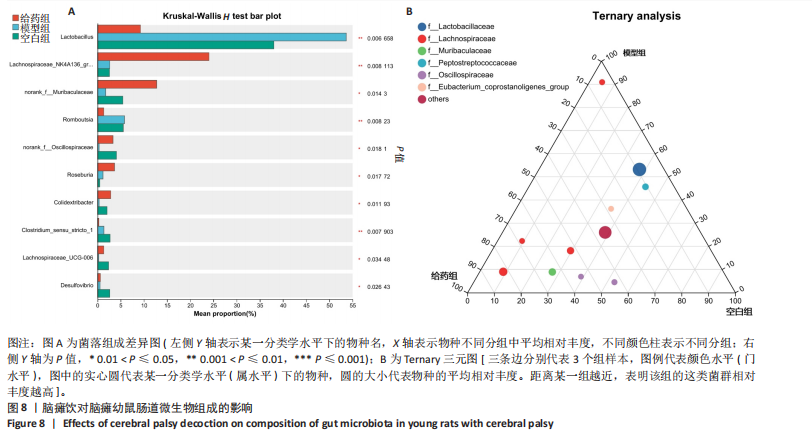
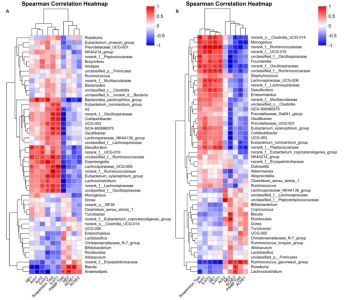
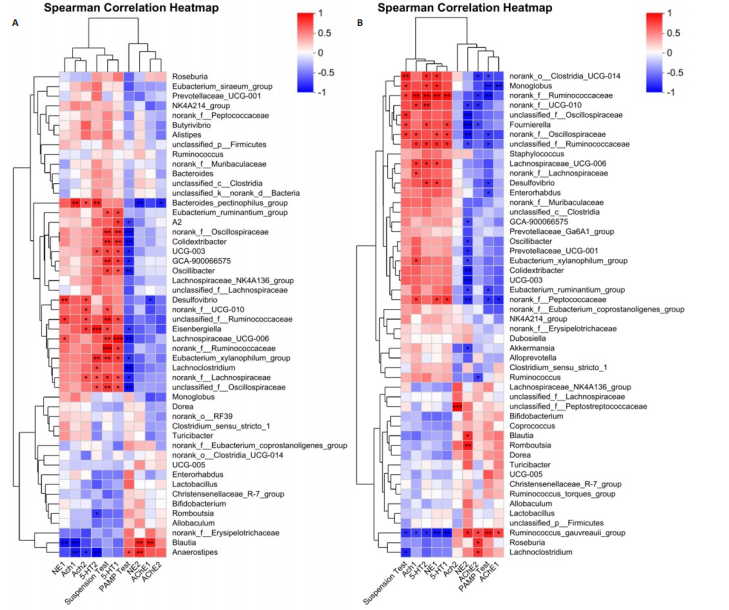
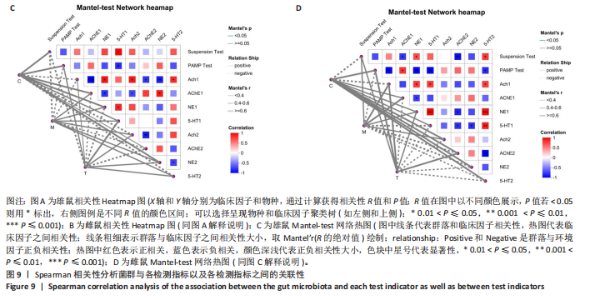
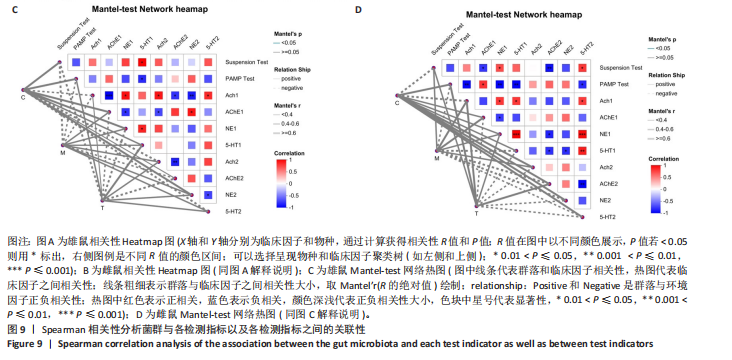
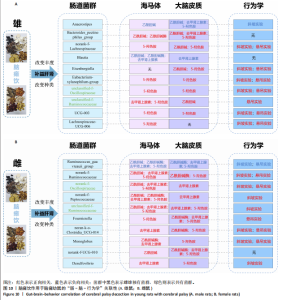
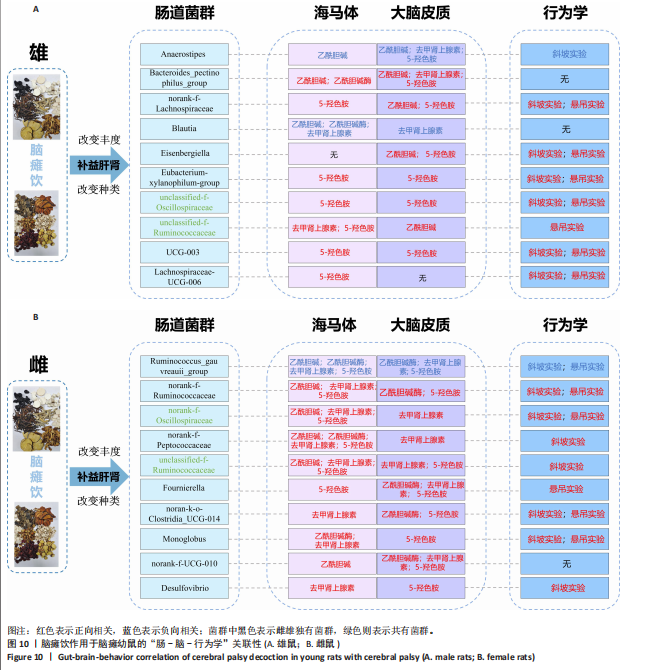
系和丰富度来衡量样本之间的距离,从而反映样本(组)之间微生物群落是否存在显著差异。各组组内离散程度分析:模型组组内离散程度最高,给药组次之,空白组最低;各组组间Beta多样性距离分析:给药组与空白组的组间距离小于模型组与空白组的组间距离(图7C)。 2.8 脑瘫饮对脑瘫幼鼠肠道微生物组成的影响 各组之间肠道微生物组成的差异性,从一定程度上也反映出此类疾病的优势菌群及劣势菌群。该研究分析属类菌群并截取前10个菌群进行分析,由菌落组成差异图可知,治疗脑瘫疾病的优势菌群有:norank_f__Muribaculaceae属;norank_f__Oscillospiraceae属;大肠杆菌属(Colidextribacter);Lachnospiraceae_UCG-006属4个菌群。劣势菌群有:乳酸杆菌属(Lactobacillus)1个菌群(图8A)。 由Ternary三元图可知,治疗脑瘫疾病的优势菌群有:norank_f__Oscillospiraceae属;大肠杆菌属(Colidextribacter);norank_f__Muribaculaceae属;unclassified_f__ Lachnospiraceae属4个菌群。劣势菌群有:乳酸杆菌属(Lactobacillus);经黏液真杆菌属(Blautia)2个菌群(图8B)。 2.9 Spearman相关性分析 通过属水平得到肠道菌群与海马体神经递质水平(乙酰胆碱1、乙酰胆碱酶1、5-羟色胺1、去甲肾上腺素1)、大脑皮质神经递质水平(乙酰胆碱2、乙酰胆碱酶2、5-羟色胺2、去甲肾上腺素2)以及行为学(斜坡实验、悬吊实验)进行Spearman相关性分析,从而得到肠道菌群与相关检测指标的正/负相关性。由此可知,在雄鼠中,粪厌氧棒杆菌(Anaerostipes);拟杆菌属Bacteroides_pectinophilus_group属;norank-f-Lachnospiraceae属;经黏液真杆菌属(Blautia);梭菌属(Eisenbergiella);Eubacterium-xylanophilum-group属;unclassified-f-Oscillospiraceae属;unclassified-f-Ruminococcaceae属;普雷沃氏菌属(UCG-003);Lachnospiraceae-UCG-006属10个菌群与各个指标相关性更强(图9A)。在雌鼠中,Ruminococcus_gauvreauii_group属;norank-f-Ruminococcaceae属;norank-f-Oscillospiraceae属;norank-f-Peptococcaceae属;unclassified-f-Ruminococcaceae属;韦荣氏球菌属(Fournierella);noran-k-o-Clostridia_UCG-014属;Monoglobus属;norank-f-UCG-010属;脱硫弧菌属(Desulfovibrio)10个菌群与各个指标相关性更强(图9B)。 各指标相关性,在雄鼠中,斜坡实验、去甲肾上腺素2、乙酰胆碱酶1、乙酰胆碱酶2指标之间关联性更强;悬吊实验、去甲肾上腺素1、乙酰胆碱1、乙酰胆碱2、5-羟色胺1、5-羟色胺2指标之间关联性更强;而在雌鼠中,斜坡实验、去甲肾上腺素2、乙酰胆碱酶1、乙酰胆碱酶2、乙酰胆碱2指标相关性更强;悬吊实验、去甲肾上腺素1、乙酰胆碱1、5-羟色胺1、5-羟色胺2指标之间相关性更强(图9C,D)。 2.10 脑肠轴相关性分析 根据图9的数值相关性,取与指标相关性前10个肠道菌群,依据正常指标数值高/低,从而统计出正向/负向相关性。由图10可知,在雄鼠中,粪厌氧棒杆菌(Anaerostipes)、norank-f-Lachnospiraceae属、梭菌属(Eisenbergiella)、Eubacterium-xylanophilum-group属、unclassified-f-Oscillospiraceae属、unclassified-f-Ruminococcaceae属、普雷沃氏菌属(UCG-003)、Lachnospiraceae-UCG-006属8个菌群与行为学具有相关性;在这8个菌群中,只有粪厌氧棒杆菌与各检测指标呈负相关,其余梭菌属和普雷沃氏菌属等7个菌群与各检测指标均呈正相关。在雌鼠中,Ruminococcus_gauvreauii_group属、norank-f-Ruminococcaceae属、norank-f-Oscillospiraceae属、norank-f-Peptococcaceae属、unclassified-f-Ruminococcaceae属、弗朗西斯氏菌属 (Fournierella)、noran-k-o-Clostridia_UCG-014属、Monoglobus属、脱硫弧菌属(Desulfovibrio)9个菌群皆与行为学具有相关性;在这9个菌群中,只有Ruminococcus_gauvreauii_group属1个菌群与各检测指标呈负相关,脱硫弧菌属和弗朗西斯氏菌属等8个菌群与各检测指标间均呈正相关。由此可知,雌雄鼠的肠道菌群与脑神经递质之间关系极为密切,并且可以影响脑瘫幼鼠行为学。 雌雄鼠中与各指标相关性前10个菌群中,只有norank-f-Oscillospiraceae属和unclassified-f-Ruminococcaceae属两类菌群是雌雄共有的。其他所有菌群中,粪厌氧棒杆菌(Anaerostipes)、Bacteroides_pectinophilus_group属和norank-f-Lachnospiraceae属等8个菌群为脑瘫雄鼠所独有;Ruminococcus_gauvreauii_group属、norank-f-Ruminococcaceae属和norank-f-Peptococcaceae属等8个菌群为脑瘫雌鼠所独有。"
"
"
"
| [1] GALEA C, MCINTYRE S, SMITHERS-SHEEDY H, et al. Cerebral palsy trends in Australia (1995-2009): a population-based observational study. Dev Med Child Neurol. 2019;61(2):186-193. [2] 中国康复医学会儿童康复专业委员会,中国残疾人康复协会小儿脑性瘫痪康复专业委员会,中国医师协会康复医师分会儿童康复专业委员会,等.中国脑性瘫痪康复指南(2022)第一章:概论[J].中华实用儿科临床杂志,2022,37(12):887-892. [3] 王强力,吴梦婷,郑贺彬,等.针刺核心肌群联合康复训练治疗脑瘫的疗效观察及对运动能力和平衡能力的影响[J].上海针灸杂志, 2024,43(10):1128-1133. [4] STIGGER F, FELIZZOLA AL, KRONBAUER GA, et al. Effects of fetal exposure to lipopolysaccharide, perinatal anoxia and sensorimotor restriction on motor skills and musculoskeletal tissue: implications for an animal model of cerebral palsy. Exp Neurol. 2011;228(2):183-191. [5] CAVARSAN CF, GORASSINI MA, QUINLAN KA. Animal models of developmental motor disorders: parallels to human motor dysfunction in cerebral palsy. J Neurophysiol. 2019;122(3):1238-1253. [6] STRATA F, COQ JO, BYL N, et al. Effects of sensorimotor restriction and anoxia on gait and motor cortex organization: implications for a rodent model of cerebral palsy. Neuroscience. 2004;129(1):141-156. [7] BALDRICK P. Developing drugs for pediatric use: a role for juvenile animal studies? Regul Toxicol Pharmacol. 2004;39(3):381-389. [8] 赵伟,孙国志.不同种实验动物间用药量换算[J].畜牧兽医科技信息,2010(5):52-53. [9] 陈玥,苏丹,贵文娟,等.实验动物与人类年龄相关性研究进展[J].中国比较医学杂志,2019,29(11):116-122. [10] LISMAN J, BUZSÁKI G, EICHENBAUM H, et al. Viewpoints: how the hippocampus contributes to memory, navigation and cognition. Nat Neurosci. 2017;20(11):1434-1447. [11] 崔连旭,李昊旻,许峻荣,等.脐带间充质干细胞条件培养基对小型猪创伤性颅脑损伤组织修复的影响[J].中国组织工程研究, 2026,30(7):1730-1735. [12] 李思宇,杨坤,宋常月,等.基于GRIN2A/PLCB1/PRKCG信号通路探讨白芍总苷减轻马钱子水提物神经损伤的作用机制[J].中国实验方剂学杂志,2024,30(23):56-63. [13] 张静雯,范琼尹,张苏素,等.新型5-羟色胺和去甲肾上腺素重摄取抑制剂ZBH2012001通过增强单胺系统功能和抑制神经免疫炎症发挥抗抑郁作用[J].中国药理学与毒理学杂志,2024,38(5):321-334. [14] 王其飞,杜兴彬,孔健达.中枢疲劳的神经生理基础及运动诱发机制[J].中国组织工程研究,2025,29(32):6979-6988. [15] SMYTH R, REID SM, PATON K, et al. Causation in cerebral palsy: Parental beliefs and associated emotions. Dev Med Child Neurol. 2024; 66(2):258-266. [16] VILLAMOR E. Changing trends in cerebral palsy prevalence: an opportunity to consider etiological pathways. Dev Med Child Neurol. 2022;64(9):1054-1055. [17] CAESAR RA, BOYD RN, CIONI G, et al. Early detection of developmental delay in infants born very preterm or with very low birthweight. Dev Med Child Neurol. 2023;65(3):346-357. [18] 刘浩哲,苗明三.基于中西医临床病症特点的脑性瘫痪动物模型分析[J].中药药理与临床,2021,37(5):189-194. [19] 姜煜,徐林,赵亚林,等.舒筋健脑方对缺血缺氧脑瘫模型大鼠细胞凋亡的影响[J].中国组织工程研究,2024,28(28):4477-4483. [20] 刘港,曾杰,赵亚林,等.舒筋健脑方干预脑瘫模型大鼠减轻大脑皮质的组织炎症反应[J].中国组织工程研究,2024,28(23):3674-3679. [21] 单海军,娄元俊,朱珊,等.补肾开窍祛痰方改善痉挛型脑瘫大鼠运动行为的效果[J].中国老年学杂志,2022,42(15):3731-3735. [22] 罗石任,谢艳,张丽,等.酸枣仁提取物靶向调控促进骨骼增长的miRNA筛选[J].中国组织工程研究,2022,26(35):5658-5664. [23] 许静,霍康,郭秦乐,等.地黄苷A对CLP诱导的脓毒症大鼠脑功能障碍和Nrf2/GPX4介导的铁死亡通路的影响[J].现代生物医学进展,2024,24(14):2619-2625. [24] 李朋月,景永帅,吴兰芳,等.山药多糖对脑缺血再灌注损伤的保护作用机制[J].中国药理学与毒理学杂志,2021,35(9):675-676. [25] 苗树船,夏勋,张列.茯苓酸抑制H2O2诱导的脑微血管内皮细胞凋亡及促进细胞存活[J].西部医学,2021,33(7):982-986. [26] 齐梓彤,刘薇,雒慧钧,等.负载丹皮酚外泌体对缺血性脑卒中大鼠线粒体功能障碍的保护作用[J].中国生物化学与分子生物学报,2023,39(4):615-621. [27] 邓云飞,李惠红,魏伟,等.泽泻醇A保护血脑屏障改善脑缺血/再灌注损伤的作用和机制研究[J].中国药理学通报,2024,40(1): 83-90. [28] 赵晓华,田倩倩,薛伟,等.吴茱萸碱通过GSK-3β/β-catenin通路减轻大鼠脑缺血再灌注损伤[J].南开大学学报(自然科学版),2023, 56(5):23-28. [29] 丁蕊,袁永,贾亚泉,等.六味地黄丸介导RAGE抑制MMP-2/MMP-9对Aβ1-40损伤bEnd.3细胞紧密连接蛋白的影响[J].中成药,2024,46(2):424-430. [30] 刘彦宏,武凤,于修芳,等.杜仲提取物通过HPG轴对APP/PS1小鼠学习认知功能的影响[J].中药材,2022,45(8):1964-1968. [31] 谢万科,刘彦宁,李治延.柯诺辛碱对创伤性脑损伤大鼠线粒体自噬的影响[J].中医药导报,2024,30(5):7-12. [32] 李雅茜.抑郁症中医辨证分型与脑功能S-ET特征、神经递质的关系分析[J].四川中医,2022,40(9):72-76. [33] 袁丽君,涂星,李三宇,等.土家族麝针疗法对缺血性脑卒中大鼠下丘脑中DA、5-HT、ICAM-1和MCP-1含量的影响[J].中国老年学杂志,2021,41(4):840-844. [34] 王永为,李海艳,高亚贤,等.脊髓损伤后5-HT2A受体的变化与鼠尾痉挛关系的分析[J].中国临床解剖学杂志,2016,34(1):83-86. [35] 张易,郑素珍,杨丽薇,等.中度有氧运动对老年抑郁症病人5-羟色胺、去甲肾上腺素水平及自主神经功能的干预效果研究[J].实用老年医学,2023,37(6):595-598. [36] 刘俊财,葛珍,江晓,等.蜂王浆肽对阿尔茨海默症模型斑马鱼运动能力与关键基因表达影响[J].食品工业科技,2023,44(21):395-401. [37] 彭颖.辣木籽水提物对酒精诱导线虫运动功能障碍的影响[J].食品与机械,2020,36(10):149-152+158. [38] 刘运琴,刘燕芹,戢汉斌,等.淫羊藿苷对精神分裂症模型大鼠认知功能的改善作用及机制[J].中国药房,2021,32(7):812-818. [39] 殷铭,吕笑丽,王碧馨,等.shRNA干扰蓝斑核去甲肾上腺素转运体(NET)表达对大鼠抑郁样行为的改善作用[J].神经解剖学杂志, 2017,33(3):329-335. [40] 申丽英,董雨,孔维,等.慢性睡眠剥夺对大鼠空间学习记忆、海马体齿状回区去甲肾上腺素水平及其受体表达的影响[J].职业与健康,2021,37(3):330-333. [41] 孙道涵,李蜀平,廖磊,等.调和肝脾方改善睡眠的时效关系及作用机制的研究[J].现代中西医结合杂志,2019,28(27):2993-2996+3001. [42] 王宏吉,曹波.基于脑肠轴探讨肠道菌群调控腹泻型肠易激综合征的研究进展[J].中国民族民间医药,2024,33(19):59-65. [43] 顾富城,杨美鑫,吴伟欣,等.龟鹿二仙胶对膝骨关节炎大鼠肠道菌群的影响:机器学习与16SrDNA分析[J].中国组织工程研究, 2026,30(4):1058-1072. [44] THURSBY E, JUGE N. Introduction to the human gut microbiota. Biochem J. 2017;474(11):1823-1836. [45] 戎新倩,舒青龙.基于脑-肠-微生物轴的肠易激综合征机制与治疗研究进展[J].微生物学通报,2023,50(9):4190-4205. [46] HUGON P, DUFOUR JC, COLSON P, et al. A comprehensive repertoire of prokaryotic species identified in human beings. Lancet Infect Dis. 2015;15(10):1211-1219. [47] 张静仪,郑泽荣,彭仕熙,等.基于脑肠轴理论探讨化痰开窍方治疗老年缺血性脑卒中的临床疗效[J].中国老年学杂志,2024, 44(15):3602-3605. [48] 周彦妮,陈敏,杨焱麟,等.基于脑肠轴的肠道菌群调控腹泻型肠易激综合征的研究进展[J].中华中医药杂志,2022,37(3):1582-1586. [49] 王菲,辛凯,陈丽,等.基于TLR4/NF-κB信号通路探究涤浊汤对高尿酸血症大鼠肠道菌群紊乱的调节作用[J].中国微生态学杂志, 2024,36(1):10-17+28. [50] 陈杰东.不同脂肪供能比饮食热量限制干预对肥胖大鼠糖脂代谢、肠道菌群和肝脏转录组的影响[D].福州:福建医科大学,2022. [51] 谢佑红,周天宇,王金枝,等.马钱子苷通过肠道菌群和神经肽抑制OVX小鼠骨量丢失的机制探讨[J].中国骨质疏松杂志,2024, 30(4):538-545. [52] ZHANG Z, SHAO S, ZHANG Y, et al. Xiaoyaosan slows cancer progression and ameliorates gut dysbiosis in mice with chronic restraint stress and colorectal cancer xenografts. Biomed Pharmacother. 2020;132:110916. [53] 魏巍,王世轩,战丽彬.肌少-骨质疏松症与肠道菌群相关性研究[J].世界科学技术-中医药现代化,2024,26(9):2434-2443. |
| [1] | Zhang Di, Zhao Jun, Ma Guangyue, Sun Hui, Jiang Rong. Mechanism of depression-like behavior in chronic social defeat stress mice based on high-throughput sequencing [J]. Chinese Journal of Tissue Engineering Research, 2026, 30(5): 1139-1146. |
| [2] | Ma Hong, Ding Xueling, Wang Qi, Lyu Hui, Asya Albusm, Cheng Xinyi, Ma Xiang. Expression and significance of tumor necrosis factor alpha, nuclear factor kappaB and ionized calcium binding adaptor molecule-1 in the hippocampus of mice with aortic dissection [J]. Chinese Journal of Tissue Engineering Research, 2026, 30(4): 858-863. |
| [3] | Gu Fucheng, Yang Meixin, Wu Weixin, Cai Weijun, Qin Yangyi, Sun Mingyi, Sun Jian, Geng Qiudong, Li Nan. Effects of Guilu Erxian Glue on gut microbiota in rats with knee osteoarthritis: machine learning and 16S rDNA analysis [J]. Chinese Journal of Tissue Engineering Research, 2026, 30(4): 1058-1072. |
| [4] | Chai Jinlian, Liang Xuezhen, Sun Tiefeng, Li Shudong, Li Wei, Li Guangzheng, Yu Huayun, Wang Ping. Mechanistic insights into how Cervi Cornus Colla regulates the intestinal flora-bile acid metabolic pathway to alleviate steroid-induced osteonecrosis of the femoral head in a rat model [J]. Chinese Journal of Tissue Engineering Research, 2026, 30(18): 4568-4581. |
| [5] | Ruan Lin, Li Jia, Shi Linan, Zhu Hong, Wu Dongning, Zheng Di, Li Yupeng, Zhao Yan. Effects and molecular mechanisms of light exposure on neurotransmitter release in a rat model of heart failure [J]. Chinese Journal of Tissue Engineering Research, 2026, 30(18): 4649-4662. |
| [6] | Wu Yilin, Tian Hongying, Sun Jiale, Jiao Jiajia, Zhao Zihan, Shao Jinhuan, Zhao Kaiyue, Zhou Min, Li Qian, Li Zexin, Yue Changwu. Intervention effect and mechanism of Compound Herba Gueldenstaedtiae in a mouse model of breast hyperplasia [J]. Chinese Journal of Tissue Engineering Research, 2026, 30(17): 4377-4389. |
| [7] | Sun Long, Wu Haiyang, Tong Linjian, Liu Rui, Yang Weiguang, Xiao Jian, Liu Lice, Sun Zhiming. Regulatory mechanism of leptin in bone metabolism [J]. Chinese Journal of Tissue Engineering Research, 2026, 30(12): 3100-3108. |
| [8] | Wang Tao, Min Youjiang, Wang Min, Wang Shunpu, Li Le, Zhang Chen, Xiao Weiping, Yu Yiping. Causal relationship between gut microbiota and amyotrophic lateral sclerosis: sample analysis from the IEU Open GWAS Database [J]. Chinese Journal of Tissue Engineering Research, 2026, 30(12): 3182-3189. |
| [9] | Wu Fangjia, Lei Senlin, Li Xianhui, Yang Yang. Aerobic and resistance exercise interventions in a mouse model of nonalcoholic fatty liver disease: correlation between gut microbiota and irisin [J]. Chinese Journal of Tissue Engineering Research, 2026, 30(12): 3029-3043. |
| [10] | Qiu Xueli, Cui Hao, Wu Chenyang, Tao Lide, Yao Yuqian, Tian Bo, Bai Jinyu, Zhang Yingzi. Gut microbiota tryptophan metabolite indole-3-propionic acid alleviates inflammatory bowel disease-related osteoporosis in a mouse model [J]. Chinese Journal of Tissue Engineering Research, 2026, 30(10): 2413-2421. |
| [11] | Song Andong, , Fu Huiling, , Yuan Bo, Li Guohua, Jia Xusheng, Jia Menghui . Dodder intervenes with chronic stress depression in a mouse model: changes in NLRP3 inflammasome [J]. Chinese Journal of Tissue Engineering Research, 2026, 30(10): 2440-2448. |
| [12] | Zhao Xiaoxuan, Liu Shuaiyi, Li Qi, Xing Zheng, Li Qingwen, Chu Xiaolei. Different exercise modalities promote functional recovery after peripheral nerve injury [J]. Chinese Journal of Tissue Engineering Research, 2025, 29(6): 1248-1256. |
| [13] |
Zhao Wensheng, Li Xiaolin, Peng Changhua, Deng Jia, Sheng Hao, Chen Hongwei, Zhang Chaoju, He Chuan.
Gut microbiota and osteoporotic fractures #br#
#br#
[J]. Chinese Journal of Tissue Engineering Research, 2025, 29(6): 1296-1304.
|
| [14] |
Sun Guanghan, Xie Zhencong, Sun Mi, Xu Yang, Guo Dong.
Therapeutic effect and mechanism by which Trichosanthis Fructus-Allii Macrostemonis Bulbus regulates gut microbiota in a rat model of coronary heart disease #br#
#br#
[J]. Chinese Journal of Tissue Engineering Research, 2025, 29(5): 917-927.
|
| [15] | Wang Tao, Wang Shunpu, Min Youjiang, Wang Min, Li Le, Zhang Chen, Xiao Weiping. Causal relationship between gut microbiota and rheumatoid arthritis: data analysis in European populations based on GWAS data [J]. Chinese Journal of Tissue Engineering Research, 2025, 29(35): 7663-7668. |
| Viewed | ||||||
|
Full text |
|
|||||
|
Abstract |
|
|||||