Chinese Journal of Tissue Engineering Research ›› 2026, Vol. 30 ›› Issue (20): 5134-5142.doi: 10.12307/2026.659
Previous Articles Next Articles
Nanohydroxyapatite-polyether carbonate urethane electrospinning membrane promotes bone defect repair
Zhou Xiaohui1, Wang Siyi2, Zhou Qiyun3, He Zhao3, Jia Yujuan3, Wang Yuanbin3, Ma Jianwu3, Chen Gang3, Zheng Feng3, Chu Genglei1
- 1Department of Orthopedics, The First Affiliated Hospital of Soochow University, Suzhou 215006, Jiangsu Province, China; 2Hunan Prevention and Treatment Institute for Occupational Diseases, Changsha 410007, Hunan Province, China; 3Qinghai Provincial People’s Hospital, Xining 810000, Qinghai Province, China
-
Accepted:2025-05-06Online:2026-07-18Published:2025-11-24 -
Contact:Chu Genglei, Attending physician, Department of Orthopedics, The First Affiliated Hospital of Soochow University, Suzhou 215006, Jiangsu Province, China Zheng Feng, Chief physician, Qinghai Provincial People’s Hospital, Xining 810000, Qinghai Province, China -
About author:Zhou Xiaohui, Master candidate, Department of Orthopedics, The First Affiliated Hospital of Soochow University, Suzhou 215006, Jiangsu Province, China Wang Siyi, Master candidate, Hunan Prevention and Treatment Institute for Occupational Diseases, Changsha 410007, Hunan Province, China -
Supported by:The 74th Batch of General Grants of the China Postdoctoral Science Foundation, No. 2023M742550 (to CGL); Qinghai Provincial People’s Hospital In-hospital Research Project (2023), No. 2023-qhsrmyy-11 (to ZXH)

CLC Number:
Cite this article
Zhou Xiaohui, Wang Siyi, Zhou Qiyun, He Zhao, Jia Yujuan, Wang Yuanbin, Ma Jianwu, Chen Gang, Zheng Feng, Chu Genglei. Nanohydroxyapatite-polyether carbonate urethane electrospinning membrane promotes bone defect repair[J]. Chinese Journal of Tissue Engineering Research, 2026, 30(20): 5134-5142.
share this article
Add to citation manager EndNote|Reference Manager|ProCite|BibTeX|RefWorks
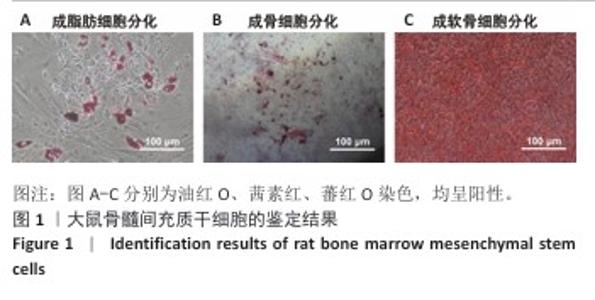
2.1 大鼠骨髓间充质干细胞的鉴定 油红O染色显示分离提取的细胞呈明显红染,说明细胞可向脂肪细胞分化;茜素红染色显示分离提取的细胞有明显的红色钙结节沉积出现,说明细胞可向成骨细胞分化;蕃红O染色显示分离提取的细胞分泌大量硫酸蛋白聚糖,说明细胞可向软骨细胞分化,见图1。"
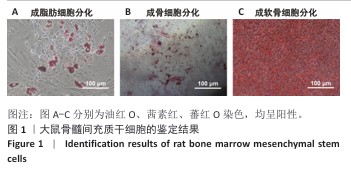
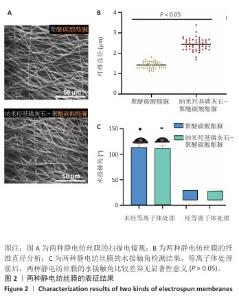
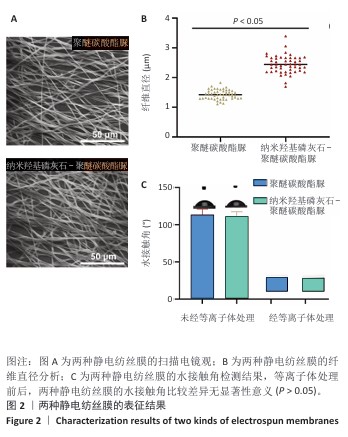
2.2 静电纺丝膜的表征结果 扫描电镜下可见两种静电纺丝膜均呈现出均匀的纤维结构,纤维表面光滑,其中纳米羟基磷灰石-聚醚碳酸酯脲静电纺丝膜的纤维直径更大且排列更为分散,见图2A,B,结果表明纳米羟基磷灰石的加入显著影响了纤维的形成过程,导致纤维直径增加。两种静电纺丝膜的水接触角比较差异无显著性意义(P > 0.05),见图2C,均具有良好的亲水性。"
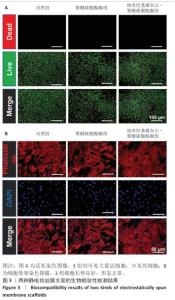
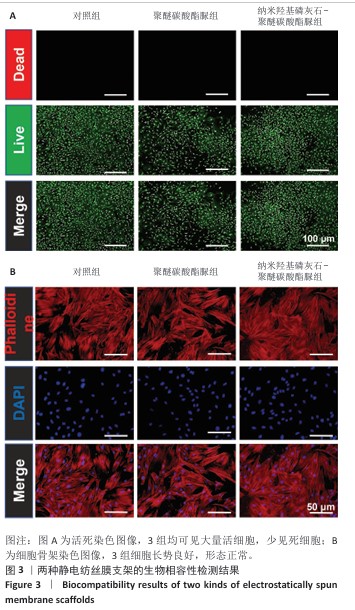
2.3 静电纺丝膜的生物相容性检测结果 活死染色结果显示,3组均可见大量活细胞,少见死细胞,见图3A。骨架染色结果显示3组细胞长势良好,形态正常,见图3B,表明两种静电纺丝膜具有良好的生物相容性。"
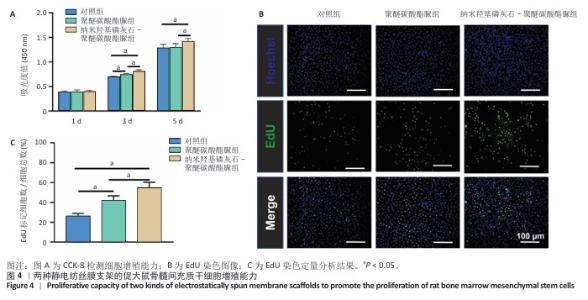
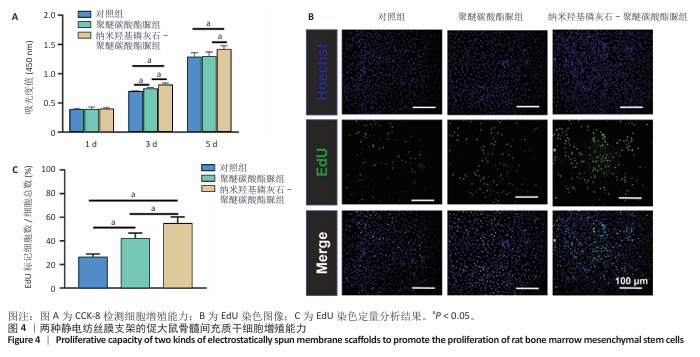
2.4 静电纺丝膜支架的促细胞增殖能力检测结果 CCK-8检测结果显示,随着培养时间的延长,各组细胞的吸光度值增加,培养第3天,聚醚碳酸酯脲组、纳米羟基磷灰石-聚醚碳酸酯脲组细胞吸光度值高于对照组(P < 0.05),纳米羟基磷灰石-聚醚碳酸酯脲组细胞吸光度值高于聚醚碳酸酯脲组(P < 0.05);培养第5天,纳米羟基磷灰石-聚醚碳酸酯脲组细胞吸光度值高于对照组、聚醚碳酸酯脲组(P < 0.05),见图4A。EdU染色结果显示,与对照组相比,聚醚碳酸酯脲组和纳米羟基磷灰石-聚醚碳酸酯脲组EdU标记细胞增加,并且纳米羟基磷灰石-聚醚碳酸酯脲组EdU标记细胞最多,见图4B,C。"
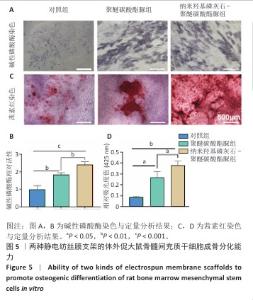
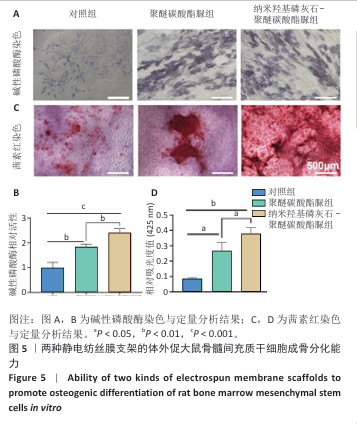
2.5 静电纺丝膜支架的体外促成骨能力 碱性磷酸酶染色结果显示,聚醚碳酸酯脲组、纳米羟基磷灰石-聚醚碳酸酯脲组碱性磷酸酶活性高于对照组(P < 0.01,P < 0.001),纳米羟基磷灰石-聚醚碳酸酯脲组碱性磷酸酶活性高于聚醚碳酸酯脲组(P < 0.01),见图 5A,B。茜素红染色结果显示,聚醚碳酸酯脲组、纳米羟基磷灰石-聚醚碳酸酯脲组钙结节产生量多于对照组(P < 0.05,P < 0.01),纳米羟基磷灰石-聚醚碳酸酯脲组钙结节产生量多于聚醚碳酸酯脲组 (P < 0.05),见图5C,D。"
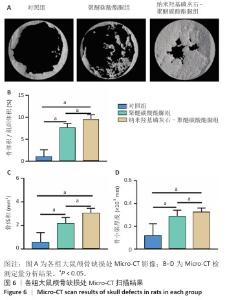
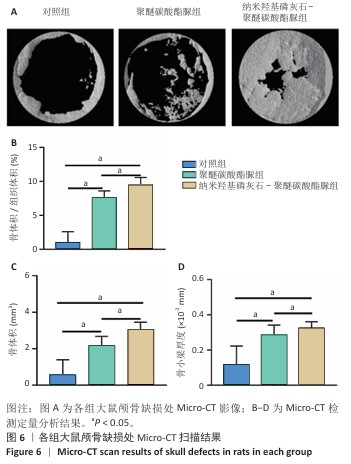
2.6 静电纺丝膜体内促成骨效果 2.6.1 实验动物数量分析 27只大鼠全部进入结果分析。 2.6.2 颅骨Micro-CT 扫描结果 对照组大鼠颅骨缺损边缘有少量新生骨产生,聚醚碳酸酯脲组颅骨缺损已经得到明显修复,纳米羟基磷灰石-聚醚碳酸酯脲组颅骨缺损已经基本完全修复,见图6A。定量分析结果显示,聚醚碳酸酯脲组、纳米羟基磷灰石-聚醚碳酸酯脲组骨体积、骨体积/组织体积与骨小梁厚度均大于对照组(P < 0.05),纳米羟基磷灰石-聚醚碳酸酯脲组骨体积、骨体积/组织体积与骨小梁厚度均大于聚醚碳酸酯脲组(P < 0.05),见图6B-D。 "
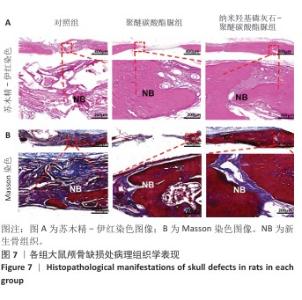
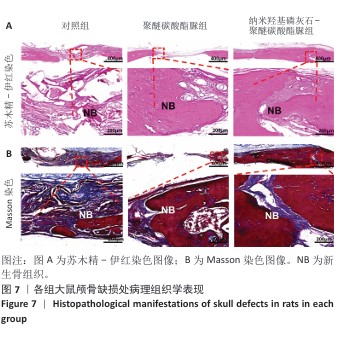
2.6.3 颅骨病理组织学观察结果 Masson染色可以很好地区分新生骨和陈旧骨,靠近缺损中心会有大量的新生骨被染成蓝色,越远离缺损中心新生骨会逐渐变得成熟,因而被染成红色。苏木精-伊红与Masson染色结果显示,对照组有少量新生骨产生,聚醚碳酸酯脲组产生较多的新生骨,从两端向缺损中心长入,并且新生骨会逐渐取代支架组织;纳米羟基磷灰石-聚醚碳酸酯脲组颅骨缺损基本快被新生骨长满,完全愈合,无任何支架残留,见图7。"
| [1] LIU D, CUI C, CHEN W, et al. Biodegradable Cements for Bone Regeneration. J Funct Biomater. 2023;14(3):134. [2] XUE N, DING X, HUANG R, et al. Bone Tissue Engineering in the Treatment of Bone Defects. Pharmaceuticals (Basel). 2022;15(7):879. [3] MIRON RJ, FUJIOKA-KOBAYASHI M, PIKOS MA, et al. The development of non-resorbable bone allografts: Biological background and clinical perspectives. Periodontol 2000. 2024;94(1):161-179. [4] MISHCHENKO O, YANOVSKA A, KOSINOV O, et al. Synthetic Calcium-Phosphate Materials for Bone Grafting. Polymers (Basel). 2023;15(18):3822. [5] MAZZONI E, IAQUINTA MR, MOSAICO M, et al. Human Mesenchymal Stem Cells and Innovative Scaffolds for Bone Tissue Engineering Applications. Tissue Eng Part B Rev. 2023;29(5):514-531. [6] LIU S, LIU S, LI S, et al. Nerves within bone and their application in tissue engineering of bone regeneration. Front Neurol. 2023;13:1085560. [7] ZHU G, ZHANG T, CHEN M, et al. Bone physiological microenvironment and healing mechanism: Basis for future bone-tissue engineering scaffolds. Bioact Mater. 2021;6(11):4110-4140. [8] Liu X, Xu H, Zhang M, et al. Electrospun Medicated Nanofibers for Wound Healing: Review. Membranes (Basel). 2021;11(10):770. [9] AL-BAADANI MA, XU L, CAI K, et al. Preparation of co-electrospinning membrane loaded with simvastatin and substance P to accelerate bone regeneration by promoting cell homing, angiogenesis and osteogenesis. Mater Today Bio. 2023;21:100692. [10] WU J, WANG S, ZHENG Z, et al. Fabrication of Biologically Inspired Electrospun Collagen/Silk fibroin/bioactive glass composited nanofibrous scaffold to accelerate the treatment efficiency of bone repair. Regen Ther. 2022;21:122-138. [11] LIU C, XIAO L, ZHANG Y, et al. Regeneration of annulus fibrosus tissue using a DAFM-blended electrospun scaffold. J Biomater Sci Polym Ed. 2020;31(18):2347-2361. [12] LIU C, XIAO L, ZHANG Y, et al. Regeneration of annulus fibrosus tissue using a DAFM/PECUU-blended electrospun scaffold. J Biomater Sci Polym Ed. 2020;31(18):2347-2361. [13] JIANG J, LIU W, XIONG Z, et al. Effects of biomimetic hydroxyapatite coatings on osteoimmunomodulation. Biomater Adv. 2022;134:112640. [14] TANG M, XU K, SHANG H, et al. Biomineralization of bone-like hydroxyapatite to upgrade the mechanical and osteoblastic performances of poly (lactic acid) scaffolds. Int J Biol Macromol. 2023; 226:1273-1283. [15] XUE B, CAO W, ZHAO H, et al. Nanocrystal hydroxyapatite carrying traditional Chinese medicine for osteogenic differentiation. Colloids Surf B Biointerfaces. 2024;244:114186. [16] CAO Z, LIU X, ZHANG W, et al. Biomimetic Macrophage Membrane-Camouflaged Nanoparticles Induce Ferroptosis by Promoting Mitochondrial Damage in Glioblastoma. ACS Nano. 2023;17(23):23746-23760. [17] CAMACHO-ALONSO F, MARTÍNEZ-ORTIZ C, PLAZAS-BUENDÍA L, et al. Bone union formation in the rat mandibular symphysis using hydroxyapatite with or without simvastatin: effects on healthy, diabetic, and osteoporotic rats. Clin Oral Investig. 2020;24(4):1479-1491. [18] GU M, LI W, JIANG L, et al. Recent progress of rare earth doped hydroxyapatite nanoparticles: Luminescence properties, synthesis and biomedical applications. Acta Biomater. 2022;148:22-43. [19] SZCZEŚ A, HOŁYSZ L, CHIBOWSKI E. Synthesis of hydroxyapatite for biomedical applications. Adv Colloid Interface Sci. 2017;249:321-330. [20] KUBI JA, BRAH AS, CHEUNG KMC, et al. A new osteogenic protein isolated from Dioscorea opposita Thunb accelerates bone defect healing through the mTOR signaling axis. Bioact Mater. 2023;27:429-446. [21] HEIMES D, PABST A, BECKER P, et al. Comparison of morbidity-related parameters between autologous and allogeneic bone grafts for alveolar ridge augmentation from patients’ perspective-A questionnaire-based cohort study. Clin Implant Dent Relat Res. 2024;26(1):170-182. [22] HUO Y, BAI B, ZHENG R, et al. In Vivo Stable Allogenic Cartilage Regeneration in a Goat Model Based on Immunoisolation Strategy Using Electrospun Semipermeable Membranes. Adv Healthc Mater. 2023;12(13):e2203084. [23] HU Q, HUANG Z, ZHANG H, et al. Coaxial electrospun Ag-NPs-loaded endograft membrane with long-term antibacterial function treating mycotic aortic aneurysm. Mater Today Bio. 2024;25:100940. [24] HU Q, HUANG Z, ZHANG H, et al. Coaxial electrospun Ag-NPs-loaded endograft membrane with long-term antibacterial function treating mycotic aortic aneurysm. Mater Today Bio. 2024;25:100940. [25] CHEN S, XIE Y, MA K, et al. Electrospun nanofibrous membranes meet antibacterial nanomaterials: From preparation strategies to biomedical applications. Bioact Mater. 2024;42:478-518. [26] CHEN X, LIU Z, MA R, et al. Electrospun nanofibers applications in caries lesions: prevention, treatment and regeneration. J Mater Chem B. 2024;12(6):1429-1445. [27] QIN H, WEI Y, HAN J, et al. 3D printed bioceramic scaffolds: Adjusting pore dimension is beneficial for mandibular bone defects repair. J Tissue Eng Regen Med. 2022;16(4):409-421. [28] ZHAO Y, XING Y, WANG M, et al. Supramolecular Hydrogel Based on an Osteogenic Growth Peptide Promotes Bone Defect Repair. ACS Omega. 2022;7(13):11395-11404. [29] ZHANG Y, LI TT, SUN L, et al. Oriented ascorbic acid onto zeolitic metal-organic framework-8 membrane via microfluidic spinning for biomedical care. Colloids Surf B Biointerfaces. 2023;229:113442. [30] SHI R, YE J, LI W, et al. Infection-responsive electrospun nanofiber mat for antibacterial guided tissue regeneration membrane. Mater Sci Eng C Mater Biol Appl. 2019;100:523-534. [31] HUANG Y, QI L, LIU Z, et al. Radially Electrospun Fibrous Membrane Incorporated with Copper Peroxide Nanodots Capable of Self-Catalyzed Chemodynamic Therapy for Angiogenesis and Healing Acceleration of Diabetic Wounds. ACS Appl Mater Interfaces. 2023;15(30):35986-35998. [32] LI X, ZHOU J, WU H, et al. Electrospun Silk Fibroin/Polylactic-co-glycolic Acid/Black Phosphorus Nanosheets Nanofibrous Membrane with Photothermal Therapy Potential for Cancer. Molecules. 2022; 27(14):4563. [33] ZHAO K, HU Z, ZHOU M, et al. Bletilla striata composite nanofibrous membranes prepared by emulsion electrospinning for enhanced healing of diabetic wounds. J Biomater Appl. 2023;38(3):424-437. [34] ZHAO P, CHEN W, FENG Z, et al. Electrospun Nanofibers for Periodontal Treatment: A Recent Progress. Int J Nanomedicine. 2022;17:4137-4162. [35] SU W, CHANG Z, E Y, et al. Electrospinning and electrospun polysaccharide-based nanofiber membranes: A review. Int J Biol Macromol. 2024;263(Pt 2):130335. [36] SUN F, YANG L, ZUO Y. Development of electrospun electroactive polyurethane membranes for bone repairing. J Biomater Appl. 2025; 39(6):620-631. [37] LIN P, QIAN Z, LIU S, et al. A Single-Cell RNA Sequencing Guided Multienzymatic Hydrogel Design for Self-Regenerative Repair in Diabetic Mandibular Defects. Adv Mater. 2024;36(50):e2410962. [38] MAC CH, CHAN HY, LIN YH, et al. Engineering a biomimetic bone scaffold that can regulate redox homeostasis and promote osteogenesis to repair large bone defects. Biomaterials. 2022;286:121574. [39] LIU Z, ZHANG H, GAN J, et al. Black Phosphorus Tagged Responsive Strontium Hydrogel Particles for Bone Defect Repair. Adv Sci (Weinh). 2025;12(1):e2408284. |
| [1] | Liu Yang, Liu Donghui , Xu Lei, Zhan Xu, Sun Haobo, Kang Kai. Role and trend of stimuli-responsive injectable hydrogels in precise myocardial infarction therapy [J]. Chinese Journal of Tissue Engineering Research, 2026, 30(8): 2072-2080. |
| [2] | Liu Dawei, Cui Yingying, Wang Fanghui, Wang Zixuan, Chen Yuhan, Li Yourui, Zhang Ronghe. Epigallocatechin gallate-mediated bidirectional regulation of reactive oxygen species and its application in nanomaterials [J]. Chinese Journal of Tissue Engineering Research, 2026, 30(8): 2101-2112. |
| [3] | Sun Lei, Zhang Qi, Zhang Yu. Pro-osteoblastic effect of chlorogenic acid protein microsphere/polycaprolactone electrospinning membrane [J]. Chinese Journal of Tissue Engineering Research, 2026, 30(8): 1877-1884. |
| [4] | Lin Kejian, Chai Yinghong, Zou Jie, Huang Ruixin, Fang Yongchao, Huang Jing, Yang Qin, Luo Xia, Zhang Hong. Preparation of Cu2+-containing microarc oxidation functional coating on medical magnesium alloy and its anti-tumor and angiogenesis-promoting effects [J]. Chinese Journal of Tissue Engineering Research, 2026, 30(20): 5103-5114. |
| [5] | Chen Weifei, Mei Yuandong, Ju Jihui. Repair of infected bone defect with dual-ion time-sequenced release multifunctional hydrogels [J]. Chinese Journal of Tissue Engineering Research, 2026, 30(20): 5188-5200. |
| [6] | Diao Youlu, Gao Jia, Pan Guoqing. Recruitable tissue repair biomaterials: advantages of regulating cell and factor migration and improving tissue integration [J]. Chinese Journal of Tissue Engineering Research, 2026, 30(20): 5270-5281. |
| [7] | Wang Liang, Zhang Xin, He Wei, Wang Jian. Clinical application and prospects of MXene-based materials for the repair of bone defects [J]. Chinese Journal of Tissue Engineering Research, 2026, 30(20): 5282-5294. |
| [8] | Xu Yawei, Meng Shilong, Zhang Xu, Wang Chengjie, Yuan Yifeng, Shi Xiaolin, Wang Jiao, Liu Kang . Repairing bone defects with active ingredients of traditional Chinese medicine combined with hydrogels: successes and challenges [J]. Chinese Journal of Tissue Engineering Research, 2026, 30(20): 5295-5303. |
| [9] | He Zhenzhen, Huang Hanji, Wang Jiawei, Xie Qingtiao, Jiang Xianfang. Role of bioscaffolds in the repair of inflammation-driven bone and cartilage destruction and structural damage in temporomandibular joint [J]. Chinese Journal of Tissue Engineering Research, 2026, 30(20): 5312-5320. |
| [10] | Wang Zitong, Wu Zijian, Yang Aofei, Mao Tian, Fang Nan, Wang Zhigang. Biomaterials regulate microenvironment imbalance for treating spinal cord injury [J]. Chinese Journal of Tissue Engineering Research, 2026, 30(20): 5321-5330. |
| [11] | Wang Ying, Wang Yawen, Xu Yingjie, Wang Yuanfei, Wu Tong. Preparation of polycaprolactone/low molecular weight fucoidan nanofibers by emulsion electrospinning and assessment of their biocompatibility [J]. Chinese Journal of Tissue Engineering Research, 2026, 30(2): 433-442. |
| [12] | Zhang Qiya, Tong Yixiang, Yang Shijiao, Zhang Yumeng, Deng Ling, Wu Wei, Xie Yao, Liao Jian, Mao Ling. In vitro biocompatibility of graded glass infiltrated ultra-translucent zirconia [J]. Chinese Journal of Tissue Engineering Research, 2026, 30(2): 443-450. |
| [13] | Jiang Kan, Alimujiang·Abudourousuli, Shalayiding·Aierxiding, Aikebaierjiang·Aisaiti, Kutiluke·Shoukeer, Aikeremujiang·Muheremu. Biomaterials and bone regeneration: research hotspots and analysis of 500 influential papers [J]. Chinese Journal of Tissue Engineering Research, 2026, 30(2): 528-536. |
| [14] | Yao Lijie, Yan Yuying, Chen Siyu, Wang Yuanfei, Wu Tong. Nanofibers with gradient deposition of endothelial cell derivatives modulate behavior of Schwann cells [J]. Chinese Journal of Tissue Engineering Research, 2026, 30(14): 3586-3596. |
| [15] | Shi Xiaonan, Wu Xuan, Zhang Daxu, Hu Jingjing, Zheng Yazhe, Liu Yutong, Zhao Shuo, Li Weilong, Ye Shujun, Wang Jingyi, Yan Li. Preparation and characterization of 3D printed microstructured silk fibroin scaffold for liver injury repair [J]. Chinese Journal of Tissue Engineering Research, 2026, 30(14): 3618-3625. |
| Viewed | ||||||
|
Full text |
|
|||||
|
Abstract |
|
|||||