Chinese Journal of Tissue Engineering Research ›› 2026, Vol. 30 ›› Issue (36): 9560-9565.doi: 10.12307/2026.902
Previous Articles Next Articles
Atractylenolide III ameliorates myocardial injury in a mouse model of myocardial infarction
Huang Weiqing, Liao Weimin, Du Tingting, Tian Xin
- Affiliated Hospital of Jiangxi University of Traditional Chinese Medicine, Nanchang 330006, Jiangxi Province, China
-
Received:2025-10-15Revised:2026-03-06Online:2026-12-28Published:2026-05-23 -
About author:Huang Weiqing, MS, Attending physician, Affiliated Hospital of Jiangxi University of Traditional Chinese Medicine, Nanchang 330006, Jiangxi Province, China -
Supported by:Jiangxi Provincial Administration of Traditional Chinese Medicine Science and Technology Program, Nos. 2021B693 and 2024B0793 (both to HWQ)

CLC Number:
Cite this article
Huang Weiqing, Liao Weimin, Du Tingting, Tian Xin. Atractylenolide III ameliorates myocardial injury in a mouse model of myocardial infarction[J]. Chinese Journal of Tissue Engineering Research, 2026, 30(36): 9560-9565.
share this article
Add to citation manager EndNote|Reference Manager|ProCite|BibTeX|RefWorks
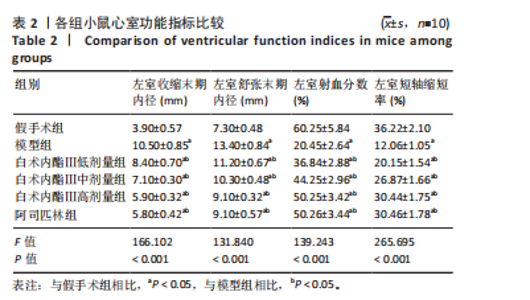
2.1 实验动物数量分析 实验选用C57BL/6小鼠60只,全部进入结果分析。 2.2 各组小鼠心室功能指标 与假手术组相比,其余各组小鼠左室收缩末期内径、左室舒张末期内径升高(P < 0.05),左室射血分数、左室短轴缩短率降低(P < 0.05);与模型组相比,白术内酯Ⅲ各剂量组和阿司匹林组小鼠的左室收缩末期内径、左室舒张末期内径降低(P < 0.05),左室射血分数、左室短轴缩短率升高(P < 0.05);白术内酯Ⅲ高剂量组和阿司匹林组心室功能指标比较差异无显著性意义(P > 0.05),见表2。"
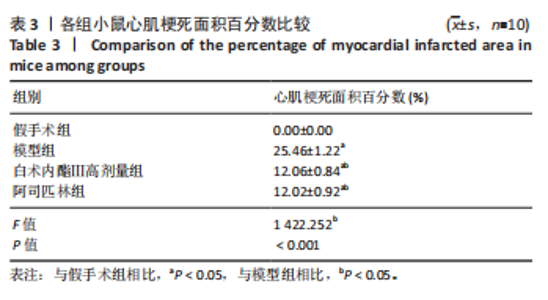
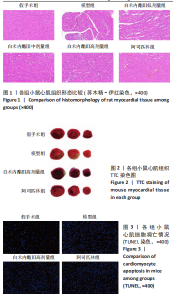
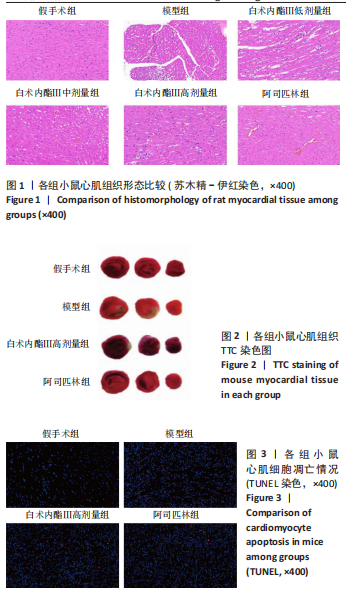
2.3 白术内酯Ⅲ对心肌组织病理变化的影响 假手术组小鼠心肌组织形态基本正常,心肌细胞结构完整,细胞之间连接紧密,没有炎性细胞浸润;模型组小鼠心肌细胞肿胀并破裂,纤维排列紊乱,伴随着大量炎性细胞浸润;白术内酯Ⅲ各剂量组和阿司匹林组小鼠心肌损伤程度明显减轻,细胞破裂减少,局部散在的炎性细胞浸润减少,其中白术内酯Ⅲ高剂量组和阿司匹林组减轻效果最为明显,因此采用60 mg/kg白术内酯Ⅲ进行后续实验,见图1。 2.4 白术内酯Ⅲ对小鼠心肌梗死面积百分数的影响 与假手术组相比,其余各组小鼠心肌梗死面积百分数升高,与模型组相比,白术内酯Ⅲ高剂量组和阿司匹林组小鼠心肌梗死面积百分数降低(P < 0.05),白术内酯Ⅲ高剂量组和阿司匹林组心肌梗死面积百分数比较差异无显著性意义(P > 0.05),见表3,图2。"
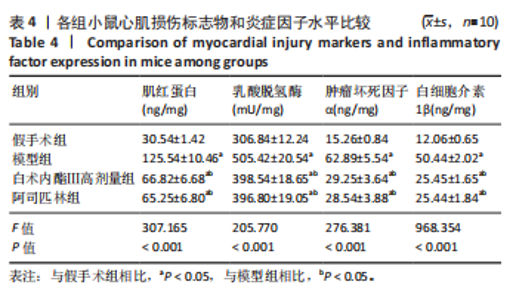
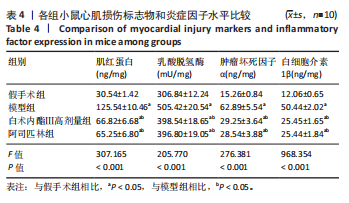
2.5 白术内酯Ⅲ对小鼠血清心肌损伤标志物和炎症因子水平的影响 与假手术组相比,其余各组小鼠心肌损伤标志物和炎症因子水平升高(P < 0.05);与模型组相比,白术内酯Ⅲ高剂量组和阿司匹林组小鼠心肌损伤标志物和炎症因子水平降低(P < 0.05);白术内酯Ⅲ高剂量组和阿司匹林组心肌损伤标志物和炎症因子水平差异无显著性意义(P > 0.05),见表4。"
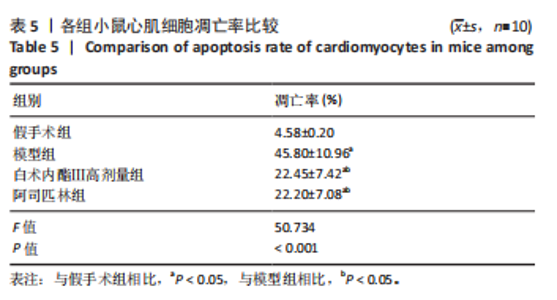
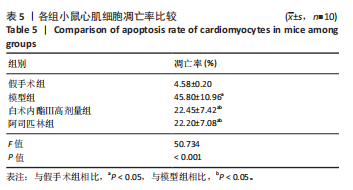
2.6 白术内酯Ⅲ对小鼠心肌细胞凋亡的影响 与假手术组相比,其余各组小鼠心肌细胞凋亡率升高(P < 0.05);与模型组相比,白术内酯Ⅲ高剂量组和阿司匹林组小鼠心肌细胞凋亡率降低(P < 0.05);白术内酯Ⅲ高剂量组和阿司匹林组心肌细胞凋亡率比较差异无显著性意义(P > 0.05),见表5,图3。"
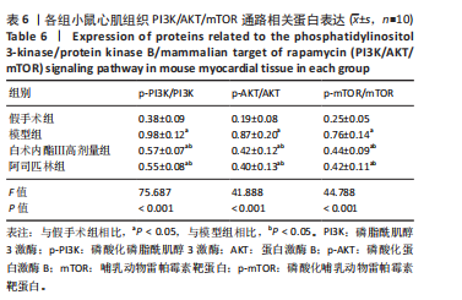
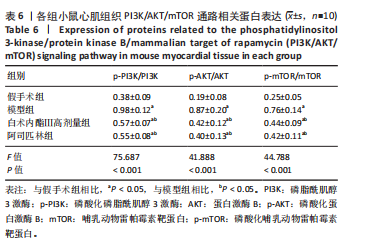
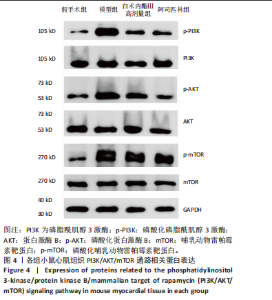
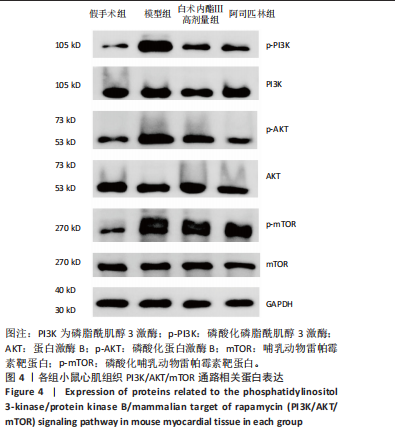
2.7 白术内酯Ⅲ对磷脂酰肌醇3激酶/蛋白激酶B/哺乳动物雷帕霉素靶蛋白通路相关蛋白表达的影响 与假手术组相比,模型组小鼠心肌组织中磷酸化磷脂酰肌醇3激酶/磷脂酰肌醇3激酶、磷酸化蛋白激酶B/蛋白激酶B、磷酸化哺乳动物雷帕霉素靶蛋白/哺乳动物雷帕霉素靶蛋白表达升高(P < 0.05);与模型组相比,白术内酯Ⅲ高剂量组和阿司匹林组小鼠心肌组织上述信号通路蛋白表达降低(P < 0.05);白术内酯Ⅲ高剂量组和阿司匹林组上述信号通路蛋白表达比较差异无显著性意义(P > 0.05),见表6,图4。"
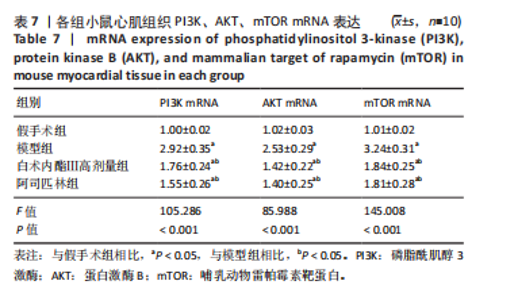
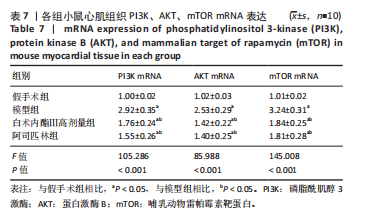
2.8 白术内酯Ⅲ对磷脂酰肌醇3激酶、蛋白激酶B、哺乳动物雷帕霉素靶蛋白mRNA表达的影响 与假手术组相比,模型组小鼠心肌组织中磷脂酰肌醇3激酶、蛋白激酶B、哺乳动物雷帕霉素靶蛋白mRNA表达升高(P < 0.05);与模型组相比,白术内酯Ⅲ高剂量组和阿司匹林组小鼠心肌组织中磷脂酰肌醇3激酶、蛋白激酶B、哺乳动物雷帕霉素靶蛋白mRNA表达降低(P < 0.05);白术内酯Ⅲ高剂量组和阿司匹林组心肌组织中磷脂酰肌醇3激酶、蛋白激酶B、哺乳动物雷帕霉素靶蛋白mRNA表达差异无显著性意义(P > 0.05),见表7。"
"
"
| [1] JINAWONG K, PIAMSIRI C, APAIJAI N, et al. Modulating Mitochondrial Dynamics Mitigates Cognitive Impairment in Rats with Myocardial Infarction. Curr Neuropharmacol. 2024;22(10):1749-1760. [2] NAIR RS, SOBHAN PK, SHENOY SJ, et al. Mitigation of Fibrosis after Myocardial Infarction in Rats by Using a Porcine Cholecyst Extracellular Matrix. Comp Med. 2023;73(4):312-323. [3] SHARMA K, KONAT A, PRAJAPATI P, et al. Can the Location of Angina Predict the Site of Coronary Artery Occlusion in Acute Myocardial Infarction? - The ACOLYTE Study. J Saudi Heart Assoc. 2025;37(2):10. [4] DENG G, YANG Y, QING O, et al. Chrysin Attenuates Myocardial Cell Apoptosis in Mice. Cardiovasc Toxicol. 2025;25(11):1791-1806. [5] ZHU D, ZHANG X, FANG Y, et al. Identification of a lactylation-related gene signature as the novel biomarkers for early diagnosis of acute myocardial infarction. Int J Biol Macromol. 2024;282(Pt 6):137431. [6] JIA J, ZHAO XA, TAO SM, et al. Icariin improves cardiac function and remodeling via the TGF-β1/Smad signaling pathway in rats following myocardial infarction. Eur J Med Res. 2023;28(1):607. [7] HU D, LI R, LI Y, et al. Inflammation-Targeted Nanomedicines Alleviate Oxidative Stress and Reprogram Macrophages Polarization for Myocardial Infarction Treatment. Adv Sci (Weinh). 2024;11(21):e2308910. [8] 刘棣文,何莉莉,崔娜,等.白术化学成分、药理作用研究进展及质量标志物预测[J].中医药信息,2024,41(1):65-78. [9] LI X, ZHU X, JIANG S, et al. Atractylenolide-III restrains cardiac fibrosis after myocardial infarction via suppression of the RhoA/ROCK1 and ERK1/2 pathway. Int Immunopharmacol. 2025;145:113825. [10] CAO M, YU C, YAO Z, et al. Atractylodesin III maintains mitochondrial function and inhibits caspase-3 activity to reverse apoptosis of cardiomyocytes in AMI rats. Int J Clin Exp Pathol. 2019;12(1):198-204. [11] ZENG Q, ZHANG LD, CHEN QF, et al. Effects of Mitochondrial ATP-Sensitive Potassium Channel in Rats with Acute Myocardial Infarction and Its Association with the AKT/mTOR Pathway.Anatol J Cardiol. 2023;27(2):88-99. [12] LU M, ZHANG Y, MA X, et al. Shenmai Injection Alleviates Myocardial Ferroptosis via Activating the AKT1/mTOR Pathway in Rats with Acute Myocardial Infarction.Ann Clin Lab Sci. 2024;54(1):35-46. [13] 杨文龙.白术内酯Ⅱ和Ⅲ预处理对小鼠心梗后心脏保护作用研究[D].上海:上海交通大学,2017. [14] 马伟谦,刘明,魏娟,等.白术内酯I调节HIF-1α/VEGF信号通路对急性心肌梗死大鼠心肌损伤的影响[J].河北医学,2024,30(4):544-549. [15] SUN M, MAO S, WU C, et al. Piezo1-Mediated Neurogenic Inflammatory Cascade Exacerbates Ventricular Remodeling After Myocardial Infarction. Circulation. 2024;149(19):1516-1533. [16] LI B, LIANG C, LV Y, et al. MiR-22 inhibits myocardial fibrosis in rats with myocardial infarction by targeting PTEN/Akt/mTOR signaling pathway. Cell Mol Biol (Noisy-le-grand). 2024;70(1):28-33. [17] NOVIANTI E, KATSUURA G, KAWAMURA N, et al. Atractylenolide-III suppresses lipopolysaccharide-induced inflammation via downregulation of toll-like receptor 4 in mouse microglia. Heliyon. 2021;7(10):e08269. [18] ZHANG L, YI H, JIANG D, et al. Protective effects of Atractylenolide III on inflammation and oxidative stress in ovalbumin-induced asthma mice and its possible mechanisms. Gen Physiol Biophys. 2021;40(2):137-146. [19] ZHANG D, LI X, SONG D, et al. Atractylenolide III induces apoptosis by regulating the Bax/Bcl-2 signaling pathway in human colorectal cancer HCT-116 Cells in vitro and in vivo. Anticancer Drugs. 2022;33(1):30-47. [20] LI S, YANG M, ZHAO Y, et al. Deletion of ASPP1 in myofibroblasts alleviates myocardial fibrosis by reducing p53 degradation. Nat Commun. 2024;15(1):8425. [21] TANI H, SADAHIRO T, YAMADA Y, et al. Direct Reprogramming Improves Cardiac Function and Reverses Fibrosis in Chronic Myocardial Infarction. Circulation. 2023;147(3):223-238. [22] CHEN G, XU H, XU T, et al. Calycosin reduces myocardial fibrosis and improves cardiac function in post-myocardial infarction mice by suppressing TGFBR1 signaling pathways. Phytomedicine. 2022;104:154277. [23] HU S, GAO Y, GAO R,et al. The selective STING inhibitor H-151 preserves myocardial function and ameliorates cardiac fibrosis in murine myocardial infarction. Int Immunopharmacol. 2022;107:108658. [24] YE T, YAN Z, CHEN C, et al. Lactoferrin attenuates cardiac fibrosis and cardiac remodeling after myocardial infarction via inhibiting mTORC1/S6K signaling pathway. Theranostics. 2023;13(10):3419-3433. [25] WANG M, LIU X, DING B, et al. SGLT2 inhibitor Dapagliflozin alleviates cardiac dysfunction and fibrosis after myocardial infarction by activating PXR and promoting angiogenesis. Biomed Pharmacother. 2024;177:116994. [26] 李璐.急性心肌梗死患者的梗死部位、脑钠肽的水平与其心肌梗死面积及预后的关系[J].当代医药论丛,2018,16(10):65-66. [27] CAI S, ZHAO M, ZHOU B, et al. Mitochondrial dysfunction in macrophages promotes inflammation and suppresses repair after myocardial infarction. J Clin Invest. 2023;133(4):e159498. [28] HUYNH P, HOFFMANN JD, GERHARDT T, et al. Myocardial infarction augments sleep to limit cardiac inflammation and damage. Nature. 2024;635(8037): 168-177. [29] LIU X, ZHANG W, LUO J, et al. TRIM21 deficiency protects against atrial inflammation and remodeling post myocardial infarction by attenuating oxidative stress. Redox Biol. 2023;62:102679. [30] ZHANG G, HAN X, XU T, et al. Buyang Huanwu Decoction suppresses cardiac inflammation and fibrosis in mice after myocardial infarction through inhibition of the TLR4 signalling pathway. J Ethnopharmacol. 2024;320:117388. [31] ZHU H, LIU X, DING Y, et al. IL-6 coaxes cellular dedifferentiation as a pro-regenerative intermediate that contributes to pericardial ADSC-induced cardiac repair. Stem Cell Res Ther. 2022;13(1):44. [32] CINAR I, YAYLA M, TAVACI T, et al. In Vivo and In Vitro Cardioprotective Effect of Gossypin Against Isoproterenol-Induced Myocardial Infarction Injury. Cardiovasc Toxicol. 2022;22(1):52-62. [33] 崔怀仁,郭瑞.心肌损伤标志物检测在急性心肌梗死早期诊断中的应用评价[J].现代医学与健康研究电子杂志,2024,8(12):120-122. [34] LV F, XIE L, LI L, et al. LMK235 ameliorates inflammation and fibrosis after myocardial infarction by inhibiting LSD1-related pathway. Sci Rep. 2024;14(1):23450. [35] ZHANG Q, WANG L, WANG S, et al. Signaling pathways and targeted therapy for myocardial infarction. Signal Transduct Target Ther. 2022;7(1):78. [36] HAN X, ZHANG G, PANG M, et al. Taohong siwu decoction suppresses oxidative stress-induced myocardial apoptosis post-myocardial infarction by inhibiting PTEN pathway. Phytomedicine. 2024;135:155388. [37] 桂杨.白术内酯Ⅲ通过抑制心肌自噬和凋亡对心肌梗死小鼠的保护作用研究[D].武汉:华中科技大学,2022. [38] QI S, YI G, YU K, et al. The Role of HSP90 Inhibitors in the Treatment of Cardiovascular Diseases.Cells. 2022;11(21):3444. [39] QIN GW, LU P, PENG L, et al. Ginsenoside Rb1 Inhibits Cardiomyocyte Autophagy via PI3K/Akt/mTOR Signaling Pathway and Reduces Myocardial Ischemia/Reperfusion Injury. Am J Chin Med. 2021;49(8):1913-1927. [40] LI JP, QIU S, TAI GJ, et al. NLRP3 inflammasome-modulated angiogenic function of EPC via PI3K/ Akt/mTOR pathway in diabetic myocardial infarction. Cardiovasc Diabetol. 2025;24(1):6. [41] GUO S, QI X, ZHANG L, et al. Plumbagin improves myocardial fibrosis after myocardial infarction by inhibiting the AKT/mTOR pathway to upregulate autophagy levels. Int Immunopharmacol. 2025;148:114086. |
| [1] | Chen Haojie, Wang Dai, Shen Shan. Immune inflammatory microenvironment mechanisms in peri-implantitis [J]. Chinese Journal of Tissue Engineering Research, 2026, 30(8): 2054-2062. |
| [2] | Liu Yang, Liu Donghui , Xu Lei, Zhan Xu, Sun Haobo, Kang Kai. Role and trend of stimuli-responsive injectable hydrogels in precise myocardial infarction therapy [J]. Chinese Journal of Tissue Engineering Research, 2026, 30(8): 2072-2080. |
| [3] | Hu Xiongke, Liu Shaohua, Tan Qian, Liu Kun, Zhu Guanghui. Shikonin intervention with bone marrow mesenchymal stem cells improves microstructure of femur in aged mice [J]. Chinese Journal of Tissue Engineering Research, 2026, 30(7): 1609-1615. |
| [4] | Han Nianrong, Huang Yifei, Akram · Osman, Liu Yanlu, Hu Wei . Programmed cell death receptor-1 suppresses osteogenic differentiation of rat bone marrow mesenchymal stem cells in a high-glucose microenvironment [J]. Chinese Journal of Tissue Engineering Research, 2026, 30(7): 1649-1657. |
| [5] | Liu Anting, Lu Jiangtao, Zhang Wenjie, He Ling, Tang Zongsheng, Chen Xiaoling. Regulation of AMP-activated protein kinase by platelet lysate inhibits cadmium-induced neuronal apoptosis [J]. Chinese Journal of Tissue Engineering Research, 2026, 30(7): 1800-1807. |
| [6] | Chen Ju, Zheng Jinchang, Liang Zhen, Huang Chengshuo, Lin Hao, Zeng Li. Effect and mechanism of beta-caryophyllene in mice with osteoarthritis [J]. Chinese Journal of Tissue Engineering Research, 2026, 30(6): 1341-1347. |
| [7] | Lyu Guoqing, Aizimaitijiang·Rouzi, Xiong Daohai. Irisin inhibits ferroptosis in human articular chondrocytes: roles and mechanisms [J]. Chinese Journal of Tissue Engineering Research, 2026, 30(6): 1359-1367. |
| [8] | Peng Zhiwei, Chen Lei, Tong Lei. Luteolin promotes wound healing in diabetic mice: roles and mechanisms [J]. Chinese Journal of Tissue Engineering Research, 2026, 30(6): 1398-1406. |
| [9] | Zhu Kuicheng, Du Chunyan, Zhang Jintao. Mechanism by which hairless gene mutation promotes white adipose tissue browning in hairless mice [J]. Chinese Journal of Tissue Engineering Research, 2026, 30(6): 1424-1430. |
| [10] | Li Hao, Tao Hongcheng, Zeng Ping, Liu Jinfu, Ding Qiang, Niu Chicheng, Huang Kai, Kang Hongyu. Mitogen-activated protein kinase signaling pathway regulates the development of osteoarthritis: guiding targeted therapy with traditional Chinese medicine [J]. Chinese Journal of Tissue Engineering Research, 2026, 30(6): 1476-1485. |
| [11] | Chen Yixian, Chen Chen, Lu Liheng, Tang Jinpeng, Yu Xiaowei. Triptolide in the treatment of osteoarthritis: network pharmacology analysis and animal model validation [J]. Chinese Journal of Tissue Engineering Research, 2026, 30(4): 805-815. |
| [12] | Liu Di, Wang Minglei, Li Chun, Wang Duo, Li Long, Wu Yongli. Warm acupuncture inhibits pyroptosis and improves cartilage degeneration in rabbit knee joints [J]. Chinese Journal of Tissue Engineering Research, 2026, 30(36): 9445-9452. |
| [13] | Ma Zhiguo, Zhou Zhengxin, Xue Song, Xiang Xinhong, Zhu Lei. Du Huo Ji Sheng Decoction delays cartilage degeneration in mice with knee osteoarthritis [J]. Chinese Journal of Tissue Engineering Research, 2026, 30(36): 9453-9461. |
| [14] | Yang Jiao, Wang Zhifeng, Shi Ting, Xu Shuangfeng, Tian Daman, Lan Junfeng, He Pengfen, Hao Zhihui, Pan Pan, Wang Jian. Electroacupuncture regulates mitochondrial copper homeostasis to modulate neuroinflammatory injury in rats with ischemic stroke [J]. Chinese Journal of Tissue Engineering Research, 2026, 30(36): 9519-9525. |
| [15] | Ji Lingshan, Qin Hewei, Cheng Shuaifang, Zhao Jing. Mechanism and effect of aescin intervention against brain injury in a rat model of intracerebral hemorrhage [J]. Chinese Journal of Tissue Engineering Research, 2026, 30(36): 9526-9537. |
| Viewed | ||||||
|
Full text |
|
|||||
|
Abstract |
|
|||||