Chinese Journal of Tissue Engineering Research ›› 2026, Vol. 30 ›› Issue (36): 9553-9559.doi: 10.12307/2026.921
Previous Articles Next Articles
Effects of isorhamnetin on skin lesions in a rat model of auricular acne
Sun Xian, Hu Zhen, Liu Rui
- No. 3 Hospital of Wuhan City, Wuhan 43000, Hubei Province, China
-
Received:2025-10-29Revised:2026-03-16Online:2026-12-28Published:2026-05-23 -
Contact:Liu Rui, MS, Attending physician, No. 3 Hospital of Wuhan City, Wuhan 43000, Hubei Province, China -
About author:Sun Xian, MS, Attending physician, No. 3 Hospital of Wuhan City, Wuhan 43000, Hubei Province, China -
Supported by:Wuhan Municipal Health and Family Planning Commission Scientific Research Project, No. WX21Z20 (to SX)

CLC Number:
Cite this article
Sun Xian, Hu Zhen, Liu Rui. Effects of isorhamnetin on skin lesions in a rat model of auricular acne [J]. Chinese Journal of Tissue Engineering Research, 2026, 30(36): 9553-9559.
share this article
Add to citation manager EndNote|Reference Manager|ProCite|BibTeX|RefWorks
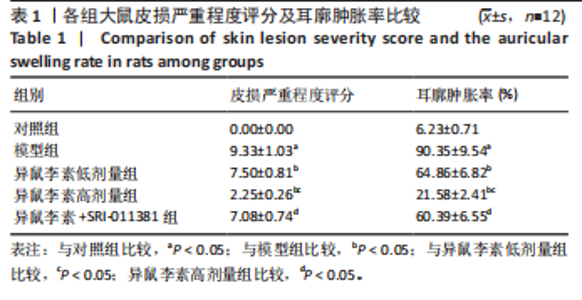
2.1 实验动物数量分析 实验过程无大鼠死亡,实验选用的60只大鼠,全部进入结果分析。 2.2 异鼠李素对耳廓痤疮大鼠皮损严重程度评分及耳廓肿胀率的影响 检测结果发现,异鼠李素处理可显著降低大鼠皮损严重程度评分及耳廓肿胀率,其中异鼠李素高剂量组变化最显著(P < 0.05);SRI-011381处理可部分逆转异鼠李素高剂量组处理对大鼠皮损严重程度评分及耳廓肿胀率的改善作用(P < 0.05);见表1。"

2.3 异鼠李素对耳廓痤疮大鼠炎性因子水平的影响 ELISA检测结果发现,异鼠李素处理可显著降低大鼠血清肿瘤坏死因子α、白细胞介素6、白细胞介素1β、白细胞介素18水平,升高白细胞介素10水平,其中异鼠李素高剂量组变化最显著(P < 0.05);SRI-011381处理可部分逆转异鼠李素高剂量组处理对大鼠血清炎性因子水平的改善作用(P < 0.05);见表2。"

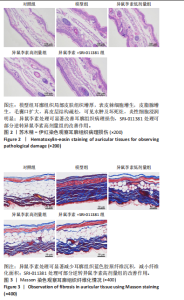
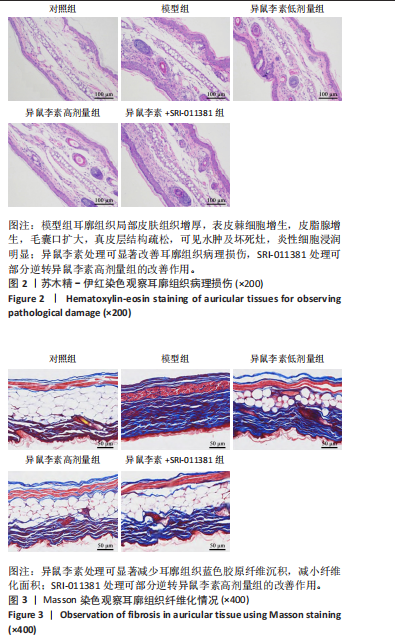
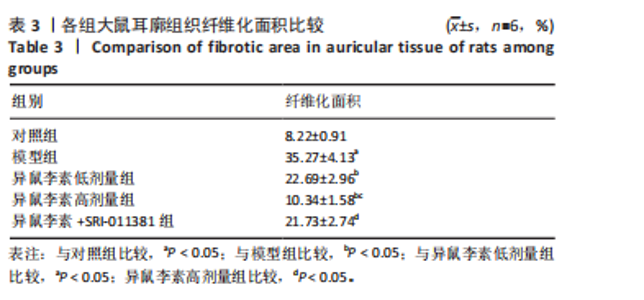
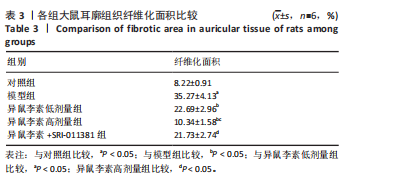
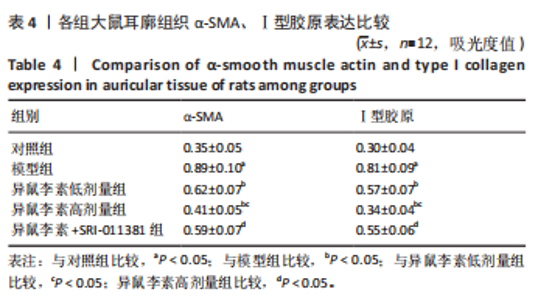
2.4 异鼠李素对耳廓痤疮大鼠耳廓组织病理变化的影响 苏木精-伊红染色病理观察发现,模型组耳廓组织局部皮肤组织增厚,表皮棘细胞增生,皮脂腺增生,毛囊口扩大,真皮层结构疏松,可见水肿及坏死灶,炎性细胞浸润明显;异鼠李素处理可显著改善耳廓组织病理损伤,其中异鼠李素高剂量组变化最为显著;SRI-011381处理可部分逆转异鼠李素高剂量组处理对大鼠耳廓组织病理损伤的改善作用,见图2。 2.5 异鼠李素对耳廓痤疮大鼠耳廓组织纤维化的影响 Masson染色观察发现,异鼠李素处理可显著减少耳廓组织蓝色胶原纤维沉积,减小纤维化面积,其中异鼠李素高剂量组变化最显著(P < 0.05);SRI-011381处理可部分逆转异鼠李素高剂量组处理对大鼠耳廓组织纤维化的改善(P < 0.05);见图3,表3。 2.6 异鼠李素对耳廓痤疮大鼠耳廓组织α-SMA、Ⅰ型胶原表达的影响 免疫组化检测结果发现,异鼠李素处理可显著降低大鼠耳廓组织α-SMA、Ⅰ型胶原表达,异鼠李素高剂量组变化最显著(P < 0.05);SRI-011381处理可部分逆转异鼠李素高剂量处理对大鼠耳廓组织α-SMA、Ⅰ型胶原表达的抑制作用(P < 0.05);见图4,表4。"
"
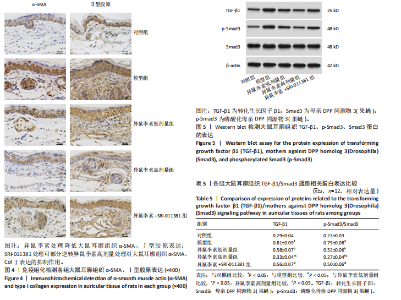
2.7 异鼠李素对大鼠耳廓组织TGF-β1/Smad3通路的影响 Western blot检测结果发现,异鼠李素处理可显著降低TGF-β1、p-Smad3/Smad3表达,异鼠李素高剂量组变化最显著(P < 0.05); SRI-011381处理可部分逆转异鼠李素高剂量处理对大鼠耳廓组织TGF-β1、p-Smad3/Smad3表达的抑制作用(P < 0.05);见图5,表5。"

"

| [1] KUTLU Ö, KARADAĞ AS, WOLLINA U. Adult acne versus adolescent acne: a narrative review with a focus on epidemiology to treatment. An Bras Dermatol. 2023;98(1):75-83. [2] JENNINGS T, DUFFY R, MCLARNEY M, et al. Acne scarring-pathophysiology, diagnosis, prevention and education: Part I. J Am Acad Dermatol. 2024;90(6): 1123-1134. [3] MOHSIN N, HERNANDEZ LE, MARTIN MR, et al. Acne treatment review and future perspectives. Dermatol Ther. 2022;35(9):e15719-e15729. [4] LAYTON AM, RAVENSCROFT J. Adolescent acne vulgaris: current and emerging treatments. Lancet Child Adolesc Health. 2023;7(2):136-144. [5] GONG G, GUAN YY, ZHANG ZL, et al. Isorhamnetin: A review of pharmacological effects. Biomed Pharmacother. 2020;128(1):110301-110315. [6] WU CS, LIN CC, CHEN YY, et al. Mechanisms and Effects of Isorhamnetin on Imiquimod-Induced Psoriasiform Dermatitis in Mice. Life (Basel). 2022;12(12): 2107-2119. [7] SHAFI T, RASOOL WANI R, HUSSAIN S, et al. Investigating dysregulation of TGF-β1/SMAD3 signaling in atopic dermatitis: a molecular and immunohistochemical analysis. Clin Exp Immunol. 2024;216(2):192-199. [8] BALDWIN H, TAN J. Effects of Diet on Acne and Its Response to Treatment. Am J Clin Dermatol. 2021;22(1):55-65. [9] 鞠强.中国痤疮治疗指南(2019修订版)[J]. 临床皮肤科杂志,2019,48(9): 583-588. [10] 吴淑辉,朱 明芳, 魏露, 等. 石榴皮多酚对大鼠耳廓痤疮模型mTOR/HIF-1α/RORγt信号通路的影响[J].中华皮肤科杂志,2022,55(6):511-516. [11] WU J, SONG Y, WANG J, et al.Isorhamnetin inhibits hypertrophic scar formation through TGF-β1/Smad and TGF-β1/CREB3L1 signaling pathways. Heliyon.Heliyon. 2024;10(13):e33802. [12] 孔维祎, 郝欧美, 盛秋菊. 宣肺开闭汤通过抑制TGF-β1/Smad3通路减缓小鼠肺纤维化进展[J]. 广州中医药大学学报,2023,40(12):3130-3138. [13] 付佳宁, 赵氏淳, 郝凌烽, 等. 金银花-蒲公英提取液纳米相态凝胶剂制备及对大鼠痤疮模型的药效评价[J]. 中草药,2024,55(24):8416-8424. [14] CRUZ S, VECEREK N, ELBULUK N. Targeting Inflammation in Acne: Current Treatments and Future Prospects. Am J Clin Dermatol. 2023;24(5):681-694. [15] HAZARIKA N. Acne vulgaris: new evidence in pathogenesis and future modalities of treatment. J Dermatolog Treat. 2021;32(3):277-285. [16] HUANG L, YANG S, YU X, et al. Association of different cell types and inflammation in early acne vulgaris. Front Immunol. 2024;15:1275269. [17] 赵东利, 李竹茜. 芹菜素对痤疮模型大鼠JAK2/STAT3通路、炎症反应及凋亡的影响[J]. 中国细胞生物学学报,2025,47(8):1939-1947. [18] 毛辉, 石年. 红细胞分化调节因子1对小鼠玫瑰痤疮模型Th1/Th2细胞分化的作用及影响[J]. 中国中西医结合皮肤性病学杂志,2023,22(1):23-26. [19] ELATTAR Y, MOURAD B, ALNGOMY HA, et al. Study of interleukin-1 beta expression in acne vulgaris and acne scars. J Cosmet Dermatol. 2022;21(10): 4864-4870. [20] 胡雯, 叶冬晴. 火针联合新型超分子水杨酸治疗中重度痤疮的临床疗效及对血清炎症因子的影响[J]. 中国皮肤性病学杂志,2026,40(1):49-55. [21] 王慧芳, 张小静. 枇杷清肺饮加减联合罗红霉素对痤疮患者血清CRP、IL-6、IL-8水平的影响[J]. 罕少疾病杂志,2025,32(9):128-130. [22] 李晓娟, 林新瑜, 沈柱, 等. 白介素-18及NOD样受体蛋白3炎性小体在痤疮发病中的作用研究[J]. 四川大学学报(医学版),2019,50(1):66-70. [23] XIONG H, LI X, MOU X, et al. Syringic acid suppresses Cutibacterium acnes-induced inflammation in human keratinocytes via regulating the NLRP3/caspase-1/IL-1β signaling axis by activating PPARγ/Nrf2-antioxidant pathway.Int Immunopharmacol. 2024;139(1):112708-112718. [24] ZUO G, GAO Y, LU G, et al. Auriculotherapy Modulates Macrophage Polarization to Reduce Inflammatory Response in a Rat Model of Acne. Mediators Inflamm. 2023;2023(1):6627393-6627401. [25] 安永峰, 袁龙, 时晋丽. 黄芩苷通过抑制SDF-1/CXCR4信号通路改善痤疮大鼠皮肤炎性损伤[J]. 免疫学杂志,2024,40(6):514-519. [26] 李知, 陈素红, 缪飞, 等.姜黄素调节JAK2/STAT3信号通路对痤疮小鼠Th17/Treg细胞免疫平衡的影响[J].中国免疫学杂志,2025,41(6):1371-1375. [27] 徐俊涛, 方玉甫, 王莹, 等.基于Th1/Th2失衡及炎症反应探讨封髓丹加味对痤疮的影响[J].中国中医基础医学杂志,2021,27(3):427-431. [28] LEE JH, YOON JY, KIM DH, et al. Potential of cannabidiol as acne and acne scar treatment: novel insights into molecular pathways of pathophysiological factors. Arch Dermatol Res. 2024;316(7):428. [29] MALFA GA, BIANCHI S, SPADARO V, et al. Protective Effects of Wild Sulla coronaria (Fabaceae) Flowers Phytocomplex in Human Dermal Fibroblasts Stimulated with Interleukin-1β. Plants (Basel). 2024;13(19):2748. [30] 李丹, 杜雪洋, 王思农. 三黄凝胶对大鼠耳廓复合痤疮模型p38MAPK信号通路及其关键分子的影响[J].中国现代应用药学,2024,41(8):1038-1046. [31] 卢卿, 赵爱国. CO2点阵激光Fusion融合模式对小鼠皮肤增生性瘢痕的影响及其机制[J]. 中华实验外科杂志,2023,40(4):655-659. [32] 彭一琳, 夏强, 刘韧, 等. Wnt/β-catenin信号通路在博来霉素诱导的系统性硬化症小鼠模型血管重塑中的作用[J]. 中国生物化学与分子生物学报,2022, 38(7):911-918. [33] KONG X, JIANG S, HE Q, et al. TLR8 aggravates skin inflammation and fibrosis by activating skin fibroblasts in systemic sclerosis. Rheumatology (Oxford). 2024; 3(6):1710-1719. [34] WANG H, CHEN L, YANG B, et al. Structures, Sources, Identification/Quantification Methods, Health Benefits, Bioaccessibility, and Products of Isorhamnetin Glycosides as Phytonutrients. Nutrients. 2023;15(8):1947. [35] HU W, WANG H, LEI Z, et al. Isorhamnetin protects melanocytes against CD8+ T cell-mediated apoptosis and reduces inflammation in vitiligo-afflicted mouse. Biomed Pharmacother. 2025;191:118456. [36] 娜依马·马木提, 胡雯, 康晓静. 异鼠李素激活线粒体自噬缓解人表皮黑素细胞氧化损伤的作用[J]. 中国皮肤性病学杂志,2026,40(3):249-258. [37] 刘笑蓉, 李硕夫, 刘湘丹, 等.异鼠李素通过调控P38 MAPK和AKT/MTOR通路改善大鼠类风湿关节炎[J].中药药理与临床,2025,41(2):39-47. [38] PU X, CAO X, LIU H, et al. Isorhamnetin attenuates the proliferation, invasion, migration and fibrosis of keloid fibroblasts by targeting S1PR1. Exp Ther Med. 2023;26(1):310-319. [39] 戴乐恒, 胡雯, 张坤杰, 等. 异鼠李素对H2O2诱导的HaCaT细胞线粒体结构及功能损伤的保护作用研究[J]. 中华皮肤科杂志,2023,56(9):857-861. [40] SHAFI T, RASOOL WANI R, HUSSAIN S, et al. Investigating dysregulation of TGF-β1/SMAD3 signaling in atopic dermatitis: a molecular and immunohistochemical analysis. Clin Exp Immunol. 2024;216(2):192-199. [41] XIAO Y, XIANG Q, WANG Y, et al. Exosomes carrying adipose mesenchymal stem cells function alleviate scleroderma skin fibrosis by inhibiting the TGF-β1/Smad3 axis. Sci Rep. 2025;15(1):7162. [42] 姚思琦, 黎文正, 汪虹. 转化生长因子β/Smad信号通路与瘢痕疙瘩的靶向治疗[J]. 中国组织工程研究,2024,28(16):2619-2624. [43] 简峰, 漆静, 杨小英, 等. 西替利嗪通过TGF-β1/Smad3信号通路调控小鼠硬皮病皮肤组织纤维化研究[J]. 海南医学院学报,2020,26(14):1056-1062. [44] XIE X, GAN H, TIAN J, et al. Iguratimod inhibits skin fibrosis by regulating TGF-β1/Smad signalling pathway in systemic sclerosis. Eur J Clin Invest. 2022; 52(8):e13791. . [45] CHI J, LI X, ZHU Z, et al. Blockade of TGF-β1/Smad3 signaling pathway by Bovine Milk-derived extracellular vesicles ameliorates skin fibrosis in systemic sclerosis mice. Biochem Biophys Res Commun. 2025;784:152579. [46] 李永强, 黄奕, 李凯, 等. 基于TGF-β1/Smads信号通路探讨红花抗硬皮病小鼠皮肤纤维化的作用机制[J].广西医学,2024,46(2):276-283. [47] RANDALL LJ, BAJAN S, TRAN TD, et al. Propolis compound inhibits profibrotic TGF-β1/SMAD signalling in human fibroblasts. Sci Rep. 2025;15(1):27260. [48] WU D, ZHOU J, TAN M, et al. LINC01116 regulates proliferation, migration, and apoptosis of keloid fibroblasts by the TGF-β1/SMAD3 signaling via targeting miR-3141. Anal Biochem. 2021;627:114249. [49] 刘洪君, 孙雪美, 孙明强, 等. 蒲公英甾醇通过TGF-β/Smad通路对小鼠痤疮模型炎症因子水平、胸腺组织形态的影响[J].河北医科大学学报,2020, 41(7):810-814. |
| [1] | Pan Hongfei, Zhuang Zhenbing, Xu Baiyun, Yang Zhangyang, Lin Kairui, Zhan Bingqing, Lan Jinghan, Gao Heng, Zhang Nanbo, Lin Jiayu. Inhibitory effects of different concentrations of auranofin on M1 macrophage function and its therapeutic potential in diabetic wound healing [J]. Chinese Journal of Tissue Engineering Research, 2026, 30(6): 1390-1397. |
| [2] | Jiang Xin, Han Zhixin, Ma Jiaqi, Yang Wen, Zhao Xiaojing. Ginsenoside Rb1 promotes wound healing in burn rats [J]. Chinese Journal of Tissue Engineering Research, 2026, 30(36): 9566-9571. |
| [3] | Zhang Bo, Zhao Jingjing, Li Wenting, Kong Jie. Protective effect of kaempferol against renal injury in lupus nephritis [J]. Chinese Journal of Tissue Engineering Research, 2026, 30(36): 9597-9603. |
| [4] | Xu Jiamu, Yang Cheng, Li Weimin, Wang Chunqing. Role and pathogenesis of pyroptosis and inflammatory factors in osteoporosis [J]. Chinese Journal of Tissue Engineering Research, 2026, 30(3): 691-700. |
| [5] | Yong Qiao, Sun Xin, Wang Guoyou, Zhang Lei, Shen Huarui, Liu Huan, Guan Taiyuan. Shaoyang Shenggu Fang inhibits oxidative stress and delays cartilage aging in rats with knee osteoarthritis [J]. Chinese Journal of Tissue Engineering Research, 2026, 30(28): 7251-7259. |
| [6] | Gao Minyi, Liu Pinghong, Lin Haixiong. Burn and multi-omic biomarkers: causal relationships with 41 inflammatory factors and 35 blood and urine markers [J]. Chinese Journal of Tissue Engineering Research, 2026, 30(23): 6062-6070. |
| [7] | Shi Gaolong, Ge Caijun, Chen Jianpeng, Wang Yuanbin, Fan Zelin, Yan Jun, Wang Qianliang. Mechanism by which the paraventricular nucleus of the hypothalamus is involved in chronic pain and anxiety in mice with lumbar disc herniation [J]. Chinese Journal of Tissue Engineering Research, 2026, 30(22): 5707-5715. |
| [8] | Niu Qi, Chen Junji, Tu Haining, Mo Weibin, Zhong Yujin, Li Mingliang. Effect of swimming exercise combined with probiotic intervention on anti-inflammatory and apoptotic gene expression in renal tissue of type 2 diabetic rats [J]. Chinese Journal of Tissue Engineering Research, 2026, 30(16): 4105-4114. |
| [9] | Jiang Kai, Rong Yifa, Jia Haifeng, Li Hanzheng, Lu Bowen, Liang Xuezhen, Li Gang. Relationship between inflammatory factors and rheumatoid arthritis: a large-sample analysis based on the FinnGen R10 database and genome-wide association studies [J]. Chinese Journal of Tissue Engineering Research, 2026, 30(10): 2629-2640. |
| [10] | Zhang Yibo, Lu Jianqi, Mao Meiling, Pang Yan, Dong Li, Yang Shangbing, Xiao Xiang. Exploring the causal relationship between rheumatoid arthritis and coronary atherosclerosis: a Mendel randomized study involving serum metabolites and inflammatory factors [J]. Chinese Journal of Tissue Engineering Research, 2025, 29(在线): 1-9. |
| [11] | Wang Tong, Zheng Yu, Jia Chengming, Yang Hu, Zhang Guangfei, Ji Yaoyao. Action mechanism of Gegenmaqi prescription in treatment of periarthritis of shoulder combined with type 2 diabetes based on TCMSP database [J]. Chinese Journal of Tissue Engineering Research, 2025, 29(35): 7669-7678. |
| [12] | Xu Biao, Dong Yuzhen, Lu Tan. Effect of dihydroquercetin on the expression of inflammatory response markers in rats with spinal cord injury [J]. Chinese Journal of Tissue Engineering Research, 2025, 29(32): 6843-6850. |
| [13] | Geng Longyu, Sheng Li, Bai Shuo, Gao Beiyao, Ge Ruidong, Jiang Shan . Role and molecular mechanism of pyroptosis in motor system diseases [J]. Chinese Journal of Tissue Engineering Research, 2025, 29(26): 5695-5703. |
| [14] | Zhang Yibo, Lu Jianqi, Mao Meiling, Pang Yan, Dong Li, Yang Shangbing, Xiao Xiang. Rheumatoid arthritis and coronary atherosclerosis: data analysis of serum metabolite and inflammatory factor in the European population [J]. Chinese Journal of Tissue Engineering Research, 2025, 29(24): 5263-5271. |
| [15] | Liang Zhou, Zhang Chi, Pan Chengzhen, Yang Bo, Pu Zhanglin, Liu Hua, Peng Jinhui, Wen Lichun, Ling Guanhan, Chen Feng. Anti-osteoporotic mechanisms of kaempferol based on gut microbiota and comprehensive targeted metabolomics [J]. Chinese Journal of Tissue Engineering Research, 2025, 29(20): 4190-4204. |
| Viewed | ||||||
|
Full text |
|
|||||
|
Abstract |
|
|||||