Chinese Journal of Tissue Engineering Research ›› 2026, Vol. 30 ›› Issue (36): 9538-9545.doi: 10.12307/2026.922
Previous Articles Next Articles
Mechanism of Huangpu Tongqiao Capsule on cognitive function in a rat model of Wilson’s disease
Xu Wenlin, Wu Haixia, Li Jie, Zhang Manhua, Rao Zhihui, Zhu Qingxiong
- Jiangxi Maternal and Child Health Hospital, Nanchang 330103, Jiangxi Province, China
-
Received:2025-11-11Revised:2026-03-18Online:2026-12-28Published:2026-05-23 -
Contact:Zhu Qingxiong, Chief physician, Jiangxi Maternal and Child Health Hospital, Nanchang 330103, Jiangxi Province, China -
About author:Xu Wenlin, Attending physician, Jiangxi Maternal and Child Health Hospital, Nanchang 330103, Jiangxi Province, China -
Supported by:Science and Technology Research Project of Jiangxi Provincial Department of Education, No. GJJ2403606 (to XWL)

CLC Number:
Cite this article
Xu Wenlin, Wu Haixia, Li Jie, Zhang Manhua, Rao Zhihui, Zhu Qingxiong. Mechanism of Huangpu Tongqiao Capsule on cognitive function in a rat model of Wilson’s disease[J]. Chinese Journal of Tissue Engineering Research, 2026, 30(36): 9538-9545.
share this article
Add to citation manager EndNote|Reference Manager|ProCite|BibTeX|RefWorks
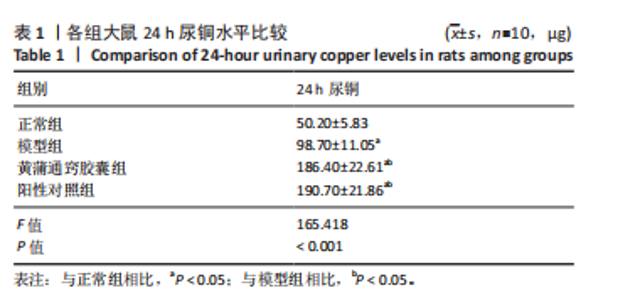
2.1 实验动物数量分析 实验选用大鼠50只,造模过程中4 只大鼠因肝脏对铜离子的急性耐受不足,出现肝细胞坏死引发的急性肝功能衰竭,表现为精神萎靡、黄疸、食欲废绝,解剖可见肝脏肿大、质地变硬,符合铜中毒早期的典型病理特征;0.185%的硫酸铜水口感酸涩;6只大鼠因多器官功能衰竭等情况最终死亡,最终40只大鼠进入结果分析。 2.2 各组大鼠24 h尿铜水平比较 与正常组相比,模型组、黄蒲通窍胶囊组、阳性对照组大鼠24 h尿铜水平升高(P < 0.05);与模型组相比,黄蒲通窍胶囊组、阳性对照组大鼠24 h尿铜水平升高(P < 0.05)。见表1。"
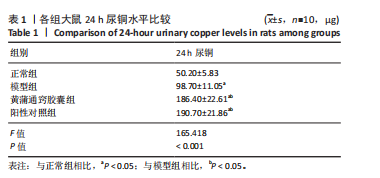
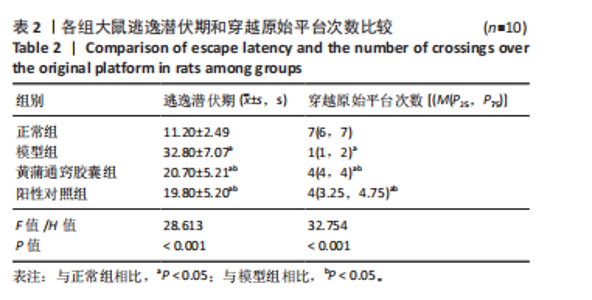
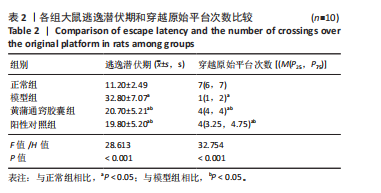
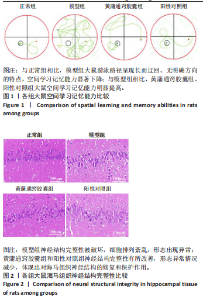
2.3 各组大鼠逃逸潜伏期和穿越原始平台次数比较 与正常组相比,模型组大鼠逃逸潜伏期增长、穿越原始平台次数降低(P < 0.05);与模型组相比,黄蒲通窍胶囊组、阳性对照组大鼠逃逸潜伏期缩短、穿越原始平台次数增加(P < 0.05)。见表2,图1。"
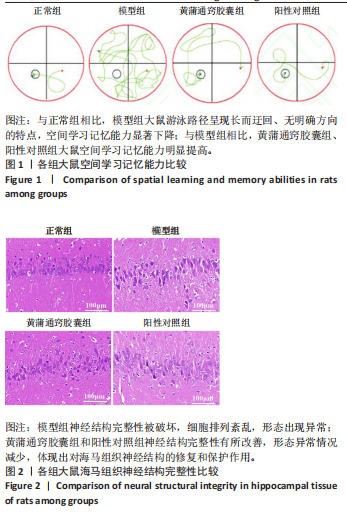
2.4 各组大鼠海马组织神经结构完整性比较 苏木精-伊红染色结果显示,正常组大鼠海马组织神经结构完整,细胞排列整齐有序,形态正常,显示出健康的神经组织结构特征;模型组大鼠神经结构完整性被破坏,细胞排列紊乱,形态出现异常,神经组织受到明显损伤;黄蒲通窍胶囊组和阳性对照组与模型组相比,神经结构完整性有所改善,细胞排列相对整齐,形态异常情况减少,体现出对海马组织神经结构的修复和保护作用。见图2。"
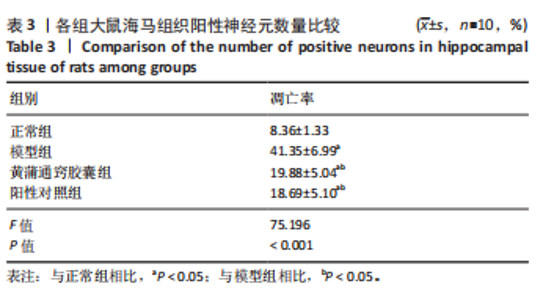
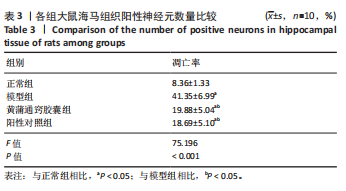
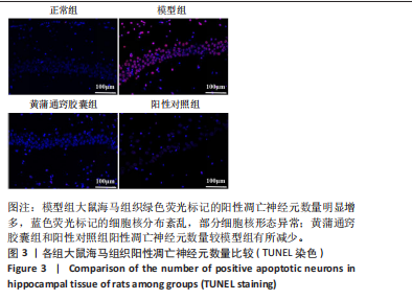
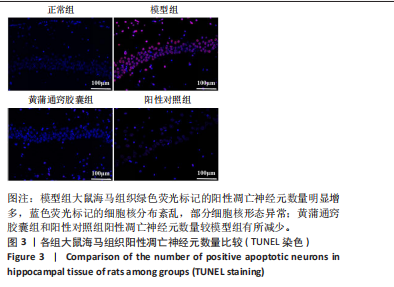
2.5 各组大鼠海马组织阳性凋亡神经元数量比较 正常组大鼠海马组织绿色荧光标记的阳性凋亡神经元数量极少,蓝色荧光标记的细胞核分布均匀,形态规则,数量正常,细胞状态良好;模型组大鼠海马组织绿色荧光标记的阳性凋亡神经元数量明显增多,神经元大量凋亡,组织受损,蓝色荧光标记的细胞核分布紊乱,部分细胞核形态异常;黄蒲通窍胶囊组和阳性对照组阳性凋亡神经元数量较模型组有所减少,神经元凋亡程度减轻,且细胞核分布相对均匀,形态异常情况减少,细胞核结构损伤得到缓解。见表3,图3。"
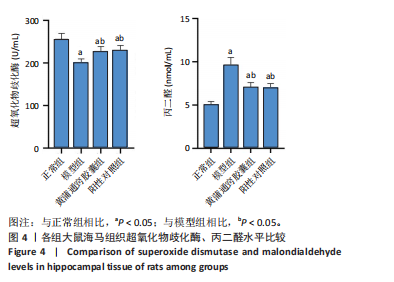
2.6 各组大鼠海马组织超氧化物歧化酶、丙二醛水平比较 与正常组相比,模型组大鼠海马组织超氧化物歧化酶水平降低、丙"
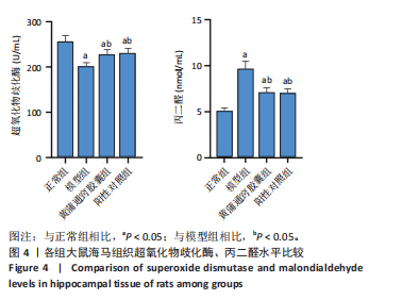
二醛浓度升高(P < 0.05);与模型组相比,黄蒲通窍胶囊组、阳性对照组大鼠超氧化物歧化酶水平升高、丙二醛浓度降低(P < 0.05)。见图4。"
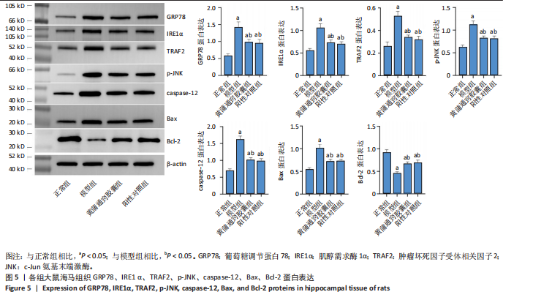
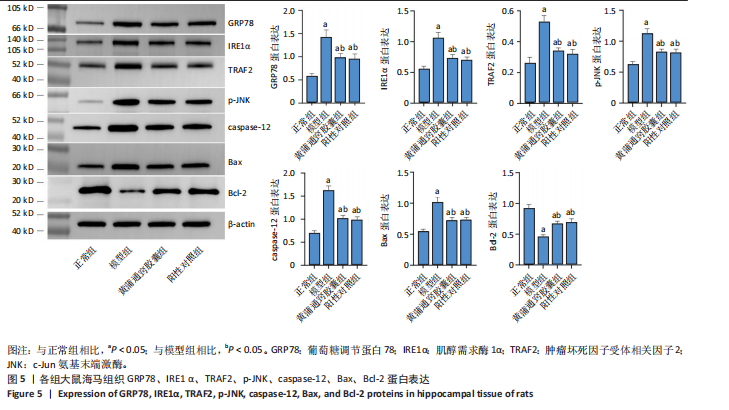
2.7 各组大鼠海马组织内质网应激相关GRP78/IRE1 α/TRAF2/JNK信号通路蛋白表达比较 与正常组相比,模型组大鼠GRP78、IRE1 α、TRAF2、p-JNK、caspase-12、Bax蛋白表达增加,Bcl-2蛋白表达下降(P < 0.05);与模型组相比,黄蒲通窍胶囊组、阳性对照组大鼠GRP78、IRE1 α、TRAF2、p-JNK、caspase-12、Bax蛋白表达下降,Bcl-2蛋白表达增加(P < 0.05),见图5。"
| [1] LUCENA-VALERA A, RUZ-ZAFRA P, AMPUERO J. Wilson’s disease: overview. Med Clin (Barc). 2023;160(6):261-267. [2] GROMADZKA G, BENDYKOWSKA M, PRZYBYŁKOWSKI A. Wilson’s Disease-Genetic Puzzles with Diagnostic Implications. Diagnostics (Basel). 2023;13(7):1287. [3] GROMADZKA G, ANTOS A, SORYSZ Z, et al. Psychiatric Symptoms in Wilson’s Disease-Consequence of ATP7B Gene Mutations or Just Coincidence?-Possible Causal Cascades and Molecular Pathways. Int J Mol Sci. 2024;25(22):12354. [4] NEHRING P, SZELIGOWSKA J, PRZYBYŁKOWSKI A. Elastography of the Liver in Wilson’s Disease. Diagnostics (Basel). 2023;13(11):1898. [5] KAMIMURA K. Wilson’s disease: practical information for general physicians. Hepatobiliary Surg Nutr. 2023;12(4):598-600. [6] YUAN XZ, YANG RM, WANG XP. Management Perspective of Wilson’s Disease: Early Diagnosis and Individualized Therapy. Curr Neuropharmacol. 2021;19(4): 465-485. [7] ZHOU D, ZI H, YANG X, et al. Dysfunction of ATP7B Splicing Variant Caused by Enhanced Interaction With COMMD1 in Wilson Disease. Cell Mol Gastroenterol Hepatol. 2025;19(2):101418. [8] ALONSO-CASTELLANO P, TUGORES A, MARIÑO Z, et al. Low penetrance of frequent ATP7B mutations explains the low prevalence of Wilson disease. Lessons from real-life registries. Dig Liver Dis. 2025;57(2):443-449. [9] 饶志红,杨文明,杨玉龙,等.肝豆状核变性“肝-肾-脑”轴病机阐释及中医辨治策略[J].北京中医药大学学报,2025,48(9):1270-1277. [10] 王路瑶,吴丽敏,王婷婷,等.肝豆补肾汤通过SIRT3/FOXO3α通路调节褪黑素合成改善Wilson病模型TX小鼠认知障碍[J].四川大学学报(医学版), 2025,56(1):102-111. [11] 韩鑫,张亮亮,董健健,等.青霉胺联合肝豆汤调控Caspase11-GSDMD通路抑制Wilson病模型神经元焦亡[J].中国中西医结合杂志,2024,44(8):974-982. [12] ALKHOURI N, GONZALEZ-PERALTA RP, MEDICI V. Wilson disease: a summary of the updated AASLD Practice Guidance. Hepatol Commun. 2023;7(6):e0150. [13] TESCHKE R, EICKHOFF A. Wilson Disease: Copper-Mediated Cuproptosis, Iron-Related Ferroptosis, and Clinical Highlights, with Comprehensive and Critical Analysis Update. Int J Mol Sci. 2024;25(9):4753. [14] 张笑颜,王谢,王杰,等.黄蒲通窍胶囊改善Wilson病铜负荷大鼠的认知损害:基于抑制内质网应激介导的凋亡途径[J].南方医科大学学报,2024,44(3):447-454. [15] KAWAHARA M, TANAKA KI, KATO-NEGISHI M. Copper as a Collaborative Partner of Zinc-Induced Neurotoxicity in the Pathogenesis of Vascular Dementia. Int J Mol Sci. 2021;22(14):7242. [16] 王刚,杨丽君,杨丹,等.延龄草总皂苷通过调控GRP78/IRE1α/TRAF2/JNK信号通路抑制内质网应激而减轻PSCI大鼠海马神经元损伤[J].中国病理生理杂志,2023,39(2):241-249. [17] KANG K, CHEN SH, WANG DP, et al. Inhibition of Endoplasmic Reticulum Stress Improves Chronic Ischemic Hippocampal Damage Associated with Suppression of IRE1α/TRAF2/ASK1/JNK-Dependent Apoptosis. Inflammation. 2024;47(4): 1479-1490. [18] 蔡标,叶树,王艳,等.黄蒲通窍胶囊对阿尔茨海默病细胞模型细胞凋亡的影响[J].中国中药杂志,2018,43(11):2378-2383. [19] 蔡标,谢道俊,王艳,等.黄蒲通窍胶囊对阿尔茨海默病大鼠海马氧化应激和线粒体凋亡途径的影响[J].中国中西医结合杂志,2018,38(6):707-711. [20] 韩辉,杨文明,张娟,等.肝豆状核变性的中医证候特征[J].中医药临床杂志,2014,26(1):16-19. [21] 王谢,谢道俊,张笑颜,等.基于“气虚髓减,毒损脑络”理论浅谈肝豆状核变性认知障碍核心病机[J].现代中西医结合杂志,2024,33(4):547-551. [22] XU J, JIANG H, LI J, et al. 1H NMR-based metabolomics investigation of copper-laden rat: a model of Wilson’s disease. PLoS One. 2015;10(4):e0119654. [23] WANG N, CHENG M, ZHANG X, et al.Gandou Decoction Decreases Copper Levels and Alleviates Hepatic Injury in Copper-Laden Hepatolenticular Degeneration Model Rats. Front Pharmacol. 2020;11:582390. [24] 杨悦,杨文明,何伟,等.姜黄素调控线粒体凋亡改善Wilson病铜负荷大鼠肝纤维化[J].中国中西医结合杂志,2025,45(6):699-705. [25] SHRIBMAN S, MARJOT T, SHARIF A, et al. Investigation and management of Wilson’s disease: a practical guide from the British Association for the Study of the Liver. Lancet Gastroenterol Hepatol. 2022;7(6):560-575. [26] GROMADZKA G, CZERWIŃSKA J, KRZEMIŃSKA E, et al. Wilson’s Disease-Crossroads of Genetics, Inflammation and Immunity/Autoimmunity: Clinical and Molecular Issues. Int J Mol Sci. 2024;25(16):9034. [27] 王清传,张志敏,于鸿杰,等.糖尿病大鼠血管平滑肌细胞内质网应激因子GRP78和caspase12的表达及阿托伐他汀的干预作用[J].山西医科大学学报, 2018,49(9):1031-1036. [28] 李潇,姚伟洁,杨鑫伟,等.糖络宁对糖尿病周围神经病变大鼠坐骨神经功能及内质网应激IRE1α-XBP-1-CHOP通路的影响[J].湖南中医药大学学报, 2019,39(7):841-847. [29] 张双双,刘佳颖,李俊平.IRE1-JNK在运动致内质网应激-细胞凋亡中的作用机制[J].北京体育大学学报,2019,42(10):139-146. [30] 吴甜甜,柴立民,杨颖溪,等.补肾益肺消癥方干预肺纤维化大鼠JNK凋亡信号通路关键分子的表达调控内质网应激的作用机制[J].现代中西医结合杂志,2016,25(19):2053-2056. [31] 王艳,谢道俊,储丹晨,等.黄蒲通窍胶囊对VaD大鼠海马CA1区突触超微结构的影响[J].广西中医药大学学报,2020,23(2):5-9. [32] DARCET F, MENDEZ-DAVID I, TRITSCHLER L, et al. Learning and memory impairments in a neuroendocrine mouse model of anxiety/depression. Front Behav Neurosci. 2014;8:136. [33] 胡凌,左萍萍,有慧,等.基于体素的形态测量学在阿尔茨海默病和轻度认知障碍中的应用价值[J].放射学实践,2010,25(1):24-28. [34] 耿昊,李海,徐陈陈,等.肝豆汤对Wilson病模型铜负荷大鼠肝脏Wnt/β-catenin信号通路的调控作用[J].中国实验方剂学杂志,2019,25(7):75-81. [35] 汪瀚,花代平,殷馨,等.从LncRNA Meg3调控细胞自噬途径探讨肝豆灵治疗Wilson病肝纤维化的作用机制[J].中华中医药杂志,2025,40(5):2574-2579. [36] 张娟,谢道俊,鲍远程,等.基于^1H-NMR的中西药干预Wilson病铜负荷大鼠肝损伤代谢组学研究[J].北京中医药大学学报,2019,42(12):1016-1023. [37] 张笑颜,王谢,王杰,等.大黄酚调控AMPK/mTOR自噬信号通路改善Wilson病铜负荷大鼠认知功能[J].中国中西医结合杂志,2023,43(5):578-584. [38] GROMADZKA G, KARPIŃSKA A, SZAFRAŃSKI TK, et al. Oxidative Stress and Psychiatric Symptoms in Wilson’s Disease. Int J Mol Sci. 2025;26(14):6774. [39] SONG D, TAKAHASHI G, ZHENG YW, et al. Retinoids rescue ceruloplasmin secretion and alleviate oxidative stress in Wilson’s disease-specific hepatocytes. Hum Mol Genet. 2022;31(21):3652-3671. [40] CHEN K, WU L, LIU Q, et al. Glutathione improves testicular spermatogenesis through inhibiting oxidative stress, mitochondrial damage, and apoptosis induced by copper deposition in mice with Wilson disease. Biomed Pharmacother. 2023;158:114107. [41] 徐陈陈,董健健,程楠,等.肝豆汤改良方对Wilson’s病模型TX乳鼠神经元内Cyt C/Caspase信号通路的分子调控机制[J].中国实验方剂学杂志,2017, 23(6):143-148. [42] 张强,单伟,王刚.鼠尾草酚改善糖尿病小鼠认知功能障碍的机制[J].锦州医科大学学报,2025,46(1):10-15. [43] 李燕,孙益贝,迂超然,等.癫痫睡眠期发作间期脑电图放电指数联合超氧化物歧化酶对认知功能损害的预测价值[J].中国现代医学杂志,2024, 34(18):64-70. [44] HUO Y, MA F, LI T, et al. Exposure to copper activates mitophagy and endoplasmic reticulum stress-mediated apoptosis in chicken (Gallus gallus) cerebrum. Environ Toxicol. 2023;38(2):392-402. [45] LIAO J, HU Z, LI Q, et al. Endoplasmic Reticulum Stress Contributes to Copper-Induced Pyroptosis via Regulating the IRE1α-XBP1 Pathway in Pig Jejunal Epithelial Cells. J Agric Food Chem. 2022;70(4):1293-1303. [46] HU J, CHEN NN, LI LG, et al. Cepharanthine-mediated endoplasmic reticulum stress inhibits Notch1 via binding GRP78 for suppressing hepatocellular carcinoma metastasis. Phytomedicine. 2024;135:156162. [47] XU B, XU J, CAI N, et al. Roflumilast prevents ischemic stroke-induced neuronal damage by restricting GSK3β-mediated oxidative stress and IRE1α/TRAF2/JNK pathway. Free Radic Biol Med. 2021;163:281-296. [48] ZHANG LN, XIA YZ, ZHANG C, et al. Vielanin K enhances doxorubicin-induced apoptosis via activation of IRE1α- TRAF2 - JNK pathway and increases mitochondrial Ca2 + influx in MCF-7 and MCF-7/MDR cells. Phytomedicine. 2020;78:153329. [49] CHAI H, YAO S, GAO Y, et al. Developments in the connection between epithelial‑mesenchymal transition and endoplasmic reticulum stress (Review). Int J Mol Med. 2025;56(1):102. [50] 江爱娟,蔡标,谢道俊,等.黄蒲通窍胶囊对阿尔茨海默病模型大鼠JNK信号通路蛋白及炎性因子表达的影响[J].中华中医药杂志,2019,34(6): 2441-2444. |
| [1] | Ji Lingshan, Qin Hewei, Cheng Shuaifang, Zhao Jing. Mechanism and effect of aescin intervention against brain injury in a rat model of intracerebral hemorrhage [J]. Chinese Journal of Tissue Engineering Research, 2026, 30(36): 9526-9537. |
| [2] | Liu Yunjia, Yue Xiaolei, Wu Liming, Zhou Huanglei, Lan Xiang, Cui Jiayu, Bai Lin, Liao Yanbo, Liang Jing, Li Mingxing, He Guozhen, Yang Sufang. Ban’s Culuan Zhuyun Decoction alleviates oxidative stress injury in vitrified ovarian tissue [J]. Chinese Journal of Tissue Engineering Research, 2026, 30(36): 9580-9588. |
| [3] | Ma Zhiguo, Zhou Zhengxin, Xue Song, Xiang Xinhong, Zhu Lei. Du Huo Ji Sheng Decoction delays cartilage degeneration in mice with knee osteoarthritis [J]. Chinese Journal of Tissue Engineering Research, 2026, 30(36): 9453-9461. |
| [4] | Tian Xuanhe, Tong Siyu, Teng Fei, Zhong Shuai, Zhao Xiaohu, Zhang Yuya, Liu Yuan, Jiang Ping. Potential targets and drug prediction for gout: identification of druggable genes [J]. Chinese Journal of Tissue Engineering Research, 2026, 30(29): 7706-7714. |
| [5] | Yan Yuge, Wang Yanxi, Qi Xiang, Cao Shan, Zou Xiaoyan, Liu Yujuan. Screening biomarkers for premature ovarian insufficiency based on cellular senescence and endoplasmic reticulum stress with experimental validation [J]. Chinese Journal of Tissue Engineering Research, 2026, 30(28): 7447-7455. |
| [6] | He Yanyan, Ge Jirong, Li Shengqiang, Chen Xuan, Huang Jingwen, Huang Xiaobin, Xue Lipeng. Transcriptomic analysis of expression and function of differential genes in traditional Chinese medicine syndromes of postmenopausal osteoporosis [J]. Chinese Journal of Tissue Engineering Research, 2026, 30(25): 6446-6454. |
| [7] | Huang Yushan, Wang Rongrong, Li Xiangmiao, Bai Jinzhu. Prostaglandin E1 pretreatment inhibits ferroptosis in endothelial cells in a rat model of spinal cord ischemia-reperfusion injury [J]. Chinese Journal of Tissue Engineering Research, 2026, 30(22): 5716-5727. |
| [8] | Peng Siwei, Yang Ruifang, Chen Xiaohua, Zheng Zhuoming, Chen Peng, Xiao Yan, Su Youxin, Guo Jiemei. The mechanism by which Zhuanggu Jianxi Decoction inhibits inflammatory response of human synovial macrophages [J]. Chinese Journal of Tissue Engineering Research, 2026, 30(17): 4400-4406. |
| [9] | Wei Jingyi, Wang Xiaojing, Liu Xihua. Application trends of eye-tracking technology in rehabilitation: a visualization analysis based on CiteSpace and VOSviewer [J]. Chinese Journal of Tissue Engineering Research, 2026, 30(16): 4265-4277. |
| [10] |
Zhang Yueting, Li Jinglin, Fu Zhenyi, Yan Fei, Gao Yu, Liu Jiaxin.
Endoplasmic reticulum stress promotes ferroptosis and aggravates cerebral ischemia-reperfusion injury#br#
#br#
[J]. Chinese Journal of Tissue Engineering Research, 2026, 30(11): 2806-2813.
|
| [11] | Tang Zhuolin, Yin Mingyue, Bai Mingyang, Zheng Huakun, Yan Henghao, Xu Kai, Liu Qian. Effects of high-intensity interval training and moderate-intensity continuous training on cognitive function in patients with neurodegenerative diseases: a meta-analysis [J]. Chinese Journal of Tissue Engineering Research, 2026, 30(10): 2594-2607. |
| [12] | Qian Kun, Li Ziqing, Sun Shui . Endoplasmic reticulum stress in the occurrence and development of common degenerative bone diseases [J]. Chinese Journal of Tissue Engineering Research, 2025, 29(6): 1285-1295. |
| [13] | Wang Yuru, Li Siyuan, Xu Ye, Zhang Yumeng, Liu Yang, Hao Huiqin. Effects of wogonin on joint inflammation in collagen-induced arthritis rats via the endoplasmic reticulum stress pathway [J]. Chinese Journal of Tissue Engineering Research, 2025, 29(5): 1026-1035. |
| [14] | Deng Qing, Wang Qingjun, Zhang Yeting. Visual analysis of dynamic evolution of research topics in the field of physical activity and hippocampal tissue [J]. Chinese Journal of Tissue Engineering Research, 2025, 29(32): 6997-7003. |
| [15] | Zhang Shuyang, Du Xinyu, Zhao Donglin, Xing Zheng, Chu Xiaolei, Li Qi. Application of virtual reality technology in functional recovery of peripheral nerve injury [J]. Chinese Journal of Tissue Engineering Research, 2025, 29(21): 4593-4601. |
| Viewed | ||||||
|
Full text |
|
|||||
|
Abstract |
|
|||||