Chinese Journal of Tissue Engineering Research ›› 2026, Vol. 30 ›› Issue (36): 9580-9588.doi: 10.12307/2026.913
Previous Articles Next Articles
Ban’s Culuan Zhuyun Decoction alleviates oxidative stress injury in vitrified ovarian tissue
Liu Yunjia1, Yue Xiaolei1, Wu Liming1, Zhou Huanglei1, Lan Xiang1, Cui Jiayu2, Bai Lin1, Liao Yanbo1, Liang Jing2, Li Mingxing1, He Guozhen1, Yang Sufang2#br#
- 1Basic Medical College, Guangxi University of Chinese Medicine, Nanning 530200, Guangxi Zhuang Autonomous Region, China; 2Guangxi International Zhuang Medicine Hospital Affiliated to Guangxi University of Chinese Medicine, Nanning 530000, Guangxi Zhuang Autonomous Region, China
-
Received:2025-11-06Revised:2026-03-23Online:2026-12-28Published:2026-05-25 -
Contact:He Guozhen, PhD, Professor, Master’s supervisor, Basic Medical College, Guangxi University of Chinese Medicine, Nanning 530200, Guangxi Zhuang Autonomous Region, China Co-corresponding author: Yang Sufang, PhD, Professor, Doctoral supervisor, Guangxi International Zhuang Medicine Hospital Affiliated to Guangxi University of Chinese Medicine, Nanning 530000, Guangxi Zhuang Autonomous Region, China -
About author:Liu Yunjia, MS candidate, Basic Medical College, Guangxi University of Chinese Medicine, Nanning 530200, Guangxi Zhuang Autonomous Region, China Yue Xiaolei, MS, Basic Medical College, Guangxi University of Chinese Medicine, Nanning 530200, Guangxi Zhuang Autonomous Region, China Liu Yunjia and Yue Xiaolei contributed equally to this work. -
Supported by:National Natural Science Foundation of China, No. 81960794 (to HGZ); Introduced Doctoral Research Start-up Fund Project of Guangxi University of Chinese Medicine, No. 2023BS048 (to LJ); Guangxi Natural Science Foundation, No. 2024JJA141299 (to HGZ); Key Project of Natural Science Research of Guangxi University of Chinese Medicine, No. 2024ZD001 (o HGZ); Nanning Liangqing District Science and Technology Plan Project, No. 202408 (to YSF)

CLC Number:
Cite this article
Liu Yunjia, Yue Xiaolei, Wu Liming, Zhou Huanglei, Lan Xiang, Cui Jiayu, Bai Lin, Liao Yanbo, Liang Jing, Li Mingxing, He Guozhen, Yang Sufang. Ban’s Culuan Zhuyun Decoction alleviates oxidative stress injury in vitrified ovarian tissue[J]. Chinese Journal of Tissue Engineering Research, 2026, 30(36): 9580-9588.
share this article
Add to citation manager EndNote|Reference Manager|ProCite|BibTeX|RefWorks
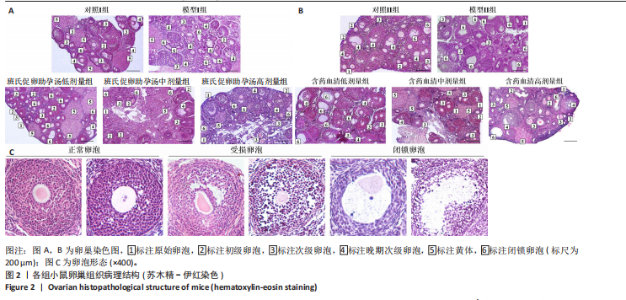
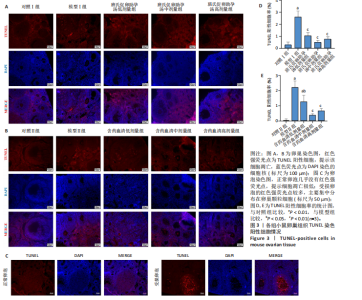
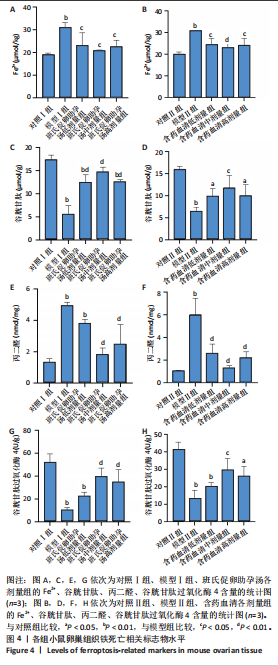
2.1 班氏促卵助孕汤对玻璃化冷冻小鼠卵巢组织形态结构的影响 对照Ⅰ组和对照Ⅱ组卵巢结构完整,存在各级卵泡且卵泡数量多,卵泡结构完整,呈典型的椭圆形,卵母细胞清晰可见,颗粒细胞围绕在卵母细胞周围且排列紧密有序,展现出良好的卵泡形态学特征。模型Ⅰ组和模型Ⅱ组的卵巢颗粒细胞排列紊乱且部分缺失,存在多个受损卵泡和闭锁卵泡,基质细胞及卵泡膜细胞数量减少,表明玻璃化冷冻可导致卵巢细胞的损伤和凋亡。与模型Ⅰ组或模型Ⅱ组相比,班氏促卵助孕汤各剂量组及含药血清各剂量组的闭锁卵泡数量较少,且各级卵泡比例正常。因此,班氏促卵助孕汤及其含药血清可改善玻璃化冷冻小鼠卵巢组织及卵泡的形态结构,见图2。 2.2 班氏促卵助孕汤对玻璃化冷冻小鼠卵巢组织TUNEL阳性细胞率的影响 对照Ⅰ组和对照Ⅱ组卵巢内TUNEL阳性细胞率极低。与对照Ⅰ组或对照Ⅱ组相比,模型Ⅰ组和模型Ⅱ组TUNEL阳性细胞率显著升高(P < 0.01)。与模型Ⅰ组或模型Ⅱ组相比,班氏促卵助孕汤各剂量及含药血清各剂量均能显著降低TUNEL阳性细胞率(P < 0.05)。因此,班氏促卵助孕汤及其含药血清可降低玻璃化冷冻小鼠卵巢组织TUNEL阳性细胞率,抑制卵巢细胞凋亡,见图3。 2.3 班氏促卵助孕汤对玻璃化冷冻小鼠卵巢组织铁死亡水平的影响 与对照Ⅰ组或对照Ⅱ组相比,模型Ⅰ组和模型Ⅱ组亚铁离子、丙二醛含量显著升高,谷胱甘肽、GPX4含量显著降低(P < 0.01)。与模型Ⅰ组相比,班氏促卵助孕汤中、高剂量均能显著降低亚铁离子、丙二醛含量,提高谷胱甘肽、GPX4含量(P < 0.05);班氏促卵助孕汤低剂量能显著降低亚铁离子含量,提高谷胱甘肽含量(P < 0.05),但在丙二醛、GPX4含量上与模型Ⅰ组比较差异无显著性意义(P > 0.05)。与模型Ⅱ组相比,含药血清中剂量均能显著降低亚铁离子、丙二醛含量,提高谷胱甘肽、GPX4含量(P < 0.05);含药血清低、高剂量能显著降低亚铁离子、丙二醛含量(P < 0.05),但在谷胱甘肽、GPX4含量上与模型Ⅱ组比较差异无显著性意义(P > 0.05)。因此,班氏促卵助孕汤及其含药血清可降低玻璃化冷冻小鼠卵巢组织铁死亡水平,中剂量为最佳剂量,见图4。"

"

"
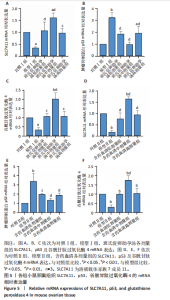
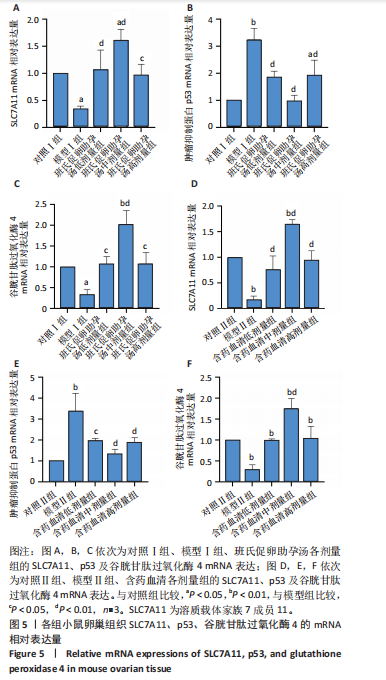
2.4 班氏促卵助孕汤对玻璃化冷冻小鼠卵巢组织p53、Slc7a11、Gpx4 mRNA表达的影响 与对照Ⅰ组或对照Ⅱ组相比,模型Ⅰ组和模型Ⅱ组p53 mRNA表达水平显著升高,Slc7a11、Gpx4 mRNA表达水平显著降低(P < 0.05)。与模型Ⅰ组或模型Ⅱ组相比,班氏促卵助孕汤各剂量及含药血清各剂量均能显著降低p53 mRNA表达水平,升高Slc7a11、Gpx4 mRNA表达水平(P < 0.05)。因此,班氏促卵助孕汤及其含药血清可抑制p53/SLC7A11/GPX4信号通路的异常激活,班氏促卵助孕汤及其含药血清可能通过调控p53/SLC7A11/GPX4信号通路抑制玻璃化冷冻卵巢组织的铁死亡,见图5。"
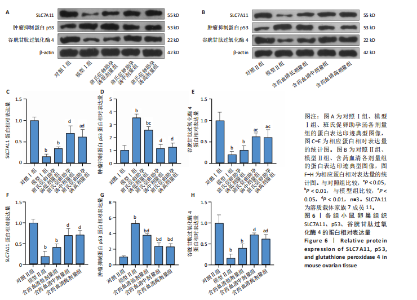
2.5 班氏促卵助孕汤对玻璃化冷冻小鼠卵巢组织p53、SLC7A11、GPX4蛋白表达的影响 与对照Ⅰ组或对照Ⅱ组相比,模型Ⅰ组和模型Ⅱ组p53蛋白表达水平显著升高,SLC7A11、GPX4蛋白表达水平显著降低(P < 0.01)。与模型Ⅰ组或模型Ⅱ组相比,班氏促卵助孕汤中、高剂量及含药血清中、高剂量均能显著降低p53蛋白表达水平,提高SLC7A11、GPX4蛋白表达水平(P < 0.05);班氏促卵助孕汤低剂量及含药血清低剂量能显著降低p53蛋白表达水平(P < 0.05),但在SLC7A11、GPX4蛋白表达水平上与模型Ⅰ组或模型Ⅱ组无显著性差异(P > 0.05)。因此,班氏促卵助孕汤及其含药血清可抑制p53/SLC7A11/GPX4信号通路的异常激活,班氏促卵助孕汤及其含药血清可能通过调控p53/SLC7A11/GPX4信号通路抑制玻璃化冷冻卵巢组织的铁死亡,见图6。"

| [1] BRAY F, LAVERSANNE M, SUNG H, et al. Global cancer statistics 2022:GLOBOCAN estimates of incidence and mortality worldwide for 36cancers in 185 countries. CA Cancer J Clin. 2024;74(3):229-263. [2] AMORIM CA, LEONEL E, AFIFI Y, et al. Cryostorage and retransplantation of ovarian tissue as an infertility treatment. Best Pract Res Clin Endocrinol Metab. 2019;33(1):89-102. [3] 王琳,徐键.卵巢组织玻璃化冷冻及移植技术的影响因素[J].国际生殖健康/计划生育杂志,2025,44(1):47-53. [4] 曾琴.抗冷冻蛋白Ⅲ对家兔卵巢组织冷冻效果的影响[D].成都:成都中医药大学,2016. [5] MA YM, GAO L, TIAN YQ, et al. Advanced biomaterials in cell preservation: hypothermic preservation and cryopreservation. Acta Biomater. 2021;131: 97-116. [6] MATEO-OTERO Y, YESTE M, DAMATO A, et al. Cryopreservation and oxidative stress in porcine oocytes. Res Vet Sci. 2021;135:20-26. [7] SOMFAI T, HARAGUCHI S, DANG-NGUYEN TQ, et al. Vitrification of porcine immature oocytes and zygotes results in different levels of DNA damage which reflects developmental competence to the blastocyst stage. PLoS One. 2023;18(3):e0282959. [8] BEHL S, JOSHI VB, LARSON NB, et al. Vitrification versus slow freezing of human ovarian tissue: a systematic review and meta-analysis of histological outcomes. J Assist Reprod Genet. 2023;40(3):455-464. [9] JIANG X, STOCKWELL BR, CONRAD M. Ferroptosis:mechanisms,biology and role in disease. Nat Rev Mol Cell Biol. 2021;22(4):266-282. [10] CHEN X, KANG R, KROEMER G, et al. Broadening horizons:the role of ferroptosis in cancer. Nat Rev Clin Oncol. 2021;18(5):280-296. [11] LIU Y, GU W. p53 in ferroptosis regulation: the new weapon for the old guardian. Cell Death Differ. 2022;29(5):895-910. [12] 首都医科大学附属北京妇产医院,中国人体健康科技促进会生育力保护与保存专业委员会.卵巢组织冻存移植技术规范团体标准[J].中国全科医学, 2023,26(23):2836-2841. [13] 吴小绸,王慧颖,王婕,等.丹参酮ⅡA对冷冻保存小鼠卵巢的保护机制[J].中国组织工程研究,2025,29(29):6198-6204. [14] WANG D, GENG M, GAN D, et al. Effect of resveratrol on mouse ovarian vitrification and transplantation. Reprod Biol Endocrinol. 2021;19(1):54. [15] 戴铭.班秀文医学文集[M].北京:科学出版社,2012:112-118. [16] 黎明星,岳晓蕾,陈秀榕,等.班氏促卵助孕汤改善多囊卵巢综合征小鼠卵母细胞的质量[J].中国组织工程研究,2025,29(14):2958-2968. [17] CELIK S, OZKAVUKCU S, CELIK-OZENCI C. Recombinant anti-Mullerian hormone treatment attenuates primordial follicle loss after ovarian cryopreservation and transplantation. J Assist Reprod Genet. 2023; 40(5):1117-1134. [18] 徐叔云,卞如濂,陈修.药理实验方法学[M].3版.北京:人民卫生出版社, 2002:1757-1759. [19] HE CJ, WANG J, ZHANG ZZ, et al. Mitochondria synthesize melatonin to ameliorate its function and improve mice oocyte’s quality under in vitro conditions. Int J Mol Sci.2016;17(6):939. [20] NAGAI S, MABUCHI T, HIRATA S, et al. Correlation of Abnormal Mitochondrial Distribution in Mouse Oocytes with Reduced Developmental Competence. Tohoku J Exp Med. 2006;210(2):137-144. [21] 王超,夏国良.女性卵巢功能基础研究与国人生殖健康[J].生命科学,2017, 29(1):1-7. [22] 朱士恩.动物配子与胚胎冷冻保存原理及应用[M].北京:科学出版社,2016: 9-10,113-117. [23] CACCIOTTOLA L, DONNEZ J, DOLMANS MM. Ovarian tissue damage after grafting: systematic review of strategies to improve follicle outcomes. Reprod Biomed Online. 2021;43(3):351-369. [24] WANG L, TANG J, WANG L, et al. Oxidative stress in oocyte aging and female reproduction. J Cell Physiol. 2021;236(12):7966-7983. [25] OUYANG S, LI H, LOU L, et al.Inhibition of STAT3-ferroptosis negative regulatory axis suppresses tumor growth and alleviates chemoresistance in gastric cancer. Redox Biol. 2022;52:102317. [26] GUPTA MK, SANG JU, LEE HT. Effect of vitrification and beta-mercaptoethanol on reactive oxygen species activity and in vitro development of oocytes vitrified before or after in vitro fertilization. Fertil Steril. 2010;93(8):2602-2607. [27] PIVOVAROVA NB, ANDREWS SB. Calcium-dependent mitochondrial function and dysfunction in neurons. FEBS J. 2010;277(18):3622-3636. [28] LARMAN MG, SHEEHAN CB, GARDNER DK. Calcium-free vitrification reduces cryoprotectant-induced zona pellucida hardening and increases fertilization rates in mouse oocytes. Reproduction. 2006;131(1):53-61. [29] 梁琳,陈秀娟.氧化应激标记物与体外受精结局和卵泡液环境的相关性研究[J].生殖医学杂志,2012,21(1):78-82. [30] HOU YJ, ZHU CC, DUAN X, et al. Both diet and gene mutation induced obesity affect oocyte quality in mice. Sci Rep. 2016;6:18858. [31] TRAPPHOFF T, HEILIGENTAG M, SIMON J, et al. Improved cryotolerance and developmental potential of in vitro and in vivo matured mouse oocytes by supplementing with a glutathione donor prior to vitrification. Mol Hum Reprod. 2016;22(12):867-881. [32] VALKO M, RHODES CJ, MONCOL J, et al. Free radicals, metals and antioxidants in oxidative stress-induced cancer. Chemico-Biological Interactions. 2006;160(1): 1-40. [33] YE R, MAO YM, FEI YR, et al. Targeting ferroptosis for the treatment of female reproductive system disorders. J Mol Med (Berl). 2025;103(4):381-402. [34] RONESS H, MEIROW D. FERTILITY PRESERVATION: follicle reserve loss in ovarian tissue transplantation. 2019;158(5):F35-F44. [35] 陈悦.铁死亡相关基因与IgA肾病的相关性研究[D].合肥:安徽医科大学, 2023:70. [36] JIANG L, KON N, LI T, et al. Ferroptosis as a p53-mediated activity during tumour suppression. Nature. 2015;520(7545):57-62. [37] 何涛.绿原酸、木犀草素和黄精多糖对猪精液冷冻保存效果的研究[D].兰州:甘肃农业大学,2021. [38] 紫薇,于博,戴佳格,等.小檗碱对玻璃化冷冻猪卵母细胞脂滴含量及胚胎发育的影响[J].北京农学院学报,2020,35(1):67-74. [39] GAO Z, YAO G, ZHANG H, et al.Resveratrol protects the mitochondria from vitrification injury in mouse 2-cell embryos. Cryobiology. 2020;95:123-129. [40] 秦清明,李治利,王宏辉,等.白藜芦醇对鸭卵巢组织冻融后移植效果的影响[J].中国家禽,2024,46(2):7-15. [41] 应函岐,施丽冰,张松英.移植卵巢组织卵泡损伤机制及保护策略[J].浙江大学学报(医学版),2024,53(3):321-330. [42] CAO B, QIN J, PAN B, et al. Oxidative Stress and Oocyte Cryopreservation: Recent Advances in Mitigation Strategies Involving Antioxidants. Cells. 2022;11(22):3573. [43] ZHU Y, LIU H, ZHENG L, et al. Vitrification of Mammalian Oocytes: Recent Studies on Mitochondrial Dysfunction. Biopreserv Biobank. 2024;22(5):428-440. [44] 姬鹏云.褪黑素改善哺乳动物胚胎玻璃化冷冻保存效果的研究[D].乌鲁木齐:新疆农业大学,2023. [45] SIROTKIN AV. Quercetin action on health and female reproduction in mammals. Crit Rev Food Sci Nutr. 2024;64(33):12670-12684. [46] HOSSEINI PS, ANARKOOLI IJ, ABDANIPOUR A, et al. The effect of coenzyme Q10 on cryotolerance of in vivo-derived mouse embryos. JBRA Assist Reprod. 2024;28(2):276-283. [47] 张凯杰,杨升,朱珍珍,等.甘氨酸对小鼠完整卵巢组织玻璃化冷冻的影响[J].中国畜牧杂志,2024,60(1):249-255. [48] 姚兴凤,陆清芳,许常龙.抗氧化剂在卵巢组织玻璃化冷冻保存中的研究进展[J].中国妇幼保健,2024,39(5):958-961. [49] 李康梅,何国珍,黎明星,等.基于网络药理学和分子对接探讨班氏促卵助孕汤治疗卵巢储备功能低下的研究[J].西部中医药,2022,35(12):65-71. [50] 何国珍,杨美春,谢桂珍,等.班氏促卵助孕汤对雷公藤多苷致大鼠卵巢功能低下模型影响的实验研究[J].新疆中医药,2018,36(2):1-4. [51] 何国珍,岑妍慧,杨美春,等.班氏促卵助孕煎剂含药血清对人体外培养人颗粒细胞增殖的影响[J].医药导报,2013,32(4):424-427. |
| [1] | Lyu Guoqing, Aizimaitijiang·Rouzi, Xiong Daohai. Irisin inhibits ferroptosis in human articular chondrocytes: roles and mechanisms [J]. Chinese Journal of Tissue Engineering Research, 2026, 30(6): 1359-1367. |
| [2] | Zou Rongji, Yu Fangfang, Wang Maolin, Jia Zhuopeng. Triptolide inhibits ferroptosis and improves cerebral ischemia-reperfusion injury in a rat model of cerebral artery occlusion/reperfusion [J]. Chinese Journal of Tissue Engineering Research, 2026, 30(4): 873-881. |
| [3] | Yang Xiao, Bai Yuehui, Zhao Tiantian, Wang Donghao, Zhao Chen, Yuan Shuo. Cartilage degeneration in temporomandibular joint osteoarthritis: mechanisms and regenerative challenges [J]. Chinese Journal of Tissue Engineering Research, 2026, 30(4): 926-935. |
| [4] | Ma Zhiguo, Zhou Zhengxin, Xue Song, Xiang Xinhong, Zhu Lei. Du Huo Ji Sheng Decoction delays cartilage degeneration in mice with knee osteoarthritis [J]. Chinese Journal of Tissue Engineering Research, 2026, 30(36): 9453-9461. |
| [5] | Xu Wenlin, Wu Haixia, Li Jie, Zhang Manhua, Rao Zhihui, Zhu Qingxiong. Mechanism of Huangpu Tongqiao Capsule on cognitive function in a rat model of Wilson’s disease [J]. Chinese Journal of Tissue Engineering Research, 2026, 30(36): 9538-9545. |
| [6] | Su Xu, Zhang Xiaoxi, Yang Yaqing, Fu Zhenyi, Liu Jiaxin. Mechanism by which non-apoptotic regulated cell death induces neuronal injury in ischemic stroke [J]. Chinese Journal of Tissue Engineering Research, 2026, 30(35): 9281-9293. |
| [7] | He Jiaqi, Shen Hengyu, Xu Mingzhang, Yan Xin, Zhang Ruifeng, Yu Ke. Cytidine/uridine monophosphate kinase 2 regulates ferroptosis of human gingival fibroblasts induced by lipopolysaccharide [J]. Chinese Journal of Tissue Engineering Research, 2026, 30(31): 8190-8196. |
| [8] | Tian Xuanhe, Tong Siyu, Teng Fei, Zhong Shuai, Zhao Xiaohu, Zhang Yuya, Liu Yuan, Jiang Ping. Potential targets and drug prediction for gout: identification of druggable genes [J]. Chinese Journal of Tissue Engineering Research, 2026, 30(29): 7706-7714. |
| [9] | He Long, Gao Shuang, Chen Chao, Qin Guozhong, Ran Qingsen, Wang Zhengchun, Yang Yafeng, Ren Hang, Qiu Yunkai, Yang Yang, Li Wei. A new strategy for preventing and treating orthopedic diseases by regulating ferroptosis through signaling pathways [J]. Chinese Journal of Tissue Engineering Research, 2026, 30(29): 7619-7631. |
| [10] | Wang Zheng, Wu Weidong, Zhu Jingsheng. Xanthohumol combined with swimming ameliorates hepatic injury in rats with metabolic associated fatty liver disease [J]. Chinese Journal of Tissue Engineering Research, 2026, 30(28): 7307-7315. |
| [11] |
Zhang Jing, He Liping, Wen Yu, Fu Hang.
Hydrogel loaded with fibroblast exosomes promotes endothelial cell function recovery and diabetic wound healing#br#
#br#
[J]. Chinese Journal of Tissue Engineering Research, 2026, 30(26): 6798-6806.
|
| [12] | Chen Gang, Ge Caijun, Chen Jianpeng, Wang Yuanbin, Wang Qianliang. Mechanism of ferrostatin-1 hydrogel in treatment of lumbar disc herniation [J]. Chinese Journal of Tissue Engineering Research, 2026, 30(26): 6807-6813. |
| [13] | He Yanyan, Ge Jirong, Li Shengqiang, Chen Xuan, Huang Jingwen, Huang Xiaobin, Xue Lipeng. Transcriptomic analysis of expression and function of differential genes in traditional Chinese medicine syndromes of postmenopausal osteoporosis [J]. Chinese Journal of Tissue Engineering Research, 2026, 30(25): 6446-6454. |
| [14] | Chen Xianxian, Xu Chengfeng, Huang Wenyi, Yang Chenfan, Su Tongshan, Li Yu, Yan Yu, Li Chun. Diabetes mellitus and ferroptosis: a visual analysis of related research literature [J]. Chinese Journal of Tissue Engineering Research, 2026, 30(25): 6691-6700. |
| [15] | Xu Dongfang, Zhao Kun, Lu Changzhu, Wang Yuge, Bai Lianjie, Meng Fanmou, Wang Yang, , Yao Hongbo. m6A-related ferroptosis gene expression and its association with immune infiltration in Alzheimer’s disease: machine learning and molecular biology validation [J]. Chinese Journal of Tissue Engineering Research, 2026, 30(24): 6421-6432. |
| Viewed | ||||||
|
Full text |
|
|||||
|
Abstract |
|
|||||