Chinese Journal of Tissue Engineering Research ›› 2026, Vol. 30 ›› Issue (36): 9488-9496.doi: 10.12307/2026.923
Previous Articles Next Articles
Comparative finite element analysis of cervical intervertebral discs in adult humans and macaques
Hao Yunteng1, Shi Jun2, Zhang Shaojie1, 3, Li Zhijun1, 3, Yang Yang1,3, Wang Chaoqun4, Ma Yuan1, Zhao Hailong1, Chen Jie3, Dong Chongyang5, Zhang Zhifeng6, Li Kun1, 3, Wang Xing1, 3
- 1Digital Medicine Center of School of Basic Medical Sciences, 2Department of Physiology of School of Basic Medical Sciences, 3Department of Human Anatomy of School of Basic Medical Sciences, 4Department of Radiology of Affiliated Hospital, 5Department of Basic Theory of Traditional Chinese Medicine of School of Traditional Chinese Medicine, 6Department of Joint Surgery of Second Affiliated Hospital, Inner Mongolia Medical University, Hohhot 010010, Inner Mongolia Autonomous Region, China
-
Received:2025-10-05Revised:2026-03-21Online:2026-12-28Published:2026-05-22 -
Contact:Wang Xing, Associate professor, Master’s and doctoral supervisor, Digital Medicine Center of School of Basic Medical Sciences, and Department of Human Anatomy of School of Basic Medical Sciences, Inner Mongolia Medical University, Hohhot 010010, Inner Mongolia Autonomous Region, China Co-corresponding author: Li Kun, Associate professor, Digital Medicine Center of School of Basic Medical Sciences, and Department of Human Anatomy of School of Basic Medical Sciences, Inner Mongolia Medical University, Hohhot 010010, Inner Mongolia Autonomous Region, China -
About author:Hao Yunteng, MS, Teaching assistant, Digital Medicine Center of School of Basic Medical Sciences, Inner Mongolia Medical University, Hohhot 010010, Inner Mongolia Autonomous Region, China Shi Jun, MD, Associate professor, Department of Physiology of School of Basic Medical Sciences, Inner Mongolia Medical University, Hohhot 010010, Inner Mongolia Autonomous Region, China Hao Yunteng and Shi Jun contributed equally to this article. -
Supported by:General Program of Inner Mongolia Medical University, No. YKD2022MS037 (to SJ); National Natural Science Foundation of China, No. 81860382 (to WX); Natural Science Foundation of Inner Mongolia Autonomous Region, No. 2025MS08060 (to WX); Support Program for Young Scientific and Technological Talents of Higher Education Institutions in Inner Mongolia Autonomous Region, No. NJYT22009 (to WX); Science and Technology Program of Inner Mongolia Autonomous Region, No. 2025YFSH0007 (to WX); Key Scientific Research Project of Inner Mongolia Medical University, No. YKD2021ZD011 (to WX); Medical and Health Science and Technology Plan Project of Health Commission of Inner Mongolia Autonomous Region, No. 202201217 (to WX); Basic Research and Applied Basic Research Project of Hohhot City, No. 2024-Gui-Ji-28 (to WX); "Good Learning" Talent Project of Inner Mongolia Medical University, No. ZY20242104 (to WX); Teaching Innovation Team of Inner Mongolia Medical University, No. NYCXTD202406 (to WX)

CLC Number:
Cite this article
Hao Yunteng, Shi Jun, Zhang Shaojie, Li Zhijun, Yang Yang, Wang Chaoqun, Ma Yuan, Zhao Hailong, Chen Jie, Dong Chongyang, Zhang Zhifeng, Li Kun, Wang Xing. Comparative finite element analysis of cervical intervertebral discs in adult humans and macaques[J]. Chinese Journal of Tissue Engineering Research, 2026, 30(36): 9488-9496.
share this article
Add to citation manager EndNote|Reference Manager|ProCite|BibTeX|RefWorks
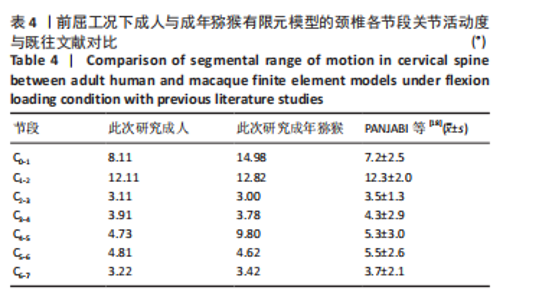
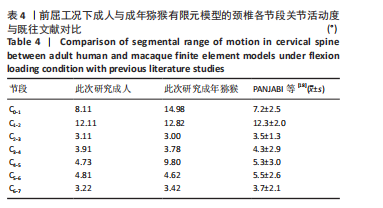
2.1 有限元模型验证 通过比较颈椎模型各节段ROM与既往文献的结果[18-19],验证模型的有效性。若此次研究计算结果处于既往文献报道的各节段ROM区间范围内,则表明模型有效。此次研究采用与既往研究相同的工况条件,即在1.0 N·m的纯力矩下模拟颈椎屈伸、侧弯和旋转运动,计算不同工况下各节段的ROM。 在前屈工况下,成人颈椎各节段活动度均处于文献记载的结果区间内,成年猕猴除C0-1、C4-5节段外也均处于文献记载的结果区间内,见表4。"
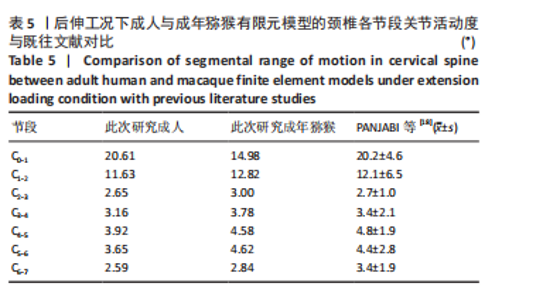
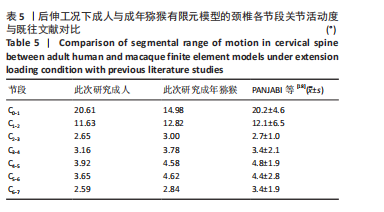
在后伸工况下,成人颈椎各节段活动度均处于文献记载的结果区间内,成年猕猴除C0-1节段外也均处于文献记载的结果区间内,见表5。"
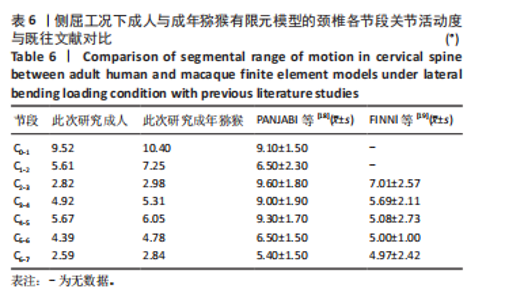
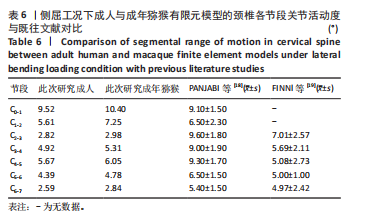
在侧屈工况下,成人与成年猕猴颈椎各节段活动度除C2-3外均处于文献记载的结果区间内,见表6。"
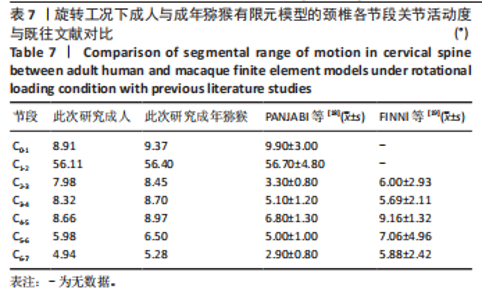
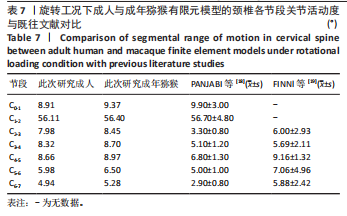
在旋转工况下,成人与成年猕猴颈椎各节段活动度均处于文献记载的结果区间内,见表7。"

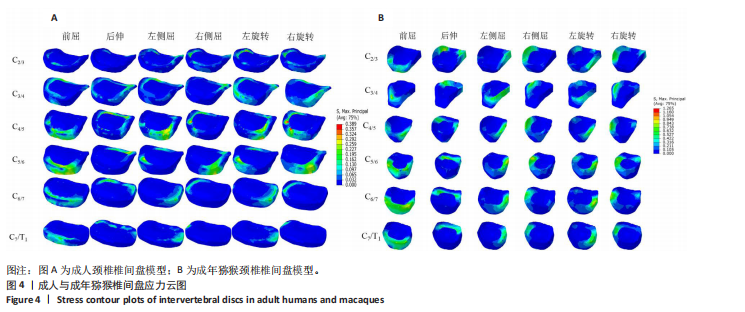
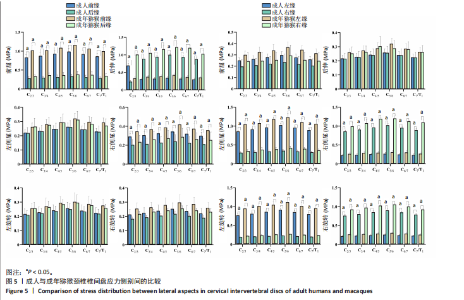
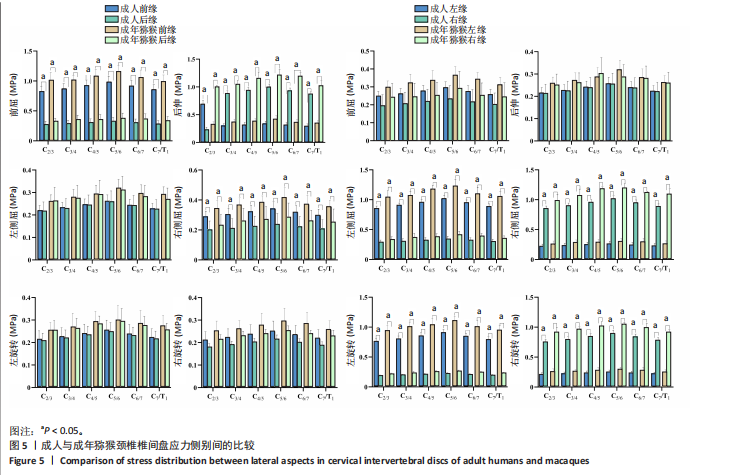
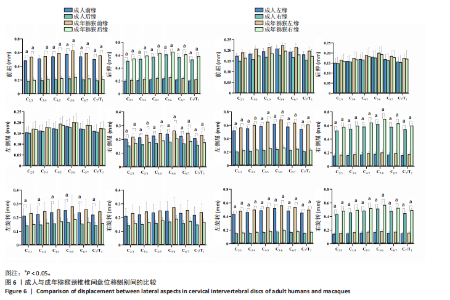
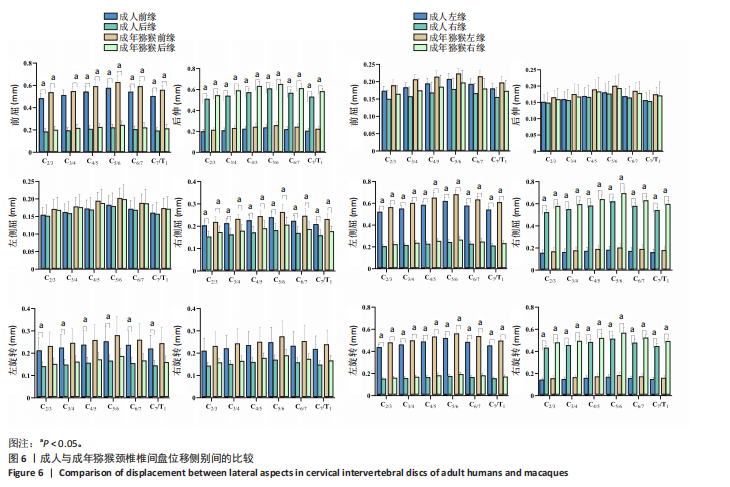
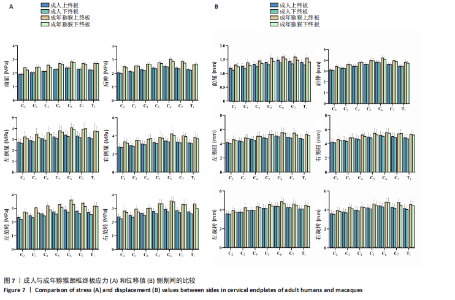
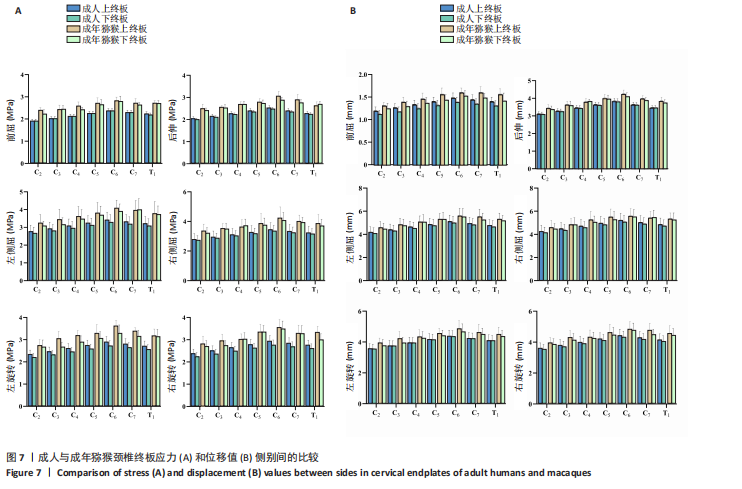
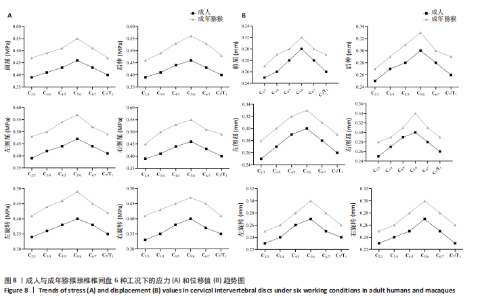
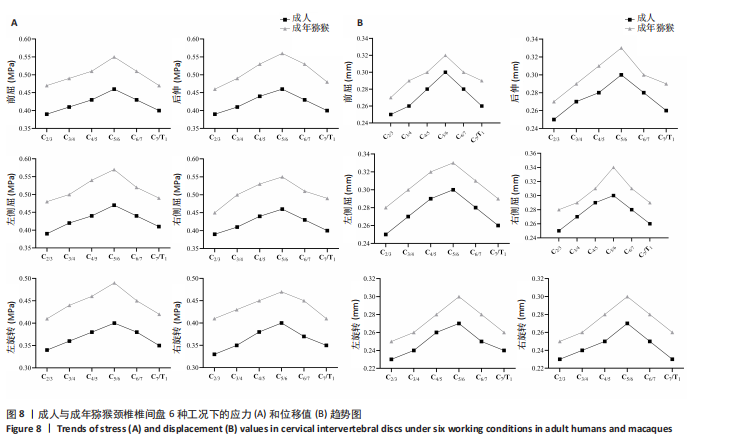
2.2 成人颈椎与成年猕猴终板椎间盘的受力特点 根据成人与成年猕猴颈椎各节段在6种工况下的应力分布云图分析,成年猕猴的平均应力显著高于人类,表明其颈椎承受的力学负荷更大。从节段分布来看,两者均以C???、C???等下颈段为核心应力集中区,且在侧屈及旋转工况下存在明显应力集中现象。同时,应力集中区域均倾向于位于椎间盘边缘部位,见图4。 2.3 成人与成年猕猴颈椎椎间盘受力特点分析 在椎间盘前后缘比较中,成人与成年猕猴的应力值和位移值在前屈、后伸、右侧屈工况下均存在显著性差异(P < 0.05);成人位移值在左旋转工况下也存在显著性差异(P < 0.05)。在椎间盘左右缘比较中,成人与成年猕猴的应力值和位移值在侧屈、旋转等4种工况下均存在显著性差异(P < 0.05),而在其余工况下均无显著性差异(P > 0.05),见图5,6。 2.4 成人与成年猕猴颈椎终板受力特点分析 在上下终板侧别间比较中,成人与成年猕猴颈椎上下终板的应力值和位移值在屈伸、侧屈、旋转等6种工况下均无显著性差异(P > 0.05),见图7。 2.5 成人与成年猕猴颈椎椎间盘受力的变化趋势 成人与成年猕猴颈椎椎间盘应力值、位移值在屈伸、侧屈、旋转等6种工况下均随椎序递增而增大,变化趋势相似,整体呈“尖峰状”,峰值均位于C5-6;成人与成年猕猴椎间盘各缘组间均无显著性差异(P > 0.05),见图8。"
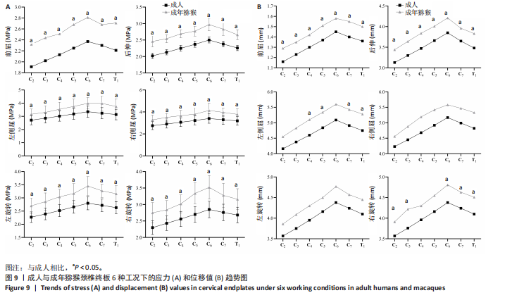
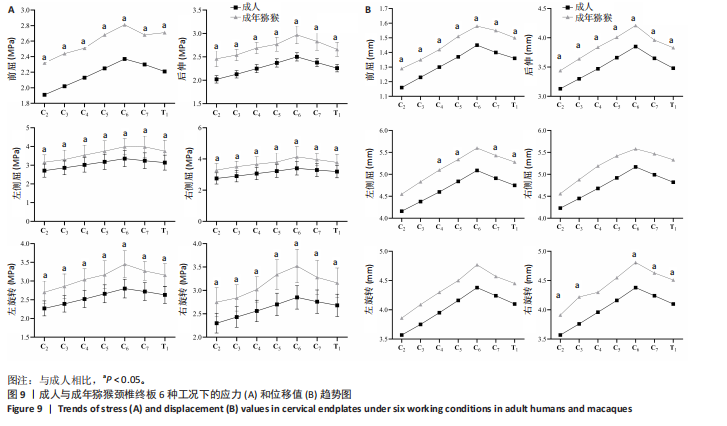
2.6 成人与成年猕猴颈椎终板受力的变化趋势 成人与成年猕猴颈椎终板的应力值和位移值在屈伸、侧屈、旋转等6种工况下均随椎序递增而增大,变化趋势相似,整体呈“尖峰状”,峰值均位于C6。 成人与成年猕猴终板应力值在屈伸、侧屈、旋转等6种工况下的组间比较均存在显著性差异(P < 0.05)。成人与成年猕猴终板位移值在前屈、后伸工况下组间存在显著性差异(P < 0.05),在左侧屈工况下C4、C5、C7和T1处具有显著性差异(P < 0.05),在右旋转工况下C2、C3、C6、C7和T1处具有显著性差异(P < 0.05),其余各工况下均无显著性差异(P > 0.05),见图9。"
"
"
"
"
| [1] LINDENMANN S, TSAGKARIS C, FARSHAD M, et al. Kinematics of the Cervical Spine Under Healthy and Degenerative Conditions: A Systematic Review. Ann Biomed Eng. 2022;50(12):1705-1733. [2] BRIKA M, MOUREY F, KUBICKI A. Sensory profiles in older adults with orthopedic conditions during quiet stance: a cross-sectional study. Eur Rev Aging Phys Act. 2025;22(1):3. [3] GBD 2021 Neck Pain Collaborators. Global, regional, and national burden of neck pain, 1990-2020, and projections to 2050: a systematic analysis of the Global Burden of Disease Study 2021. Lancet Rheumatol. 2024;6(3):e142-e155. [4] LIEBSCHNER MAK, KIM D, KLONIS N, et al. High-Fidelity Finite Element Modeling Technique to Improve Sensitivity to Bone Tissue Changes of Older Adults with Obesity undergoing Intensive Lifestyle Intervention. Ann Biomed Eng. 2025; 53(9):2359-2371. [5] LIANG L, LIU M, ELEFTERIADES J, et al. Synergistic Integration of Deep Neural Networks and Finite Element Method with Applications of Nonlinear Large Deformation Biomechanics. Comput Methods Appl Mech Eng. 2023;416:116347. [6] STOTT B, DRISCOLL M. Biomechanical evaluation of the thoracolumbar spine comparing healthy and irregular thoracic and lumbar curvatures. Comput Biol Med. 2023;160:106982. [7] CACHOT U, KANDIL K, ZAÏRI F, et al. A multiscale finite element model of fluid-microstructure interactions in human intervertebral disc compression. Acta Biomater. 2025;207:398-413. [8] DUITS A, SALVATORI D, SCHOUTEN J, et al. Preclinical model for lumbar interbody fusion in small ruminants: Rationale and guideline. J Orthop Translat. 2022;38: 167-174. [9] LING Z, LI L, CHEN Y, et al. Changes of the end plate cartilage are associated with intervertebral disc degeneration: A quantitative magnetic resonance imaging study in rhesus monkeys and humans. J Orthop Translat. 2020;24:23-31. [10] ZENG X, WEI QS, YE JC, et al. A biocompatible gelatin sponge scaffold confers robust tissue remodeling after spinal cord injury in a non-human primate model. Biomaterials. 2023;299:122161. [11] POULEN G, PERRIN FE. Advances in spinal cord injury: insights from non-human primates. Neural Regen Res. 2024;19(11):2354-2364. [12] 黄吉军, 张恒柱, 王永祥, 等.正常颈椎有限元模型建立及有效性验证[J]. 中国医学物理学杂志,2023,40(4):487-495. [13] YANG H, ZHANG F, XU H, et al. Anatomical Brushite-Coated Mg-Nd-Zn-Zr Alloy Cage Promotes Cervical Fusion: One-Year Results in Goats. ACS Biomater Sci Eng. 2024;10(3):1753-1764. [14] 陈群响, 倪斌, 郭群峰, 等. 带肌肉组织全颈椎三维有限元模型的建立及分析[J]. 中国脊柱脊髓杂志,2019,29(4):348-355. [15] WHEELDON JA, STEMPER BD, YOGANANDAN N, et al. Validation of a finite element model of the young normal lower cervical spine. Ann Biomed Eng. 2008; 36(9):1458-1469. [16] HERRON MR, PARK J, DAILEY AT, et al. Febio finite element models of the human cervical spine. J Biomech. 2020;113:110077. [17] HA SK. Finite element modeling of multi-level cervical spinal segment(C3-C6) and biomechanical analysis of an elastomer-type prosthetic disc. Med Eng Phys. 2006; 28(6):534-541. [18] PANJABI MM, CRISCO JJ, VASAVADA A, et al. Mechanical properties of the human cervical spine as shown by three-dimensional load-displacement curves. Spine (Phila Pa 1976). 2001;26(24):2692-2700. [19] FINN MA, BRODKE DS, DAUBS M, et al. Local and global subaxial cervical spine biomechanics after single-level fusion or cervical arthroplasty. Eur Spine J. 2009; 18(10):1520-1527. [20] WHEELDON JA, STEMPER BD, YOGANANDAN N, et al. Validation of a finite element model of the young normal lower cervical spine. Ann Biomed Eng. 2008; 36(9):1458-1469. [21] HERRON MR, PARK J, DAILEY AT, et al. Febio finite element models of the human cervical spine. J Biomech. 2020;113:110077. [22] JANNESAR S, SALEGIO EA, BEATTIE MS, et al. Correlating Tissue Mechanics and Spinal Cord Injury: Patient-Specific Finite Element Models of Unilateral Cervical Contusion Spinal Cord Injury in Non-Human Primates. J Neurotrauma. 2021; 38(6):698-717. [23] LIU J, YANG Z, WU X, et al. Comparison of the anatomical morphology of cervical vertebrae between humans and macaques: related to a spinal cord injury model. Exp Anim. 2021;70(1):108-118. [24] RICHMOND FJ, SINGH K, CORNEIL BD. Neck muscles in the rhesus monkey. I. Muscle morphometry and histochemistry. J Neurophysiol. 2001;86(4):1717-1728. [25] TAO Y, GALBUSERA F, NIEMEYER F, et al. Radiographic cervical spine degenerative findings: a study on a large population from age 18 to 97 years. Eur Spine J. 2021; 30(2):431-443. [26] SUZUKI A, DAUBS MD, HAYASHI T, et al. Patterns of Cervical Disc Degeneration: Analysis of Magnetic Resonance Imaging of Over 1000 Symptomatic Subjects. Global Spine J. 2018;8(3):254-259. [27] LIANG Y, QIAN Y, XIA W, et al. Adjacent segment degeneration after single- and double-level cervical total disc replacement: a cohort with an over 12-year follow-up. Eur Spine J. 2024;33(1):232-242. [28] CHEN C, YUCHI CX, GAO Z, et al. Comparative analysis of the biomechanics of the adjacent segments after minimally invasive cervical surgeries versus anterior cervical discectomy and fusion: A finite element study. J Orthop Translat. 2020; 23:107-112. [29] IORIO JA, JAKOI AM, SINGLA A. Biomechanics of Degenerative Spinal Disorders. Asian Spine J. 2016;10(2):377-384. [30] WANG H, MA Z, WU Z, et al. Biomechanical analysis of spinal range of motion and intervertebral disc loadings in normal and adolescent idiopathic scoliosis models. Front Bioeng Biotechnol. 2025;13:1473776. [31] TSUJI T, FUJIWARA H, NISHIWAKI Y, et al. Modic changes in the cervical spine: Prospective 20-year follow-up study in asymptomatic subjects. J Orthop Sci. 2019; 24(4):612-617. [32] LIU J, CHEN B, HAO L, et al. Disc degeneration is easily occurred at the same and adjacent cephalad level in cervical spine when Modic changes are present. J Orthop Surg Res. 2023;18(1):548. [33] VAN DIEËN JH, KINGMA I, MEIJER R, et al. Stress distribution changes in bovine vertebrae just below the endplate after sustained loading. Clin Biomech (Bristol). 2001;16 Suppl 1:S135-S142. [34] 黄力鹏, 陈淑超, 胡文超, 等. 终板及终板下骨质在MRI上的信号改变与颈椎关节突关节退变的关系[J]. 临床骨科杂志,2021,24(6):765-768. [35] 王星, 李琨, 马渊, 等. 人与成年猕猴全颈椎有限元模型建立及有效性验证的对比[J].中国组织工程研究,2023,27(13):2022-2027. [36] 王星, 徐雪彬, 张少杰, 等. 成年猕猴C0-T1全颈椎有限元模型的建立及有效性验证[J]. 中国组织工程研究,2021,25(35):5632-5637. |
| [1] | Liu Wenlong, Dong Lei, Xiao Zhengzheng, Nie Yu. Finite element analysis of tibial prosthesis loosening after fixed-bearing unicompartmental knee arthroplasty for osteoporosis [J]. Chinese Journal of Tissue Engineering Research, 2026, 30(9): 2191-2198. |
| [2] | Zheng Wangyang, Fei Ji, Yang Di, Zhao Lang, Wang Lingli, Liu Peng, Li Haiyang. Finite element analysis of the force changes of the supraspinatus tendon and glenohumeral joint during the abduction and flexion of the humerus [J]. Chinese Journal of Tissue Engineering Research, 2026, 30(9): 2199-2207. |
| [3] | Cai Qirui, Dai Xiaowei, Zheng Xiaobin, Jian Sili, Lu Shaoping, Liu Texi, Liu Guoke, Lin Yuanfang. Mechanical effects of Long’s traction orthopedic method on cervical functional units: quantitative analysis of biomechanical model of head and neck [J]. Chinese Journal of Tissue Engineering Research, 2026, 30(9): 2208-2216. |
| [4] | Rao Jingcheng, Li Yuwan, Zheng Hongbing, Xu Zhi, Zhu Aixiang, Shi Ce, Wang Bing, Yang Chun, Kong Xiangru, Zhu Dawei. Biomechanical differences between the new proximal femoral stable intramedullary nail and traditional intramedullary nail#br# [J]. Chinese Journal of Tissue Engineering Research, 2026, 30(9): 2217-2225. |
| [5] | Chen Long, Wang Xiaozhen, Xi Jintao, Lu Qilin. Biomechanical performance of short-segment screw fixation combined with expandable polyetheretherketone vertebral body replacement in osteoporotic vertebrae [J]. Chinese Journal of Tissue Engineering Research, 2026, 30(9): 2226-2235. |
| [6] | Zhu Xiaolong, Zhang Wei, Yang Yang. Visualization analysis of research hotspots and cutting-edge information in the field of intervertebral disc regeneration and repair [J]. Chinese Journal of Tissue Engineering Research, 2026, 30(9): 2391-2402. |
| [7] | Chen Huiting, Zeng Weiquan, Zhou Jianhong, Wang Jie, Zhuang Congying, Chen Peiyou, Liang Zeqian, Deng Weiming. Tail anchoring technique of vertebroplasty in treatment of osteoporotic vertebral compression fractures with intravertebral cleft: a finite element analysis [J]. Chinese Journal of Tissue Engineering Research, 2026, 30(9): 2145-2152. |
| [8] | Cheng Qisheng, Julaiti·Maitirouzi, Xiao Yang, Zhang Chenwei, Paerhati·Rexiti. Finite element analysis of novel variable-diameter screws in modified cortical bone trajectory of lumbar vertebrae [J]. Chinese Journal of Tissue Engineering Research, 2026, 30(9): 2162-2171. |
| [9] | Liu Jiafu, Ren Ruxia, Liao Zhouwei, Zhou Xiali, Wu Yihong, Zhang Shaoqun. Three-dimensional finite element analysis of cervical spine biomechanical characteristics in a rat model of cervical vertigo [J]. Chinese Journal of Tissue Engineering Research, 2026, 30(9): 2182-2190. |
| [10] | Zhang Zizheng, Luo Wang, Liu Changlu. Application value of finite element analysis on unicompartmental knee arthroplasty for medial knee compartmental osteoarthritis [J]. Chinese Journal of Tissue Engineering Research, 2026, 30(9): 2313-2322. |
| [11] | Zheng Xuying, Hu Hongcheng, Xu Libing, Han Jianmin, Di Ping. Stress magnitude and distribution in two-piece cement-retained zirconia implants under different loading conditions and with varying internal connection shapes [J]. Chinese Journal of Tissue Engineering Research, 2026, 30(8): 1979-1987. |
| [12] | Cai Ziming, Yu Qinghe, Ma Pengfei, Zhang Xin, Zhou Longqian, Zhang Chongyang, Lin Wenping. Heme oxygenase-1 alleviates lipopolysaccharide-induced inflammatory response in nucleus pulposus mesenchymal stem cells [J]. Chinese Journal of Tissue Engineering Research, 2026, 30(7): 1624-1631. |
| [13] | Xia Linfeng, Wang Lu, Long Qianfa, Tang Rongwu, Luo Haodong, Tang Yi, Zhong Jun, Liu Yang. Human umbilical cord mesenchymal stem cell-derived exosomes alleviate blood-brain barrier damage in mice with septic encephalopathy [J]. Chinese Journal of Tissue Engineering Research, 2026, 30(7): 1711-1719. |
| [14] | Fan Yongjing, Jin Wulong, Bai Haoyu, Ma Ping, Wang Shu. Role and mechanism of stem cells from human exfoliated deciduous teeth in tissue regeneration and disease treatment [J]. Chinese Journal of Tissue Engineering Research, 2026, 30(7): 1850-1857. |
| [15] | Liu Xingyu, Li Lijie. Secretome of stem cells from human exfoliated deciduous teeth: a new hotspot in tissue engineering and stem cell therapy [J]. Chinese Journal of Tissue Engineering Research, 2026, 30(7): 1858-1868. |
| Viewed | ||||||
|
Full text |
|
|||||
|
Abstract |
|
|||||