Chinese Journal of Tissue Engineering Research ›› 2026, Vol. 30 ›› Issue (33): 8607-8617.doi: 10.12307/2026.394
Previous Articles Next Articles
Regulatory role of mediating plasma protein alpha-2-HS glycoprotein in celiac disease and its predictive efficacy analysis for osteoporosis
Duan Yudong, Zhao Piqian, Guo Qianping, Xie Jile
- Department of Orthopedics, First Affiliated Hospital of Soochow University; Institute of Orthopedics, Soochow University, Suzhou 215006, Jiangsu Province, China
-
Received:2025-06-06Revised:2025-10-20Online:2026-11-28Published:2026-06-09 -
Contact:Xie Jile, MD, Attending physician, Department of Orthopedics, First Affiliated Hospital of Soochow University; Institute of Orthopedics, Soochow University, Suzhou 215006, Jiangsu Province, China -
About author:Duan Yudong, Master candidate, Department of Orthopedics, First Affiliated Hospital of Soochow University; Institute of Orthopedics, Soochow University, Suzhou 215006, Jiangsu Province, China Zhao Piqian, MS, Department of Orthopedics, First Affiliated Hospital of Soochow University; Institute of Orthopedics, Soochow University, Suzhou 215006, Jiangsu Province, China -
Supported by:Suzhou Gusu Medical Talent Program, No. GSWS2023087 (to XJL).

CLC Number:
Cite this article
Duan Yudong, Zhao Piqian, Guo Qianping, Xie Jile. Regulatory role of mediating plasma protein alpha-2-HS glycoprotein in celiac disease and its predictive efficacy analysis for osteoporosis[J]. Chinese Journal of Tissue Engineering Research, 2026, 30(33): 8607-8617.
share this article
Add to citation manager EndNote|Reference Manager|ProCite|BibTeX|RefWorks
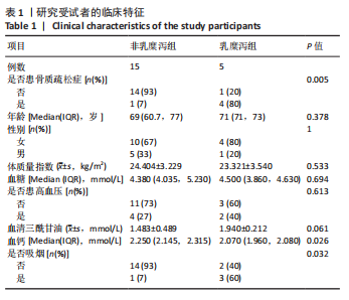
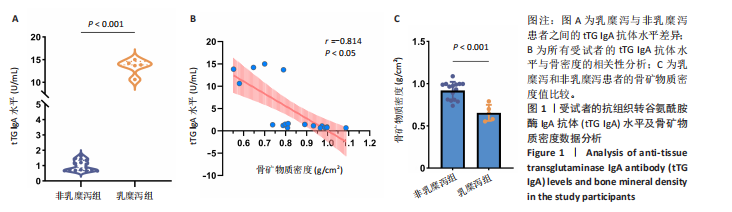
2.1 乳糜泻患者与非乳糜泻患者的基线特征及比较分析 在排除不符合纳入标准的参与者之后,纳入了20例受试者进行分析,临床数据见表1。研究对象中,男性占30%(n=6),女性占70%(n=14)。其中,5例患者被诊断为乳糜泻,而其余15例患者不能诊断为乳糜泻,所有受试者抗组织转谷氨酰胺酶IgA抗体浓度的具体分布情况参见图1A。"
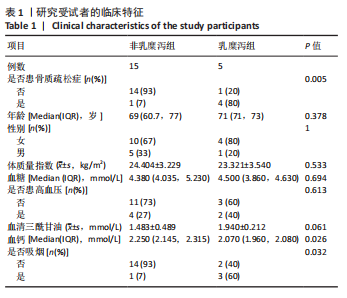
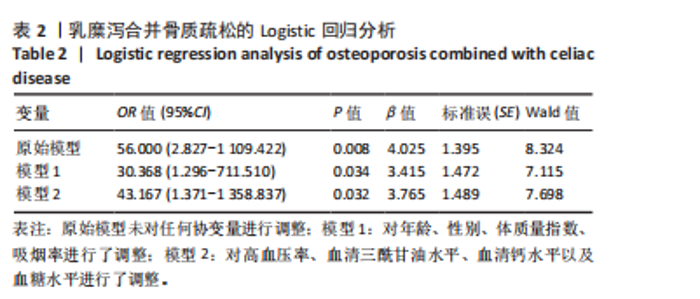
在所有受试者中,乳糜泻组和非乳糜泻组之间的骨质疏松症患者占比存在显著差异(P=0.005)。然而,两组在年龄、体质量指数以及性别分布方面未观察到显著差异。在血清代谢物方面,两组在血糖水平、高血压患病率或三酰甘油水平方面未见显著差异。然而,乳糜泻组的血清钙水平显著低于非乳糜泻组(P=0.026)。这一发现也与既往研究中的报告一致,即乳糜泻会引起钙吸收不良和骨代谢紊乱,导致血清钙水平下降,并可能产生更高的骨折风险。在生活方式方面,乳糜泻组的吸烟率显著高于非乳糜泻组(P=0.032)。吸烟是已知的骨质疏松症的危险因素之一,可能通过多种途径影响骨骼健康,如影响骨骼的血流供应、干扰钙的吸收等。总体而言,与非乳糜泻患者相比,乳糜泻患者的骨矿物质密度和血清钙水平降低,但吸烟者比率升高,而其他相关因素未表现出显著差异。 2.2 骨质疏松风险的Logistic回归分析 为了进一步探讨乳糜泻与骨质疏松风险之间的关系,研究采用Logistic回归分析,并构建了3个回归模型,这些模型包含了不同的协变量,结果显示,在未对变量进行调整的情况下,乳糜泻患者患骨质疏松症的风险是非乳糜泻患者的56倍(95%CI:2.827-1 109.422,P=0.008),见表2。这一结果表明,乳糜泻患者在骨质疏松症发生上表现出显著的高风险。然而,在调整了年龄、性别、体质量指数和吸烟率等因素后,OR值降至30.368(95%CI:1.296-711.510,P=0.034),但乳糜泻组依然表现出明显较高的骨质疏松症发生风险。这些调整后的结果进一步验证了乳糜泻与骨质疏松症之间的强相关性。"
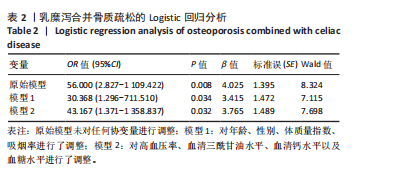
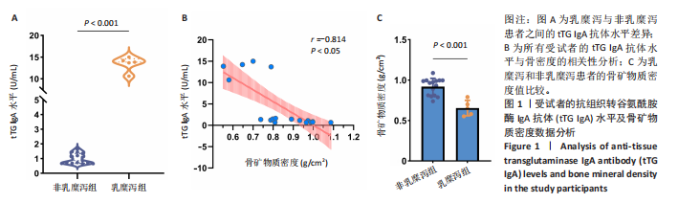
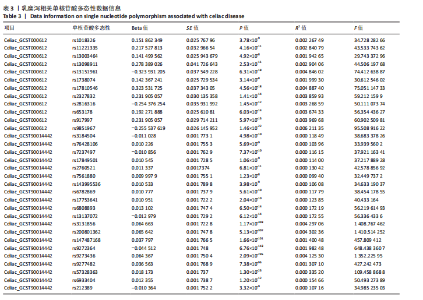
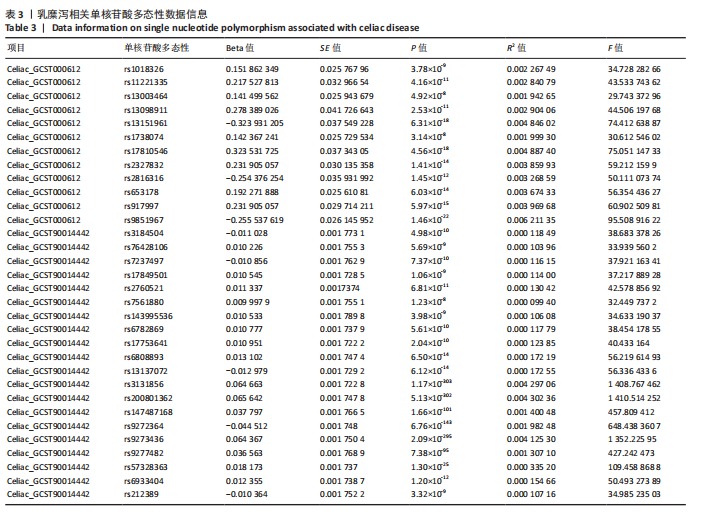
在调整了高血压率、血清三酰甘油水平、血清钙水平以及血糖水平等代谢相关因素后,乳糜泻患者与非乳糜泻患者之间的骨质疏松症概率差异仍然显著,乳糜泻患者患骨质疏松症的风险为非乳糜泻患者的43倍(95%CI:1.371-1 358.837,P=0.032)。这些数据不仅为乳糜泻与骨质疏松症之间的关系提供了有力的证据,进一步强调了乳糜泻患者在骨代谢方面的潜在风险。特别是乳糜泻患者由于长期受到肠道吸收障碍的影响,可能导致骨代谢紊乱,进一步加剧了骨质疏松症的发生风险。 为了深入了解抗组织转谷氨酰胺酶IgA抗体水平与骨矿物质密度之间的关系,研究进行了Spearman相关分析,结果显示,抗组织转谷氨酰胺酶IgA抗体水平与骨矿物质密度呈显著负相关(r=-0.814,P < 0.05),见图1B。这一发现提示,抗组织转谷氨酰胺酶IgA抗体浓度可能是乳糜泻患者骨质疏松症的一个重要生物标志物。随着抗组织转谷氨酰胺酶IgA抗体水平升高,患者骨密度降低,进一步支持了乳糜泻患者骨质疏松症风险增高的结论。为了进一步验证这一结果,还使用了Mann-Whitney U检验对乳糜泻患者和非乳糜泻患者的骨矿物质密度进行了比较,结果显示,乳糜泻患者的骨矿物质密度显著低于非乳糜泻患者,见图1C。上述研究结果表明,乳糜泻患者的骨质疏松症风险显著高于非乳糜泻患者,并且这一风险与抗组织转谷氨酰胺酶IgA抗体水平密切相关。此外,调整了多个潜在混杂因素后,乳糜泻依然是骨质疏松症的重要危险因素。 2.3 通过孟德尔随机化分析建立因果关系 基于横断面数据表明乳糜泻与骨质疏松风险之间存在正相关关系,为进一步探索两者之间的因果关系,研究进行了孟德尔随机化分析。在既定的选择标准基础上,研究从主要分析数据集(GCST90014442)中筛选出了20个与乳糜泻相关的单核苷酸多态性,并使用来自次要数据集(GCST000612)的12个乳糜泻相关单核苷酸多态性对结果进行了验证,见表3。通过采用双样本孟德尔随机化方法,文章系统评估了乳糜泻与骨质疏松之间可能的因果关系。 逆方差加权法分析结果表明,乳糜泻与骨质疏松风险之间存在显著的因果关系(OR=2.363,95%CI:1.414-3.948,P < 0.01),见图2A。复制分析中,乳糜泻与骨质疏松风险之间的正相关关系依然得到保持(OR=1.111,95%CI:1.049-1.177,P < 0.01)。此外,采用MR-Egger回归、最大似然法、加权中位数法和cML-MA-BIC对数据进行验证,结果显示所有方法得出的OR值均大于1,进一步支持了乳糜泻与骨质疏松风险之间存在显著的因果关系。 灵敏度分析结果表明,主要分析方法存在显著的异质性,因此研究在逆方差加权计算中应用了随机效应模型。相比之下,在复制分析中则未观察到显著的异质性。MR-Egger截距检验结果未发现水平多效性的证据,这一结果进一步表明乳糜泻对骨质疏松风险的影响并未受到其他潜在因素干扰。此外,来自cML-MA法的分析结果也表明,即便考虑潜在的水平多效性,乳糜泻与骨质疏松风险之间的因果关系依然稳定且显著。"
"
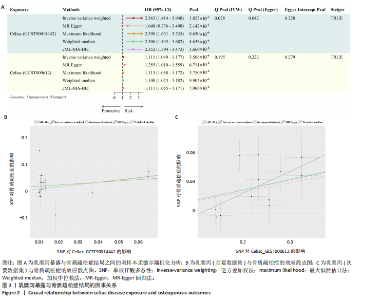
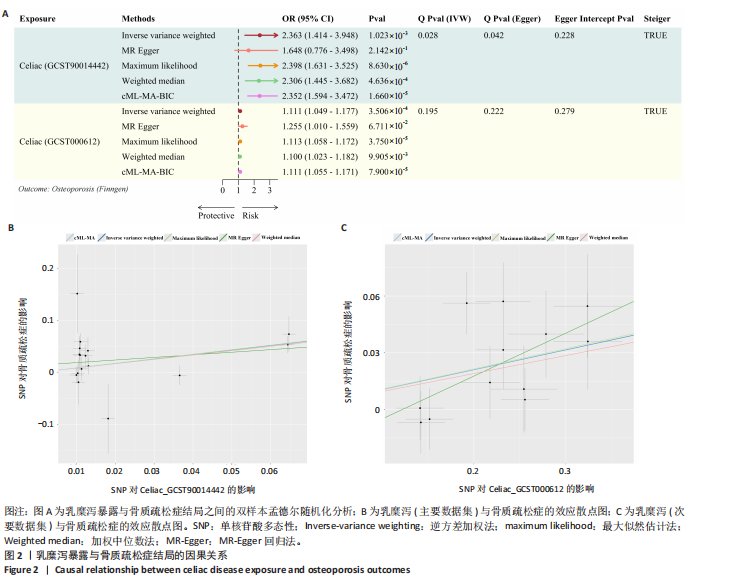
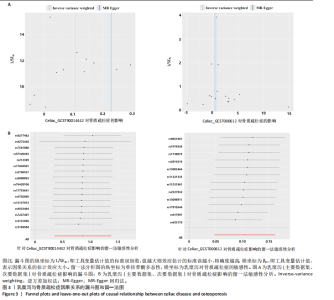
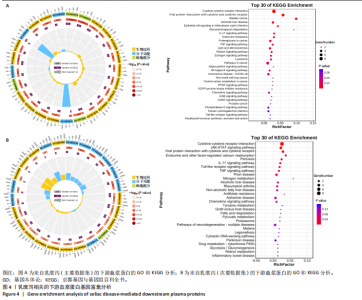
随后,研究进一步对数据结果的敏感性进行分析。散点图数据显示逆方差加权法、MR-Egger法、最大似然法、加权中位数法和cML-MA-BIC 法的分析结果方向一致,见图2B,C。此外,漏斗图中呈现的因果效应分布基本具有对称性,未见明显偏倚,见图3A。留一法进一步支持了这些结果的稳健性,见图3B。这些图形化分析验证了数据的一致性,排除了潜在的偏倚,并增强了研究结论的可靠性,即乳糜泻暴露与骨质疏松风险之间确实存在明显的因果关系。 2.4 乳糜泻暴露的下游血浆蛋白与基因富集分析 许多先前的报道都反映了中介因素在因果关系中的重要性[21-23]。同时,也有研究发现血浆蛋白与骨质疏松、乳糜泻存在不同程度的相互作用和密切关系[24-26]。因此,该研究探索了与乳糜泻相关的下游血浆蛋白是否为介导乳糜泻与骨质疏松关系的媒介,以进一步阐明机制。通过来自主要分析数据集的乳糜泻相关单核苷酸多态性,研究进行了双样本孟德尔随机化分析,并识别出在deCODE数据库中与乳糜泻相关的多种下游血浆蛋白。同时,研究在UKBPPP数据库中检测到了560个相关蛋白,也在次要分析数据集中分别从deCODE和UKBPPP数据库中发现了1 021个和383个乳糜泻相关的下游血浆蛋白。 为了深入探讨这些血浆蛋白的生物学意义,研究从deCODE和UKBPPP数据库中识别出了主要和次级数据集的交集蛋白,并对相关信息进行了系统总结和富集分析。结果表明,这些血浆蛋白主要参与细胞调节、反馈刺激、信号转导等多种生物学过程。此外,它们还影响细胞组件的功能以及蛋白质和RNA等分子的活性,表明这些蛋白可能在多种生理和病理过程中发挥重要作用。KEGG分析显示,这些血浆蛋白涉及的相关通路包括JAK-STAT信号通路、钙重吸收通路和内分泌抵抗,见图4。值得注意的是,JAK-STAT信号通路已知对成骨细胞的功能具有重要影响,并在骨骼发育和代谢过程中发挥着至关重要的作用[27-28]。此外,激素平衡和钙重吸收机制被认为直接影响骨代谢的平衡和稳态[29-30]。因此,这些血浆蛋白可能通过影响上述通路,在乳糜泻与骨质疏松之间建立起复杂的联系。 2.5 AHSG的共定位与表达分析 在确定了乳糜泻相关的下游血浆蛋白之后,进一步研究与骨质疏松相关的上游血浆蛋白。通过从deCODE和UKBPPP数据库中筛选识别出了42个和49个候选蛋白。具体而言,如果某个蛋白在乳糜泻相关的下游蛋白和"
"
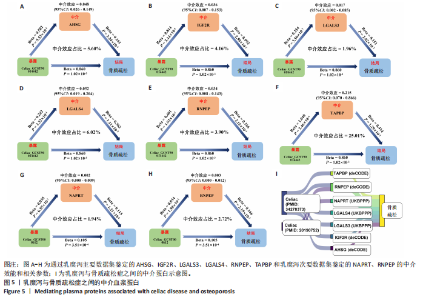
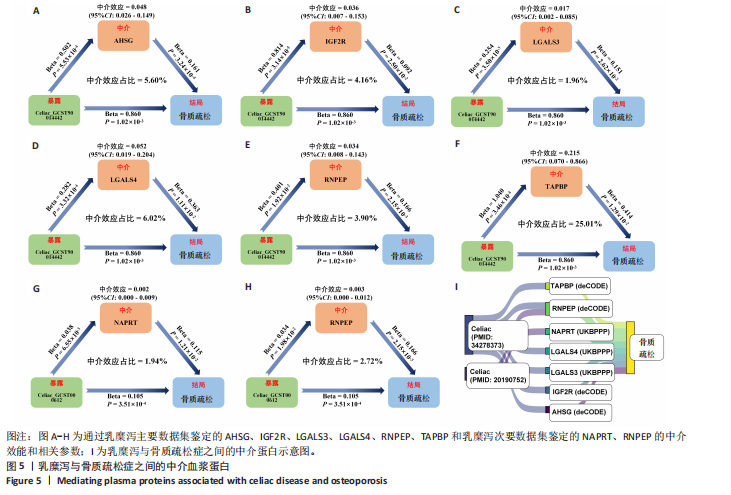
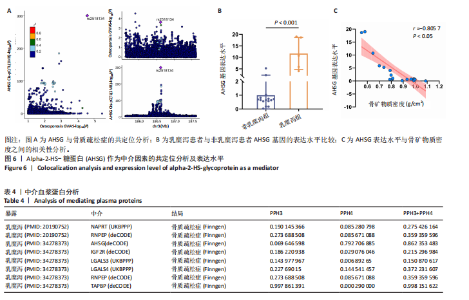
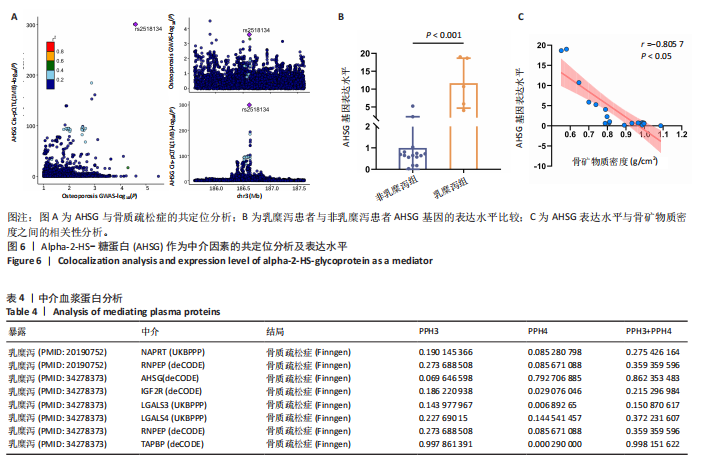
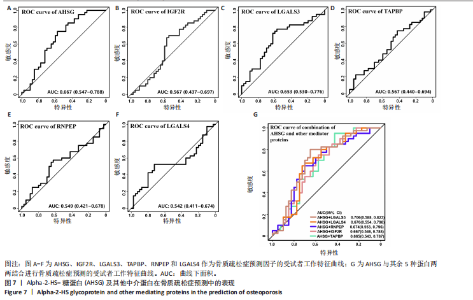
骨质疏松相关的上游蛋白中同时出现,则该蛋白可能在乳糜泻与骨质疏松之间的因果关系中充当中介作用。基于这一假设,研究在主要数据集中鉴定出有6个中介蛋白,分别为AHSG、IGF2R、LGALS3、LGALS4、RNPEP和TAPBP,而在复制分析中NAPRT和RNPEP被确定为中介蛋白。它们的中介效能和相关参数数据见图5A-H。值得注意的是,RNPEP在2个数据集中均被识别为中介蛋白,而另一方面有2个LGALS家族的蛋白被认为发挥中介效应,见图5I。 此外,研究又通过共定位分析对所有中介蛋白在因果关系中的潜在作用进行了进一步验证,见表4。结果显示,在上述所有中介蛋白中,AHSG表现出强烈的共定位(PPH3+PPH4=0.862,PPH4=0.793),见图6A。这一发现强调了AHSG在乳糜泻与骨质疏松之间的因果关系中的潜在中介作用。同时,研究提取了乳糜泻患者与非乳糜泻患者的RNA进行聚合酶链式反应分析,结果显示,乳糜泻患者的AHSG表达显著高于对照组(11.67 vs. 1.00,P < 0.001),见图6B。为了进一步探讨AHSG与骨矿物质密度之间的潜在关联,对AHSG表达水平和骨矿物质密度进行了相关性分析。分析结果显示,AHSG表达水平与骨矿物质密度之间存在显著的负相关关系(r=-0.805 7,P < 0.05),进一步支持了AHSG在骨质疏松发病机制中的作用,见图6C。 2.6 基于AHSG的受试者工作特征曲线分析 从GEO数据库中获取了来自不同平台的骨质疏松患者和正常人群的测序数据,涵盖了6种蛋白:AHSG、IGF2R、LGALS3、LGALS4、RNPEP和TAPBP。对这些蛋白的预测能力进行了受试者工作特征曲线分析,结果显示当单独使用这6种蛋白作为预测因子时,AHSG的曲线下面积值最高,达到了0.667,而LGALS4的曲线下面积值最低,为0.542,见图7A-F。这一结果与研究前期关于AHSG获得了强烈的共定位相吻合,进一步支持AHSG在骨质疏松风险"

预测中的潜力。 为了进一步提升预测性能,研究评估了AHSG与其他潜在生物标志物(如LGALS3、RNPEP等)的联合预测能力。结果显示,AHSG + LGALS3的组合表现最佳,曲线下面积提升至0.706,见图7G。这表明AHSG更适合作为乳糜泻相关骨质疏松症的辅助预测因子,而非单一的独立诊断标志物。此外,联合多种血浆蛋白的综合预测模型相比单一生物标志物具有更高的预测准确性,提示未来可结合其他生物学指标和临床特征,进一步优化乳糜泻患者骨质疏松症的风险评估模型,以提高临床实用性。"
"
"

| [1] XI JY, LIN X, HAO YT. Measurement and projection of the burden of disease attributable to population aging in 188 countries, 1990-2050: A population-based study. J Glob Health. 2022;12:04093. [2] PAPA MV, CEOLIN C, SIMONATO C, et al. The correlation between bone mineral density measured at the forearm and at the lumbar spine or femoral neck: a systematic review and meta-analysis. BMC Musculoskelet Disord. 2025;26(1):151. [3] CAWTHON PM. Gender differences in osteoporosis and fractures. Clin Orthop Relat Res. 2011;469(7):1900-1905. [4] SALARI N, GHASEMI H, MOHAMMADI L, et al. The global prevalence of osteoporosis in the world: a comprehensive systematic review and meta-analysis. J Orthop Surg Res. 2021;16(1):609. [5] BERGMAN D, KING J, LEBWOHL B, et al. Two waves of coeliac disease incidence in Sweden: a nationwide population-based cohort study from 1990 to 2015. Gut. 2022;71(6):1088-1094. [6] FASANO A, CATASSI C. Clinical practice. Celiac disease. N Engl J Med. 2012; 367(25):2419-2426. [7] EBELING PR, NGUYEN HH, ALEKSOVA J, et al. Secondary Osteoporosis. Endocr Rev. 2022;43(2):240-313. [8] INFANTINO C, FRANCAVILLA R, VELLA A, et al. Role of Vitamin D in Celiac Disease and Inflammatory Bowel Diseases. Nutrients. 2022;14(23): 5154. [9] VERDU EF, SCHUPPAN D. Co-factors, Microbes, and Immunogenetics in Celiac Disease to Guide Novel Approaches for Diagnosis and Treatment. Gastroenterology. 2021;161(5):1395-1411.e4. [10] LEGROUX-GEROT I, LELOIRE O, BLANCKAERT F, et al. Screening for celiac disease in patients with osteoporosis. Joint Bone Spine. 2009;76(2):162-165. [11] GALLI G, LAHNER E, CONTI L, et al. Risk factors associated with osteoporosis in a cohort of prospectively diagnosed adult coeliac patients. United European Gastroenterol J. 2018;6(8):1161-1168. [12] SKORACKA K, MARCINIAK MD, MICHALAK M, et al. The other side of celiac disease - assessment of bone mineral density and body composition in patients with celiac disease. Prz Gastroenterol. 2024; 16(4):434-438. [13] HANSEN S, SCHWARZ P, RUMESSEN J, et al. Osteoporosis and bone fractures in patients with celiac disease: A nationwide cohort study. Bone. 2023;177:116913. [14] DUERKSEN DR, LIX LM, JOHANSSON H, et al. Fracture risk assessment in celiac disease: a registry-based cohort study. Osteoporos Int. 2021;32(1):93-99. [15] METELLI S, CHAIMANI A. Challenges in meta-analyses with observational studies. Evid Based Ment Health. 2020;23(2):83-87. [16] GAIL MH, ALTMAN DG, CADARETTE SM, et al. Design choices for observational studies of the effect of exposure on disease incidence. BMJ Open. 2019;9(12): e031031. [17] AL-TOMA A, VOLTA U, AURICCHIO R, et al. European Society for the Study of Coeliac Disease (ESsCD) guideline for coeliac disease and other gluten-related disorders. United European Gastroenterol J. 2019;7(5):583-613. [18] SANDERSON E, GLYMOUR MM, HOLMES MV, et al. Mendelian randomization. Nat Rev Methods Primers. 2022;2:6. [19] PLOTNIKOV D, GUGGENHEIM JA. Mendelian randomisation and the goal of inferring causation from observational studies in the vision sciences. Ophthalmic Physiol Opt. 2019;39(1):11-25. [20] MU H, CHEN J, HUANG W, et al. OmicShare tools: A zero-code interactive online platform for biological data analysis and visualization. Imeta. 2024;3(5):e228. [21] SANDERSON E. Multivariable Mendelian Randomization and Mediation. Cold Spring Harb Perspect Med. 2021;11(2):a038984. [22] WANG Y, KONG L, YE C, et al. Causal impacts of educational attainment on chronic liver diseases and the mediating pathways: Mendelian randomization study. Liver Int. 2023;43(11):2379-2392. [23] TIMMINS IR, ZACCARDI F, YATES T, et al. Mendelian randomisation and mediation analysis of self-reported walking pace and coronary artery disease. Sci Rep. 2024;14(1):9995. [24] ZHANG B, HE W, PEI Z, et al. Plasma proteins, circulating metabolites mediate causal inference studies on the effect of gut bacteria on the risk of osteoporosis development. Ageing Res Rev. 2024;101:102479. [25] VIGNOLI A, LUCHINAT C, SEGATA N, et al. Serum metabolomics and lipoproteomics discriminate celiac disease and non-celiac gluten sensitivity patients. Clin Nutr. 2025;45:31-35. [26] KUTRI MA, AYDEMIR Y, BARIS Z. Evaluating osteopontin levels in pediatric celiac disease: a potential indicator for mucosal atrophy and osteoporosis. Eur J Pediatr. 2024;184(1):22. [27] DENG Y, ZHANG D, SMITH P, et al. Microrna Associated with Periprosthetic Osteoloysis Via Jak-Stat Pathway. Orthop Proc. 2023;105-B(SUPP_3):112. [28] WANG P, ZHANG Z. Bone marrow-derived mesenchymal stem cells promote healing of rabbit tibial fractures via JAK-STAT signaling pathway. Exp Ther Med. 2020;19(3):2310-2316. [29] FLEET JC. Vitamin D-Mediated Regulation of Intestinal Calcium Absorption. Nutrients. 2022;14(16):3351. [30] KLEIN GL. The Role of Calcium in Inflammation-Associated Bone Resorption. Biomolecules. 2018;8(3):69. [31] POTTER MDE, WALKER MM, HANCOCK S, et al. A Serological Diagnosis of Coeliac Disease Is Associated with Osteoporosis in Older Australian Adults. Nutrients. 2018;10(7):849. [32] KAMYCHEVA E, GOTO T, CAMARGO CA JR. Celiac disease is associated with reduced bone mineral density and increased FRAX scores in the US National Health and Nutrition Examination Survey. Osteoporos Int. 2017;28(3):781-790. [33] LEFFLER DA, GREEN PH, FASANO A. Extraintestinal manifestations of coeliac disease. Nat Rev Gastroenterol Hepatol. 2015;12(10):561-571. [34] WALKER MD, WILLIAMS J, LEWIS SK, et al. Measurement of Forearm Bone Density by Dual Energy X-Ray Absorptiometry Increases the Prevalence of Osteoporosis in Men With Celiac Disease. Clin Gastroenterol Hepatol. 2020;18(1):99-106. [35] LEE CC, BOWMAN BH, YANG FM. Human alpha 2-HS-glycoprotein: the A and B chains with a connecting sequence are encoded by a single mRNA transcript. Proc Natl Acad Sci U S A. 1987;84(13):4403-4407. [36] VAN DEN AKKER GGH, STEIJNS JSJJ, STASSEN RHMJ, et al. Development of a cyclic-inverso AHSG/Fetuin A-based peptide for inhibition of calcification in osteoarthritis. Osteoarthritis Cartilage. 2023;31(6):727-740. [37] SRITARA C, THAKKINSTIAN A, ONGPHIPHADHANAKUL B, et al. Causal relationship between the AHSG gene and BMD through fetuin-A and BMI: multiple mediation analysis. Osteoporos Int. 2014;25(5):1555-1562. [38] LARUSSA T, SURACI E, NAZIONALE I, et al. Bone mineralization in celiac disease. Gastroenterol Res Pract. 2012;2012:198025. [39] CHAN LS, MALAKHOV MM, PAN W. A novel multivariable Mendelian randomization framework to disentangle highly correlated exposures with application to metabolomics. Am J Hum Genet. 2024;111(9):1834-1847. [40] GRANT AJ, BURGESS S. A Bayesian approach to Mendelian randomization using summary statistics in the univariable and multivariable settings with correlated pleiotropy. Am J Hum Genet. 2024;111(1):165-180. [41] POLAN C, BRENNER C, HERTEN M, et al. Increased UHMWPE Particle-Induced Osteolysis in Fetuin-A-Deficient Mice. J Funct Biomater. 2023;14(1):30. [42] SHIHA MG, SCHIEPATTI A, MAIMARIS S, et al. Clinical outcomes of potential coeliac disease: a systematic review and meta-analysis. Gut. 2024;73(12):1944-1952. |
| [1] | Liu Wenlong, Dong Lei, Xiao Zhengzheng, Nie Yu. Finite element analysis of tibial prosthesis loosening after fixed-bearing unicompartmental knee arthroplasty for osteoporosis [J]. Chinese Journal of Tissue Engineering Research, 2026, 30(9): 2191-2198. |
| [2] | Chen Long, Wang Xiaozhen, Xi Jintao, Lu Qilin. Biomechanical performance of short-segment screw fixation combined with expandable polyetheretherketone vertebral body replacement in osteoporotic vertebrae [J]. Chinese Journal of Tissue Engineering Research, 2026, 30(9): 2226-2235. |
| [3] | Chen Huiting, Zeng Weiquan, Zhou Jianhong, Wang Jie, Zhuang Congying, Chen Peiyou, Liang Zeqian, Deng Weiming. Tail anchoring technique of vertebroplasty in treatment of osteoporotic vertebral compression fractures with intravertebral cleft: a finite element analysis [J]. Chinese Journal of Tissue Engineering Research, 2026, 30(9): 2145-2152. |
| [4] | Zeng Xuan, Weng Rui, Ye Shicheng, Tang Jiadong, Mo Ling, Li Wenchao. Two lumbar rotary manipulation techniques in treating lumbar disc herniation: a finite element analysis of biomechanical differences [J]. Chinese Journal of Tissue Engineering Research, 2026, 30(9): 2153-2161. |
| [5] | Cheng Qisheng, Julaiti·Maitirouzi, Xiao Yang, Zhang Chenwei, Paerhati·Rexiti. Finite element analysis of novel variable-diameter screws in modified cortical bone trajectory of lumbar vertebrae [J]. Chinese Journal of Tissue Engineering Research, 2026, 30(9): 2162-2171. |
| [6] | Hu Xiongke, Liu Shaohua, Tan Qian, Liu Kun, Zhu Guanghui. Shikonin intervention with bone marrow mesenchymal stem cells improves microstructure of femur in aged mice [J]. Chinese Journal of Tissue Engineering Research, 2026, 30(7): 1609-1615. |
| [7] | Wu Zhilin, , He Qin, Wang Pingxi, Shi Xian, Yuan Song, Zhang Jun, Wang Hao . DYRK2: a novel therapeutic target for rheumatoid arthritis combined with osteoporosis based on East Asian and European populations [J]. Chinese Journal of Tissue Engineering Research, 2026, 30(6): 1569-1579. |
| [8] | Zhang Haiwen, Zhang Xian, Xu Taichuan, Li Chao. Bibliometric and visual analysis of the research status and trends of senescence in osteoporosis [J]. Chinese Journal of Tissue Engineering Research, 2026, 30(6): 1580-1591. |
| [9] | Liu Hongtao, Wu Xin, Jiang Xinyu, Sha Fei, An Qi, Li Gaobiao. Causal relationship between age-related macular degeneration and deep vein thrombosis: analysis based on genome-wide association study data [J]. Chinese Journal of Tissue Engineering Research, 2026, 30(6): 1602-1608. |
| [10] | Wen Guangwei, Zhen Yinghao, Zheng Taikeng, Zhou Shuyi, Mo Guoye, Zhou Tengpeng, Li Haishan, Lai Yiyi. Effects and mechanisms of isoginkgetin on osteoclastogenesis [J]. Chinese Journal of Tissue Engineering Research, 2026, 30(6): 1348-1358. |
| [11] | Guo Ying, Tian Feng, Wang Chunfang. Potential drug targets for the treatment of rheumatoid arthritis: large sample analysis from European databases [J]. Chinese Journal of Tissue Engineering Research, 2026, 30(6): 1549-1557. |
| [12] | Huang Jie, Zeng Hao, Wang Wenchi, Lyu Zhucheng, Cui Wei. Visualization analysis of literature on the effect of lipid metabolism on osteoporosis [J]. Chinese Journal of Tissue Engineering Research, 2026, 30(6): 1558-1568. |
| [13] | Gao Zengjie, , Pu Xiang, Li Lailai, Chai Yihui, Huang Hua, Qin Yu. Increased risk of osteoporotic pathological fractures associated with sterol esters: evidence from IEU-GWAS and FinnGen databases [J]. Chinese Journal of Tissue Engineering Research, 2026, 30(5): 1302-1310. |
| [14] | Liu Fengzhi, Dong Yuna, Tian Wenyi, Wang Chunlei, Liang Xiaodong, Bao Lin. Gene-predicted associations between 731 immune cell phenotypes and rheumatoid arthritis [J]. Chinese Journal of Tissue Engineering Research, 2026, 30(5): 1311-1319. |
| [15] | Zhang Cuicui, Chen Huanyu, Yu Qiao, Huang Yuxuan, Yao Gengzhen, Zou Xu. Relationship between plasma proteins and pulmonary arterial hypertension and potential therapeutic targets [J]. Chinese Journal of Tissue Engineering Research, 2026, 30(5): 1331-1340. |
| Viewed | ||||||
|
Full text |
|
|||||
|
Abstract |
|
|||||