Chinese Journal of Tissue Engineering Research ›› 2026, Vol. 30 ›› Issue (32): 8529-8535.doi: 10.12307/2026.878
Previous Articles Next Articles
Properties of machinable resin-ceramic composites and their application in onlay restorations
Huang Rongjie1, Bao Xuemei2
- 1School of Stomatology, Inner Mongolia Medical University, Hohhot 010059, Inner Mongolia Autonomous Region, China; 2Department of Stomatology, Affiliated Hospital of Inner Mongolia Medical University, Hohhot 010050, Inner Mongolia Autonomous Region, China
-
Accepted:2026-02-05Online:2026-11-18Published:2026-04-29 -
Contact:Bao Xuemei, MS, Chief physician, Department of Stomatology, Affiliated Hospital of Inner Mongolia Medical University, Hohhot 010050, Inner Mongolia Autonomous Region, China -
About author:Huang Rongjie, Physician, MS, School of Stomatology, Inner Mongolia Medical University, Hohhot 010059, Inner Mongolia Autonomous Region, China -
Supported by:Natural Science Foundation Project of Inner Mongolia Autonomous Region, No. 2019LH08012 (to BXM)

CLC Number:
Cite this article
Huang Rongjie, Bao Xuemei. Properties of machinable resin-ceramic composites and their application in onlay restorations[J]. Chinese Journal of Tissue Engineering Research, 2026, 30(32): 8529-8535.
share this article
Add to citation manager EndNote|Reference Manager|ProCite|BibTeX|RefWorks
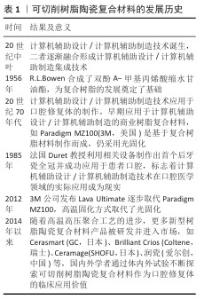
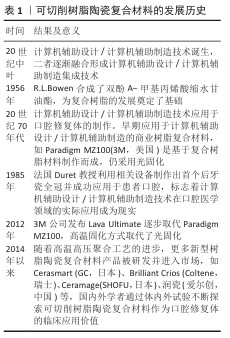
2.1 可切削树脂陶瓷复合材料的发展历史 见表1。"
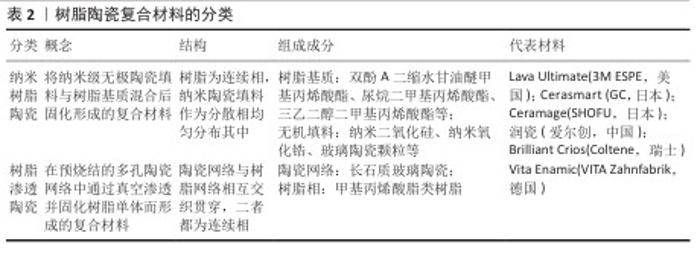
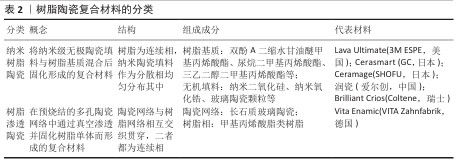
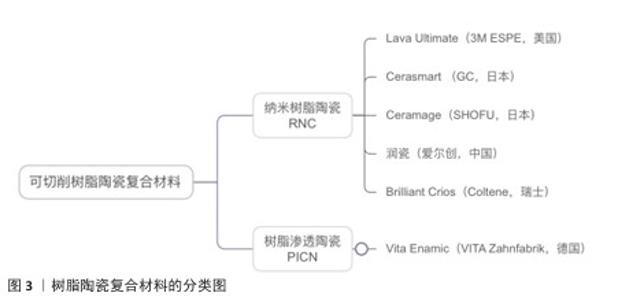
2.2 可切削树脂陶瓷复合材料的分类及性能特点 可切削树脂陶瓷复合材料是一种新型的椅旁修复材料,又称为“混合陶瓷”,是由树脂和无机陶瓷组合而成的可切削复合材料,主要应用于嵌体、高嵌体、贴面及单冠修复[3]。2022年,《中华口腔医学杂志》发表的“树脂陶瓷复合材料椅旁计算机辅助设计与辅助制作修复技术指南”[3],将可切削树脂陶瓷复合材料分为两类:一类是通过高温和高压工艺在树脂基质中加入高比例无机填料制造而成的纳米树脂陶瓷,树脂基质由双官能团甲基丙烯酸酯单体聚合而成,如双酚A二缩水甘油醚二甲基丙烯酸酯、乙氧基化双酚A二甲基丙烯酸酯、聚氨酯二甲基丙烯酸酯和三乙二醇二甲基丙烯酸酯[4-5],填料的多孔结构与树脂基质形成微机械互锁,从而增强材料的性能,以Lava Ultimate(3M ESPE,美国)为代表;另一类是通过复合树脂聚合物(质量占比14%)渗透到预烧结长石质陶瓷(质量占比86%)相互连接空隙中形成的树脂渗透陶瓷[6],在单体聚合后形成陶瓷和聚合物的双网联锁结构,其中无机相占据高达86%的比例,代表材料为Vita Enamic(VITA Zahnfabrik,德国),见表2,图3。 "
"
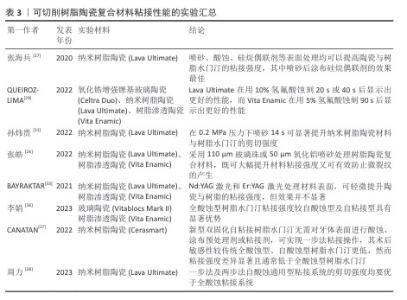
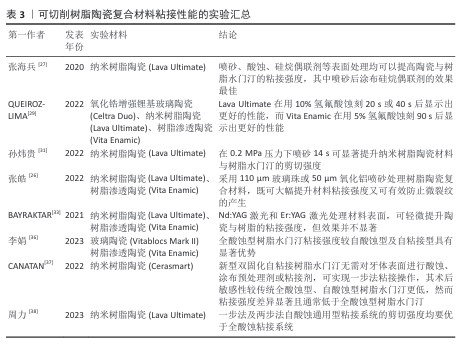
.2.1 可切削树脂陶瓷复合材料的机械性能 吴传兴等[7]研究表明,CAD/CAM可切削树脂陶瓷复合材料具有高回弹模量和初始断裂韧性,在较高的加载力范围内(1 200-1400 N)仍表现出极高的存留率(50%-80%)。可切削纳米树脂陶瓷的弹性模量为12-16 GPa,可切削树脂渗透陶瓷的弹性模量为26-30 GPa[3],均较接近牙本质的弹性模量(18 GPa)。相较于传统陶瓷材料,树脂陶瓷复合材料的弹性模量更低,能够有效缓冲应力,使应力分布更均匀、峰值更小[8-9]。SUKSAWAT等[10]通过体外实验比较不同CAD/CAM可切削材料高嵌体修复根管治疗后的牙齿折裂方式,发现半透明氧化锆高嵌体虽因无玻璃相结构而具有较高的抗断裂性,但其不可修复失败率高达70%;树脂陶瓷复合材料高嵌体因弹性模量与牙本质相近且柔韧性优异,同时其聚合物结构可有效阻止裂纹扩展[11], 高达90%的折裂是可修复的。纳米树脂陶瓷对于小面积缺损可直接修补,而玻璃陶瓷的脆性高,在发生折裂时往往需拆除重做[12]。由于弹性模量较低,树脂陶瓷复合材料的脆性更低、柔韧性更高,相较于玻璃陶瓷表现出更好的抗疲劳性能[13-14]。树脂陶瓷复合材料的抗疲劳性能与填料颗粒的尺寸、分布、含量以及与树脂基质的结合密切相关[15],填料颗粒小、含量高的结构可减少界面缺陷,增强粘接,从而优化抗疲劳性能。Weibull分布分析用于评估材料的可靠性,经疲劳循环后的树脂陶瓷复合材料Weibull模量略有下降,可切削纳米树脂陶瓷的Weibull模量高于树脂渗透陶瓷[16]。综上所述,可切削树脂陶瓷复合材料作为修复体时可满足临床应用要求,凭借适配牙本质弹性模量的特点,可有效优化应力分布,提升临床二次修复的可能性。 树脂渗透陶瓷与复合树脂对磨时其自身摩擦系数相对较低,而与二氧化锆对磨时会产生较高的磨损量[17]。二硅酸锂玻璃陶瓷的维氏硬度值(5.378 GPa)显著高于树脂陶瓷复合材料(Vita Enamic:1.510 GPa;Lava Ultimate:1.069 GPa)[18]。 高填料含量(填料颗粒小、孔隙率低)及加工固化工艺使得树脂陶瓷复合材料的耐磨性能优于传统复合树脂。玻璃陶瓷因硬度高在耐磨性上仍表现出显著优势。纳米树脂陶瓷及树脂渗透陶瓷的耐磨性介于玻璃陶瓷与复合树脂之间[11,19]。就耐磨性而言,树脂渗透陶瓷要优于纳米树脂陶瓷;在各类纳米树脂陶瓷中,Cerasmart表现出较高的耐磨性,Lava Ultimate的耐磨性相对略低[11];理想修复材料的耐磨性能应与牙体硬组织相匹配。玻璃陶瓷较树脂陶瓷复合材料对对颌牙的磨损更大[11],为避免损伤对颌天然牙,树脂陶瓷复合材料较玻璃陶瓷更适合用于咬合力较高、夜磨牙症患者[18]。有研究认为纳米树脂陶瓷的纳米簇结构提高了材料初始硬度,在初始阶段,树脂渗透陶瓷的磨损较纳米树脂陶瓷更严重,但随着时间推移,树脂渗透陶瓷的聚合物网状结构会阻止磨损裂纹扩展而表现出长期耐磨性[20]。也有研究认为,纳米树脂陶瓷的小型纳米颗粒与基质会在表面形成一层致密的磨损层,使材料表面相对光滑,降低材料的磨损损伤,故高密度纳米树脂陶瓷更有利于抵抗磨损[21]。有研究进一步表明,树脂渗透陶瓷的耐磨性能优于纳米树脂陶瓷,更适用于咬合力大或咬合空间有限的患者[22]。抛光工艺影响材料表面性能及细菌黏附情况,对于高填料颗粒的树脂渗透陶瓷可以选用上釉方式降低表面粗糙度[23]。另外,纳米树脂陶瓷的磨损速率与树脂粘接剂相近,从而可保持良好的边缘适应性[24-25]。树脂陶瓷复合材料较低的耐磨性在高磨耗环境下反而成为优势,不仅能够避免出现修复体表面出现裂纹或断裂,更有利于修复体的边缘密封性,防止微渗漏。 2.2.2 可切削树脂陶瓷复合材料的粘接性能 间接修复体的粘接效果是影响临床应用成功率与长期稳定性的重要因素[26]。修复体内表面处理是一种常见的改善粘接强度方法。张海兵等[27] 通过剪切实验评估不同表面处理方法对纳米树脂陶瓷与树脂水门汀粘接强度的影响,发现喷砂、酸蚀、硅烷偶联剂等表面处理均可以提高与树脂水门汀的粘接强度,其中喷砂后涂布硅烷偶联剂的效果最佳。氢氟酸酸蚀通过部分溶解材料表面玻璃相从而形成微孔结构,增强材料与树脂粘接剂的微机械锁合作用[26-27]。纳米树脂陶瓷通过将纳米级陶瓷颗粒混入复合树脂中形成致密簇状结构,经氢氟酸处理后形成的微孔结构属于纳米级空隙,对粘接强度的影响不明显[27]。树脂渗透陶瓷因含有86%的长石质陶瓷,经酸蚀处理后的表面粗糙度增幅明显[28]。 研究表明,Lava Ultimate采用10%的氢氟酸酸蚀20 s或40 s,Vita Enamic用5%氢氟酸酸蚀90 s,更有利于促进树脂粘接剂产生良好的微机械锁合作用[29]。在另一项针对润瓷的研究中发现,经氢氟酸处理过的纳米树脂材料不适宜再应用硅烷偶联剂[30]。喷砂通过微粒冲击粗化材料表面,增加材料粘接强度,但不适宜的喷砂条件可能会在修复体表面形成尖锐突起或裂纹,反而影响修复成功率。研究表明,纳米树脂陶瓷材料在0.2 MPa压力下喷砂14 s可显著提升与树脂水门汀的剪切强度[31]。对于树脂陶瓷复合材料,采用110 μm玻璃珠或50 μm氧化铝喷砂处理,既可大幅提升材料粘接强度又可有效防止微裂纹的产生[26]。有研究利用Nd:YAG激光和Er:YAG 激光处理Lava Ultimate材料表面,发现Lava Ultimate与树脂的粘接强度有所提升,但效果并不显著[32-33]。在特定的环境中,硅烷偶联剂分子一端的甲氧基能够与SiO2表面的羟基缩合形成硅氧烷(Si-O-Si),连接修复体表面,另一端的有机基团能与树脂单体共聚并与粘接树脂结合,使得修复体与粘接树脂实现稳固连接[27]。研究表明,联合应用硅烷偶联剂与通用粘接剂可显著提升树脂陶瓷复合材料的粘接强度,其中用硅烷偶联剂+One Coat 7 Univers处理纳米树脂陶瓷Brilliant Crio和用硅烷偶联剂+Single Bond Univers处理树脂渗透陶瓷Vita Enamic可取得较高的Weibull模量[34]。纳米树脂陶瓷及树脂渗透陶瓷的表面处理方案因结构成分差异而存在不同,纳米树脂陶瓷可单独采用喷砂或联合硅烷偶联剂处理,树脂渗透陶瓷推荐采用氢氟酸酸蚀联合硅烷偶联剂处理[35]。不同厂商生产的树脂陶瓷复合材料对表面处理的要求可能存在差异,临床操作时应严格遵循产品说明。 树脂陶瓷复合材料与树脂水门汀具有相似的成分,易于形成化学结合,目前树脂陶瓷复合材料修复体推荐使用树脂水门汀进行粘 接[36]。有研究对比3种类型树脂水门汀(全酸蚀型、自酸蚀型、自粘接型)对树脂渗透陶瓷粘接强度的影响,发现尽管全酸蚀型树脂水门汀的操作繁琐且存在污染粘接面的风险,但其粘接强度较自酸蚀型及自粘接型具有显著优势[36]。新型双固化自粘接树脂水门汀无需对牙体表面进行酸蚀、涂布预处理剂或粘接剂,可实现一步法粘接操作,其术后敏感性较传统全酸蚀型、自酸蚀型树脂水门汀更低,然而粘接强度差异显著且通常低于全酸蚀型树脂水门汀[37]。周力等[38]通过体外实验将3种粘接系统(两步法自酸蚀粘接系统、一步法自酸蚀粘接系统、双组分全酸蚀粘接系统)应用于纳米树脂陶瓷(Lava Ultimate)与牙本质的粘接,发现一步法及两步法自酸蚀通用型粘接系统的剪切强度要优于全酸蚀粘接系统,同时该口腔酸碱环境对3种粘接系统与纳米树脂陶瓷的粘接强度影响甚微。3种粘接系统的断裂形貌均表现为纳米树脂陶瓷材料表面残留较多的粘接剂,而在牙本质面上较少,反映出树脂粘接剂与牙本质的粘接仍是薄弱环节[38]。可切削树脂陶瓷复合材料粘接性能的实验汇总,见表3。"
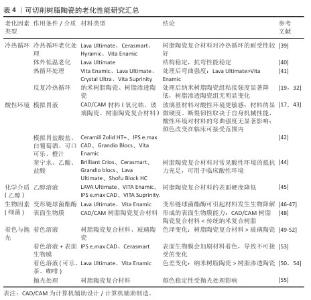
2.2.3 可切削树脂陶瓷复合材料的老化性能 口内修复体长期暴露于口腔内复杂环境中,受到物理、化学、生物等多方面因素的影响,不可避免地会出现老化现象,引起材料性能的改变。可切削树脂陶瓷复合材料经冷热循环老化处理后的表面性能仍较稳定,表面粗糙度可满足临床要求[39]。Lava Ultimate在体外低温老化环境下仍具有良好的结构及抗弯稳定性[40],经过热循环后的Lava Ultimate弯曲强度高于Vita Enamic[41],可能与Lava Ultimate含有的氧化锆及二硅酸锂颗粒有关。也有研究表明,反复热循环会影响树脂陶瓷复合材料HC(SHOFU,日本)及Brilliant Crios修复体的边缘稳定性[42]。反复冷热循环会破坏材料的粘接界面,树脂成分越多受到的影响越大,加之硅烷偶联剂部分水解,故纳米树脂陶瓷在反复冷热循环后粘接强度会显著降低[18],而对树脂渗透陶瓷并无显著影响。 酸性环境会对可切削树脂陶瓷复合材料的表面粗糙度、显微硬度及断裂韧性产生影响,主要表现为降低材料表面粗糙度,玻璃基材料更易受到酸的影响[16];显微硬度及断裂韧性更多取决于材料本身的机械性能[16,43],对颜色的改变属于临床可接受范围[44]。另有研究表明,含酸介质对树脂陶瓷复合材料的弯曲强度无显著影响,纳米树脂陶瓷较树脂渗透陶瓷表现出更高的弯曲强度[16]。有学者通过检测表面粗糙度及维氏硬度发现,可切削树脂陶瓷复合材料对3种酸性介质(奎宁水、乙酸、盐酸)和软化水均表现出足够的抵抗力,可以在临床酸性环境中使用[45]。乙醇溶液会降低纳米陶瓷及树脂渗透陶瓷的表面硬度[46]。口腔内环境复杂,存在大量细菌微生物,Lava Ultimate和Vita Enamic会在变形链球菌酯酶的作用下发生生物降解[47-48],可能引起微渗漏,影响修复效果。由于制造工艺及固化程度的差异,CAD/CAM树脂陶瓷复合材料较传统纳米复合树脂形成的表面生物膜更少[49]。另有研究表明,树脂陶瓷复合材料的色泽相较于玻璃陶瓷更易受到着色溶液的影响[50–53],若材料表面存在生物膜会导致不可接受的变色(ΔE > 1.8)[54],纳米树脂陶瓷色差变化幅度大,这可能与双酚A-甲基丙烯酸缩水甘油酯引起的高吸水性有关[51]。抛光对材料颜色稳定性有一定影响[55]。同种类型树脂陶瓷复合材料的不同产品,表现也不尽相同[56]。以上研究提示,对美学区域修复以及存在口腔易染色环境的患者(如存在长期饮用咖啡习惯等)应尽量避免使用纳米树脂陶瓷修复。目前对树脂陶瓷复合材料老化机制的研究更多局限于体外模拟实验,无法替代口腔真实复杂环境,仍需更多的研究探讨。可切削树脂陶瓷的老化性能研究汇总,见表4。 "
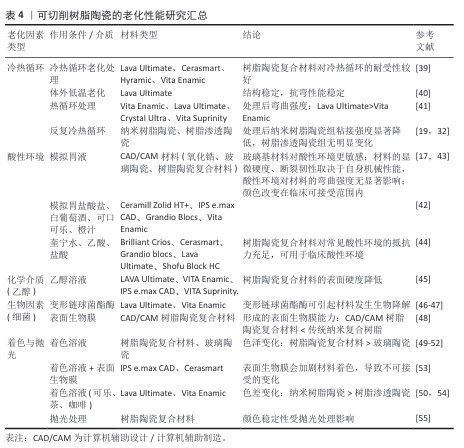
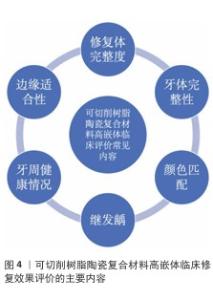
2.3 可切削树脂陶瓷复合材料在高嵌体修复中的应用 2.3.1 可切削树脂陶瓷高嵌体的临床适应证 修复体的成功取决于材料性能与受力机制的精准匹配,不同材料因性能不同适用的修复体类型也各有差异。可切削树脂陶瓷复合材料的“半树脂半陶瓷”特性使其成为高嵌体和嵌体的理想选择,但却不推荐用于贴面、全冠及种植单冠[3]。采用树脂陶瓷复合材料高嵌体修复,要求患牙颊舌壁完整,当牙体组织的大面积缺损致牙尖薄弱、支持不足时可采用高嵌体覆盖部分牙尖,转移咬合力以保护剩余牙体组织;若剩余牙体组织强度不足,则需采用超嵌体覆盖整个牙合面。但当牙釉质广泛丧失时,应选用全冠修复,当冠部组织无法提供足够的固位时需行桩冠修复[57]。树脂陶瓷复合材料的结构成分及性能特点提示,可切削树脂陶瓷高嵌体在夜磨牙症、树脂过敏、美观要求高以及存在口腔易染色环境的患者中慎用[3]。临床操作的一般流程包括:牙体预备、口内扫描获得数字化印模、比色、CAD/CAM、临床试戴及粘接等。目前对可切削树脂陶瓷高嵌体的病例选择、牙体预备方式等尚无具体统一的标准[58],在《树脂陶瓷复合材料椅旁计算机辅助设计与辅助制作修复技术指南》中建议,牙合面深度与宽度不小于1.5 mm,轴面在去除倒凹、保证聚合度及肩台宽度的条件下适量调整[3]。可切削树脂陶瓷高嵌体的成功应用依赖于严格筛选适应证、规避高风险因素、遵循微创预备标准、材料定制化粘接,精准把握上述原则,可使3年存留率提升至97%以上[59],实现真正意义上的生物力学微创修复。 2.3.2 可切削树脂陶瓷复合材料在高嵌体修复中的临床应用 可切削树脂陶瓷复合材料高嵌体凭借微创、高效、具有良好的机械性能及粘接性能等特点,成为了新的口腔修复体设计之选。可切削树脂陶瓷复合材料在高嵌体修复中的成功率是评估临床效果的重要指标。一项研究分别对50例根管治疗后患者行Vita Enamic高嵌体和氧化锆增强锂基高嵌体修复,1年后随访显示,观察组树脂陶瓷高嵌体的完整度、牙体组织完整度及边缘适合性均明显优于对照组,修复效果及临床效果良好,并且对牙周组织的影响较小[60]。ELMOSELHY等[61]的一项临床研究表明,修复6个月后,Brilliant间接修复体的边缘完整性要优于玻璃陶瓷。另有研究通过比较Ceramage高嵌体与二硅酸锂玻璃陶瓷高嵌体修复即刻及1年后的患者满意度发现,二者可取得相近的修复效果[62]。在一项针对Cerasmart高嵌体修复后牙牙体缺损的体外实验中发现,树脂陶瓷复合材料高嵌体发生折裂后的二次修复率可达到90%以上[63],另一研究也得出了相同结论[10]。多项研究证实,可切削树脂陶瓷复合材料在高嵌体修复中具有良好的修复效果[64–66]。一项研究采用CAD/CAM技术制作树脂陶瓷复合材料髓腔固位高嵌体对45例根管治疗后的牙体缺损进行微创修复,进行6个月及12个月的随访,结果显示树脂陶瓷复合材料髓腔固位高嵌体的修复体完整度、边缘密合性以及并发症的发生情况等与全瓷材料相当[67]。另一项研究同样采用可切削树脂陶瓷复合材料制作髓腔固位高嵌体,对124例老年脑卒中短冠磨牙患者进行修复,在6个月及12个月时对修复效果、微渗漏情况、相关并发症的发生率以及口腔健康相关生活质量进行评估,发现与氧化锆全瓷冠修复比较,纳米树脂陶瓷髓腔固位高嵌体在保证修复合格率的基础上能够有效提高患者口腔健康质量,修复效果满意度评分高[68],多项研究支持这一结论[12,69-70]。另有研究采用CAD/CAM技术制作Lava Ultimate高嵌体,并与氧化锆增强锂基陶瓷高嵌体修复根管治疗后的牙体缺损进行比较,结果显示CAD/CAM树脂陶瓷高嵌体在保证修复效果的同时有利于保护剩余牙体组织,并且更有利于保护患者牙龈健康[71]。HASSAN等[24]在20例患者中进行了CAD/CAM二硅酸锂玻璃陶瓷和纳米树脂陶瓷高嵌体修复,其中纳米树脂陶瓷高嵌体经喷砂联合硅烷偶联剂处理后使用All-Bond通用型粘接剂+树脂水门汀进行粘接,在为期2年的随访中发现,纳米树脂陶瓷高嵌体与二硅酸锂玻璃陶瓷能达到相似的修复效果,两种修复体的存活率均可达90%。另一项研究也取得了相同的结论,同时发现纳米树脂陶瓷在光学特性方面表现稍逊色,对于美观要求高的患者可优先考虑二硅酸锂玻璃陶瓷[65]。可切削树脂陶瓷复合材料高嵌体临床修复效果评价的主要内容,见图4。 "
| [1] 吴洁,达云萌,张钊,等.Cad/cam高嵌体与全冠修复上颌前磨牙的抗折性能研究[J].口腔医学研究,2023,39(8):727-731. [2] 陈文丽,谢小飞,刘芳,等.根管治疗后高嵌体与纤维桩核冠修复后牙牙体缺损的临床疗效观察[J].中华全科医学,2021,19(5):767-770. [3] 中华口腔医学会口腔修复学专业委员会.树脂陶瓷复合材料椅旁计算机辅助设计与辅助制作修复技术指南[J].中华口腔医学杂志,2022, 57(9):895-898. [4] KOENIG A, SCHMIDTKE J, SCHMOHL L, et al. Characterisation of the filler fraction in CAD/CAM resin-based composites. Materials(basel, Switzerland). 2021;14(8):1986. [5] ILIE N. Spatial distribution of the micro-mechanical properties in high-translucent CAD/CAM resin-composite blocks. Materials (basel, Switzerland). 2020;13(15):3352. [6] MARCHESI G, CAMURRI PILONI A, NICOLIN V, et al. Chairside CAD/CAM Materials: Current Trends of Clinical Uses. Biology (Basel). 2021;10(11):1170. [7] 吴传兴,林敏,陈铭晟,等.Cad/cam陶瓷树脂复合体材料在超薄嵌体应用中的疲劳性能研究[J].实用口腔医学杂志,2020,36(4):581-585. [8] 洪煜锐,李阳,骆伟燕,等.树脂陶瓷复合材料单冠美学区种植修复的三维有限元分析[J].上海口腔医学,2020,29(3):262-266. [9] 卓盈颖,林捷,陈睿桢,等.冠材料对种植牙应力分布影响的有限元分析[J].口腔医学,2024, 44(12):899-903. [10] SUKSAWAT N, ANGWARAVONG O, ANGWARAWONG T. Fracture resistance and fracture modes in endodontically treated maxillary premolars restored using different CAD-CAM onlays. J Prosthodont Res. 2024;68(2):290-298. [11] LABORIE M, NAVEAU A, MENARD A. CAD-CAM resin-ceramic material wear: A systematic review. J Prosthet. 2024;131(5):812-818. [12] 孔宁华,金文静,吴迪,等.树脂纳米陶瓷髓腔固位冠修复老年人短冠磨牙的临床评价[J].中华老年口腔医学杂志,2023,21(1):38-41,49. [13] SCHLICHTING LH, RESENDE TH, REIS KR, et al. Ultrathin CAD-CAM glass-ceramic and composite resin occlusal veneers for the treatment of severe dental erosion: An up to 3-year randomized clinical trial. J Prosthet Dent. 2022;128(2): 158.e1-158.e12. [14] FASBINDER DJ, NEIVA GF, HEYS D, et al. Clinical evaluation of chairside Computer Assisted Design/Computer Assisted Machining nano‐ceramic restorations: Five‐year status. J Esthet Restor Dent. 2020;32(2):193-203. [15] BERGAMO ETP, YAMAGUCHI S, COELHO PG, et al. Survival of implant-supported resin-matrix ceramic crowns: In silico and fatigue analyses. Dent Mater. 2021;37(3):523-533. [16] ELRAGGAL A, R AFIFI R, ALAMOUSH RA, et al. Effect of acidic media on flexural strength and fatigue of CAD-CAM dental materials. Dent Mater. 2023;39(1):57-69. [17] 古丽米拉·木明,叶钟泰,寇正威,等.对磨材料对树脂渗透陶瓷Vita enamic磨损的实验研究[J].口腔材料器械杂志,2023,32(2):92-98. [18] 袁珊珊,王月秋,孙汪心悦,等.3种椅旁CAD/CAM修复材料耐磨性能和粘接强度的体外研究[J].实用口腔医学杂志,2022,38(5):601-607. [19] 钱小宇,徐欣蕊,黄慧.刷牙对可切削复合树脂陶瓷表面粗糙度的影响[J].口腔材料器械杂志,2020,29(3):128-132,137. [20] WENDLER M, KAIZER MR, BELLI R, et al. Sliding contact wear and subsurface damage of CAD/CAM materials against zirconia. Dent Mater. 2020; 36(3):387-401. [21] JIN C, DENG J, PAN P, et al. Comparative study on the impact-sliding wear behaviour of CAD/CAM resin-ceramic materials and tooth enamel. Dent Mater. 2023;39(1):25-40. [22] 徐启妹,田菊忠,丛孟启,等.3种切削成型复合材料体外耐磨耗性能研究[J].实用口腔医学杂志,2023, 39(5):619-624. [23] ÖZARSLAN M, BILGILI CAN D, AVCIOGLU NH, et al. Effect of different polishing techniques on surface properties and bacterial adhesion on resin-ceramic CAD/CAM materials. Clin Oral Investig. 2022;26(8):5289-5299. [24] HASSAN A, HAMDI K, ALI AI, et al. Clinical performance comparison between lithium disilicate and hybrid resin nano-ceramic CAD/CAM onlay restorations: A two-year randomized clinical split-mouth study. Odontology. 2024;112(2): 601-615. [25] 赵信义.数控切削成形复合材料的进展[J].口腔材料器械杂志,2021,30(3):129-134. [26] 张皓,王秀文,李斯文,等.不同表面处理方法对树脂-陶瓷复合材料微观形貌和粘接强度影响研究[J]. 中国实用口腔科杂志,2022, 15(6):705-710. [27] 张海兵,霍欢,刘利军.不同表面处理方法对纳米复合陶瓷与树脂水门汀粘接强度的影响[J].华西口腔医学杂志,2020,38(2):155-159. [28] MOURA DMD, VERÍSSIMO AH, LEITE VILA-NOVA TE, et al. Which surface treatment promotes higher bond strength for the repair of resin nanoceramics and polymer-infiltrated ceramics? A systematic review and meta-analysis. J Prosthet Dent. 2022;128(2):139-149. [29] QUEIROZ-LIMA G, STRAZZI-SAHYON HB, MALULY-PRONI AT, et al. Surface characterization of indirect restorative materials submitted to different etching protocols. J Dent. 2022;127:104348. [30] 杜亚鑫,王强,仇丽鸿.不同表面处理方式对润瓷与树脂水门汀黏结强度的影响研究[J].中国实用口腔科杂志,2020,13(3):157-161. [31] 孙炜贵,刘芳,章非敏.不同表面处理对LAVA树脂纳米瓷剪切强度的影响[J].口腔医学, 2022,42(12):1063-1066. [32] 陈良.激光蚀刻对陶瓷与树脂间粘接强度的影响[D].长春:吉林大学,2022. [33] BAYRAKTAR Y, ARSLAN M, DEMIRTAG Z. Repair bond strength and surface topography of resin-ceramic and ceramic restorative blocks treated by laser and conventional surface treatments. Microsc Res Tech. 2021;84(6):1145-1154. [34] 范晓东,马晓平,窦晨云,等.硅烷与通用粘接剂的应用对树脂陶瓷复合材料微剪切粘接强度的影响[J].实用口腔医学杂志,2025,41(5): 610-616. [35] FATHY H, HAMAMA HH, EL-WASSEFY N, et al. Clinical performance of resin-matrix ceramic partial coverage restorations: a systematic review. Clin Oral Investig. 2022;26(5):3807-3822. [36] 李娟,章非敏,胡建.不同粘结剂对两种椅旁cad/cam全瓷材料粘结强度影响的实验研究[J].口腔医学,2020,40(9):792-795. [37] CANATAN S, OZ FD, BOLAY S. A randomized, controlled clinical evaluation of two resin cement systems in the adhesion of CAD/CAM‐fabricated resin nanoceramic restorations: 18‐month preliminary results. J Esthet Restor Dent. 2022;34(7):1005-1014. [38] 周力,颜越,章非敏.不同粘接系统用于树脂陶瓷复合材料的体外实验研究[J].南京医科大学学报(自然科学版),2023,43(10):1372-1377. [39] 刘亚男,刘思思,王立凯,等.冷热循环对cad/cam树脂陶瓷复合材料表面粗糙度及形貌的影响[J].口腔材料器械杂志,2022,31(3):158-162. [40] 颜越,谢海峰,孟虹良,等.一种CAD/CAM复合树脂块的低温老化后晶相、结构及抗弯强度稳定性的评价[J].口腔医学,2020,40(4):309-312. [41] BEYABANAKI E, ASHTIANI RE, MORADI M, et al. Biaxial flexural strength and Weibull characteristics of a resin ceramic material after thermal‐cycling. J Prosthodont. 2023;32(8):721-727. [42] TAHA AI, HAFEZ ME. An in vitro study measuring marginal gaps of inlay restorations fabricated from different CAD-CAM materials after thermocycling. BMC oral health. 2023;23(1):974. [43] ELRAGGAL A, AFIFI R, ABDELRAHEEM I. Effect of erosive media on microhardness and fracture toughness of CAD-CAM dental materials. BMC Oral Health. 2022;22(1):191. [44] CRUZ MEM, SIMÕES R, MARTINS SB, et al. Influence of simulated gastric juice on surface characteristics of CAD-CAM monolithic materials. J Prosthet. 2020;123(3):483-490. [45] SCHMOHL L, ROESNER AJ, FUCHS F, et al. Acid resistance of CAD/CAM resin composites. Biomedicines. 2022;10(6):1383. [46] SAGSOZ O, POLAT SAGSOZ N. Chemical degradation of dental CAD/CAM materials. Biomed Mater Eng. 2019;30(4):419-426. [47] 赵洪岩,于依岩,陈佳文.变形链球菌酯酶降解CAD/CAM树脂陶瓷复合材料的研究[C]//中华口腔医学会牙体牙髓病学专业委员会.第十六次全国牙体牙髓病学学术大会论文汇编.吉林大学口腔医院;2023:44-46. [48] YU Y, GUO X, CHEN J, et al. Biodegradation of urethane dimethacrylate-based materials (CAD/CAM resin-ceramic composites) and its effect on the adhesion and proliferation of streptococcus mutans. J Mech Behav Biomed Mater. 2024;150: 106280. [49] IONESCU AC, HAHNEL S, KÖNIG A, et al. Resin composite blocks for dental CAD/CAM applications reduce biofilm formation in vitro. Dent Mater. 2020;36(5):603-616. [50] ARIF R, YILMAZ B, JOHNSTON WM. In vitro color stainability and relative translucency of CAD-CAM restorative materials used for laminate veneers and complete crowns. J Prosthet. 2019; 122(2):160-166. [51] STAMENKOVIĆ DD, TANGO RN, TODOROVIĆ A, et al. Staining and aging-dependent changes in color of CAD-CAM materials. J Prosthet. 2021; 126(5):672-678. [52] AL AMRI MD, LABBAN N, ALHIJJI S, et al. In Vitro Evaluation of Translucency and Color Stability of CAD/CAM Polymer‐Infiltrated Ceramic Materials after Accelerated Aging. J Prosthodont. 2021;30(4):318-328. [53] NAFFAH N, OUNSI H, OZCAN M, et al. Evaluation of the color stability of three resin-ceramic materials using a spectrophotometer and a digital photography software. Contemp Clin Dent. 2024;15(1):44-50. [54] TOPÇU S, TEKÇE N, KOPUZ D, et al. Effect of surface roughness and biofilm formation on the color properties of resin-infiltrated ceramic and lithium disilicate glass-ceramic CAD-CAM materials. J Prosthet. 2024;131(5):935.e1-935.e8. [55] PAOLONE G, MANDURINO M, DE PALMA F, et al. Color stability of polymer-based composite CAD/CAM blocks: A systematic review. Polymers (Basel). 2023;15(2):464. [56] MAHROUS AI, SALAMA AA, SHABAAN AA, et al. Color stability of two different resin matrix ceramics: Randomized clinical trial. BMC oral health. 2023;23(1):665. [57] 王剑.浅谈嵌体和高嵌体修复的临床应用[J].国际口腔医学杂志,2021,48(5):497-505. [58] 徐西红,于波,张雪,等.高嵌体结合即刻牙本质封闭技术修复磨牙中重度缺损的临床观察[J].口腔颌面修复学杂志,2022,23(1):32-37. [59] LU T, PENG L, XIONG F, et al. A 3-year clinical evaluation of endodontically treated posterior teeth restored with two different materials using the CEREC AC chair-side system. J. Prosthet. 2018;119(3):363-368. [60] 王惠娟,俞凌燕.树脂复合陶瓷嵌体在根管治疗后患牙修复中的应用效果观察[J].浙江医学,2023,45(10):1075-1078,1083. [61] ELMOSELHY HAS, HASSANIEN OES, HARIDY MF, et al. Two‑year clinical performance of indirect restorations fabricated from CAD/CAM nano hybrid composite versus lithium disilicate in mutilated vital teeth. A randomized controlled trial. BMC Oral Health. 2024;24(1):101. [62] 何琴,杨卫东,黎景景,等.瓷睿刻系统制作的高嵌体在后牙牙体缺损修复根管治疗中的效果研究[J].实用临床医药杂志,2021,25(5): 109-111,124. [63] KASSIS C, KHOURY P, MEHANNA CZ, et al. Effect of inlays, onlays and endocrown cavity design preparation on fracture resistance and fracture mode of endodontically treated teeth: An in vitro study. J Prosthodont. 2021;30(7):625-631. [64] 宋明宇,刘楠,陈会珍.Lava Ultimate优韧瓷高嵌体修复无髓后牙牙体缺损的临床疗效[J].临床和实验医学杂志,2022,21(12):1311-1314. [65] 顾静怡,冯华英,李洁.两种不同材料的瓷嵌体用于后牙修复的临床效果比较[J].口腔材料器械杂志,2023,32(3):195-198,204. [66] SOUZA J, FUENTES MV, BAENA E, et al. One-year clinical performance of lithium disilicate versus resin composite CAD/CAM onlays. Odontology. 2021;109(1):259-270. [67] 周敏,许雯倩,王占刚,等.两种材料cad/cam髓腔固位的高嵌体修复无髓后牙缺损的临床对比研究[J]. 现代口腔医学杂志,2021,35(3): 173-177. [68] 朱玉龙.树脂纳米陶瓷Lava Ultimate髓腔内固位冠修复老年脑卒中病人短冠磨牙的疗效观察[J].安徽医药,2023,27(10):1981-1985,2124. [69] 鲁铭祺,范欣,郝建忠,等.Lava Ultimate优韧瓷髓腔固位冠在大面积牙体缺损短冠磨牙修复中的应用观察[J].山东医药,2022,62(33):27-31. [70] 张志娟,印小建,王宁郇,等.聚合瓷高嵌体和铸瓷高嵌体修复根管治疗后短冠磨牙的疗效[J].江苏医药,2022,48(11): 1149-1152,1189. [71] 姜澜.可切削树脂复合陶瓷cad/cam高嵌体修复根管治疗后牙缺损的临床观察[J].临床合理用药杂志,2020,13(22):159-160. [72] SULAIMAN TA. Materials in digital dentistry—A review. J Esthet Restor Dent. 2020;32(2):171-181. [73] 史恒瑞.3种不同材料修复无髓年轻第一恒磨牙的临床研究[J].实用口腔医学杂志,2021,37(2): 216-219. [74] FATHY H, HAMAMA HH, EL-WASSEFY N, et al. Effect of different surface treatments on resin-matrix CAD/CAM ceramics bonding to dentin: in vitro study. BMC oral health. 2022;22(1): 635. [75] 杨慧,于皓.使用树脂-陶瓷复合材料进行嵌体修复的研究进展[J].口腔颌面修复学杂志, 2019,20(3): 184-187. [76] 苏妍,孙源,牟君,等.基底颜色及树脂水门汀对可切削复合材料修复体颜色的影响[J].实用口腔医学杂志,2021,37(5):616-620. |
| [1] | Wu Lin, Lu Tong. Mechanism by which polyetheretherketone, a novel oral restorative material, promotes the proliferation of dental pulp stem cells [J]. Chinese Journal of Tissue Engineering Research, 2026, 30(32): 8345-8351. |
| [2] | Hu Zhizhao, Liu Zhaoyong, Guo Jing, Jin Shengnan, Zhou Qiqi, Hu Yang. Preparation and characterization of beta-tricalcium phosphate/polyvinyl alcohol and hydroxyapatite/polyvinyl alcohol bone substitute materials [J]. Chinese Journal of Tissue Engineering Research, 2026, 30(26): 6729-6735. |
| [3] | Zhou Lijing, Wang Shuang, Xiang Jinjiao, Wang Huichao, Chai Xuejiao. Apical sealing and resistance strength of C-Root BP material in in vitro environment [J]. Chinese Journal of Tissue Engineering Research, 2026, 30(26): 6868-6872. |
| [4] | Zhang Mindi, Ma Teng, Su Qilong, Diao Kaixuan, Ren Guanghui, . Properties of boron nitride nanosheet-reinforced resin-matrix ceramics [J]. Chinese Journal of Tissue Engineering Research, 2026, 30(26): 6899-6906. |
| [5] | Wang Qiuyue, Fu Hongyu, Tian Yueming, Feng Yuchi. Influence of oral restorative material type and thickness on esthetic performance of all-ceramic restorations [J]. Chinese Journal of Tissue Engineering Research, 2026, 30(20): 5125-5133. |
| [6] | Sun Danhe, Guo Xiaoling, Zhao Lingzhou. Construction and osteogenic activity of titanium dioxide nanotube and polydopamine composite coating on titanium implants [J]. Chinese Journal of Tissue Engineering Research, 2026, 30(20): 5167-5177. |
| [7] | Zhang Junjie, Gegentana. Three-dimensional finite element analysis of influence of different filling methods of the maxillary second premolar on root resistance [J]. Chinese Journal of Tissue Engineering Research, 2026, 30(14): 3515-3523. |
| [8] | Li Qian, Qumanguli · Abudukelimu, Shao Ziyu, Hu Yang. Hard template construction of nano-beta-tricalcium phosphate and nano-hydroxyapatite root canal sealing materials [J]. Chinese Journal of Tissue Engineering Research, 2026, 30(14): 3597-3608. |
| [9] | Yang Xirui, He Jinfeng. Pathogenesis of diabetic periodontitis and its local drug delivery treatment strategies [J]. Chinese Journal of Tissue Engineering Research, 2026, 30(11): 2846-2857. |
| [10] | Shao Ziyu, Li Qian, Qumanguli·Abudukelimu, Han Youjun, Hu Yang. Preparation and characterization properties of three different ratios of biphasic calcium phosphate [J]. Chinese Journal of Tissue Engineering Research, 2026, 30(8): 1952-1961. |
| [11] | Zheng Xuying, Hu Hongcheng, Xu Libing, Han Jianmin, Di Ping. Stress magnitude and distribution in two-piece cement-retained zirconia implants under different loading conditions and with varying internal connection shapes [J]. Chinese Journal of Tissue Engineering Research, 2026, 30(8): 1979-1987. |
| [12] | Yan Qiquan, Yang Libin, Li Mengjun, Ni Yazhuo, Chen Keying, Xu Bo, Li Yaoyang, Ma Shiqing, Li Rui, Li Jianwen. Preparation and antibacterial properties of porcine small intestinal submucosal composite nanohydroxyapatite bioscaffold loaded with antimicrobial peptide KR-12-a5 [J]. Chinese Journal of Tissue Engineering Research, 2026, 30(2): 384-394. |
| [13] | Zhang Qiya, Tong Yixiang, Yang Shijiao, Zhang Yumeng, Deng Ling, Wu Wei, Xie Yao, Liao Jian, Mao Ling. In vitro biocompatibility of graded glass infiltrated ultra-translucent zirconia [J]. Chinese Journal of Tissue Engineering Research, 2026, 30(2): 443-450. |
| [14] | Shi Chunrong, He Jiaxu, Deng Lishan, Wang Hailan, Zhao Aimin, Yu Yiling, Geng Haixia, Song Weijun. Application of graphene oxide in field of oral implant restoration [J]. Chinese Journal of Tissue Engineering Research, 2025, 29(28): 6118-6126. |
| [15] | Yang Yuqian, Li Wenjun, Zhao Jian, Chen Gang. Injectable dental pulp extracellular matrix prepared by grinding treatment for dental pulp regeneration [J]. Chinese Journal of Tissue Engineering Research, 2025, 29(22): 4663-4670. |
| Viewed | ||||||
|
Full text |
|
|||||
|
Abstract |
|
|||||