Chinese Journal of Tissue Engineering Research ›› 2026, Vol. 30 ›› Issue (31): 8041-8046.doi: 10.12307/2026.847
Anethole promotes osteogenic differentiation of human bone marrow mesenchymal stem cells
Lu Chuan, Yang Jiale, Li Youliang, Li Chao
- Department of Joint Surgery, Affiliated Hospital of Qinghai University, Xining 810001, Qinghai Province, China
-
Received:2025-10-29Accepted:2026-01-22Online:2026-11-08Published:2026-05-21 -
Contact:Li Chao, MS, Associate chief physician, Department of Joint Surgery, Affiliated Hospital of Qinghai University, Xining 810001, Qinghai Province, China -
About author:Lu Chuan, MD, Attending physician, Department of Joint Surgery, Affiliated Hospital of Qinghai University, Xining 810001, Qinghai Province, China -
Supported by:2025 Qinghai Province "Kunlun Talents · High-Level Innovation and Entrepreneurship Talents" Program, No. QHKLYC-GDCXCY-2025-277 (to LC)

CLC Number:
Cite this article
Lu Chuan, Yang Jiale, Li Youliang, Li Chao. Anethole promotes osteogenic differentiation of human bone marrow mesenchymal stem cells[J]. Chinese Journal of Tissue Engineering Research, 2026, 30(31): 8041-8046.
share this article
Add to citation manager EndNote|Reference Manager|ProCite|BibTeX|RefWorks
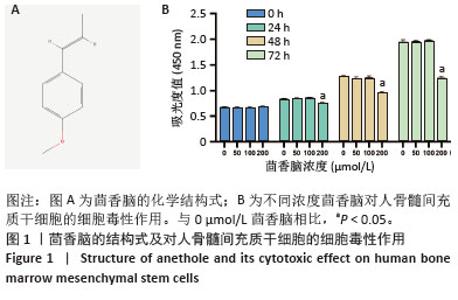
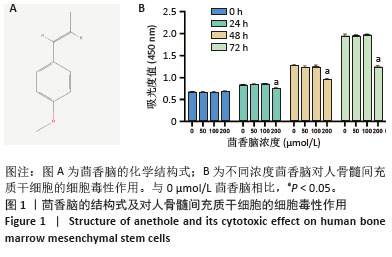
2.1 茴香脑的结构及对人骨髓间充质干细胞的毒性作用 搜索PubChem数据库可知茴香脑的分子式为C10H12O,分子结构中含有苯环结构,为苯丙素类化合物。使用0,50,100,200 μmol/L茴香脑刺激人骨髓间充质干细胞0,24,48,72 h,结果显示与低浓度茴香脑相比,200 μmol/L茴香脑在24,48,72 h时吸光度值显著降低,抑制人骨髓间充质干细胞增殖,而50,100 μmol/L茴香脑对人骨髓间充质干细胞无毒性作用(图1),选择100 μmol/L茴香脑进行后续探索性实验。 "
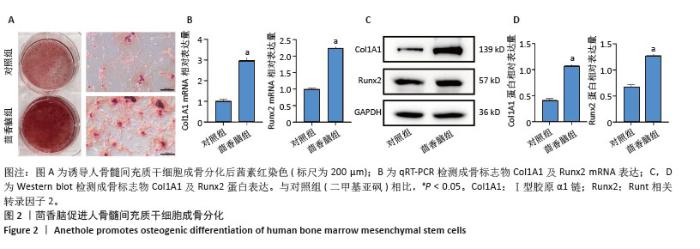
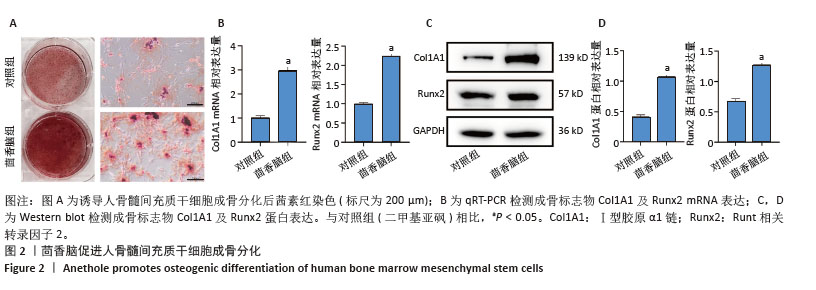
2.2 茴香脑能促进人骨髓间充质干细胞成骨分化 茜素红染色结果显示,与对照组相比,100 μmol/L茴香脑组细胞中钙结节更多。qRT-PCR和Western blot结果显示,与对照组相比,100 μmol/L茴香脑组成骨标志物Ⅰ型胶原α1链及Runt相关转录因子2 mRNA和蛋白表达显著升高(图2)。"
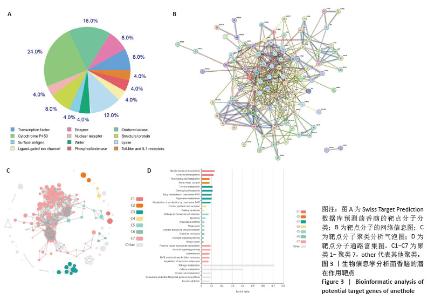
2.3 表皮生长因子受体相关通路可能是茴香脑的潜在作用靶点 借助Swiss Target Prediction数据库,检索与茴香脑相关的靶点分子,通过生物信息平台将获得的靶点分子绘制网络信息图并进行通路富集,结果显示茴香脑的作用范围广泛,可能和表皮生长因子受体相关通路、雌激素相关信号通路、类风湿关节炎相关信号通路等多条通路相关(图3)。 "
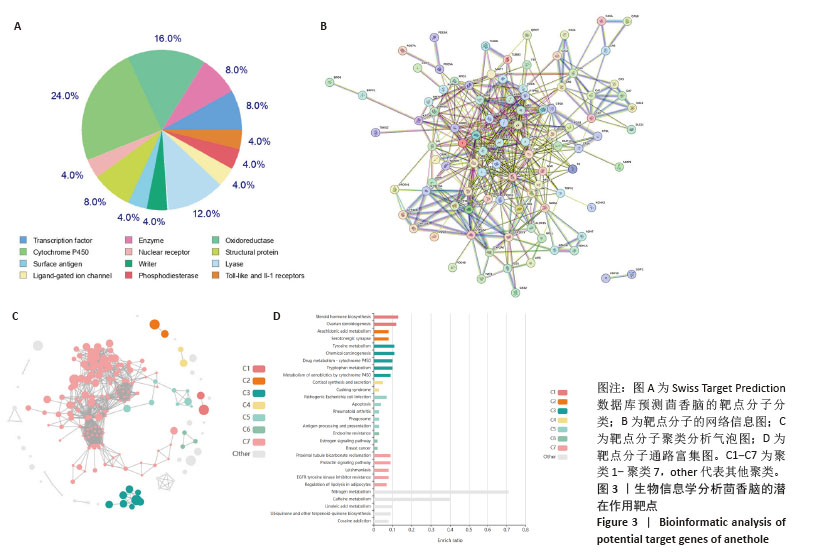
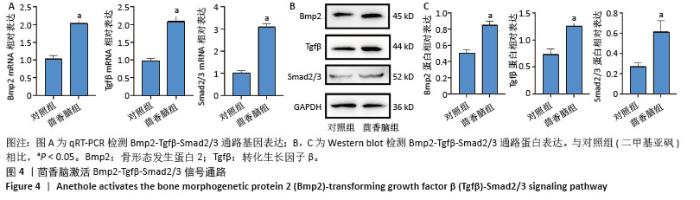
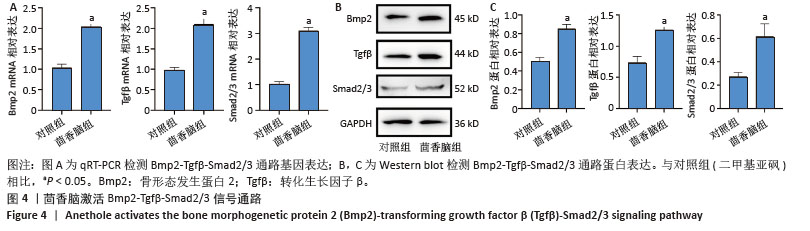
2.4 茴香脑能够激活骨形态发生蛋白2-转化生长因子β-Smad2/3信号通路 与对照组比较,100 μmol/L茴香脑组骨形态发生蛋白2、转化生长因子β、Smad2/3 mRNA和蛋白表达显著升高(图4),说明茴香脑能激活骨形态发生蛋白2-转化生长因子β-Smad2/3信号通路。 "
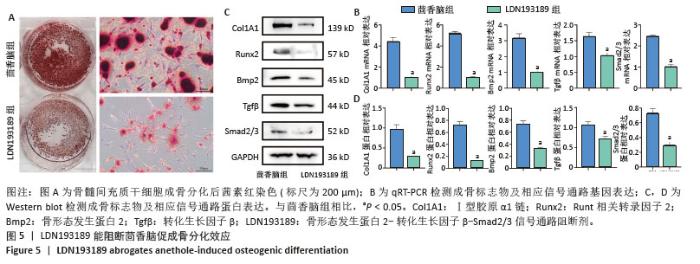
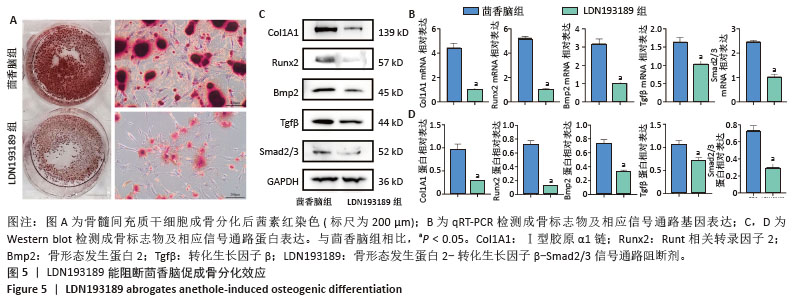
2.5 抑制骨形态发生蛋白2-转化生长因子β-Smad2/3信号通路激活能减弱茴香脑促成骨分化效果 茜素红染色结果显示,与茴香脑组相比,1 μmol/L LDN193189组细胞中钙结节明显较少。qRT-PCR和Western blot结果显示,与茴香脑组相比,1 μmol/L LDN193189组骨形态发生蛋白2、转化生长因子β、Smad2/3 mRNA和蛋白表达以及Ⅰ型胶原α1链、Runt相关转录因子2 mRNA和蛋白表达显著降低(图5)。因此,抑制骨形态发生蛋白2-转化生长因子β-Smad2/3通路激活能有效减弱茴香脑促成骨分化效果。 "
| [1] CLYNES MA, HARVEY NC, CURTIS EM, et al. The epidemiology of osteoporosis. Br Med Bull. 2020;133(1):105-117. [2] YII CY, HUANG JY, YONG SB, et al. Interaction of ALDH2 and ALDH1A single-nucleotide polymorphisms with alcohol consumption and impact on osteoporosis risk. J Formos Med Assoc. 2025. doi: 10.1016/j.jfma.2025.08.040. [3] YIN YH, LIN YQ, WU J, et al. Investigation of prevalence rate of osteoporosis and analysis of its influencing factors in older adults in Jiuting Town, Songjiang District, Shanghai City. Zhonghua Yu Fang Yi Xue Za Zhi. 2024;58(7):1048-1054. [4] GERALDI MV, GREGORI G, JOHANSSON L, et al. Associations between body composition and bone loss in early postmenopausal women. J Bone Miner Res. 2025:zjaf125. [5] JENSEN LB, VESTERGAARD P, HERMANN AP, et al. Hormone replacement therapy dissociates fat mass and bone mass, and tends to reduce weight gain in early postmenopausal women: a randomized controlled 5-year clinical trial of the Danish Osteoporosis Prevention Study. J Bone Miner Res. 2003;18(2):333-342. [6] MONACI S, WU M, OKADA H, et al. PTH counteracts Hippo signaling via Src-dependent YAP stabilization to enhance bone marrow stromal cell differentiation. JCI Insight. 2025;10(16):e191245. [7] CHEN Y, ZHANG Z, TI H, et al. Sympathetic cholinergic nerve fibres promote BMSC differentiation into osteoblasts via NRTN secretion: a potential treatment for osteoporosis. J Orthop Surg Res. 2025;20(1):571. [8] KO SY, LIN JF, LIN CH, et al. Patients with osteoporosis: Treatment with zoledronic acid instead of alendronic acid is associated with a higher risk of ischemic stroke - A real-world global study. J Stroke Cerebrovasc Dis. 2025;34(11):108456. [9] RATTANAPITOON NK, THITIMAHATTHANAKUSOL P, AEKSANIT T, et al. Advancing Nutritional Strategies for Glucocorticoid-Induced Osteoporosis: Perspectives on Selenium-Enriched Egg White Protein and Gut-Bone Axis Modulation. J Food Sci. 2025;90(10):e70584. [10] IZQUIERDO M, RAMÍREZ-VÉLEZ R, FIATARONE SINGH MA. Integrating exercise and medication management in geriatric care: a holistic strategy to enhance health outcomes and reduce polypharmacy. Lancet Healthy Longev. 2025;6(9):100763. [11] XU X, ZHANG Z, WANG W, et al. Therapeutic Effect of Cistanoside A on Bone Metabolism of Ovariectomized Mice. Molecules. 2017;22(2):197. [12] HU W, SI Y, WEN X, et al. Pharmacological Effects and Mechanisms of Tanshinone IIA in Bone Injury Repair. Pharmaceuticals (Basel). 2025;18(9):1338. [13] ZHU Z, XUE LM, HAN T, et al. Antiosteoporotic effects and proteomic characterization of the target and mechanism of an Er-Xian Decoction on osteoblastic UMR-106 and osteoclasts induced from RAW264.7. Molecules. 2010;15(7):4695-4710. [14] JIN Z, DA W, SHEN Y, et al. A traditional herbal decoction regulates skeletal muscle satellite cell osteogenesis and myogenesis for repairing osteosarcopenic fractures via β-catenin. Stem Cell Res Ther. 2025;16(1):521. [15] 侯振丽,胡爱林,石旭柳,等.八角茴香的化学成分及生物活性研究进展[J].中药材,2021,44(8):2008-2017. [16] WANG Y, WANG L, NIU Y, et al. Preparation of a Carbon Quantum Dot from Star Anise and Its Applications as an Antibacterial Agent and as a Probe for Sensing of Permanganate Ions. ACS Omega. 2025;10(32):35528-35539. [17] GIRI SS, KIM HJ, SAHA S, et al. Effect of Illicium verum Hook.f. (star anise) extract on the modulation of systemic and mucosal immunity in Aeromonas hydrophila-aggravated Cyprinus carpio. Fish Shellfish Immunol. 2025;166:110615. [18] 王文慧.茴香脑对局灶性脑梗死小鼠神经功能及血脑屏障保护作用的机制研究[D].石家庄:河北医科大学,2016. [19] QU H, ZHANG Y, HE R, et al. Anethole inhibits RANKL-induced osteoclastogenesis by downregulating ERK/AKT signaling and prevents ovariectomy-induced bone loss in vivo. Int Immunopharmacol. 2021;100:108113. [20] CHENG CH, CHEN LR, CHEN KH. Osteoporosis Due to Hormone Imbalance: An Overview of the Effects of Estrogen Deficiency and Glucocorticoid Overuse on Bone Turnover. Int J Mol Sci. 2022;23(3):1376. [21] ZENG Z, ZHOU X, WANG Y, et al. Mitophagy-A New Target of Bone Disease. Biomolecules. 2022;12(10):1420. [22] LIANG Z, WU B, JI Z, et al. The binding of LDN193189 to CD133 C-terminus suppresses the tumorigenesis and immune escape of liver tumor-initiating cells. Cancer Lett. 2021;513:90-100. [23] NAN W, ZHOU WM, ZI JL, et al. Ferroptosis and bone metabolic diseases: the dual regulatory role of the Nrf2/HO-1 signaling axis. Front Cell Dev Biol. 2025;13:1615197. [24] SHEN J, LAI Y, PENG Q, et al. Mitochondrial Transplantation: A Paradigm Shift in Osteoporosis Therapy. Int J Nanomedicine. 2025;20:11169-11196. [25] ARUN M, RAJASINGH S, MADASAMY P, et al. Immunomodulatory and Regenerative Functions of MSC-Derived Exosomes in Bone Repair. Bioengineering (Basel). 2025;12(8):844. [26] WATTS NB, CAMACHO PM, LEWIECKI EM, et al. American Association of Clinical Endocrinologists/American College of Endocrinology Clinical Practice Guidelines for the Diagnosis and Treatment of Postmenopausal Osteoporosis-2020 Update. Endocr Pract. 2021;27(4):379-380. [27] ZHU Y, CAI B. Mechanisms and therapeutic insights into MASH-associated fibrosis. Trends Endocrinol Metab. 2025. doi: 10.1016/j.tem.2025.09.004. [28] FARIA LP, ARANA-CHAVEZ VE, HOLLIDAY LS. Alendronate Alters the Release of EVs by Raw 264.7 Osteoclasts. J Histochem Cytochem. 2025;73(9-10):371-377. [29] HASSAN N, GREGSON CL, TOBIAS JH. Anabolic treatments for osteoporosis in postmenopausal women. Fac Rev. 2021;10:44. [30] LEI C, SONG JH, LI S, et al. Advances in materials-based therapeutic strategies against osteoporosis. Biomaterials. 2023;296:122066. [31] ZHANG S, KUANG X, GUO C, et al. Advanced strategies for the processing and utilization of star Anise (Illicium verum hook. F.): blanching, drying and bioactive compounds extraction. Food Res Int. 2025;217:116863. [32] ALBRAKATI A. Protective effects of shikimic acid against thioacetamide-induced hepatic fibrosis: role of Nrf2/NF-κB signaling pathways. Front Pharmacol. 2025; 16:1609711. [33] LI SD, XING W, WANG SC, et al. Fibulin2: a negative regulator of BMSC osteogenic differentiation in infected bone fracture healing. Exp Mol Med. 2023;55(2):443-456. [34] YANG X, WANG X, BAO S, et al. Exploring plasticisers-osteoporosis links and mechanisms: a cohort and network toxicology study. Front Toxicol. 2025;7:1617663. [35] WANG S, TIAN C, LIU J, et al. Melatonin inhibits adipogenesis and enhances osteogenesis of BMSCs through increasing KLF5 expression. Cell Signal. 2025;135:112017. [36] XIE B, ZHOU H, LIU H, et al. Salidroside alleviates dexamethasone-induced inhibition of bone formation via transforming growth factor-beta/Smad2/3 signaling pathway. Phytother Res. 2023;37(5):1938-1950. [37] MARINI JC, FORLINO A, BÄCHINGER HP, et al. Osteogenesis imperfecta. Nat Rev Dis Primers. 2017;3:17052. [38] WANG WX, LEI YX, LAI YZ, et al. Modulation of osteogenic differentiation in mouse osteoprogenitor cells by curved microgrooves with varied roughness on polycaprolactone surfaces. Zhonghua Kou Qiang Yi Xue Za Zhi. 2025;60(10):1152-1161. [39] SILLMANN YM, BAGGIO AMP, EBER P, et al. Advancing Scaffold Architecture for Bone Tissue Engineering: A Comparative Study of 3D-Printed β-TCP Constructs in Dynamic Culture with pBMSC. J Funct Biomater. 2025;16(9):327. [40] ELGAMILY M, DENEWAR M, EMAM AA, et al. Injectable GSK3 inhibitor (Tideglusib) hydrogel versus enhanced β-tricalcium phosphate in tibial bone healing (in vitro and in vivo study). Odontology. 2025. doi: 10.1007/s10266-025-01203-4. [41] YANG L, YANG G, YANG Q, et al. Importin-7 promotes tension-induced osteogenesis by regulating RUNX2 nuclear translocation during orthodontic tooth movement. Sci Rep. 2025;15(1):33026. [42] MEDRADO NV, COSTA BH, PIRES ABM, et al. Enhancing osteoinduction: Collagen biogel enriched with piezoelectric barium titanate nanoparticles. Int J Biol Macromol. 2025;323(Pt 1):146883. [43] KOTRYCH K, WOJTUŃ M, GÓRSKA A, et al. The Influence of Clinical Factors and Genetic Variants of COL1A1 and TNFRSF11B on Bone Mineral Density in Postmenopausal Women. Int J Mol Sci. 2025;26(18):8894. [44] ZOU ML, CHEN ZH, TENG YY, et al. The Smad Dependent TGF-β and BMP Signaling Pathway in Bone Remodeling and Therapies. Front Mol Biosci. 2021;8:593310. [45] WU M, WU S, CHEN W, et al. The roles and regulatory mechanisms of TGF-β and BMP signaling in bone and cartilage development, homeostasis and disease. Cell Res. 2024;34(2):101-123. [46] DU Y, LIU G, LIU Z, et al. Avermectin reduces bone mineralization via the TGF-β signaling pathway in zebrafish. Comp Biochem Physiol C Toxicol Pharmacol. 2023;272:109702. [47] LIU X, LI X, TAO Y, et al. TCDD inhibited the osteogenic differentiation of human fetal palatal mesenchymal cells through AhR and BMP-2/TGF-β/Smad signaling. Toxicology. 2020;431:152353. [48] CHENG WH, KAO SY, CHEN CL, et al. Amphiregulin induces CCN2 and fibronectin expression by TGF-β through EGFR-dependent pathway in lung epithelial cells. Respir Res. 2022;23(1):381. [49] LI J, CAO J, YAN C, et al. TGF-α/EGFR signaling promotes lipopolysaccharide-induced abnormal elastin deposition and alveolar simplification. Exp Cell Res. 2024;437(1):113997. [50] MINATO Y, NAKANO-DOI A, MAEDA S, et al. A Bone Morphogenetic Protein Signaling Inhibitor, LDN193189, Converts Ischemia-Induced Multipotent Stem Cells into Neural Stem/Progenitor Cell-Like Cells. Stem Cells Dev. 2022;31(23-24):756-765. [51] ZHANG L, JIAO G, REN S, et al. Exosomes from bone marrow mesenchymal stem cells enhance fracture healing through the promotion of osteogenesis and angiogenesis in a rat model of nonunion. Stem Cell Res Ther. 2020;11(1):38. |
| [1] | Chen Huiting, Zeng Weiquan, Zhou Jianhong, Wang Jie, Zhuang Congying, Chen Peiyou, Liang Zeqian, Deng Weiming. Tail anchoring technique of vertebroplasty in treatment of osteoporotic vertebral compression fractures with intravertebral cleft: a finite element analysis [J]. Chinese Journal of Tissue Engineering Research, 2026, 30(9): 2145-2152. |
| [2] | Zeng Xuan, Weng Rui, Ye Shicheng, Tang Jiadong, Mo Ling, Li Wenchao. Two lumbar rotary manipulation techniques in treating lumbar disc herniation: a finite element analysis of biomechanical differences [J]. Chinese Journal of Tissue Engineering Research, 2026, 30(9): 2153-2161. |
| [3] | Cheng Qisheng, Julaiti·Maitirouzi, Xiao Yang, Zhang Chenwei, Paerhati·Rexiti. Finite element analysis of novel variable-diameter screws in modified cortical bone trajectory of lumbar vertebrae [J]. Chinese Journal of Tissue Engineering Research, 2026, 30(9): 2162-2171. |
| [4] | Liu Wenlong, Dong Lei, Xiao Zhengzheng, Nie Yu. Finite element analysis of tibial prosthesis loosening after fixed-bearing unicompartmental knee arthroplasty for osteoporosis [J]. Chinese Journal of Tissue Engineering Research, 2026, 30(9): 2191-2198. |
| [5] | Chen Long, Wang Xiaozhen, Xi Jintao, Lu Qilin. Biomechanical performance of short-segment screw fixation combined with expandable polyetheretherketone vertebral body replacement in osteoporotic vertebrae [J]. Chinese Journal of Tissue Engineering Research, 2026, 30(9): 2226-2235. |
| [6] | Wu Yanting, Li Yu, Liao Jinfeng. Magnesium oxide nanoparticles regulate osteogenesis- and angiogenesis-related gene expressions to promote bone defect healing [J]. Chinese Journal of Tissue Engineering Research, 2026, 30(8): 1885-1895. |
| [7] | Jiang Xinghai, Song Yulin, Li Dejin, Shao Jianmin, Xu Junzhi, Liu Huakai, Wu Yingguo, Shen Yuehui, Feng Sicheng. Vascular endothelial growth factor 165 genes transfected into bone marrow mesenchymal stem cells to construct a vascularized amphiphilic peptide gel module [J]. Chinese Journal of Tissue Engineering Research, 2026, 30(8): 1903-1911. |
| [8] | Hu Xiongke, Liu Shaohua, Tan Qian, Liu Kun, Zhu Guanghui. Shikonin intervention with bone marrow mesenchymal stem cells improves microstructure of femur in aged mice [J]. Chinese Journal of Tissue Engineering Research, 2026, 30(7): 1609-1615. |
| [9] | Yuan Xiaoshuang, Yang Xu, Yang Bo, Chen Xiaoxu, Tian Ting, Wang Feiqing, Li Yanju, Liu Yang, Yang Wenxiu. Effect of conditioned medium of diffuse large B-cell lymphoma cells on proliferation and apoptosis of human bone marrow mesenchymal stem cells [J]. Chinese Journal of Tissue Engineering Research, 2026, 30(7): 1632-1640. |
| [10] | Li Zhenyu, Zhang Siming, Bai Jiaxiang, Zhu Chen. Osthole improves osteogenic differentiation function of bone marrow mesenchymal stem cells under high-glucose conditions [J]. Chinese Journal of Tissue Engineering Research, 2026, 30(7): 1641-1648. |
| [11] | Han Nianrong, Huang Yifei, Akram · Osman, Liu Yanlu, Hu Wei . Programmed cell death receptor-1 suppresses osteogenic differentiation of rat bone marrow mesenchymal stem cells in a high-glucose microenvironment [J]. Chinese Journal of Tissue Engineering Research, 2026, 30(7): 1649-1657. |
| [12] | Jin Dongsheng, Zhao Zhanghong, Zhu Ziyin, Zhang Sen, Sun Zuyan, Deng Jiang. Effects of icariin-loaded microsphere-three-dimensional scaffold on osteogenic differentiation of rabbit bone marrow mesenchymal stem cells [J]. Chinese Journal of Tissue Engineering Research, 2026, 30(7): 1658-1668. |
| [13] | Zou Yulian, Chen Chaopei, Huang Haixia, Lan Yuyan, Liu Min, Huang Ting. Resveratrol promotes osteogenic differentiation of bone marrow mesenchymal stem cells in an inflammatory microenvironment [J]. Chinese Journal of Tissue Engineering Research, 2026, 30(7): 1669-1678. |
| [14] | Wu Zhilin, , He Qin, Wang Pingxi, Shi Xian, Yuan Song, Zhang Jun, Wang Hao . DYRK2: a novel therapeutic target for rheumatoid arthritis combined with osteoporosis based on East Asian and European populations [J]. Chinese Journal of Tissue Engineering Research, 2026, 30(6): 1569-1579. |
| [15] | Zhang Haiwen, Zhang Xian, Xu Taichuan, Li Chao. Bibliometric and visual analysis of the research status and trends of senescence in osteoporosis [J]. Chinese Journal of Tissue Engineering Research, 2026, 30(6): 1580-1591. |
| Viewed | ||||||
|
Full text |
|
|||||
|
Abstract |
|
|||||