Chinese Journal of Tissue Engineering Research ›› 2026, Vol. 30 ›› Issue (27): 7176-7181.doi: 10.12307/2026.443
Previous Articles Next Articles
Low-frequency repetitive transcranial magnetic stimulation improves limb motor function and upper limb muscles in stroke patients: a meta-analysis
Ren Pengbo1, Li Tingwen2, Cai Feng3, Zhang Jianhua3
- 1Changzhou University Huaide College, Jingjiang 214500, Jiangsu Province, China; 2School of Physical Education, Minnan Normal University, Zhangzhou 363000, Fujian Province, China; 3School of Physical Education, Northwest Normal University, Lanzhou 730070, Gansu Province, China
-
Received:2025-11-18Accepted:2026-01-23Online:2026-09-28Published:2026-05-25 -
Contact:Li Tingwen, PhD, Lecturer, Master’s supervisor, School of Physical Education, Minnan Normal University, Zhangzhou 363000, Fujian Province, China Co-corresponding author: Zhang Jianhua, MS, Professor (Level II), Doctoral supervisor, School of Physical Education, Northwest Normal University, Lanzhou 730070, Gansu Province, China -
About author:Ren Pengbo, MS, Lecturer, Changzhou University Huaide College, Jingjiang 214500, Jiangsu Province, China -
Supported by:National Social Science Foundation of China, No. 20BTY090 (to ZJH); Ministry of Education Humanities and Social Sciences Research Foundation, No. 24YJCZH145 (to LTW); Fujian Provincial Social Science Research Foundation, No. FJ2022C014 (to LTW)

CLC Number:
Cite this article
Ren Pengbo, Li Tingwen, Cai Feng, Zhang Jianhua. Low-frequency repetitive transcranial magnetic stimulation improves limb motor function and upper limb muscles in stroke patients: a meta-analysis[J]. Chinese Journal of Tissue Engineering Research, 2026, 30(27): 7176-7181.
share this article
Add to citation manager EndNote|Reference Manager|ProCite|BibTeX|RefWorks
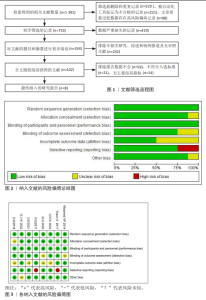
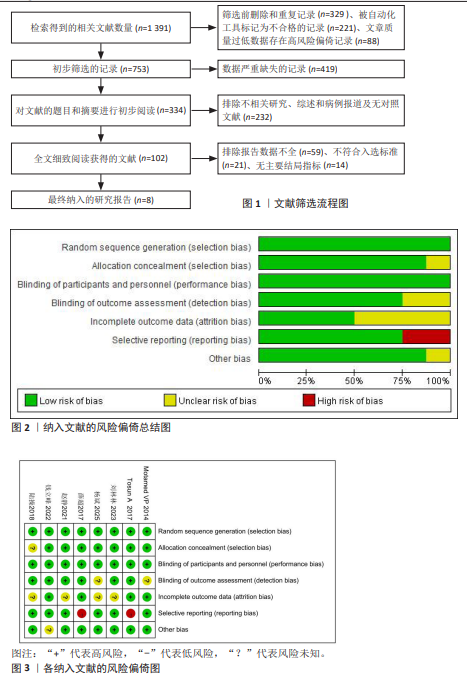
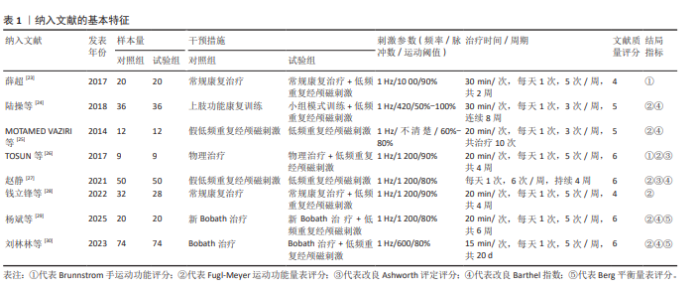
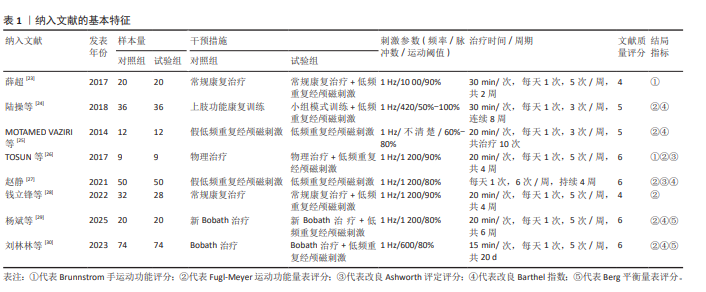
2.1 文献检索结果及纳入文献基本情况 共检索到相关文献1 391篇,删除重复文献329篇、不合格文献221篇、文章质量过低数据存在高风险偏倚88篇与数据严重缺失文献419篇;对文献的题目和摘要进行初步阅读,排除不相关研究、综述和病例报道及无对照文献232篇,排除报告数据不全、不符合入选标准与无主要结局指标文献94篇,最终纳入8篇高质量文献,样本总量为502例。文献筛选流程图见图1。纳入文献的基本特征见表1。 2.2 纳入文献方法学质量评估 纳入的8篇文献均对研究对象的基线特征进行了详细报告,并且均详细阐述了具体的干预措施、评估指标与具体分组方法,然而,均未对盲法应用以及失访或退出者数量及原因进行详尽说明。纳入文献的风险偏倚分析结果见图2,3。"
"
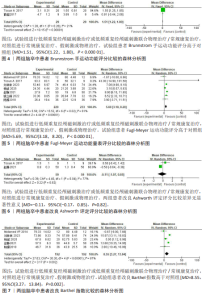
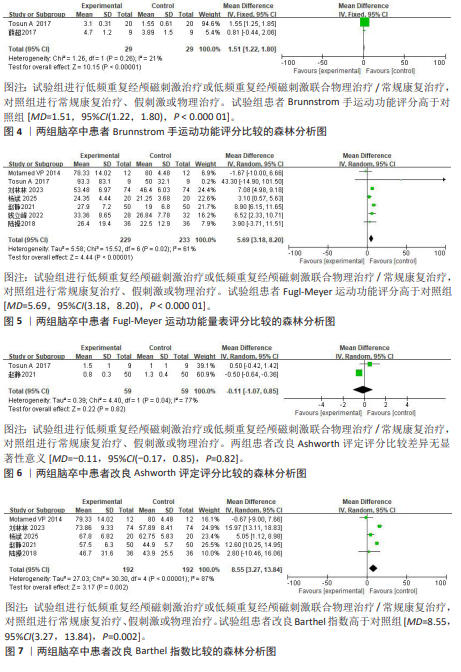
2.3 Meta分析结果 2.3.1 Brunnstrom手运动功能评分 2项研究明确报告了Brunnstrom手运动功能评分数据[23,26]。 异质性检验结果显示各研究间的异质性较低(I2=21%,P=0.26),采用固定效应模型进行分析,结果显示试验组患者Brunnstrom手运动功能评分高于对照组[MD=1.51,95%CI(1.22,1.80),P < 0.000 01],见图4。结果表明,试验组患者手运动功能改善情况显著优于对照组。 2.3.2 Fugl-Meyer运动功能量表评分 7项研究报告了Fugl-Meyer运动功能量表评分[24-30]。异质性检验结果显示各研究间的异质性较高(I2=61%,P=0.02),采用随机效应模型进行分析,结果显示试验组患者Fugl-Meyer运动功能评分高于对照组 [MD=5.69,95%CI(3.18,8.20), P < 0.000 01],见图5。结果表明,试验组患者上肢运动功能改善情况优于对照组。 2.3.3 改良Ashworth评定评分 2项研究报告了改良Ashworth评定评分[26-27]。异质性检验结果显示各研究间的异质性较高(I2=77%,P=0.04),采用随机效应模型进行分析,结果显示两组患者改良Ashworth评定评分比较差异无显著性意义[MD=-0.11,95%CI(-0.17,0.85),P=0.82],见图6。结果表明,试验组患者上肢肌肉痉挛改善情况与对照组相比无明显差异。 2.3.4 改良Barthel指数 5项研究报告了改良Barthel指数[24-25,28-30]。异质性检验结果显示各研究间的异质性较高(I2=87%,P < 0.000 01),采用随机效应模型进行分析,结果显示试验组患者改良Barthel指数高于对照组[MD=8.55,95%CI(3.27,13.84),P=0.002],见图7。结果表明,试验组患者日常生活活动能力较对照组明显提高,从而客观地反映和衡量一个人的日常生活活动能力是“完全独立”“中度依赖”还是“严重依赖”。"
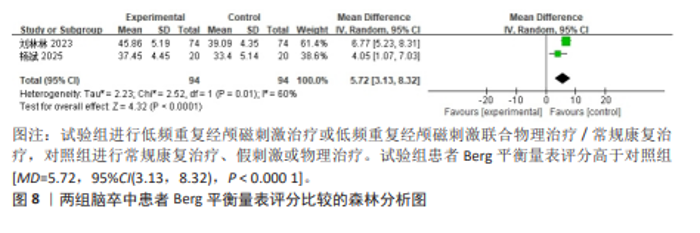
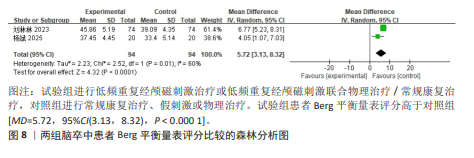
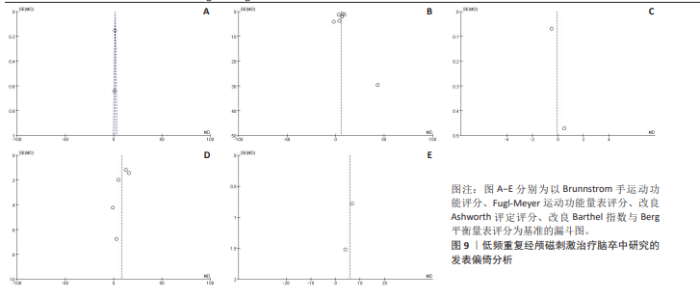
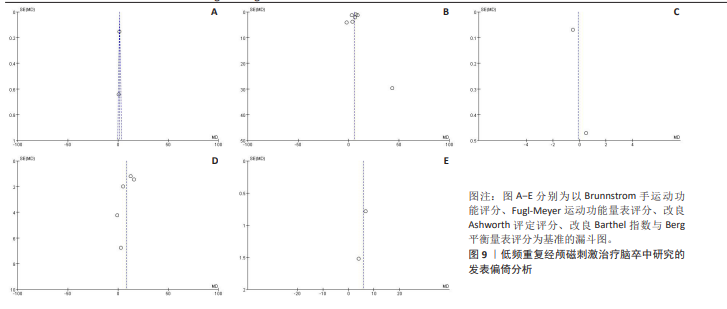
2.3.5 Berg平衡量表评分 2项研究报告了Berg平衡量表评分[29-30]。异质性检验结果显示各研究间的异质性较高(I2=60%,P=0.01),采用随机效应模型进行分析,结果显示试验组患者Berg平衡量表评分高于对照组[MD=5.72,95%CI(3.13,8.32),P < 0.000 1],见图8。结果表明,试验组患者平衡功能优于对照组。 2.3.6 发表偏倚分析 此次研究以Brunnstrom手运动功能评分、Fugl-Meyer运动功能量表评分、改良Ashworth评定评分、改良Barthel指数及Berg平衡量表评分作为评价指标,分别绘制漏斗图以评估发表偏倚,见图9。分析结果显示多数漏斗图整体呈现大致对称分布,但是由于纳入研究数量较少,提示此次分析所纳入的研究可能存在发表偏倚。由于当前纳入文献数量有限,进行亚组分析或Meta回归分析的可行性较低、解释力有限,因此未进一步开展此类分析,建议在未来相关研究积累更充分时再行深入探讨。"
"
| [1] POTTER TBH, TANNOUS J, VAHIDY FS. A Contemporary Review of Epidemiology, Risk Factors, Etiology, and Outcomes of Premature Stroke. Curr Atheroscler Rep. 2022;24(12):939-948. [2] 熊丹,谢海花,李浩,等.不同重复经颅磁刺激模式对脑卒中后上肢运动功能障碍干预效果的网状Meta分析[J].中国全科医学,2023, 26(8):997-1007,1014. [3] 陈庆梅,蔡秀英,潘习,等.重复经颅磁刺激治疗急性脑卒中后上肢运动功能障碍的研究进展[J].中国康复医学杂志,2022,37(10):1415-1420. [4] KLOOSTER DCW, FERGUSON MA, BOON PAJM, et al. Personalizing Repetitive Transcranial Magnetic Stimulation Parameters for Depression Treatment Using Multimodal Neuroimaging. Biol Psychiatry Cogn Neurosci Neuroimaging. 2022;7(6):536-545. [5] SAFDAR A, SMITH MC, BYBLOW WD, et al. Applications of Repetitive Transcranial Magnetic Stimulation to Improve Upper Limb Motor Performance After Stroke: A Systematic Review. Neurorehabil Neural Repair. 2023;37(11-12):837-849. [6] BREDA V, FREIRE R. Repetitive Transcranial Magnetic Stimulation (rTMS) in Major Depression. Adv Exp Med Biol. 2024;1456:145-159. [7] LANZA G, FISICARO F, CANTONE M, et al. Repetitive transcranial magnetic stimulation in primary sleep disorders. Sleep Med Rev. 2023;67:101735. [8] FITZSIMMONS SMDD, VAN DER WERF YD, VAN CAMPEN AD, et al. Repetitive transcranial magnetic stimulation for obsessive-compulsive disorder: A systematic review and pairwise/network meta-analysis. J Affect Disord. 2022;302:302-312. [9] DONG C, CHEN C, WANG T, et al. Low-Frequency Repetitive Transcranial Magnetic Stimulation for the Treatment of Chronic Tinnitus: A Systematic Review and Meta-Analysis of Randomized Controlled Trials. Biomed Res Int. 2020;2020:3141278. [10] 刘鹏程,刘静,曾国锋,等.气电驱动软体康复手套联合低频重复经颅磁刺激对脑卒中患者上肢和手功能的影响[J].中国康复医学杂志, 2025,40(1):79-84. [11] 李响,张洪蕊,杨帅,等.低频重复经颅磁刺激联合下肢康复机器人对脑卒中患者平衡和运动功能的影响[J].中国康复医学杂志,2025, 40(2):211-216. [12] PAN J, LI H, WANG Y, et al. Effects of low-frequency rTMS combined with antidepressants on depression in patients with post-stroke depression: a systematic review and meta-analysis. Front Neurol. 2023;14:1168333. [13] 胡渊,位娜娜,许雷雷.超低频重复经颅磁刺激对缺血性脑卒中患者吞咽功能及血清CRP、IL-6水平的影响[J].中国卫生工程学,2024, 23(6):793-795. [14] 陆以欢,杨雪,姚黎清,等.经颅磁刺激在脑卒中患者平衡及步行障碍中的研究进展[J].中国老年保健医学,2024,22(2):135-138. [15] BAI Z, ZHANG J, FONG KNK. Effects of transcranial magnetic stimulation in modulating cortical excitability in patients with stroke: a systematic review and meta-analysis. J Neuroeng Rehabil. 2022;19(1):24. [16] LEE Y, OH BM, PARK SH, et al. Low-Frequency Repetitive Transcranial Magnetic Stimulation in the Early Subacute Phase of Stroke Enhances Angiogenic Mechanisms in Rats. Ann Rehabil Med. 2022;46(5):228-236. [17] 崔莉茹,王寒明,杨傲然,等.联合低频重复经颅磁刺激和神经肌肉关节促进法技术在改善卒中后肌张力增高的研究[J].中国医学装备,2024, 21(10):90-95. [18] LI C, YANG H, CHENG L, et al. Quantitative Assessment of Hand Motor Function for Post-Stroke Rehabilitation Based on HAGCN and Multimodality Fusion. IEEE Trans Neural Syst Rehabil Eng. 2022;30:2032-2041. [19] 李永义,张义发,徐秀芳,等.rTMS联合肩前屈特定角度训练对脑卒中偏瘫患者上肢功能恢复的影响[J].中南医学科学杂志,2024,52(5):779-781. [20] PAN JX, DIAO YX, PENG HY, et al. Effects of repetitive peripheral magnetic stimulation on spasticity evaluated with modified Ashworth scale/Ashworth scale in patients with spastic paralysis: A systematic review and meta-analysis. Front Neurol. 2022;13:997913. [21] MCGILL K, SACKLEY C, GODWIN J, et al. Using the Barthel Index and modified Rankin Scale as Outcome Measures for Stroke Rehabilitation Trials; A Comparison of Minimum Sample Size Requirements. J Stroke Cerebrovasc Dis. 2022;31(2):106229. [22] KASHIF M, AHMAD A, BANDPEI MAM, et al. Psychometric Properties of the Urdu Translation of Berg Balance Scale in People with Parkinson’s Disease. Int J Environ Res Public Health. 2022; 19(4):2346. [23] 薛超.重复经颅磁刺激对脑卒中后手运动功能恢复的疗效研究[D].蚌埠:蚌埠医学院,2017. [24] 陆操,金丹丹,傅晓倩,等.低频重复经颅磁刺激联合小组模式康复训练对脑卒中偏瘫患者上肢及手功能的影响[J].中国康复,2018,33(5):369-372. [25] MOTAMED VAZIRI P, BAHRPEYMA F, FIROOZABADI M, et al. Low frequency repetitive transcranial magnetic stimulation to improve motor function and grip force of upper limbs of patients with hemiplegia. Iran Red Crescent Med J. 2014;16(8):e13579. [26] TOSUN A, TÜRE S, ASKIN A, et al. Effects of low-frequency repetitive transcranial magnetic stimulation and neuromuscular electrical stimulation on upper extremity motor recovery in the early period after stroke: a preliminary study. Top Stroke Rehabil. 2017;24(5):361-367. [27] 赵静.低频重复经颅磁刺激对脑卒中患者偏瘫上肢痉挛及肢体运动功能的疗效观察[J].临床研究,2021,29(2):83-85. [28] 钱立锋,金文杰,朱鑫鑫,等.低频重复经颅磁刺激对脑卒中患者上肢运动功能及脑血流的影响[J].中国现代医生,2022,60(9):88-92. [29] 杨斌,刘奥龙,何双双,等.新Bobath治疗联合低频重复经颅磁刺激对脑卒中偏瘫患者下肢运动功能的影响[J].神经损伤与功能重建,2025, 20(1):59-62. [30] 刘林林,魏冬梅,苏庆文,等.低频重复经颅磁刺激联合Bobath疗法对脑卒中偏瘫患者神经功能、运动功能及平衡能力的影响[J].现代生物医学进展,2023,23(6):1116-1120. [31] 郝小路,严兴科,刘安国.重复经颅磁刺激治疗缺血性脑卒中的机制研究进展[J].中外医学研究,2023,21(10):174-179. [32] 李阳阳,刘欣欣.低频重复经颅脑刺激联合针刺法治疗脑梗死后淡漠综合征的效果[J].河南医学研究,2025,34(1):80-84. [33] 陈迎年,刘雪,张晨茜.低频重复经颅磁刺激联合分期针刺疗法在脑卒中后偏瘫患者中的应用研究[J].河北中医,2024,46(7):1164-1168. [34] CABRAL DF, FRIED P, KOCH S, et al. Efficacy of mechanisms of neuroplasticity after a stroke. Restor Neurol Neurosci. 2022;40(2):73-84. [35] 张成才,寸勇丹,周丽,等.外周电刺激在促进脑卒中后神经可塑性中应用及机制[J].中国老年学杂志,2024,44(12):3055-3061. [36] 张成才,宁蓉,陈娜,等.正中神经电刺激对缺血性脑卒中大鼠突触可塑性的影响[J].昆明医科大学学报,2023,44(12):6-12. [37] LUK KY, OUYANG HX, PANG MYC. Low-Frequency rTMS over Contralesional M1 Increases Ipsilesional Cortical Excitability and Motor Function with Decreased Interhemispheric Asymmetry in Subacute Stroke: A Randomized Controlled Study. Neural Plast. 2022;2022:3815357. [38] YUKAWA Y, SHIBATA S, KOGANEMARU S, et al. Low-frequency repetitive transcranial magnetic stimulation can alleviate spasticity and induce functional recovery in patients with severe chronic stroke: A prospective, non-controlled, pilot study. Heliyon. 2023;9(4):e15564. [39] WANG Y, WANG L, NI X, et al. Efficacy of repetitive transcranial magnetic stimulation with different application parameters for post-stroke cognitive impairment: a systematic review. Front Neurosci. 2024;18:1309736. [40] RAJAIN M, BHATIA R, TRIPATHI M, et al. Low-Frequency Repetitive Transcranial Magnetic Stimulation for Chronic Tension-Type Headache: A Randomized Controlled Study. Cureus. 2023;15(2):e34922. [41] HU Q, JIAO X, ZHOU J, et al. Low-frequency repetitive transcranial magnetic stimulation over the right orbitofrontal cortex for patients with first-episode schizophrenia: A randomized, double-blind, sham-controlled trial. Psychiatry Res. 2023;330:115600. [42] LI D, CHENG A, ZHANG Z, et al. Effects of low-frequency repetitive transcranial magnetic stimulation combined with cerebellar continuous theta burst stimulation on spasticity and limb dyskinesia in patients with stroke. BMC Neurol. 2021;21(1):369. [43] CHIEFFO R, COMI G, LEOCANI L. Noninvasive neuromodulation in poststroke gait disorders: rationale, feasibility, and state of the art. Neurorehabil Neural Repair. 2016;30(1):71-82. [44] 沈滢,单春雷,殷稚飞,等.不同频率重复经颅磁刺激对脑梗死患者上肢功能的影响[J].中国康复医学杂志,2012,27(11):997-1001. [45] 赵利娜,张志强,张立新,等.1Hz重复经颅磁刺激对缺血性脑卒中后上肢运动功能的疗效[J].中国康复理论与实践,2015,21(2):216-219. [46] 崔莉茹,王寒明,杨傲然,等.联合低频重复经颅磁刺激和神经肌肉关节促进法技术在改善卒中后肌张力增高的研究[J].中国医学装备, 2024,21(10):90-95. [47] NAKAMURA S, KISHIMOTO Y, SEKINO M, et al. Depression induced by low-frequency repetitive transcranial magnetic stimulation to ventral medial frontal cortex in monkeys. Exp Neurol. 2022;357:114168. [48] LIU L, DING M, WU J, et al. High-frequency repetitive transcranial magnetic stimulation promotes ipsilesional functional hyperemia and motor recovery in mice with ischemic stroke. Cereb Cortex. 2024;34(3):bhae074. [49] BAI G, JIANG L, HUAN S, et al. Study on Low-Frequency Repetitive Transcranial Magnetic Stimulation Improves Speech Function and Mechanism in Patients With Non-fluent Aphasia After Stroke. Front Aging Neurosci. 2022;14:883542. [50] AHMED I, MUSTAFAOGLU R, ROSSI S, et al. Non-invasive Brain Stimulation Techniques for the Improvement of Upper Limb Motor Function and Performance in Activities of Daily Living After Stroke: A Systematic Review and Network Meta-analysis. Arch Phys Med Rehabil. 2023;104(10):1683-1697. [51] CAPARELLI EC, ABULSEOUD OA, GU H, et al. Low frequency repetitive transcranial magnetic stimulation to the right dorsolateral prefrontal cortex engages thalamus, striatum, and the default mode network. Front Neurosci. 2022;16:997259. [52] XIE Y, GUAN M, CAI Y, et al. Impact of low-frequency repetitive transcranial magnetic stimulation on functional network connectivity in schizophrenia patients with auditory verbal hallucinations. Psychiatry Res. 2023;320:114974. [53] CHOU TY, WANG JC, LIN MY, et al. Low-Frequency vs. Theta Burst Transcranial Magnetic Stimulation for the Treatment of Chronic Non-fluent Aphasia in Stroke: A Proof-of-Concept Study. Front Aging Neurosci. 2022;13:800377. [54] 刘天昊,唐芷晴,王荣荣,等.不同模式经颅磁刺激治疗脑卒中后上肢运动功能障碍的研究进展[J].神经损伤与功能重建,2024,19(10):589-592. [55] 熊文勤,习翀.醒脑开窍针法联合低频重复经颅磁刺激辅治脑卒中偏瘫临床观察[J].实用中医药杂志,2024,40(11):2198-2199. [56] 李昭缘,齐瑞,姜林鸿,等.低频重复经颅磁刺激对脑卒中后失语症疗效的Meta分析[J].中国康复,2021,36(11):677-683. [57] CHE LQ, QU ZZ, XIE T, et al. Effect of low‑frequency repetitive transcranial magnetic stimulation on cognitive function in rats with medial temporal lobe epilepsy. Acta Neurobiol Exp (Wars). 2023; 83(4):395-403. [58] 王晓兰,张红艳,张昆,等.电热针联合低频重复经颅磁刺激治疗脑卒中屈肘肌痉挛的临床研究[J].中国康复,2023,38(4):204-207. [59] 朱彦伟,柳韶真,岳玮.低频重复经颅磁刺激联合分期针灸疗法对脑卒中后偏瘫患者表面肌电信号及康复效果的影响[J].新中医,2024, 56(8):127-133. [60] 刘婉,加健,罗昱君,等.基于脑-肢协同调控模式探讨LF-rTMS联合推拿对脑卒中后肢体运动功能障碍的影响[J].中医药信息,2021, 38(7):43-47. |
| [1] | Fang Fengchao, Yang Wenwu, Wu Hongtao, Peng Peng, Liang Zhiye, Jiang Tao, Chen Weijian, Liu Wengang, Zhao Chuanxi. Association between mitochondrial dynamics imbalance and cartilage degeneration in osteoarthritis [J]. Chinese Journal of Tissue Engineering Research, 2026, 30(在线): 1-8. |
| [2] | Wang Nan, Chen Shuang, Xi Zhipeng, Qian Yuzhang, Zhang Xiaoyu, Gu Jun, Kang Ran, Xie Lin. MRI evaluation of nerve root subsidence sign affecting efficacy of percutaneous endoscopic decompression in lumbar spinal stenosis [J]. Chinese Journal of Tissue Engineering Research, 2026, 30(9): 2262-2268. |
| [3] | Li Zhifei, Han Bin, Liu Qiuli, Zhang Zhanming, Wei Haokai, Zuo Kuangshi, Zhang Yisheng. Cervical motion characteristics in patients with cervical spondylotic radiculopathy based on motion capture technology [J]. Chinese Journal of Tissue Engineering Research, 2026, 30(9): 2286-2293. |
| [4] | Zhu Xiaolong, Zhang Wei, Yang Yang. Visualization analysis of research hotspots and cutting-edge information in the field of intervertebral disc regeneration and repair [J]. Chinese Journal of Tissue Engineering Research, 2026, 30(9): 2391-2402. |
| [5] | Wen Fayan, Li Yan, Qiang Tianming, Yang Chen, Shen Linming, Li Yadong, Liu Yongming. Unilateral biportal endoscopic technology for treatment of lumbar degenerative diseases: global research status and changing trends [J]. Chinese Journal of Tissue Engineering Research, 2026, 30(9): 2380-2390. |
| [6] | Xinjiang Branch of China Trauma Rescue & Treatment Association. Expert consensus on diagnosis and treatment of brucellar osteoarthritis [J]. Chinese Journal of Tissue Engineering Research, 2026, 30(9): 2403-2412. |
| [7] | Jiang Xinghai, Song Yulin, Li Dejin, Shao Jianmin, Xu Junzhi, Liu Huakai, Wu Yingguo, Shen Yuehui, Feng Sicheng. Vascular endothelial growth factor 165 genes transfected into bone marrow mesenchymal stem cells to construct a vascularized amphiphilic peptide gel module [J]. Chinese Journal of Tissue Engineering Research, 2026, 30(8): 1903-1911. |
| [8] | Sun Lei, Zhang Qi, Zhang Yu. Pro-osteoblastic effect of chlorogenic acid protein microsphere/polycaprolactone electrospinning membrane [J]. Chinese Journal of Tissue Engineering Research, 2026, 30(8): 1877-1884. |
| [9] | Wu Yanting, Li Yu, Liao Jinfeng. Magnesium oxide nanoparticles regulate osteogenesis- and angiogenesis-related gene expressions to promote bone defect healing [J]. Chinese Journal of Tissue Engineering Research, 2026, 30(8): 1885-1895. |
| [10] | Li Qingbin, Lin Jianhui, Huang Wenjie, Wang Mingshuang, Du Jiankai, Lao Yongqiang. Bone cement filling after enlarged curettage of giant cell tumor around the knee joint: a comparison of subchondral bone grafting and non-grafting [J]. Chinese Journal of Tissue Engineering Research, 2026, 30(8): 1896-1902. |
| [11] | Yang Xuetao, Zhu Menghan, Zhang Chenxi, Sun Yimin, Ye Ling. Applications and limitations of antioxidant nanomaterials in oral cavity [J]. Chinese Journal of Tissue Engineering Research, 2026, 30(8): 2044-2053. |
| [12] | Chen Haojie, Wang Dai, Shen Shan. Immune inflammatory microenvironment mechanisms in peri-implantitis [J]. Chinese Journal of Tissue Engineering Research, 2026, 30(8): 2054-2062. |
| [13] | Yang Qiongqiong, Liu Wei. Comparison of performance and clinical effects of zirconia and titanium implants [J]. Chinese Journal of Tissue Engineering Research, 2026, 30(8): 2063-2071. |
| [14] | Liu Yang, Liu Donghui , Xu Lei, Zhan Xu, Sun Haobo, Kang Kai. Role and trend of stimuli-responsive injectable hydrogels in precise myocardial infarction therapy [J]. Chinese Journal of Tissue Engineering Research, 2026, 30(8): 2072-2080. |
| [15] | Wang Zheng, Cheng Ji, Yu Jinlong, Liu Wenhong, Wang Zhaohong, Zhou Luxing. Progress and future perspectives on the application of hydrogel materials in stroke therapy [J]. Chinese Journal of Tissue Engineering Research, 2026, 30(8): 2081-2090. |
| Viewed | ||||||
|
Full text |
|
|||||
|
Abstract |
|
|||||