Chinese Journal of Tissue Engineering Research ›› 2026, Vol. 30 ›› Issue (27): 7002-7008.doi: 10.12307/2026.799
Previous Articles Next Articles
Finite element analysis of five internal fixation strategies for Schatzker IV tibial plateau fractures
Liu Mingxiang, Zhou Zulong, Fang Run, Kong Lingchao, Wu Chaofan, Wu Chaoqun, Zhang Chengnan, Ning Rende
- Department of Orthopedics, The Third Affiliated Hospital of Anhui Medical University, Hefei 230061, Anhui Province, China
-
Received:2025-09-05Accepted:2025-12-12Online:2026-09-28Published:2026-04-17 -
Contact:Ning Rende, PhD, Chief physician, Department of Orthopedics, The Third Affiliated Hospital of Anhui Medical University, Hefei 230061, Anhui Province, China -
About author:Liu Mingxiang, MS candidate, Physician, Department of Orthopedics, The Third Affiliated Hospital of Anhui Medical University, Hefei 230061, Anhui Province, China -
Supported by:Hefei Municipal Health Applied Medicine Research Project (Clinical), No. 201917201 (to NRD); Anhui Provincial Health Commission Health Research Project, No. AHWJ2024Aa30021 (to KLC)

CLC Number:
Cite this article
Liu Mingxiang, Zhou Zulong, Fang Run, Kong Lingchao, Wu Chaofan, Wu Chaoqun, Zhang Chengnan, Ning Rende. Finite element analysis of five internal fixation strategies for Schatzker IV tibial plateau fractures[J]. Chinese Journal of Tissue Engineering Research, 2026, 30(27): 7002-7008.
share this article
Add to citation manager EndNote|Reference Manager|ProCite|BibTeX|RefWorks
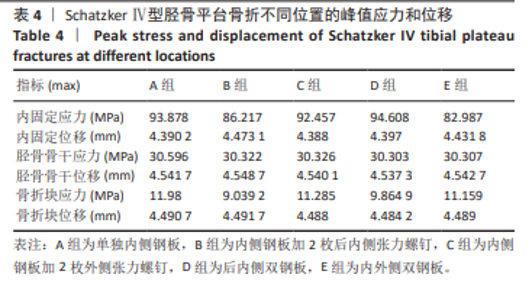
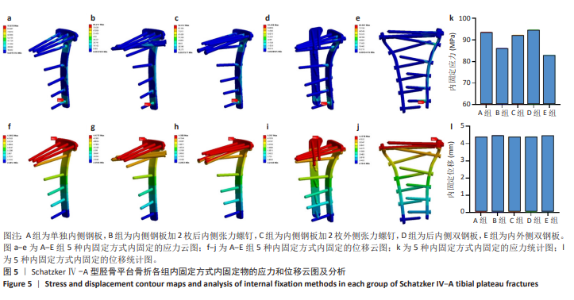
针对Schatzker Ⅳ-A型胫骨平台骨折的5种内固定方式进行有限元分析,包括内植物的应力和位移、胫骨骨干的应力和位移以及骨折块的应力和位移。表4显示了在胫骨平台内侧予以720 N、外侧予以480 N载荷时Schatzker Ⅳ-A型胫骨平台骨折的5个固定组中观察到的位移和应力。 2.1 内植物的应力和位移 有限元分析显示,5组模型中内植物的位移从小到大近似为C组< A组< D组< E组< B组,分别为4.388,4.390 2,4.397,4.431 8,4.473 1 mm,并无显著差异。内固定应力大小为E组< B组< C组< A组< D组,分别为82.987,86.217,92.457,93.878,94.608 MPa。图5显示了5组内固定装置模型的内植物应力分布和位移云图,峰值应力始终出现在胫骨远端第1枚螺钉与钢板的连接点。由此可见,在内固定位移方面,微创组合(C组)达到最优,尽管D组较差,但在位移数值上与传统双钢板组合(D、E组)并无显著差异;而在内固定应力方面,微创组合(B、C组)也与传统双钢板组合(D、E组)相当。"
"
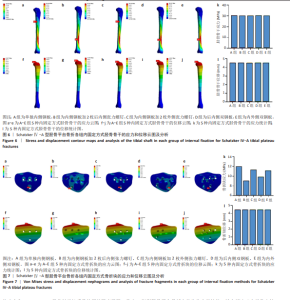
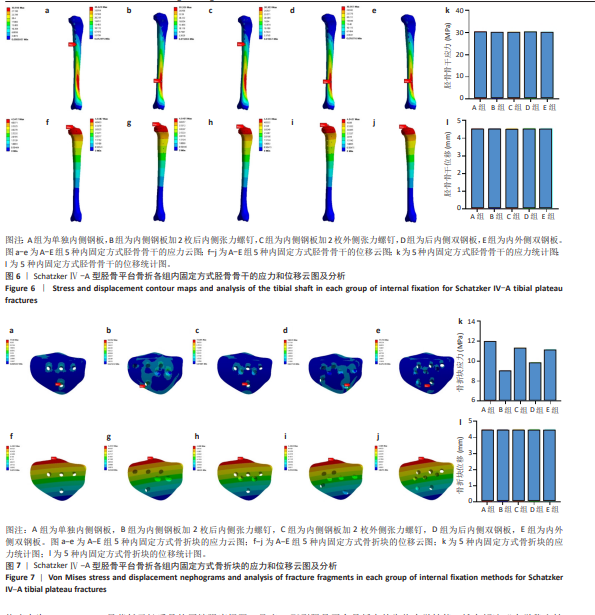
2.2 胫骨骨干的应力和位移 针对Schatzker Ⅳ-A型胫骨平台骨折的5种内固定方式的胫骨骨干应力和位移云图如图6所示。结果显示各组之间并无显著差异,且都符合理想状态。具体来说,胫骨骨干的应力从小到大为D组< E组< B组< C组< A组,分别为30.303,30.307,30.322,30.326,30.596 MPa;胫骨骨干位移从小到大为D组< C组< A组< E组< B组,分别为4.537 3,4.540 1,4.541 7,4.542 7,4.548 7 mm。以上数据表明微创组合(B、C组)与传统双钢板组合(D、E组)在胫骨骨干的应力和位移方面达到相当的效果。 2.3 胫骨平台骨折块的应力和位移 最后,还分析了骨折块的应力和位移(图7)。结果显示,骨折块应力从小到大为B组< D组< E组< C组< A组,分别为9.039 2,9.864 9,11.159,11.285,11.98 MPa。其中B组在骨折块应力方面表现最佳,峰值应力为9.039 2MPa,显著低于松质骨的压缩强度极限。且应力分布显示骨折块得到了有效支撑,没有明显的应力集中点。骨折块位移从小到大为D组< C组< E组< A组< B组,分别为4.484 2,4.488,4.489,4.490 7,4.491 7 mm,并无明显差异,表明在骨折块位移方面,5组内固定方式都比较理想,能提供骨折一期愈合所需的稳定性。"
| [1] AUBERT K, GERMANEAU A, ROCHETTE M, et al. Development of Digital Twins to Optimize Trauma Surgery and Postoperative Management. A Case Study Focusing on Tibial Plateau Fracture. Front Bioeng Biotechnol. 2021;9:722275. [2] REÁTIGA AGUILAR J, RIOS X, et al. Epidemiological characterization of tibial plateau fractures. J Orthop Surg Res. 2022;17(1):106. [3] OLADEJI LO, WORLEY JR, CRIST BD. Age-Related Variances in Patients with Tibial Plateau Fractures. J Knee Surg. 2020;33(6):611-615. [4] KFURI M, SCHATZKER J. Revisiting the Schatzker classification of tibial plateau fractures. Injury. 2018;49(12):2252-2263. [5] CHAPMAN JP, PATRICK MR, REB CW, et al. Comparable outcomes with intramedullary nail and plate constructs for Schatzker VI tibial plateau fractures. Eur J Orthop Surg Traumatol. 2023;33(5):1653-1661. [6] YANG G, ZHU Y, LUO C, et al. Morphological characteristics of Schatzker type IV tibial plateau fractures: a computer tomography based study. Int Orthop. 2012; 36(11):2355-2360. [7] MARKHARDT BK, GROSS JM, MONU JU. Schatzker classification of tibial plateau fractures: use of CT and MR imaging improves assessment. Radiographics. 2009;29(2):585-597. [8] RAMOUTAR DN, LEFAIVRE K, BROEKHUYSE H, et al. Mapping recovery in simple and complex tibial plateau fracture fixation. Bone Joint J. 2019;101-b(8):1009-1014. [9] CHEN P, SHEN H, WANG W, et al. The morphological features of different Schatzker types of tibial plateau fractures: a three-dimensional computed tomography study. J Orthop Surg Res. 2016;11(1):94. [10] YAN B, SUN J, YIN W. The prevalence of soft tissue injuries in operative Schatzker type IV tibial plateau fractures. Arch Orthop Trauma Surg. 2021;141(8): 1269-1275. [11] STEPHENS A, SEARLE H, CARLOS W, et al. Diagnostic impacts on management of soft tissue injuries associated with tibial plateau fractures: A narrative review. Injury. 2024;55(6):111546. [12] HUA K, JIANG X, ZHA Y, et al. Retrospective analysis of 514 cases of tibial plateau fractures based on morphology and injury mechanism. J Orthop Surg Res. 2019; 14(1):267. [13] RISITANO S, REA A, GAROFALO G, et al. Impact of Surgical Timing, Fasciotomy, and External Fixation on Infection Risk in Tibial Plateau Fractures. J Pers Med. 2025; 15(3):108. [14] BORMANN M, BITSCHI D, NEIDLEIN C, et al. Mismatch between Clinical-Functional and Radiological Outcome in Tibial Plateau Fractures: A Retrospective Study. J Clin Med. 2023;12(17):5583. [15] PENG J, REN W, FENG B, et al. Schatzker IV tibial plateau fractures involving the posterolateral column: Higher incidence of lateral meniscus and anterior cruciate ligament injuries with suboptimal postoperative outcomes. Injury. 2024;55(12):111921. [16] SMITH TO, CASEY L, MCNAMARA IR, et al. Surgical fixation methods for tibial plateau fractures. Cochrane Database Syst Rev. 2024;8(8):Cd009679. [17] XU Z, LI Y, TIAN S, et al. Preliminary exploration of finite element biomechanical preoperative planning for complex tibial plateau fractures. Sci Rep. 2025;15(1): 15913. [18] SCHATZKER J, KFURI M. Revisiting the management of tibial plateau fractures. Injury. 2022;53(6):2207-2218. [19] SONG Z, WANG Q, MA T, et al. Failure analysis of primary surgery and therapeutic strategy of revision surgery for complex tibial plateau fractures. J Orthop Surg Res. 2019;14(1):110. [20] STANNARD JP, LOPEZ R, VOLGAS D. Soft tissue injury of the knee after tibial plateau fractures. J Knee Surg. 2010;23(4):187-192. [21] BENNETT WF, BROWNER B. Tibial plateau fractures: a study of associated soft tissue injuries. J Orthop Trauma. 1994;8(3):183-188. [22] WEI G, NIU X, LI Y, et al. Biomechanical analysis of internal fixation system stability for tibial plateau fractures. Front Bioeng Biotechnol. 2023;11:1199944. [23] WAHLQUIST M, IAGUILLI N, EBRAHEIM N, et al. Medial tibial plateau fractures: a new classification system. J Trauma. 2007;63(6):1418-1421. [24] LIU Z, WANG S, TIAN X, et al. The Relationship between the Injury Mechanism and the Incidence of ACL Avulsions in Schatzker Type IV Tibial Plateau Fractures: A 3D Quantitative Analysis Based on Mimics Software. J Knee Surg. 2023;36(6): 644-651. [25] TSCHERNE H, LOBENHOFFER P. Tibial plateau fractures. Management and expected results. Clin Orthop Relat Res. 1993;(292):87-100. [26] RUDRAN B, LITTLE C, WIIK A, et al. Tibial Plateau Fracture: Anatomy, Diagnosis and Management. Br J Hosp Med (Lond). 2020;81(10):1-9. [27] PRAT-FABREGAT S, CAMACHO-CARRASCO P. Treatment strategy for tibial plateau fractures: an update. EFORT Open Rev. 2016;1(5):225-232. [28] HÖRMANDINGER C, BITSCHI D, BERTHOLD DP, et al. Lack of standardisation in the management of complex tibial plateau fractures: a multicentre experience. Eur J Trauma Emerg Surg. 2024;50(6):2937-2945. [29] HONKONEN SE. Indications for surgical treatment of tibial condyle fractures. Clin Orthop Relat Res. 1994;(302):199-205. [30] TEKIN A, ÇAKAR M, ESENYEL CZ, et al. An evaluation of meniscus tears in lateral tibial plateau fractures and repair results. J Back Musculoskelet Rehabil. 2016; 29(4):845-851. [31] 谭红略, 代朋乙, 刘伟峰, 等. 联合入路双钢板固定治疗陈旧性Schatzker Ⅳ型胫骨平台骨折[J]. 中国骨伤,2017,30(10):1003-0034. [32] WANG G, WANG B, TANG Y, et al. A quantitative biomechanical study of positive buttress techniques for femoral neck fractures: a finite element analysis. Chin Med J (Engl). 2019;132(21):2588-2593. [33] LIU CD, HU SJ, CHANG SM, et al. Treatment of posterolateral tibial plateau fractures: a narrative review and therapeutic strategy. Int J Surg. 2025;111(1): 1071-1082. [34] 王伟, 罗强, 李天宇, 等. 联合入路双钢板内固定治疗Schatzker Ⅴ,Ⅵ型胫骨平台骨折的临床疗效分析[J]. 创伤外科杂志,2019,21(3):185-187. [35] 方丁, 曾义高, 陈先洲, 等. 复杂胫骨平台骨折两种微创内固定方法的生物力学对比研究[J]. 实用临床医药杂志,2016,20(23):72-74. [36] 冯大军, 叶金标. 双钢板固定结合植骨治疗SchatzkerⅤ、Ⅵ型胫骨平台骨折的临床效果研究[J]. 医疗卫生装备,2017,38(2):80-82. [37] 王友良, 冯庆虎, 衣龙云, 等. 前正中入路双钢板固定在Schatzker分型Ⅴ,Ⅵ型胫骨平台骨折中的研究应用[J]. 生物骨科材料与临床研究,2021,18(1): 43-46,50. [38] 高榅青, 魏锋. 双切口双钢板内固定与单侧锁定钢板内固定对Schatzker Ⅴ/Ⅵ型胫骨平台骨折患者膝关节内翻角,后倾角的影响[J]. 中国当代医药 2023,30(31):99-102. [39] GUO J, CHEN X, LIN Z, et al. Tight junction disruption through activation of the PI3K/AKT pathways in the skin contributes to blister fluid formation after severe tibial plateau fracture. Front Bioeng Biotechnol. 2022;10:946261. [40] 方丁, 曾义高, 陈先洲, 等. 复杂胫骨平台骨折两种微创内固定方法的生物力学对比研究[J]. 实用临床医药杂志,2016,20(23):72-74. [41] LV H, LI W, WANG Y, et al. Prediction model for tibial plateau fracture combined with meniscus injury. Front Surg. 2023;10:1095961. |
| [1] | Liu Wenlong, Dong Lei, Xiao Zhengzheng, Nie Yu. Finite element analysis of tibial prosthesis loosening after fixed-bearing unicompartmental knee arthroplasty for osteoporosis [J]. Chinese Journal of Tissue Engineering Research, 2026, 30(9): 2191-2198. |
| [2] | Zheng Wangyang, Fei Ji, Yang Di, Zhao Lang, Wang Lingli, Liu Peng, Li Haiyang. Finite element analysis of the force changes of the supraspinatus tendon and glenohumeral joint during the abduction and flexion of the humerus [J]. Chinese Journal of Tissue Engineering Research, 2026, 30(9): 2199-2207. |
| [3] | Cai Qirui, Dai Xiaowei, Zheng Xiaobin, Jian Sili, Lu Shaoping, Liu Texi, Liu Guoke, Lin Yuanfang. Mechanical effects of Long’s traction orthopedic method on cervical functional units: quantitative analysis of biomechanical model of head and neck [J]. Chinese Journal of Tissue Engineering Research, 2026, 30(9): 2208-2216. |
| [4] | Rao Jingcheng, Li Yuwan, Zheng Hongbing, Xu Zhi, Zhu Aixiang, Shi Ce, Wang Bing, Yang Chun, Kong Xiangru, Zhu Dawei. Biomechanical differences between the new proximal femoral stable intramedullary nail and traditional intramedullary nail#br# [J]. Chinese Journal of Tissue Engineering Research, 2026, 30(9): 2217-2225. |
| [5] | Chen Long, Wang Xiaozhen, Xi Jintao, Lu Qilin. Biomechanical performance of short-segment screw fixation combined with expandable polyetheretherketone vertebral body replacement in osteoporotic vertebrae [J]. Chinese Journal of Tissue Engineering Research, 2026, 30(9): 2226-2235. |
| [6] | Zhang Zizheng, Luo Wang, Liu Changlu. Application value of finite element analysis on unicompartmental knee arthroplasty for medial knee compartmental osteoarthritis [J]. Chinese Journal of Tissue Engineering Research, 2026, 30(9): 2313-2322. |
| [7] | Zhao Feifan, Cao Yujing. Risk factors and coping strategies of internal fixation failure in treatment of intertrochanteric fracture with proximal femoral nail antirotation [J]. Chinese Journal of Tissue Engineering Research, 2026, 30(9): 2323-2333. |
| [8] | Zhang Xianxu, Ma Zhong, Liu Xin, Huang Lei, Shen Wenxiang, Luo Zhiqiang . Lumbar fusion combined with unilateral fixation for lumbar degenerative diseases: biomechanics, technical evolution, and clinical applications [J]. Chinese Journal of Tissue Engineering Research, 2026, 30(9): 2334-2342. |
| [9] | Chen Huiting, Zeng Weiquan, Zhou Jianhong, Wang Jie, Zhuang Congying, Chen Peiyou, Liang Zeqian, Deng Weiming. Tail anchoring technique of vertebroplasty in treatment of osteoporotic vertebral compression fractures with intravertebral cleft: a finite element analysis [J]. Chinese Journal of Tissue Engineering Research, 2026, 30(9): 2145-2152. |
| [10] | Cheng Qisheng, Julaiti·Maitirouzi, Xiao Yang, Zhang Chenwei, Paerhati·Rexiti. Finite element analysis of novel variable-diameter screws in modified cortical bone trajectory of lumbar vertebrae [J]. Chinese Journal of Tissue Engineering Research, 2026, 30(9): 2162-2171. |
| [11] | Liu Jiafu, Ren Ruxia, Liao Zhouwei, Zhou Xiali, Wu Yihong, Zhang Shaoqun. Three-dimensional finite element analysis of cervical spine biomechanical characteristics in a rat model of cervical vertigo [J]. Chinese Journal of Tissue Engineering Research, 2026, 30(9): 2182-2190. |
| [12] | Zheng Xuying, Hu Hongcheng, Xu Libing, Han Jianmin, Di Ping. Stress magnitude and distribution in two-piece cement-retained zirconia implants under different loading conditions and with varying internal connection shapes [J]. Chinese Journal of Tissue Engineering Research, 2026, 30(8): 1979-1987. |
| [13] | Zhong Caihong, Xiao Xiaoge, Li Ming, Lin Jianhong, Hong Jing. Biomechanical mechanism of sports-related patellar tendinitis [J]. Chinese Journal of Tissue Engineering Research, 2026, 30(6): 1417-1423. |
| [14] | Xu Hao, Ding Lu, Li Xiao. Mechanical effect of mechanical wear of abutment screws on the Morse taper connection implant system: a three-dimensional finite element analysis [J]. Chinese Journal of Tissue Engineering Research, 2026, 30(6): 1375-1383. |
| [15] | Hao Yunteng, Shi Jun, Zhang Shaojie, Li Zhijun, Yang Yang, Wang Chaoqun, Ma Yuan, Zhao Hailong, Chen Jie, Dong Chongyang, Zhang Zhifeng, Li Kun, Wang Xing. Comparative finite element analysis of cervical intervertebral discs in adult humans and macaques [J]. Chinese Journal of Tissue Engineering Research, 2026, 30(36): 9488-9496. |
| Viewed | ||||||
|
Full text |
|
|||||
|
Abstract |
|
|||||