Chinese Journal of Tissue Engineering Research ›› 2026, Vol. 30 ›› Issue (26): 6807-6813.doi: 10.12307/2026.802
Previous Articles Next Articles
Mechanism of ferrostatin-1 hydrogel in treatment of lumbar disc herniation
Chen Gang1, Ge Caijun2, Chen Jianpeng2, Wang Yuanbin1, Wang Qianliang2
- 1Department of Orthopedics, Qinghai Provincial People's Hospital, Xining 810000, Qinghai Province, China; 2Department of Orthopedics, The Second Affiliated Hospital of Soochow University, Suzhou 215004, Jiangsu Province, China
-
Accepted:2025-12-11Online:2026-09-18Published:2026-03-11 -
Contact:Wang Qianliang, MD, Attending physician, Department of Orthopedics, The Second Affiliated Hospital of Soochow University, Suzhou 215004, Jiangsu Province, China Wang Yuanbin, MS, Physician, Department of Orthopedics, Qinghai Provincial People's Hospital, Xining 810000, Qinghai Province, China -
About author:Chen Gang, MS, Associate chief physician, Department of Orthopedics, Qinghai Provincial People's Hospital, Xining 810000, Qinghai Province, China -
Supported by:National Natural Science Foundation of China, No. 81902239 (to WQL)

CLC Number:
Cite this article
Chen Gang, Ge Caijun, Chen Jianpeng, Wang Yuanbin, Wang Qianliang. Mechanism of ferrostatin-1 hydrogel in treatment of lumbar disc herniation[J]. Chinese Journal of Tissue Engineering Research, 2026, 30(26): 6807-6813.
share this article
Add to citation manager EndNote|Reference Manager|ProCite|BibTeX|RefWorks
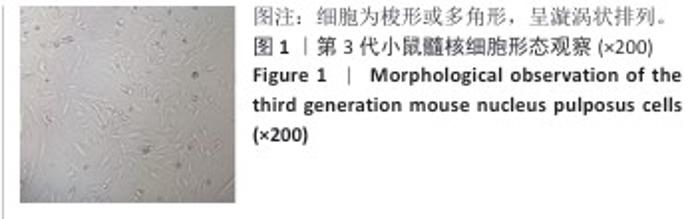
2.1 髓核细胞的培养与观察 分离培养的第3代细胞呈梭形或多角形,呈漩涡状排列,见图1,符合髓核细胞的特征。"
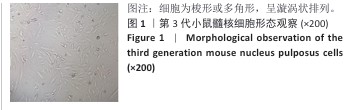
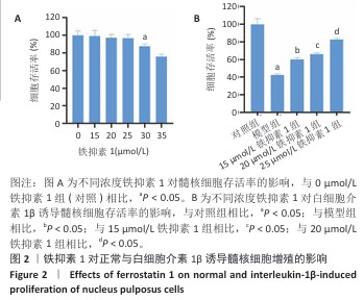
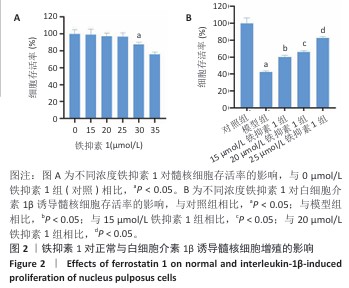
2.2 铁抑素1对正常与白细胞介素1β诱导髓核细胞增殖的影响 CCK-8检测结果显示,铁抑素1浓度在15-25 μmol/L范围内对髓核细胞存活率无显著影响,但浓度超过25 μmol/L时细胞存活率明显降低,见图2A。因此,后续实验选用15,20,25 μmol/L铁抑素1处理白细胞介素1β诱导的腰椎间盘突出症细胞模型。CCK-8检测结果显示,与对照组相比,模型组髓核细胞存活率显著下降,而低、中、高浓度铁抑素1干预后细胞存活率有所提升,并且随浓度增加呈上升趋势,见图2B。据此,后续研究选择25 μmol/L铁抑素1处理细胞。"
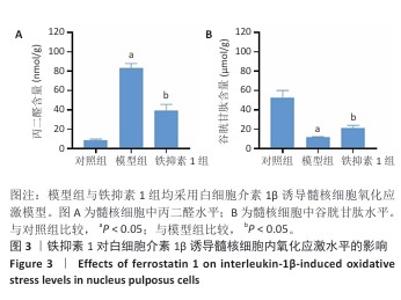
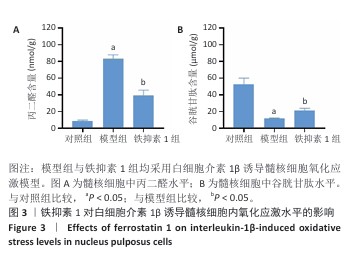
2.3 铁抑素1对髓核细胞氧化应激水平的影响 与对照组相比,模型组髓核细胞内丙二醛水平升高(P < 0.05),谷胱甘肽水平降低(P < 0.05);与模型组相比,铁抑素1组髓核细胞内丙二醛水平降低(P < 0.05),谷胱甘肽水平升高(P < 0.05),见图3。"
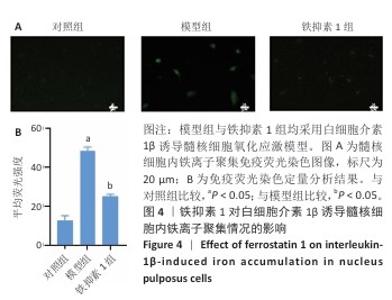
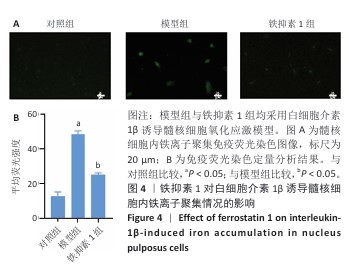
2.4 铁抑素1对白细胞介素1β诱导髓核细胞内铁离子聚集的影响 免疫荧光染色显示,模型组细胞内的荧光显著增强,表明细胞内聚集了过多的铁离子,并伴随细胞形态的明显变化,如细胞体积增大和细胞形态变圆;给予铁抑素1治疗后,细胞内的荧光强度显著下降,铁离子聚集减少,细胞形态趋于正常,表现为细胞体积恢复正常和形态趋向于梭状,见图4。"
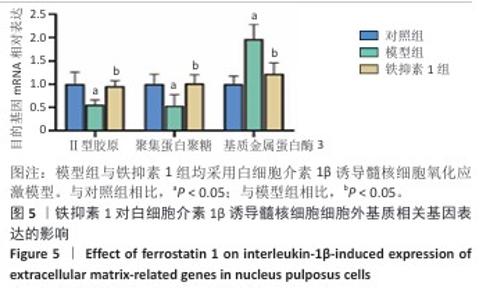
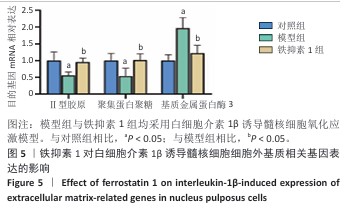
2.5 铁抑素1对白细胞介素1β诱导髓核细胞细胞外基质降解的影响 RT-qPCR检测结果显示,与对照组相比,模型组髓核细胞中Ⅱ型胶原和聚集蛋白聚糖mRNA表达降低(P < 0.05),基质金属蛋白酶3 mRNA表达升高(P < 0.05);相比模型组,铁抑素1组髓核细胞中Ⅱ型胶原和聚集蛋白聚糖mRNA升高(P < 0.05),基质金属蛋白酶3 mRNA表达降低(P < 0.05),见图5。 "
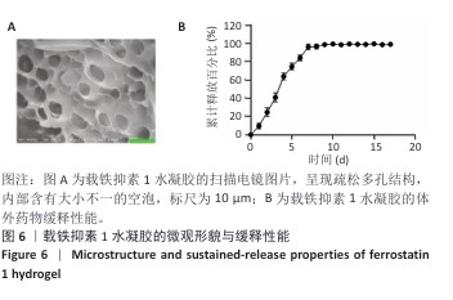
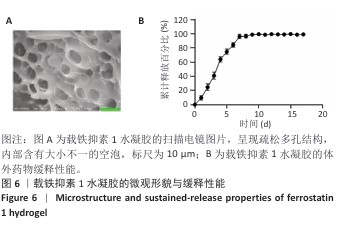
2.6 水凝胶的微观形貌与缓释性能 扫描电镜观察显示载药水凝胶均呈现疏松多孔结构,内部含有大小不一的空泡,孔径在 10 μm以下,见图6A。实验对载药水凝胶体外释放药物的情况进行了17 d的观察,结果显示:1-7 d,铁抑素1在水凝胶中呈现缓慢释放的趋势,在第7天累计释放药物达到96%以上,见图6B。"
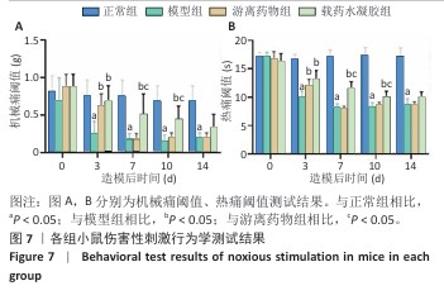
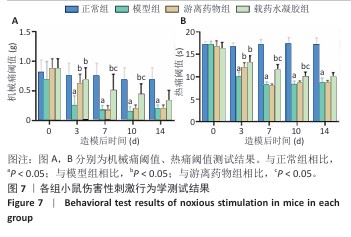
2.7 载药水凝胶的动物实验结果 2.7.1 实验动物数量分析 80只小鼠全部进入结果分析。 2.7.2 各组小鼠伤害性刺激行为学测试结果 造模后第3,7,10,14天,与正常组相比,模型组小鼠机械痛阈值、热痛阈值显著下降(P < 0.05);与模型组相比,游离药物组小鼠造模第3天的机械痛阈值、热痛阈值升高(P < 0.05),载药水凝胶组造模第3,7,10天的机械痛阈值、热痛阈值升高(P < 0.05);载药水凝胶组小鼠造模后第7,10天的机械痛阈值、热痛阈值高于游离药物组(P < 0.05),见图7。"
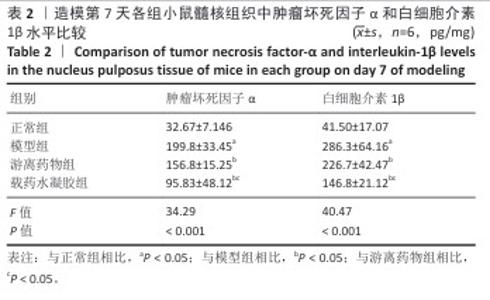
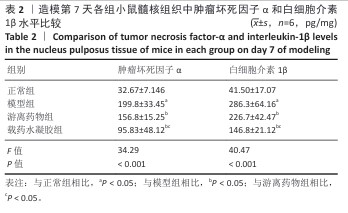
2.7.3 各组小鼠髓核组织内炎症因子水平比较 与正常组相比,模型组小鼠髓核组织中肿瘤坏死因子α和白细胞介素1β水平高于正常组(P < 0.05),游离药物组两种炎症因子水平低于模型组(P < 0.05),载药水凝胶组两种炎症因子水平低于游离药物组(P < 0.05),见表2。"
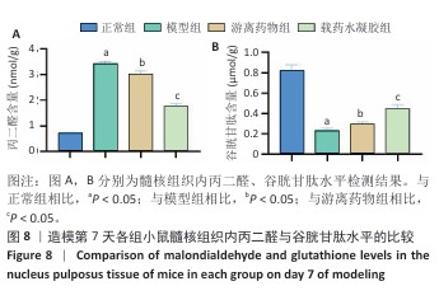
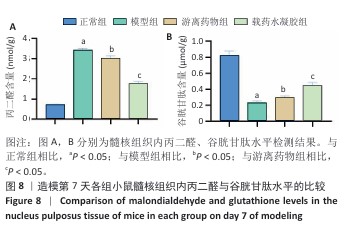
2.7.4 各组小鼠髓核组织氧化应激水平比较 与正常组相比,模型组髓核组织中丙二醛水平升高(P < 0.05),谷胱甘肽水平降低 (P < 0.05);与模型组相比,游离药物组髓核组织中丙二醛水平降低(P < 0.05),谷胱甘肽水平升高(P < 0.05);与游离药物组相比,载药水凝胶组髓核组织中丙二醛水平降低(P < 0.05),谷胱甘肽水平升高(P < 0.05),见图8。"
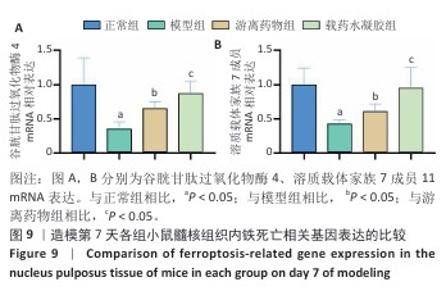
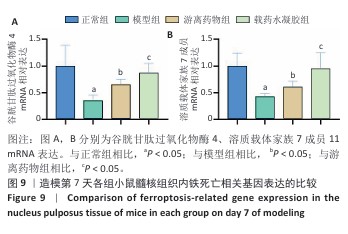
2.7.5 各组小鼠髓核组织中铁死亡相关基因表达比较 RT-qPCR检测结果显示,与正常组相比,模型组小鼠髓核组织中谷胱甘肽过氧化物酶4、溶质载体家族7成员11 mRNA表达均降低(P < 0.05);与模型组相比,游离药物组小鼠髓核组织中谷胱甘肽过氧化物酶4、溶质载体家族7成员11 mRNA表达升高(P < 0.05);与游离药物组相比,载药水凝胶组小鼠髓核组织中谷胱甘肽过氧化物酶4、溶质载体家族7成员11 mRNA表达升高(P < 0.05),见图9。"
| [1] ZHANG AS, XU A, ANSARI K, et al. Lumbar Disc Herniation: Diagnosis and Management. Am J Med. 2023;136(7):645-651. [2] BEALL DP, KIM KD, MACADAEG K, et al. Treatment Gaps and Emerging Therapies in Lumbar Disc Herniation. Pain Physician. 2024;27(7):401-413. [3] ZOU L, WANG Y, HU Y, et al. N-cadherin Alleviates Apoptosis and Senescence of Nucleus Pulposus Cells via Suppressing ROS-dependent ERS in the Hyper-osmolarity Microenvironment. Int J Med Sci. 2024;21(2):341-356. [4] WANG L, FAN W, YU C, et al. Clinical effects of electrical stimulation therapy on lumbar disc herniation-induced sciatica and its influence on peripheral ROS level. J Musculoskelet Neuronal Interact. 2018;18(3):393-398. [5] WANG W, CHENG Z, YU M, et al. Injectable ECM-mimetic dynamic hydrogels abolish ferroptosis-induced post-discectomy herniation through delivering nucleus pulposus progenitor cell-derived exosomes. Nat Commun. 2025;16(1):3131. [6] SHAN L, XU X, ZHANG J, et al. Increased hemoglobin and heme in MALDI-TOF MS analysis induce ferroptosis and promote degeneration of herniated human nucleus pulposus. Mol Med. 2021;27(1):103. [7] LU Z, ZHENG Z. Integrated analysis of single-cell and bulk RNA sequencing data identifies the characteristics of ferroptosis in lumbar disc herniation. Funct Integr Genomics. 2023;23(3):289. [8] FAN C, CHU G, YU Z, et al. The role of ferroptosis in intervertebral disc degeneration. Front Cell Dev Biol. 2023;11:1219840. [9] WANG W, JING X, DU T, et al. Iron overload promotes intervertebral disc degeneration via inducing oxidative stress and ferroptosis in endplate chondrocytes. Free Radic Biol Med. 2022;190:234-246. [10] GUTIERREZ AM, FRAZAR EM, MV XK, et al. Hydrogels and Hydrogel Nanocomposites: Enhancing Healthcare through Human and Environmental Treatment. Adv Healthc Mater. 2022;11(7):e2101820. [11] WANG J, ZHU M, HU Y, et al. Exosome-Hydrogel System in Bone Tissue Engineering: A Promising Therapeutic Strategy. Macromol Biosci. 2023;23(4):e2200496. [12] DING Q, ZHANG S, LIU X, et al. Hydrogel Tissue Bioengineered Scaffolds in Bone Repair: A Review. Molecules. 2023;28(20):7039. [13] CAO Y, LIU C, YE W, et al. Functional Hydrogel Interfaces for Cartilage and Bone Regeneration. Adv Healthc Mater. 2025;14(6):e2403079. [14] HEINE S, AGUILAR-PIMENTEL A, RUSSKAMP D, et al. Thermosensitive PLGA-PEG-PLGA Hydrogel as Depot Matrix for Allergen-Specific Immunotherapy. Pharmaceutics. 2022; 14(8):1527. [15] DENG W, CHEN J, WANG X, et al. Paravertebrally-Injected Multifunctional Hydrogel for Sustained Anti-Inflammation and Pain Relief in Lumbar Disc Herniation. Adv Healthc Mater. 2024;13(27):e2401227. [16] DIXON SJ, LEMBERG KM, LAMPRECHT MR, et al. Ferroptosis: an iron-dependent form of nonapoptotic cell death. Cell. 2012;149(5):1060-1072. [17] WANG H, WU S, JIANG X, et al. Acteoside alleviates salsolinol-induced Parkinson’s disease by inhibiting ferroptosis via activating Nrf2/SLC7A11/GPX4 pathway. Exp Neurol. 2025;385: 115084. [18] CHEN Y, HE W, WEI H, et al. Srs11-92, a ferrostatin-1 analog, improves oxidative stress and neuroinflammation via Nrf2 signal following cerebral ischemia/reperfusion injury. CNS Neurosci Ther. 2023;29(6):1667-1677. [19] ZHOU C, YU T, ZHU R, et al. Timosaponin AIII promotes non-small-cell lung cancer ferroptosis through targeting and facilitating HSP90 mediated GPX4 ubiquitination and degradation. Int J Biol Sci. 2023;19(5):1471-1489. [20] JIN L, XIAO L, DING M, et al. Heterogeneous macrophages contribute to the pathology of disc herniation induced radiculopathy. Spine J. 2022;22(4):677-689. [21] KIM H, HONG J Y, LEE J, et al. IL-1β promotes disc degeneration and inflammation through direct injection of intervertebral disc in a rat lumbar disc herniation model. Spine J. 2021;21(6):1031-1041. [22] LIU Y, ZHU X, WEI Z, et al. Customized Photothermal Therapy of Subcutaneous Orthotopic Cancer by Multichannel Luminescent Nanocomposites. Adv Mater. 2021; 33(30):e2008615. [23] CHEN X, WO F, JIN Y, et al. Drug-Porous Silicon Dual Luminescent System for Monitoring and Inhibition of Wound Infection. ACS Nano. 2017;11(8):7938-7949. [24] ZHOU LP, ZHANG RJ, JIA CY, et al. Ferroptosis: A potential target for the intervention of intervertebral disc degeneration. Front Endocrinol (Lausanne). 2022;13:1042060. [25] LIU Y, WAN Y, JIANG Y, et al. GPX4: The hub of lipid oxidation, ferroptosis, disease and treatment. Biochim Biophys Acta Rev Cancer. 2023;1878(3):188890. [26] CHEN X, LI J, KANG R, et al. Ferroptosis: machinery and regulation. Autophagy. 2021; 17(9):2054-2081. [27] KOPPULA P, ZHUANG L, GAN B. Cystine transporter SLC7A11/xCT in cancer: ferroptosis, nutrient dependency, and cancer therapy. Protein Cell. 2021;12(8):599-620. [28] ZHANG X, HOU L, GUO Z, et al. Lipid peroxidation in osteoarthritis: focusing on 4-hydroxynonenal, malondialdehyde, and ferroptosis. Cell Death Discov. 2023;9(1):320. [29] NIU B, LIAO K, ZHOU Y, et al. Application of glutathione depletion in cancer therapy: Enhanced ROS-based therapy, ferroptosis, and chemotherapy. Biomaterials. 2021; 277:121110. [30] CHEN BL, GUO JB, ZHANG HW, et al. Surgical versus non-operative treatment for lumbar disc herniation: a systematic review and meta-analysis. Clin Rehabil. 2018;32(2):146-160. [31] ROGERSON A, AIDLEN J, JENIS LG. Persistent radiculopathy after surgical treatment for lumbar disc herniation: causes and treatment options. Int Orthop. 2019;43(4):969-973. [32] JU CI, LEE SM. Complications and Management of Endoscopic Spinal Surgery. Neurospine. 2023;20(1):56-77. [33] CHANG MC, CHOO YJ, DENIS I, et al. Effectiveness of intradiscal ozone injections for treating pain following herniated lumbar disc: A systematic review and meta-analysis. J Back Musculoskelet Rehabil. 2024;37(5):1131-1139. [34] WANG HS, LIN S, YU HM. Exosome-mediated Repair of Intervertebral Disc Degeneration: The Potential Role of miRNAs. Curr Stem Cell Res Ther. 2024;19(6):798-808. [35] JING S, YANG C, ZHANG X, et al. Efficacy and safety of etanercept in the treatment of sciatica: A systematic review and meta-analysis. J Clin Neurosci. 2017;44:69-74. [36] LIU X, SUN S, WANG N, et al. Therapeutic application of hydrogels for bone-related diseases. Front Bioeng Biotechnol. 2022;10:998988. [37] ZHU J, YANG S, QI Y, et al. Stem cell-homing hydrogel-based miR-29b-5p delivery promotes cartilage regeneration by suppressing senescence in an osteoarthritis rat model. Sci Adv. 2022;8(13):eabk0011. [38] WANG X, ZENG J, GAN D, et al. Recent Strategies and Advances in Hydrogel-Based Delivery Platforms for Bone Regeneration. Nanomicro Lett. 2024;17(1):73. [39] KHODAVERDI E, TEKIE FS, MOHAJERI SA, et al. Preparation and investigation of sustained drug delivery systems using an injectable, thermosensitive, in situ forming hydrogel composed of PLGA-PEG-PLGA. AAPS PharmSciTech. 2012;13(2):590-600. [40] DUTTA K, DAS R, LING J, et al. In Situ Forming Injectable Thermoresponsive Hydrogels for Controlled Delivery of Biomacromolecules. ACS Omega. 2020;5(28):17531-17542. [41] RU Q, LI Y, CHEN L, et al. Iron homeostasis and ferroptosis in human diseases: mechanisms and therapeutic prospects. Signal Transduct Target Ther. 2024;9(1):271. [42] SCARPELLINI C, KLEJBOROWSKA G, LANTHIER C, et al. Beyond ferrostatin-1: a comprehensive review of ferroptosis inhibitors. Trends Pharmacol Sci. 2023;44(12): 902-916. |
| [1] | Liu Hongjie, Mu Qiuju, Shen Yuxue, Liang Fei, Zhu Lili. Metal organic framework/carboxymethyl chitosan-oxidized sodium alginate/platelet-rich plasma hydrogel promotes healing of diabetic infected wounds [J]. Chinese Journal of Tissue Engineering Research, 2026, 30(8): 1929-1939. |
| [2] |
Dong Chunyang, Zhou Tianen, Mo Mengxue, Lyu Wenquan, Gao Ming, Zhu Ruikai, Gao Zhiwei.
Action mechanism of metformin combined with Eomecon chionantha Hance dressing in treatment of deep second-degree burn wounds#br#
#br#
[J]. Chinese Journal of Tissue Engineering Research, 2026, 30(8): 2001-2013.
|
| [3] | Yang Xuetao, Zhu Menghan, Zhang Chenxi, Sun Yimin, Ye Ling. Applications and limitations of antioxidant nanomaterials in oral cavity [J]. Chinese Journal of Tissue Engineering Research, 2026, 30(8): 2044-2053. |
| [4] | Liu Yang, Liu Donghui , Xu Lei, Zhan Xu, Sun Haobo, Kang Kai. Role and trend of stimuli-responsive injectable hydrogels in precise myocardial infarction therapy [J]. Chinese Journal of Tissue Engineering Research, 2026, 30(8): 2072-2080. |
| [5] | Guo Yuchao, Ni Qianwei, Yin Chen, Jigeer·Saiyilihan, Gao Zhan . Quaternized chitosan hemostatic materials: synthesis, mechanism, and application [J]. Chinese Journal of Tissue Engineering Research, 2026, 30(8): 2091-2100. |
| [6] | Yang Guang, Yin Zhitao, Xu Yan. Three-dimensional printed isoniazid liposome photothermal composite scaffolds and their performance evaluation [J]. Chinese Journal of Tissue Engineering Research, 2026, 30(26): 6701-6709. |
| [7] | Zhang Yibo, Li Jian, Wang Peng, Jiang Qing. Curcumin-loaded chitosan/beta-glycerophosphate sodium thermoresponsive hydrogel promotes tendon healing in rats [J]. Chinese Journal of Tissue Engineering Research, 2026, 30(26): 6779-6798. |
| [8] |
Zhang Jing, He Liping, Wen Yu, Fu Hang.
Hydrogel loaded with fibroblast exosomes promotes endothelial cell function recovery and diabetic wound healing#br#
#br#
[J]. Chinese Journal of Tissue Engineering Research, 2026, 30(26): 6798-6806.
|
| [9] | Yang Qi, Xiang Xi, Wang Han, Zou Zhen, Zhang Lunci, Mireadeli·Abulimiti, Liao Yue, Li Xinzhi. Development and application of natural oral hydrogels in drug delivery systems [J]. Chinese Journal of Tissue Engineering Research, 2026, 30(26): 6930-6936. |
| [10] | Cao Yuqing, Guo Meiling, Liu Feng, Wei Junchao. Preparation, classification and application of polysaccharide-based hydrogels in skin damage repair [J]. Chinese Journal of Tissue Engineering Research, 2026, 30(20): 5257-5269. |
| [11] | Xu Yawei, Meng Shilong, Zhang Xu, Wang Chengjie, Yuan Yifeng, Shi Xiaolin, Wang Jiao, Liu Kang . Repairing bone defects with active ingredients of traditional Chinese medicine combined with hydrogels: successes and challenges [J]. Chinese Journal of Tissue Engineering Research, 2026, 30(20): 5295-5303. |
| [12] | Xu Yixuan, Yao Jun, Liu Xulu, Li Xinlian, Liu Zhixiong, Zhang Zhihong. Vancomycin-containing porcine skin acellular extracellular matrix hydrogel promotes wound healing in skin infections [J]. Chinese Journal of Tissue Engineering Research, 2026, 30(20): 5214-5228. |
| [13] | Dong Chao, Zhao Mohan, Liu Yunan, Yang Zeli, Chen Leqin, Wang Lanfang. Effects of magnetic nano-drug carriers on exercise-induced muscle injury and inflammatory response in rats [J]. Chinese Journal of Tissue Engineering Research, 2026, 30(2): 345-353. |
| [14] | Liu Xiaohong, Zhao Tian, Mu Yunping, Feng Wenjin, Lyu Cunsheng, Zhang Zhiyong, Zhao Zijian, Li Fanghong. Acellular dermal matrix hydrogel promotes skin wound healing in rats [J]. Chinese Journal of Tissue Engineering Research, 2026, 30(2): 395-403. |
| [15] | Yu Le, Nan Songhua, Shi Zijian, He Qiqi, Li Zhenjia, Cui Yinglin. Mechanisms underlying mitophagy, ferroptosis, cuproptosis, and disulfidptosis in Parkinson’s disease [J]. Chinese Journal of Tissue Engineering Research, 2026, 30(17): 4446-4456. |
| Viewed | ||||||
|
Full text |
|
|||||
|
Abstract |
|
|||||