Chinese Journal of Tissue Engineering Research ›› 2026, Vol. 30 ›› Issue (25): 6463-6471.doi: 10.12307/2026.433
Previous Articles Next Articles
Grape seed proanthocyanidin oligomers alleviate demyelination in cuprizone-fed mice
Wang Qing1, Yang Zhichao1, Liu Jian1, Liang Yajie1, Tang Yibin1, Guo Yu1, Song Guobin2, Ma Cungen1, 2
- 1Research Center of Neurobiology, The Key Research Laboratory of Benefiting Qi for Acting Blood Circulation Method to Treat Multiple Sclerosis of State Administration of Traditional Chinese Medicine, Shanxi University of Chinese Medicine, Jinzhong 030619, Shanxi Province, China; 2Institute of Brain Science, Shanxi Datong University, Datong 037009, Shanxi Province, China
-
Received:2025-07-04Revised:2026-01-26Online:2026-09-08Published:2026-04-17 -
Contact:Ma Cungen, PhD, Professor, Research Center of Neurobiology, The Key Research Laboratory of Benefiting Qi for Acting Blood Circulation Method to Treat Multiple Sclerosis of State Administration of Traditional Chinese Medicine, Shanxi University of Chinese Medicine, Jinzhong 030619, Shanxi Province, China; Institute of Brain Science, Shanxi Datong University, Datong 037009, Shanxi Province, China -
About author:Wang Qing, PhD, Research Center of Neurobiology, The Key Research Laboratory of Benefiting Qi for Acting Blood Circulation Method to Treat Multiple Sclerosis of State Administration of Traditional Chinese Medicine, Shanxi University of Chinese Medicine, Jinzhong 030619, Shanxi Province, China -
Supported by:National Natural Science Foundation of China (Youth Fund), No. 81903596 (to WQ); Research Funding Project for Returned Overseas Chinese Scholars in Shanxi Province, No. 2022-165 (to WQ); Traditional Chinese Medicine Innovation Team of Shanxi Provincial Administration of Traditional Chinese Medicine, No. zyytd2024039 (to WQ); Basic Research Project of Shanxi Province, No. 202303021221162 (to WQ); Scientific Research Project of Shanxi Administration of Traditional Chinese Medicine, No. 2023ZYYB040 (to WQ); 2022 Traditional Chinese Medicine Scientific Research Project Plan of Shanxi Provincial Health Commission, No. 2022ZYYC090 (to MCG); 2022 Science and Technology Innovation Team of Shanxi University of Traditional Chinese Medicine, No. 2022TD2006 (to WQ); Basic Research on the Discipline of Integrated Traditional Chinese and Western Medicine for Neuritic Diseases at Shanxi University of Chinese Medicine, No. 2024XKJS-02 (to MCG)

CLC Number:
Cite this article
Wang Qing, Yang Zhichao, Liu Jian, Liang Yajie, Tang Yibin, Guo Yu, Song Guobin, Ma Cungen. Grape seed proanthocyanidin oligomers alleviate demyelination in cuprizone-fed mice[J]. Chinese Journal of Tissue Engineering Research, 2026, 30(25): 6463-6471.
share this article
Add to citation manager EndNote|Reference Manager|ProCite|BibTeX|RefWorks
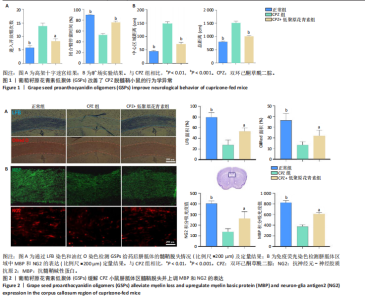
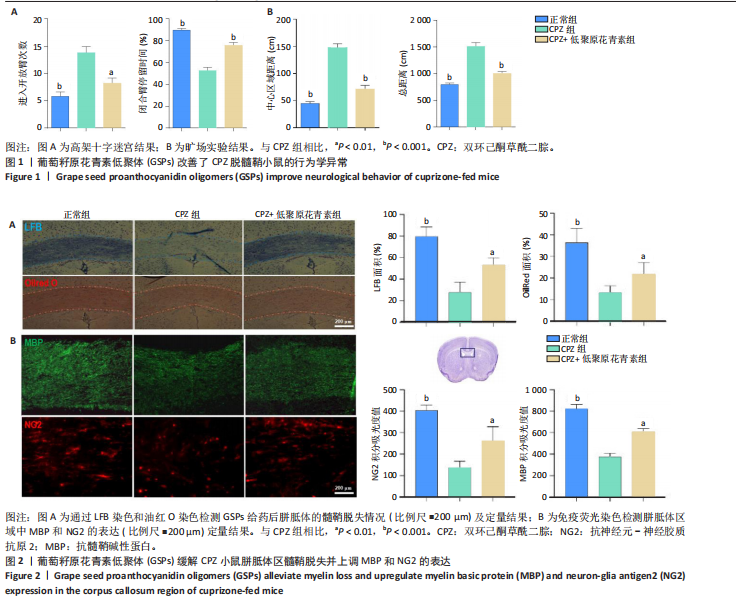
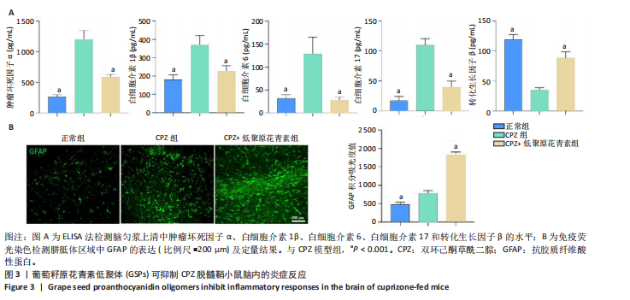
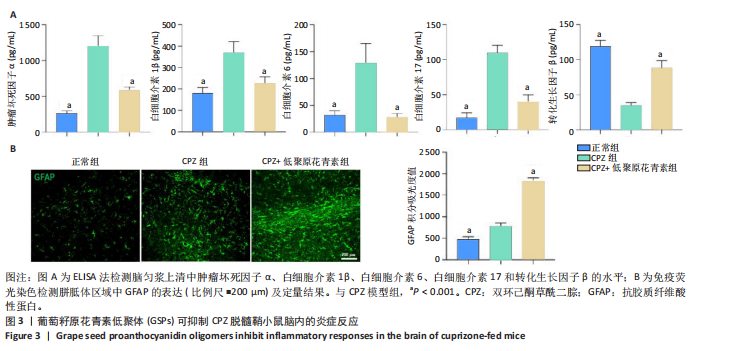
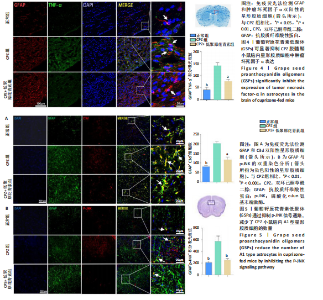
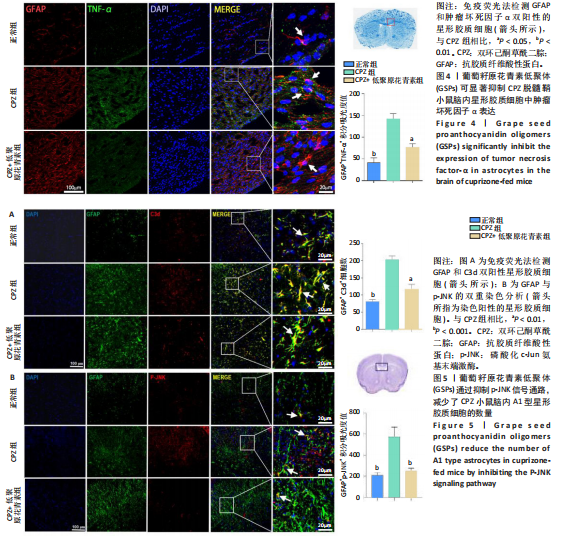
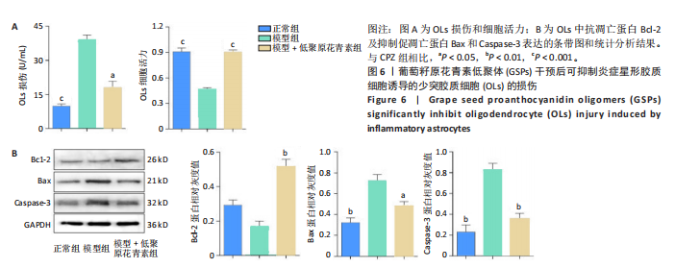
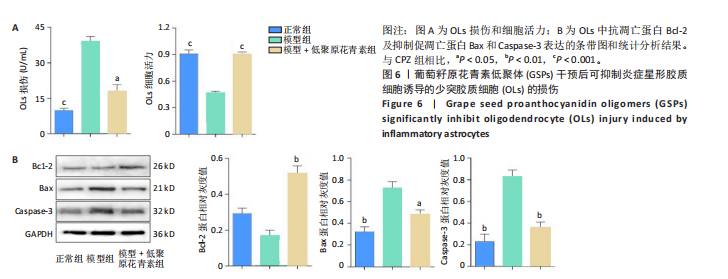
2.1 实验动物数量分析 30只小鼠分为3组,全部进入结果分析。 2.2 葡萄籽原花青素低聚体改善CPZ小鼠的行为学 2.2.1 高架十字迷宫实验结果 通过开放臂进入次数和闭合臂停留时间百分比来评价小鼠在危险环境中焦虑迟钝的异常情感表现。与正常组相比,CPZ组小鼠进入开放臂的次数增多,进入闭合臂的时间缩短;经葡萄籽原花青素低聚体治疗后,小鼠进入开放臂的次数减少,在闭合臂中仪时间延长,见图1A。 2.2.2 旷场实验结果 通过中央区活动距离和总活动距离来评价小鼠危险环境中焦虑迟钝的异常情感表现。与正常组相比,CPZ组小鼠在中心区域的活动距离和总行走距离显著增加;经葡萄籽原花青素低聚体治疗后,小鼠在中心区域的活动距离和总行走距离明显缩短,见图1B。 以上结果表明,葡萄籽原花青素低聚体缓解了CPZ小鼠在危险环境中焦虑迟钝的异常情感表现。 2.3 葡萄籽原花青素低聚体抑制CPZ小鼠的髓鞘脱失 为探究葡萄籽原花青素低聚体能否抑制CPZ小鼠胼胝体区域的髓鞘脱失,分别进行了LFB、油红染色和抗神经元-神经胶质抗原2、抗髓鞘碱性蛋白的免疫荧光染色。 2.3.1 LFB和油红染色结果 正常组小鼠胼胝体区髓鞘染色深且均匀,CPZ组胼胝体区髓鞘染色明显变浅,经葡萄籽原花青素低聚体治疗后,胼胝体区髓鞘染色显著加深,见图2A。 2.3.2 免疫荧光染色结果 与正常组比较,CPZ组小鼠胼胝体区抗髓鞘碱性蛋白和抗神经元-神经胶质抗原2表达显著下降,平均荧光强度降低;与CPZ组比较,CPZ+低聚原花青素组小鼠胼胝体区抗髓鞘碱性蛋白和抗神经元-神经胶质抗原2表达显著升高,平均荧光强度明显增强。说明葡萄籽原花青素低聚体能够抑制CPZ小鼠的髓鞘脱失,见图2B。 2.4 葡萄籽原花青素低聚体抑制CPZ小鼠脑内的炎症反应 2.4.1 ELISA法检测结果 基于炎症反应在CPZ小鼠髓鞘脱失中的作用,实验检测了葡萄籽原花青素低聚体对CPZ小鼠脑内炎症反应的影响。结果显示,葡萄籽原花青素低聚体显著抑制了肿瘤坏死因子α、白细胞介素1β、白细胞介素6和白细胞介素17的表达水平,升高了转化生长因子β的水平,见图3A。 2.4.2 免疫荧光法检测结果 星形胶质细胞参与了CPZ小鼠的炎症反应,介导了髓鞘脱失的进程,为了探究葡萄籽原花青素低聚体发挥作用的细胞机制,免疫荧光法检测检测了药物对星形胶质细胞的影响。结果表明,与正常组相比,CPZ组抗胶质纤维酸性蛋白阳性的星形胶质细胞数量明显增加,而葡萄籽原花青素低聚体显著促进了抗胶质纤维酸性蛋白阳性的星形胶质细胞增生,见图3B。 为了验证增生的星形胶质细胞是否有益于髓鞘,检测了抗胶质纤维酸性蛋白阳性的星形胶质细胞中肿瘤坏死因子α的表达情况,发现CPZ+低聚原花青素组中抗胶质纤维酸性蛋白和肿瘤坏死因子α双阳性的星形胶质细胞平均荧光强度下降了45%,见图4。结果说明葡萄籽原花青素低聚体抑制抗胶质纤维酸性蛋白阳性的星形胶质细胞的炎症反应。 2.5 葡萄籽原花青素低聚体减少CPZ小鼠A1型的星形胶质细胞 为了研究葡萄籽原花青素低聚体对CPZ小鼠脑内星形胶质细胞极化的影响,采用免疫荧光法测定抗胶质纤维酸性蛋白和C3d双阳性的星形胶质细胞的表达情况,见图5A。与正常组相比,CPZ组小鼠脑内抗胶质纤维酸性蛋白和C3d双阳性的星形胶质细胞明显增加,葡萄籽原花青素低聚体则使抗胶质纤维酸性蛋白和C3d双阳性的细胞数量显著减少。前期实验表明,葡萄籽原花青素低聚体在体外可能通过抑制p-JNK的表达减少A1型星形胶质细胞的数量[14],所以在体内检测了p-JNK在抗胶质纤维酸性蛋白阳性的星形胶质细胞中的表达情况,结果表明,葡萄籽原花青素低聚体显著抑制了p-JNK在抗胶质纤维酸性蛋白阳性的星形胶质细胞中的表达,见图5B。 2.6 葡萄籽原花青素低聚体抑制促炎型星形胶质细胞诱导的少突胶质细胞的凋亡 为了探究葡萄籽原花青素低聚体通过调控星形胶质细胞的极化对少突胶质细胞的影响,在体外建立原代星形胶质细胞炎症模型,采用L-乳酸脱氢酶法和CCK-8法检测少突胶质细胞的损伤和细胞活力情况。结果表明,与正常组相比,模型组的细胞存活率降低和细胞毒性增加,模型+低聚原花青素组可显著增加少突胶质细胞的活力、降低炎性星形胶质细胞对少突胶质细胞的毒性,见图6A。收集少突胶质细胞检测与凋亡相关的蛋白,发现模型+低聚原花青素组可显著增加少突胶质细胞中抗凋亡蛋白Bcl-2的表达,抑制促凋亡蛋白Bax和Caspase-3的表达,见图6B。"
"
"
"
| [1] HAKI M, AL-BIATI HA, AL-TAMEEMI ZS, et al. Review of multiple sclerosis: Epidemiology, etiology, pathophysiology, and treatment. Medicine (Baltimore). 2024;103(8):e37297. [2] WARD M, GOLDMAN MD. Epidemiology and Pathophysiology of Multiple Sclerosis. Continuum (Minneap Minn). 2022;28(4):988-1005. [3] 王柳清, 朱峰, 薛群, 等. 多发性硬化疾病修饰治疗药物的临床应用现状[J].临床药物治疗杂志,2023,21(10):6-11. [4] LIU R, DU S, ZHAO L, et al.Autoreactive lymphocytes in multiple sclerosis: Pathogenesis and treatment target. Front Immunol. 2022;13:996469. [5] ABSINTA M, MARIC D, GHARAGOZLOO M, et al. A lymphocyte-microglia-astrocyte axis in chronic active multiple sclerosis. Nature. 2021;597(7878): 709-714. [6] ZHANG C, LIU W, WANG L, et al. Prevalence and Burden of Multiple Sclerosis in China, 1990-2019: Findings From the Global Burden of Disease Study 2019. Neurology. 2024;102(11):e209351. [7] WANG M, LIU C, ZOU M, et al. Recent progress in epidemiology, clinical features, and therapy of multiple sclerosis in China. Ther Adv Neurol Disord. 2023;16:17562864231193816. [8] AMIN M, HERSH CM. Updates and advances in multiple sclerosis neurotherapeutics. Neurodegener Dis Manag. 2023;13(1):47-70. [9] BAECHER-ALLAN C, KASKOW BJ, WEINER HL. Multiple sclerosis: mechanisms and immunotherapy. Neuron. 2018;97:742-768. [10] SEN MK, MAHNS DA, COORSSEN JR, et al. The roles of microglia and astrocytes in phagocytosis and myelination: Insights from the cuprizone model of multiple sclerosis. Glia. 2022;70(7):1215-1250. [11] ANGELINO D, CARREGOSA D, DOMENECH-COCA C, et al. 5-(Hydroxyphenyl)-γ-Valerolactone-Sulfate, a Key Microbial Metabolite of Flavan-3-ols, Is Able to Reach the Brain: Evidence from Different in Silico, In Vitro and In Vivo Experimental Models. Nutrients. 2019;11(11):2678. [12] GAO WL, LI XH, DUN XP, et al. Grape Seed Proanthocyanidin Extract Ameliorates Streptozotocin-induced Cognitive and Synaptic Plasticity Deficits by Inhibiting Oxidative Stress and Preserving AKT and ERK Activities. Curr Med Sci. 2020;40(3):434-443. [13] WANG Q, WANG J, Y ZC, et al. Therapeutic effect of oligomeric proanthocyanidin in cuprizone-induced demyelination. Exp Physiol. 2019; 104(6):876-886. [14] 王青, 杨智超, 董艺薇, 等. 葡萄籽原花青素低聚体抑制A1型星形胶质细胞极化机制[J].中国药理学通报,2023,39(1):77-82. [15] TORKILDSEN O, BRUNBORG LA, MYHR KM, et al. The cuprizone model for demyelination. Acta Neurol Scand Suppl. 2008;188:72-76. [16] YOO DY, KIM W, YOO KY, et al. Grape seed extract enhances neurogenesis in the hippocampal dentate gyrus in C57BL/6 mice. Phytother Res. 2011; 25(5):668-674. [17] GONG XD, XU LZ, FANG X, et al. Protective effects of grape seed procyanidin on isoflurane-induced cognitive impairment inmice. Pharm Biol. 2020;58(1): 200-207. [18] 王芸, 李永德, 彭超, 等. CPZ诱导精神分裂症样模型小鼠海马脱髓鞘改变与行为学变化及其相关性的研究[J]. 重庆医科大学学报,2014, 39(2):129-136. [19] LIU HX, ZHAI JG, WANG B, et al. Olig2 Silence Ameliorates Cuprizone-Induced Schizophrenia-Like Symptoms in Mice. Med Sci Monit. 2017; 3:4834-4840. [20] 陈玉宁, 蒋颖, 廖翔宇, 等. 补气活血合剂干预脑缺血再灌注模型大鼠相关因子及自噬蛋白的表达 [J]. 中国组织工程研究,2024,29(6):1252-1258. [21] CONG H, LIANG M, WANG Y, et al. Icariin ameliorates the cuprizone-induced acute brain demyelination and modulates the number of oligodendrocytes, microglia and astrocytes in the brain of C57BL/6J mice. Brain Res Bull. 2021; 175:37-47. [22] 谢媛, 梅晓峰, 陶柳颖, 等. 香烟烟雾联合Poly I:C诱导COPD模型小鼠气道上皮屏障损伤的机制 [J].中国病理生理杂志,2024,40(7):1222-1229. [23] KERKERING J, MUINJONOV B, ROSIEWICZ KS, et al. iPSC-derived reactive astrocytes from patients with multiple sclerosis protect cocultured neurons in inflammatory conditions. J Clin Invest. 2023;133(13):e164637. [24] SEN MK, MAHNS DA, COORSSEN JR, et al. The roles of microglia and astrocytes in phagocytosis and myelination: Insights from the cuprizone model of multiple sclerosis. Glia. 2022;70(7):1215-1250. [25] SHI J, XIAO Y, ZHANG N, et al. HMGB1 from Astrocytes Promotes EAE by Influencing the Immune Cell Infiltration-Associated Functions of BMECs in Mice. Neurosci Bull. 2022;38(11):1303-1314. [26] ABULABAN AA, AL-KURAISHY HM, AL-GAREEB AI, et al. The janus face of astrocytes in multiple sclerosis: Balancing protection and pathology. Brain Res Bull. 2025;226:111356. [27] LEE HG, RONE JM, LI Z, et al. Disease-associated astrocyte epigenetic memory promotes CNS pathology. Nature. 2024;627(8005):865-872. [28] ZHA Z, LIU YJ, LIU SS, et al. Bu Shen Yi Sui Capsule Promotes Myelin Repair by Modulating the Transformation of A1/A2 Reactive Astrocytes In Vivo and In Vitro. Oxid Med Cell Longev. 2022;2022:3800004. [29] ABSINTA M, MARIC D, GHARAGOZLOO M, et al. A lymphocyte-microglia-astrocyte axis in chronic active multiple sclerosis. Nature. 2021;597(7878): 709-714. [30] TIZIANA V, ANDRONIKI VK, MARIELLA E, et al. Mesenchymal stem cells instruct a beneficial phenotype in reactive astrocytes. Glia. 2021;69(5):1204-1215. [31] SUTTER PA, WILLIS CM, MENORET A, et al. Astrocytic TIMP-1 regulates production of Anastellin, an inhibitor of oligodendrocyte differentiation and FTY720 responses. Proc Natl Acad Sci U S A. 2024; 121(5):e2306816121. [32] HE Y, AN J, YIN JJ, et al. Ethyl Pyruvate-Derived Transdifferentiation of Astrocytes to Oligodendrogenesis in Cuprizone-Induced Demyelinating Model. Neurotherapeutics. 2021;18(1):488-502. [33] CHEN C, SHU Y, YAN C, et al. Astrocyte-derived clusterin disrupts glial physiology to obstruct remyelination in mouse models of demyelinating diseases. Nat Commun. 2024;15(1):7791. [34] LI X, DING Z, LIU K, et al. Astrocytic phagocytosis of myelin debris and reactive characteristics in vivo and in vitro. Biol Cell. 2023;115(12): e202300057. [35] SANTIAGO-BALMASEDA A, AGUIRRE-OROZCO A, VALENZUELA-ARZETA IE, et al. Neurodegenerative Diseases: Unraveling the Heterogeneity of Astrocytes. Cells. 2024;13(11):921. [36] SAMTLEBEN S, MINA L, YAP MC, et al. Astrocytes show increased levels of Ero1alpha in multiple sclerosis and its experimental autoimmune encephalomyelitis animal model. Eur J Neurosci. 2022;56(8):5177-5190. [37] KEMPURAJ D, THANGAVEL R, NATTERU PA, et al. Neuroinflammation Induces Neurodegeneration. J Neurol Neurosurg Spine. 2016;1(1):1003. [38] LUO J. TGF-beta as a Key Modulator of Astrocyte Reactivity: Disease Relevance and Therapeutic Implications. Biomedicines. 2022;10(5):1206. [39] KHAN Z, MEHAN S, GUPTA GD, et al. Immune System Dysregulation in the Progression of Multiple Sclerosis: Molecular Insights and Therapeutic Implications. Neuroscience. 2024;548:9-26. [40] CHENG YJ, WANG F, FENG J, et al. Prolonged myelin deficits contribute to neuron loss and functional impairments after ischaemic stroke. Brain. 2024;147(4):1294-1311. [41] DEDONI S, SCHERMA M, CAMOGLIO C, et al. An overall view of the most common experimental models for multiple sclerosis. Neurobiol Dis. 2023; 184:106230. [42] TORKILDSEN O, BRUNBORG LA, MYHR KM, et al. The cuprizone model for demyelination. Acta Neurol Scand Suppl. 2008;188:72-76. [43] MI Y, QI G, VITALI F, et al. Loss of fatty acid degradation by astrocytic mitochondria triggers neuroinflammation and neurodegeneration. Nat Metab. 2023;5(3):445-465. [44] SHINOZAKI Y, SHIBATA K, YOSHIDA K, et al. Transformation of Astrocytes to a Neuroprotective Phenotype by Microglia via P2Y(1) Receptor Downregulation. Cell Rep. 2017;19(6):1151-1164. [45] WU L, LIU YC, HE QG, et al. PEDF-34 attenuates neurological deficit and suppresses astrocyte-dependent neuroinflammation by modulating astrocyte polarization via 67LR/JNK/STAT1 signaling pathway after subarachnoid hemorrhage in rats. J Neuroinflammation. 2024;21(1):178. [46] LI X, DING Z, LIU K, et al. Astrocytic phagocytosis of myelin debris and reactive characteristics in vivo and in vitro. Biol Cell. 2023;115(12): e202300057. [47] CHEN C, SHU Y, YAN C, et al. Astrocyte-derived clusterin disrupts glial physiology to obstruct remyelination in mouse models of demyelinating diseases. Nat Commun. 2024;15(1):7791. [48] SCHIRMER L, SCHAFER DP, BARTELS T, et al. Diversity and Function of Glial Cell Types in Multiple Sclerosis. Trends Immunol. 2021;42(3):228-247. [49] GUPTA S, SIMIC M, SAGAN SA, et al. CAR-T Cell-Mediated B-Cell Depletion in Central Nervous System Autoimmunity. Neurol Neuroimmunol Neuroinflamm. 2023;10(2):e200080. [50] ROBINSON AP, HARP CT, NORONHA A, et al. The experimental autoimmune encephalomyelitis (EAE) model of MS: utility for understanding disease pathophysiology and treatment. Handb Clin Neurol. 2014;122:173-189. |
| [1] | Liu Anting, Lu Jiangtao, Zhang Wenjie, He Ling, Tang Zongsheng, Chen Xiaoling. Regulation of AMP-activated protein kinase by platelet lysate inhibits cadmium-induced neuronal apoptosis [J]. Chinese Journal of Tissue Engineering Research, 2026, 30(7): 1800-1807. |
| [2] | Cao Yong, Teng Hongliang, Tai Pengfei, Li Junda, Zhu Tengqi, Li Zhaojin. Interactions between cytokines and satellite cells in muscle regeneration [J]. Chinese Journal of Tissue Engineering Research, 2026, 30(7): 1808-1817. |
| [3] | Cai Ziming, Yu Qinghe, Ma Pengfei, Zhang Xin, Zhou Longqian, Zhang Chongyang, Lin Wenping. Heme oxygenase-1 alleviates lipopolysaccharide-induced inflammatory response in nucleus pulposus mesenchymal stem cells [J]. Chinese Journal of Tissue Engineering Research, 2026, 30(7): 1624-1631. |
| [4] | Yuan Xiaoshuang, Yang Xu, Yang Bo, Chen Xiaoxu, Tian Ting, Wang Feiqing, Li Yanju, Liu Yang, Yang Wenxiu. Effect of conditioned medium of diffuse large B-cell lymphoma cells on proliferation and apoptosis of human bone marrow mesenchymal stem cells [J]. Chinese Journal of Tissue Engineering Research, 2026, 30(7): 1632-1640. |
| [5] | He Jiale, Huang Xi, Dong Hongfei, Chen Lang, Zhong Fangyu, Li Xianhui. Acellular dermal matrix combined with adipose-derived stem cell exosomes promotes burn wound healing [J]. Chinese Journal of Tissue Engineering Research, 2026, 30(7): 1699-1710. |
| [6] | Xia Linfeng, Wang Lu, Long Qianfa, Tang Rongwu, Luo Haodong, Tang Yi, Zhong Jun, Liu Yang. Human umbilical cord mesenchymal stem cell-derived exosomes alleviate blood-brain barrier damage in mice with septic encephalopathy [J]. Chinese Journal of Tissue Engineering Research, 2026, 30(7): 1711-1719. |
| [7] | Cui Lianxu, Li Haomin, Xu Junrong, Tan Baodong, Lu Dahong, Peng Siwei, Wang Jinhui. Effect of umbilical cord mesenchymal stem cell conditioned medium on tissue repair after traumatic craniocerebral injury in miniature pigs [J]. Chinese Journal of Tissue Engineering Research, 2026, 30(7): 1730-1735. |
| [8] | Zhu Kuicheng, Du Chunyan, Zhang Jintao. Mechanism by which hairless gene mutation promotes white adipose tissue browning in hairless mice [J]. Chinese Journal of Tissue Engineering Research, 2026, 30(6): 1424-1430. |
| [9] | Jia Jinwen, Airefate·Ainiwaer, Zhang Juan. Effects of EP300 on autophagy and apoptosis related to allergic rhinitis in rats [J]. Chinese Journal of Tissue Engineering Research, 2026, 30(6): 1439-1449. |
| [10] | Hou Chaowen, Li Zhaojin, Kong Jianda, Zhang Shuli. Main physiological changes in skeletal muscle aging and the multimechanism regulatory role of exercise [J]. Chinese Journal of Tissue Engineering Research, 2026, 30(6): 1464-1475. |
| [11] | You Huijuan, Wu Shuzhen, Rong Rong, Chen Liyuan, Zhao Yuqing, Wang Qinglu, Ou Xiaowei, Yang Fengying. Macrophage autophagy in lung diseases: two-sided effects [J]. Chinese Journal of Tissue Engineering Research, 2026, 30(6): 1516-1526. |
| [12] | Zhang Di, Zhao Jun, Ma Guangyue, Sun Hui, Jiang Rong. Mechanism of depression-like behavior in chronic social defeat stress mice based on high-throughput sequencing [J]. Chinese Journal of Tissue Engineering Research, 2026, 30(5): 1139-1146. |
| [13] | Li Haojing, Wang Xin, Song Chenglin, Zhang Shengnan, Chen Yunxin. Therapeutic efficacy of extracorporeal shock wave therapy in the upper trapezius muscle area combined with exercise control training in patients with chronic non-specific neck pain [J]. Chinese Journal of Tissue Engineering Research, 2026, 30(5): 1162-1170. |
| [14] | Liu Yu, Lei Senlin, Zhou Jintao, Liu Hui, Li Xianhui. Mechanisms by which aerobic and resistance exercises improve obesity-related cognitive impairment [J]. Chinese Journal of Tissue Engineering Research, 2026, 30(5): 1171-1183. |
| [15] | Yu Huifen, Mo Licun, Cheng Leping. The position and role of 5-hydroxytryptamine in the repair of tissue injury [J]. Chinese Journal of Tissue Engineering Research, 2026, 30(5): 1196-1206. |
| Viewed | ||||||
|
Full text |
|
|||||
|
Abstract |
|
|||||