Chinese Journal of Tissue Engineering Research ›› 2026, Vol. 30 ›› Issue (21): 5597-5604.doi: 10.12307/2026.696
Previous Articles Next Articles
Diagnostic value of diffusion-weighted imaging with different diffusion sensitivity coefficients for spinal tuberculosis and Brucellar spondylitis
Sun Na1, Wang Hui2, Zhao Guyue1, Yu Honghao3
- 1Department of Radiology, 3Department of Orthopedics, Shengjing Hospital Affiliated to China Medical University, Shenyang 110004, Liaoning Province, China; 2Department of Radiology, Xuzhou No.1 People's Hospital, Xuzhou 221002, Jiangsu Province, China
-
Accepted:2025-05-19Online:2026-07-28Published:2026-03-05 -
Contact:Sun Na, MS, Physician, Department of Radiology, Shengjing Hospital Affiliated to China Medical University, Shenyang 110004, Liaoning Province, China -
About author:Sun Na, MS, Physician, Department of Radiology, Shengjing Hospital Affiliated to China Medical University, Shenyang 110004, Liaoning Province, China

CLC Number:
Cite this article
Sun Na, Wang Hui, Zhao Guyue, Yu Honghao. Diagnostic value of diffusion-weighted imaging with different diffusion sensitivity coefficients for spinal tuberculosis and Brucellar spondylitis[J]. Chinese Journal of Tissue Engineering Research, 2026, 30(21): 5597-5604.
share this article
Add to citation manager EndNote|Reference Manager|ProCite|BibTeX|RefWorks
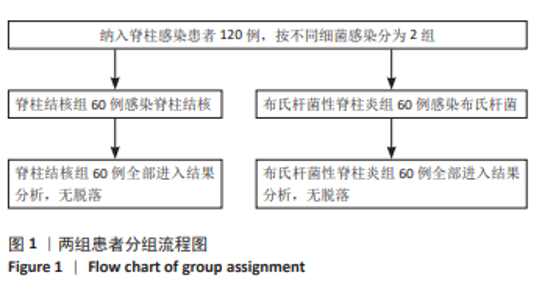
2.1 参与者数量分析 纳入60例脊柱结核患者与60例布氏杆菌性脊柱炎患者作为研究对象,所有研究对象均按照要求完成一般资料、实验室资料与弥散加权成像影像学资料收集,所有数据均纳入结果分析。 2.2 试验流程图 见图1。"
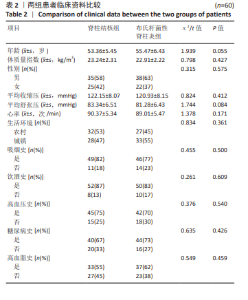
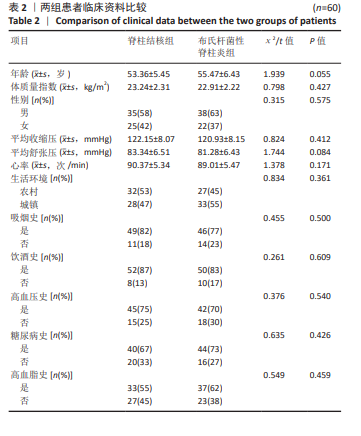
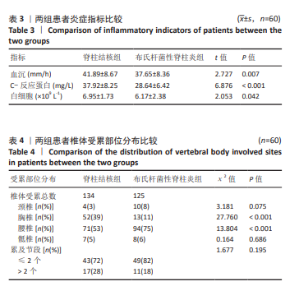
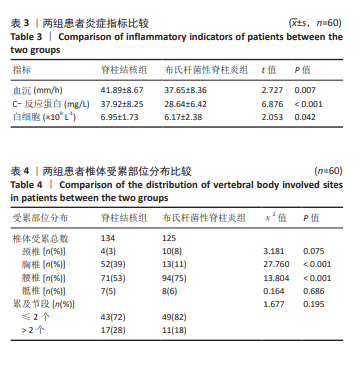
2.3 临床资料比较 结果显示,两组患者在年龄、体质量指数、性别、血压、心率、生活环境、吸烟饮酒史、合并症等方面差异均无显著性意义(P > 0.05),具有可比性,见表2。 2.4 两组患者炎症指标比较 结果显示,脊柱结核组患者的血沉、C-反应蛋白、白细胞水平显著高于布氏杆菌性脊柱炎组(P < 0.05),见表3。 2.5 椎体受累部位分布比较 结果显示,脊柱结核组与布氏杆菌性脊柱炎组腰椎、胸椎受累部位的分布情况差异有显著性意义(P < 0.05),脊柱结核最易累及腰椎与胸椎,布氏杆菌性脊柱炎最易累及腰椎,见表4。"
"
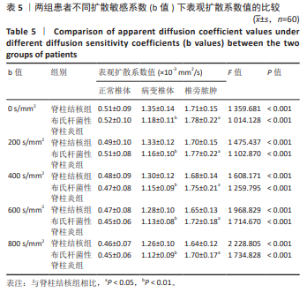
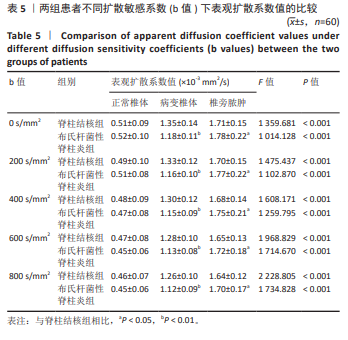
2.6 两组患者不同椎体在不同b值下的表观扩散系数值比较 比较两组患者不同椎体(正常、病变、椎旁脓肿)在不同b值下表观扩散系数值。结果显示,b=0,200,400,600,800 s/mm2时,脊柱结核组患者病变椎体、椎旁脓肿的表观扩散系数值与布氏杆菌性脊柱炎组相比均有显著性差异(P < 0.05);在不同b值下同一组别中,正常椎体、病变椎体、椎旁脓肿表观扩散系数值相比差异有显著性意义(P < 0.05),见表5。"
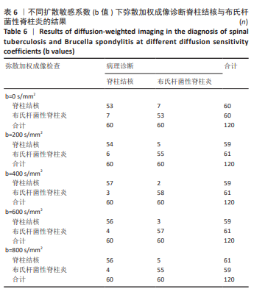
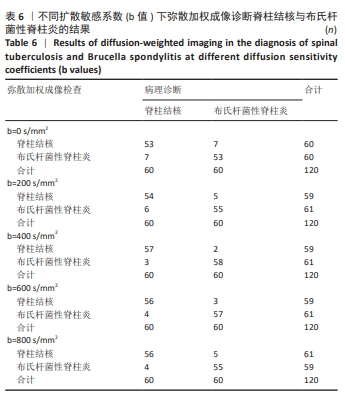
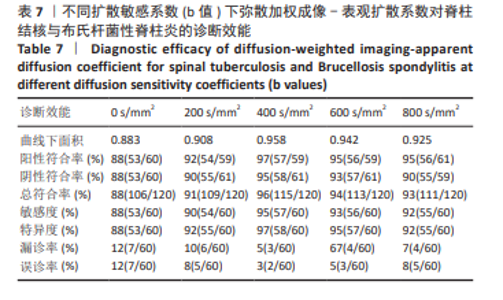
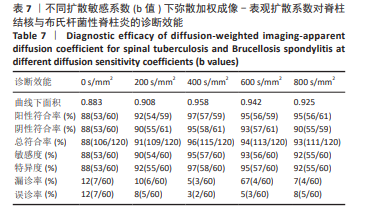
2.7 不同b值下弥散加权成像-表观扩散系数值对脊柱结核与布氏杆菌性脊柱炎的诊断效能分析 病理诊断结果为脊柱结核及布氏杆菌性脊柱炎患者不同b值下弥散加权成像诊断结果详见表6。b值为0,200,400,600,800 s/mm2时的曲线下面积分别为0.883,0.908,0.958,0.942,0.925,b=400 s/mm2时表观扩散系数值的鉴别诊断效能最大,敏感度为95%,特异度为97%,见表7。"
"
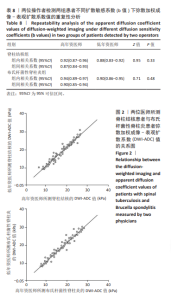
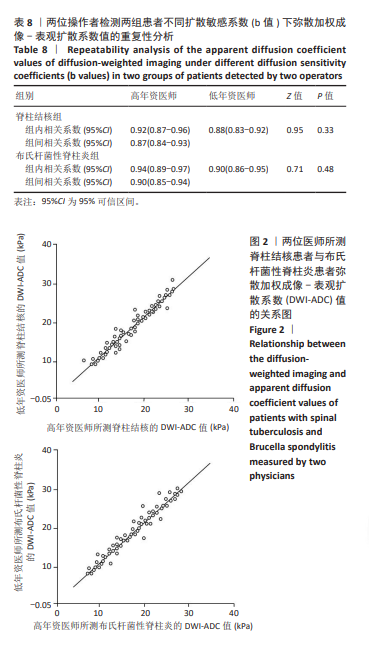
2.8 两位操作者检测两组患者不同b值下弥散加权成像-表观扩散系数值的重复性分析 高年资医师、低年资医师在脊柱结核、布氏杆菌性脊柱炎患者弥散加权成像-表观扩散系数值的组内、组间相关系数均> 0.75。高年资医师3次测量的组内相关系数稍高于低年资医师,但差异无显著性意义(P > 0.05)。见表8,图2。"
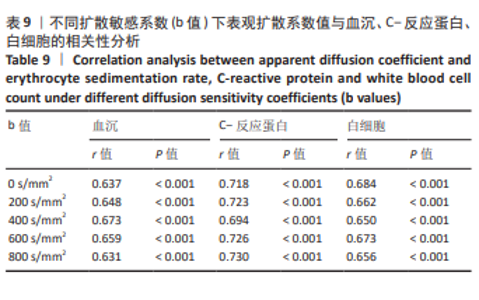
2.9 不同b值下病变椎体表观扩散系数值与炎症指标的相关性分析 不同b值下病变椎体的表观扩散系数值与血沉、C-反应蛋白、白细胞进行Pearson相关性分析,结果显示,不同b值下的表观扩散系数值(1.03×10⁻³-1.49×10⁻³ mm2/s)与血沉、C-反应蛋白、白细胞均存在显著相关性(P < 0.001),见表9。"
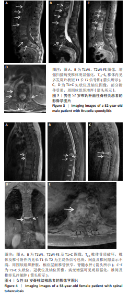
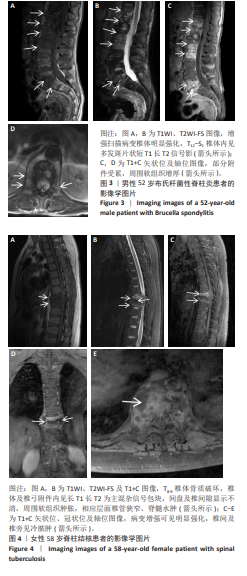
2.10 典型病例 如图3,4所示。"
| [1] KUMAR V, NERADI D, SHERRY B, et al. Tuberculosis of the spine and drug resistance: a review article. Neurosurg Rev. 2022;45(1):217-229. [2] ABUDUKADIER M, ZHANG Y, LI M, et al. A novel differentiation nomogram model for brucellar spondylitis and tuberculous spondylitis. Infect Drug Resist. 2024;17(27):5895-5907. [3] MA Z, LIU X, ZHANG M, et al. Differences analysis between spinal tuberculosis and brucella spondylitis with preoperative non-invasive differential diagnosis. Eur Spine J. 2025;34(2):675-683. [4] WANG W, FAN Z, ZHEN J. MRI radiomics-based evaluation of tuberculous and brucella spondylitis. J Int Med Res. 2023;51(8): 3000605231195156. [5] GUO C, ZHENG K, XIE Z, et al. Intravoxel incoherent motion diffusion-weighted imaging as a quantitative tool for evaluating disease activity in patients with axial spondyloarthritis. Clin Radiol. 2022;77(6):e434-e441. [6] HENKELMANN J, BREMICKER K, DENECKE T, et al. Clinical suspicion of spondylodiscitis with equivocal MRI findings: does diffusion-weighted imaging prove helpful here? Acta Radiol. 2021;62(3):394-400. [7] WANG F, ZHANG H, DAI F, et al. Multiple b-value model-based residual network (MORN) for accelerated high-resolution diffusion-weighted imaging. IEEE J Biomed Health Inform. 2022;26(9):4575-4586. [8] 王振兴, 薛伟, 魏萌, 等. 多b值DWI序列ADC值在脊柱骨质疏松性压缩骨折与椎体转移瘤病理性压缩骨折鉴别诊断中的价值研究[J]. 颈腰痛杂志,2023,44(2):179-182. [9] NING Q, FAN T, REN H, et al. Differentiating active from inactive sacroiliitis in ankylosing spondylitis by combination of DWI and magnetization transfer imaging. Pak J Med Sci. 2023;39(2):417-422. [10] HOHENHAUS M, MERZ Y, KLINGLER JH, et al. Diffusion tensor imaging in unclear intramedullary tumor-suspected lesions allows separating tumors from inflammation. Spinal Cord. 2022;60(7):655-663. [11] HU C, BIAN C, CAO N, et al. Synthesizing high b-value diffusion-weighted imaging of gastric cancer using an improved vision transformer CycleGAN. Bioengineering (Basel). 2024;11(8):805-814. [12] HAO Y, ZHENG J, LI W, et al. Ultra-high b-value DWI in rectal cancer: image quality assessment and regional lymph node prediction based on radiomics. Eur Radiol. 2025;35(1):49-60. [13] BERARDO S, SUKHOVEI L, ANDORNO S, et al. Quantitative bone marrow magnetic resonance imaging through apparent diffusion coefficient and fat fraction in multiple myeloma patients. Radiol Med. 2021;126(3):445-452. [14] YILDIZ S, SCHECHT M, AGGARWAL A, et al. Diffusion weighted imaging in spine tumors. Neuroimaging Clin N Am. 2023;33(3):459-475. [15] ZHANG J, XING X, WANG Q, et al. Preliminary study of monoexponential, biexponential, and stretched-exponential models of diffusion-weighted MRI and diffusion kurtosis imaging on differential diagnosis of spinal metastases and chordoma. Eur Spine J. 2022;31(11): 3130-3138. [16] Liu YJ, Lin SC, Liao CH, et al. MUSE and PROPELLER DWI for ADC in parasagittal dura: insights from high-resolution and reduced-distortion DWI. Sci Rep. 2025;15(1):7473-7480. [17] ZHOU B, LIU X, GAN H, et al. Differentiation of prostate cancer and stromal hyperplasia in the transition zone with monoexponential, stretched-exponential diffusion-weighted imaging and diffusion kurtosis imaging in a reduced number of b values: correlation with whole-mount pathology. J Comput Assist Tomogr. 2022;46(4):545-550. [18] HAMEED M, SIDDIQUI F, KHAN MK, et al. The role of diffusion-weighted MRI in the accurate diagnosis of vertebral compression fractures: a comparative study. Radiography (Lond). 2024;30(1):353-358. [19] GUIRGUIS M, GUPTA A, THAKUR U, et al. Diffusion weighted imaging of extremity bone tumors-inter-reader analysis and incremental value over conventional MR imaging. Br J Radiol. 2023;96(1151):20230352. [20] TRENTADUE M, SOZZI C, IDOLAZZI L, et al. Magnetic resonance imaging at 3.0-T in postmenopausal osteoporosis: a prospective study and review of the literature. Radiol Bras. 2022;55(4):216-224. [21] LEE H, AHN TR, HWANG KH, et al. Evaluation of three imaging methods to quantify key events in pelvic bone metastasis. Cancers (Basel). 2024;16(1):214-220. [22] 姚晓群, 杨益宏, 卫建民. MRI-DWI技术对脊柱结核,脊柱转移瘤的鉴别诊断及影像学分析[J]. 中国CT和MRI杂志,2022,20(6): 162-163,166. [23] BOUSSAID S, MRABET M, REKIK S, et al. Spinal tuberculosis: features and early predictive factors of poor outcomes. Mediterr J Rheumatol. 2023;34(2):220-228. [24] RAMMEH S, ROMDHANE E, RIAHI H, et al. Granulomatous spondylodiscitis: a case series with focus on histopathological features. J Spinal Cord Med. 2021;44(2):282-287. [25] COMPAGNONE D, CECCHINATO R, PEZZI A, et al. Diagnostic approach and differences between spinal infections and tumors. Diagnostics (Basel). 2023;13(17):2737-2748. [26] GARG B, MEHTA N, MUKHERJEE RN, et al. Epidemiological insights from 1,652 patients with spinal tuberculosis managed at a single center: a retrospective review of 5-year data. Asian Spine J. 2022;16(2):162-172. [27] ZHOU J, YANG X, HU Y, et al. Epidemiological and osteoarticular involvement sites’ characteristics of multiple osteoarticular tuberculosis: a scoping review. Epidemiol Infect. 2025;153:e26-e32. [28] XU Q, JING X, ZHENG M, et al. Bone features reinforce differential diagnosis between tuberculous spondylitis and brucellosis spondylitis. BMC Infect Dis. 2024;24(1):1272-1279. [29] 徐传辉, 孙爱君, 沈连芳, 等. 布氏杆菌性脊柱炎MRI征象与病理对照分析[J]. 中国医学计算机成像杂志,2021,27(5):431-435. [30] XU T, LAI Q, QU N, et al. Diagnostic values of peripheral blood T-cell spot test for tuberculosis (T-SPOT.TB) for spinal tuberculosis. Surg Infect (Larchmt). 2023;24(6):534-540. [31] BARAN AI, CELIK M, ARSLAN Y, et al. A comparative perspective on brucellar, pyogenic, and tuberculous spondylodiscitis. Eur Rev Med Pharmacol Sci. 2024;28(6):2550-2557. [32] ZHU X, LI K, ZHENG J, et al. Usage of procalcitonin and sCD14-ST as diagnostic markers for postoperative spinal infection. J Orthop Traumatol. 2022;23(1):25-33. [33] CHEN J, LIU Y, HUANG S, et al. Spinal infections? mNGS combined with microculture and pathology for answers. Infect Drug Resist. 2024;17: 3025-3034. [34] KAGNA O, KEIDAR Z, BEN-HAIM S. Negative influence of antimicrobial therapy on radiolabeled white blood cells scintigraphy performance in infective endocarditis: myth or fact? J Nucl Cardiol. 2023;30(1):354-356. [35] 王杰, 张耀申, 赵昌松, 等. 一期后路病灶清除减压融合内固定术治疗老年布鲁氏菌性脊柱炎的疗效观察[J]. 中国脊柱脊髓杂志, 2023,33(2):123-131. [36] CHARDE P, SAMAL N, GUDHE M, et al. Postoperative clinicoradiological outcome of pott’s spine. Ann Afr Med. 2021;20(3):164-168. [37] ZENG H, CHENG L, LU DZ, et al. Unbiased multitissue transcriptomic analysis reveals complex neuroendocrine regulatory networks mediated by spinal cord injury-induced immunodeficiency. J Neuroinflammation. 2023;20(1):219-225. [38] 王娟, 周守国. DWI, DCE-MRI及脂肪定量技术在强直性脊柱炎骶髂关节病变活动性评价中的应用价值[J]. 放射学实践,2023,38(5):610-614. [39] 莫少芬, 黄建锋, 江楚君, 等. 探讨T_(2)WI,DWI和T_(2)-DWI融合序列在子宫颈癌宫旁侵犯的诊断价值[J]. 中国CT和MRI杂志, 2023,21(9):147-150. [40] PERERA MOLLIGODA ARACHCHIGE AS, VERMA Y. State of the art in the diagnostic evaluation of osteomyelitis: exploring the role of advanced MRI sequences-a narrative review. Quant Imaging Med Surg. 2024;14(1):1070-1085. |
| [1] |
Lu Guangqi, Li Jing, Sun Xinyue, Liang Long, Liu Guangwei, Zhou Shuaiqi, Mao Hanze, Ma Mingming, Cui Ying, Liu Yakun, Hu Jiaming, Zhu Liguo, Yu Jie, Zhuang Minghui.
Correlation between cervical instability and neck muscle changes in middle-aged and young adults#br#
#br#
[J]. Chinese Journal of Tissue Engineering Research, 2026, 30(24): 6220-6224.
|
| [2] | Zhou Tianle, Wang Wei, Zhang Zhiwen, Liu Ximing. Application and progress of transcriptomics and proteomics techniques in the study of intervertebral disc degeneration [J]. Chinese Journal of Tissue Engineering Research, 2026, 30(23): 5925-5933. |
| [3] | Xie Ziying, Li Songbo, Li Jianwen, Yin Yuchao, Zheng Baichuan, Hu Chengshang. Animal experimental study on the treatment of lumbar intervertebral disc degeneration with Chinese herbal compound: species selection, modeling method and drug administration [J]. Chinese Journal of Tissue Engineering Research, 2026, 30(23): 5934-5942. |
| [4] | Gu Jiangpeng, Guo Wei, Chen Xujing, Liu Xiaomin, Liu Hongbo, Sun Peng, Ye Chaoqun, Feng Wei, Wang Fei. Feng’s spinal manipulation for cervical spondylosis: kinematic changes [J]. Chinese Journal of Tissue Engineering Research, 2026, 30(23): 6081-6091. |
| [5] | Lu Guangqi, Sun Xinyue, Han Xue, Liu Yakun, Ma Mingming, Mao Hanze, Zhou Shuaiqi, Liang Long, Li Jing, Hu Jiaming, Zhu Liguo, Yu Jie, Zhuang Minghui. Construction and validation of a deep learning prediction model for cervical instability [J]. Chinese Journal of Tissue Engineering Research, 2026, 30(21): 5369-5375. |
| [6] | Xie Xuechen, Julaiti·Maitirouzi, Li Chunchao, Zhang Le, Wang Yixi, Paerhati·Rexiti. Mechanical analysis of a bone cement-augmented cortical bone trajectory screw versus a new variable-diameter all-cortical bone screw [J]. Chinese Journal of Tissue Engineering Research, 2026, 30(21): 5403-5410. |
| [7] | Peng Yujian, Xie Yu, Wang Qianliang, Jiang Fengxian. Perioperative hidden blood loss and risk factors in transforaminal lumbar interbody fusion calculated by a new method [J]. Chinese Journal of Tissue Engineering Research, 2026, 30(21): 5549-5555. |
| [8] | Wu Ronghai, Zheng Zhouhang, Chen Huan, You Dongchun, Guo Weifeng, Liu Xingming, Zhang Yu . Meta-analysis of application effect of 3D-printed artificial vertebral bodies in anterior cervical corpectomy and fusion [J]. Chinese Journal of Tissue Engineering Research, 2026, 30(21): 5621-5628. |
| [9] | Lin Kejian, Chai Yinghong, Zou Jie, Huang Ruixin, Fang Yongchao, Huang Jing, Yang Qin, Luo Xia, Zhang Hong. Preparation of Cu2+-containing microarc oxidation functional coating on medical magnesium alloy and its anti-tumor and angiogenesis-promoting effects [J]. Chinese Journal of Tissue Engineering Research, 2026, 30(20): 5103-5114. |
| [10] | Gao Sheng, Xin Shimin, Liu Xingquan, Kang Liqing, Ren Baolin, Wang Haiyan. Biomechanical finite element analysis of lumbar degeneration based on radiological imaging [J]. Chinese Journal of Tissue Engineering Research, 2026, 30(15): 3810-3819. |
| [11] | Li Chunchao, Julaiti·Maitirouzi, Xie Xuechen, Zhang Le, Wang Yixi, Paerhati·Rexiti. Finite element analysis of effect of passive support of deep intrinsic lumbar muscle groups on the lumbar spine [J]. Chinese Journal of Tissue Engineering Research, 2026, 30(15): 3820-3831. |
| [12] | Liang Long, Liu Guangwei, Yu Jie, Wei Xu, Li Jing, Lu Guangqi, Zhu Liguo, Yin Xunlu, Feng Minshan. Method and verification of three-dimensional finite element modeling for cervical spondylotic radiculopathy [J]. Chinese Journal of Tissue Engineering Research, 2026, 30(15): 3871-3877. |
| [13] | Ma Le, Song Yuke, Zhong Xianxing, Zhang Wensheng. Risk factors for axial symptoms following posterior cervical laminoplasty: a systematic review and meta-analysis [J]. Chinese Journal of Tissue Engineering Research, 2026, 30(15): 3983-3992. |
| [14] | Cheng Qisheng, Julaiti·Maitirouzi, Xiao Yang, Zhang Chenwei, Paerhati·Rexiti. Finite element analysis of novel variable-diameter screws in modified cortical bone trajectory of lumbar vertebrae [J]. Chinese Journal of Tissue Engineering Research, 2026, 30(9): 2162-2171. |
| [15] | Liu Jiafu, Ren Ruxia, Liao Zhouwei, Zhou Xiali, Wu Yihong, Zhang Shaoqun. Three-dimensional finite element analysis of cervical spine biomechanical characteristics in a rat model of cervical vertigo [J]. Chinese Journal of Tissue Engineering Research, 2026, 30(9): 2182-2190. |
| Viewed | ||||||
|
Full text |
|
|||||
|
Abstract |
|
|||||