Chinese Journal of Tissue Engineering Research ›› 2026, Vol. 30 ›› Issue (34): 9081-9087.doi: 10.12307/2026.852
Previous Articles Next Articles
Medication patterns for traditional Chinese medicine in children with cerebral palsy: an analysis based on medical records and literature
Zou Yuxiong1, 2, Liu Ying1, Liu Xiaomeng2, Gu Nan2, Zhu Yue2, Zhu Jintai2, Li Shuming2, Ao Meiying2, Liu Qian1, 2, He Yuan1
- 1Affiliated Hospital of Jiangxi University of Chinese Medicine, Nanchang 330000, Jiangxi Province, China; 2Discipline of Chinese and Western Integrative Medicine, Integrated Chinese and Western Medicine Institute for Children Health & Drug Innovation, Key Laboratory of Traditional Chinese Medicine Prevention and Treatment of Hemangioma of Jiangxi Provincial Administration of Traditional Chinese Medicine, Jiangxi University of Chinese Medicine, Nanchang 330004, Jiangxi Province, China
-
Received:2025-10-15Revised:2026-01-19Online:2026-12-08Published:2026-04-15 -
Contact:He Yuan, MS, Attending physician, Affiliated Hospital of Jiangxi University of Chinese Medicine, Nanchang 330000, Jiangxi Province, China Co-corresponding author: Ao Meiying, PhD, Professor, Discipline of Chinese and Western Integrative Medicine, Integrated Chinese and Western Medicine Institute for Children Health & Drug Innovation, Key Laboratory of Traditional Chinese Medicine Prevention and Treatment of Hemangioma of Jiangxi Provincial Administration of Traditional Chinese Medicine, Jiangxi University of Chinese Medicine, Nanchang 330004, Jiangxi Province, China Co-corresponding author: Liu Qian, Doctoral supervisor, Professor, Affiliated Hospital of Jiangxi University of Chinese Medicine, Nanchang 330000, Jiangxi Province, China; Discipline of Chinese and Western Integrative Medicine, Integrated Chinese and Western Medicine Institute for Children Health & Drug Innovation, Key Laboratory of Traditional Chinese Medicine Prevention and Treatment of Hemangioma of Jiangxi Provincial Administration of Traditional Chinese Medicine, Jiangxi University of Chinese Medicine, Nanchang 330004, Jiangxi Province, China -
About author:Zou Yuxiong, MS, Physician, Affiliated Hospital of Jiangxi University of Chinese Medicine, Nanchang 330000, Jiangxi Province, China; Discipline of Chinese and Western Integrative Medicine, Integrated Chinese and Western Medicine Institute for Children Health & Drug Innovation, Key Laboratory of Traditional Chinese Medicine Prevention and Treatment of Hemangioma of Jiangxi Provincial Administration of Traditional Chinese Medicine, Jiangxi University of Chinese Medicine, Nanchang 330004, Jiangxi Province, China -
Supported by:National Natural Science Foundation of China, No. 82060658 (to AMY); Key Research and Development Program of National Key Laboratories, No. 20243BCC31008 (to LQ); Jiangxi University of Chinese Medicine Scientific Research Cultivation Project, No. 2023ZDPY001 (to LQ); Innovative Research Team on Integrated Chinese and Western Medicine for Prevention and Treatment of Pediatric Diseases and Health Protection, No. CXTD22014 (to LQ); University-Level Teaching Reform Project of Jiangxi University of Chinese Medicine, No. 2022jzyx-2 (to AMY)

CLC Number:
Cite this article
Zou Yuxiong, Liu Ying, Liu Xiaomeng, Gu Nan, Zhu Yue, Zhu Jintai, Li Shuming, Ao Meiying, Liu Qian, He Yuan. Medication patterns for traditional Chinese medicine in children with cerebral palsy: an analysis based on medical records and literature[J]. Chinese Journal of Tissue Engineering Research, 2026, 30(34): 9081-9087.
share this article
Add to citation manager EndNote|Reference Manager|ProCite|BibTeX|RefWorks
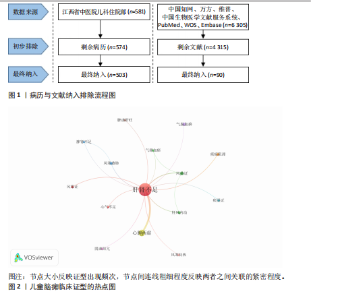
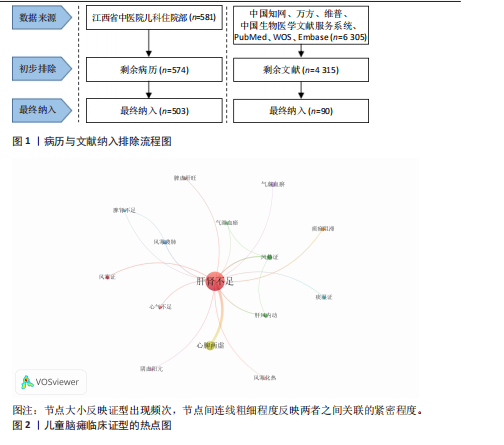
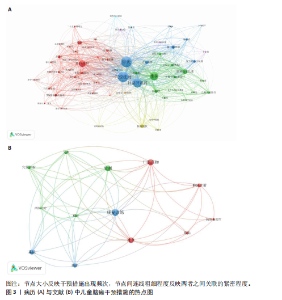
2.1 纳入排除结果 共收集儿童脑瘫住院病历581份,初步排除数据不全病历,剩余574份病历,严格纳入排除标准筛选后最终纳入中药治疗儿童脑瘫临床病历503份,见图1。同时,检索7个常用中英文数据库近20年文献,共获得6 305篇文献,初步排除重复文献后剩余4 315篇文献,通过阅读全文后最终纳入中药治疗儿童脑瘫临床研究文献90篇,见图1。 2.2 脑瘫患儿证候分型 中医治疗疾病讲究辨证论治,相同疾病不同证型用药不一[16-19]。此研究统计分析病历中脑瘫儿童的证候分型,基于聚类分析原则通过VOSviewer软件制作可视化知识地图。结果显示:儿童脑瘫主要表现证型为肝肾不足证,其次则为心脾两虚证;兼证则以肝肾不足兼心脾两虚最为常见,见图2。 2.3 脑瘫患儿干预措施 统计分析干预措施可为临床治疗提供借鉴与参考。此研究基于病历及文献资料统计分析脑瘫患儿的干预措施,通过VOSviewer软件制作可视化时间知识地图。 基于病历统计显示:该院治疗儿童脑瘫以外治法为主,其中针灸与穴位注射使用频次最高,其次则为推拿;而在药物治疗中,则以补益肝肾类中药治疗为主要手段,其次则为西药奥拉西坦与脑神经生长素,且补益肝肾类药物使用频次仅次于针灸与穴位注射的使用频次,见图3A。基于文献干预措施聚类分析结果显示:当前治疗儿童脑瘫主要为外治法,以康复训练、针刺、推拿最为常见,其中康复训练使用频次"
"
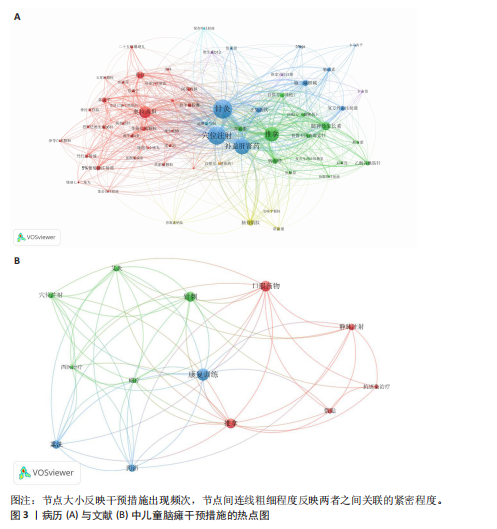
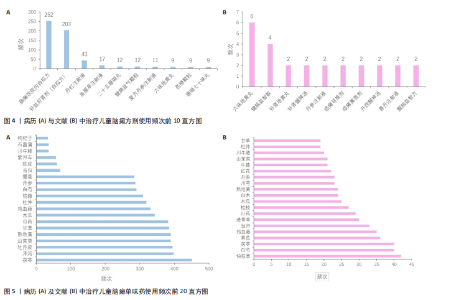
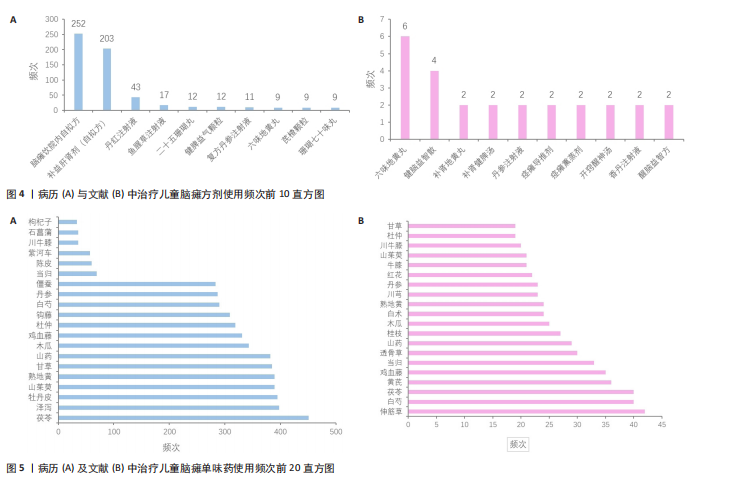
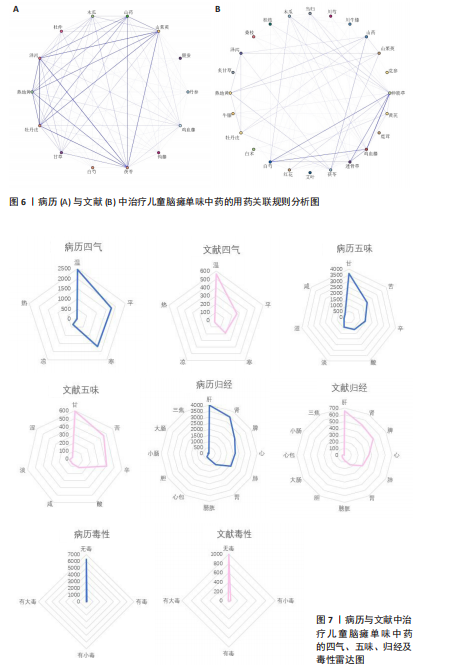
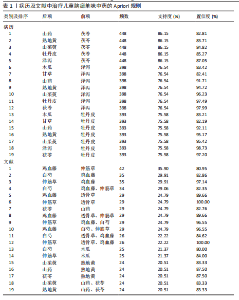
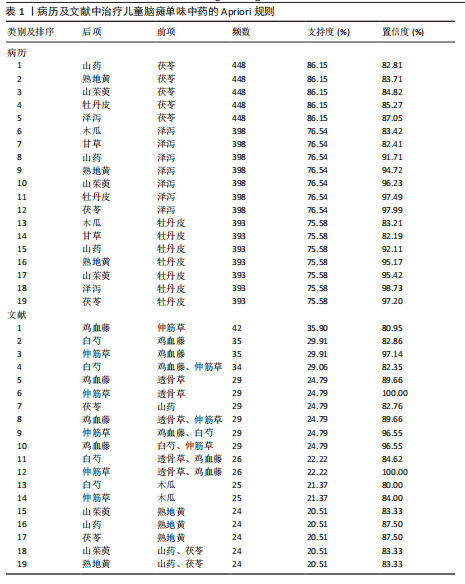
最高;而口服药物频次则仅次于康复训练,在口服药物中中药频次占80.77%,见图3B。 2.4 中药用药规律 2.4.1 常用方剂 统计分析治疗儿童脑瘫的方剂使用频次,遴选出常用方剂,为临床遣方用药提供参考。此研究对病历及文献中常用的中药复方使用频次统计分析,分别纳入处方520首与117首,统计使用频次前10的中药方。在病历中使用频次最高的3类方剂为脑瘫院内自拟方(252次)(自拟方组成:熟地黄、淮山药、茯苓、牡丹皮、泽泻、杜仲、木瓜、鸡血藤、钩藤、僵蚕、白芍、丹参、甘草、山茱萸)、补益肝肾剂(203次)、丹红注射液(43次),尤其是脑瘫院内自拟方与补益肝肾剂的使用频次远远高于其他方剂,且这2个方剂功效皆以补益肝肾为主,丹红注射液则以活血为主。在病历中使用频次排第八的六味地黄丸功效亦为补益肝肾,见图4A。在文献中使用频次最高的2个方剂则为六味地黄丸(6次)与健脑益智散(4次),其余使用频次前10的另外8个方剂皆并列第三,其中使用频次最多的六味地黄丸与使用频次第三的补肾地黄丸功效皆为补益肝肾,见图4B。 2.4.2 单味中药使用频次 治疗儿童脑瘫的中药复方常由数位中药组成,分析高频药物可知治疗儿童脑瘫的主要药物种类。病历与文献中分别使用中药6 303味与1 065味,中药种类分别为201种与162种。 由统计结果可知:病历中使用频次前20味中药由高至低分别是茯苓、泽泻、牡丹皮、山茱萸、熟地黄、甘草、山药、木瓜、鸡血藤、杜仲、钩藤、白芍、丹参、僵蚕、当归、陈皮、紫河车、川牛膝、石菖蒲、枸杞子,见图5A。文献中使用频次前20味中药由高至低分别是伸筋草、白芍、茯苓、黄芪、鸡血藤、当归、透骨草、山药、桂枝、木瓜、白术、熟地黄、川芎、丹参、红花、牛膝、山茱萸、川牛膝、杜仲、甘草,见图5B。在病历与文献中使用频次前20味药中,二者皆含有的药物有:熟地黄、山茱萸、山药、茯苓、川牛膝、丹参、杜仲、木瓜、鸡血藤、白芍、当归以及甘草12味药,由此可见,无论是病历或者是文献中,单味中药使用相似度较高。 2.4.3 药物关联规则 中药方剂组成有着一定的规则,为进一步探究配伍规则,基于Apriori算法分析用药规律[20-23]。将弱链上限设置为10,强链下限设置为20,最小支持度设置为10%,最小置信度设置为80%,并且将最大前因设置为5。对此研究所涉及的药材进行了关联规则分析,并各截取实例前19组药物展示。其中“频数”代表2种中药在所有中药复方中出现的频率,“支持度”代表2种中药同时出现的概率。“置信度”是“草药B”在含有“草药A”的复合物中出现的可能性,用来衡量关联规则的置信度,支持度越高,说明该中药组合的使用频率越高;置信度越高,说明该中药组合的可靠性越好。 在病历的药物组合中,支持度最高的相关药物组合为山药-茯苓;熟地-茯苓;山茱萸-茯苓;牡丹皮-茯苓;泽泻-茯苓5组药对,说明在病历中这5组药对使用频率最高;置信度最高的则为泽泻-牡丹皮,说明在病历中这组药对最可靠。在文献的药物组合中,支持度最高的相关药物组合为鸡血藤-伸筋草,说明在文献中这组药对使用频率最高;置信度最高的相关药物组合则为伸筋草-透骨草,说明在病历中这组药对最可靠,见表1。 综合病历与文献中的Apriori算法可知,山药与茯苓、熟地与茯苓2个药对皆位于二者实例前19之中,且此2个药对支持度皆位于前19,置信度百分比皆高于82.50%,见表1。此外,结合病历与文献关联规则网络图可知:山药与茯苓、熟地与茯苓相关联性更高,见图6A,B。 2.4.4 治疗儿童脑瘫药物的四气、五味与归经 中药药性理论是中药基本理论的核心,包括四气、五味、归经、有毒无毒等[24-26]。根据前期常用药材的统计结果,将雷达图的边缘设置为统计频率。对所有药物的性味、归经及药物毒性进行统计。 由统计结果可知:病历四气以温(出现频次2 441次,占比38.87%)为主,平(出现频次1 780次,占比28.34%)、寒(出现频次1 705次,占比27.15%)次之;文献病历以温(出现频次564次,占比53.16%)为主,平(出现频次268次,占比25.26%)、寒(出现频次188次,占比17.72%)次之。病历五味以甘(出现频次3 631次,占比37.25%)为主,苦(出现频次"

1 965次,占比20.16%)、辛(出现频次1 384次,占比14.20%)次之;文献五味以甘(出现频次593次,占比34.00%)为主,苦(出现频次460次,占比26.38%)、辛(出现频次404次,占比23.17%)次之。病历归经以肝(出现频次3 984次,占比24.35%)、肾(出现频次3 474次,占比21.23%)为主,脾(出现频次2 466次,占比15.07%)、心(出现频次2 171次,占比13.27%)、肺(出现频次2 113次,占比12.91%)次之;文献归经以肝(出现频次660次,占比24.35%)、肾(出现频次518次,占比19.11%)为主,脾(出现频次493次,占比18.19%)、心(出现频次363次,占比13.39%)、肺(出现频次309次,占比11.40%)次之。病历药物基本上为无毒药物(出现频次6 255次,占比99.24%);文献药物基本上为无毒药物(出现频次993次,占比93.24%)。见图7。 综上所述:治疗儿童脑瘫的所有药物中,性以温为主,平、寒次之;味以甘为主,苦、辛次之;归经以肝、肾经为主,脾、心、肺经次之;所有治疗儿童脑瘫的中药组方中基本上为无毒药物。"
"
| [1] 中国康复医学会儿童康复专业委员会,中国残疾人康复协会小儿脑性瘫痪康复专业委员会,《中国脑性瘫痪康复指南》编委会.中国脑性瘫痪康复指南(2015):第一部分[J].中国康复医学杂志,2015,30(7):747-754. [2] 中国康复医学会儿童康复专业委员会,中国残疾人康复协会小儿脑性瘫痪康复专业委员会,中国医师协会康复医师分会儿童康复专业委员会,等.中国脑性瘫痪康复指南(2022)第一章:概论[J].中华实用儿科临床杂志,2022,37(12):887-892. [3] ROSENBAUM P, PANETH N, LEVITON A, et al. A report: the definition and classification of cerebral palsy April 2006. Dev Med Child Neurol Suppl. 2007;109:8-14. [4] GALEA C, MCINTYRE S, SMITHERS-SHEEDY H, et al. Cerebral palsy trends in Australia (1995-2009): a population-based observational study. Dev Med Child Neurol. 2019;61(2):186-193. [5] DAR H, STEWART K, MCINTYRE S, et al. Multiple motor disorders in cerebral palsy. Dev Med Child Neurol. 2024;66(3):317-325. [6] 中国康复医学会儿童康复专业委员会,中国残疾人康复协会小儿脑性瘫痪康复专业委员会,中国医师协会康复医师分会儿童康复专业委员会,等.中国脑性瘫痪康复指南(2022)第五章:中医康复治疗[J].中华实用儿科临床杂志, 2022,37(18):1365-1376. [7] 中国康复医学会儿童康复专业委员会,中国残疾人康复协会小儿脑性瘫痪康复专业委员会,中国医师协会康复医师分会儿童康复专业委员会,等.中国脑性瘫痪康复指南(2022)第四章:康复治疗(下)[J].中华实用儿科临床杂志, 2022,37(17):1281-1309. [8] 中国康复医学会儿童康复专业委员会,中国残疾人康复协会小儿脑性瘫痪康复专业委员会,中国医师协会康复医师分会儿童康复专业委员会,等.中国脑性瘫痪康复指南(2022)第六章:康复护理[J].中华实用儿科临床杂志, 2022,37(19):1441-1451. [9] 中国康复医学会儿童康复专业委员会,中国残疾人康复协会小儿脑性瘫痪康复专业委员会,中国医师协会康复医师分会儿童康复专业委员会,等.中国脑性瘫痪康复指南(2022)第四章:康复治疗(上)[J].中华实用儿科临床杂志, 2022,37(16):1201-1229. [10] WU Q, CHEN X, GAN G, et al. Visual analysis and evaluation of clinical research on Traditional Chinese medicine compounds in treating insomnia of Yin deficiency syndrome. J Ethnopharmacol. 2022;298:115669. [11] LI J, WU J, XUE X, et al. Clinical research hotspots and trends of atherosclerosis treatment with traditional Chinese medicine preparations. J Herb Med. 2024;43:10. DOI:10.1016/j.hermed. 2023.100839. [12] 吴皎,涂思,张清源,等.健脾渗湿祛痰化浊类复方治疗高脂血症的临床研究热点分析[J]. 中成药,2023,45(3):1025-1030. [13] 甘文平.《妇人大全良方》外治方药的文献计量与内容研究[D]. 恩施:湖北民族大学,2021. [14] 李蕙质,周小玲,杨玉杰,等.数据挖掘算法在中药方剂研究中的应用现状[J].中国药房, 2024,35(1):112-118. [15] 谢佳东,何伟明,赵玉凤,等.基于数据挖掘分析孙伟治疗慢性肾脏病合并高尿酸血症用药规律[J].中国中医基础医学杂志,2024,30(4):674-679. [16] 杨婷,陈少丽,都广礼.论基于“病、证、征结合”方剂的主治表述[J].上海中医药杂志, 2024,58(4):45-48. [17] 杨丽惠,李靖华,周天,等.中医辨证论治肺结节研究现状与思考[J].中华中医药杂志,2024, 39(3):1431-1436. [18] 尹笑玉,陈明.试论中医诊疗中病、证、症的离合关系及其应用[J].华中医药杂志,2024, 39(2):636-641. [19] 尤良震,张晓雨,蒋寅,等.面向精准医学的中医辨证论治数智化研究问题与策略[J].中华中医药杂志,2024,39(2):551-555. [20] LAI WD, LI DM, YU J, et al. An Apriori Algorithm-Based Association Analysis of Analgesic Drugs in Chinese Medicine Prescriptions Recorded From Patients With Rheumatoid Arthritis Pain. Front Pain Res (Lausanne). 2022;3:937259. [21] ZHENG Y, CHEN Y. The Identification of Chinese Herbal Medicine Combination Association Rule Analysis Based on an Improved Apriori Algorithm in Treating Patients with COVID-19 Disease. J Healthc Eng. 2022;2022:6337082. [22] GUO WL, JIANG HJ, LI YR, et al. Analysis of Medication Rules of Traditional Chinese Medicine for Malaria Treatment Based on Data Mining. Chin Med Sci J. 2023;38(3):218-227. [23] IBRAHIM H, SAAD A, ABDO A, et al. Mining association patterns of drug-interactions using post marketing FDA’s spontaneous reporting data. J Biomed Inform. 2016;60:294-308. [24] 宋振光,颜冬梅,黄璐琦,等.中药药性:四气、五味、归经研究的方法学进展[J].江西中医药大学学报,2023,35(3):110-114. [25] 许曼文,施钧瀚,王艳丽,等.中药性味辨识的研究进展[J].医药导报,2023,42(5):701-707. [26] 占永立.中药的四气五味[J].中华肾病研究电子杂志,2018,7(4):148-150. [27] SMYTH R, REID SM, PATON K, et al. Causation in cerebral palsy: Parental beliefs and associated emotions. Dev Med Child Neurol. 2024;66(2):258-266. [28] VILLAMOR E. Changing trends in cerebral palsy prevalence: an opportunity to consider etiological pathways. Dev Med Child Neurol. 2022; 64(9):1054-1055. [29] CAESAR RA, BOYD RN, CIONI G, et al. Early detection of developmental delay in infants born very preterm or with very low birthweight. Dev Med Child Neurol. 2023;65(3):346-357. [30] 张健,赵澎.小儿脑瘫的中医研究近况[J].医学综述,2010,16(7):1092-1095. [31] 何爽,骆钧梵,陈竞芬.督任冲三脉在小儿脑性瘫痪针灸治疗中的作用[J].长春中医药大学学报,2006,22(2):15-16. [32] 赵任杰,王学明,陈芳民,等.六味地黄丸治疗小儿脑瘫的疗效及其基于网络药理学的机制研究[J].世界科学技术-中医药现代化,2022, 24(6):2283-2293. [33] 六味地黄丸在难疑病中的应用研究(三)[J].吕梁高等专科学校学报,2002(3):71-72. [34] YANG S, ZHOU W, ZHANG Y, et al. Effects of Liuwei Dihuang decoction on ion channels and synaptic transmission in cultured hippocampal neuron of rat. J Ethnopharmacol. 2006;106(2):166-172. [35] 李秋菊,王萍,王美佳,等.基于中医方证代谢组学技术的六味地黄丸干预脑瘫大鼠模型研究[J].世界科学技术-中医药现代化,2016, 18(10):1684-1696. [36] 王萍,王喜军.六味地黄丸研究现状[J].中医药信息,2013,30(3):163-165. [37] 赵亚林,邓博文,张厚君,等.基于因子和聚类分析痉挛型脑瘫用药规律[J].辽宁中医杂志, 2021,48(9):6-10+221. [38] 张曦,张万义,石作荣.基于阴阳五行探讨《黄帝内经》中药药性与天人相应用药观[J].中华中医药杂志,2023,38(9):4116-4119. [39] 何丽娟,宋囡,孙月娇,等.古今本草典籍中“益肾精”中药之药性规律研究[J].北京中医药大学学报,2014,37(5):297-299+361. [40] 史伟,孙东雪.金元医家药性理论探析[J].上海中医药大学学报,2017,31(4):8-11+14. [41] 卢训丛.中药性味归经理论的研究思路与方法[J].中国中医基础医学杂志,2006,12(11):803-804. [42] 许静,霍康,郭秦乐,等.地黄苷A对CLP诱导的脓毒症大鼠脑功能障碍和Nrf2/GPX4介导的铁死亡通路的影响[J].现代生物医学进展, 2024,24(14):2619-2625. [43] 李朋月,景永帅,吴兰芳,等.山药多糖对脑缺血再灌注损伤的保护作用机制[J].中国药理学与毒理学杂志,2021,35(9):675-676. [44] 苗树船,夏勋,张列.茯苓酸抑制H2O2诱导的脑微血管内皮细胞凋亡及促进细胞存活[J].西部医学,2021,33(7):982-986. [45] 齐梓彤,刘薇,雒慧钧,等.负载丹皮酚外泌体对缺血性脑卒中大鼠线粒体功能障碍的保护作用[J].中国生物化学与分子生物学报,2023, 39(4):615-621. [46] 邓云飞,李惠红,魏伟,等.泽泻醇A保护血脑屏障改善脑缺血/再灌注损伤的作用和机制研究[J].中国药理学通报,2024,40(1):83-90. [47] 赵晓华,田倩倩,薛伟,等.吴茱萸碱通过GSK-3β/β-catenin通路减轻大鼠脑缺血再灌注损伤[J].南开大学学报(自然科学版),2023,56(5):23-28. [48] 丁蕊,袁永,贾亚泉,等.六味地黄丸介导RAGE抑制MMP-2/MMP-9对Aβ1-40损伤bEnd.3细胞紧密连接蛋白的影响[J].中成药, 2024,46(2):424-430. [49] 刘彦宏,武凤,于修芳,等.杜仲提取物通过HPG轴对APP/PS1小鼠学习认知功能的影响[J].中药材,2022,45(8):1964-1968. [50] 谢万科,刘彦宁,李治延.柯诺辛碱对创伤性脑损伤大鼠线粒体自噬的影响[J].中医药导报, 2024,30(5):7-12. |
| [1] | Hou Mingkai, Geng Siyu, Qin Jinghan, Shen Liya, Huang Haoxuan, Zhao Qianao, Zhang Daopei, Zhang Huailiang. Outcome measures in randomized controlled trials of vestibular peripheral vertigo: a systematic evaluation of traditional Chinese medicine treatment [J]. Chinese Journal of Tissue Engineering Research, 2026, 30(29): 7696-7705. |
| [2] | Tian Xuanhe, Tong Siyu, Teng Fei, Zhong Shuai, Zhao Xiaohu, Zhang Yuya, Liu Yuan, Jiang Ping. Potential targets and drug prediction for gout: identification of druggable genes [J]. Chinese Journal of Tissue Engineering Research, 2026, 30(29): 7706-7714. |
| [3] | Li Zhengpeng, Shao Weigang, Zeng Hao, Xiang Kelin, Zhang Botao, Zou Shunyi, Chen Sheng, Qi Wen. Osteoarthritis characteristic genes and prediction of targeted food-medicine homology traditional Chinese medicine: bioinformatics analysis and kinetic simulation [J]. Chinese Journal of Tissue Engineering Research, 2026, 30(29): 7739-7748. |
| [4] | Wang Shaona, Li Ruiyang, An Lanhua, Zhang Jinsheng. Role of non-coding RNAs in Alzheimer’s disease and treatment with traditional Chinese medicine [J]. Chinese Journal of Tissue Engineering Research, 2026, 30(29): 7663-7672. |
| [5] | Fan Yuanhe, Yang Yongju, He Fanyu, Qiao Long, Zhang Yu, Zhang Shuai, Li Zhiwen, Guan Xuefeng. Mechanism by which Yougui Pill inhibits pyroptosis of chondrocytes in rats with knee osteoarthritis [J]. Chinese Journal of Tissue Engineering Research, 2026, 30(24): 6214-6219. |
| [6] | Zhong Haotian, Li Jianwen, Han Weichao, Li Songbo. Traditional Chinese Medicine compound formula and effective ingredients for treating intervertebral disc degeneration: a multi-targeted and holistic regulation concept [J]. Chinese Journal of Tissue Engineering Research, 2026, 30(24): 6316-6327. |
| [7] | Yang Jun, Li Bin, Xing Guogang, Cai Jie, Liu Lu, Chen Peng, Zhang Tao, Fu Yuanbo, Liu Huilin. Application of patch-clamp technique in traditional Chinese medicine: a visual analysis of relevant literature [J]. Chinese Journal of Tissue Engineering Research, 2026, 30(23): 6010-6020. |
| [8] | Yao Yinxuan, Wen Suru, Chen Chaosheng, Wen Xin, Feng Keying, Kuang Zaoyuan, Zhang Wen. Puerarin-loaded injectable double-network hydrogel for promoting skin wound healing [J]. Chinese Journal of Tissue Engineering Research, 2026, 30(20): 5201-5213. |
| [9] | Xu Yawei, Meng Shilong, Zhang Xu, Wang Chengjie, Yuan Yifeng, Shi Xiaolin, Wang Jiao, Liu Kang . Repairing bone defects with active ingredients of traditional Chinese medicine combined with hydrogels: successes and challenges [J]. Chinese Journal of Tissue Engineering Research, 2026, 30(20): 5295-5303. |
| [10] | He Jia, Zhu Weidong, Chen Lidian, Ren Danni. Compatibility strategy of Fangxiang Wentong method drug pairs for the prevention and treatment of myocardial inflammaging [J]. Chinese Journal of Tissue Engineering Research, 2026, 30(17): 4487-4497. |
| [11] | Wu Yilin, Tian Hongying, Sun Jiale, Jiao Jiajia, Zhao Zihan, Shao Jinhuan, Zhao Kaiyue, Zhou Min, Li Qian, Li Zexin, Yue Changwu. Intervention effect and mechanism of Compound Herba Gueldenstaedtiae in a mouse model of breast hyperplasia [J]. Chinese Journal of Tissue Engineering Research, 2026, 30(17): 4377-4389. |
| [12] | Fu Xiao, Li Jigao, Yan Xiaonan, Song Zhe, Guo Yuejun, Li Hanbing, Zhou Quan. Traditional Chinese medicine effective ingredients for the treatment of rheumatoid arthritis: mechanism based on nuclear factor kappaB signaling pathway [J]. Chinese Journal of Tissue Engineering Research, 2026, 30(16): 4180-4192. |
| [13] | Qi Xiang, Cao Shan, Chen Jian, Zhang Yijia, Liu Keke, Xu Zifu, Liu Wang, Fu Xiaoxiao, Yin Xiaolei. Screening of genes related to mitochondrial dysfunction and ferroptosis in atherosclerosis and target prediction of regulatory traditional Chinese medicine [J]. Chinese Journal of Tissue Engineering Research, 2026, 30(10): 2641-2652. |
| [14] | Li Yiwen, Liu Feixiang, Zhang Yunke. Regulation of lysosome function by stem cells in treatment of lysosomal storage diseases [J]. Chinese Journal of Tissue Engineering Research, 2026, 30(1): 145-152. |
| [15] | Zhou Panpan, Cui Yinglin, Zhang Wentao, Wang Shurui, Chen Jiahui, Yang Tong . Role of cellular autophagy in cerebral ischemic injury and the regulatory mechanism of traditional Chinese medicine [J]. Chinese Journal of Tissue Engineering Research, 2025, 29(8): 1650-1658. |
| Viewed | ||||||
|
Full text |
|
|||||
|
Abstract |
|
|||||