Chinese Journal of Tissue Engineering Research ›› 2026, Vol. 30 ›› Issue (27): 7130-7134.doi: 10.12307/2026.840
Previous Articles Next Articles
Correlation between preoperative anemia and lower extremity deep vein thrombosis in patients after elective lumbar fusion
Zhang Haoliang, Wang Zhibing, Shan Tao, Han Guosong, Li Chun
- Third Affiliated Hospital of Anhui Medical University, Hefei 230071, Anhui Province, China
-
Received:2025-09-17Accepted:2026-01-05Online:2026-09-28Published:2026-05-15 -
Contact:Li Chun, Chief physician, Third Affiliated Hospital of Anhui Medical University, Hefei 230071, Anhui Province, China -
About author:Zhang Haoliang, MS, Third Affiliated Hospital of Anhui Medical University, Hefei 230071, Anhui Province, China -
Supported by:Basic and Clinical Collaborative Research Project of Third Affiliated Hospital of Anhui Medical University, No. 2023sfy015 (to HGS)

CLC Number:
Cite this article
Zhang Haoliang, Wang Zhibing, Shan Tao, Han Guosong, Li Chun. Correlation between preoperative anemia and lower extremity deep vein thrombosis in patients after elective lumbar fusion[J]. Chinese Journal of Tissue Engineering Research, 2026, 30(27): 7130-7134.
share this article
Add to citation manager EndNote|Reference Manager|ProCite|BibTeX|RefWorks
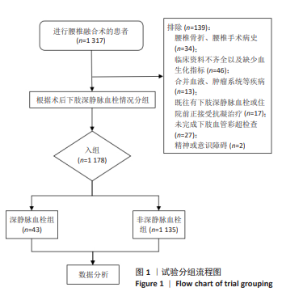
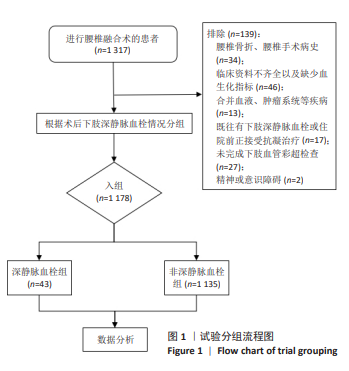
2.1 参与者数量分析 收集1 317例接受腰椎融合术的患者,根据纳入与排除标准,139例患者不符合标准,最终1 178例患者进入最终分析。根据术后下肢彩超检查结果,深静脉血栓组43例,非深静脉血栓组1 135例。患者使用的植入物具有较好的骨整合作用,植入物周围无感染、过敏反应、免疫反应及排斥反应等。 2.2 试验流程图 见图1。"
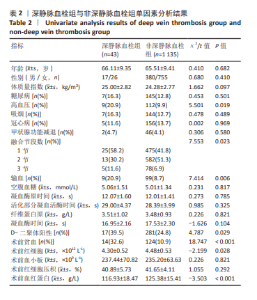
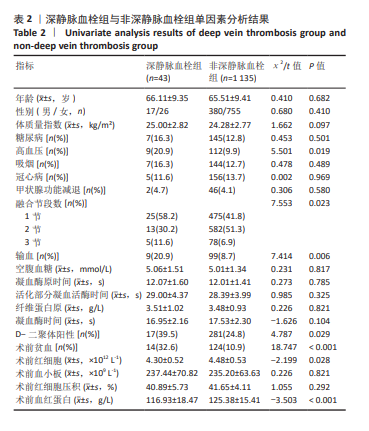
2.3 两组患者术前贫血发生率比较 1 178例患者中,术后发生深静脉血栓的患者43例(深静脉血栓组),未发生深静脉血栓的患者1 135例(非深静脉血栓组)。术前138例患者发生贫血,其中深静脉血栓组14例(14/43,32.6%),非深静脉血栓组124例(124/1 135,10.9%),差异有显著性意义(P < 0.001)。 2.4 两组患者单因素分析结果 单因素分析发现,两组患者高血压、输血、D-二聚体阳性、融合节段数、术前红细胞、术前血红蛋白以及贫血等指标相比差异有显著性意义(P < 0.05),见表2。"
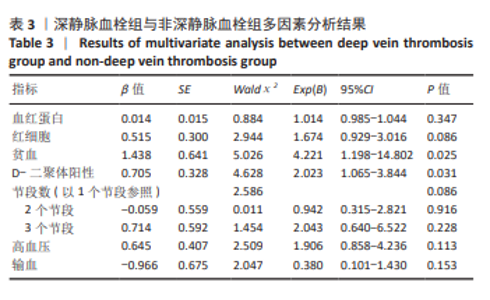
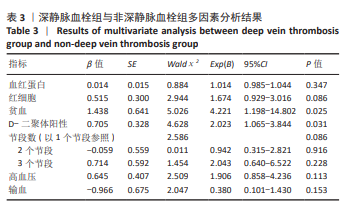
2.5 两组患者多因素分析结果 多因素Logistic回归分析显示,术前贫血(OR=4.221,95%CI:1.198-14.802,P=0.025)和D-二聚体阳性(OR=2.023,95%CI:1.065-3.844,P=0.031)是腰椎融合术后发生下肢深静脉血栓的危险因素,见表3。"
| [1] DE KUNDER SL, VAN KUIJK SMJ, RIJKERS K, et al. Transforaminal lumbar interbody fusion (tlif) versus posterior lumbar interbody fusion (plif) in lumbar spondylolisthesis: A systematic review and meta-analysis. Spine J. 2017;17(11): 1712-1721. [2] SCHNAKE KJ, RAPPERT D, STORZER B, et al. Lumbar fusion-indications and techniques. Orthopade. 2019;48(1):50-58. [3] RATHBONE J, RACKHAM M, NIELSEN D, et al. A systematic review of anterior lumbar interbody fusion (alif) versus posterior lumbar interbody fusion (plif), transforaminal lumbar interbody fusion (tlif), posterolateral lumbar fusion (plf). Eur Spine J. 2023;32(6):1911-1926. [4] ZHAO CM, ZHANG Y, YANG SD, et al. Risk factors for lower limb deep vein thrombosis in patients with single-level lumbar fusion: A prospective study of 710 cases. Clin Appl Thromb Hemost. 2018;24(9_suppl):157s-162s. [5] STROM RG, FREMPONG-BOADU AK. Low-molecular-weight heparin prophylaxis 24 to 36 hours after degenerative spine surgery: Risk of hemorrhage and venous thromboembolism. Spine (Phila Pa 1976). 2013;38(23):E1498-1502. [6] GURALNIK JM, EISENSTAEDT RS, FERRUCCI L, et al. Prevalence of anemia in persons 65 years and older in the united states: Evidence for a high rate of unexplained anemia. Blood. 2004;104(8):2263-2268. [7] BAILEY A, EISEN I, PALMER A, et al. Preoperative anemia in primary arthroplasty patients-prevalence, influence on outcome, and the effect of treatment. J Arthroplasty. 2021;36(7):2281-2289. [8] NEUWIRTH AL, BODDAPATI V, HELD MB, et al. Preoperative anemia is associated with 30-day morbidity in total knee arthroplasty. Orthopedics. 2022;45(2): e86-e90. [9] ZHANG HC, ZHANG Y, DAI HB, et al. Preoperative anemia and complications after total joint arthroplasty: A systematic review and meta-analysis. Eur Rev Med Pharmacol Sci. 2022;26(20):7420-7430. [10] MENDEZ-PINO L, ZORRILLA-VACA A, HEPNER DL. Management of preoperative anemia. Anesthesiol Clin. 2024;42(1):65-73. [11] BARON DM, HOCHRIESER H, POSCH M, et al. Preoperative anaemia is associated with poor clinical outcome in non-cardiac surgery patients. Br J Anaesth. 2014; 113(3):416-423. [12] XIONG X, LI T, CHENG B. Anemia and formation of deep vein thrombosis before operation in patients with knee osteoarthritis: a cross-sectional study. J Orthop Surg Res. 2023;18(1):33. [13] MIN L, LINYI Y, CHEN L, et al. Preoperative moderate to severe anemia is associated with increased postoperative major adverse cardiac and cerebral events and pulmonary complications: A propensity score-matched analysis in hip fracture surgery patients over 80 years old. Perioper Med (Lond). 2023;12(1):56. [14] 孟唯浩,陈曦,孟晓,等.成年股骨干骨折患者术前贫血的临床特征及其危险因素分析[J]. 中华骨科杂志,2023,43(20):1379-1386. [15] PASRICHA SR, COLMAN K, CENTENO-TABLANTE E, et al. Revisiting WHO haemoglobin thresholds to define anaemia in clinical medicine and public health. Lancet Haematol. 2018;5(2):e60-e62. [16] BUTRICO C, MEISEL HJ, SAGE K. Patient comorbidities, their influence on lumbar spinal fusion surgery, and recommendations to reduce unfavorable outcomes. J Am Acad Orthop Surg. 2024;32(24):1115-1121. [17] LIU C, ZHAO M, ZHANG W, et al. Biomechanical assessment of different transforaminal lumbar interbody fusion constructs in normal and osteoporotic condition: A finite element analysis. Spine J. 2024;24(6):1121-1131. [18] RUSSO A, PARK DK, LANSFORD T, et al. Impact of surgical risk factors for non-union on lumbar spinal fusion outcomes using cellular bone allograft at 24-months follow-up. BMC Musculoskelet Disord. 2024;25(1):351. [19] FINEBERG SJ, OGLESBY M, PATEL AA, et al. The incidence and mortality of thromboembolic events in lumbar spine surgery. Spine (Phila Pa 1976). 2013; 38(13):1154-1159. [20] JIANG YQ, WANG YZ, HU AN, et al. Analysis of d-dimer levels for the detection of deep venous thrombosis for patients with spinal metastasis undergoing decompression with fixation. BMC Musculoskelet Disord. 2024;25(1):672. [21] YANG SD, DING WY, YANG DL, et al. Prevalence and risk factors of deep vein thrombosis in patients undergoing lumbar interbody fusion surgery: A single-center cross-sectional study. Medicine (Baltimore). 2015;94(48):e2205. [22] SEICEAN A, SEICEAN S, ALAN N, et al. Preoperative anemia and perioperative outcomes in patients who undergo elective spine surgery. Spine (Phila Pa 1976). 2013;38(15):1331-1341. [23] LASOCKI S, KRAUSPE R, VON HEYMANN C, et al. Prepare: The prevalence of perioperative anaemia and need for patient blood management in elective orthopaedic surgery: A multicentre, observational study. Eur J Anaesthesiol. 2015;32(3):160-167. [24] LIN S, ALEPUZ A, TRITSCH T, et al. Deep vein thrombosis prophylaxis in orthopedic surgery. Cureus. 2024;16(2):e53726. [25] MUÑOZ M, GÓMEZ-RAMÍREZ S, CAMPOS A, et al. Pre-operative anaemia: prevalence, consequences and approaches to management. Blood Transfus. 2015;13(3):370-379. [26] 王晶,徐帅,刘海鹰.伴和不伴类风湿性关节炎患者腰椎管狭窄后路减压融合过程中隐性失血的对比[J].中国组织工程研究,2020,24(33):5307-5314. [27] RUBINO AS, DE SANTO LS, MONTELLA AP, et al. Prognostic Implication of Preoperative Anemia in Redo Cardiac Surgery: A Single-Center Propensity-Matched Analysis. J Cardiovasc Dev Dis. 2023;10(4):160. [28] DE WIT A, BOOTSMA BT, HUISMAN DE, et al. Taskforce Anastomotic Leakage. Early detection and correction of preoperative anemia in patients undergoing colorectal surgery-a prospective study. Tech Coloproctol. 2025;29(1):92. [29] CHARDALIAS L, PAPACONSTANTINOU I, GKLAVAS A, et al. Iron Deficiency Anemia in Colorectal Cancer Patients: Is Preoperative Intravenous Iron Infusion Indicated? A Narrative Review of the Literature. Cancer Diagn Progn. 2023;3(2):163-168. [30] GOODNOUGH LT, MANIATIS A, EARNSHAW P, et al. Detection, evaluation, and management of preoperative anaemia in the elective orthopaedic surgical patient: NATA guidelines. Br J Anaesth. 2011;106(1):13-22. [31] 彭超,刘云鹏,王小龙,等.单髁置换与全膝关节置换后隐性失血的对比研究[J].中国组织工程研究,2020,24(15):2303-2309. [32] SANTANA DC, EMARA AK, ORR MN, et al. An update on venous thromboembolism rates and prophylaxis in hip and knee arthroplasty in 2020. Medicina (Kaunas). 2020;56(9):416. [33] TANG G, QI L, SUN Z, et al. Evaluation and analysis of incidence and risk factors of lower extremity venous thrombosis after urologic surgeries: A prospective two-center cohort study using lasso-logistic regression. Int J Surg. 2021;89:105948. [34] WEI Q, WEI ZQ, JING CQ, et al. Incidence, prevention, risk factors, and prediction of venous thromboembolism in chinese patients after colorectal cancer surgery: A prospective, multicenter cohort study. Int J Surg. 2023;109(10):3003-3012. [35] AHMAD J, LYNCH MK, MALTENFORT M. Incidence and Risk Factors of Venous Thromboembolism After Orthopaedic Foot and Ankle Surgery. Foot Ankle Spec. 2017;10(5):449-454. [36] RAHMANI R, EADDY S, STEGELMANN SD, et al. Chemical prophylaxis and venous thromboembolism following elective spinal surgery: A systematic review and meta-analysis. N Am Spine Soc J. 2024;17:100295. [37] GLOTZBECKER MP, BONO CM, WOOD KB, et al. Thromboembolic disease in spinal surgery: A systematic review. Spine (Phila Pa 1976). 2009;34(3):291-303. [38] LEON L, RODRIGUEZ H, TAWK RG, et al. The prophylactic use of inferior vena cava filters in patients undergoing high-risk spinal surgery. Ann Vasc Surg. 2005;19(3): 442-447. [39] SENDERS ZJ, ZUSSMAN BM, MALTENFORT MG, et al. The incidence of pulmonary embolism (pe) after spinal fusions. Clin Neurol Neurosurg. 2012;114(7):897-901. [40] SYMEONIDIS A, ATHANASSIOU G, PSIROYANNIS A, et al. Impairment of erythrocyte viscoelasticity is correlated with levels of glycosylated haemoglobin in diabetic patients. Clin Lab Haematol. 2001;23(2):103-109. [41] SONG AB, KUTER DJ, AL-SAMKARI H. Characterization of the rate, predictors, and thrombotic complications of thrombocytosis in iron deficiency anemia. Am J Hematol. 2020;95(10):1180-1186. [42] ZHANG H, WU L, CHENG B. Preoperative anemia and deep vein thrombosis in patients with perioperative bone trauma: A cohort study. BMC Musculoskelet Disord. 2022;23(1):905. |
| [1] | Zeng Xuan, Weng Rui, Ye Shicheng, Tang Jiadong, Mo Ling, Li Wenchao. Two lumbar rotary manipulation techniques in treating lumbar disc herniation: a finite element analysis of biomechanical differences [J]. Chinese Journal of Tissue Engineering Research, 2026, 30(9): 2153-2161. |
| [2] | Zhao Jiaqing, Liu Dong, Lu Suni, Wang Dawei, Geng Xiaopeng, Ning Huaxiu. One-hole split endoscope surgery with the aid of digital 3D technology for highly migrated lumbar disc herniation [J]. Chinese Journal of Tissue Engineering Research, 2026, 30(9): 2278-2285. |
| [3] | Zhang Xianxu, Ma Zhong, Liu Xin, Huang Lei, Shen Wenxiang, Luo Zhiqiang . Lumbar fusion combined with unilateral fixation for lumbar degenerative diseases: biomechanics, technical evolution, and clinical applications [J]. Chinese Journal of Tissue Engineering Research, 2026, 30(9): 2334-2342. |
| [4] | Aikeremujiang·Muheremu, Aikebaierjiang·Aisaiti, Alimujiang·Abudurousuli, Kutiluke·Shoukeer, Sala Yiding·Aierxiding, Abuduwupuer·Tailaiti, Abudunaibi·Aili, Jia Zhiwei. Mechanism of spontaneous resorption in lumbar disc herniation and new strategies for precision treatment [J]. Chinese Journal of Tissue Engineering Research, 2026, 30(35): 9135-9142. |
| [5] | Zhao Jingang, Liu Liping, Chen Jianwei, . Finite element analysis comparing lumbar fusion and artificial intervertebral disc replacement [J]. Chinese Journal of Tissue Engineering Research, 2026, 30(3): 553-560. |
| [6] | Abudusalamu·Tuoheti, Xiao Yang, Wang Yixi, Musitapa·Mijiti, Chen Qihao, Maimaitiming·Saiyiti, Guo Hailong, Paerhati·Rexiti. Effects of three internal fixation techniques on biomechanics of adjacent segment degeneration in lumbar interbody fusion [J]. Chinese Journal of Tissue Engineering Research, 2026, 30(3): 586-595. |
| [7] | Wang Yalei, Wang Xuezhi, Zhou Tao, Shen Xinxin, Fang Ding, Chen Hongliang. Effect of sacroiliac joint ankylosis on outcomes of L5/S1 transforminal lumbar interbody fusion and lumbar sagittal parameters [J]. Chinese Journal of Tissue Engineering Research, 2026, 30(3): 634-641. |
| [8] | Wang Zhipeng, Zhang Xiaogang, Zhang Hongwei, Zhao Xiyun, Li Yuanzhen, Guo Chenglong, Qin Daping, Ren Zhen. A systematic review of application value of machine learning to prognostic prediction models for patients with lumbar disc herniation [J]. Chinese Journal of Tissue Engineering Research, 2026, 30(3): 740-748. |
| [9] | Yu Weijie, Cao Dongdong, Guo Tianci, Niu Puyu, Yang Jialin, Wang Simin, Liu Aifeng. Risk prediction models of recurrence after percutaneous endoscopic lumbar discectomy: a systematic review and meta-analysis [J]. Chinese Journal of Tissue Engineering Research, 2026, 30(3): 749-759. |
| [10] | Chen Gang, Ge Caijun, Chen Jianpeng, Wang Yuanbin, Wang Qianliang. Mechanism of ferrostatin-1 hydrogel in treatment of lumbar disc herniation [J]. Chinese Journal of Tissue Engineering Research, 2026, 30(26): 6807-6813. |
| [11] | Jiang Qiang, Ding Yu, Ding Zhili, Han Jiaheng. Mechanisms by which mitochondria-endoplasmic reticulum interaction stress mediates activation of inflammatory vesicles in nerve roots of lumbar intervertebral disc herniation rabbits modulated by acupotomy [J]. Chinese Journal of Tissue Engineering Research, 2026, 30(23): 6110-6121. |
| [12] | Shi Gaolong, Ge Caijun, Chen Jianpeng, Wang Yuanbin, Fan Zelin, Yan Jun, Wang Qianliang. Mechanism by which the paraventricular nucleus of the hypothalamus is involved in chronic pain and anxiety in mice with lumbar disc herniation [J]. Chinese Journal of Tissue Engineering Research, 2026, 30(22): 5707-5715. |
| [13] | Gu Shan, Zhang Long, Li Zhigang. Relationship between inflammatory factors, white blood cells, and lumbar disc herniation [J]. Chinese Journal of Tissue Engineering Research, 2026, 30(18): 4782-4790. |
| [14] | Lu Qi, Sun Maji, Wang Xuezhi, Song Ting, Ma Yiming, Yuan Feng, Chen Hongliang. Two visual arthroplasty techniques for L5-S1 disc herniation: a half-year follow-up evaluation of clinical outcomes [J]. Chinese Journal of Tissue Engineering Research, 2025, 29(9): 1841-1847. |
| [15] | Feng Zhimeng, Sun Ning, Sun Zhaozhong, Li Yuefei, Liu Changzhen, Li Sa. Three-dimensional image reconstruction can safely assist one-hole split endoscope in treatment of #br# L5/S1 far lateral lumbar disc herniation [J]. Chinese Journal of Tissue Engineering Research, 2025, 29(9): 1876-1882. |
| Viewed | ||||||
|
Full text |
|
|||||
|
Abstract |
|
|||||