Chinese Journal of Tissue Engineering Research ›› 2026, Vol. 30 ›› Issue (31): 8092-8099.doi: 10.12307/2026.450
Previous Articles Next Articles
Preparation and performance evaluation of essence with mesenchymal stem cell conditioned medium
Wang Quansheng1, 2, 3, Chen Songtao1, 2, 3, Zhang Yongqing1, 2, 3, Qiao Hua1, 2, 3
- 1Department of Biochemistry and Molecular Biology, School of Basic Medicine, Shanxi Medical University, Taiyuan 030001, Shanxi Province, China; 2Ministry of Education Key Laboratory of Coal Environmental Pathogenicity and Prevention, Taiyuan 030001, Shanxi Province, China; 3Shanxi Key Laboratory of Birth Defect and Cell Regeneration, Taiyuan 030001, Shanxi Province, China
-
Received:2025-12-01Accepted:2026-02-02Online:2026-11-08Published:2026-05-22 -
Contact:Qiao Hua, MD, Associate professor, Master’s supervisor, Department of Biochemistry and Molecular Biology, School of Basic Medicine, Shanxi Medical University, Taiyuan 030001, Shanxi Province, China; Ministry of Education Key Laboratory of Coal Environmental Pathogenicity and Prevention, Taiyuan 030001, Shanxi Province, China; Shanxi Key Laboratory of Birth Defect and Cell Regeneration, Taiyuan 030001, Shanxi Province, China -
About author:Wang Quansheng, MS candidate, Department of Biochemistry and Molecular Biology, School of Basic Medicine, Shanxi Medical University, Taiyuan 030001, Shanxi Province, China; Ministry of Education Key Laboratory of Coal Environmental Pathogenicity and Prevention, Taiyuan 030001, Shanxi Province, China; Shanxi Key Laboratory of Birth Defect and Cell Regeneration, Taiyuan 030001, Shanxi Province, China -
Supported by:Shanxi Provincial Undergraduate Innovation and Entrepreneurship Program, No. 20240411 (to QH); Shanxi Provincial Natural Science Foundation Project, No. 202203021211232 (to QH)

CLC Number:
Cite this article
Wang Quansheng, Chen Songtao, Zhang Yongqing, Qiao Hua. Preparation and performance evaluation of essence with mesenchymal stem cell conditioned medium[J]. Chinese Journal of Tissue Engineering Research, 2026, 30(31): 8092-8099.
share this article
Add to citation manager EndNote|Reference Manager|ProCite|BibTeX|RefWorks
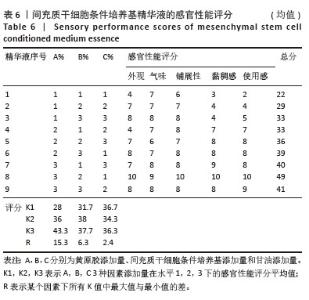
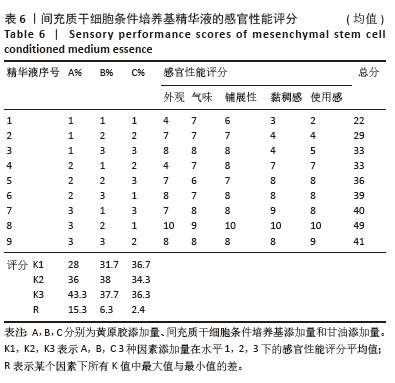
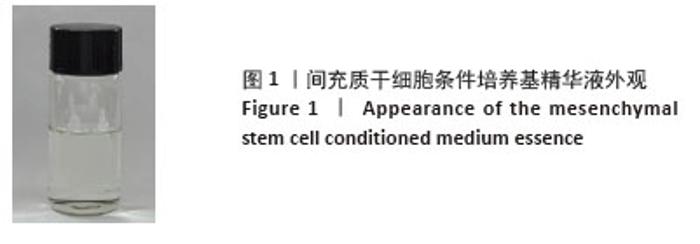
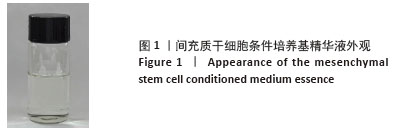
2.1 间充质干细胞条件培养基精华液的配方设计 通过L9(33)正交试验优化精华液配方,以感官性能评分为考察指标,筛选黄原胶添加量(A)、间充质干细胞条件培养基添加量(B)和甘油添加量(C)的最优用量和配比。由表6可知,黄原胶添加量对感官性能影响最大,其次是间充质干细胞条件培养基,影响最小的是甘油。根据极差分析,以感官性能为评分标准时,3个因素的最优组合为A2B1C3,即间充质干细胞条件培养基添加量为5%,甘油添加量为5%,黄原胶添加量为0.25%。在最优组合下,重复配制间充质干细胞条件培养基精华液多次,发现此配方重复性高,操作简易,感官评分高。最终间充质干细胞条件培养基精华液成品见图1。 "
"
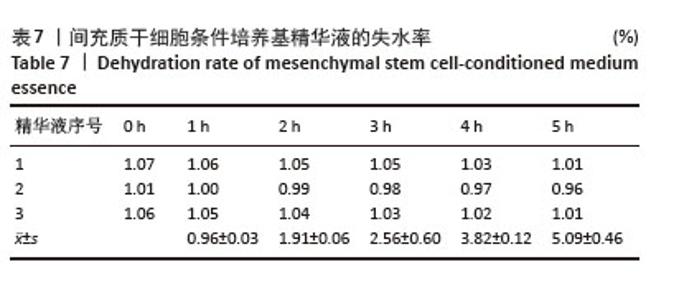
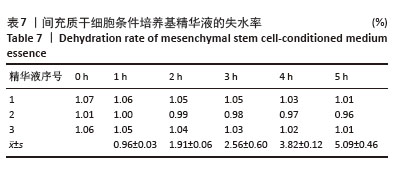
2.2 间充质干细胞条件培养基精华液的稳定性 精华液在4 ℃下放置1,3,6,12个月后,无沉淀产生,未出现分层,说明4 ℃条件下贮存12个月该精华液稳定性良好。冷热循环方面,48 ℃下存放12 h,精华液无沉淀产生,无分层现象;再放入-16 ℃冰箱中存放12 h后,亦无沉淀产生,也未出现分层,说明该精华液在冷热循环条件下稳定。精华液3 750 r/min离心5 h (相当于地心重力作用1年的结果),无沉淀产生和分层、变色、浮油现象,提示该精华液具有良好的离心稳定性,在地心重力作用1年的条件下稳定。 2.3 间充质干细胞条件培养基精华液的pH值 用pH计测得精华液的pH值为6.50±0.10,符合《化妆品通用检测法》所规定的要求[29],可以避免刺激皮肤或破坏活性成分。 2.4 间充质干细胞条件培养基精华液的失水率 37 ℃恒温5 h,精华液的失水率较低,仅为(5.09±0.46)%,结果见表7。该结果与同类型精华液的失水率相当[30],表明该精华液具有良好的保湿性能,为精华液中活性物质发挥功能提供了可能。 "
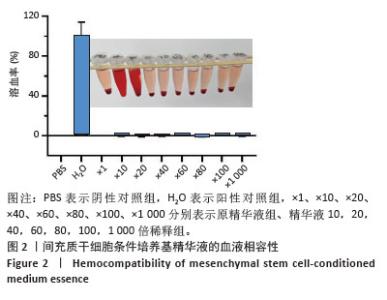
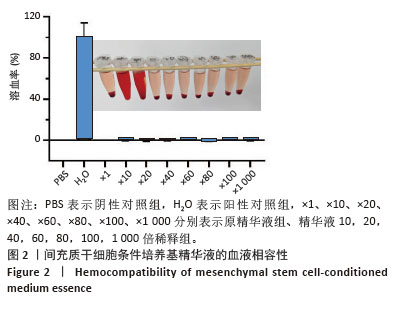
2.5 安全性评价 2.5.1 溶血实验结果 与阴性对照组相比,精华液不同倍数稀释液的溶血率均低于1%,无明显溶血现象;因精华液原液质地黏稠,红细胞会稳定分散在精华液中,在离心作用下会有少量红细胞沉淀析出,见图2;当加入pH=7.4的PBS稀释后,可离心分离出红细胞。因此,间充质干细胞条件培养基精华液无溶血现象,血液相容性良好。 "
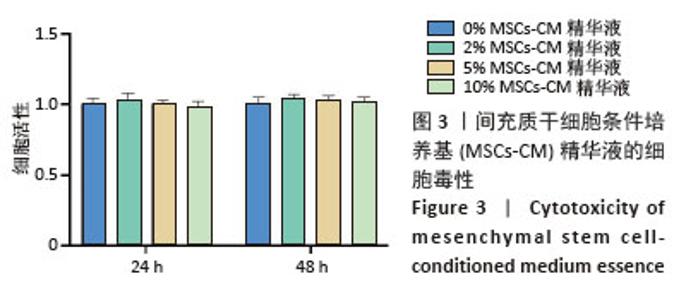
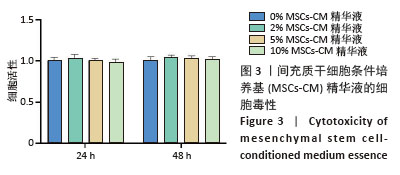
2.5.2 细胞毒性实验结果 不同浓度间充质干细胞条件培养基精华液对第3代人皮肤成纤维细胞的生存率没有影响,见图3。"
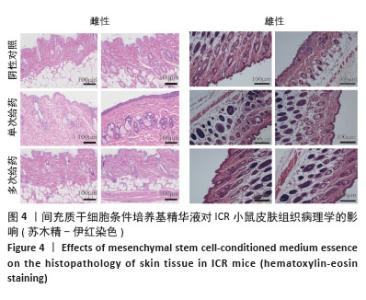
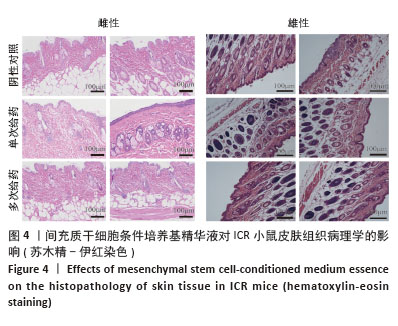
2.5.3 皮肤刺激实验 不论给药次数还是动物性别,用间充质干细胞条件培养基精华液处理后都没有出现皮肤红斑和水肿反应,各个时间点皮肤刺激性积分均值均为0分;光学显微镜下,雄性小鼠和雌性小鼠给药后各个时间点的皮肤组织结构均完整,未发生明显的组织病理学改变,无明显炎性细胞浸润以及血管扩张性充血等现象,与阴性对照组相比无明显差异,见图4。"
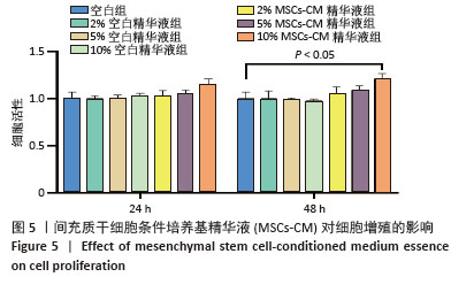
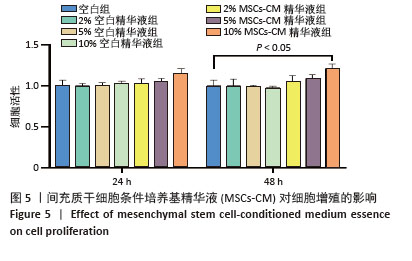
2.6 间充质干细胞条件培养基精华液的抗衰老功效评价 2.6.1 细胞增殖实验结果 课题组前期实验已证明第20代人皮肤成纤维细胞发生了复制性衰老,因此用第20代人皮肤成纤维细胞为衰老细胞模型考察间充质干细胞条件培养基精华液的抗皮肤衰老功效[31]。不同浓度精华液处理均未表现出细胞毒性。空白精华液各组与对照组均无显著性差异。当培养基中精华液的浓度逐渐增大时,细胞活性逐步提高;当培养基中精华液的浓度达到10%时,显示出最高的细胞活性,48 h细胞生存率为(121.0±1.3)%(P < 0.05)。这些结果表明,间充质干细胞条件培养基精华液具有一定的刺激衰老细胞增殖的效果,见图5。 "
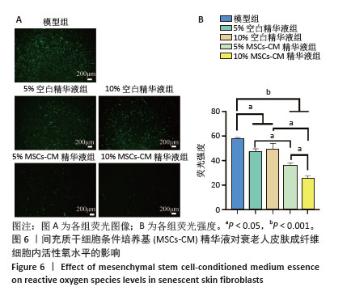
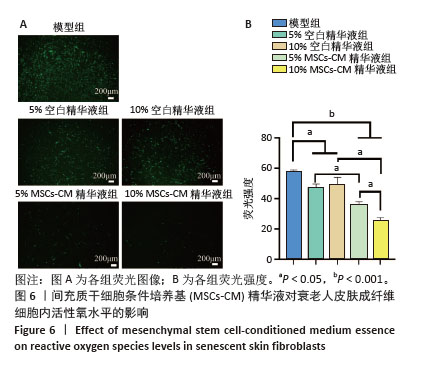
2.6.2 衰老人皮肤成纤维细胞中活性氧水平 如图6所示,与模型组相比,其他组细胞活性氧水平显著下调(P < 0.05)。5%,10%空白精华液组活性氧水平分别为(47.49±1.29)%,(49.55±3.15)%,5%,10%间充质干细胞条件培养基精华液组活性氧水平分别为(36.05±1.35)%和(25.17±1.66)%,空白精华液组与间充质干细胞条件培养基精华液组细胞内活性氧水平均有显著性差异(P < 0.05)。10%间充质干细胞条件培养基精华液组细胞内活性氧的清除效果最强(P < 0.001)。这些结果表明空白精华液及间充质干细胞条件培养基精华液均能对衰老人皮肤成纤维细胞内活性氧有一定的清除作用,但间充质干细胞条件培养基精华液抑制细胞内活性氧生成能力更强,同时随着精华液浓度增加清除活性氧能力增强。 "
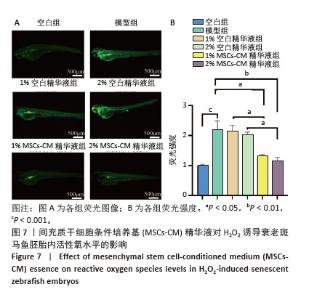
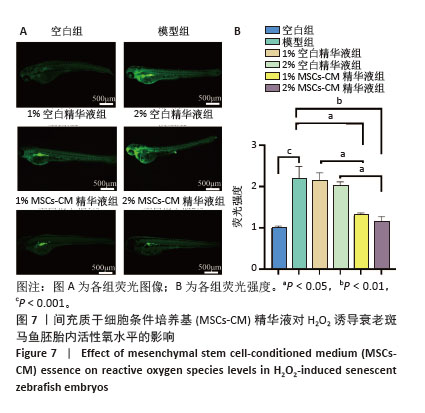
2.6.3 衰老斑马鱼胚胎活性氧水平 见图7。 如图7所示,当设置空白组荧光强度为1,模型组绿色荧光水平为2.185±0.215,相较空白组显著提高(P < 0.001),说明H2O2诱导斑马鱼胚胎体内活性氧水平升高。1%,2%空白精华液组荧光强度分别为2.09±0.18和2.03±0.06,与模型组无显著性差异。1%,2%间充质干细胞条件培养基精华液组荧光强度分别为1.28±0.55和1.13±0.10,均较模型组显著下降(P < 0.05,P < 0.01),且呈现出浓度依赖性。在相同浓度下,间充质干细胞条件培养基精华液组与空白精华液组活性氧水平均有显著性差异(P < 0.05),说明加入间充质干细胞条件培养基成分的精华液可显著抑制H2O2诱导的衰老斑马鱼胚胎体内活性氧产生。 "
| [1] 张虎成,杨国伟,杨军,等.虫草素纳米乳液制备及对皮肤光老化修复机制研究[J].日用化学工业(中英文),2022,52(10):1072-1080. [2] DAINES SM, MOBLEY SR. Considerations in male aging face consultation: psychologic aspects. Facial Plast Surg Clin North Am. 2008;16(3):281-287. [3] FRANCO AC, AVELEIRA C, CAVADAS C. Skin senescence: mechanisms and impact on whole-body aging. Trends Mol Med. 2022;28(2):97-109. [4] ANSARI LARI S, ZUMOT MS, NEMRISH S, et al. Role of mesenchymal cells in enhancing cosmetic outcomes for autologous augmented fat transfers for facial rejuvenation and reconstructive surgery. Front Med (Lausanne). 2024;11:1466939. [5] WU S, SUN S, FU W, et al. The Role and Prospects of Mesenchymal Stem Cells in Skin Repair and Regeneration. Biomedicines. 2024;12(4):743. [6] 潘盛盛.胎儿真皮间充质干细胞的抗衰老作用和机制研究[D].济南:山东大学,2022. [7] 刘宏伟,郭澍,程飚,等.干细胞在整形修复美容领域研究和临床试验的专家共识[J].中国美容整形外科杂志,2021,32(1):6-12. [8] WANG JV, SCHOENBERG E, ZAYA R, et al. The rise of stem cells in skin rejuvenation: A new frontier. Clin Dermatol. 2020;38(4):494-496. [9] SHUAI Q, LIANG Y, XU X, et al. Sodium alginate hydrogel integrated with type III collagen and mesenchymal stem cell to promote endometrium regeneration and fertility restoration. Int J Biol Macromol. 2023;253(Pt 6):127314. [10] 尹张奕,魏莹莹,钟继新.风湿免疫病的细胞治疗进展[J/OL].生命科学,1-18[2025-09-20].https://link.cnki.net/urlid/31.1600.Q.20250904.1642.002. [11] KLEIN D, STEENS J, WIESEMANN A, et al. Mesenchymal Stem Cell Therapy Protects Lungs from Radiation-Induced Endothelial Cell Loss by Restoring Superoxide Dismutase 1 Expression. Antioxid Redox Signal. 2017;26(11):563-582. [12] 胡伟伟,汪洋,史春梦.人脐带间充质干细胞条件培养基促进放创复合伤创面愈合及其机制[J].重庆医科大学学报,2024,49(11):1385-1393. [13] 卢曼萍.无血清培养体系的脐带间充质干细胞条件培养基在光老化皮肤修复再生中的作用研究[D].广州:广州医科大学,2020. [14] 邱晓慧,王檬,唐江解,等.负载人脐带间充质干细胞外泌体的壳聚糖水凝胶促进慢性糖尿病大鼠的伤口愈合[J].南方医科大学学报,2025,45(10): 2082-2091. [15] 郑桂纯,赵姝灿,黄丽贞,等.不同来源间充质干细胞条件培养基对内源性衰老细胞作用的比较[J].中国组织工程研究,2019,23(21):3357-3363. [16] DING C, ZOU Q, WANG F, et al. HGF and BFGF Secretion by Human Adipose-Derived Stem Cells Improves Ovarian Function During Natural Aging via Activation of the SIRT1/FOXO1 Signaling Pathway. Cell Physiol Biochem. 2018;45(4):1316-1332. [17] 林志魁,赵守辉,许紫芬.一种新型琼胶寡糖面膜精华液的研制[J].广东化工,2022,49(8):77-80. [18] 陈思,牛李臣,王肖园,等.杏鲍菇贴式面膜精华液的研制[J].食用菌,2020, 42(4):65-67. [19] 郭沛鑫,解宇环,杨金艳,等.复方紫草乳液的制备工艺及稳定性研究[J]. 香料香精化妆品,2019(6):53-57+77. [20] 陆玲,孙志高,周麟晨,等.新型石蜡微乳液冰浆制备与性能试验研究[J]. 制冷学报,2020,41(6):85-92. [21] 门乘百,周鸿立.乌拉草乳液配方筛选及其保湿功能评价[J].大众标准化, 2019(18):8-9. [22] 习彦茹,崔铭姝,王熙宇,等.pH敏感型ZIF-90-FA纳米递药系统的制备与初步评价[J].沈阳药科大学学报,2023,40(4):403-408. [23] 俞婕,祝愿,鲍红洁.红细胞溶血法用于体外评价日化产品和原料刺激性的研究[J].中国洗涤用品工业,2020(12):36-41. [24] YAN H, XIA F. 3D-printed nano-hydroxyapatite/poly(lactic-co-glycolic acid) scaffolds with adipose-derived mesenchymal stem cells enhance bone regeneration in rat model of bone defects. J Biomater Appl. 2025;40(2):284-296. [25] 赵梦恬,杨艺,徐建,等.驱蚊凝胶的制备及效能评价[J].日用化学工业, 2021,51(12):1215-1220. [26] 申丽艳.含有6种功效成分的传递体凝胶的制备及美容功效评价[D].太原:山西医科大学,2022. [27] 张淼,杨迪,魏爽,等.岩藻黄素对H2O2诱导斑马鱼衰老的抑制作用[J]. 广西科学,2023,30(2):403-412. [28] 祁保霞.丁香酚在水产养殖中的应用技术[J].科学养鱼,2024(9):30. [29] 董兵,董晓杰,刘思然,等.解读《化妆品安全技术规范》(2015年版)[J]. 环境卫生学杂志,2016,6(6):431-436. [30] 李波,周娅丽,张亚茹,等.灵芝面膜精华液的研制[J].食用菌,2021,43(6): 71-74. [31] 朱惠敏.间充质干细胞外泌体联合水解胶原蛋白肽延缓皮肤成纤维细胞衰老及其初步应用[D].太原:山西医科大学,2024. [32] FABI S, SUNDARAM H. The potential of topical and injectable growth factors and cytokines for skin rejuvenation. Facial Plast Surg. 2014;30(2):157-171. [33] 赵绚,王领,刘佳伟.一款含蓝铜胜肽精华液的制备及其抗皱功效评价[J].中国化妆品,2022(12):106-109. [34] DUSABIMANA T, KAREKEZI J, NUGROHO TA, et al. Oyster hydrolysate ameliorates UVB-induced skin dehydration and barrier dysfunction. Life Sci. 2024;358:123149. [35] FERNANDES A, RODRIGUES PM, PINTADO M, et al. A systematic review of natural products for skin applications: Targeting inflammation, wound healing, and photo-aging. Phytomedicine. 2023;115:154824. [36] ANTONIOU C, KOSMADAKI MG, STRATIGOS AJ, et al. Sunscreens--what’s important to know. J Eur Acad Dermatol Venereol. 2008;22(9):1110-1118. [37] WITTING M, BOREHAM A, BRODWOLF R, et al. Interactions of hyaluronic Acid with the skin and implications for the dermal delivery of biomacromolecules. Mol Pharm. 2015;12(5):1391-1401. [38] BANODE K, PATHARKAR O, JADHAV V, et al. Glycerosomes: Versatile Carriers for Multi-Route Drug Delivery Systems. Assay Drug Dev Technol. 2025;23(3):136-150. [39] HEUSCHKEL S, WOHLRAB J, SCHMAUS G, et al. Modulation of dihydroavenanthramide D release and skin penetration by 1,2-alkanediols. Eur J Pharm Biopharm. 2008;70(1):239-247. [40] 颜子涵.胶原及其降解产物的理化性质及在精华液中保湿、修复的功效研究[D].武汉:武汉轻工大学,2021. [41] 李幸彬.羧基端结合蛋白1(CTBP1)通过促进成纤维细胞的增殖和活化加重肺纤维化[D].石家庄:河北医科大学,2023. [42] 孔政毅,李楚君,严庆丰.线粒体调控衰老相关分泌表型的研究进展[J].中国细胞生物学学报,2025,47(8):2020-2031. [43] WLASCHEK M, MAITY P, MAKRANTONAKI E, et al. Connective Tissue and Fibroblast Senescence in Skin Aging. J Invest Dermatol. 2021;141(4S):985-992. [44] WEINMÜLLNER R, ZBIRAL B, BECIROVIC A, et al. Organotypic human skin culture models constructed with senescent fibroblasts show hallmarks of skin aging. NPJ Aging Mech Dis. 2020;6:4. [45] 王冰倩,夏芸.肤衰老体外模型构建的组织工程策略研究进展[J].中国美容整形外科杂志,2023,34(8):502-505. [46] 彭晓敏.miR-377通过抑制DNMT1促进人皮肤成纤维细胞衰老[D].长沙: 中南大学,2013. [47] 刘贺磊,都日娜,董俊娟,等.光老化与自噬机制的研究进展[J].内蒙古医学杂志,2024,56(3):322-325. [48] 侯雪峰,宋小飞,王朝霞,等.GX-50抗皮肤衰老的研究[J].上海交通大学学报(医学版),2013,33(2):145-149. [49] MACRAE CA, PETERSON RT. Zebrafish as tools for drug discovery. Nat Rev Drug Discov. 2015;14(10):721-731. [50] 代卓雅,施雨,孟令浩,等.三氯生及其环境衍生物对斑马鱼早期发育毒性机制[J].中国环境科学,2026,46(2):1061-1071. [51] 张梦斯.琼玉膏通过sirt1/p53信号通路延缓H2O2诱导斑马鱼衰老的研究[D].广州:广州中医药大学,2018. |
| [1] | Liu Hongjie, Mu Qiuju, Shen Yuxue, Liang Fei, Zhu Lili. Metal organic framework/carboxymethyl chitosan-oxidized sodium alginate/platelet-rich plasma hydrogel promotes healing of diabetic infected wounds [J]. Chinese Journal of Tissue Engineering Research, 2026, 30(8): 1929-1939. |
| [2] | Yang Lixia, Diao Liqin, Li Hua, Feng Yachan, Liu Xin, Yu Yuexin, Dou Xixi, Gu Huifeng, Xu Lanju. Regulatory mechanism of recombinant type III humanized collagen protein improving photoaging skin in rats [J]. Chinese Journal of Tissue Engineering Research, 2026, 30(8): 1988-2000. |
| [3] | Yang Xuetao, Zhu Menghan, Zhang Chenxi, Sun Yimin, Ye Ling. Applications and limitations of antioxidant nanomaterials in oral cavity [J]. Chinese Journal of Tissue Engineering Research, 2026, 30(8): 2044-2053. |
| [4] | Yuan Xiaoshuang, Yang Xu, Yang Bo, Chen Xiaoxu, Tian Ting, Wang Feiqing, Li Yanju, Liu Yang, Yang Wenxiu. Effect of conditioned medium of diffuse large B-cell lymphoma cells on proliferation and apoptosis of human bone marrow mesenchymal stem cells [J]. Chinese Journal of Tissue Engineering Research, 2026, 30(7): 1632-1640. |
| [5] | Ye Qianqian, Pan Hang, Tian Chuan, Zhu Xiangqing, Ye Li, Zhao Xiaojuan, Shu Liping, Pan Xinghua. Effects of highly active umbilical cord mesenchymal stem cells on structure and function of thymus in elderly tree shrews [J]. Chinese Journal of Tissue Engineering Research, 2026, 30(7): 1720-1729. |
| [6] | Cui Lianxu, Li Haomin, Xu Junrong, Tan Baodong, Lu Dahong, Peng Siwei, Wang Jinhui. Effect of umbilical cord mesenchymal stem cell conditioned medium on tissue repair after traumatic craniocerebral injury in miniature pigs [J]. Chinese Journal of Tissue Engineering Research, 2026, 30(7): 1730-1735. |
| [7] | Liu Xingyu, Li Lijie. Secretome of stem cells from human exfoliated deciduous teeth: a new hotspot in tissue engineering and stem cell therapy [J]. Chinese Journal of Tissue Engineering Research, 2026, 30(7): 1858-1868. |
| [8] | Yu Shiyu, Yu Sutong, Xu Yang, Zhen Xiangyan, Han Fengxuan. Advances in research and application of tissue engineering therapeutic strategies in oral submucous fibrosis [J]. Chinese Journal of Tissue Engineering Research, 2026, 30(4): 936-948. |
| [9] | Xu Hongtao, Wang Jianping, Xu Yuehong, Li Qin, Qi Qihua, Xia Qipeng. Asiaticoside promotes osteogenic differentiation in osteoporotic rats [J]. Chinese Journal of Tissue Engineering Research, 2026, 30(35): 9113-9119. |
| [10] | Chen Yida, Cheng Xinyi, Zhao Huan, Zhou Xichao, Gu Qiaoli, Lin Xiao, Shi Qin. Effects of physiological osmotic pressure on chondrocyte differentiation and extracellular matrix metabolism [J]. Chinese Journal of Tissue Engineering Research, 2026, 30(35): 9143-9150. |
| [11] | Zhou Jinlong, Wang Juan, Bian Lu, Lyu Long, Que Yunduan, Qian Wenwu. Modulation of nasal mucosa-derived ectomesenchymal stem cell senescence by mechanical modulus [J]. Chinese Journal of Tissue Engineering Research, 2026, 30(31): 8100-8107. |
| [12] | Liu Fang, Hu Haimin, Song Dan, Nan Jie, Cai Xiaoxiao, He Qingrui, Lian Ruijiao, Luo Lin, Yuan Chunhui. Human umbilical cord-derived mesenchymal stem cells to treat osteoarthritis in rats: dual effect of relieving pain and protecting cartilage [J]. Chinese Journal of Tissue Engineering Research, 2026, 30(31): 8108-8115. |
| [13] | Liu Jinrui, Yang Xianguang, Liu Haolong, Li Li, Ruan Zhaohui, Li Yanlin. Exosomes from different sources and osteoarthritis: engineering technology, targeting, and drug carrier function [J]. Chinese Journal of Tissue Engineering Research, 2026, 30(31): 8219-8229. |
| [14] | Liu Lei, Mao Wen, Qi Fu, Li Hong, Zhang Minghuan. Hypoxia preconditioning of bone marrow mesenchymal stem cells promotes angiogenesis in human umbilical vein endothelial cells through paracrine cytokines [J]. Chinese Journal of Tissue Engineering Research, 2026, 30(31): 8047-8053. |
| [15] | Qin Ying, Chen Jibing, Liang Weiping, Jing Wenyao, Zhu Xiangyun, He Junkui, Pang Lihong, Li Hongli. miR-122-5p-transfected exosomes from human adipose-derived mesenchymal stem cells for treatment of intrauterine adhesions in rats [J]. Chinese Journal of Tissue Engineering Research, 2026, 30(31): 8068-8076. |
| Viewed | ||||||
|
Full text |
|
|||||
|
Abstract |
|
|||||