Chinese Journal of Tissue Engineering Research ›› 2026, Vol. 30 ›› Issue (27): 7108-7114.doi: 10.12307/2026.447
Previous Articles Next Articles
Effect of proximal femoral morphology on coronal varus positioning of cementless femoral stems
Song Yang1, Yuan Liufeng1, Guo Zheng1, Shen Dahui2, Sun Shoukang1, Xu Xiangjun3, Guo Dongsheng3, Dong Yuefu1
- 1Affiliated Lianyungang Hospital of Xuzhou Medical University, Lianyungang 222000, Jiangsu Province, China; 2Lianyungang Clinical Medical College of Nanjing Medical University, Lianyungang 222000, Jiangsu Province, China; 3First People's Hospital of Lianyungang, Lianyungang 222000, Jiangsu Province, China
-
Received:2025-10-17Accepted:2026-01-23Online:2026-09-28Published:2026-05-15 -
Contact:Dong Yuefu, MD, Chief physician, Affiliated Lianyungang Hospital of Xuzhou Medical University, Lianyungang 222000, Jiangsu Province, China -
About author:Song Yang, MS, Affiliated Lianyungang Hospital of Xuzhou Medical University, Lianyungang 222000, Jiangsu Province, China

CLC Number:
Cite this article
Song Yang, Yuan Liufeng, Guo Zheng, Shen Dahui, Sun Shoukang, Xu Xiangjun, Guo Dongsheng, Dong Yuefu. Effect of proximal femoral morphology on coronal varus positioning of cementless femoral stems[J]. Chinese Journal of Tissue Engineering Research, 2026, 30(27): 7108-7114.
share this article
Add to citation manager EndNote|Reference Manager|ProCite|BibTeX|RefWorks
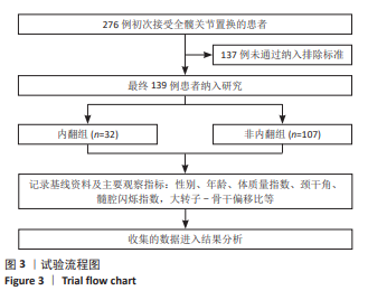
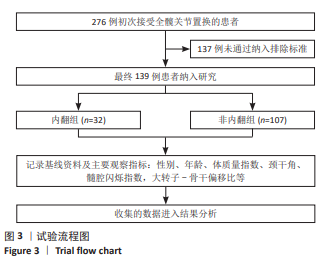
2.1 参与者数量分析 选择初次接受全髋关节置换的276例患者,根据排除标准,共137例患者被排除。排除原因为:既往脊柱、下肢手术史与外伤史(26例),既往髋关节手术史(21例),全身状况禁忌(20例),非标准影像资料(19例),既往髋部创伤史(16例),病态肥胖(15例),局部骨与关节病变(10例),重度骨质疏松(10例)。部分病例同时符合多项排除标准,以主要排除原因计数。最终139例患者纳入研究。 2.2 试验分组流程 见图3。"
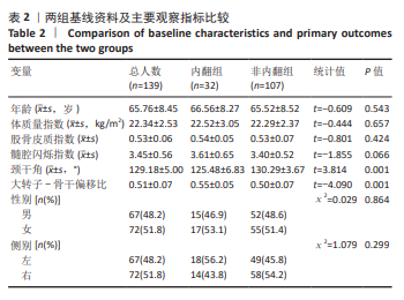
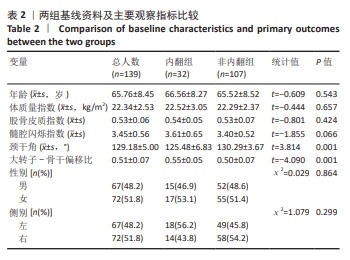
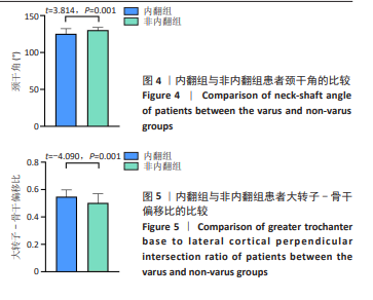
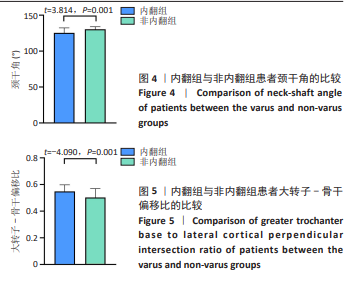
2.3 基线资料及主要观察指标比较 单因素分析显示,内翻组与非内翻组在颈干角和大转子-骨干偏移比方面差异有显著性意义(均P < 0.05),而在年龄(t=-0.609,P=0.543)、性别(χ2=0.029,P=0.864)、体质量指数(t=-0.444,P=0.657)以及侧别分布(χ2=1.079,P=0.299)方面无统计学差异。股骨皮质指数(P=0.424)与髓腔闪烁指数(P=0.066)亦未呈现显著组间差异。具体结果见表2及图4,5。"
"
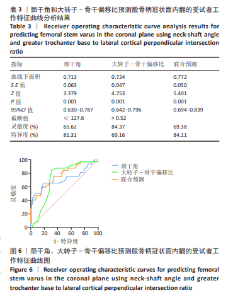
2.4 受试者工作特征曲线预测效能分析 受试者工作特征曲线用于确定颈干角和大转子-骨干偏移比预测股骨柄内翻对线的阈值,见表3及图6。"
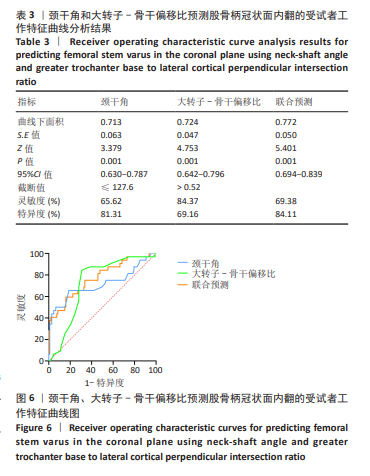
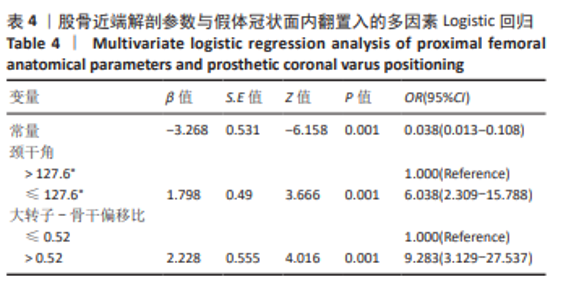
颈干角:当颈干角≤127.6°时,预测内翻的曲线下面积为0.713(95%CI:0.630-0.787),灵敏度为65.62%,特异度为81.31%(P < 0.001)。 大转子-骨干偏移比:当大转子-骨干偏移比> 0.52时,曲线下面积为0.724(95%CI:0.642-0.796),灵敏度为84.37%,特异度为69.16%(P < 0.001)。 两者联合预测:受试者工作特征曲线下面积为0.772,检验P值< 0.05,灵敏度为69.38%,特异度为84.11%,说明联合预测有较大的把握预测患者为内翻组人群。 上述结果表明,颈干角≤127.6°与大转子-骨干偏移比> 0.52可作为冠状面内翻对线的有效预测阈值,两者的联合预测拥有更高的预测效能。 2.5 股骨柄冠状面内翻的多因素Logistic回归模型构建 经多因素Logistic回归分析校正混杂因素后(表4),对于颈干角,以> 127.6°为参照组时:颈干角≤127.6°,回归检验P值< 0.05,说明在其他变量保持不变的情况下,其对因变量的影响具有统计学意义,OR > 1,说明当患者颈干角≤127.6°时,股骨柄冠状面内翻发生率升高,是独立危险因素。 对于大转子-骨干偏移比,以≤0.52为参照组时:大转子-骨干偏移比> 0.52,回归检验P值< 0.05,说明在其他变量保持不变的情况下,其对因变量的影响具有统计学意义,OR > 1,说明当患者大转子-骨干偏移比> 0.52时,股骨柄冠状面内翻置入发生率升高,是独立危险因素。 综上所述,颈干角≤127.6°与大转子-骨干偏移比> 0.52均被证实为冠状面内翻对线的独立危险因素(均P < 0.001)。模型通过Hosmer-Lemeshow检验(P=0.815 > 0.05),拟合优度良好。"
| [1] HARADA S, HAMAI S, SHIOMOTO K, et al. Patient-reported outcomes after primary or revision total hip arthroplasty: A propensity score-matched Asian cohort study. PLoS One. 2021;16(5):e0252112. [2] 李志鹏, 环大维, 袁兆丰, 等. 老年股骨颈骨折全髋或半髋关节置换的中远期状态:倾向性评分匹配法评价[J]. 中国组织工程研究,2024,28(24): 3839-3844. [3] 闫瑞忠, 李佳慧, 林树忠, 等. 骨盆倾斜对髋关节置换后站立位髋臼侧应力影响的有限元分析[J]. 中国组织工程研究,2023,27(36):5795-5800. [4] KITRIDIS D, TSIKOPOULOS K, GIVISSIS P, et al. Mortality and complication rates in nonagenarians and octogenarians undergoing total hip and knee arthroplasty: a systematic review and meta-analysis. Eur Geriatr Med. 2022;13(3):725-733. [5] PATEL I, NHAM F, ZALIKHA AK, et al. Epidemiology of total hip arthroplasty: demographics, comorbidities and outcomes. Arthroplasty. 2023;5(1):2. [6] YOHE N, WEISBERG MD, CIMINERO M, et al. Complications and Readmissions After Total Hip Replacement in Octogenarians and Nonagenarians. Geriatr Orthop Surg Rehabil. 2020;11:2151459320940959. [7] ZHANG ZF, WANG D, WU LD, et al. Case report: A 10 years follow-up of periprosthetic femoral fracture after total hip arthroplasty in osteopetrosis. Chin J Traumatol. 2017;20(3):173-176. [8] RAHM S, HOCH A, TONDELLI T, et al. Revision rate of THA in patients younger than 40 years depends on primary diagnosis - a retrospective analysis with a minimum follow-up of 10 years. Eur J Orthop Surg Traumatol. 2021;31(7):1335-1344. [9] WANG Q, WANG Q, LIU P, et al. Clinical and radiological outcomes of jumbo cup in revision total hip arthroplasty: A systematic review. Front Surg. 2022;9:929103. [10] HAUER G, RASIC L, KLIM S, et al. Septic complications are on the rise and aseptic loosening has decreased in total joint arthroplasty: an updated complication based analysis using worldwide arthroplasty registers. Arch Orthop Trauma Surg. 2024;144(12):5199-5204. [11] WANG H, GU J, LIU X, et al. Variation in greater trochanteric lateroversion: a risk factor for femoral stem varus in total hip arthroplasty. Hip Int. 2020;30(1):33-39. [12] AGARWAL S, ECKHARD L, WALTER WL, et al. The Use of Computer Navigation in Total Hip Arthroplasty Is Associated with a Reduced Rate of Revision for Dislocation: A Study of 6,912 Navigated THA Procedures from the Australian Orthopaedic Association National Joint Replacement Registry. J Bone Joint Surg Am. 2021;103(20):1900-1905. [13] BELZUNCE MA, HENCKEL J, DI LAURA A, et al. Uncemented femoral stem orientation and position in total hip arthroplasty: A CT study. J Orthop Res. 2020;38(7):1486-1496. [14] WANG X, HUNTER DJ, VESENTINI G, et al. Technology-assisted rehabilitation following total knee or hip replacement for people with osteoarthritis: a systematic review and meta-analysis. BMC Musculoskelet Disord. 2019; 20(1):506. [15] WIDMER KH. The Impingement-free, Prosthesis-specific, and Anatomy-adjusted Combined Target Zone for Component Positioning in THA Depends on Design and Implantation Parameters of both Components. Clin Orthop Relat Res. 2020; 478(8):1904-1918. [16] FOTTNER A, WOICZINSKI M, KISTLER M, et al. Varus malalignment of cementless hip stems provides sufficient primary stability but highly increases distal strain distribution. Clin Biomech (Bristol). 2018;58:14-20. [17] LUGER M, FELDLER S, PISECKY L, et al. The ‘critical trochanter angle’ does not show superiority over the CCD angle in predicting varus stem alignment in cementless short-stem total hip arthroplasty. Arch Orthop Trauma Surg. 2023;143(1):529-537. [18] D’AMBROSIO A, PEDUZZI L, ROCHE O, et al. Influence of femoral morphology and canal fill ratio on early radiological and clinical outcomes of uncemented total hip arthroplasty using a fully coated stem. Bone Joint Res. 2020;9(4):182-191. [19] 冯骁, 蒋健, 王龙, 等. 髋关节骨性关节炎患者经髋关节置换术后发生股骨假体冠状面角度误差的原因分析[J]. 中国中西医结合外科杂志,2023, 29(2):180-185. [20] OKOWINSKI M, HJORTH MH, MOSEGAARD SB, et al. Ten-year comparison of two different techniques for femoral bone cavity preparation-broaching versus compaction in patients with cementless total hip arthroplasty : a randomized radiostereometric study of 30 total hip arthroplasties in 15 patients operated bilaterally. Bone Jt Open. 2021;2(12):1035-1042. [21] ZHANG B, SUN J, DU Y, et al. Treatment of Osteoarthritis Secondary to Severe Coxa Vara with Modular Total Hip Arthroplasty. Ther Clin Risk Manag. 2021;17: 1199-1207. [22] NISHIOKA ST, ANDREWS SN, MATHEWS K, et al. Varus malalignment of short femoral stem not associated with post-hip arthroplasty fracture. Arch Orthop Trauma Surg. 2022;142(11):3533-3538. [23] HADDAD B, HAMDAN M, AL NAWAISEH M, et al. Femoral neck shaft angle measurement on plain radiography: is standing or supine radiograph a reliable template for the contralateral femur? BMC Musculoskelet Disord. 2022;23(1):1092. [24] BECK EC, KUNZE KN, FRIEL NA, et al. Is there a correlation between outcomes after hip arthroscopy for femoroacetabular impingement syndrome and patient cortical bone thickness? J Hip Preserv Surg. 2019;6(1):16-24. [25] GONG Y, SU H, JIN Z, et al. Bleeder’s Femur: The Proximal Femoral Morphology in Hemophilic Patients Who Underwent Total Hip Arthroplasty. Orthop Surg. 2024;16(3):718-723. [26] 陈华星, 施能兵, 熊文, 等. 基于股骨端假体稳定性的髓腔解剖参数测定及临床意义[J]. 解剖学杂志,2019,42(6):569-572. [27] FEY B, BRENNEIS M, STIEF F, et al. Effect of Stem Design and Positioning on the Leg Axis after Total Hip Arthroplasty: A Secondary Analysis. J Clin Med. 2024; 13(15):4453. [28] DING ZC, LING TX, YUAN MC, et al. Minimum 8-year follow-up of revision THA with severe femoral bone defects using extensively porous-coated stems and cortical strut allografts. BMC Musculoskelet Disord. 2020;21(1):218. [29] PENG L, MA J, ZENG Y, et al. Clinical and radiological results of high offset tri-lock bone preservation stem in unilateral primary total hip arthroplasty at a minimum follow-up of 3 years. J Orthop Surg Res. 2021;16(1):635. [30] KONOW T, GLISMANN K, LAMPE F, et al. Stem size and stem alignment affects periprosthetic fracture risk and primary stability in cementless total hip arthroplasty. J Orthop Res. 2024;42(4):829-836. [31] COULOMB R, LABORDE A, HAIGNÈRE V, et al. Varus stem positioning does not affect long-term functional outcome in cementless anatomical total hip arthroplasty. Arch Orthop Trauma Surg. 2023;143(1):511-518. [32] RAMAVATH A, LAMB JN, PALAN J, et al. Postoperative periprosthetic femoral fracture around total hip replacements: current concepts and clinical outcomes. EFORT Open Rev. 2020;5(9):558-567. [33] KAKU N, HOSOYAMA T, SHIBUTA Y, et al. Femoral Bowing Increases Early Postoperative Stress around the Femoral Stem in Humans: A Finite Element Analysis. Clin Orthop Surg. 2023;15(5):725-733. [34] LUGER M, STIFTINGER J, ALLERSTORFER J, et al. High varus stem alignment in short-stem total hip arthroplasty: a risk for reconstruction of femoro-acetabular offset, leg length discrepancy and stem undersizing? Arch Orthop Trauma Surg. 2022;142(10):2935-2944. [35] TEH HL, ABOUNOUH M, HAIBOCK P, et al. A comprehensive analysis on contributing factors for varus or valgus malposition of femoral stems in uncemented total hip arthroplasty via DAA. J Orthop. 2024;50:42-48. [36] BOESE CK, FRINK M, JOSTMEIER J, et al. The Modified Femoral Neck-Shaft Angle: Age- and Sex-Dependent Reference Values and Reliability Analysis. Biomed Res Int. 2016;2016:8645027. [37] WELTON KL, KRAEUTLER MJ, GARABEKYAN T, et al. Radiographic Parameters of Adult Hip Dysplasia. Orthop J Sports Med. 2023;11(2):23259671231152868. [38] MURPHY CG, BONNIN MP, DESBIOLLES AH, et al. Varus will have varus; a radiological study to assess and predict varus stem placement in uncemented femoral stems. Hip Int. 2016;26(6):554-560. [39] XU J, PIERREPONT J, MADURAWE C, et al. The effect of varus stem placement on joint offset during total hip arthroplasty: a virtual study. Hip Int. 2022;32(5): 620-626. [40] KAINZ H, MINDLER GT, KRANZL A. Influence of femoral anteversion angle and neck-shaft angle on muscle forces and joint loading during walking. PLoS One. 2023;18(10):e0291458. [41] BAYLEY M, CNUDDE P, ADDS PJ, et al. Does Medial Overhang of the Greater Trochanter Influence Femoral Stem Position During Cemented Hip Arthroplasty? A Retrospective Radiological Review. Cureus. 2020;12(10):e10968. [42] KEGGI KJ, HUO MH, ZATORSKI LE. Anterior approach to total hip replacement: surgical technique and clinical results of our first one thousand cases using non-cemented prostheses. Yale J Biol Med. 1993;66(3):243-256. [43] SHERIDAN G, HUGHES H, WELCH-PHILLIPS A, et al. The varus cemented femoral stem in total hip arthroplasty: Predictors, implications and The Femoral Access Ratio. J Orthop. 2021;23:8-12. [44] ZHANG CL, SHEN GQ, ZHU KP, et al. Biomechanical effects of morphological variations of the cortical wall at the bone-cement interface. J Orthop Surg Res. 2016;11(1):72. [45] TATANI I, SOLOU K, PANAGOPOULOS A, et al. Short-term clinical and radiological results of two different design metaphyseal fitting femoral stems in total hip arthroplasty: a prospective, randomized trial. J Orthop Surg Res. 2021;16(1):316. [46] LIU B, WANG H, ZHANG N, et al. Femoral Stems With Porous Lattice Structures: A Review. Front Bioeng Biotechnol. 2021;9:772539. [47] HOSOYAMA T, KAKU N, PRAMUDITA JA, et al. Comparison of Early Postoperative Stress Distribution around Short and Tapered Wedge Stems in Femurs with Different Femoral Marrow Cavity Geometries Using Finite Element Analysis. Clin Orthop Surg. 2024;16(5):724-732. [48] YAMAUCHI T, SHARMA S, CHANDRA S, et al. Superiority of MRI for Evaluation of Sacral Insufficiency Fracture. J Clin Med. 2022;11(17):4968. [49] BEKKOUCH IEI, MAKSUDOV B, KISELEV S, et al. Multi-landmark environment analysis with reinforcement learning for pelvic abnormality detection and quantification. Med Image Anal. 2022;78:102417. [50] DU Y, LI T, SUN J, et al. The Effect of the False Acetabulum on Femoral Proximal Medullary Canal in Unilateral Crowe Type IV Developmental Dislocation of the Hip. Ther Clin Risk Manag. 2020;16:631-637. [51] RICHARDSON VR, CHONG ACM, BROWN AN. Biomechanical Comparison of Impaction Techniques and Cross-Sectional Femoral Stem Shapes for Cementless Total Hip Arthroplasty. Kans J Med. 2024;17(2):30-33. [52] WANG W, ZHANG Z, WANG G, et al. Prospective randomized controlled trial on the accuracy of prosthesis positioning in total hip arthroplasty assisted by a newly designed whole-process robotic arm. Int Orthop. 2023;47(2):413-419. [53] RUANGSOMBOON P, RUANGSOMBOON O, OSMAN K, et al. Clinical, functional, and radiological outcomes of robotic assisted versus conventional total hip arthroplasty: a systematic review and meta-analysis of randomized controlled trials. J Robot Surg. 2024;18(1):255. [54] LUO C, WU XD, WAN Y, et al. Femoral Stress Changes after Total Hip Arthroplasty with the Ribbed Prosthesis: A Finite Element Analysis. Biomed Res Int. 2020; 2020:6783936. [55] KWAK DK, BANG SH, LEE SJ, et al. Effect of stem position and length on bone-stem constructs after cementless hip arthroplasty. Bone Joint Res. 2021;10(4):250-258. |
| [1] | Fang Fengchao, Yang Wenwu, Wu Hongtao, Peng Peng, Liang Zhiye, Jiang Tao, Chen Weijian, Liu Wengang, Zhao Chuanxi. Association between mitochondrial dynamics imbalance and cartilage degeneration in osteoarthritis [J]. Chinese Journal of Tissue Engineering Research, 2026, 30(在线): 1-8. |
| [2] | Zhu Xiaolong, Zhang Wei, Yang Yang. Visualization analysis of research hotspots and cutting-edge information in the field of intervertebral disc regeneration and repair [J]. Chinese Journal of Tissue Engineering Research, 2026, 30(9): 2391-2402. |
| [3] | Wen Fayan, Li Yan, Qiang Tianming, Yang Chen, Shen Linming, Li Yadong, Liu Yongming. Unilateral biportal endoscopic technology for treatment of lumbar degenerative diseases: global research status and changing trends [J]. Chinese Journal of Tissue Engineering Research, 2026, 30(9): 2380-2390. |
| [4] | Xinjiang Branch of China Trauma Rescue & Treatment Association. Expert consensus on diagnosis and treatment of brucellar osteoarthritis [J]. Chinese Journal of Tissue Engineering Research, 2026, 30(9): 2403-2412. |
| [5] | Li Zhifei, Han Bin, Liu Qiuli, Zhang Zhanming, Wei Haokai, Zuo Kuangshi, Zhang Yisheng. Cervical motion characteristics in patients with cervical spondylotic radiculopathy based on motion capture technology [J]. Chinese Journal of Tissue Engineering Research, 2026, 30(9): 2286-2293. |
| [6] | Wang Nan, Chen Shuang, Xi Zhipeng, Qian Yuzhang, Zhang Xiaoyu, Gu Jun, Kang Ran, Xie Lin. MRI evaluation of nerve root subsidence sign affecting efficacy of percutaneous endoscopic decompression in lumbar spinal stenosis [J]. Chinese Journal of Tissue Engineering Research, 2026, 30(9): 2262-2268. |
| [7] | Yang Xuetao, Zhu Menghan, Zhang Chenxi, Sun Yimin, Ye Ling. Applications and limitations of antioxidant nanomaterials in oral cavity [J]. Chinese Journal of Tissue Engineering Research, 2026, 30(8): 2044-2053. |
| [8] | Chen Haojie, Wang Dai, Shen Shan. Immune inflammatory microenvironment mechanisms in peri-implantitis [J]. Chinese Journal of Tissue Engineering Research, 2026, 30(8): 2054-2062. |
| [9] | Yang Qiongqiong, Liu Wei. Comparison of performance and clinical effects of zirconia and titanium implants [J]. Chinese Journal of Tissue Engineering Research, 2026, 30(8): 2063-2071. |
| [10] | Liu Yang, Liu Donghui , Xu Lei, Zhan Xu, Sun Haobo, Kang Kai. Role and trend of stimuli-responsive injectable hydrogels in precise myocardial infarction therapy [J]. Chinese Journal of Tissue Engineering Research, 2026, 30(8): 2072-2080. |
| [11] | Wang Zheng, Cheng Ji, Yu Jinlong, Liu Wenhong, Wang Zhaohong, Zhou Luxing. Progress and future perspectives on the application of hydrogel materials in stroke therapy [J]. Chinese Journal of Tissue Engineering Research, 2026, 30(8): 2081-2090. |
| [12] | Guo Yuchao, Ni Qianwei, Yin Chen, Jigeer·Saiyilihan, Gao Zhan . Quaternized chitosan hemostatic materials: synthesis, mechanism, and application [J]. Chinese Journal of Tissue Engineering Research, 2026, 30(8): 2091-2100. |
| [13] | Liu Dawei, Cui Yingying, Wang Fanghui, Wang Zixuan, Chen Yuhan, Li Yourui, Zhang Ronghe. Epigallocatechin gallate-mediated bidirectional regulation of reactive oxygen species and its application in nanomaterials [J]. Chinese Journal of Tissue Engineering Research, 2026, 30(8): 2101-2112. |
| [14] | Lai Yu, Chen Yueping, Zhang Xiaoyun. Research hotspots and frontier trends of bioactive materials in treating bone infections [J]. Chinese Journal of Tissue Engineering Research, 2026, 30(8): 2132-2144. |
| [15] | Sun Lei, Zhang Qi, Zhang Yu. Pro-osteoblastic effect of chlorogenic acid protein microsphere/polycaprolactone electrospinning membrane [J]. Chinese Journal of Tissue Engineering Research, 2026, 30(8): 1877-1884. |
| Viewed | ||||||
|
Full text |
|
|||||
|
Abstract |
|
|||||