Chinese Journal of Tissue Engineering Research ›› 2013, Vol. 17 ›› Issue (16): 2935-2942.doi: 10.3969/j.issn.2095-4344.2013.16.012
Previous Articles Next Articles
Controlled drug release capability of paclitaxel-loaded poly(butylcyanoacrylate)-pluronic P123/F68 polymeric micells
Zhang Yang-de1, Xu Hong-juan1, Liang Jian2, Wang Ji-wei1, Pan Yi-feng1, Deng Xin2
- 1 National Hepatobiliary and Enteric Surgery Research Center, Ministry of Health, Central South University, Changsha 410008, Hunan Province, China
2 Ruikang Hospital, Guangxi University of Chinese Medicine, Nanning 530011, Guangxi Zhuang Autonomous Region, China
-
Received:2013-01-19Revised:2013-03-15Online:2013-04-16Published:2013-05-24 -
Contact:Liang Jian, Doctor, Professor, Ruikang Hospital, Guangxi University of Chinese Medicine, Nanning 530011, Guangxi Zhuang Autonomous Region, China -
About author:Zhang Yang-de☆, Doctor, Professor, National Hepatobiliary and Enteric Surgery Research Center, Ministry of Health, Central South University, Changsha 410008, Hunan Province, China 530222867@qq.com -
Supported by:the International S&T Cooperation Program of China, No. 2011DFA32620*

CLC Number:
Cite this article
Zhang Yang-de, Xu Hong-juan, Liang Jian, Wang Ji-wei, Pan Yi-feng, Deng Xin. Controlled drug release capability of paclitaxel-loaded poly(butylcyanoacrylate)-pluronic P123/F68 polymeric micells[J]. Chinese Journal of Tissue Engineering Research, 2013, 17(16): 2935-2942.
share this article
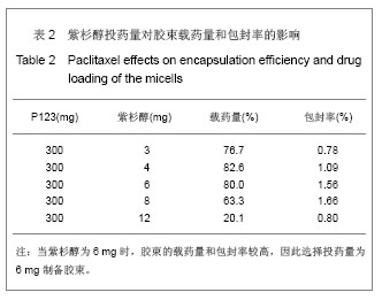
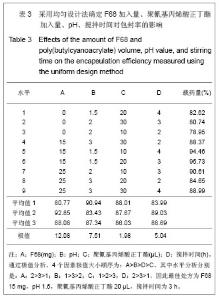
2.1 胶束储备液的优化情况 根据试验现象分别采用40,50,70 ℃作为水化温度,发现超过50 ℃,溶液就会变成乳浊液,分析在50 ℃出现起昙现象,因此采用40 ℃作为水化温度。同时,实现发现,当投药量为6 mg时,载药量和包封率是最合适的,因此实验选择投药量为6 mg,见表2。 采用均匀设计法确定胶束制备的最佳处方为F68 15 mg,pH 1.5,聚氰基丙烯酸正丁酯20 µL,搅拌时间为3 h,见表3。"
"
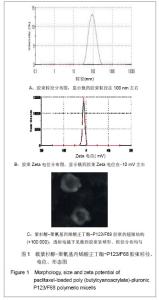
2.2 载药胶束的粒径、电位和形态 测量结果显示,实验制备的载药胶束粒径在100 nm左右,分布范围小,分散度=0.10-0.20,见图1A。载药胶束的Zeta电位在 -10 mV左右,见图1B。透射电镜下见载药胶束呈球形、粒径分布均匀,见图1C。"
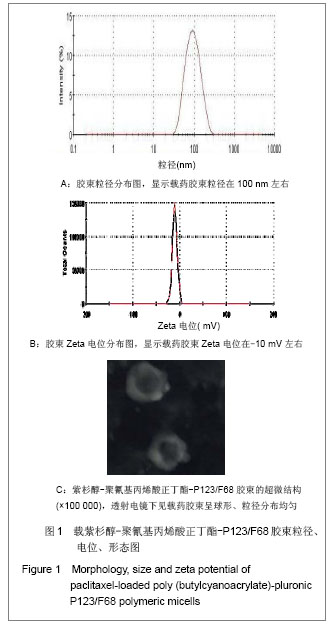
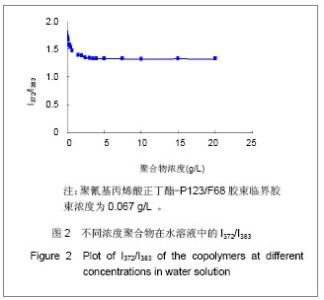
2.3 胶束的临界胶束浓度 图2显示I372/I383值随着聚合物浓度增大而减小,曲线拐点处即为临界胶束浓度。实验制备的空白胶束的临界胶束浓度为0.067 g/L。"
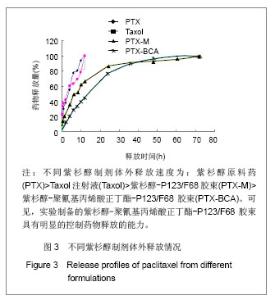
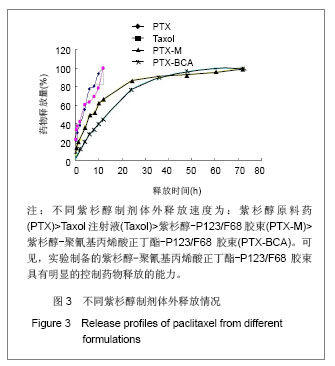
2.4 紫杉醇胶束溶液体外释放情况 实验结果显示,体外释放10 h时,紫杉醇原料药的累积释放量为93.93%,Taxol注射液的累积释放量为78.46%,不加聚氰基丙烯酸正丁酯载药胶束的累积释放量为61.47%,而加聚氰基丙烯酸正丁酯载药胶束的累积释放量为38.86%。此外,紫杉醇原料药和Taxol注射液在12 h时就已经释放完毕,而胶束溶液接近72 h才释放完毕,因此胶束溶液具有一定缓释的功能。并且加入聚氰基丙烯酸正丁酯后释放的速度比不加聚氰基丙烯酸正丁酯释放速度慢,见图3。"
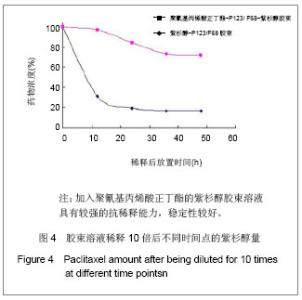
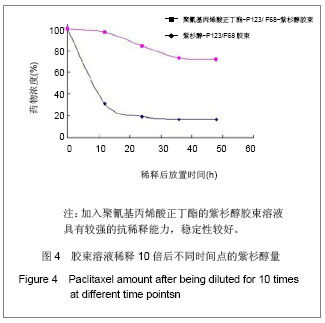
2.5 胶束的稳定性 稀释稳定性试验表明,当聚氰基丙烯酸正丁酯-P123/F68-紫杉醇胶束溶液和紫杉醇- P123/F68胶束溶液稀释10倍后,在37 ℃放置48 h后,两种胶束溶液的药物浓度分别是80.3%和19.7%。因此,加入聚氰基丙烯酸正丁酯后,紫杉醇胶束溶液的药物浓度降低缓慢,而不加聚氰基丙烯酸正丁酯的紫杉醇胶束溶液,药物浓度降低较快,见图4。"
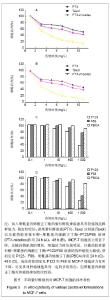
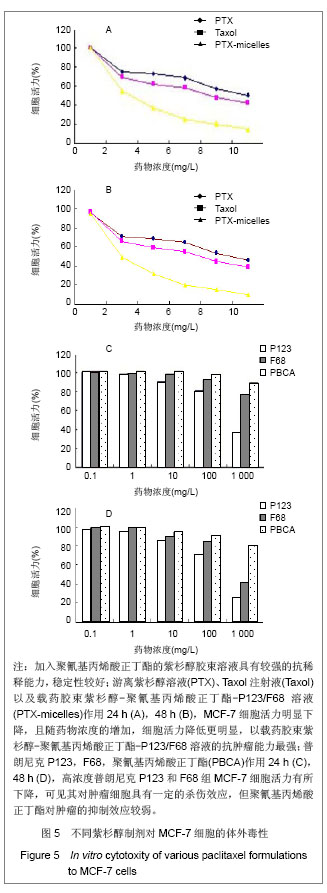
2.6 载药胶束的细胞毒性 体外抗癌活性的研究是确定抗肿瘤药物药效的方法之一。抗肿瘤药物的抗癌活性可用半数抑制浓度(IC50)进行定量表示,IC50是指在用药后存活的细胞数量减少一半所需的药物浓度[5] 。采用MTT方法,探测紫杉醇-聚氰基丙烯酸正丁酯- P123/F68对MCF-7的IC50,并与紫杉醇原料药和Taxol注射液进行比较,见图5。 由图5可见,当药物与细胞作用24 h时,紫杉醇原料药、Taxol注射液、载药胶束的IC50分别是13.47,7.59,2.38 mg/L;而当作用时间为48 h时,三者的IC50分别变为10.64,6.25,2.03 mg/L。因此,在两个时间点,与游离药物和注射液相比,载药胶束均显示较强的杀死肿瘤细胞的能力。同时,普朗尼克P123和F68在一定的作用时间和浓度下,对肿瘤细胞同样具有一定的杀伤效应,这与文献记载是一致的,但是聚氰基丙烯酸正丁酯对肿瘤的抑制效应较弱,具有良好的生物相容性。"
| [1]Marupudi NI, Han JE, Li KW, et al. Paclitaxel: a review of adverse toxicities and novel delivery strategies. Expert Opin Drug Saf. 2007;6(5):609-621.[2]Gogate US, Schwartz PA, Agharkar SN. Effect of unpurfied Cremophor EL on the solution stability of paclitaxel. Pharm Dev Technol. 2009;14(1):1-8.[3]Huh KM, Min HS, Lee SC, et al. A new hydrotropic block copolymer micelle system for aqueous solubilization of paclitaxel. J Control Release. 2008;126(2):122-129.[4]Yang T, Choi MK, Cui FD, et al. Preparation and evaluation of paclitaxel-loaded PEGylated immunoliposome. J Control Release. 2007;120(3):169-177.[5]Wei Z, Hao J, Yuan S, et al. Paclitaxel-loaded Pluronic P123/F127 mixed polymeric micelles: formulation, optimization and in vitro characterization. Int J Pharm. 2009;376(1-2):176-185.[6]Dahmani FZ, Yang H, Zhou J, et al. Enhanced oral bioavailability of paclitaxel in pluronic/LHR mixed polymeric micelles: preparation, in vitro and in vivo evaluation. Eur J Pharm Sci. 2012;47(1):179-189.[7]Oh KS, Song JY, Cho SH, et al. Paclitaxel-loaded Pluronic nanoparticles formed by a temperature-induced phase transition for cancer therapy. J Control Release. 2010; 148(3): 344-350.[8]Liu J, Meisner D, Kwong E, et al. A novel trans-lymphatic drug delivery system: implantable gelatin sponge impregnated with PLGA-paclitaxel microspheres. Biomaterials. 2007;28(21): 3236-3244.[9]Parka IlK, Kimb YJ, Trana TH, et al. Water-soluble heparin-PTX conjugates for cancer targeting. Polymer. 2010; 51(15):3387-3393.[10]Ooya T, Lee J, Park K. Effects of ethylene glycol-based graft, star-shaped, and dendritic polymers on solubilization and controlled release of paclitaxel. J Control Release. 2003;93(2): 121-127.[11]Kedar U, Phutane P, Shidhaye S, et al. Advances in polymeric micelles for drug delivery and tumor targeting. Nanomedicine. 2010;6(6):714-729.[12]Batrakova EV, Li S, Brynskikh AM, et al. Effects of pluronic and doxorubicin on drug uptake, cellular metabolism, apoptosis and tumor inhibition in animal models of MDR cancers. J Control Release. 2010;143(3):290-301.[13]Han LM, Guo J, Zhang LJ, et al. Pharmacokinetics and biodistribution of polymeric micelles of paclitaxel with Pluronic P123. Acta Pharmacol Sin. 2006;27(6):747-753.[14]Jansson J, Schillén K, Olofsson G, et al. The interaction between PEO-PPO-PEO triblock copolymers and ionic surfactants in aqueous solution studied using light scattering and calorimetry. J Phys Chem B. 2004;108(1):82-92.[15]Wulff-Pérez M, Torcello-Gómez A, Gálvez-Ruíz MJ, et al. Stability of emulsions for parenteral feeding: preparation and characterization of o/w nanoemulsions with natural oils and Pluronic f68 as surfactant. Food Hydrocolloids. 2009;23(4): 1096-1102.[16]Cha MH, Choi J, Choi BG, et al. Synthesis and characterization of novel thermo-responsive F68 block copolymers with cell-adhesive RGD peptide. J Colloid Interface Sci. 2011;360(1):78-85. [17]Dabholkar RD, Sawant RM, Mongayt DA, et al. Polyethylene glycol-phosphatidylethanolamine conjugate (PEG-PE)-based mixed micelles: some properties, loading with paclitaxel, and modulation of P-glycoprotein-mediated efflux. Int J Pharm. 2006;315(1-2):148-157.[18]Zhao L, Du J, Duan Y, et al. Curcumin loaded mixed micelles composed of Pluronic P123 and F68: preparation, optimization and in vitro characterization. Colloids Surf B Biointerfaces. 2012;97:101-108.[19]Wang L, Zeng R, Li C, et al. Self-assembled polypeptide- block-poly(vinylpyrrolidone) as prospective drug-delivery systems. Colloids Surf B Biointerfaces. 2009;74(1):284-292.[20]Adams ML, Lavasanifar A, Kwon GS. Amphiphilic block copolymers for drug delivery. J Pharm Sci. 2003;92(7): 1343-1355.[21]Lin J, Zhu J, Chen T, et al. Drug releasing behavior of hybrid micelles containing polypeptide triblock copolymer. Biomaterials. 2009;30(1):108-117.[22]Van Butsele K, Sibret P, Fustin CA, et al. Synthesis and pH-dependent micellization of diblock copolymer mixtures. J Colloid Interface Sci. 2009;329(2):235-243.[23]Zhang J, Jiang W, Zhao X, et al. Preparation and characterization of polymeric micelles from poly (D,L-lactide) and methoxypolyethylene glycol block copolymers as potential drug carriers. Tsinghua Sci Technol. 2007;12(4):493-496.[24]Taillefer J, Jones MC, Brasseur N, et al. Preparation and characterization of pH-responsive polymeric micelles for the delivery of photosensitizing anticancer drugs. J Pharm Sci. 2000;89(1):52-62.[25]Sezgin Z, Yüksel N, Baykara T. Preparation and characterization of polymeric micelles for solubilization of poorly soluble anticancer drugs. Eur J Pharm Biopharm. 2006;64(3):261-268.[26]Liao DL, WU GS, Liao BQ. Zeta potential of shape-controlled TiO2 nanoparticles with surfactants. Colloids and surfaces A: Physicochemical and Engineering Aspects. 2009;348(1-3): 270-275.[27]Liu Y, Cao X, Luo M, et al. Self-assembled micellar nanoparticles of a novel star copolymer for thermo and pH dual-responsive drug release. J Colloid Interface Sci. 2009; 329(2):244-252.[28]Wang XH. Changsha: Central South University. 2007.王夏红.苯妥英钠聚氰基丙烯酸正丁酯纳米微粒的制备及抗癫痫的药效学研究[D].长沙:中南大学,2007.[29]Agnihotri SA, Mallikarjuna NN, Aminabhavi TM. Recent advances on chitosan-based micro- and nanoparticles in drug delivery. J Control Release. 2004;100(1):5-28. |
| [1] | Yang Qiongqiong, Liu Wei. Comparison of performance and clinical effects of zirconia and titanium implants [J]. Chinese Journal of Tissue Engineering Research, 2026, 30(8): 2063-2071. |
| [2] | Wang Songpeng, Liu Yusan, Yu Huanying, Gao Xiaoli, Xu Yingjiang, Zhang Xiaoming, Liu Min. Bidirectional regulation of reactive oxygen species based on zeolitic imidazolate framework-8 nanomaterials: from tumor therapy and antibacterial activity to cytoprotection [J]. Chinese Journal of Tissue Engineering Research, 2026, 30(8): 2033-2013. |
| [3] | Li Qingbin, Lin Jianhui, Huang Wenjie, Wang Mingshuang, Du Jiankai, Lao Yongqiang. Bone cement filling after enlarged curettage of giant cell tumor around the knee joint: a comparison of subchondral bone grafting and non-grafting [J]. Chinese Journal of Tissue Engineering Research, 2026, 30(8): 1896-1902. |
| [4] | Huang Jiawen, Pan Zhiyi, Xue Wenjun, Lian Yuanpei, Xu Jianda. Plant-derived vesicles and malignant tumor therapy: cross-species communication and modulation of host cell responses [J]. Chinese Journal of Tissue Engineering Research, 2026, 30(7): 1828-1838. |
| [5] | Guo Jiachen, Gao Jun, Dai Wenhao, Liao Huayuan, Jiang You, Zhang Xi . Effect of compressive stress microenvironment on cytokines during fracture healing [J]. Chinese Journal of Tissue Engineering Research, 2026, 30(4): 908-916. |
| [6] | Yu Shiyu, Yu Sutong, Xu Yang, Zhen Xiangyan, Han Fengxuan. Advances in research and application of tissue engineering therapeutic strategies in oral submucous fibrosis [J]. Chinese Journal of Tissue Engineering Research, 2026, 30(4): 936-948. |
| [7] | Ma Hong, Ding Xueling, Wang Qi, Lyu Hui, Asya Albusm, Cheng Xinyi, Ma Xiang. Expression and significance of tumor necrosis factor alpha, nuclear factor kappaB and ionized calcium binding adaptor molecule-1 in the hippocampus of mice with aortic dissection [J]. Chinese Journal of Tissue Engineering Research, 2026, 30(4): 858-863. |
| [8] | Liu Yunjia, Yue Xiaolei, Wu Liming, Zhou Huanglei, Lan Xiang, Cui Jiayu, Bai Lin, Liao Yanbo, Liang Jing, Li Mingxing, He Guozhen, Yang Sufang. Ban’s Culuan Zhuyun Decoction alleviates oxidative stress injury in vitrified ovarian tissue [J]. Chinese Journal of Tissue Engineering Research, 2026, 30(36): 9580-9588. |
| [9] | Wang Quan, Tang Zhenglong. Visualization analysis of literature on medication-related osteonecrosis of the jaw [J]. Chinese Journal of Tissue Engineering Research, 2026, 30(35): 9327-9335. |
| [10] | Jiang Li, Peng Guoqiang, Li Sen. Interleukin-10 alleviates inflammatory responses after acute tendon injury [J]. Chinese Journal of Tissue Engineering Research, 2026, 30(34): 8906-8913. |
| [11] | Wei Wei, Wang Deyu, Yu Zhitong, Qiao Chunlin, Cui Xiangran, Liu Hongfei, Wang Chengbo, Wang Shixuan, Teng Hai. Effects of Gushukang Granules on the expression of myogenic and osteogenic factors in the muscles and bones of sarcopenic osteoporosis rats [J]. Chinese Journal of Tissue Engineering Research, 2026, 30(34): 8921-8929. |
| [12] | Gao Zhendong, Zhang Li, Chen Pan, Yin Xiyao, Li Jiayi, Yang Pingjuan, Zhang Min, Liao Shuxin, Shi Linlin, Gao Shegan. Establishment and identification of a patient-derived organoid model for esophagogastric junction adenocarcinoma [J]. Chinese Journal of Tissue Engineering Research, 2026, 30(34): 8970-8977. |
| [13] | Zhou Dayu, Dong Na, Geng Ganshu, Zhang Xue. Long non-coding RNA-TNFRSF13C improves periodontal pathomorphology in rat models of periodontitis via target regulation [J]. Chinese Journal of Tissue Engineering Research, 2026, 30(33): 8662-8668. |
| [14] | Li Xuanze, Fang Hanhong, Xu Zhe. Preparation and cytocompatibility of sodium alginate-hydroxyapatite-graphene oxide hydrogels [J]. Chinese Journal of Tissue Engineering Research, 2026, 30(32): 8420-8426. |
| [15] | Jin Yuan, Zhou Jiabing. Applications and advances of hydrogels in bone tissue engineering repair related to sports injuries [J]. Chinese Journal of Tissue Engineering Research, 2026, 30(32): 8512-8520. |
| Viewed | ||||||
|
Full text |
|
|||||
|
Abstract |
|
|||||