Chinese Journal of Tissue Engineering Research ›› 2026, Vol. 30 ›› Issue (31): 8077-8083.doi: 10.12307/2026.795
Previous Articles Next Articles
Interleukin-4 modulates macrophage polarization and osteogenic differentiation of adipose-derived mesenchymal stem cells
Wang Jing, Shi Haijie, Zhang Mengmeng, Zhang Jinyong, Wang Miaomiao, Tang Lin
- Department of Stomatology, Cangzhou Medical College, Cangzhou 061001, Hebei Province, China
-
Received:2025-09-04Accepted:2025-12-16Online:2026-11-08Published:2026-05-22 -
Contact:Tang Lin, Department of Stomatology, Cangzhou Medical College, Cangzhou 061001, Hebei Province, China -
About author:Wang Jing, MS, Associate professor, Department of Stomatology, Cangzhou Medical College, Cangzhou 061001, Hebei Province, China -
Supported by:Natural Science Project of Cangzhou Medical College, No. 25Z003 (to WJ); Cangzhou Science and Technology Plan Self-raised Fund Project, No. 213107003 (to WJ)

CLC Number:
Cite this article
Wang Jing, Shi Haijie, Zhang Mengmeng, Zhang Jinyong, Wang Miaomiao, Tang Lin. Interleukin-4 modulates macrophage polarization and osteogenic differentiation of adipose-derived mesenchymal stem cells[J]. Chinese Journal of Tissue Engineering Research, 2026, 30(31): 8077-8083.
share this article
Add to citation manager EndNote|Reference Manager|ProCite|BibTeX|RefWorks
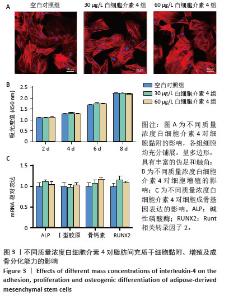
2.1 不同质量浓度白细胞介素4对脂肪间充质干细胞黏附、增殖及成骨分化的影响 如图3所示,空白对照组、30 μg/L白细胞介素4组、60 μg/L白细胞介素4组脂肪间充质干细胞的黏附、增殖及成骨分化能力没有显著差异。 "
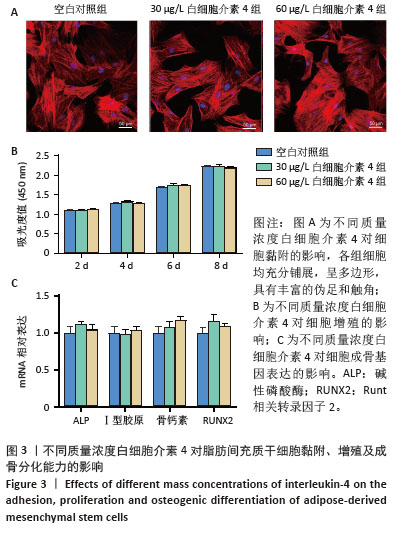
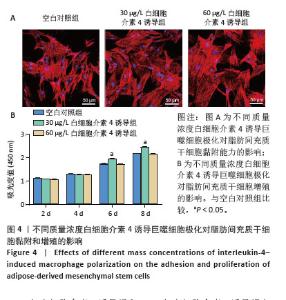
2.2 不同质量浓度白细胞介素4诱导巨噬细胞极化对脂肪间充质干细胞黏附和增殖的影响 如图4A所示,脂肪间充质干细胞和巨噬细胞共同培养,在不同质量浓度白细胞介素4作用下,脂肪间充质干细胞都保持多边形形状,铺展良好,空白对照组、30 μg/L白细胞介素4诱导组和60 μg/L白细胞介素4诱导组鬼笔环肽的整合密度没有显著差异。 如图4B所示,随培养时间延长,各组细胞活性都明显增强,培养6 d时30 μg/L白细胞介素4诱导组细胞增殖水平明显高于其他2组(P < 0.05);第8天时30 μg/L白细胞介素4诱导组增殖水平最强(P < 0.05),可能是白细胞介素4诱导巨噬细胞向M2型极化增加了脂肪间充质干细胞的细胞活力,促进脂肪间充质干细胞增殖。 "

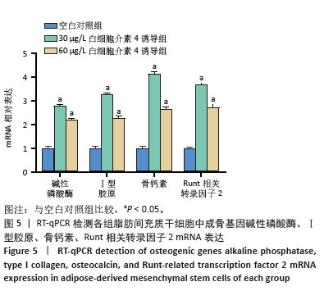
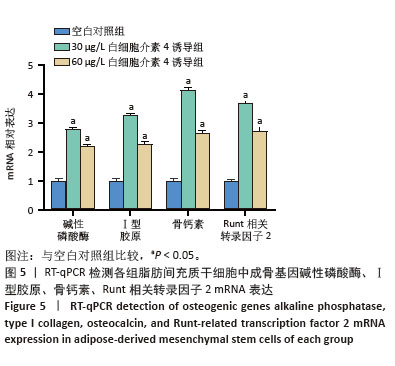
2.3 不同质量浓度白细胞介素4诱导巨噬细胞极化对脂肪间充质干细胞成骨分化的影响 2.3.1 RT-qPCR检测成骨基因的表达 如图5所示,成骨基因碱性磷酸酶、Ⅰ型胶原、骨钙素、Runt相关转录因子2 mRNA表达均升高,30 μg/L白细胞介素4诱导组成骨基因表达水平最高,差异有显著性意义(P < 0.05)。 "
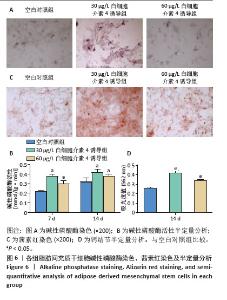
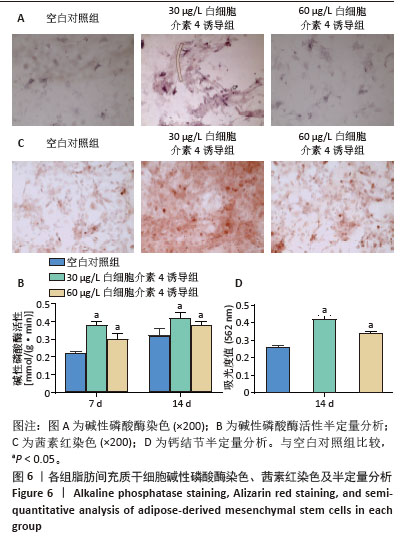
2.3.2 碱性磷酸酶染色和茜素红染色 如图6A、C所示,30 μg/L白细胞介素4诱导组碱性磷酸酶染色和茜素红染色程度明显高于其他2组(P < 0.05),这与半定量分析结果一致(图6B、D),各时间点30 μg/L白细胞介素4诱导组脂肪间充质干细胞的碱性磷酸酶活性和矿化水平均高于其他2组,差异均有显著性意义(P < 0.05)。 "
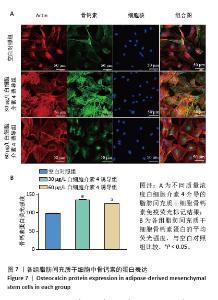
2.3.3 免疫荧光检测各组脂肪间充质干细胞骨钙素蛋白表达 如图7A所示,30 μg/L白细胞介素4诱导组骨钙素的荧光(绿色)强度最高,其次是60 μg/L白细胞介素4诱导组和空白对照组,差异均有显著性意义(P < 0.05)。与定量分析结果一致(图7B),表明巨噬细胞用白细胞介素4诱导后能够显著促进脂肪间充质干细胞的成骨分化,且30 μg/L白细胞介素4诱导的效果最佳。 "

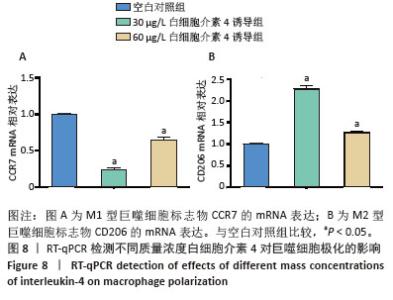
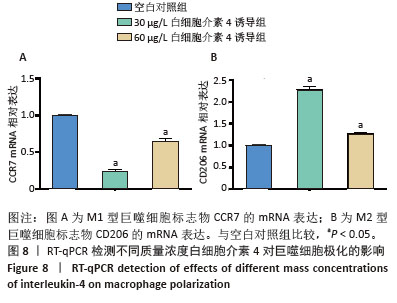
2.4 不同质量浓度白细胞介素4对巨噬细胞极化的影响 如图8所示,与空白对照组相比,30 μg/L白细胞介素4诱导组和60 μg/L白细胞介素4诱导组增加了巨噬细胞M2标记CD206 mRNA表达,减少了巨噬细胞M1标记CCR7 mRNA表达,且30 μg/L白细胞介素4组效果更显著(P < 0.05),表明巨噬细胞用白细胞介素4诱导后倾向于向M2型极化,且30 μg/L白细胞介素4诱导的效果最佳。 "
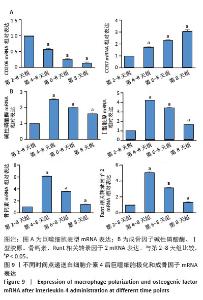
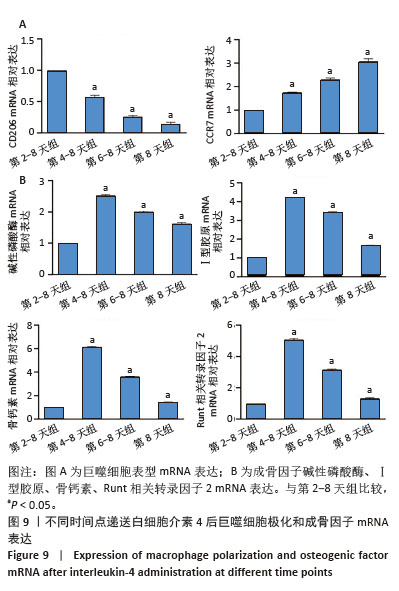
2.5 白细胞介素4在不同时间点对巨噬细胞极化和脂肪间充质干细胞成骨分化的影响 如图9A所示,从第2-8天组到第8天组,M2型巨噬细胞表型标记物CD206表达逐渐降低,M1型巨噬细胞表型标记物CCR7表达逐渐升高,第2-8天组CD206表达水平最高,表明此组倾向于诱导更多的M2巨噬细胞产生。第8天组巨噬细胞CCR7表达水平最高,表明第8天组倾向于诱导更多的M1巨噬细胞产生。在第14天时,RT-qPCR检测脂肪间充质干细胞时间依赖性成骨作用,如图9B所示,成骨基因(碱性磷酸酶、Ⅰ型胶原、骨钙素及Runt相关转录因子2)的表达水平在第4-8天组最高,差异均有显著性意义(P < 0.05),这说明良好的骨修复并非依赖于M2巨噬细胞的绝对数量,而在于M1与M2之间的协同作用和动态平衡,适度的M1炎症启动是修复的前提,而后续向M2的序贯性极化对促进成骨至关重要,二者共同营造出更有利于成骨的免疫微环境。 "
| [1] LIN Z, XIONG Y, MENG W, et al. Exosomal PD-L1 induces osteogenic differentiation and promotes fracture healing by acting as an immunosuppressant. Bioact Mater. 2021;13:300-311. [2] 杨虎,郑宇,贾承明,等.免疫微环境调节骨再生[J].中国组织工程研究, 2025,30(3):171-180. [3] WANG YH, ZHAO CZ, WANG RY, et al. The crosstalk between macrophages and bone marrow mesenchymal stem cells in bone healing. Stem Cell Res Ther. 2022;13(1):511. [4] FAN SY, SUN X, SU C, et al. Macrophages-bone marrow mesenchymal stem cells crosstalk in bone healing. Front Cell Dev Biol. 2023;11:1193765. [5] ZHANG FF, HAO Y, ZHANG KX, et al. Interplay between mesenchymal stem cells and macrophages: Promoting bone tissue repair. World J Stem Cells. 2024;16(4): 375-388. [6] JAMALPOOR Z, ASGARI A, LASHKARI MH, et al. Modulation of Macrophage Polarization for Bone Tissue Engineering Applications. Iran J Allergy Asthma Immunol. 2018;17(5):398-408. [7] HE Z, LIU Y, ZHENG ZL, et al. Periodic Lamellae-Based Nanofibers for Precise Immunomodulation to Treat Inflammatory Bone Loss in Periodontitis. Adv Healthc Mater. 2024;13(18):e2303549. [8] YANG SY, ZHOU YN, YU XG, et al. A xonotlite nanofiber bioactive 3D-printed hydrogel scaffold based on osteo-/angiogenesis and osteoimmune microenvironment remodeling accelerates vascularized bone regeneration. J Nanobiotechnology. 2024;22(1):59. [9] JIN SS, HE DQ, LUO D, et al. A Biomimetic Hierarchical Nanointerface Orchestrates Macrophage Polarization and Mesenchymal Stem Cell Recruitment To Promote Endogenous Bone Regeneration. ACS Nano. 2019;13(6):6581-6595. [10] ZHANG J, SHI H, ZHANG N, et al. Interleukin-4-loaded hydrogel scaffold regulates macrophages polarization to promote bone mesenchymal stem cells osteogenic differentiation via TGF-β1/Smad pathway for repair of bone defect. Cell Prolif. 2020;53(10):e12907. [11] 张洁,肖天骄,李丽,等.白细胞介素4调控巨噬细胞极化及骨髓间充质干细胞的成骨分化[J].中国组织工程研究,2024,28(25):30-36. [12] YU Y, CUI H, ZHANG C, et al. Human nail bed extracellular matrix facilitates bone regeneration via macrophage polarization mediated by the JAK2/STAT3 pathway. J Mater Chem B. 2020;8(18):4067-4079. [13] LI D, LI X, ZHANG J, et al. The immunomodulatory effect of IL-4 accelerates bone substitute material-mediated osteogenesis in aged rats via NLRP3 inflammasome inhibition. Front Immunol. 2023;14:1121549. [14] DUDA GN, GEISSLER S, CHECA S, et al. The decisive early phase of bone regeneration. Nat Rev Rheumatol. 2023;19(2):78-95. [15] ZHANG F, LV M, WANG S, et al. Ultrasound-triggered biomimetic ultrashort peptide nanofiber hydrogels promote bone regeneration by modulating macrophage and the osteogenic immune microenvironment. Bioact Mater. 2023;31:231-246. [16] LOCATI M, CURTALE G, MANTOVANI A. Diversity, Mechanisms, and Significance of Macrophage Plasticity. Annu Rev Pathol. 2020;15:123-147. [17] 蓝春花,孟玲,陈成英,等.绿原酸抑制糖酵解及脂肪酸代谢调控M1型巨噬细胞极化[J].中国免疫学杂志,2021,37(20):2440-2444. [18] COTZOMI-ORTEGA I, NIETO-YAÑEZ O, JUÁREZ-AVELAR I, et al. Autophagy inhibition in breast cancer cells induces ROS-mediated MIF expression and M1 macrophage polarization. Cell Signal. 2021;86:110075. [19] WITHEREL CE, SAO K, BRISSON BK, et al. Regulation of extracellular matrix assembly and structure by hybrid M1/M2 macrophages. Biomaterials. 2021;269: 120667. [20] TIAN H, LIN S, WU J, et al. Kaempferol alleviates corneal transplantation rejection by inhibiting NLRP3 inflammasome activation and macrophage M1 polarization via promoting autophagy. Exp Eye Res. 2021;208:108627. [21] ZHANG H, WANG SQ, HANG L, et al. GRP78 facilitates M2 macrophage polarization and tumour progression. Cell Mol Life Sci. 2021;78(23):7709-7732. [22] LUO Q, LI X, ZHONG W, et al. Dicalcium silicate-induced mitochondrial dysfunction and autophagy-mediated macrophagic inflammation promotes osteogenic differentiation of BMSCs. Regen Biomater. 2021;9:rbab075. [23] WU J, ZHANG L, SHI J, et al. Macrophage phenotypic switch orchestrates the inflammation and repair/regeneration following acute pancreatitis injury. EBioMedicine. 2020;58:102920. [24] HWANG SM, CHUNG G, KIM YH, et al. The Role of Maresins in Inflammatory Pain: Function of Macrophages in Wound Regeneration. Int J Mol Sci. 2019; 20(23):5849. [25] CHEN C, LIU T, TANG Y, et al. Epigenetic regulation of macrophage polarization in wound healing. Burns Trauma. 2023;11:tkac057. [26] MOFARRAH M, JAFARI-GHARABAGHLOU D, FARHOUDI-SEFIDAN-JADID M, et al. Potential application of inorganic nano-materials in modulation of macrophage function: Possible application in bone tissue engineering. Heliyon. 2023;9(6):e16309. [27] GLASS GE, CHAN JK, FREIDIN A, et al. TNF-alpha promotes fracture repair by augmenting the recruitment and differentiation of muscle-derived stromal cells. Proc Natl Acad Sci U S A. 2011;108(4):1585-1590. [28] CHEN L, WU C, WEI D, et al. Biomimetic mineralized microenvironment stiffness regulated BMSCs osteogenic differentiation through cytoskeleton mediated mechanical signaling transduction. Mater Sci Eng C Mater Biol Appl. 2021;119:111613. [29] MARTIN KE, GARCÍA AJ. Macrophage phenotypes in tissue repair and the foreign body response: Implications for biomaterial-based regenerative medicine strategies. Acta Biomater. 2021;133:4-16. [30] BARATCHART E, LO CH, LYNCH CC, et al. Integrated computational and in vivo models reveal Key Insights into macrophage behavior during bone healing. PLoS Comput Biol. 2022;18(5):e1009839. [31] HUANG D, XU K, HUANG X, et al. Remotely Temporal Scheduled Macrophage Phenotypic Transition Enables Optimized Immunomodulatory Bone Regeneration. Small. 2022;18(39):e2203680. [32] HU Z, MA C, RONG X, et al. Immunomodulatory ECM-like Microspheres for Accelerated Bone Regeneration in Diabetes Mellitus. ACS Appl Mater Interfaces. 2018;10(3):2377-2390. |
| [1] | Yu Cenqi, Liu Yang, Yu Jiangfeng, Kang Kang, Deng Yaoge, Xia Xiaowei, Zhang Yijian, Zhu Xuesong. Biomimetic Black Phosphorus Nanosystem Regulates Synovial Macrophage Polarization for Osteoarthritis Treatment [J]. Chinese Journal of Tissue Engineering Research, 2026, 30(在线): 1-13. |
| [2] | Haonan Yang, Zhengwei Yuan, Junpeng Xu, Zhiqi Mao, Jianning Zhang. Preliminary study on the mechanisms and efficacy of deep brain stimulation in treating depression [J]. Chinese Journal of Tissue Engineering Research, 2026, 30(在线): 1-9. |
| [3] | Wang Qisa, Lu Yuzheng, Han Xiufeng, Zhao Wenling, Shi Haitao, Xu Zhe. Cytocompatibility of 3D printed methyl acrylated hyaluronic acid/decellularized skin hydrogel scaffolds [J]. Chinese Journal of Tissue Engineering Research, 2026, 30(8): 1912-1920. |
| [4] | Sun Lei, Zhang Qi, Zhang Yu. Pro-osteoblastic effect of chlorogenic acid protein microsphere/polycaprolactone electrospinning membrane [J]. Chinese Journal of Tissue Engineering Research, 2026, 30(8): 1877-1884. |
| [5] | Song Puzhen, Ma Hebin, Chen Hongguang, Zhang Yadong. Effect of bone marrow mesenchymal stem cell-derived exosomes combined with transforming growth factor beta 1 on macrophages [J]. Chinese Journal of Tissue Engineering Research, 2026, 30(7): 1616-1623. |
| [6] | Jin Dongsheng, Zhao Zhanghong, Zhu Ziyin, Zhang Sen, Sun Zuyan, Deng Jiang. Effects of icariin-loaded microsphere-three-dimensional scaffold on osteogenic differentiation of rabbit bone marrow mesenchymal stem cells [J]. Chinese Journal of Tissue Engineering Research, 2026, 30(7): 1658-1668. |
| [7] | You Huijuan, Wu Shuzhen, Rong Rong, Chen Liyuan, Zhao Yuqing, Wang Qinglu, Ou Xiaowei, Yang Fengying. Macrophage autophagy in lung diseases: two-sided effects [J]. Chinese Journal of Tissue Engineering Research, 2026, 30(6): 1516-1526. |
| [8] | Huang Liuyan, Zhang Wenxi, Chen Shuwen, Yu Shimei, Dai Zhong, Zuo Changqing. Forskolin promotes C2C12 myoblast differentiation via regulating the ERK and Akt signaling pathways [J]. Chinese Journal of Tissue Engineering Research, 2026, 30(5): 1114-1121. |
| [9] | Cao Wenqi, Feng Xiuzhi, Zhao Yi, Wang Zhimin, Chen Yiran, Yang Xiao, Ren Yanling. Effect of macrophage polarization on osteogenesis-angiogenesis coupling in type 2 diabetic osteoporosis [J]. Chinese Journal of Tissue Engineering Research, 2026, 30(4): 917-925. |
| [10] | Zhao Canbin, Zeng Ping, Shi Weiqi, Liu Jinfu, Ding Qiang, Guo Liang, Wang Weiwei, Tao Hongcheng, Guo Yafeng, Qin Ying. Mechanism by which luteolin regulates macrophage polarization in the treatment of knee osteoarthritis [J]. Chinese Journal of Tissue Engineering Research, 2026, 30(34): 8868-8877. |
| [11] | Jin Yuan, Zhou Jiabing. Applications and advances of hydrogels in bone tissue engineering repair related to sports injuries [J]. Chinese Journal of Tissue Engineering Research, 2026, 30(32): 8512-8520. |
| [12] | Qiu Jiajing, Huang Liqu. Hydrogel scaffolds in tissue engineering for urethral repair and reconstruction [J]. Chinese Journal of Tissue Engineering Research, 2026, 30(32): 8521-8528. |
| [13] | Huang Rongjie, Bao Xuemei. Properties of machinable resin-ceramic composites and their application in onlay restorations [J]. Chinese Journal of Tissue Engineering Research, 2026, 30(32): 8529-8535. |
| [14] | Sun Jingshan, Deng Jingqian, Qi Liya, Zhao Xiaohuan, Hou Dandan. Material selection and manufacture method of non-porous adherent cell microcarriers [J]. Chinese Journal of Tissue Engineering Research, 2026, 30(32): 8536-8543. |
| [15] | Zheng Ying, Li Mengyao, Zheng Fanfan, He Zhao, Zhang Ning, Zou Jialun, Li Youlei, Gao Feng. Mechanism of action of extracellular vesicles loaded with biomaterials in repairing spinal cord injury [J]. Chinese Journal of Tissue Engineering Research, 2026, 30(32): 8544-8554. |
| Viewed | ||||||
|
Full text |
|
|||||
|
Abstract |
|
|||||