Chinese Journal of Tissue Engineering Research ›› 2026, Vol. 30 ›› Issue (34): 9095-9102.doi: 10.12307/2026.869
Previous Articles Next Articles
Triangular fibrocartilage complex injuries: a visualization analysis of treatment hotspots and frontiers
Bu Fanchen1, Hua Zhen1, 2, Li Xiaolong1, Lyu Jinye1, Man Hao1, Wang Jianwei1, 2
- 1Nanjing University of Chinese Medicine, Nanjing 210000, Jiangsu Province, China; 2Wuxi Hospital Affiliated to Nanjing University of Chinese Medicine, Wuxi 214000, Jiangsu Province, China
-
Received:2025-10-29Revised:2026-01-24Online:2026-12-08Published:2026-04-15 -
Contact:Wang Jianwei, PhD, Chief physician, Nanjing University of Chinese Medicine, Nanjing 210000, Jiangsu Province, China; Wuxi Hospital Affiliated to Nanjing University of Chinese Medicine, Wuxi 214000, Jiangsu Province, China -
About author:Bu Fanchen, MS candidate, Nanjing University of Chinese Medicine, Nanjing 210000, Jiangsu Province, China -
Supported by:National Natural Science Foundation of China, Nos. 82274546 (to WJW) and 82205142 (to HZ); Wuxi City “Double Hundred” Program for Outstanding Young Medical Professionals, No. HB2023073 (to HZ)

CLC Number:
Cite this article
Bu Fanchen, Hua Zhen, , Li Xiaolong, Lyu Jinye, Man Hao, Wang Jianwei, . Triangular fibrocartilage complex injuries: a visualization analysis of treatment hotspots and frontiers[J]. Chinese Journal of Tissue Engineering Research, 2026, 30(34): 9095-9102.
share this article
Add to citation manager EndNote|Reference Manager|ProCite|BibTeX|RefWorks
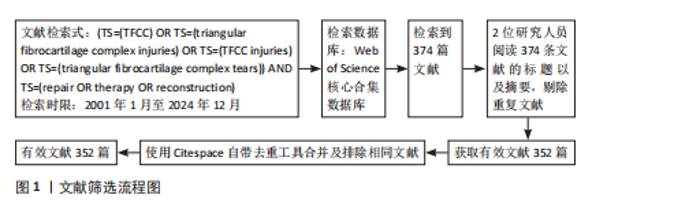
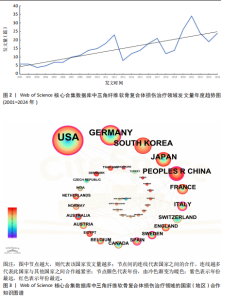
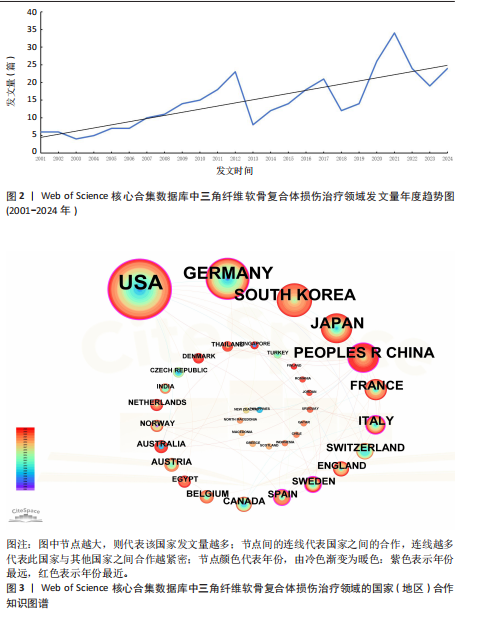
2.1 三角纤维软骨复合体损伤治疗领域发文量年度趋势 通过年发文量可以直观了解该研究领域的发展情况。由图2可知,2001-2024年间,三角纤维软骨复合体损伤治疗领域的发文量整"
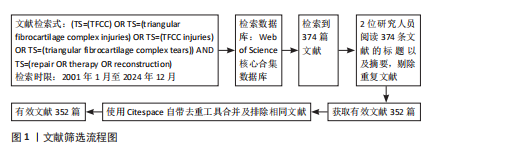
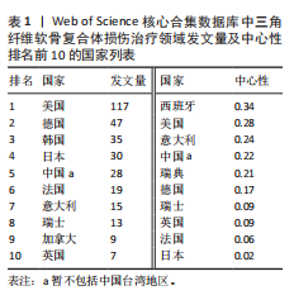
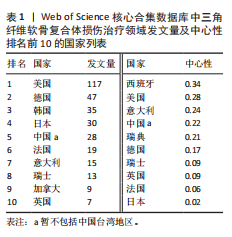
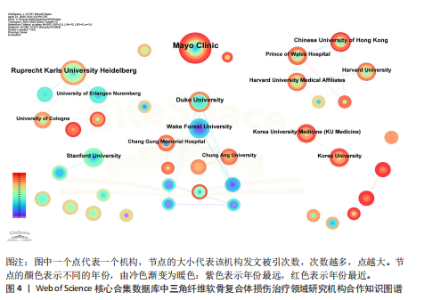
体呈阶段上升趋势,分别出现2001-2012年、2013年-2017年、2018-2021年3个持续增长阶段,并于2021年达到发文量顶峰,这表明自21世纪以来三角纤维软骨复合体损伤治疗领域的研究日益受到重视,预计未来将得到研究者们更为广泛和深入的关注。 2.2 三角纤维软骨复合体治疗相关文献发文国家(地区)分析 使用Citespace对纳入文献的发文国家(地区)情况进行分析,国家或地区分布图由38个节点和51个链接组成,图中每个节点代表一个国家,节点的大小代表相应国家关于三角纤维软骨复合体损伤治疗研究文献的产出量,节点之间的连线代表两个国家之间的合作。如图3和表1所示,近24年三角纤维软骨复合体损伤治疗领域发文量最多的国家为美国(117篇),中国以28篇位居世界前列。中心性排名第一的国家为西班牙(0.34),美国位列第二。对发文量和中心性进行分析可知,美国是图谱中最大的节点,以117篇的发文量位居首位,并且为第二位德国的2.49倍,远高于其他各国(地区);韩国、日本、中国(暂不包括中国台湾地区)在该研究领域的发文量居后。西班牙虽然发文量没有显著优势,但0.34的中心性显示了西班牙在三角纤维软骨复合体损伤治疗领域国际合作中扮演重要角色。美国的中心性为0.28,仅次于西班牙,位居世界第二。美国发文量以及中心性皆名列前茅,这表明美国在三角纤维软骨复合体损伤治疗领域位于领军地位并起到关键枢纽的作用。中国在此领域位于世界前列,但仍需争取提高发文数量和加强国际合作。"
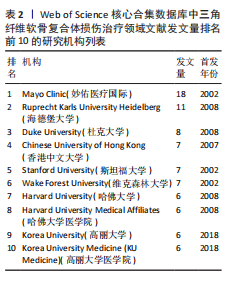
2.3 三角纤维软骨复合体损伤治疗相关文献发文机构分析 在CiteSpace软件中以机构 (Institution)为节点统计,生成的机构合作图谱如图4所示,共有 290个节点和273条连线。发文量排名前3的研究机构分别为妙佑医疗国际(18篇)、海德堡大学(11篇)、杜克大学(8篇)。香港中文大学、斯坦福大学、维克森林大学并列第四(7篇),哈佛大学及其医学院各自发文6篇紧随其后。高丽大学及医学院首发年份与其他机构相比较晚(2018年),但以各6篇的数量位于世界前列。在Web of Science核心合集数据库中,发文量排名前10的机构中,有半数来自美国,表明美国的科研机构在三角"
"
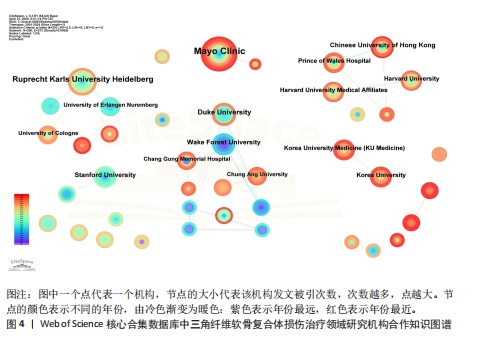
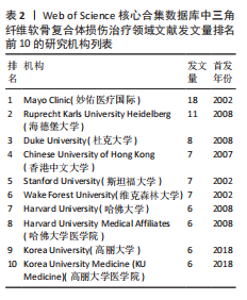
纤维软骨复合体损伤治疗领域占据重要地位,展示了强大的科研实力和学术影响力。发文量排名前10位的机构及发文量见表2。"
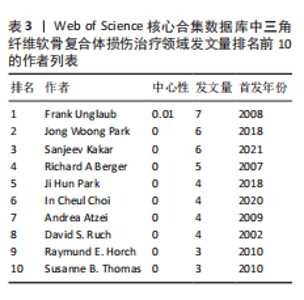
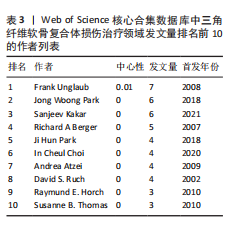
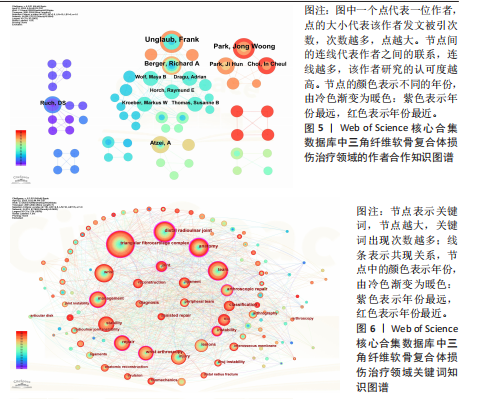
2.4 三角纤维软骨复合体损伤治疗相关文献作者合作情况分析 使用CiteSpace软件对纳入文献的作者进行分析(图5)。研究者之间的合作联系比较分散,在排名前10位的作者中,形成了3个联系较为紧密的研究团体。以David S.Ruch为首的研究团体最早开展合作,研究方向主要为三角纤维软骨复合体损伤机制和患者特征对预后的影响,并开发和完善多种关节镜修复技术,以及关节镜下修复治疗三角纤维软骨复合体损伤[14-19]。Frank Unglaub是发表文章最多的作者,并与Richard A Berger等人合作密切,构成最大的合作网络,该团队主要从事三角纤维软骨复合体损伤细胞分子机制与生物力学的研究,并探究优化关节镜个体化治疗策略[20-23]。Jong Woong Park与Ji Hun Park、In Cheul Choi三人构成联系密切的合作团体,该团体合作起步较晚,但对三角纤维软骨复合体损伤影像学评估、关节镜下单隧道经骨缝合技术优化以及损伤的病理机制和预后等方面都有所研究[24-28],见表3。"
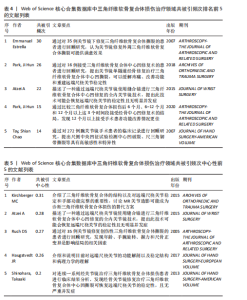
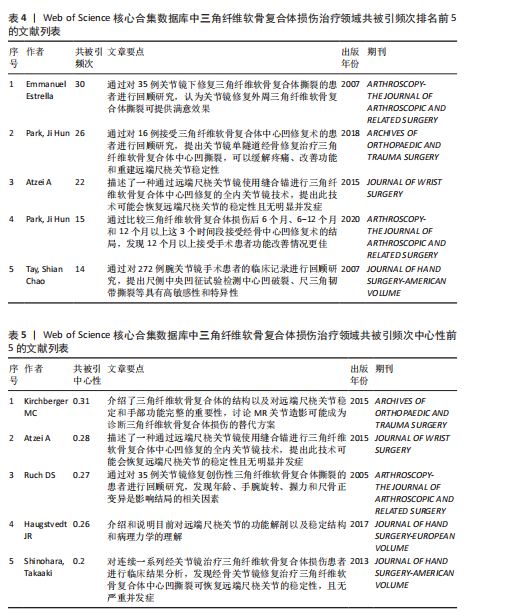
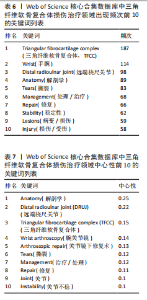
2.5 三角纤维软骨复合体损伤治疗相关文献共被引情况分析 高共被引频次的文献是该领域优秀研究成果的结晶,为后续的临床研究提供指导。使用CiteSpace软件对三角纤维软骨复合体损伤治疗领域的文献被引情况进行分析,可归纳出共被引频次及中心性最高的前5名文献(表4,5)。由结果可知,共被引最多的参考文献是Estrella,Emmanuel P.等发表的一篇研究性文章,该研究通过对35例关节镜下修复三角纤维软骨复合体撕裂的患者进行回顾研究,使用日常生活活动评分和改良Mayo手腕评分评估功能结果,验证了关节镜修复外周三角纤维软骨复合体撕裂可提供满意效果[29]。与此同时,21世纪以来三角纤维软骨复合体领域共被引频次较高的其他几篇文章对各类关节镜手术治疗三角纤维软骨复合体中心凹损伤进行了临床研究,并都提出关节镜手术治疗对改善和恢复远端尺桡关节的稳定性、减少并发症有良好的效果[30-31]。共被引中心性最高的文章介绍了三角纤维软骨复合体的结构以及对远端尺桡关节稳定和手部功能完整的重要性,讨论磁共振关节造影可能成为诊断三角纤维软骨复合体损伤的替代方案[32]。 2.6 三角纤维软骨复合体损伤治疗相关文献关键词分析 关键词共现分析是揭示学术领域研究热点与发展趋势的重要方法,能够直观反映研究者的关注焦点与研究方向,帮助读者直观快速地了解该领域的主要研究热点[33]。使用Citespcace软件进行关键词共现分析,见图6。频次排名前5的关键词为“三角纤维软骨复合体(TFCC)”“手腕”“远端尺桡关节”“解剖学”“撕裂”。中心性排名前5的关键词为“解剖学”“远端尺桡关节”“三角纤维软骨复合体(TFCC)”“腕关节镜”“关节镜下修复术”(表6,7)。除去与检索策略有关的关键词,三角纤维软骨复合体损伤治疗的研究内容主要有“手腕”“远端尺桡关节”“解剖学”“稳定性”等,并借助“腕关节镜”“关节镜下修复术”等中心词形成一个有机整体。其中“解剖学”和“远端桡尺关节”等关键词的高中心性表明,远端尺桡关节的解剖细节以及生物力学功能是探索三角纤维软骨复合体损伤机制的基础,而“稳定性”“关节不稳”等关键词则提示远端尺桡关节不稳的病理机制是如今临床干预的重要目标之一。孙"
"
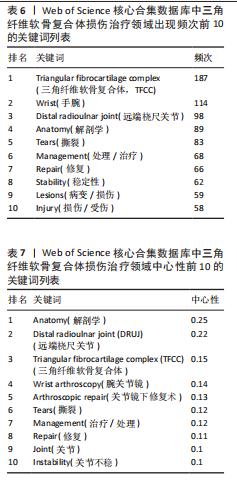
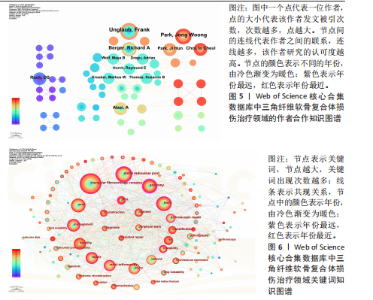
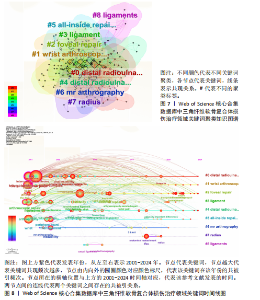
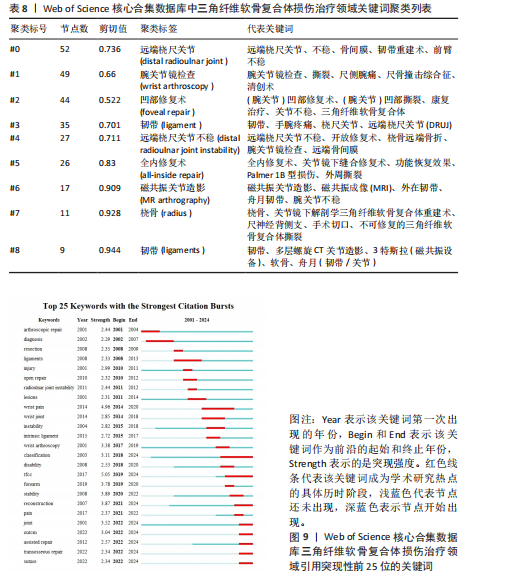
捷等[34]通过对新鲜的三角纤维软骨复合体标本进行Karnovsky-Roots染色,并在光学显微镜下对三角纤维软骨复合体不同区域的运动神经纤维分布进行划分,提出尺月韧带、尺三角韧带、桡尺韧带能维持覆盖在尺骨小头与腕骨之间的三角纤维软骨复合体的稳定性。SHIN等[35]则认为,止于尺骨茎突凹的桡尺韧带深支对于远端尺桡关节稳定性比浅支更重要。 Citespace的聚类分析功能将具有相似特征的关键词划分至同一组中,可以了解一个学科领域的发展历程以及最新的研究热点。关键词进行聚类可视化分析见图7。三角纤维软骨复合体损伤治疗的关键词共形成9个聚类,即9个主要研究方向(表8)。观察剪切值(反映聚类内部同质性的指标,越接近于1表示同质性越高)≥0.7的#0、#3、#4、#5、#6、#7、#8聚类可知,三角纤维软骨复合体治疗研究的代表性关键词分别为“远端尺桡关节”“韧带”“远端尺桡关节不稳”“全内修复术”“磁共振关节造影”“桡骨”。此外,“腕关节镜检查”“(腕关节)凹部修复术”等也可视为21世纪以来的研究热点。 Citespace的时间线图谱功能可将关键词知识图谱中涉及的关键词按发表年份进行可视化展示,揭示出各个研究方向之间的时间关系,见图8。在2001-2012年这个阶段时间线图谱所反映的关键词如“解剖(anatomy)”“韧带(ligament)”“尺侧腕伸肌腱(carpi ulnaris)”“关节造影术(arthrography)”“关节镜治疗(arthroscopic "
"
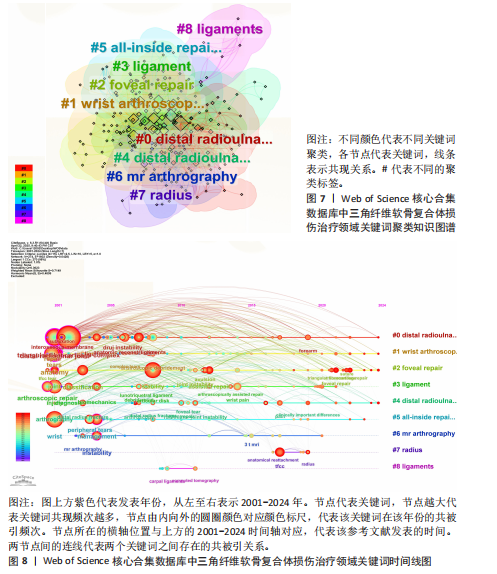
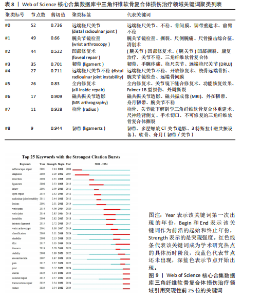
treatment)”“palmer 1b分型(palmer 1b)”等,表明研究者们主要聚焦于对三角纤维软骨复合体解剖学机制进行深入的探索和诊断技术的开发,开启了对关节镜微创治疗的初步研究。在2013-2018年这个阶段,“锚钉缝合修复(suture anchor repair)”“关节镜关节囊修复(arthroscopic capsular repair)”“全关节内修复术(all inside repair)”“3T磁共振(3 t mri)”“青少年运动员(adolescent athletes)”等关键词的出现,展示出这个阶段开始关注青少年运动员等特殊群体的需求。与此同时,关节镜技术不断革新,锚钉技术的普及和影像诊断技术的升级,使三角纤维软骨复合体损伤治疗领域的研究逐渐向个体化治疗过渡和材料科学延伸。第三阶段为2019-2024年,此阶段出现了“患者自评结局(patient rated)”“治疗路径(algorithm)”“可靠性(reliability)”等关键词,这提示现阶段研究者们开始侧重于手术技术的标准化和术后疗效的评估,与此同时,“穴位(acupuncture)”“电针疗法(acupuncture therapy electroacupuncture)”等作为前沿关键词的出现,凸显了中医在三角纤维软骨复合体损伤研究中日益重要的地位。 关键词是对论文的核心概括,而强突发关键词是在一段时间内具有较高的突发值。对文献关键词进行突现性检测可以明确某一时间段内的研究重点与热点,从而判断研究的发展动向与前沿研究[36]。三角纤维软骨复合体治疗共出现25个突现词,见图9,主要分为3个阶段,其中第一阶段为2001-2009年,突发性关键词是关节镜修复术、诊断、切除术,说明研究者在三角纤维软骨复合体损伤治疗研究早期多聚焦于腕关节损伤的手术修复技术以及解剖学基础和关节镜手术的探索;第二阶段为2010-2018年,突发性关键词是腕关节疼痛、关节不稳定、功能障碍、腕关节镜手术等,其中腕关节疼痛的突现强度达4.96,这表明在此阶段中研究者研究重心开始转向关节镜术后并发症与长期预后,出现了对患者功能评估的需求;第三阶段为2019-2024年,突发性关键词是三角纤维软骨复合体、前臂、分类系统、经骨修复技术、辅助修复技术、重建术、缝合术等,由此说明现阶段三角纤维软骨复合体损伤治疗研究呈现出精准化、标准化和跨学科融合的特点,治疗技术向更小切口、更少损伤的方向迭代更新,与生物力学、材料学等多学科交叉联合优化。"
| [1] JUNG HS, KIM SH, JUNG CW, et al. Arthroscopic Transosseous Repair of Foveal Tears of the Triangular Fibrocartilage Complex: A Systematic Review of Clinical Outcomes. Arthroscopy. 2021; 37(5):1641-1650. [2] BEDNAR MS, ARNOCZKY SP, WEILAND AJ. The microvasculature of the triangular fibrocartilage complex: its clinical significance. J Hand Surg Am. 1991;16(6):1101-1105. [3] PALMER AK. Triangular fibrocartilage complex lesions: a classification. J Hand Surg Am. 1989; 14(4):594-606. [4] LIU EH, SUEN K, THAM SK, et al. Surgical Repair of Triangular Fibrocartilage Complex Tears: A Systematic Review. J Wrist Surg. 2021;10(1):70-83. [5] MCNAMARA CT, COLAKOGLU S, IORIO ML. A Systematic Review and Analysis of Palmer Type I Triangular Fibrocartilage Complex Injuries: Outcomes of Treatment. J Hand Microsurg. 2020; 12(2):116-122. [6] DUNN JC, POLMEAR MM, NESTI LJ. Surgical Repair of Acute TFCC Injury. Hand (N Y). 2020;15(5):674-678. [7] ANDERSSON JK, ÅHLÉN M, ANDERNORD D. Open versus arthroscopic repair of the triangular fibrocartilage complex: a systematic review. J Exp Orthop. 2018;5(1):6. [8] 杨顺,程亚博,徐文东,等.腕关节镜下腕三角纤维软骨复合体 PalmerⅠB 型损伤的诊断和治疗[J].中华手外科杂志,2016,32(4):283-285. [9] ROBERTSON G, ANG KK, MAFFULLI N, et al. Return to sport following surgical management of triangular fibrocartilage tears: a systematic review. Br Med Bull. 2019;130(1):89-103. [10] 付健,丁敬达.Citespace 和 VOSviewer 软件的可视化原理比较[J].农业图书情报学报,2019, 31(10):31-37. [11] AI S, LI Y, ZHENG H, et al. Collision of herbal medicine and nanotechnology: a bibliometric analysis of herbal nanoparticles from 2004 to 2023. J Nanobiotechnology. 2024;22(1):140. [12] LEYDESDORFF L, CARLEY S, RAFOLS I. Global maps of science based on the new Web-of-Science categories. Scientometrics. 2013;94(2):589-593. [13] 李科科,于文兵,李硕奇,等.基于CiteSpace的大学生社交焦虑研究的热点与前沿趋势分析[J].中国全科医学,2022,25(33):4217-4226. [14] RUCH DS, YANG CC, SMITH BP. Results of acute arthroscopically repaired triangular fibrocartilage complex injuries associated with intra-articular distal radius fractures. Arthroscopy. 2003;19(5):511-516. [15] RUCH DS, GINN TA, YANG CC, et al. Use of a distraction plate for distal radial fractures with metaphyseal and diaphyseal comminution. J Bone Joint Surg Am. 2005;87(5):945-954. [16] PAPAPETROPOULOS PA, RUCH DS. Repair of arthroscopic triangular fibrocartilage complex tears in athletes. Hand Clin. 2009;25(3):389-394. [17] PAPAPETROPOULOS PA, WARTINBEE DA, RICHARD MJ, et al. Management of peripheral triangular fibrocartilage complex tears in the ulnar positive patient: arthroscopic repair versus ulnar shortening osteotomy. J Hand Surg Am. 2010;35(10):1607-1613. [18] WYSOCKI RW, RICHARD MJ, CROWE MM, et al. Arthroscopic treatment of peripheral triangular fibrocartilage complex tears with the deep fibers intact. J Hand Surg Am. 2012;37(3):509-516. [19] WHITLOCK K, RUCH DS. Editorial Commentary: Ulnar Variance Is Not the Sole Determinant of Arthroscopic Wrist Triangular Fibrocartilage Complex Repair Outcome: Considering the Forest From the Ulnar-Positive Tree. Arthroscopy. 2020;36(9):2423-2424. [20] UNGLAUB F, HAHN P, WOLF E, et al. Degeneration process of symptomatic central tears in the triangular fibrocartilage. Ann Plast Surg. 2007; 59(5):515-519. [21] UNGLAUB F, FELLENBERG J, GERMANN G, et al. Detection of apoptotic cartilage cells in symptomatic central tears of the triangular fibrocartilage. J Hand Surg Am. 2007;32(5):618-622. [22] UNGLAUB F, THOMAS SB, KROEBER MW, et al. Apoptotic pathways in degenerative disk lesions in the wrist. Arthroscopy. 2009;25(12):1380-1386. [23] SPIES CK, BRUCKNER T, MÜLLER LP, et al. Long-term outcome after arthroscopic debridement of Palmer type 2C central degenerative lesions of the triangular fibrocartilage complex. Arch Orthop Trauma Surg. 2021;141(10):1807-1814. [24] PARK JH, KIM D, PARK JW. Arthroscopic one-tunnel transosseous foveal repair for triangular fibrocartilage complex (TFCC) peripheral tear. Arch Orthop Trauma Surg. 2018;138(1):131-138. [25] PARK JH, KIM D, PARK H, et al. The Effect of Triangular Fibrocartilage Complex Tear on Wrist Proprioception. J Hand Surg Am. 2018;43(9):866.e1-866.e8. [26] PARK JH, AHN KS, CHANG A, et al. Changes in the morphology of the triangular fibrocartilage complex (TFCC) on magnetic resonance arthrography related to disruption of ulnar foveal attachment. Skeletal Radiol. 2020;49(2):249-256. [27] KWON YW, PARK JH, CHOI IC, et al. Revisional triangular fibrocartilage complex (TFCC) repair using arthroscopic one-tunnel transosseous suture: preliminary results. Arch Orthop Trauma Surg. 2022;142(2):197-203. [28] KWON YW, CHOI IC, PARK JH, et al. Influence of TFCC foveal tear on the location of lunate chondromalacia in ulnar impaction syndrome. Skeletal Radiol. 2021;50(9):1855-1861. [29] ESTRELLA EP, HUNG LK, HO PC, et al. Arthroscopic repair of triangular fibrocartilage complex tears. Arthroscopy. 2007;23(7):729-737. [30] ATZEI A, LUCHETTI R, BRAIDOTTI F. Arthroscopic foveal repair of the triangular fibrocartilage complex. J Wrist Surg. 2015;4(1):22-30. [31] SHINOHARA T, TATEBE M, OKUI N, et al. Arthroscopically assisted repair of triangular fibrocartilage complex foveal tears. J Hand Surg Am. 2013;38(2):271-277. [32] KIRCHBERGER MC, UNGLAUB F, MÜHLDORFER-FODOR M, et al. Update TFCC: histology and pathology, classification, examination and diagnostics. Arch Orthop Trauma Surg. 2015; 135(3):427-437. [33] 陈文娟.数字资源评价研究特征、前沿与展望:基于WOS数据库的文献计量学分析[J].图书馆学研究,2022(7):2-14. [34] 孙捷,张益,高甲科,等.腕关节三角纤维软骨复合体解剖及组织学观察[J].青岛大学学报(医学版),2020,56(5):516-519. [35] SHIN WJ, KIM JP, YANG HM, et al. Topographical Anatomy of the Distal Ulna Attachment of the Radioulnar Ligament. J Hand Surg Am. 2017; 42(7):517-524. [36] VANDENPUT L, JOHANSSON H, MCCLOSKEY EV, et al. Update of the fracture risk prediction tool FRAX: a systematic review of potential cohorts and analysis plan. Osteoporos Int. 2022;33(10):2103-2136. [37] GRAESSER EA, WALL LB, KAKAR S, et al. Reliability of Wrist Arthroscopy in the Diagnosis and Treatment of Triangular Fibrocartilage Complex Tears. J Hand Surg Am. 2025;50(1):2-9. [38] BRAIG ZV, DITTMAN LE, AMRAMI KK, et al. Dynamic Computed Tomography of the Distal Radioulnar Joint Versus Magnetic Resonance Imaging in Detecting Foveal Tears of the Triangular Fibrocartilage Complex. Hand (N Y). 2025;20(4):612-618. [39] DMOUR A, TIRNOVANU SD, POPESCU DC, et al. Advancements in Diagnosis and Management of Distal Radioulnar Joint Instability: A Comprehensive Review Including a New Classification for DRUJ Injuries. J Pers Med. 2024; 14(9):943. [40] ATZEI A. New trends in arthroscopic management of type 1-B TFCC injuries with DRUJ instability. J Hand Surg Eur Vol. 2009;34(5):582-591. [41] LUCHETTI R, ATZEI A, COZZOLINO R, et al. Comparison between open and arthroscopic-assisted foveal triangular fibrocartilage complex repair for post-traumatic distal radio-ulnar joint instability. J Hand Surg Eur Vol. 2014;39(8):845-855. [42] SOREIDE E, HAUGSTVEDT JR, HUSBY T. Arthroscopic Assisted Resection of Triangular Fibrocartilage Complex Lesions: A 19-Year Follow-up. Hand (N Y). 2018;13(3):325-330. [43] YIN YB, LIU B, ZHU J, et al. Clinical and Epidemiological Features Among Patients with Wrist Arthroscopy Surgery: A Hospital-based Study in China. Orthop Surg. 2020;12(4):1223-1229. [44] HERMANSDORFER JD, KLEINMAN WB. Management of chronic peripheral tears of the triangular fibrocartilage complex. J Hand Surg Am. 1991;16(2):340-346. [45] TREHAN SK, WALL LB, CALFEE RP, et al. Arthroscopic Diagnosis of the Triangular Fibrocartilage Complex Foveal Tear: A Cadaver Assessment. J Hand Surg Am. 2018;43(7):680.e1-680.e5. [46] HERZBERG G, BURNIER M, LY L, et al. A New Arthroscopic Classification of Triangular Fibrocartilage Complex Disorders. J Wrist Surg. 2023;13(1):2-8. [47] 汪亮,吴志鹏,吴龙,等.腕关节三角纤维软骨复合体尺背侧损伤类型对Palmer分型的补充[J].温州医科大学学报,2025,55(7):586-591. [48] ROBBA V, FOWLER A, KARANTANA A, et al. Open Versus Arthroscopic Repair of 1B Ulnar-Sided Triangular Fibrocartilage Complex Tears: A Systematic Review. Hand (N Y). 2020;15(4):456-464. [49] 赵铜林,魏本磊.镜下穿双骨道修复三角纤维软骨复合体[J].中国矫形外科杂志,2024,32(6): 553-556. [50] 魏本磊,张玉,赵铜林,等.关节镜下三种技术修复腕三角纤维软骨复合体比较[J].中国矫形外科杂志,2025,33(1):19-24. [51] SRINIVASAN RC, DELA CRUZ JA, EUBANKS RD, et al. Arthroscopic TFCC Ulnar Bone Tunnel Foveal Repair in Adult Patients. Arthrosc Tech. 2022;11(10):e1753-e1761. [52] 杨顺,程亚博,徐文东,等.腕关节镜下腕三角纤维软骨复合体 PalmerⅠB 型损伤的诊断和治疗[J].中华手外科杂志,2016,32(4):283-285. [53] YEH KT, WU WT, WANG JH, et al. Arthroscopic foveal repair with suture anchors for traumatic tears of the triangular fibrocartilage complex. BMC Musculoskelet Disord. 2022;23(1):634. [54] 阮剑辉,陈燕,何阳,等.可视化富血小板血浆注射联合阶梯式康复治疗军事训练三角纤维软骨复合体损伤的效果[J].广东医学,2024, 45(9):1131-1136. [55] KIM S, HWANG B. Relationship between bone mineral density and the frequent administration of epidural steroid injections in postmenopausal women with low back pain. Pain Res Manag. 2014;19(1):30-34. [56] 关云飞,张勇,郑倩,等.一种用于三角纤维软骨复合体损伤后固定的新型低温热塑肘腕手矫形器的研发与初步效果测试[J].中国康复, 2022,37(11):698-701. |
| [1] | Xu Canli, He Wenxing, Wang Yuping, Ba Yinying, Chi Li, Wang Wenjuan, Wang Jiajia. Research context and trend of TBK1 in autoimmunity, signaling pathways, gene expression, tumor prevention and treatment [J]. Chinese Journal of Tissue Engineering Research, 2026, 30(在线): 1-11. |
| [2] | Zhu Xiaolong, Zhang Wei, Yang Yang. Visualization analysis of research hotspots and cutting-edge information in the field of intervertebral disc regeneration and repair [J]. Chinese Journal of Tissue Engineering Research, 2026, 30(9): 2391-2402. |
| [3] | Wen Fayan, Li Yan, Qiang Tianming, Yang Chen, Shen Linming, Li Yadong, Liu Yongming. Unilateral biportal endoscopic technology for treatment of lumbar degenerative diseases: global research status and changing trends [J]. Chinese Journal of Tissue Engineering Research, 2026, 30(9): 2380-2390. |
| [4] | Lai Yu, Chen Yueping, Zhang Xiaoyun. Research hotspots and frontier trends of bioactive materials in treating bone infections [J]. Chinese Journal of Tissue Engineering Research, 2026, 30(8): 2132-2144. |
| [5] | Huang Jie, Zeng Hao, Wang Wenchi, Lyu Zhucheng, Cui Wei. Visualization analysis of literature on the effect of lipid metabolism on osteoporosis [J]. Chinese Journal of Tissue Engineering Research, 2026, 30(6): 1558-1568. |
| [6] | He Renda, Ma Wei, Sun Yongsi, Mo Xueni. Future medical research on brain organoids: interdisciplinary training, bioengineering technologies, and optimized model maturity [J]. Chinese Journal of Tissue Engineering Research, 2026, 30(34): 9088-9094. |
| [7] | Wang Degang, Mei Junhua, Wang Junli, Zheng Li, Chen Guohua. Bibliometric and visualization analysis of the mechanism of osteogenic factors and neurotransmitters in the bone-brain axis [J]. Chinese Journal of Tissue Engineering Research, 2026, 30(29): 7724-7731. |
| [8] | Wang Lei, Hu Baoyang, Fang Fang. Bibliometric analysis of research hotspots on mitochondria and spinal cord injury treatment [J]. Chinese Journal of Tissue Engineering Research, 2026, 30(29): 7764-7772. |
| [9] | Liu Yan, Zuo Qingchun, Li Weiying, Wu Xubo. Research hotspots and trends of optogenetics in behavioral neuroscience [J]. Chinese Journal of Tissue Engineering Research, 2026, 30(28): 7396-7403. |
| [10] | Wang Xueting, Yang Wei, Wang Pengqin. Post-stroke rehabilitation robotics: current research status and hot topics in and outside China [J]. Chinese Journal of Tissue Engineering Research, 2026, 30(28): 7404-7409. |
| [11] | Zhang Jingyi, Zhi Liang, Yang Zeyu, Li Yaning, Hu Jia, Wang Jia, Wang Yulong, Long Jianjun. Extracorporeal shock wave therapy: current research status, hotspots, and trends [J]. Chinese Journal of Tissue Engineering Research, 2026, 30(28): 7410-7417. |
| [12] | Yue Yuhang, Xie Liangyu, Shi Liupeng, Yin Zuozhen, Cao Shengnan, Shi Bin, Sun Guodong. Bibliometric analysis of application of artificial intelligence in orthopedic imaging diagnosis [J]. Chinese Journal of Tissue Engineering Research, 2026, 30(28): 7418-7427. |
| [13] | Guo Jun, Lu Zheng, Yu Jinling, Hao Yuanyuan, Liu Kaishun, Liu Xuexia, Huang Yourong. Oxidative stress and osteoporosis: a bibliometric analysis of literature from SCI core database [J]. Chinese Journal of Tissue Engineering Research, 2026, 30(28): 7428-7436. |
| [14] | Xu Canli, He Wenxing, Wang Yuping, Ba Yinying, Chi Li, Wang Wenjuan, Wang Jiajia. Research context and trend of TANK binding kinase 1 in autoimmunity and tumor prevention and treatment [J]. Chinese Journal of Tissue Engineering Research, 2026, 30(28): 7456-7464. |
| [15] | Dilida·Bahetikelede, Zhou Xin, Wang Xinyi, Zeng Zhihan, Wang Liqiong, Hu Danrong. Research status and trends of nanotechnology in improving photodynamic therapy for hypoxic tumors [J]. Chinese Journal of Tissue Engineering Research, 2026, 30(26): 6952-6960. |
| Viewed | ||||||
|
Full text |
|
|||||
|
Abstract |
|
|||||