Chinese Journal of Tissue Engineering Research ›› 2026, Vol. 30 ›› Issue (26): 6952-6960.doi: 10.12307/2026.384
Previous Articles Next Articles
Research status and trends of nanotechnology in improving photodynamic therapy for hypoxic tumors
Dilida·Bahetikelede1, Zhou Xin1, Wang Xinyi1, Zeng Zhihan1, Wang Liqiong1, 2, 3, Hu Danrong1, 2, 3
- 1West China School of Clinical Medicine, Sichuan University, Chengdu 610041, Sichuan Province, China; 2Rehabilitation Medicine Center/Institute of Rehabilitation Medicine, West China Hospital, Sichuan University, Chengdu 610041, Sichuan Province, China; 3Key Laboratory of Rehabilitation Medicine in Sichuan Province, Chengdu 610041, Sichuan Province, China
-
Accepted:2025-09-23Online:2026-09-18Published:2026-03-20 -
Contact:Hu Danrong, PhD, Associate professor, West China School of Clinical Medicine, Sichuan University, Chengdu 610041, Sichuan Province, China; Rehabilitation Medicine Center/Institute of Rehabilitation Medicine, West China Hospital, Sichuan University, Chengdu 610041, Sichuan Province, China; Key Laboratory of Rehabilitation Medicine in Sichuan Province, Chengdu 610041, Sichuan Province, China Wang Liqiong, PhD, Lecturer, West China School of Clinical Medicine, Sichuan University, Chengdu 610041, Sichuan Province, China; Rehabilitation Medicine Center/Institute of Rehabilitation Medicine, West China Hospital, Sichuan University, Chengdu 610041, Sichuan Province, China; Key Laboratory of Rehabilitation Medicine in Sichuan Province, Chengdu 610041, Sichuan Province, China -
About author:Dilida·Bahetikelede, West China School of Clinical Medicine, Sichuan University, Chengdu 610041, Sichuan Province, China -
Supported by:National Natural Science Foundation of China, No. NSFC32001003 (to HDR); Natural Science Foundation of Sichuan Province, No. 2025ZNSFSC0775 (to HDR); The Undergraduate Innovation and Entrepreneurship Training Program of Sichuan University in 2024, No. 2025HXDC193 (to DB)

CLC Number:
Cite this article
Dilida·Bahetikelede, Zhou Xin, Wang Xinyi, Zeng Zhihan, Wang Liqiong, Hu Danrong. Research status and trends of nanotechnology in improving photodynamic therapy for hypoxic tumors[J]. Chinese Journal of Tissue Engineering Research, 2026, 30(26): 6952-6960.
share this article
Add to citation manager EndNote|Reference Manager|ProCite|BibTeX|RefWorks
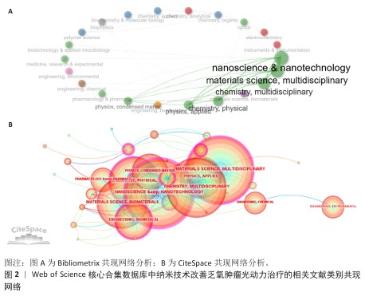
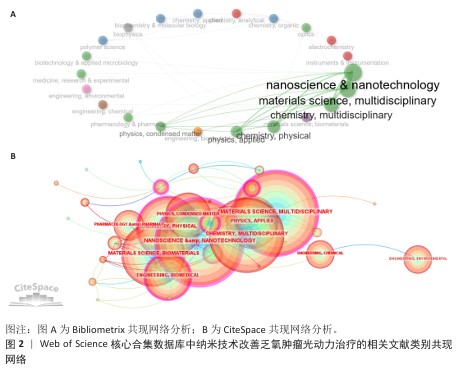
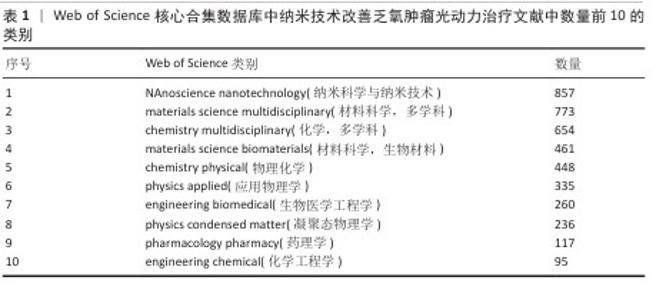
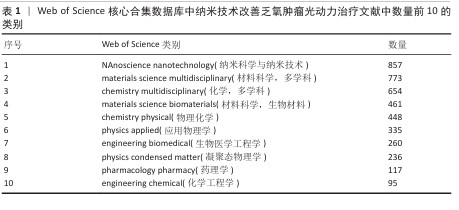
2.1 Web of Science类别分析 Web of Science类别是基于学科领域对文献进行分类的系统,分析Web of Science类别可以了解该领域涉及学科的发展趋势与动态,挖掘学科交叉与融合路径,为临床实践提供新思路。使用Bibliometrix和CiteSpace对Web of Science核心数据集中纳入的文献进行Web of Science类别分析,结果如图2、表1所示。图2中节点代表不同学科类别,节点大小反映了类别的发文量或被引频次,连线表示类别间的共现关系,线条的粗细和数量体现了关联强度,同时图中形成了多个聚类,如材料科学、化学、生物医学等,显示了该领域的热点和趋势。 其中“nanoscience & nanotechnology(纳米科学与纳米技术)”(857篇)和“materials science,multidisciplinary(材料科学,多学科)”(773篇)等节点在网络中处于核心位置,颜色最深,并且与其他节点有着广泛的联系,表明纳米材料和先进材料在光动力治疗用于乏氧肿瘤中的关键作用,包括开发新型光敏剂、纳米载体和靶向递送系统等,以提高治疗效果和肿瘤特异性。属于“chemistry,multidisciplinary(化学,多学科)”的文献共有 654 篇,化学研究在光敏剂的设计、合成和功能化方面发挥了关键作用。排名前10的 Web of Science类别发文量均≥95篇,并且有较多领域进行交叉融合,进一步揭示潜在的跨学科合作机会,为光动力治疗进一步的科学研究和临床应用提供了重要参考。 "
"
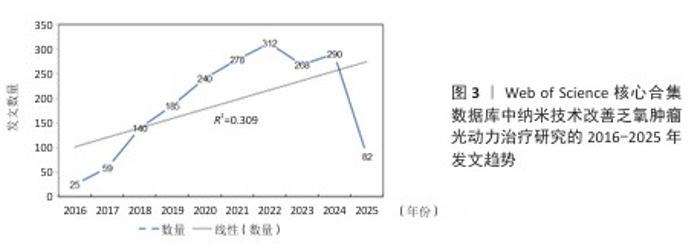
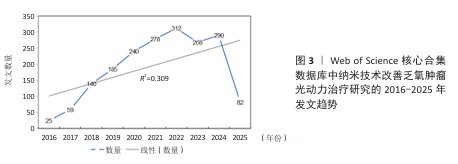
2.2 发文趋势分析 发文量可以展现一个领域的发展现状以及未来前景[25],如图3所示,2016-2022年,纳米技术改善乏氧肿瘤光动力治疗领域的发文量逐年递增,在2023年发文量略有下降,其中2024年发文量有所回升,2025年的发文量由于数据只统计到2025年4月,因此不能说明2025年的整体趋势。 总体而言,2017-2018年发文量增长率最大(57.9%),可能与“十三五”国家重点研发计划“纳米科技”重点专项“基于肿瘤微环境调控的纳米药物研究(2017)”等项目启动以及2016-2017年美国癌症研究协会AACR年会将“纳米材料改善肿瘤治疗”作为热点主题有关,后续发文量显著增加;往后增长率逐年降低,表明在此研究中投入的国家和作者减少,并且通过 Excel趋势线得出相关系数 R2=0.309(越接近1表明模型拟合效果越好),表明模型拟合效果一般,可能与纳米光动力治疗临床进展缓慢、大规模生产稳定性难以保证有关,同时由于COVID-19时期各国更倾向于疫苗递送的脂质纳米颗粒制剂,未来在此研究的投入发展和各国与国际支持仍需加强和提高。 "

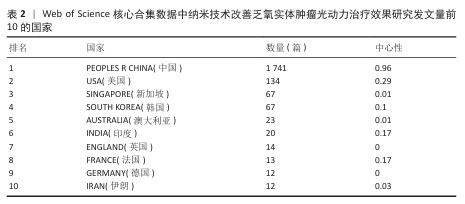
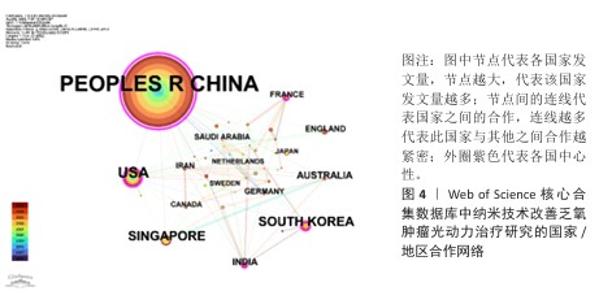
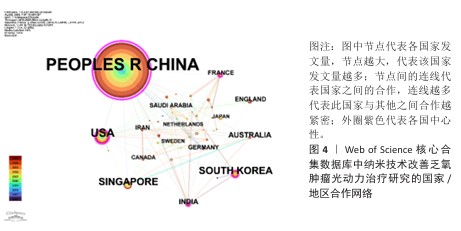
2.3 国家、机构、合作作者分析 2.3.1 国家/地区发文量和合作分析 运用CiteSpace软件对文献可视化分析得到国家合作网络图[26]。Web of Science核心合集数据中发文量前10的国家如表2所示。中国发文数量明显多于其他国家位列第一(1 741篇),说明在一定程度上中国的研究热点可以代表全球的研究方向和未来趋势,美国(134)、韩国(67)和新加坡(67)的发文量占据前四。全球而言,亚洲以中国为代表,北美洲以美国为代表,大洋洲以澳大利亚为代表,欧洲以英国为代表,都在此领域的研究中做出卓越贡献。Web of Science核心合集数据库中合作国家/地区分析图见图4,研究共纳入44个国家,连线118条,国家合作次数越多,连线数越多;各国合作越紧密,连接线就越粗,根据数目的多少和线条粗细可以看出中国与其他国家之间的合作次数最多,但紧密程度不如美国与其他国家,中国与其他国家之间的合作有待加强,但不排除纳入标准的文献造成误差。以CiteSpace中心性计算为基础,中国为0.96,美国为0.29,代表它们的国际合作影响力高。 "
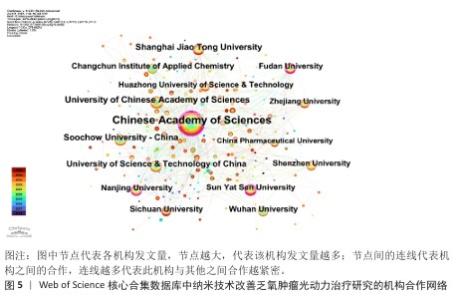
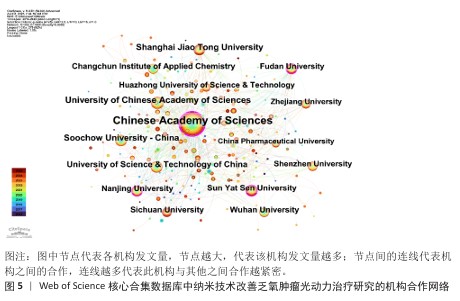
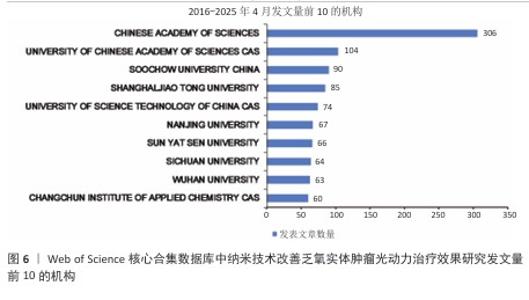
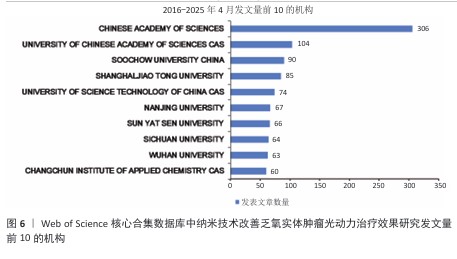
2.3.2 机构分析 在纳米技术改善乏氧肿瘤光动力治疗领域,1 879 篇文献共有200家机构和1 600条连线,网络密度较低,最大文献共被引278次,各机构之间尤其是与中国研究机构之间的联系较为紧密,同时中国机构也应加强与国外机构的合作,如图5所示。发文量排名前5的分别是:CHINESE ACADEMY OF SCIENCES(中国科学院)306篇、UNIVERSITY OF CHINESE ACADEMY OF SCIENCES(中国科学院大学)104篇、SOOCHOW UNIVERSITY CHINA(苏州大学) 90 篇、SHANGHAI JIAO TONG UNIVERSITY(上海交通大学)85 篇、UNIVERSITY OF SCIENCE TECHNOLOGY OF CHINA(中国科学技术大学)74 篇,再次印证了中国在此领域的发文量位于全球第一,见图6。"
"
"
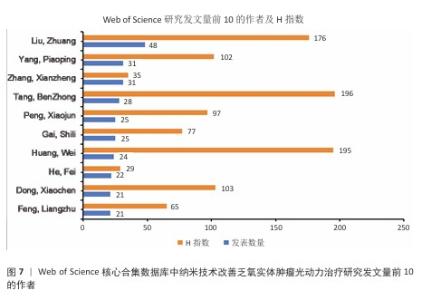
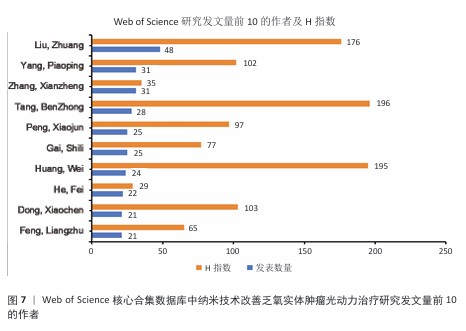
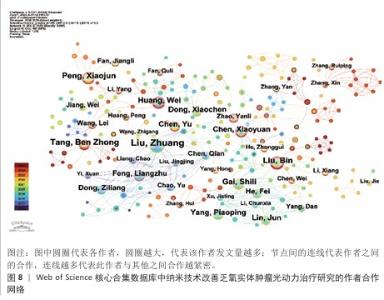
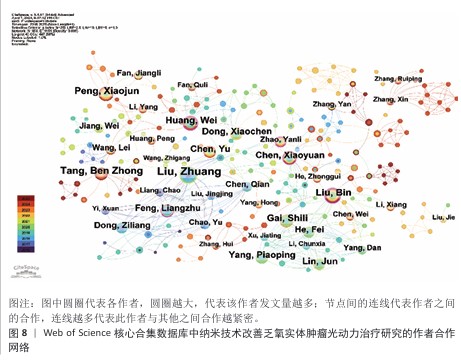
2.3.3 作者分析 核心作者是推动学术创新与学科发展的骨干力量,同时也是提升期刊学术影响力和竞争力的重要因素之一[27]。图7所示发文量前10名的作者平均发文量在20篇以上,来自苏州大学的Liu, Zhuang以48篇位居榜首,该作者主要研究方向为新型纳米探针用于体外生物检测与活体分子影像,并探索了多种基于纳米技术和生物材料的肿瘤光学治疗、放射治疗、免疫治疗等新策略,可见他在纳米粒子肿瘤光学治疗领域做出了突出贡献。 合作作者网络可以找到当前活跃的作者或潜在的新兴机构团队,了解该领域的核心研究力量以及预测未来活跃的团队或方向。图8对200名研究人员可视化分析,共有1 151条连线,每个圆圈的大小代表作者的发文数量,更多的发文量产生更大的圆圈[28],圆圈颜色的深浅代表发文年份,哈尔滨工程大学的Yang, Piaoping(杨飘萍)、武汉大学的Zhang, Xianzheng(张先正)团队都在此领域研究时间较长、占据较为重要的位置,各合作作者之间的连线大多数因属同一单位机构合作发文较为稳定,但在不同单位团队中的合作较为分散、跨机构合作度不够,还未形成稳定合作的核心研究团队,权威性和指导作用还不够,作者间的合作频率和强度需要提高。核心作者如Liu, Zhuang(刘庄)的H指数达176,代表该作者的长期影响力与引用量积累。 "
"
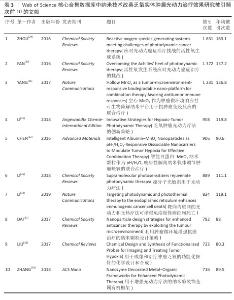
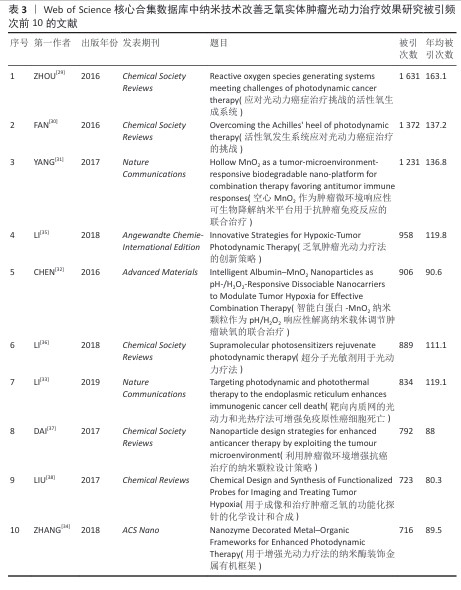
2.4 文献高被引分析 高被引文献通常代表该领域的经典研究、突破性成果或者创新思维,分析总结高被引文献的特征,有助于人们发现该领域的研究热点和前沿,更好地探索未来的研究方向。为确定2016-2025年间该领域的高被引文献特征,使用Bibliometrix软件对纳入统计的1 879篇文献进行被引频次统计与分析,得到了引用次数排名前10名的文献[29-38],如表3所示。其中ZHOU 等[29]在2016年发表于《Chemical Society Reviews》的文献总被引次数高达1 631次,年平均被引次数达到163.10次。在所有被引次数排名前10的文献中,所有文献年平均被引次数均高于80次,这些文献因开创性的理论、方法或发现为后续的研究奠定了坚实的基础,并提供了关键的知识框架和支持,代表了相关领域的核心知识和重要进展。 ZHOU等[29]系统解析了活性氧生成体系在光动力治疗中的关键作用,从光敏剂设计、激发源优化及跨学科策略融合等维度提出活性氧介导的肿瘤治疗的切入点与理论框架。FAN等[30]系统探讨了光动力治疗的核心技术瓶颈,并提出基于近红外光、X射线辐射和内部自发光体系的深度光动力治疗策略。YANG等[31]、CHEN等[32]通过构建二氧化锰(MnO2)基纳米材料调节乏氧肿瘤微环境,从而产生有利于抗肿瘤免疫反应的综合效果。LI 等[33]聚焦于内质网靶向策略,通过精准诱发内质网应激相活性氧生成实现了光动力治疗与光热疗法的协同增效。ZHANG等[34]构建均一固定在金属有机框架上具有高稳定性和类似过氧化氢酶活性的铂纳米颗粒,通过金属有机框架孔道结构实现氧气的可控释放,显著改善了乏氧区域的治疗效果。除此以外,LI等[35]、LI等[36]、DAI等[37]、LIU等[38]分别总结了克服光动力治疗介导的耗氧量和微血管损伤增加肿瘤乏氧的策略、超分子光敏剂设计与开发的最新进展、用于癌症治疗的纳米制剂的最新进展以及影像引导下的乏氧肿瘤精准治疗策略,共同推动了光动力治疗技术的临床应用拓展。 "
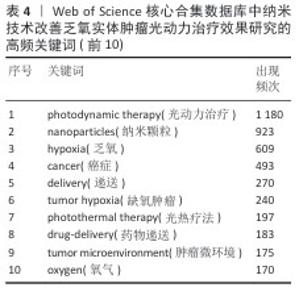
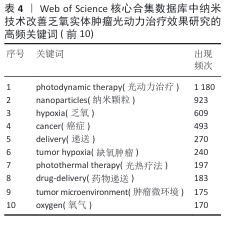
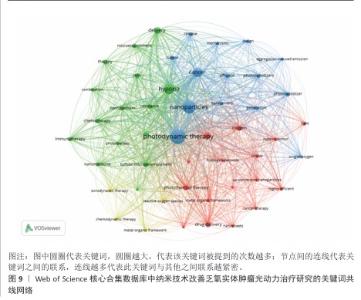
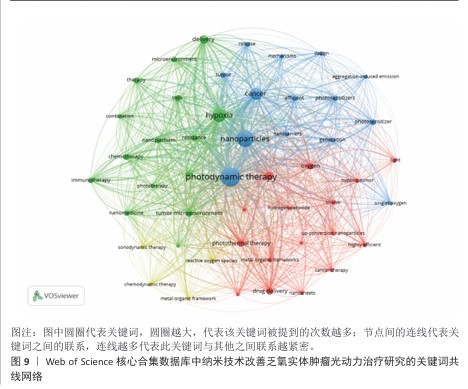
2.5 关键词分析 关键词是对文献主题的高度概括和凝练,通过对文献的高频关键词进行分析可以解释该领域研究的热点、趋向以及各研究主题之间的关系[39]。 2.5.1 关键词共线分析 利用 VOSviewer软件构建关键词共线网络,由出现频次前10的高频关键词(表4)和关键词共线网络(图9)可知:纳米技术改善乏氧实体肿瘤光动力治疗以癌症治疗为核心,聚焦于纳米材料的微环境响应性光学治疗策略。光动力治疗作为主导治疗方法,与纳米载体技术和肿瘤微环境研究紧密结合,形成“材料-环境-治疗”三位一体的研究范式。其中“photodynamic therapy(光动力治疗)”和“nanoparticles(纳米颗粒)”的频次最高,表明纳米颗粒在光动力疗法中的关键作用;“hypoxia(乏氧)”和“tumor microenvironment(肿瘤微环境)”凸显了肿瘤乏氧微环境对治疗效果的显著影响。 "
"
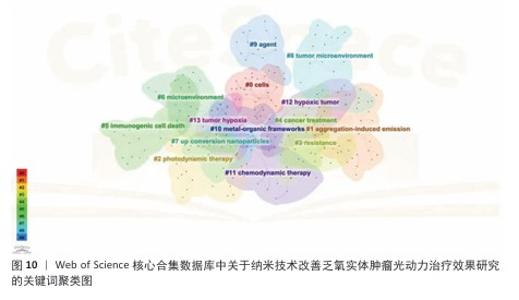
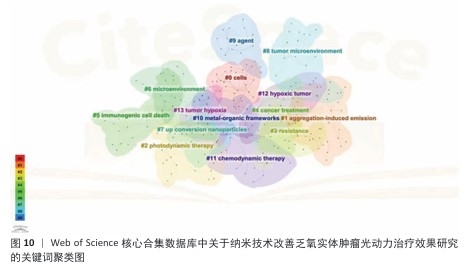
2.5.2 关键词聚类分析 运用 Citespace 软件对有效文献进行关键词聚类分析,将关键词中具有明显特征的词汇作为聚类对象,可得到纳米技术改善乏氧肿瘤光动力治疗领域的关键词聚类图谱,见图10。聚类模块值Q=0.758 6, 平均轮廓值S=0.891 7,满足Q > 0.3、S > 0.5,提示关键词聚类结构显著且聚类结果同质性较高。共形成了#0 cells(细胞)、#1 aggregation-induced emission(聚集诱导发光)、#2 photodynamic therapy(光动力疗法)、#3 resistance(抵抗)、#4 cancer treatment(癌症治疗)、#5 immunogenic cell death(免疫原性细胞死亡)、#6 microenvironment(微环境)、#7 up-conversion nanoparticles(上转换纳米颗粒)、#8 tumor microenvironment(肿瘤微环境)、#9 agent(药物)、#10 metal-organic frameworks(金属-有机框架)、#11 chemodynamic therapy(化学动力学疗法)、#12 hypoxic tumor(乏氧肿瘤)、#13 tumor hypoxia(乏氧肿瘤)14个有意义的聚类。各聚类间形成较为密集的连线,表明各聚类间联系紧密。 其中,肿瘤乏氧(聚类#12、聚类#13)与治疗抵抗性(聚类#3)密切相关,解释了传统疗法效果受限的原因,纳米材料技术(聚类#7和聚类#10)可能通过改善光动力疗法和化学动力学疗法(聚类#11)克服乏氧障碍,该结果揭示了通过调控微环境和优化纳米技术提高治疗有效性的科学问题。 "
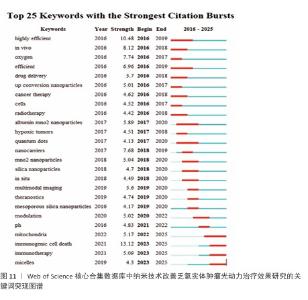
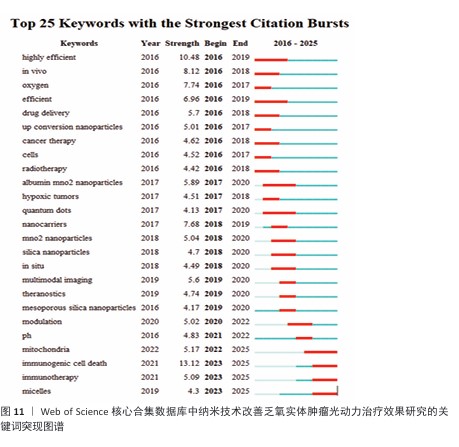
2.5.3 关键词突现图谱分析 通过对关键词突现分析可以找出一段时间内激增的关键词,从更深度的层面观察该领域的发展变化[40]。如图11的关键词突现结果所示,immunogenic cell death(免疫原性细胞死亡)是纳米技术改善乏氧肿瘤光动力治疗领域中突现强度最大的关键词,提示免疫调节在该研究领域的重要性。另外,highly efficient(高效率)、efficient(效率)、albumin MnO2 nanoparticles(白蛋白-MnO2纳米颗粒)、quantum dots(量子点)、mitochondria(线粒体)均是该领域突现时间最长的关键词。 "
| [1] LI XS, LOVELL JF, YOON JY, et al. Clinical Development and Potential of Photothermal and Photodynamic Therapies for Cancer. Nat Rev Clin Oncol. 2020;17:657-674. [2] HU DR, LI YC, LI R, et al. Recent Advances in Reactive Oxygen Species (Ros)-Responsive Drug Delivery Systems for Photodynamic Therapy of Cancer. Acta Pharm Sin B. 2024;14:5106-5131. [3] ZHANG HC, CUI MH, TANG DS, et al. Localization of Cancer Cells for Subsequent Robust Photodynamic Therapy by Ros Responsive Polymeric Nanoparticles with Anti-Metastasis Complexes Nami-A. Adv Mater. 2024;36:2310298. [4] DIRAK M, YENICI CM, KOLEMEN S. Recent Advances in Organelle-Targeted Organic Photosensitizers for Efficient Photodynamic Therapy. Coord Chem Rev. 2024;506:215710. [5] WU X, FAN Y, WANG K, et al. NIR-II Imaging-Guided Precise Photodynamic Therapy for Augmenting Tumor-Starvation Therapy by Glucose Metabolism Reprogramming Interference. SCI BULL. 2024;69: 1263-1274. [6] TANG Y, LI Y, LI B, et al. Oxygen-Independent Organic Photosensitizer with Ultralow-Power Nir Photoexcitation for Tumor-Specific Photodynamic Therapy. Nat Commun. 2024;15:2530. [7] HU DR, PAN M, YU Y, et al. Application of Nanotechnology for Enhancing Photodynamic Therapy Via Ameliorating, Neglecting, or Exploiting Tumor Hypoxia. View. 2020;1:e6. [8] HU DR, CHEN LJ, QU Y, et al. Oxygen-Generating Hybrid Polymeric Nanoparticles with Encapsulated Doxorubicin and Chlorin E6 for Trimodal Imaging-Guided Combined Chemo-Photodynamic Therapy. Theranostics 2018;8:1558-1574. [9] SUN Y, ZHAO D, WANG G, et al. Recent Progress of Hypoxia-Modulated Multifunctional Nanomedicines to Enhance Photodynamic Therapy: Opportunities, Challenges, and Future Development. Acta Pharm Sin B. 2020;10: 1382-1396. [10] HUANG L, ZHAO SJ, WU JS, et al. Photodynamic Therapy for Hypoxic Tumors: Advances and Perspectives. Coord Chem Rev.2021;438:213888. [11] LI XT, CHEN L, HUANG MT, et al. Innovative Strategies for Photodynamic Therapy against Hypoxic Tumor. Asian J Pharm Sci. 2023;18: 100775. [12] WAN Y, FU LH, LI C, et al. Conquering the Hypoxia Limitation for Photodynamic Therapy. Adv Mater. 2021;33:2103978. [13] WEI JP, LI JC, SUN D, et al. A Novel Theranostic Nanoplatform Based on Pd@Pt-Peg-Ce6 for Enhanced Photodynamic Therapy by Modulating Tumor Hypoxia Microenvironment. Adv Funct Mater. 2018;28:1706310. [14] REN Q, YU N, WANG L, et al. Nanoarchitectonics with Metal-Organic Frameworks and Platinum Nanozymes with Improved Oxygen Evolution for Enhanced Sonodynamic/Chemo-Therapy. J Colloid Interface Sci. 2022;614:147-159. [15] CHEN H, TIAN J, HE W, et al. H2O2-Activatable and O2-Evolving Nanoparticles for Highly Efficient and Selective Photodynamic Therapy against Hypoxic Tumor Cells. J Am Chem Soc. 2015;137: 1539-1547. [16] JIANG W, ZHANG Z, WANG Q, et al.Tumor Reoxygenation and Blood Perfusion Enhanced Photodynamic Therapy Using Ultrathin Graphdiyne Oxide Nanosheets. Nano Lett. 2019;19: 4060-4067. [17] BROEKGAARDEN M, WEIJER R, KREKORIAN M, et al. Inhibition of Hypoxia-Inducible Factor 1 with Acriflavine Sensitizes Hypoxic Tumor Cells to Photodynamic Therapy with Zinc Phthalocyanine-Encapsulating Cationic Liposomes. Nano Res. 2016;9:1639. [18] LIU S, FENG G, TANG BZ, et al. Recent Advances of Aie Light-up Probes for Photodynamic Therapy. Chem Sci. 2021;12: 6488-6506. [19] HAMBLIN MR. Upconversion in Photodynamic Therapy: Plumbing the Depths. Dalton T. 2018; 47:8571-8580. [20] ZHU H, LI J, QI X, et al. Oxygenic Hybrid Semiconducting Nanoparticles for Enhanced Photodynamic Therapy. Nano Lett. 2018;18: 586-594. [21] LEE D, KWON S, JANG SY, et al. Overcoming the Obstacles of Current Photodynamic Therapy in Tumors Using Nanoparticles. Bioact Mater. 2022;8:20-34. [22] TIAN J, DING L, XU HJ, et al. Cell-Specific and Ph-Activatable Rubyrin-Loaded Nanoparticles for Highly Selective near-Infrared Photodynamic Therapy against Cancer. J Am Chem Soc. 2013; 135:18850-18858. [23] AKRAM MW, RAZIQ F, FAKHAR-E-ALAM M, et al. Tailoring of Au-Tio2 Nanoparticles Conjugated with Doxorubicin for Their Synergistic Response and Photodynamic Therapy Applications. J Photochem Photobiol A Chem. 2019;384:112040. [24] CHEN Y, YANG Y, DU S, et al. Mitochondria-Targeting Upconversion Nanoparticles@MOF for Multiple-Enhanced Photodynamic Therapy in Hypoxic Tumor. ACS Appl Mater Interfaces. 2023;15:35884-35894. [25] NINKOV A, FRANK JR, MAGGIO LA. Bibliometrics: Methods for Studying Academic Publishing. Perspect Med Educ. 2022;11:173-176. [26] 高俊宽. 文献计量学方法在科学评价中的应用探讨[J]. 图书情报知识,2005(2):14-17. [27] 崔丽丽. 基于作者-主题关联的学科知识网络中核心作者影响力研究[D]. 武汉:华中师范大学,2022. [28] JIANG S, LIU Y, ZHENG H, et al. Evolutionary Patterns and Research Frontiers in Neoadjuvant Immunotherapy: A Bibliometric Analysis. Int J Surg. 2023;109:2774-2783. [29] ZHOU Z, SONG J, NIE L, et al. Reactive Oxygen Species Generating Systems Meeting Challenges of Photodynamic Cancer Therapy. Chem Soc Rev. 2016;45:6597-6626. [30] FAN W, HUANG P, CHEN X. Overcoming the Achilles’ Heel of Photodynamic Therapy. Chem Soc Rev. 2016;45:6488-6519. [31] YANG G, XU L, CHAO Y, et al. Hollow Mno2 as a Tumor-Microenvironment-Responsive Biodegradable Nano-Platform for Combination Therapy Favoring Antitumor Immune Responses. Nat Commun. 2017;8:902. [32] CHEN Q, FENG LZ, LIU JJ, et al. Intelligent Albumin-Mno2 Nanoparticles as Ph-/H2o2-Responsive Dissociable Nanocarriers to Modulate Tumor Hypoxia for Effective Combination Therapy. Adv Mater. 2016;28:7129. [33] LI W, YANG J, LUO L, et al. Targeting Photodynamic and Photothermal Therapy to the Endoplasmic Reticulum Enhances Immunogenic Cancer Cell Death. Nat Commun. 2019;10:3349. [34] ZHANG Y, WANG F, LIU C, et al. Nanozyme Decorated Metal-Organic Frameworks for Enhanced Photodynamic Therapy. ACS Nano. 2018;12:651-661. [35] LI XS, KWON N, GUO T, et al. Innovative Strategies for Hypoxic-Tumor Photodynamic Therapy. Angew Chem-Int Edit. 2018;57:11522-11531. [36] LI X, LEE S, YOON J. Supramolecular Photosensitizers Rejuvenate Photodynamic Therapy. Chem Soc Rev. 2018;47:1174-1188. [37] DAI Y, XU C, SUN X, et al. Nanoparticle Design Strategies for Enhanced Anticancer Therapy by Exploiting the Tumour Microenvironment. Chem Soc Rev. 2017;46:3830-3852. [38] LIU JN, BU WB, SHI JL. Chemical Design and Synthesis of Functionalized Probes for Imaging and Treating Tumor Hypoxia. Chem Rev. 2017;117: 6160-6224. [39] 常金霞, 刘羽飞, 牛少辉,等. 巨噬细胞极化在组织修复过程中的可视化分析[J]. 中国组织工程研究,2025,29(7):1486-1496. [40] 黄文彬, 王冰璐, 步一,等. 关键词共引分析的科学计量方法研究[J]. 情报资料工作,2018(2): 37-42. [41] KOLARIKOVA M, HOSIKOVA B, DILENKO H, et al. Photodynamic Therapy: Innovative Approaches for Antibacterial and Anticancer Treatments. Med Res Rev. 2023;43:717-774. [42] JI B, WEI M, YANG B. Recent Advances in Nanomedicines for Photodynamic Therapy (Pdt)-Driven Cancer Immunotherapy. Theranostics. 2022;12:434-458. [43] LIN T, ZHAO X, ZHAO S, et al. O2-Generating Mno2 Nanoparticles for Enhanced Photodynamic Therapy of Bladder Cancer by Ameliorating Hypoxia. Theranostics. 2018;8:990-1004. [44] XU T, MA Y, YUAN Q, et al. Enhanced Ferroptosis by Oxygen-Boosted Phototherapy Based on a 2-in-1 Nanoplatform of Ferrous Hemoglobin for Tumor Synergistic Therapy. ACS Nano. 2020;14: 3414-3425. [45] SEMENZA GL. Targeting Hif-1 for Cancer Therapy. Nat Rev Cancer. 2003;3:721-732. [46] SUN B, BTE RAHMAT JN, ZHANG Y. Advanced Techniques for Performing Photodynamic Therapy in Deep-Seated Tissues. Biomaterials. 2022;291:121875. [47] HE L, YU X, LI W. Recent Progress and Trends in X-Ray-Induced Photodynamic Therapy with Low Radiation Doses. ACS Nano.2022;16:19691-19721. [48] CHEN JJ, ZHOU Q, CAO WW. Multifunctional Porphyrin-Based Sonosensitizers for Sonodynamic Therapy. Adv Funct Mater. 2024;34:2405844. [49] OVERCHUK M, WEERSINK RA, WILSON BC, et al. Photodynamic and Photothermal Therapies: Synergy Opportunities for Nanomedicine. ACS Nano. 2023;17:7979-8003. [50] YU Z, LI Q, WANG J, et al. Reactive Oxygen Species-Related Nanoparticle Toxicity in the Biomedical Field. Nanoscale Res Lett. 2020;15:115. [51] HUA S, DE MATOS MBC, METSELAAR JM, et al. Current Trends and Challenges in the Clinical Translation of Nanoparticulate Nanomedicines: Pathways for Translational Development and Commercialization. Front Pharmacol. 2018;9:790. [52] PARK K. The Beginning of the End of the Nanomedicine Hype. J Controlled Release. 2019; 305:221-222. [53] ALGORRI JF, OCHOA M, ROLDÁN-VARONA P, et al. Light Technology for Efficient and Effective Photodynamic Therapy: A Critical Review. Cancers. 2021;13:3484. |
| [1] | Wang Songpeng, Liu Yusan, Yu Huanying, Gao Xiaoli, Xu Yingjiang, Zhang Xiaoming, Liu Min. Bidirectional regulation of reactive oxygen species based on zeolitic imidazolate framework-8 nanomaterials: from tumor therapy and antibacterial activity to cytoprotection [J]. Chinese Journal of Tissue Engineering Research, 2026, 30(8): 2033-2013. |
| [2] | Guo Zhiyou, Hu Rui, Zhu Jinling. Main preparation methods of new fluorescent nanomaterial carbon quantum dots and their applications in tumor diagnosis and treatment [J]. Chinese Journal of Tissue Engineering Research, 2026, 30(26): 6937-6945. |
| [3] | Lin Kejian, Chai Yinghong, Zou Jie, Huang Ruixin, Fang Yongchao, Huang Jing, Yang Qin, Luo Xia, Zhang Hong. Preparation of Cu2+-containing microarc oxidation functional coating on medical magnesium alloy and its anti-tumor and angiogenesis-promoting effects [J]. Chinese Journal of Tissue Engineering Research, 2026, 30(20): 5103-5114. |
| [4] | Yang Fengli, Zhou Chao, Xiong Wei, Zhou Yuxiang, Li Dengshun, Wang Xin, Li Zhanzhen. 3D printed poly-L-lactic acid bone scaffolds in repair of bone defects [J]. Chinese Journal of Tissue Engineering Research, 2026, 30(2): 507-515. |
| [5] | Jiang Kan, Alimujiang·Abudourousuli, Shalayiding·Aierxiding, Aikebaierjiang·Aisaiti, Kutiluke·Shoukeer, Aikeremujiang·Muheremu. Biomaterials and bone regeneration: research hotspots and analysis of 500 influential papers [J]. Chinese Journal of Tissue Engineering Research, 2026, 30(2): 528-536. |
| [6] | Li Qingshan, Li Runmeng, Gao Yuyang, Han Gang, Chen Jiying, Guo Quanyi. Magnetocaloric antitumor and osteogenic properties of magnetic bioactive glass scaffolds [J]. Chinese Journal of Tissue Engineering Research, 2026, 30(14): 3494-3503. |
| [7] | Zheng Xiaodong, Gao Shan, Han Wenjin, Liu Lijun, Jia Menglong, Yu Longtan. Visual analysis of treatment of adolescent idiopathic scoliosis [J]. Chinese Journal of Tissue Engineering Research, 2025, 29(3): 645-653. |
| Viewed | ||||||
|
Full text |
|
|||||
|
Abstract |
|
|||||