Chinese Journal of Tissue Engineering Research ›› 2026, Vol. 30 ›› Issue (6): 1602-1608.doi: 10.12307/2026.596
Causal relationship between age-related macular degeneration and deep vein thrombosis: analysis based on genome-wide association study data
Liu Hongtao, Wu Xin, Jiang Xinyu, Sha Fei, An Qi, Li Gaobiao
- Wangjing Hospital, China Academy of Chinese Medical Sciences, Beijing 100102, China
-
Received:2024-12-04Accepted:2025-03-01Online:2026-02-28Published:2025-07-19 -
Contact:Wu Xin, MD, Chief physician, Wangjing Hospital, China Academy of Chinese Medical Sciences, Beijing 100102, China -
About author:Liu Hongtao, MS candidate, Wangjing Hospital, China Academy of Chinese Medical Sciences, Beijing 100102, China -
Supported by:Science and Technology Innovation Project of China Academy of Chinese Medical Sciences, No. CI2021A01905 (to WX)]]
]

CLC Number:
Cite this article
Liu Hongtao, Wu Xin, Jiang Xinyu, Sha Fei, An Qi, Li Gaobiao. Causal relationship between age-related macular degeneration and deep vein thrombosis: analysis based on genome-wide association study data[J]. Chinese Journal of Tissue Engineering Research, 2026, 30(6): 1602-1608.
share this article
Add to citation manager EndNote|Reference Manager|ProCite|BibTeX|RefWorks
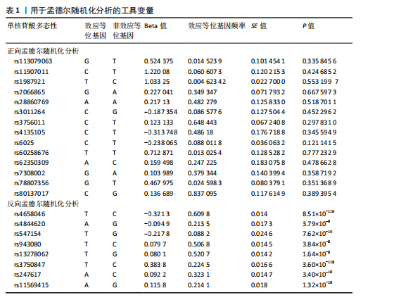
2.1 用于孟德尔随机化分析的工具变量 2.1.1 正向孟德尔随机化分析 从深静脉血栓形成GWAS 汇总数据中筛选出15个显著相关且相互独立的单核苷酸多态性,其中1个单核苷酸多态性未在年龄相关性黄斑变性的GWAS 汇总数据中找到,1个具有中等等位基因频率的单核苷酸多态性被排除在外,共14个单核苷酸多态性用于因果分析,见表1。 2.1.2 反向孟德尔随机化分析 从年龄相关性黄斑变性GWAS 汇总数据中筛选出8个显著相关且相互独立的单核苷酸多态性,均用于因果分析,见表1。 2.2 双样本孟德尔随机化分析 采用逆方差加权法作为主要分析方法,正向分析显示深静脉血栓形成与年龄相关性黄斑变性之间不存在明显的统计学关联(逆方差加权法:OR=1.017,95%CI=0.972-1.064,P=0.444)。其余4种孟德尔随机化分析结果显示了相同的因果估计方向,但未能达到统计学意义(加权中位数法:OR=1.045,95%CI=0.981-1.113,P=0.163;MR "
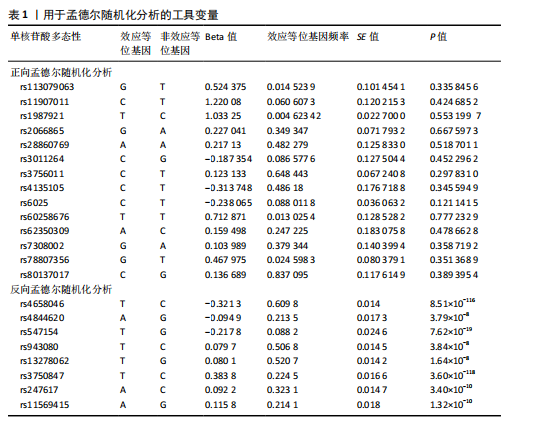
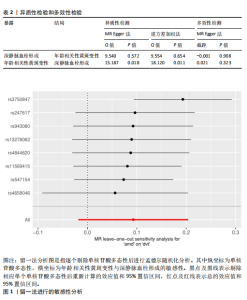
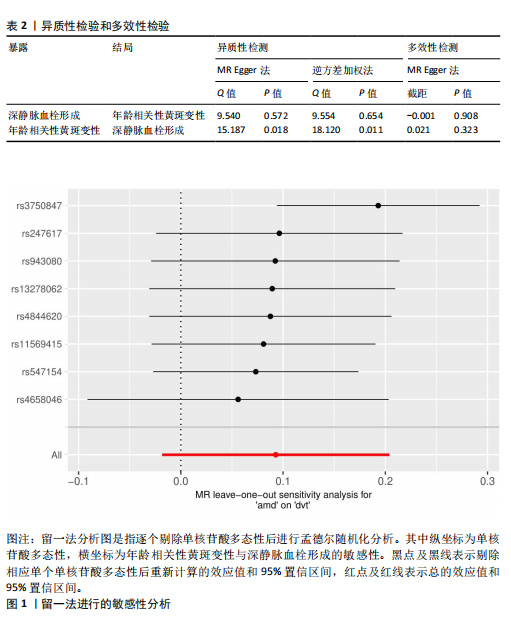
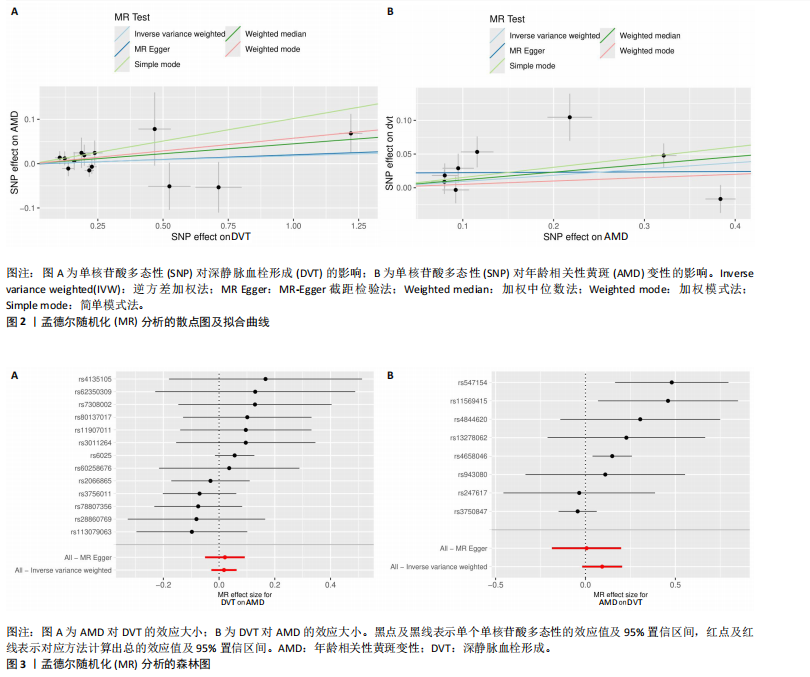
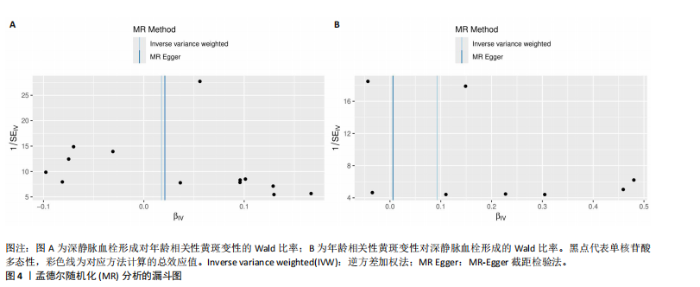
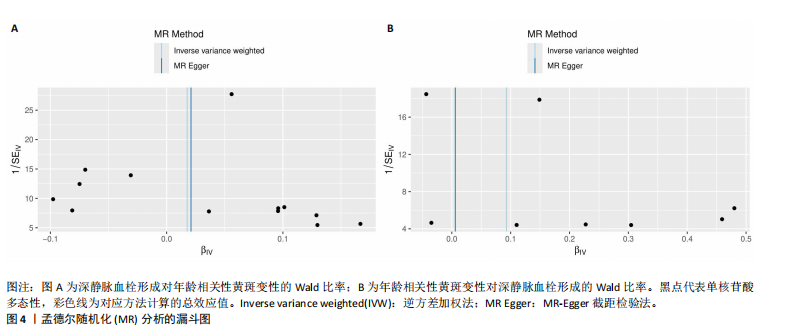
Egger法:OR=1.021,95%CI=0.950-1.096,P=0.575;简单模式法:OR=1.107,95%CI=0.986-1.242,P=0.110;加权模式法:OR=1.058,95%CI=0.981-1.143,P=0.167),支持逆方差加权法的结论,进一步验证了结果的可靠性。反向分析显示年龄相关性黄斑变性与深静脉血栓形成之间无因果关系(逆方差加权法:OR=1.097,95%CI=0.981-1.226,P=0.101),其余4种方法(加权中位数法:OR=1.122,95%CI=1.001-1.257,P=0.046;MR Egger法:OR=1.005,95%CI=0.829-1.219,P=0.954;简单模式法:OR=1.163,95%CI=0.897-1.508,P=0.290;加权模式法:OR=1.051,95%CI=0.953-1.158,P=0.347),虽然加权中位数法的P=0.046 < 0.05,但加权中位数对异常值和极端值的敏感性较低,该反向分析中可能存在异常值或者极端值,但在反向分析中其余方法均支持逆方差加权法的结论。 2.3 分析结果可视化 采用Cochran’s Q检测异质性,MR Egger截距检测水平多效性,均没有发现异质性和水平多效性的存在(P > 0.05),见表2;MR-PRESSO全局检验也未发现任何异常值。所有单核苷酸多态性的F > 10,表明孟德尔随机化分析结果没有受到弱工具变量偏倚的影响。采用留一法进行敏感性分析,表明孟德尔随机化分析结果并非单个单核苷酸多态性的影响,所得结果呈现出较高的一致性,验证了两样本孟德尔随机化分析结果的稳健性(图1)。此外,研究还分析了每个单核苷酸多态性作为工具变量对结局(如深静脉血栓形成或年龄相关性黄斑变性)风险的因"
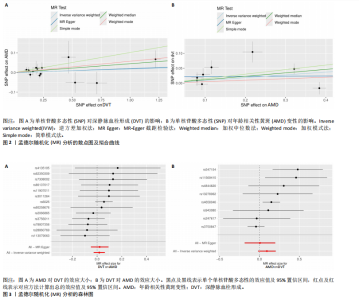
果效应。散点图显示每个单核苷酸多态性对暴露和结局的点估计值及区间估计值,逆方差加权法、加权中位数法及MR-Egger法的曲线均呈现一致的斜率,表明遗传工具变量对暴露和结果的影响是一致的,增强了因果关系估计的可信度(图2)。森林图显示 MR-Egger法和逆方差加权法的结果均与虚线相交,表明暴露与结局间在统计学上都没有显著效应,且两种方法的结果具有一致性(图3)。漏斗图中以MR-Egger法和逆方差加权法的中线为基准,图中两侧散点分布基本均匀,表明结果没有显著的发表偏倚,两种方法的结果一致,增强了因果推断的可信度(图4)。"
"
| [1] JIAN X, YANG D, WANG L, et al. Downregulation of microRNA-200c-3p alleviates the aggravation of venous thromboembolism by targeting serpin family C member 1. Bioengineered. 2021; 12(2):11156-11168. [2] LEE WS, KIM KI, LEE HJ, et al. The incidence of pulmonary embolism and deep vein thrombosis after knee arthroplasty in Asians remains low: a meta-analysis. Clin Orthop Relat Res. 2013;471(5):1523-1532. [3] SØGAARD KK, SCHMIDT M, PEDERSEN L, et al. 30-year mortality after venous thromboembolism: a population-based cohort study. Circulation. 2014;130(10): 829-836. [4] RABINOVICH A, KAHN SR. The postthrombotic syndrome: current evidence and future challenges. J Thromb Haemost. 2017;15(2):230-241. [5] DE MAESENEER MG, KAKKOS SK, AHERNE T, et al. Editor’s Choice - European Society for Vascular Surgery (ESVS) 2022 Clinical Practice Guidelines on the Management of Chronic Venous Disease of the Lower Limbs. Eur J Vasc Endovasc Surg. 2022;63(2): 184-267. [6] ZHANG S, ZHAI Z, YANG Y, et al. Pulmonary embolism risk stratification by European Society of Cardiology is associated with recurrent venous thromboembolism: Findings from a long-term follow-up study. Int J Cardiol. 2016;202:275-281. [7] JONAS JB. Global prevalence of age-related macular degeneration. Lancet Glob Health. 2014;2(2):e65-66. [8] SCHULTZ NM, BHARDWAJ S, BARCLAY C, et al. Global Burden of Dry Age-Related Macular Degeneration: A Targeted Literature Review. Clin Ther. 2021;43(10):1792-1818. [9] WONG WL, SU X, LI X, et al. Global prevalence of age-related macular degeneration and disease burden projection for 2020 and 2040: a systematic review and meta-analysis. Lancet Glob Health. 2014;2(2):e106-116. [10] LAUDE A, CACKETT PD, VITHANA EN, et al. Polypoidal choroidal vasculopathy and neovascular age-related macular degeneration: same or different disease? Prog Retin Eye Res. 2010;29(1):19-29. [11] PENNINGTON KL, DEANGELIS MM. Epidemiology of age-related macular degeneration (AMD): associations with cardiovascular disease phenotypes and lipid factors. Eye Vis (Lond). 2016;3:34. [12] RUDNICKA AR, MACCALLUM PK, WHITELOCKE R, et al. Circulating markers of arterial thrombosis and late-stage age-related macular degeneration: a case-control study. Eye (Lond). 2010;24(7):1199-1206. [13] THOMAS CJ, MIRZA RG, GILL MK. Age-Related Macular Degeneration. Med Clin North Am. 2021;105(3):473-491. [14] 王玉琢,沈洪兵.孟德尔随机化研究应用于因果推断的影响因素及其结果解读面临的挑战[J].中华流行病学杂志, 2020,41(8):1231-1236. [15] SWANSON SA, TIEMEIER H, IKRAM MA, et al. Nature as a Trialist?: Deconstructing the Analogy Between Mendelian Randomization and Randomized Trials. Epidemiology. 2017;28(5):653-659. [16] EMDIN CA, KHERA AV, KATHIRESAN S. Mendelian Randomization. JAMA. 2017; 318(19):1925-1926. [17] BIRNEY E. Mendelian Randomization. Cold Spring Harb Perspect Med. 2022;12(4): a041302. [18] LAWLOR DA, HARBORD RM, STERNE JA, et al. Mendelian randomization: using genes as instruments for making causal inferences in epidemiology. Stat Med. 2008;27(8):1133-1163. [19] HAYCOCK PC, BURGESS S, WADE KH, et al. Best (but oft-forgotten) practices: the design, analysis, and interpretation of Mendelian randomization studies. Am J Clin Nutr. 2016;103(4):965-978. [20] 张明琛,林安,桑志成,等.特应性疾病与骨关节炎的因果关系:一项孟德尔随机化研究[J].中国骨伤,2024,37(9):904-909. [21] MUKAMAL KJ, STAMPFER MJ, RIMM EB. Genetic instrumental variable analysis: time to call mendelian randomization what it is. The example of alcohol and cardiovascular disease. Eur J Epidemiol. 2020;35(2):93-97. [22] PARK JH, WACHOLDER S, GAIL MH, et al. Estimation of effect size distribution from genome-wide association studies and implications for future discoveries. Nat Genet. 2010;42(7):570-575. [23] CARTER AR, SANDERSON E, HAMMERTON G, et al. Mendelian randomisation for mediation analysis: current methods and challenges for implementation. Eur J Epidemiol. 2021;36(5):465-478. [24] BURGESS S, THOMPSON SG. Avoiding bias from weak instruments in Mendelian randomization studies. Int J Epidemiol. 2011;40(3):755-764. [25] BURGESS S, BOWDEN J, FALL T, et al. Sensitivity Analyses for Robust Causal Inference from Mendelian Randomization Analyses with Multiple Genetic Variants. Epidemiology. 2017;28(1):30-42. [26] YANG Y, XIAN W, WU D, et al. The role of obesity, type 2 diabetes, and metabolic factors in gout: A Mendelian randomization study. Front Endocrinol (Lausanne). 2022; 13:917056. [27] LIN Z, PAN I, PAN W. A practical problem with Egger regression in Mendelian randomization. PLoS Genet. 2022;18(5): e1010166. [28] BOWDEN J, DAVEY SMITH G, BURGESS S. Mendelian randomization with invalid instruments: effect estimation and bias detection through Egger regression. Int J Epidemiol. 2015;44(2):512-525. [29] XU J, ZHANG S, TIAN Y, et al. Genetic Causal Association between Iron Status and Osteoarthritis: A Two-Sample Mendelian Randomization. Nutrients. 2022; 14(18):3683. [30] GRECO M FD, MINELLI C, SHEEHAN NA, et al. Detecting pleiotropy in Mendelian randomisation studies with summary data and a continuous outcome. Stat Med. 2015; 34(21):2926-2940. [31] VERBANCK M, CHEN CY, NEALE B, et al. Detection of widespread horizontal pleiotropy in causal relationships inferred from Mendelian randomization between complex traits and diseases. Nat Genet. 2018;50(5):693-698. [32] 张鹏,孟永,宋硕,等.干性年龄相关性黄斑变性动物模型研究进展[J].中国药理学与毒理学杂志,2023,37(8):621-630. [33] 赵晓勇,刘弘扬,任原.基于Caprini血栓风险评分及D-二聚体构建老年髋部骨折术后深静脉血栓形成的风险预测模型[J].安徽医药,2024,28(12):2452-2457+2554. [34] THOMSON RJ, CHAZARO J, OTERO-MARQUEZ O, et al. Subretinal drusenoid deposits and soft drusen: Are They Markers for Distinct Retinal Diseases? Retina. 2022; 42(7):1311-1318. [35] 金明,陈有信.中成药治疗年龄相关性黄斑变性(湿性)临床应用指南(2020年)[J].中国中西医结合杂志,2021,41(2):151-156. [36] 成龙,张传伟,薛俊杰,等.清脂化瘀方联合复方血栓通片对痰瘀互结型年龄相关性黄斑变性患者的临床疗效[J].中成药,2023,45(9):2901-2906. [37] 黄滟凌,罗远湘,陈娟,等.雷珠单抗联合复方血栓通胶囊对年龄相关性黄斑变性患者血液流变学和血清VEGF、PDGF的影响[J].现代生物医学进展,2022,22(8): 1582-1585+1600. [38] 陈文黎,张丽霞,魏宇娇,等.不同中成药联合雷珠单抗治疗wAMD临床疗效的网状Meta分析[J].中国中医眼科杂志, 2022,32(1):77-83. |
| [1] | Wu Zhilin, , He Qin, Wang Pingxi, Shi Xian, Yuan Song, Zhang Jun, Wang Hao . DYRK2: a novel therapeutic target for rheumatoid arthritis combined with osteoporosis based on East Asian and European populations [J]. Chinese Journal of Tissue Engineering Research, 2026, 30(6): 1569-1579. |
| [2] | Guo Ying, Tian Feng, Wang Chunfang. Potential drug targets for the treatment of rheumatoid arthritis: large sample analysis from European databases [J]. Chinese Journal of Tissue Engineering Research, 2026, 30(6): 1549-1557. |
| [3] | Gao Zengjie, , Pu Xiang, Li Lailai, Chai Yihui, Huang Hua, Qin Yu. Increased risk of osteoporotic pathological fractures associated with sterol esters: evidence from IEU-GWAS and FinnGen databases [J]. Chinese Journal of Tissue Engineering Research, 2026, 30(5): 1302-1310. |
| [4] | Liu Fengzhi, Dong Yuna, Tian Wenyi, Wang Chunlei, Liang Xiaodong, Bao Lin. Gene-predicted associations between 731 immune cell phenotypes and rheumatoid arthritis [J]. Chinese Journal of Tissue Engineering Research, 2026, 30(5): 1311-1319. |
| [5] | Zhang Cuicui, Chen Huanyu, Yu Qiao, Huang Yuxuan, Yao Gengzhen, Zou Xu. Relationship between plasma proteins and pulmonary arterial hypertension and potential therapeutic targets [J]. Chinese Journal of Tissue Engineering Research, 2026, 30(5): 1331-1340. |
| [6] | Zeng Hao, Sun Pengcheng, Chai Yuan, Huang Yourong, Zhang Chi, Zhang Xiaoyun. Association between thyroid function and osteoporosis: genome-wide data analysis of European populations [J]. Chinese Journal of Tissue Engineering Research, 2026, 30(4): 1019-1027. |
| [7] | Rong Xiangbin, , Zheng Haibo, Mo Xueshen, Hou Kun, Zeng Ping, . Plasma metabolites, immune cells, and hip osteoarthritis: causal inference based on GWAS data from European populations [J]. Chinese Journal of Tissue Engineering Research, 2026, 30(4): 1028-1035. |
| [8] | He Qiwang, , , Chen Bo, Liang Fuchao, Kang Zewei, Zhou Yuan, Ji Anxu, Tang Xialin, . Relationship between Alzheimer’s disease and sarcopenia and body mass index: analysis of GWAS datasets for European populations [J]. Chinese Journal of Tissue Engineering Research, 2026, 30(4): 1036-1046. |
| [9] | Ding Yu, Chen Jingwen, Chen Xiuyan, Shi Huimin, Yang Yudie, Zhou Meiqi, Cui Shuai, . Circulating inflammatory proteins and myocardial hypertrophy: large sample analysis of European populations from GWAS Catalog and FinnGen databases [J]. Chinese Journal of Tissue Engineering Research, 2026, 30(4): 1047-1057. |
| [10] | Zhao Feifan, Cao Yujing. An artificial neural network model of ankylosing spondylitis and psoriasis shared genes and machine learning-based mining and validation [J]. Chinese Journal of Tissue Engineering Research, 2026, 30(3): 770-784. |
| [11] | Liu Chu, Qiu Boyuan, Tong Siwen, He Linyuwei, Chen Haobo, Ou Zhixue. A genetic perspective reveals the relationship between blood metabolites and osteonecrosis: an analysis of information from the FinnGen database in Finland [J]. Chinese Journal of Tissue Engineering Research, 2026, 30(3): 785-794. |
| [12] | Liu Shuhong, Xie Yuhan, Huang Chengcheng, Yang Zhenguo, Li Yang. The relationship between gout and some lifestyles, cardiovascular disease, bone disease, and psychiatric disease [J]. Chinese Journal of Tissue Engineering Research, 2026, 30(10): 2525-2535. |
| [13] | Jiang Kai, Rong Yifa, Jia Haifeng, Li Hanzheng, Lu Bowen, Liang Xuezhen, Li Gang. Relationship between inflammatory factors and rheumatoid arthritis: a large-sample analysis based on the FinnGen R10 database and genome-wide association studies [J]. Chinese Journal of Tissue Engineering Research, 2026, 30(10): 2629-2640. |
| [14] | Tian Meng, Lou Tianwei, Zhang Yongchen, Jia Hongling . Cathepsin F as a potential serum biomarker for stroke risk prediction: GWAS database data analysis [J]. Chinese Journal of Tissue Engineering Research, 2026, 30(10): 2662-2670. |
| [15] | Zhang Yibo, Lu Jianqi, Mao Meiling, Pang Yan, Dong Li, Yang Shangbing, Xiao Xiang. Exploring the causal relationship between rheumatoid arthritis and coronary atherosclerosis: a Mendel randomized study involving serum metabolites and inflammatory factors [J]. Chinese Journal of Tissue Engineering Research, 2025, 29(在线): 1-9. |
| Viewed | ||||||
|
Full text |
|
|||||
|
Abstract |
|
|||||