Chinese Journal of Tissue Engineering Research ›› 2026, Vol. 30 ›› Issue (36): 9566-9571.doi: 10.12307/2026.917
Previous Articles Next Articles
Ginsenoside Rb1 promotes wound healing in burn rats
Jiang Xin1, Han Zhixin2, Ma Jiaqi1, Yang Wen1, Zhao Xiaojing2
- 1Anyang Vocational and Technical College, Anyang 455000, Henan Province, China; 2Anyang People’s Hospital, Anyang 455000, Henan Province, China
-
Received:2025-11-18Revised:2026-03-15Online:2026-12-28Published:2026-05-23 -
Contact:Han Zhixin, Attending physician, Anyang People’s Hospital, Anyang 455000, Henan Province, China -
About author:Jiang Xin, Lecturer, Anyang Vocational and Technical College, Anyang 455000, Henan Province, China -
Supported by:Henan Provincial Medical Science and Technology Research Plan Joint Construction Project, No. LHGJ20230855 (to HZX)

CLC Number:
Cite this article
Jiang Xin, Han Zhixin, Ma Jiaqi, Yang Wen, Zhao Xiaojing. Ginsenoside Rb1 promotes wound healing in burn rats[J]. Chinese Journal of Tissue Engineering Research, 2026, 30(36): 9566-9571.
share this article
Add to citation manager EndNote|Reference Manager|ProCite|BibTeX|RefWorks
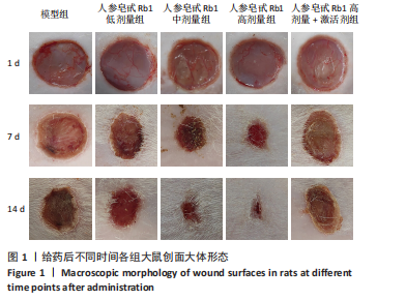
2.1 实验动物数量分析 96只大鼠全部进入结果分析。 2.2 各组大鼠创面愈合情况 给药后不同时间各组大鼠创面大体形态,见图1。"
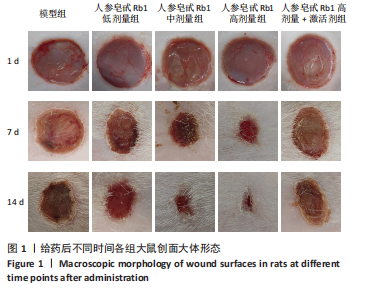
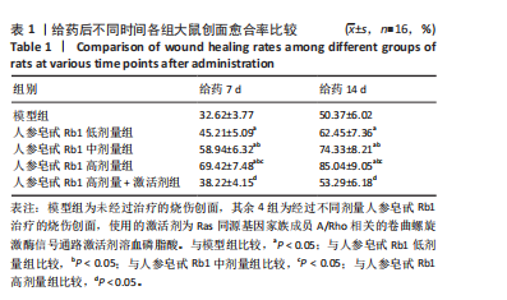
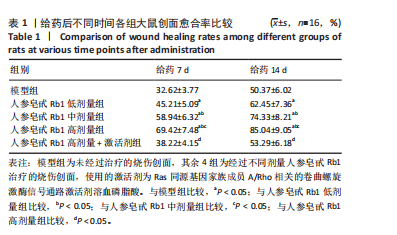
给药7,14 d,模型组创面存在结痂现象;与模型组相比,人参皂甙Rb1低、中、高剂量组创面面积缩小,存在脱痂情况,并且创面出现新生背毛;与人参皂甙Rb1高剂量组相比,人参皂甙Rb1高剂量+激活剂组创面面积较大,未出现脱痂及新生背毛。给药7,14 d,人参皂甙Rb1低、中、高剂量组创面愈合率明显高于模型组(P < 0.05),人参皂甙Rb1高剂量组创面愈合率高于人参皂甙Rb1低、中剂量组(P < 0.05),人参皂甙Rb1中剂量组创面愈合率高于人参皂甙Rb1低剂量组(P < 0.05),人参皂甙Rb1高剂量+激活剂组创面愈合率低于人参皂甙Rb1高剂量组(P < 0.05),见表1。"
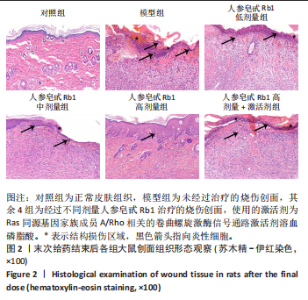
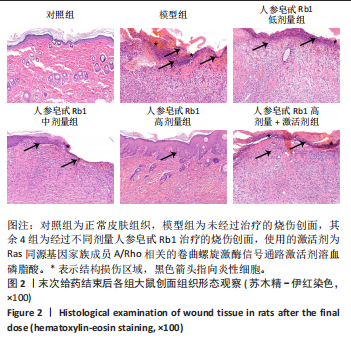
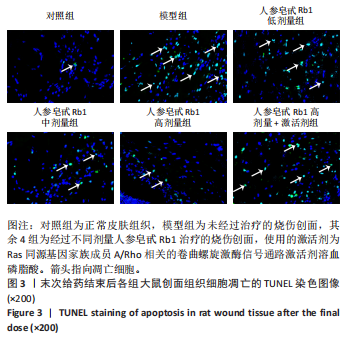
2.3 各组大鼠创面组织形态观察 苏木精-伊红染色显示,与对照组相比,模型组创面存在大量炎性细胞浸润,组织结构不完整,上皮细胞生长不良;与模型组相比,人参皂甙Rb1低、中、高剂量组创面炎性细胞浸润不明显,组织结构较为完整,上皮细胞生长良好;与人参皂甙Rb1高剂量组相比,人参皂甙Rb1高剂量+激活剂组创面存在明显炎性细胞浸润,组织结构完整性较差,上皮细胞生长不良,见图2。 2.4 各组大鼠创面组织细胞凋亡情况 TUNEL染色结果显示,模型组创面组织细胞凋亡率高于对照组(P < 0.05),人参皂甙Rb1低、"
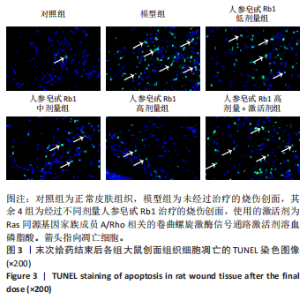
中、高剂量组创面组织细胞凋亡率低于模型组(P < 0.05),人参皂甙Rb1高剂量组创面组织细胞凋亡率低于人参皂甙Rb1低、中剂量组(P < 0.05),人参皂甙Rb1中剂量组创面组织细胞凋亡率低于人参皂甙Rb1低剂量组(P < 0.05),人参皂甙Rb1高剂量+激活剂组创面组织细胞凋亡率高于人参皂甙Rb1高剂量组(P < 0.05),见图3,表2。"
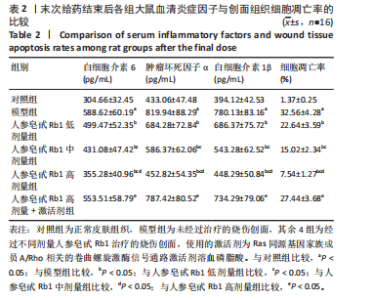
2.5 各组大鼠血清炎症因子水平比较 模型组白细胞介素6、肿瘤坏死因子α、白细胞介素1β水平高于对照组(P < 0.05),人参皂甙Rb1低、中、高剂量组白细胞介素6、肿瘤坏死因子α、白细胞介素1β水平低于模型组(P < 0.05),人参皂甙Rb1高剂量组白细胞介素6、肿瘤坏死因子α、白细胞介素1β水平低于人参皂甙Rb1低、中剂量组(P < 0.05),人参皂甙Rb1中剂量组白细"
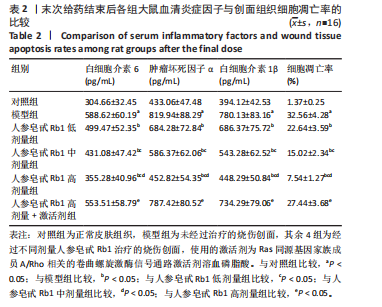
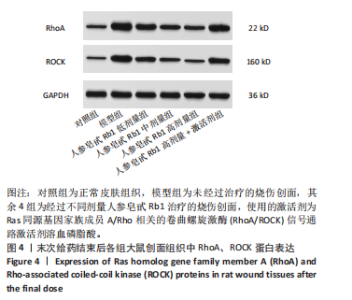
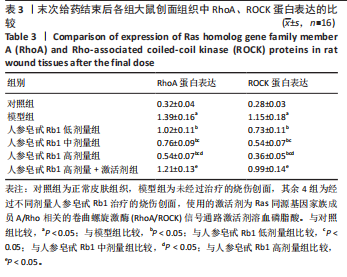
胞介素6、肿瘤坏死因子α、白细胞介素1β水平低于人参皂甙Rb1低剂量组(P < 0.05),人参皂甙Rb1高剂量+激活剂组白细胞介素6、肿瘤坏死因子α、白细胞介素1β水平高于人参皂甙Rb1高剂量组(P < 0.05),见表2。 2.6 各组大鼠创面组织中RhoA、ROCK蛋白表达比较 末次给药结束后,各组大鼠创面组织中RhoA、ROCK蛋白表达的Western blot检测免疫印迹图像,见图4。"
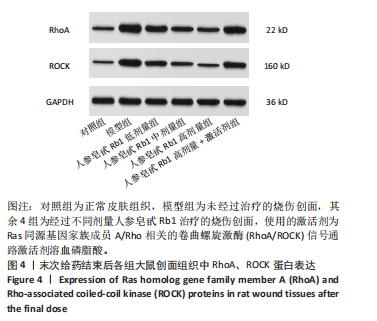
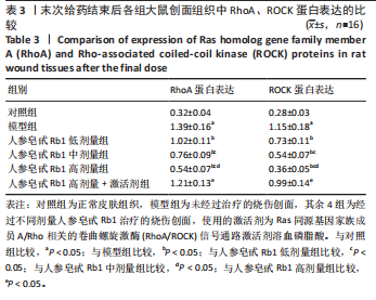
Western blot检测定量分析结果显示,模型组RhoA、ROCK蛋白表达高于对照组(P < 0.05),人参皂甙Rb1低、中、高剂量组RhoA、ROCK蛋白表达低于模型组(P < 0.05),人参皂甙Rb1高剂量组RhoA、ROCK蛋白表达低于人参皂甙Rb1低、中剂量组(P < 0.05),人参皂甙Rb1中剂量组RhoA、ROCK蛋白表达低于人参皂甙Rb1低剂量组(P < 0.05),人参皂甙Rb1高剂量+激活剂组,RhoA、ROCK蛋白表达高于人参皂甙Rb1高剂量组(P < 0.05),见表3。"
| [1] 张国辉,张海博,曹东升.紫花牡荆素对浅Ⅱ度烧伤大鼠创面愈合的影响及机制研究[J].中国药房,2024,35(21):2603-2608. [2] KAMOLZ LP, HECKER A. Molecular Mechanisms Related to Burns, Burn Wound Healing and Scarring. Int J Mol Sci. 2023;24(10):8785-8796. [3] TIAN S, GUO L, SONG Y, et al. Radix Salvia miltiorrhiza Ameliorates Burn Injuries by Reducing Inflammation and Promoting Wound Healing. J Inflamm Res. 2023; 16:4251-4263. [4] JIANG L, YIN X, CHEN YH, et al. Proteomic analysis reveals ginsenoside Rb1 attenuates myocardial ischemia/reperfusion injury through inhibiting ROS production from mitochondrial complex I. Theranostics. 2021;11(4):1703-1720. [5] 王芳玉,韩汶龙,马天鹏,等.基于RhoA/ROCK通路探讨益智仁对糖尿病肾病防治作用及机制研究[J]. 河北医药,2024,46(18):2732-2736. [6] 谭蕊,李论,罗登.飞燕草素调控RhoA/ROCK信号通路对结肠癌细胞生物学行为及血管生成拟态形成的影响[J].陕西医学杂志,2024,53(11):1468-1473. [7] PINOȘANU EA, PÎRȘCOVEANU D, ALBU CV, et al. Rhoa/ROCK, mTOR and Secretome-Based Treatments for Ischemic Stroke: New Perspectives. Curr Issues Mol Biol. 2024;46(4):3484-3501. [8] 王欢.基于TLR4/RhoA信号通路研究连续血液滤过治疗烧伤脓毒症对血管内皮细胞通透性的影响[D]. 合肥:安徽医科大学,2021. [9] CUI YC, PAN CS, YAN L, et al. Ginsenoside Rb1 protects against ischemia/reperfusion-induced myocardial injury via energy metabolism regulation mediated by RhoA signaling pathway. Sci Rep. 2017;7:44579. [10] 李树松,马滢,吴晓明,等.胸腺素β4联合水胶体敷料对深Ⅱ度烧伤大鼠创面愈合及p38丝裂原活化蛋白激酶信号转导通路的影响[J].河北医科大学学报,2024,45(7):832-838. [11] 程斌,宋焕瑾,李锋涛,等.不同剂量人参皂甙Rb1对大鼠脊髓缺血再灌注损伤及survivin的作用[J]. 中国康复理论与实践,2018,24(5):520-525. [12] 赵馨,尹健,贾彤.利多卡因调节RhoA/ROCK轴对结直肠癌细胞生物学行为的影响[J].中国细胞生物学学报,2024,46(3):466-476. [13] 韩艳丽,孙玉信.眠安方对抑郁症睡眠障碍大鼠血清IL-6、IL-1β、TNF-α及海马组织BDNF蛋白表达的影响[J].世界中西医结合杂志,2024,19(6):1139-1144. [14] PEDROSA R, SOUZA MARTINS L, FREIRE RM, et al. Accuracy of infrared thermography evaluation in burn wound healing: a systematic review and meta-analysis. J Wound Care. 2024;1(14):33-45. [15] TSUNOI Y, SATO N, NISHIDATE I, et al. Burn depth assessment by dual-wavelength light emitting diodes-excited photoacoustic imaging in rats. Wound Repair Regen. 2023;31(1):69-76. [16] CHEN S, XIONG Y, YANG F, et al. Approaches to scarless burn wound healing: application of 3D printed skin substitutes with dual properties of anti-infection and balancing wound hydration levels. EBioMedicine. 2024;106(1):5258-5273. [17] LADHANI HA, YOWLER CJ, CLARIDGE JA. Burn Wound Colonization, Infection, and Sepsis. Surg Infect (Larchmt). 2021;22(1):44-48. [18] YAN Z, LI S, GONG Z. Bisacurone gel ameliorated burn wounds in experimental rats via its anti-inflammatory, antioxidant, and angiogenic properties. Acta Cir Bras. 2023;21(1):38:82423-82437. [19] ANGILIA C, SARY NL, INDAH R, et al. Wound healing effect of nutmeg (Myristica fragrans) cream on second-degree burn in animal model. Narra J. 2024;4(1):621-635. [20] QIN GW, LU P, PENG L, et al. Ginsenoside Rb1 Inhibits Cardiomyocyte Autophagy via PI3K/Akt/mTOR Signaling Pathway and Reduces Myocardial Ischemia/Reperfusion Injury. Am J Chin Med. 2021;49(8):1913-1927. [21] 邹树峰,姜碧霞,冯九庚,等.人参皂甙-Rb1通过促进神经元线粒体自噬治疗大鼠创伤性颅脑损伤的机制[J].浙江中医药大学学报,2022,46(10):1063-1069. [22] ZENG J, ZHANG Y, GAO Y, et al. Biomimetic Ginsenoside Rb1 and Probucol Co-Assembled Nanoparticles for Targeted Atherosclerosis Therapy via Inhibition of Oxidative Stress, Inflammation, and Lipid Deposition. ACS Nano. 2025;19(25):22968-22987. [23] NAM OH, KIM JH, KANG SW, et al. Ginsenoside Rb1 alleviates lipopolysaccharide-induced inflammation in human dental pulp cells via the PI3K/Akt, NF-κB, and MAPK signalling pathways. Int Endod J. 2024;57(6):759-768. [24] ZHANG R, GUAN S, MENG Z, et al. Ginsenoside Rb1 alleviates 3-MCPD-induced renal cell pyroptosis by activating mitophagy. Food Chem Toxicol. 2024;186(13): 1145-1157. [25] LI Y, LI J, YANG L, et al. Ginsenoside Rb1 protects hippocampal neurons in depressed rats based on mitophagy-regulated astrocytic pyroptosis. Phytomedicine. 2023;121(13):1583-1596. [26] GLOTFELTY EJ, TOVAR-Y-ROMO LB, HSUEH SC, et al. The RhoA-ROCK1/ROCK2 Pathway Exacerbates Inflammatory Signaling in Immortalized and Primary Microglia. Cells. 2023;12(10):1367-1378. [27] LU W, CHEN Z, WEN J. The role of RhoA/ROCK pathway in the ischemic stroke-induced neuroinflammation. Biomed Pharmacother. 2023;165(12):115141. [28] 王维,穆宝龙,张文双,等.益母草碱调节RhoA/ROCK信号通路对乙型肝炎大鼠的治疗作用[J].广州中医药大学学报,2024,41(12):3259-3265. [29] 那丽莎,曲娜,于雪,等.水蛭素调节RhoA/ROCK信号通路对脑梗死大鼠神经元细胞凋亡和炎症反应的影响[J].中国免疫学杂志,2024,40(8):1640-1645. [30] TU PC, PAN YL, LIANG ZQ, et al. Mechanical Stretch Promotes Macrophage Polarization and Inflammation via the RhoA-ROCK/NF-κB Pathway. Biomed Res Int. 2022;22(32):6871-6885. [31] 严娅芬,陆光兵,田良东,等.橄榄苦苷调节RhoA/ROCK信号通路对肺炎链球菌感染导致的肺泡上皮细胞损伤的影响[J].中国细胞生物学学报, 2024,46(9):1663-1671. [32] XU J, ZHAO S, ZHAO L, et al. Carvedilol alleviates lipopolysaccharide (LPS)-induced acute lung injury by inhibiting Ras homolog family member A (RhoA)/ROCK activities. Bioengineered. 2022;13(2):4137-4145. |
| [1] |
Dong Chunyang, Zhou Tianen, Mo Mengxue, Lyu Wenquan, Gao Ming, Zhu Ruikai, Gao Zhiwei.
Action mechanism of metformin combined with Eomecon chionantha Hance dressing in treatment of deep second-degree burn wounds#br#
#br#
[J]. Chinese Journal of Tissue Engineering Research, 2026, 30(8): 2001-2013.
|
| [2] | Yuan Xiaoshuang, Yang Xu, Yang Bo, Chen Xiaoxu, Tian Ting, Wang Feiqing, Li Yanju, Liu Yang, Yang Wenxiu. Effect of conditioned medium of diffuse large B-cell lymphoma cells on proliferation and apoptosis of human bone marrow mesenchymal stem cells [J]. Chinese Journal of Tissue Engineering Research, 2026, 30(7): 1632-1640. |
| [3] | He Jiale, Huang Xi, Dong Hongfei, Chen Lang, Zhong Fangyu, Li Xianhui. Acellular dermal matrix combined with adipose-derived stem cell exosomes promotes burn wound healing [J]. Chinese Journal of Tissue Engineering Research, 2026, 30(7): 1699-1710. |
| [4] | Liu Anting, Lu Jiangtao, Zhang Wenjie, He Ling, Tang Zongsheng, Chen Xiaoling. Regulation of AMP-activated protein kinase by platelet lysate inhibits cadmium-induced neuronal apoptosis [J]. Chinese Journal of Tissue Engineering Research, 2026, 30(7): 1800-1807. |
| [5] | Pan Hongfei, Zhuang Zhenbing, Xu Baiyun, Yang Zhangyang, Lin Kairui, Zhan Bingqing, Lan Jinghan, Gao Heng, Zhang Nanbo, Lin Jiayu. Inhibitory effects of different concentrations of auranofin on M1 macrophage function and its therapeutic potential in diabetic wound healing [J]. Chinese Journal of Tissue Engineering Research, 2026, 30(6): 1390-1397. |
| [6] | Peng Zhiwei, Chen Lei, Tong Lei. Luteolin promotes wound healing in diabetic mice: roles and mechanisms [J]. Chinese Journal of Tissue Engineering Research, 2026, 30(6): 1398-1406. |
| [7] | Jia Jinwen, Airefate·Ainiwaer, Zhang Juan. Effects of EP300 on autophagy and apoptosis related to allergic rhinitis in rats [J]. Chinese Journal of Tissue Engineering Research, 2026, 30(6): 1439-1449. |
| [8] | Liu Yu, Lei Senlin, Zhou Jintao, Liu Hui, Li Xianhui. Mechanisms by which aerobic and resistance exercises improve obesity-related cognitive impairment [J]. Chinese Journal of Tissue Engineering Research, 2026, 30(5): 1171-1183. |
| [9] | Wang Zhengye, Liu Wanlin, Zhao Zhenqun. Advance in the mechanisms underlying miRNAs in steroid-induced osteonecrosis of the femoral head [J]. Chinese Journal of Tissue Engineering Research, 2026, 30(5): 1207-1214. |
| [10] | Yang Xiao, Bai Yuehui, Zhao Tiantian, Wang Donghao, Zhao Chen, Yuan Shuo. Cartilage degeneration in temporomandibular joint osteoarthritis: mechanisms and regenerative challenges [J]. Chinese Journal of Tissue Engineering Research, 2026, 30(4): 926-935. |
| [11] | Bao Zhuoma, Hou Ziming, Jiang Lu, Li Weiyi, Zhang Zongxing, Liu Daozhong, Yuan Lin. Effect and mechanism by which Pterocarya hupehensis skan total flavonoids regulates the proliferation, migration and apoptosis of fibroblast-like synoviocytes [J]. Chinese Journal of Tissue Engineering Research, 2026, 30(4): 816-823. |
| [12] | Ji Lingshan, Qin Hewei, Cheng Shuaifang, Zhao Jing. Mechanism and effect of aescin intervention against brain injury in a rat model of intracerebral hemorrhage [J]. Chinese Journal of Tissue Engineering Research, 2026, 30(36): 9526-9537. |
| [13] | Zhang Bo, Zhao Jingjing, Li Wenting, Kong Jie. Protective effect of kaempferol against renal injury in lupus nephritis [J]. Chinese Journal of Tissue Engineering Research, 2026, 30(36): 9597-9603. |
| [14] | Li Wenhao, Zhang Wei, Li Wenming, Xia Wenyu, Wu Zebin, Geng Dechun. Nimbolide relieves osteoporosis by regulating osteoclast differentiation and apoptosis [J]. Chinese Journal of Tissue Engineering Research, 2026, 30(35): 9120-9127. |
| [15] | Ma Runqiu, Yang Huixia, Li Xuer, Bai Zhigang, Li Guizhong, Hao Yinju, Ma Shengchao, Jiang Yideng. Mechanism of glucocorticoid-induced mitochondrial dysfunction in osteoblasts in steroid-induced osteonecrosis of the femoral head [J]. Chinese Journal of Tissue Engineering Research, 2026, 30(34): 8845-8851. |
| Viewed | ||||||
|
Full text |
|
|||||
|
Abstract |
|
|||||