Chinese Journal of Tissue Engineering Research ›› 2026, Vol. 30 ›› Issue (35): 9345-9354.doi: 10.12307/2026.266
Previous Articles Next Articles
Animal models of Parkinson’s disease: research status and trend analysis
Li Huiping, Jia Huanhuan, Zhao Weibo
- Guangdong Provincial Biotechnology Research Institute (Guangdong Provincial Laboratory Animals Monitoring Center), Guangzhou 510663, Guangdong Province, China
-
Received:2025-09-28Revised:2025-12-08Online:2026-12-18Published:2026-04-30 -
Contact:Zhao Weibo, MS, Researcher, Guangdong Provincial Biotechnology Research Institute (Guangdong Provincial Laboratory Animals Monitoring Center), Guangzhou 510663, Guangdong Province, China -
About author:Li Huiping, MS, Researcher, Guangdong Provincial Biotechnology Research Institute (Guangdong Provincial Laboratory Animals Monitoring Center), Guangzhou 510663, Guangdong Province, China -
Supported by:Guangzhou Basic and Applied Basic Project, No. 202102080391 (to LHP)

CLC Number:
Cite this article
Li Huiping, Jia Huanhuan, Zhao Weibo. Animal models of Parkinson’s disease: research status and trend analysis[J]. Chinese Journal of Tissue Engineering Research, 2026, 30(35): 9345-9354.
share this article
Add to citation manager EndNote|Reference Manager|ProCite|BibTeX|RefWorks
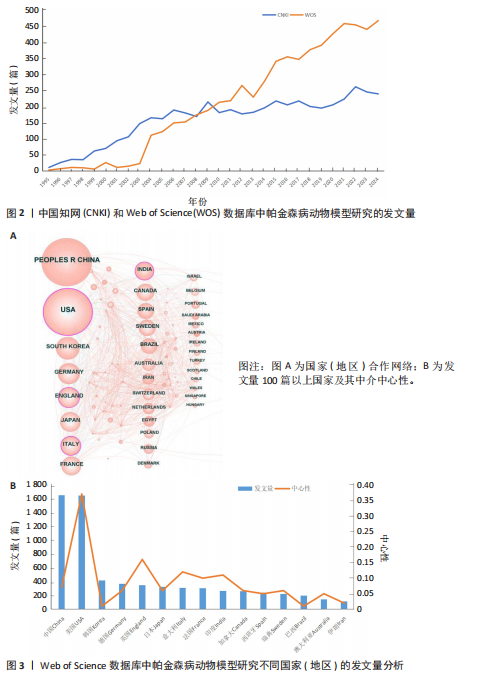
2.1 帕金森病动物模型研究的年度发文量 从帕金森病动物模型研究的年度发文量趋势来看(图2),国内学者关注帕金森病动物模型领域的研究早于国外,1995-2009年间,中国知网该领域的发文量均高于Web of Science数据库;从2010年开始,帕金森病动物模型研究的发文量出现了差距,Web of Science数据库该领域的发文量持续高于中国知网,并且差距越来"
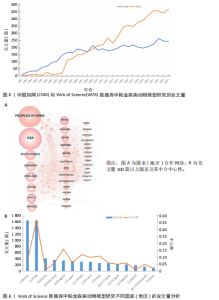
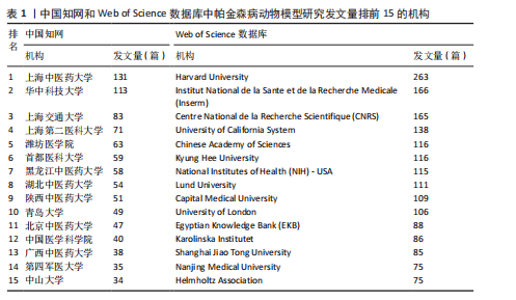
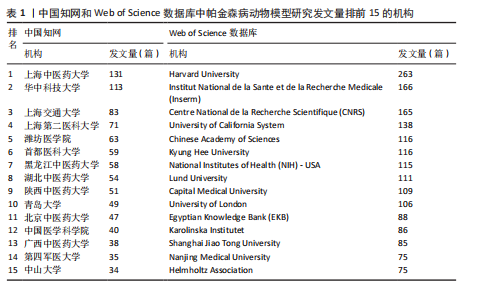
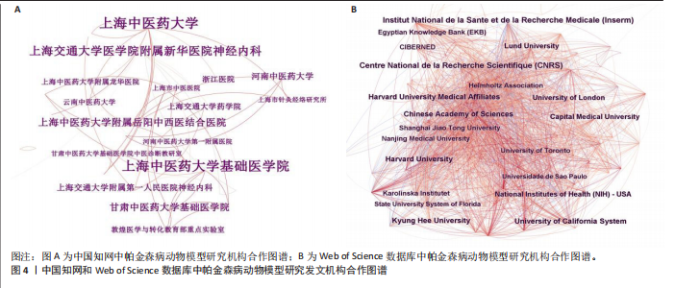
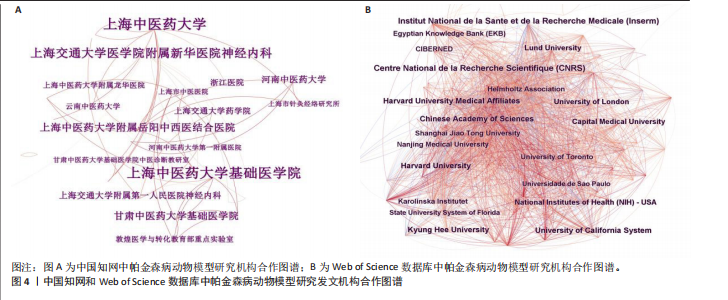
越明显。中国知网该领域的发文量历史最高点出现在2022年(261篇),Web of Science数据库该领域的发文量历史最高点在2024年(466篇)。整体上看,近30年来,国内外关于帕金森病动物模型研究的年度发文量呈波动上升趋势,2010年之后国际上对于帕金森病动物模型研究的关注度更高,研究成果呈快速增长态势。 2.2 帕金森病动物模型研究国家(地区)发文分析 通过CiteSpace绘制出Web of Science数据库中帕金森病动物模型研究国家(地区)合作网络图谱(图3A),图中共有99个节点、853条连接线,网络密度为0.175 8,其中节点大小代表发文数量,连接线粗细代表合作频次,节点的紫颜色代表中介中心性强度。从图中可见帕金森病动物模型研究涉及全球99个国家(地区),中国是发文量最高的国家(1 649篇),位居第二的是美国(1 642篇),其次是韩国、德国、英国、日本等。中国的帕金森病动物模型研究领域高产表现可能来自多方面因素,随着中国人口老龄化日益严重,中国政府将神经退行性疾病研究纳入“健康中国2030”及国家重点研发计划,进行预防医学基础研究的布局;再有国家在生命科学研究领域持续加大投入,增强技术平台建设,进一步推动了成果产出;另外,近年来中国加强了与国际合作,例如国内相关机构与全球帕金森病研究联盟(如非营利性帕金森病研究资助机构——美国迈克尔·J·福克斯基金会)深度合作,共享资源及发表成果等。 从帕金森病动物模型研究发文量100篇以上的15个国家及中介中心性分析来看(图3B),15个国家发文量排序分别是中国、美国、韩国、德国、英国、日本、意大利、法国、印度、加拿大、西班牙、瑞典、巴西、澳大利亚、伊朗。但从中介中心性排序来看,美国中介中心性达0.37,位居第一,其次是英国、意大利、印度、法国,中国的中介中心性仅0.07,位居第六,说明中国在帕金森病动物模型研究中虽然具有广泛影响力,但研究成果还需在数量与应用转化效能上平衡,研究质量和深度需进一步提高。 2.3 帕金森病动物模型研究发文机构分析 根据中国知网和Web of Science数据库的统计分析(表1),中国知网中发文最多的3个机构分别是上海中医药大学(131篇)、华中科技大学(113篇)、上海交通大学(83篇);Web of Science数据库中发文前3位的机构分别是哈佛大学(263篇)、法国国家健康与医学研究院(166篇)、法国国家科学研究中心(165篇)。从Web of Science数据库发文机构的中介中心性来看,美国国立卫生研究院的中介中心性最高(0.17),其次是哈佛大学(0.13)、加利福尼亚大学(0.13),可见这几个机构在该研究领域属于核心机构。总体来看,中国知网和Web of Science数据库中帕金森病动物模型领域研究的主力军均为高校,不同的是国内以中医药类高校占据主要地位,因此,学者们以动物模型为对象,从中医药视角产出不少关于帕金森病机理机制以及病症治疗等研究领域成果。 使用CiteSpace绘制帕金森病动物模型研"
"

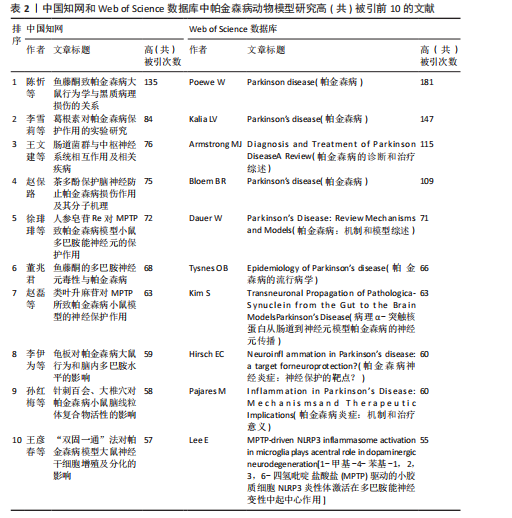
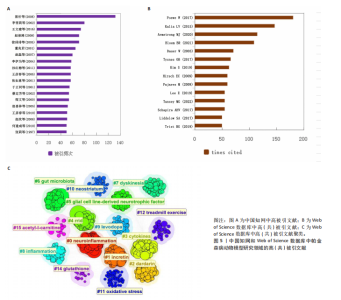
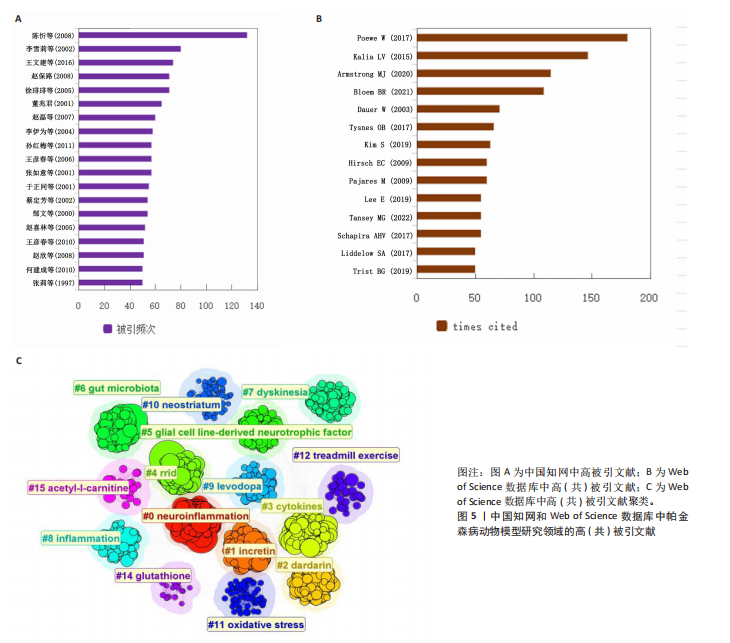
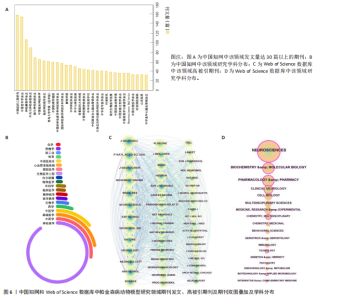
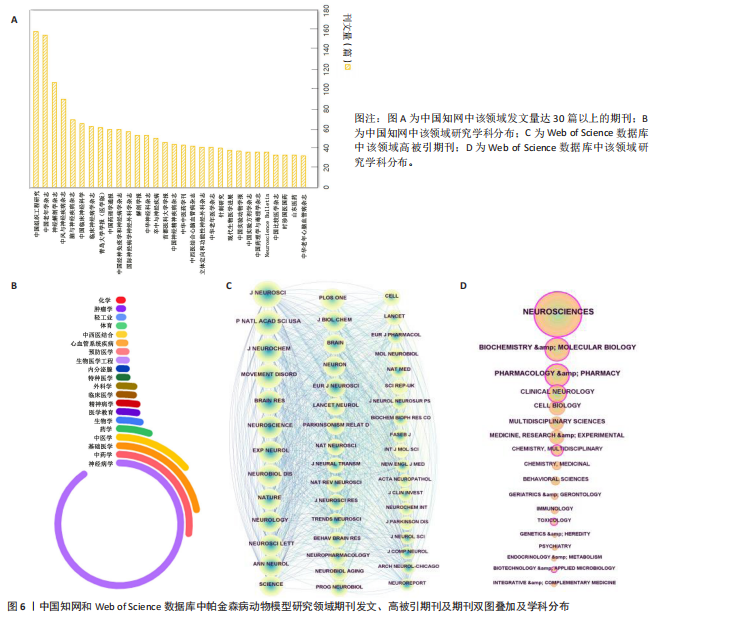
究机构网络图谱(图4),中国知网的图谱有880个节点、连接线360条,网络密度为0.000 9,从连接线和网络密度可见国内各研究机构间合作较少,主要是上海中医药大学、上海交通大学及附属系统内部、本区域间的合作,国内机构间的交流与合作有待加强。Web of Science数据库图谱共有577个节点、3 315条连接线,网络密度为0.019 9,可见国际上关于帕金森病动物模型研究的机构间合作更紧密。 2.4 帕金森病动物模型研究高被引文献、期刊及学科分析 2.4.1 高被引文献分析 文献的被引频次在一定程度上反映了文献具有的学术价值和影响力。根据普赖斯的高被引论文计算公式M=0.749×,代表最高被引频次,当计算的数值≥M时,表明该文章为高被引论文[16]。按照该规则,中国知网中得出≥8.6(取整数9)的被引论文823篇,占总发文量的18.3%,被引频次最高的文献是陈忻等[17]发表的《鱼藤酮致帕金森病大鼠行为学与黑质病理损伤的关系》(被引131次)。引用文献年份主要集中在2001-2008年间,表明这一时期成果为该领域提供了重要的理论基础,并得到了同行的认可(图5A、表2)。 对Web of Science数据库中高(共)被引文献进行分析(图5B、表2),可见POEWE等 [18]发表的《Parkinson disease》被引频次最高达181次。与中国知网相比,Web of Science数据库的引用文献年份主要集中在2017-2021年间,表明Web of Science数据库中帕金森病动物模型研究成果在这一时期引起了学者的认可和关注。进一步对Web of Science数据库中高(共)被引文献进行聚类分析,共得到15个聚类(图5C),显示学者们对当前帕金森病的病理机制关注度高,如聚类#0(neuroinflammation,神经炎症)、#6(gut microbiota,肠道菌群)、#11(oxidative stress,氧化应激)等。 2.4.2 发文期刊及学科分析 根据中国知网中发文期刊及学科分析,刊文量最高的是《中国组织工程研究》(159篇),其次是《中国老年学杂志》《神经解剖学杂志》。从图6A中可见,刊文量前30篇以上的期刊有19个期刊是北大核心期刊或中国科学引文数据库(CSCD)核心期刊,表明这些期刊刊载帕金森病动物模型领域的文章质量较高。按学科领域统计发现,发文量排前6位的学科分别是神经病学、中药学、基础医学、中医学、药学、生物学,其中神经病学学科占据主要地位(图6B)。国内研究学科的中药学、中医学占据重要地位,充分体现了中国中医药学科领域的影响力。 从Web of Science数据库的高被引期刊图谱可见(图6C),被引最高的期刊是《J Neuro Sci》(3 957次),其次是《P Natl Acad Sci USA》(3 586次)、《J Neuro Chem》(3 429次),排名前10的期刊大多数位于中科院文献分区的1区或2区,JCR则分布在 Q1或Q2区,表明这些期刊刊载的帕金森病动物模型研究成果得到了业内的高度认可。从学科领域来看,Web of Science数据库中发文量分布最多的学科是神经科学、生物学、分子生物学、药理学、临床神"
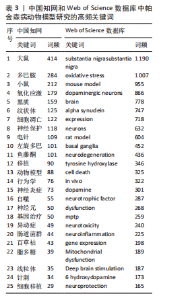
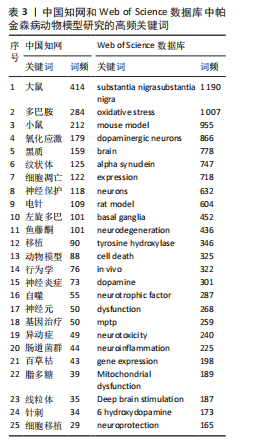
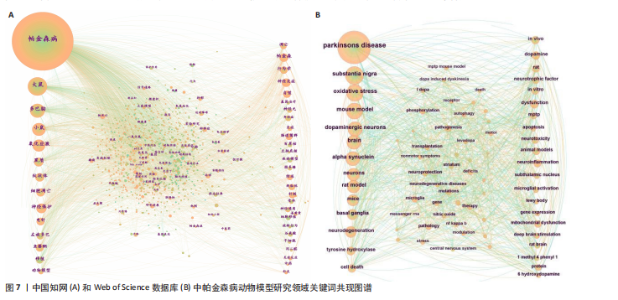
经病学等(图6D)。 2.5 帕金森病动物模型研究关键词共现、聚类及突现分析 2.5.1 关键词共现分析 关键词是对文章中研究内容的高度概括,通过CiteSpace软件对样本数据进行关键词的可视化分析,能清晰地呈现出该研究领域的核心内容和重点方向。在中国知网中,帕金森病动物模型研究领域的关键词共现图谱(图7A)共形成节点906个、连接线3 238条,网络密度为0.007 9,节点越大说明关键词出现的频次越高,再结合关键词的词频分析(表3),围绕帕金森病的研究涉及最多的关键词包括大鼠、多巴胺、小鼠、氧化应激、黑质、纹状体、细胞凋亡、电针、肠道菌群等方面,涵盖帕金森病的机理研究、动物模型以及帕金森病的病症治疗等领域内容。 在Web of Science数据库中,该领域关键词共现图谱(图7B)共有977个节点、11 786条连接线,网络密度为0.024 7,与中国知网中该领域关键词共现图谱的连接线和网络密度相比,Web of Science数据库中该领域关键词共现图谱各个节点间的关联性更紧密。围绕帕金森病的研究涉及最多的关键词包括substantia nigra、oxidative stress、mouse model、dopaminergic neurons、brain、alpha synuclein、expression、neurons、rat model等,Web of Science数据库中排名前25的关键词词频都在160次以上(表"
"
"
"
"

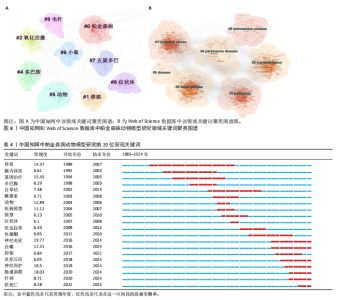
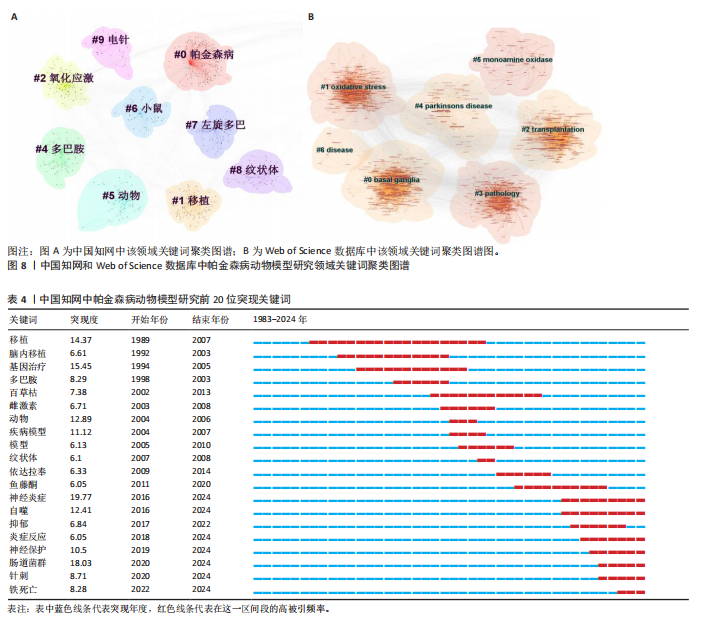
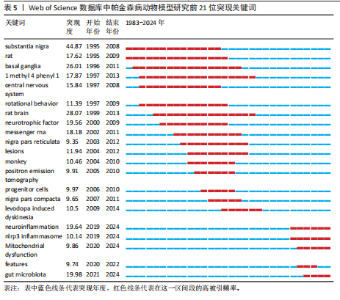
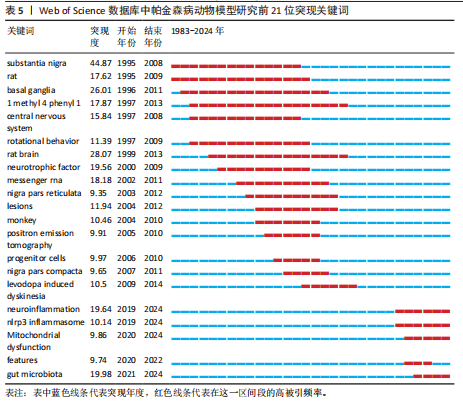
3),表明这些关键词在该领域研究中关注度高,它们的重要性和影响力也越高。 2.5.2 关键词聚类分析 在关键词共现分析基础上,使用CiteSpace软件的“Clusters”工具,以LLR(对数极大似然率)算法得到中国知网和Web of Science数据库中该领域的关键词聚类图谱(图8)。中国知网中该领域的关键词聚类分析共得到9个聚类结果(图8A),聚类模块值Q为0.386 9 (Q > 0.3),聚类平均轮廓值S为0.769 2 (S > 0.5),表明聚类结果的结构是显著的,聚类效果可信度高。在9个主题聚类中,#1(移植)、聚类#7(左旋多巴)、聚类#9(电针)主要是研究帕金森病的病症治疗内容;聚类#2(氧化应激)、聚类#4(多巴胺)、聚类8(纹状体)主要与帕金森病机制研究相关;聚类#5(动物)、聚类#6(小鼠)主要与实验动物及动物模型实验相关。 Web of Science数据库中该领域的关键词聚类分析中共得到7个聚类结果(图8B),聚类模块值Q为0.296 1 (Q≈0.3),聚类平均轮廓值S为0.595 4 (S > 0.5),表明聚类基本合理且可信。聚类#0(basal ganglia)、聚类#1(oxidative stress)、聚类#3(pathology)主要为帕金森病机制研究;聚类#2(transplantation)、聚类#4(parkinsons disease)、聚类#6(disease)、聚类#5(monoamine oxidase)主要与疾病和治疗相关。 从中国知网和Web of Science数据库中该领域关键词聚类可见,学者们对帕金森病机制研究的关注度高,特别是氧化应激可能成为帕金森病研究的重要方向。 2.5.3 突现关键词分析 突现词反映的是一段时间内受到相关研究领域学者们高度关注的关键词,也代表一段时期内该领域的研究热点、研究趋势及未来研究方向,突现词强度是衡量关键词突现程度的重要指标,突现词强度值越高,代表该关键词在特定时间段内的突现程度越显著。通过CiteSpace软件,设置Burstdetectio参数Y[0,1] =0.5(表4,5),表中蓝色线条代表突现年度,红色线条代表在这一区间段的高被引频率。从中国知网中共得到20个突现词(表4),其中神经炎症(突现度19.77)的突现强度最高,其次是肠道菌群(突现度18.03),说明这2个关键词在帕金森病的病理机制研究过程中被学者们广泛关注;另外,关键词铁死亡(突现度8.28)近年来(2022-2024年)在帕金森病等神经退行性疾病中的研究呈突现状态。 从Web of Science数据库中的突现词来看(表5),substantia nigra(突现度44.87)、rat brain(突现度28.07)、basal ganglia(突现度26.01)、gut microbiota(突现度19.98)、neuroinflammation(突现度19.64)、neurotrophic factor(突现度19.56)、messenger rna(突现度18.18)、1 methyl 4 phenyl 1(突现度17.87)、rat(突现度17.62)呈现出较高的突现度,成为学者们在帕金森病研究过程中广泛关注的内容。2019-2024年,Web of Science数据库中有5个突现关键词,分别是neuroinflammation、nlrp3 inflammasome、Mitochondrial dysfunction、gut microbiota,主要与炎症、肠道菌群相关。 综上可见,神经炎症、肠道菌群在帕金森病等神经退行性疾病中的研究可能成为该领域未来一段时期内的研究热点。"
"
| [1] 吴悦,唐业忠,方光战.帕金森病步态障碍发生机制及动物模型[J].科学通报,2023,68(23): 3043-3051. [2] 刘书一,王正波. 非人灵长类帕金森动物模型中的行为学评估[J].中国比较医学杂志, 2023,33(11):96-103. [3] BIERI G, BRAHIC M, BOUSSET L, et al. LRRK2 modifies α-syn pathology and spread in mouse models and human neurons. Acta Neuropathol. 2019;137(6):961-980. [4] LIU T, GUO D, WEI J. The pathogenesis of Parkinson’s disease and crosstalk with other diseases. Biocell. 2024;48(8):1155-1179. [5] TREVISAN L, GAUDIO A, MONFRINI E, et al. Genetics in Parkinson’s disease,state-of-the-art and future perspectives. Br Med Bull. 2024; 149(1):60-71. [6] FOLTYNIE T, BRUNO V, FOX S, et al. Medical, surgical, and physical treatments for Parkinson’s disease. Lancet. 2024;403(10423):305-324. [7] WANG Q, LIU Y, ZHOU J. Neuroinflammation in Parkinson’s disease and its potential as therapeutic target. Transl. Transl Neurodegener. 2015;4:19. [8] XIAO B, ZHOU Z, CHAO Y, et al. Pathogenesis of Parkinson’s Disease. Neurol Clin. 2025;43(2): 185-207. [9] 王美华,干敏,吴海琴,等.不同训练负荷太极拳运动对早中期帕金森病患者康复疗效[J].生物化学与生物物理进展,2023,50(10):2487-2495. [10] LAL R, SINGH A, WATTS S, et al. Experimental models of Parkinson’s disease: Challenges and Opportunities. Eur J Pharmacol. 2024;980:176819. [11] SUBHAN I, SIDDIQUE YH. Modeling of Parkinson’s Disease in Different Models. CNS Neurol Disord Drug Targets. 2025;24(2):102-114. [12] HE S, RU Q, CHEN L, et al. Advances in animal models of Parkinson’s disease. Brain Res Bull. 2024;215:111024. [13] 杨东明,杨利峰,赵德明,等.帕金森病动物模型的研究进展[J].中国实验动物学报,2020, 28(3):397-404. [14] 王子瑜,王晓慧.帕金森病动物模型研究进展[J].中国神经精神疾病杂志,2025,51(3):186-192. [15] 陈悦,陈超美,刘则渊,等.CiteSpace知识图谱的方法论功能[J].科学学研究,2015, 33(2):242-253. [16] KONG Q, FAN C, ZHANG Y, et al. Rare disease publishing trends worldwide and in China: ACiteSpace-based bibliometric study. Intractable Rare Dis Res. 2025;14(1):1-13. [17] 陈忻,张楠,赵晖,等.鱼藤酮致帕金森病大鼠行为学与黑质病理损伤的关系[J].中国神经精神疾病杂志,2008,34(4):232-234. [18] POEWE W, SEPPI K, TANNER CM, et al. Parkinson disease. Nat Rev Dis Primers. 2017;3:17013. [19] BETARBET R, SHERER TB, MACKENZIE G, et al.Chronic systemic pesticide exposure reproduces features of Parkinson’s disease. Nat Neurosci. 2000;3(12):1301-1306. [20] 曹依群,周晓平,胡小吾,等.脑深部电刺激猴帕金森病模型的建立[J].立体定向和功能性神经外科杂志,2005,18(5):30-33. [21] 徐美玲,张帆,张瑜,等.Prnp-SNCA-A53T帕金森病转基因小鼠肠道菌群差异[J].中国实验动物学报,2021,29(3):284-292. [22] 孔健达,解瑛傲,马雯,等.帕金森病相关线粒体功能障碍及运动对其潜在的改善作用[J].中国组织工程研究,2024,28(27):4413-4420. [23] LEHMANN S, COSTA AC, CELARDO I, et al. Parp mutations protect against mitochondrial dysfunction and neurodegeneration in a PARKIN model of Parkinson’s disease. Cell Death Dis. 2016;7(3):e2166. [24] BURBULLA LF, SONG P, MAZZULLI JR, et al. Dopamine oxidation mediates mitochondrial and lysosomal dysfunction in Parkinson’s disease. Science. 2017;357(6357):1255. [25] 肖琪,樊慧杰,李艳荣,等.PARK2介导的帕金森病中帕金蛋白对α-突触核蛋白的作用[J].中国老年学杂志,2024,44(4):999-1005. [26] YANG K, LV Z, ZHAO W, et al.The potential of natural products to inhibit abnormal aggregation of α-Synuclein in the treatment of Parkinson’s disease. Front Pharmacol. 2024;15:1468850. [27] ZHANG J, ZHOU D, ZHANG Z, et al. miR-let-7a suppresses α-Synuclein-induced microglia inflammation through targeting STAT3 in Parkinson’s disease. Biochem Biophys Res Commun. 2019;519(4):740-746. [28] 李少创,韩诚,秦亚莉,等.阿尔茨海默病实验动物模型评述[J].中国实验动物学报,2022, 30(1):131-145. [29] 赵晓阳,王小玲,梁文娜,等.丁苯酞对帕金森小鼠模型细胞凋亡和氧化应激的影响[J].中国临床药理学杂志,2021,37(16):2209-2212. [30] WANG G, ZHUANG W, ZHOU Y, et al. 17β-estradiol alleviated ferroptotic neuroinflammation by suppressing ATF4 in mouse model of Parkinson’s disease. Cell Death Discov. 2024;10(1):507. [31] ZHOU Y, LU M, DU R, et al. MicroRNA-7 targets Nod-like receptor protein 3 inflammasome to modulate neuroinflammation in the pathogenesis of Parkinson’s disease. Mol Neurodegener. 2016;11:28. [32] CHENG W, FANG K, OUYANG X, et al. Vagus nerve stimulation with a small total charge transfer improves motor behavior and reduces neuroinflammation in a mouse model of Parkinson’s disease. Neurochem Int. 2024;180: 105871. [33] JIANG Z, WANG X, ZHANG H, et al. Ketogenic diet protects MPTP-induced mouse model of Parkinson’s disease via altering gut microbiota and metabolites. MedComm (2020). 2023;4(3):e268. [34] LEE YZ, CHENG S, CHANG M, et al. Neuroprotective Effects of Lactobacillus plantarum PS128 in a Mouse Model of Parkinson’s Disease: The Role of Gut Microbiota and MicroRNAs. Int J Mol Sci. 2023;24(7):6794. [35] BHATTARAI Y, SI J, PU M, et al. Role of gut microbiota in regulating gastrointestinal dysfunction and motor symptoms in a mouse model of Parkinson’s disease. Gut Microbes. 2021;13(1):1866974. [36] 谌盈帆,郝斐然,汤响林,等.基于核受体辅激活因子4介导的铁自噬探讨补肾活血颗粒对帕金森病模型小鼠脑黑质神经元铁死亡的影响[J].中华中医药杂志,2024,39(2):926-931. [37] 高达,黎庆连,王启章,等.艾灸调控SNX5对帕金森病模型小鼠神经元铁死亡的影响[J].针刺研究,2024,49(7):736-742. [38] 卢冬磊,张文玉,谭思洁,等.运动调控铁死亡改善帕金森病的潜在机制[J].生物化学与生物物理进展,2024,51(11):2880-2896. [39] KOO JH, CHO JY. Treadmill Exercise Attenuates α-Synuclein Levels by Promoting Mitochondrial Function and Autophagy Possibly via SIRT1 in the Chronic MPTP/P-Induced Mouse Model of Parkinson’s Diseasee. Neurotox Res. 2017; 32(3):473-486. [40] 吴成举,英锡相,陈靖,等.针刺疗法对帕金森病大鼠黑质神经元凋亡蛋白bcl-2、bax的影响[J].陕西中医,2020,41(1):8-11+133. [41] 王照钦,钟蕊,高崚,等.针刺对帕金森病模型小鼠肠道菌群多样性的调节作用[J].中华中医药杂志,2020,35(5):2265-2270. [42] 刘艳阳,郭雅碧,翟宏宇,等.电针调节NLRP3/Caspase-1通路对帕金森病大鼠多巴胺能神经元焦亡的影响[J].针刺研究,2022,47(11):983-992. [43] 王飞,李亚楠,张小蕾,等.电针调节PI3K/AKT/mTOR信号通路激活帕金森大鼠脑组织自噬改善行为学反应机制[J].中国临床解剖学杂志, 2023,41(6):709-715. [44] 刘麒麟,邱百怡,靳晶,等.基于cGAS-STING信号通路探究针刺对帕金森病认知障碍大鼠神经炎性反应的影响[J].针刺研究,2025,50(2): 159-166. [45] 郭雨驰,季昭臣,黎敬波.基于复杂网络分析中医药治疗帕金森病用药规律[J].中医杂志, 2018,59(24):2142-2147. [46] 王雨,孟芊,邰国香,等.天麻素对帕金森氏症模型大鼠mTOR/HIF-1α通路、糖酵解代谢的影响[J].时珍国医国药,2023,34(12):2852-2856. [47] 郇鹏飞,何竹青,王利,等.病证结合帕金森病小鼠模型的构建及中医证候属性研究[J].上海中医药大学学报,2022,36(2):36-42. [48] CHEN Z, ZHAO G. First-in-human transplantation of autologous induced neural stem cell-derived dopaminergic precursors to treat Parkinson’s disease. Sci Bull (Beijing). 2023;68(22):2700-2703. [49] DU X. Modulation of the PI3K/AKT pathway by using Traditional Chinese Medicines in treating Parkinson’s disease: A review of animal model studies. Bol Latinoam Caribe Plant Med Aromat. 2025; 23(2):172-185. [50] LI M, WANG H, BAI Y, et al. Pharmacodynamical research of extracts and compounds in traditional Chinese medicines for Parkinson’s disease. Fitoterapia. 2024;177:106086. [51] WU J, LI CS, HUANG WY, et al. Gut microbiota promote the propagation of pathologic α-syn from gut to brain in a gut-originated mouse model of Parkinson’s disease. Brain Behav Immun. 2025;128:152-169. [52] FENG M, ZOU Z, SHOU P, et al. Gut microbiota and Parkinson’s disease: potential links and the role of fecal microbiota transplantation. Front Aging Neurosci. 2024;16:1479343. [53] YAO Z, JIAO Q, DU X, et al.Ferroptosis in Parkinson’s disease -- The iron-related degenerative disease. Ageing Res Rev. 2024;101:102477. [54] CLARK BJ, LELOS MJ, LORING JF. Advancing Parkinson’s disease treatment: cell replacement therapy with neurons derived from pluripotent stem cells. Stem Cells. 2024;42(9):781-790. [55] 张逸悦,王峰.人工智能与PET/MR在帕金森病诊断中的应用[J].南京医科大学学报(自然科学版),2024,44(6):876-881. [56] 任虹宇,马俊,何森,等.丘脑底核脑深部电刺激术治疗帕金森病患者的疗效及术后认知功能分析[J].中国实用神经疾病杂志,2024,27(4): 448-452. [57] 罗文豪.机器人辅助丘脑底核脑深部电刺激治疗帕金森病的疗效分析[D].南昌:南昌大学, 2024. [58] 王子豪,夏欢,冯婷婷,等.基于生物信息学及机器学习算法筛选诊断帕金森病的枢纽基因[J].神经疾病与精神卫生,2023,23(12):837-847. [59] EGHLIDOS Z, RAHIMIAN Z, VADIEE G, et al. Effects of subthalamic deep brainstimulation on non-motor symptoms of Parkinson’s disease: A meta-analysis. Acta Neurol Scand. 2022;146(2):115-125. [60] 徐如祥.脑芯片-脑机接口治疗技术进展[J].中华脑科疾病与康复杂志(电子版),2020, 10(6):383-384. [61] 科技部.《脑机接口研究伦理指引》和《人-非人动物嵌合体研究伦理指引》发布[EB/OL].(2024-02-02)[2024-03-22] .https://www.most.gov.cn/kjbgz/202402/t20240202_189582.html. |
| [1] | Xu Canli, He Wenxing, Wang Yuping, Ba Yinying, Chi Li, Wang Wenjuan, Wang Jiajia. Research context and trend of TBK1 in autoimmunity, signaling pathways, gene expression, tumor prevention and treatment [J]. Chinese Journal of Tissue Engineering Research, 2026, 30(在线): 1-11. |
| [2] | Zhang Haiwen, Zhang Xian, Xu Taichuan, Li Chao. Bibliometric and visual analysis of the research status and trends of senescence in osteoporosis [J]. Chinese Journal of Tissue Engineering Research, 2026, 30(6): 1580-1591. |
| [3] | Huang Jie, Zeng Hao, Wang Wenchi, Lyu Zhucheng, Cui Wei. Visualization analysis of literature on the effect of lipid metabolism on osteoporosis [J]. Chinese Journal of Tissue Engineering Research, 2026, 30(6): 1558-1568. |
| [4] | Leng Xiaoxuan, Zhao Yuxin, Liu Xihua. Effects of different neuromodulatory stimulation modalities on non-motor symptoms in Parkinson’s patients: a network meta-analysis [J]. Chinese Journal of Tissue Engineering Research, 2026, 30(5): 1282-1293. |
| [5] | Yang Zeyu, Zhi Liang, Wang Jia, Zhang Jingyi, Zhang Qingfang, Wang Yulong, Long Jianjun. A visualized analysis of research hotspots in high-frequency repetitive transcranial magnetic stimulation from the macroscopic perspective [J]. Chinese Journal of Tissue Engineering Research, 2026, 30(5): 1320-1330. |
| [6] | Yang Jing, Wang Houmei, Wang Yi, Song Min, Ren Jie, Dai Lujun, Xiao Ziwen. Constructing a rat animal model of pelvic organ prolapse: a comparison of three modeling methods [J]. Chinese Journal of Tissue Engineering Research, 2026, 30(4): 864-872. |
| [7] | Guo Feng, Li Qian, Hou Chaowen, Guo Chengji. Exercise improves neuropathic pain: precision exercise prescription and multimodal synergy advance clinical applications [J]. Chinese Journal of Tissue Engineering Research, 2026, 30(35): 9269-9280. |
| [8] | Wang Xiaojing, Wei Jingyi, Liu Xihua. A visualized analysis of vagus nerve stimulation in the field of stroke rehabilitation [J]. Chinese Journal of Tissue Engineering Research, 2026, 30(35): 9316-9326. |
| [9] | Chen Xiaoxia, Zhao Lihua, Li Taowen, Qin Yimei, Liang Jinyu. Postmenopausal cognitive impairment: a bibliometric analysis of developmental context and hot trends [J]. Chinese Journal of Tissue Engineering Research, 2026, 30(35): 9336-9344. |
| [10] | Yuan Yue, Chang Guoxin, Lin Dingmei, Mo Zixuan, Yu Jingjing, Zhu Yixia, Zheng Zhaoguang, Wang Yan. Applications and advances of tissue/organ perfusion [J]. Chinese Journal of Tissue Engineering Research, 2026, 30(35): 9231-9238. |
| [11] | He Renda, Ma Wei, Sun Yongsi, Mo Xueni. Future medical research on brain organoids: interdisciplinary training, bioengineering technologies, and optimized model maturity [J]. Chinese Journal of Tissue Engineering Research, 2026, 30(34): 9088-9094. |
| [12] | Bu Fanchen, Hua Zhen, , Li Xiaolong, Lyu Jinye, Man Hao, Wang Jianwei, . Triangular fibrocartilage complex injuries: a visualization analysis of treatment hotspots and frontiers [J]. Chinese Journal of Tissue Engineering Research, 2026, 30(34): 9095-9102. |
| [13] | Liu Yi, Fu Yuping, Cheng Qiannan. Global analysis and hotspot exploration of acne scarring: a bibliometric visualization approach [J]. Chinese Journal of Tissue Engineering Research, 2026, 30(34): 9103-9112. |
| [14] | Peng Hao, Chen Qigang, Shen Zhen. A visual analysis of research hotspots of H-type vessels in various bone diseases [J]. Chinese Journal of Tissue Engineering Research, 2026, 30(3): 760-769. |
| [15] | Zhang Anqi, Hua Haotian, Cai Tianyuan, Wang Zicheng, Meng Zhuo, Zhan Xiaoqian, Chen Guoqian . Pain after total knee arthroplasty: current status and trend analysis [J]. Chinese Journal of Tissue Engineering Research, 2026, 30(3): 795-804. |
| Viewed | ||||||
|
Full text |
|
|||||
|
Abstract |
|
|||||