Chinese Journal of Tissue Engineering Research ›› 2026, Vol. 30 ›› Issue (34): 9103-9112.doi: 10.12307/2026.858
Global analysis and hotspot exploration of acne scarring: a bibliometric visualization approach
Liu Yi, Fu Yuping, Cheng Qiannan
- Department of Medical Cosmetology, The First Affiliated Hospital of Jinzhou Medical University, Jinzhou 121000, Liaoning Province, China
-
Received:2025-11-26Revised:2026-01-14Online:2026-12-08Published:2026-04-15 -
Contact:Cheng Qiannan, MS, Physician, Department of Medical Cosmetology, The First Affiliated Hospital of Jinzhou Medical University, Jinzhou 121000, Liaoning Province, China -
About author:Liu Yi, Physician, Department of Medical Cosmetology, The First Affiliated Hospital of Jinzhou Medical University, Jinzhou 121000, Liaoning Province, China -
Supported by:The Basic Research Project of the Department of Education of Liaoning Province, No. JYTMS20230678 (to FYP)

CLC Number:
Cite this article
Liu Yi, Fu Yuping, Cheng Qiannan. Global analysis and hotspot exploration of acne scarring: a bibliometric visualization approach[J]. Chinese Journal of Tissue Engineering Research, 2026, 30(34): 9103-9112.
share this article
Add to citation manager EndNote|Reference Manager|ProCite|BibTeX|RefWorks
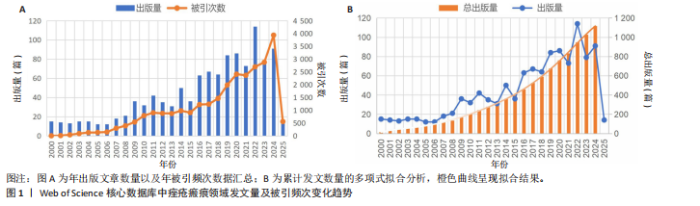
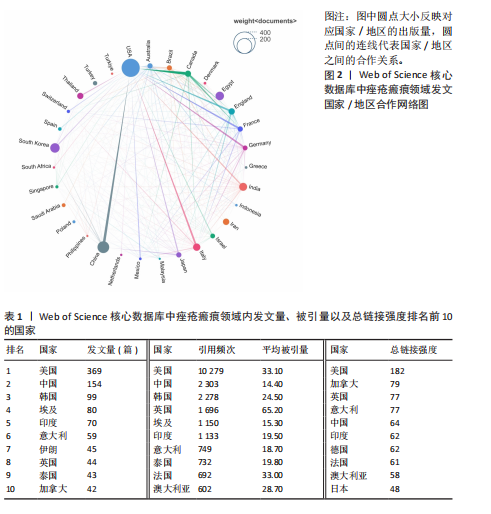
2.1 痤疮瘢痕领域年出版物发表与引用频次趋势 图1A所示为2000-2025年间痤疮瘢痕领域相关文章的年出版量与年引用频率。2个指标总体都呈现出增长的趋势,2022年是年发文量最高的一年,共计114篇,而年被引次数于2024年达到峰值(3 933次)。值得注意的是,由于数据收集工作在2025-02-28截止,因此2025年度统计数据仅涵盖部分文献,存在样本覆盖不全的局限性。对年累计发文量进行了多项式拟合,如图1B所示,其中拟合曲线的拟合公式为y=-6×10-5x6+0.004 8x5-0.137 3x4+1.921 3x3-12.243x2+45.217-22.117,拟合优度:R2=0.999 7,呈现出良好的上升趋势,同时具有较高的拟合优度。 2.2 痤疮瘢痕领域研究国家/地区贡献分析 表1呈现了痤疮瘢痕领域中发文量、被引次数以及总连接强度排名居前10的国家。在这些指标上,美国以绝对优势远超第二名,稳居首位,发文量达369篇,被引次数为10 279,由此可见美国在该研究领域的权威性。同时,中国(154篇,2 303次)、韩国(99篇,2 278次)以及英国(44篇,1 696次)等国家在该领域的贡献,亦构成了推动该领域持续发展的重要力量。值得注意的是,英国在痤疮瘢痕领域的文献平均被引量位列各国之首,这一量化指标不仅反映出英国该领域研究成果的质量优势,亦直观体现了它在痤疮瘢痕研究领域所具备的国际学术影响力。图2展示了痤疮瘢痕领域各国的学术产出情况及国家间的学术合作网络。图中圆点大小反映对应国家的出版量,这与表1的结果一致;从圆点间的连线可知,美国作为该领域研究的学术核心,在国际上建立了广泛的学术合作关系;此外,加拿大、英国等国家在学术交流中也较为活跃。值得注意的是,加拿大与美国之间的合作交流程度紧密,可能受到地理毗邻优势的影响,与此同时,虽然加拿大在该领域的发文数量不高,但总链接强度排"
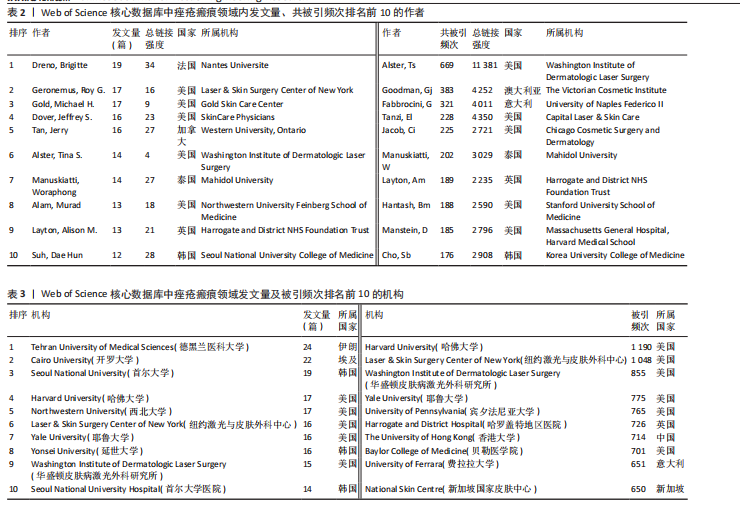
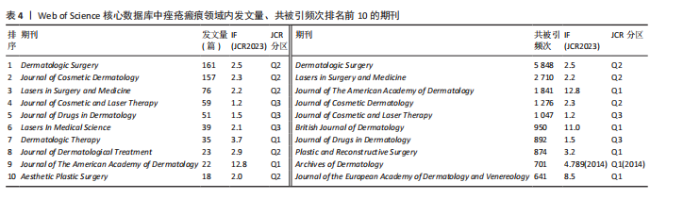
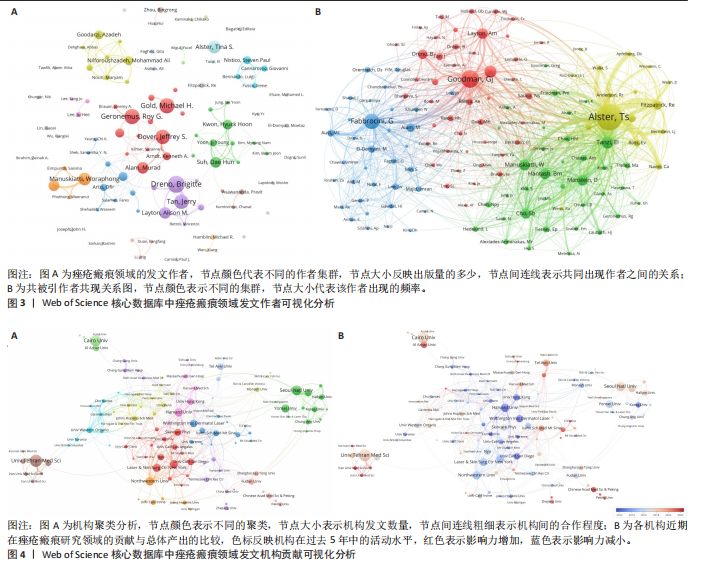
名第2,这也在一定程度上说明了加拿大专注研究质量。 2.3 痤疮瘢痕领域发文作者分析 表2所示为痤疮瘢痕领域内出版量与共被引次数排名前10的作者。法国作者Dreno, Brigitte有着最高的发文量(19篇),其次是美国的Geronemus, Roy G.(17篇)、Gold, Michael H.(17篇)等。Alster, Ts(共被引频次669)、Goodman, Gj(共被引频次383)、Fabbrocini, G(共被引频次321)等是该领域内受关注度较高的作者,代表他们的学术成果具有极高参考价值。 这些作者的合作关系在图3A上得到直观地呈现,其中有着最高出版量的Dreno, Brigitte被归入紫色聚类,与其联系紧密的还有同一聚类的Tan, Jerry与Layton, Alison M.等。Gold, Michael H.、Geronemus, Roy G.以及Dover, Jeffrey S.等所在的红色聚类代表了一个更为复杂的学术关系网。除此之外,还能看到以Manuskiatti, Woraphong为代表的橙色聚类、以Suh, Dae Hun为代表的绿色聚类以及以Goodarzi, Azadeh为代表的黄色聚类等,这些自发形成的聚类之间或多或少都存在着一定的地域属性。与之相反的,散在图周围的灰色圆点所代表的作者在该领域的研究中则较少参与到学术交流之中。 共被引分析是文献计量学中的一个重要分析方法[20],当多篇论文同时引用了2位或更多的作者时,这些被共同引用的作者就被称为共被引作者。图3B呈现了这些作者之间的共被引关系,可见图中主要形成了4个聚类,其中作者的共被引强度由圆点大小反映。红色聚类包括Goodman, Gj、Layton, Am、Dreno, B等作者;蓝色聚类囊括Fabbrocini, G、Alam, M、Aust, Mc等作者;黄色聚类包含Alster, Ts、Nanni, Ca、Fitzpatrick, Re等作者;最后Manuskiatti, W、Hantash, Bm以及Tanzi, El等作者被归入绿色聚类中,各聚类中的作者之间的研究内容存在更紧密的关联。 2.4 痤疮瘢痕领域发文机构分析 痤疮瘢痕领域内出版物数量与被引次数排名前10的机构如表3所示。出版量前3依次是伊朗的Tehran University of Medical Sciences(24篇)、埃及的Cairo University(22篇)以及韩国的Seoul National University(19篇),由此可见,这些机构在痤疮瘢痕相关研究内的大量投入。美国的Harvard University和Laser & Skin Surgery Center"
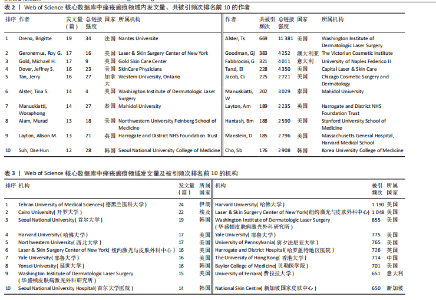
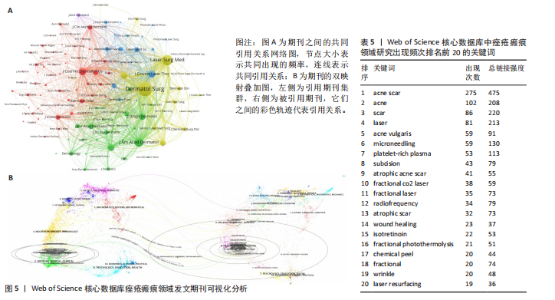
of New York在被引次数上均超过1 000次,代表它们的研究成果在学术界受到广泛关注与认可。各机构之间的合作关系可以通过图4A了解,图中聚类的形成依旧具有明显的地域属性,伊朗的University of Medical Sciences of Kerman、University of Tehran Medical Sciences和Iran University of Medical Sciences被分入棕色聚类中,韩国的Seoul National University、Hallym University以及Yonsei University等位于绿色聚类,还有位于图左上方的浅绿色聚类,包含Assiut University、Cairo University以及Al Azhar University等埃及机构,不难看出这3个聚类中的机构与国外机构之间的学术交流较少。而位于图中心的红色聚类则囊括了大多位于美国的机构,如Cornell University、University of California,Davis、University of California,Los Angeles等,从这些机构之间复杂繁多的连线可以看出,它们在该研究领域中起到学术枢纽的作用。在图4A的基础上叠加了对合作发生时间顺序的考量,结果如图4B所示,可以发现,颜色偏红的圆点如Iran University of Medical Sciences、University of Medical Sciences of Kerman以及中国医学科学院,这些机构是在近年来才逐渐投入到该领域的研究中。 2.5 痤疮瘢痕领域发文期刊分析 表4显示痤疮瘢痕领域内出版量与共被引量排名前10的期刊。《Dermatologic Surgery》(161篇)和《Journal of Cosmetic Dermatology》(157篇)收"
"
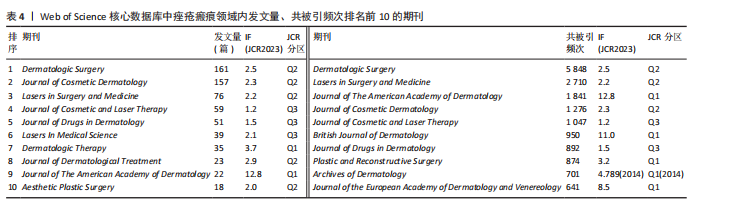
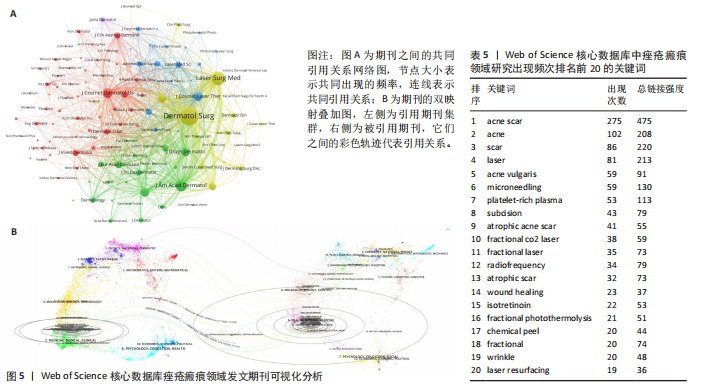
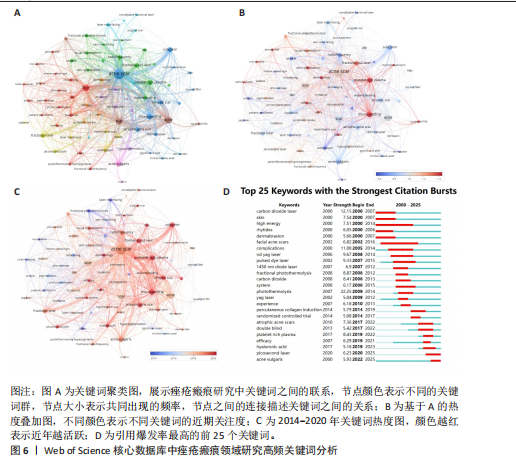
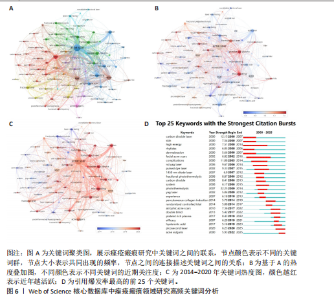
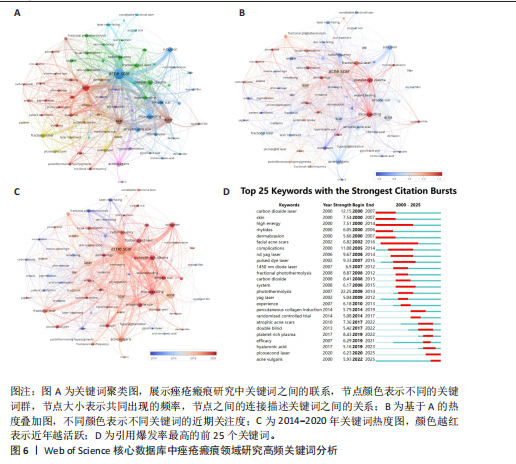
录文章超过了100篇,是该领域的核心期刊,同时《Dermatologic Surgery》还是受关注度最高的期刊,共被引次数达到5 848。图5A可视化了在痤疮瘢痕研究领域发表文章的期刊以及它们之间的共被引关系,依据这种关系将期刊分入5个聚类中。黄色聚类关注生物医学光学在外科及皮肤相关领域的应用,囊括《Dermatologic Surgery》《Lasers in Surgery and Medicine》等期刊。绿色聚类包括《Skin Therapy Letter》《European Journal of Dermatology》等关注皮肤病学基础研究的期刊。关注皮肤临床治疗、美容、修复再生等研究的期刊,如《Annals of Dermatology》《Journal of Cosmetic Dermatology》等被纳入红色聚类。蓝色聚类囊括《Photodermatology Photoimmunology & Photomedicine》《Aesthetic Plastic Surgery》等着重激光、光技术在美容皮肤科和整形手术中的应用研究的期刊。综合皮肤病多方面研究的期刊《JAMA Dermatology》居于紫色聚类中。图5B是期刊的双映射叠加图,引用关系由左侧的施引期刊通过中间的连线指向位于右侧的被引期刊,可以看到牙科学、皮肤病学以及外科学方向的期刊多引用健康学、护理学以及医学方向的期刊文献。 2.6 痤疮瘢痕领域发文关键词分析 关键词作为文章研究方向的指引与研究内容的凝练,能够高度概括文章主旨,因此,关键词分析在计量分析中占据重要地位,对把握研究领域现状、预测发展趋势意义重大。在痤疮瘢痕领域,通过对相关文献的分析发现,“acne scar(痤疮瘢痕)”的出现次数高达275,成为该领域最热门的关键词,紧随其后的是“acne(痤疮)”,出现次数为102,“scar(瘢痕)”(86次) “laser(激光)”(81次)等也频繁出现(表5)。从关键词共现关系来看(图6A),关注痤疮瘢痕医美治疗的关键词,如“acne scar(痤疮瘢痕)”“atrophic scar(萎缩性瘢痕)”“subcision(皮下分离术)”等被归为蓝色聚类;红色聚类聚焦于激光技术在皮肤美容与治疗方面的应用,涵盖“laser(激光)”“picossecond(皮秒)”“non-ablative(非剥脱性)”等名词;绿色聚类囊括了“fractional photothermolysis(点阵光热分解)” "
"
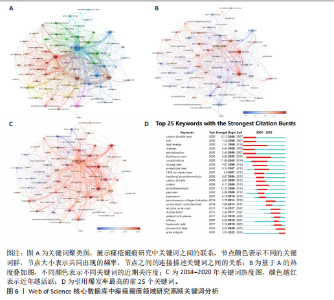
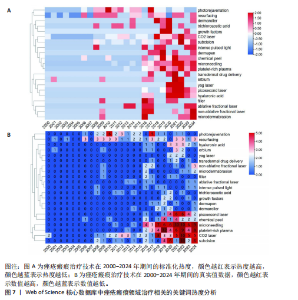
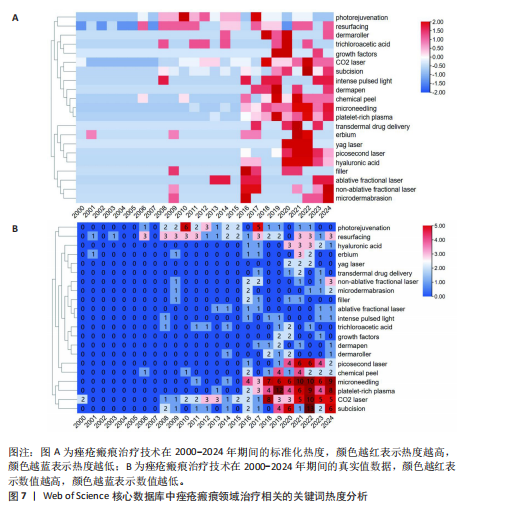
“radiofrequency(射频)”和“fractional co2 laser(二氧化碳点阵激光)”等与皮肤美容和修复治疗方向相关的术语;强调激光技术对瘢痕外观和质地修复的关键词,例如“nonablative fractional laser(非剥脱性点阵激光)” “laser resurfacing(激光换肤)”与“yag laser(钇铝石榴石激光)”等,被纳入青色和黄色聚类;基础名词如“acne vulgaris(寻常痤疮)” “cicatrix(瘢痕)”以及前文提及的“scar(瘢痕)” “acne(痤疮)”与其他关键词关联紧密,分别处于粉色和棕色聚类;橙色聚类包含“efficacy(疗效)” “safety(安全性)”以及“systematic review(系统评价)”等侧重于皮肤病学研究评估的关键词。结合图6B,C的信息可知,“platelet-rich plasm(富血小板血浆)”“microneedling(微针疗法)”“quality-of-life(生活质量)”等是当前热度较高的关键词,而“microneedling(微针疗法)” “atrophic scar(萎缩性瘢痕)” “subcision(皮下分离术)”等是近年来在该领域受到关注的术语。这些关键词在一定程度上代表了该领域当前研究的重点与难点。 具有最强引用爆发的前25个关键词如图6D所示。其中,“photothermolysis(光热解)”的爆发强度最高,数值为22.25;紧随其后的是“carbon dioxide laser(二氧化碳激光)”,爆发强度达12.15,“complications(并发症)”的爆发强度为11.08。尤为值得关注的是,“picosecond laser(皮秒激光)”与“acne vulgaris(寻常痤疮)”这2个关键词截至目前仍处于爆发期,爆发强度分别为6.23和5.93,表明它们可能揭示了该领域当前的前沿热点。 图7呈现了痤疮瘢痕领域治疗相关关键词在不同年份的热度分布,可为该领域研究热点与前沿动态的直观分析提供数据支撑。其中,图7A为痤疮瘢痕领域治疗相关关键词的标准化热度可视化结果,采用色彩梯度表征热度差异:红色越深代表关键词热度越高,蓝色越深代表关键词热度越低。在2000-2010年期间,该领域多数治疗技术相关关键词的热度较低,可视化结果中颜色以蓝色为主;自2010年起,部分治疗技术关键词的热度呈逐步上升趋势,尤其在2015年后,“dermaroller(微针滚轮)” “microneedling(微针疗法)” “platelet-rich plasma(富血小板血浆)” 等关键词的热度显著提升,对应可视化颜色转为深红色。 图7B 展示了2000-2024年痤疮瘢痕领域各治疗技术关键词热度的真实值。2000-2010年期间,多数治疗技术关键词的真实值较低,可视化颜色以蓝色为主,并且多个单元格数值为 0,提示这些治疗技术在该阶段的研究与应用频次较少;2015年以后,“microneedling(微针疗法)”“platelet-rich plasma(富血小板血浆)”“CO? laser(二氧化碳激光)”“subcision(皮下分离术)” 等技术关键词的真实值呈现明显上升趋势。 将图7A与图7B进行对比可见,治疗技术关键词热度的真实值变化趋势与标准化热度变化趋势基本一致,表明此次数据标准化处理未改变原始数据的整体变化规律,验证了标准化结果的可靠性。"
"
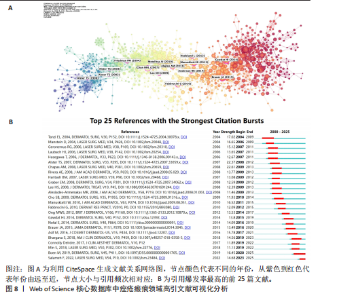
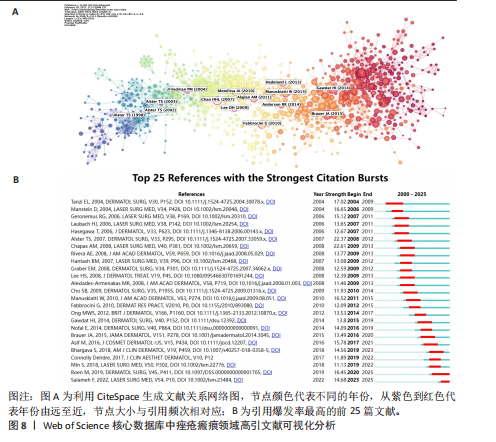
2.7 痤疮瘢痕领域引文分析 痤疮瘢痕领域内被引频次位居前15的文章相关信息,见表6。其中,WILLIAMS 等[3]学者于2012年在《Lancet》发表的“Acne vulgaris”一文备受瞩目,被引频次高达814,在这篇综述中,作者讨论了痤疮的病理生理机制、临床表现、治疗方法及其对患者心理的影响。此外,AVCI等[21]2013年在《Seminars in Cutaneous Medicine and Surgery》发表的“Low-Level Laser (Light) Therapy (LLLT) in Skin: Stimulating,Healing,Restoring”以及THIBOUTOT等[22]于2009年在《Journal of the American Academy of Dermatology》刊载的“New insights into the management of acne: An update from the Global Alliance to Improve Outcomes in Acne Group”,被引频次分别为608,561,也在该领域关注度排名靠前。 此次研究借助CiteSpace软件针对不同研究成果在时间序列上的关联性进行深入剖析,相关分析结果直观呈现于图8A。特别需要指出的是,图中以紫色圆圈标识的文献,在痤疮瘢痕研究领域演进历程中的研究内容与学术观点极有可能成为关键的转折点,例如,CHAN等[23]2007年在《Lasers in Surgery and Medicine》发表的“The prevalence and risk factors of post-inflammatory hyperpigmentation after fractional resurfacing in Asians”以及FABBROCINI团队[24]2010年在《Journal of the American Academy of "
"

Dermatology》刊发的“Percutaneous collagen induction: A new treatment for acne scarring”等。 引文爆发情况见于图8B。CHAPAS等[25]2008年在《Lasers in Surgery and Medicine》发表的“Successful treatment of acneiform scarring with CO2 ablative fractional resurfacing”以及ALSTER等[26]2007年在《Dermatologic Surgery》发表的“The use of fractional laser photothermolysis for the treatment of atrophic scars”,有着最高的引文爆发强度,分别达到22.61和22.37。截至2025-02-28,BOEN等[27]和SALAMEH等[28]的相关研究依旧处于高关注度的爆发期(爆发强度分别为16.45和14.68),这充分说明这些研究内容已成为当前痤疮瘢痕研究领域的焦点话题。"

| [1] JENNINGS T, DUFFY R, MCLARNEY M, et al. Acne scarring d pathophysiology, diagnosis, prevention and education: Part I. J Am Acad Dermatol. 2024; 90(6):1123-1134. [2] KUTLU O, KARADAG AS, WOLLINA U. Adult acne versus adolescent acne: a narrative review with a focus on epidemiology to treatment. An Bras Dermatol. 2023;98(1):75-83. [3] WILLIAMS HC, DELLAVALLE RP, GARNER S. Acne vulgaris. Lancet. 2012;379(9813):361-372. [4] BHATE K, WILLIAMS HC. Epidemiology of acne vulgaris. Br J Dermatol. 2013;168(3):474-485. [5] HENG AHS, CHEW FT. Systematic review of the epidemiology of acne vulgaris. Sci Rep. 2020; 10(1):5754. [6] CLARK AK, SARIC S, SIVAMANI RK. Acne Scars: How Do We Grade Them? Am J Clin Dermatol. 2018; 19(2):139-144. [7] FABBROCINI G, ANNUNZIATA MC, D’ARCO V, et al. Acne Scars: Pathogenesis, Classification and Treatment. Dermatol Res Pract. 2010;2010: 893080. [8] WEN Y, CAI Y, ZHANG LF, et al. Research Situation, Hotspots, and Global Trends in Laser Treatment of Acne Scars: A Bibliometric Analysis of Related Research From 2014 to 2024. J Cosmet Dermatol. 2025;24(2):e16663. [9] GOODMAN GJ. Management of post-acne scarring. What are the options for treatment? Am J Clin Dermatol. 2000;1(1):3-17. [10] CHEN JG, WAN YY, LIN Y, et al. Fractional Carbon Dioxide Laser or Erbium: Yttrium-Aluminum-Garnet Laser Assisted by Topical Application/Intradermal Injection of Platelet-Rich Plasma for Postacne Scars. Plast Reconstr Surg. 2021; 148(6):915e-927e. [11] LIU F, ZHOU QJ, TAO MC, et al. Efficacy and safety of CO2 fractional laser versus Er:YAG fractional laser in the treatment of atrophic acne scar: A meta-analysis and systematic review. J Cosmet Dermatol. 2024;23(9):2768-2778. [12] TAUDORF EH, DANIELSEN PL, PAULSEN IF, et al. Non-Ablative Fractional Laser Provides Long-Term Improvement of Mature Burn Scars-A Randomized Controlled Trial With Histological Assessment. Lasers Surg Med. 2015;47(2):141-147. [13] ELLEGAARD O, WALLIN JA. The bibliometric analysis of scholarly production: How great is the impact? Scientometrics. 2015;105(3):1809-1831. [14] PERIANES-RODRIGUEZ A, WALTMAN L, VAN ECK NJ. Constructing bibliometric networks: A comparison between full and fractional counting. J Informetr. 2016;10(4):1178-1195. [15] ZHOU W, PAN Y, SHU Q, et al. Dynamic Development Analysis of Complex Network Research: A Bibliometric Analysis. COmplexity. 2022. doi:10.1155/2022/1512939. [16] GARCÍA-PÉREZ MA. Accuracy and Completeness of Publication and Citation Records in the Web of Science, PsycINFO, and Google Scholar: A Case Study for the Computation of h Indices in Psychology. J Am Soc Inf Sci Technol. 2010;61(10): 2070-2085. [17] CHEN CM. CiteSpace II: Detecting and visualizing emerging trends and transient patterns in scientific literature. J Am Soc Inf Sci Technol. 2006;57(3):359-377. [18] XIE L, CHEN ZH, WANG HL, et al. Bibliometric and Visualized Analysis of Scientific Publications on Atlantoaxial Spine Surgery Based on Web of Science and VOSviewer. World Neurosurg. 2020;137:435-442.e4. [19] ARIA M, CUCCURULLO C. bibliometrix: An R-tool for comprehensive science mapping analysis. J Informetr. 2017;11(4):959-975. [20] BOYACK KW, KLAVANS R. Co-Citation Analysis, Bibliographic Coupling, and Direct Citation: Which Citation Approach Represents the Research Front Most Accurately? J Am Soc Inf Sci. 2010; 61(12):2389-2404. [21] AVCI P, GUPTA A, SADASIVAM M, et al. Low-Level Laser (Light) Therapy (LLLT) in Skin: Stimulating, Healing, Restoring. Semin Cutan Med Surg. 2013; 32(1):41-52. [22] THIBOUTOT D, GOLLNICK H, BETTOLI V, et al. New insights into the management of acne: An update from the Global Alliance to Improve Outcomes in Acne Group. J Am Acad Dermatol. 2009;60(5):S1-S50. [23] CHAN HH, MANSTEIN D, YU CS, et al. The prevalence and risk factors of post-inflammatory hyperpigmentation after fractional resurfacing in Asians. Lasers Surg Med. 2007;39(5):381-385. [24] FABBROCINI G, CHU AC, BRAZZINI B, et al. Percutaneous collagen induction: A new treatment for acne scarring. J Am Acad Dermatol. 2010;62(3):AB17. [25] CHAPAS AM, BRIGHTMAN L, SUKAL S, et al. Successful treatment of acneiform scarring with CO2 ablative fractional resurfacing. Lasers Surg Med. 2008;40(6):381-386. [26] ALSTER TS, TANZI EL, LAZARUS M. The use of fractional laser photothermolysis for the treatment of atrophic scars. Dermatol Surg. 2007;33(3):295-299. [27] BOEN M, JACOB C. A Review and Update of Treatment Options Using the Acne Scar Classification System. Dermatol Surg. 2019;45(3): 411-422. [28] SALAMEH F, SHUMAKER PR, GOODMAN GJ, et al. Energy-based devices for the treatment of acne scars: 2021 international consensus recommendations. Lasers Surg Med. 2022;54(1): 10-26. [29] JFRI A, ALAJMI A, ALAZEMI M, et al. Acne Scars: An Update on Management. Skin Therapy Lett. 2022;27(6):6-9. [30] ZHANG M, LIU CM, ZHANG SN, et al. Advances in the treatment of acne scars. Front Med (Lausanne). 2025;12:1643035. [31] TAHILIANI S, MYSORE V, GANJOO A, et al. Practical Aspects of Acne Scar Management: ASAP 2024. Cureus. 2024;16(3):e55897. [32] MOON J, YOON JY, YANG JH, et al. Atrophic acne scar: a process from altered metabolism of elastic fibres and collagen fibres based on transforming growth factor-β1 signalling. Br J Dermatol. 2019; 181(6):1226-1237. [33] ABDELWAHAB SI, TAHA MME, FARASANI A, et al. The most influential research in laser therapy for acne and acne scars: A bibliometric analysis. Lasers Med Sci. 2025;40(1):371. [34] WAIBEL JS, RUDNICK A. Current trends and future considerations in scar treatment. Semin Cutan Med Surg. 2015;34(1):13-16. [35] NARURKAR VA. Nonablative Fractional Laser Resurfacing. Dermatol Clin. 2009;27(4):473-478. [36] WANG J, HUANG LJ, LI J, et al. Efficacy and safety of sequential treatment with botulinum toxin type A, fractional CO2 laser, and topical growth factor for hypertrophic scar management: a retrospective analysis. Sci Rep. 2024;14(1):27233. [37] MEGHE S, SAOJI V, MADKE B, et al. Efficacy of Microneedling and CO2 Laser for Acne Scar Remodelling: A Comprehensive Review. Cureus. 2024;16(2):e55092. [38] ZHANG JB, GUO P, QIU MY, et al. A novel natural polysaccharide dissolving microneedle capable of adsorbing pus to load EGCG for the treatment of acne vulgaris. Mater Design. 2024;238:112639. [39] ZALDIVAR-FUJIGAKI JL, NAVA LA. Botulinum toxin A as monotherapy for syringoma. J Cosmet Dermatol. 2021;20(5):1393-1395. [40] GOODMAN GJ. The use of botulinum toxin as primary or adjunctive treatment for post acne and traumatic scarring. J Cutan Aesthet Surg. 2010;3(2):90-92. [41] ALVES NSD, REIGADO GR, SANTOS M, et al. Advances in regenerative medicine-based approaches for skin regeneration and rejuvenation. Front Bioeng Biotechnol. 2025; 13:1527854. [42] ALMADORI A, BUTLER PEM. Scarring and Skin Fibrosis Reversal with Regenerative Surgery and Stem Cell Therapy. Cells. 2024;13(5):443. [43] GAUGLITZ GG, JESCHKE MG. Combined Gene and Stem Cell Therapy for Cutaneous Wound Healing. Mol Pharm. 2011;8(5):1471-1479. [44] ZHANG WY, HUANG X. Stem cell-based drug delivery strategy for skin regeneration and wound healing: potential clinical applications. Inflamm Regen. 2023;43(1):33. [45] YU YL, XIAO HM, TANG GK, et al. Biomimetic hydrogel derived from decellularized dermal matrix facilitates skin wounds healing. Mater Today Bio. 2023;21:100725. [46] OTSUKA T, KAN HM, LAURENCIN CT. Regenerative Engineering Approaches to Scar-Free Skin Regeneration. Regen Eng Transl Med. 2022;8(2):225-247. [47] NING XL, JIANG LF, YU RX, et al. Advances in the Application of Noninvasive Skin Imaging Techniques in Acne Scars. Am J Clin Dermatol. 2024;25(5):823-835. [48] GILL SS, XU MX, OTTAVIANI C, et al. AI for next generation computing: Emerging trends and future directions. Internet of Things. 2022;19:100514. [49] KUROKAWA I, LAYTON AM, OGAWA R. Updated Treatment for Acne: Targeted Therapy Based on Pathogenesis. Dermatol Ther (Heidelb). 2021; 11(4):1129-1139. [50] MAHAJAN N, SOKER S, MURPHY SV. Regenerative Medicine Approaches for Skin Wound Healing: from Allografts to Engineered Skin Substitutes. Curr TRANS Rep. 2024;11(4):207-221. |
| [1] | Xu Canli, He Wenxing, Wang Yuping, Ba Yinying, Chi Li, Wang Wenjuan, Wang Jiajia. Research context and trend of TBK1 in autoimmunity, signaling pathways, gene expression, tumor prevention and treatment [J]. Chinese Journal of Tissue Engineering Research, 2026, 30(在线): 1-11. |
| [2] | Zhu Xiaolong, Zhang Wei, Yang Yang. Visualization analysis of research hotspots and cutting-edge information in the field of intervertebral disc regeneration and repair [J]. Chinese Journal of Tissue Engineering Research, 2026, 30(9): 2391-2402. |
| [3] | Wen Fayan, Li Yan, Qiang Tianming, Yang Chen, Shen Linming, Li Yadong, Liu Yongming. Unilateral biportal endoscopic technology for treatment of lumbar degenerative diseases: global research status and changing trends [J]. Chinese Journal of Tissue Engineering Research, 2026, 30(9): 2380-2390. |
| [4] | Huang Jie, Zeng Hao, Wang Wenchi, Lyu Zhucheng, Cui Wei. Visualization analysis of literature on the effect of lipid metabolism on osteoporosis [J]. Chinese Journal of Tissue Engineering Research, 2026, 30(6): 1558-1568. |
| [5] | Zhang Haiwen, Zhang Xian, Xu Taichuan, Li Chao. Bibliometric and visual analysis of the research status and trends of senescence in osteoporosis [J]. Chinese Journal of Tissue Engineering Research, 2026, 30(6): 1580-1591. |
| [6] | Yang Zeyu, Zhi Liang, Wang Jia, Zhang Jingyi, Zhang Qingfang, Wang Yulong, Long Jianjun. A visualized analysis of research hotspots in high-frequency repetitive transcranial magnetic stimulation from the macroscopic perspective [J]. Chinese Journal of Tissue Engineering Research, 2026, 30(5): 1320-1330. |
| [7] | He Renda, Ma Wei, Sun Yongsi, Mo Xueni. Future medical research on brain organoids: interdisciplinary training, bioengineering technologies, and optimized model maturity [J]. Chinese Journal of Tissue Engineering Research, 2026, 30(34): 9088-9094. |
| [8] | Bu Fanchen, Hua Zhen, , Li Xiaolong, Lyu Jinye, Man Hao, Wang Jianwei, . Triangular fibrocartilage complex injuries: a visualization analysis of treatment hotspots and frontiers [J]. Chinese Journal of Tissue Engineering Research, 2026, 30(34): 9095-9102. |
| [9] | Peng Hao, Chen Qigang, Shen Zhen. A visual analysis of research hotspots of H-type vessels in various bone diseases [J]. Chinese Journal of Tissue Engineering Research, 2026, 30(3): 760-769. |
| [10] | Zhang Anqi, Hua Haotian, Cai Tianyuan, Wang Zicheng, Meng Zhuo, Zhan Xiaoqian, Chen Guoqian . Pain after total knee arthroplasty: current status and trend analysis [J]. Chinese Journal of Tissue Engineering Research, 2026, 30(3): 795-804. |
| [11] | Wang Degang, Mei Junhua, Wang Junli, Zheng Li, Chen Guohua. Bibliometric and visualization analysis of the mechanism of osteogenic factors and neurotransmitters in the bone-brain axis [J]. Chinese Journal of Tissue Engineering Research, 2026, 30(29): 7724-7731. |
| [12] | Sun Kui, Huang Hailun, Wei Yatao, Liu Yongai, Gao Heng. Bibliometric analysis of exercise therapy interventions for adolescent idiopathic scoliosis [J]. Chinese Journal of Tissue Engineering Research, 2026, 30(29): 7755-7763. |
| [13] | Wang Lei, Hu Baoyang, Fang Fang. Bibliometric analysis of research hotspots on mitochondria and spinal cord injury treatment [J]. Chinese Journal of Tissue Engineering Research, 2026, 30(29): 7764-7772. |
| [14] | Liu Yan, Zuo Qingchun, Li Weiying, Wu Xubo. Research hotspots and trends of optogenetics in behavioral neuroscience [J]. Chinese Journal of Tissue Engineering Research, 2026, 30(28): 7396-7403. |
| [15] | Wang Xueting, Yang Wei, Wang Pengqin. Post-stroke rehabilitation robotics: current research status and hot topics in and outside China [J]. Chinese Journal of Tissue Engineering Research, 2026, 30(28): 7404-7409. |
| Viewed | ||||||
|
Full text |
|
|||||
|
Abstract |
|
|||||