Chinese Journal of Tissue Engineering Research ›› 2026, Vol. 30 ›› Issue (35): 9302-9308.doi: 10.12307/2026.442
Previous Articles Next Articles
Effects of exercise intervention on cortical excitability and motor performance in healthy populations: a meta-analysis based on transcranial magnetic stimulation measurements
Li Lei1, Zhao Qisheng2
- 1School of Physical Education, Nanchang Normal University, Nanchang 330032, Jiangxi Province, China; 2School of Physical Education, Dehong Normal University, Mangshi 678400, Yunnan Province, China
-
Received:2025-11-26Revised:2026-01-22Online:2026-12-18Published:2026-04-29 -
Contact:Zhao Qisheng, MS, Associate professor, School of Physical Education, Dehong Normal University, Mangshi 678400, Yunnan Province, China -
About author:Li Lei, PhD, Associate professor, Master’s supervisor, School of Physical Education, Nanchang Normal University, Nanchang 330032, Jiangxi Province, China -
Supported by:Jiangxi Provincial Department of Education Scientific Research Project, No. GJJ2202010 (to LL)

CLC Number:
Cite this article
Li Lei, Zhao Qisheng. Effects of exercise intervention on cortical excitability and motor performance in healthy populations: a meta-analysis based on transcranial magnetic stimulation measurements[J]. Chinese Journal of Tissue Engineering Research, 2026, 30(35): 9302-9308.
share this article
Add to citation manager EndNote|Reference Manager|ProCite|BibTeX|RefWorks
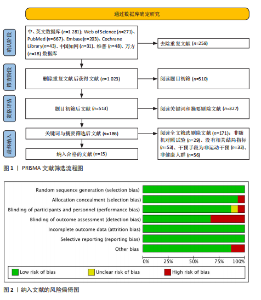
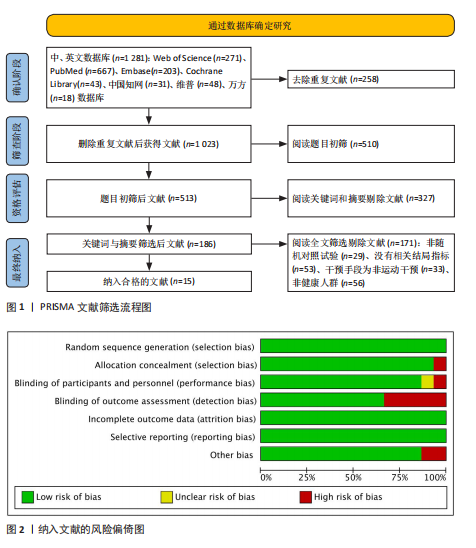
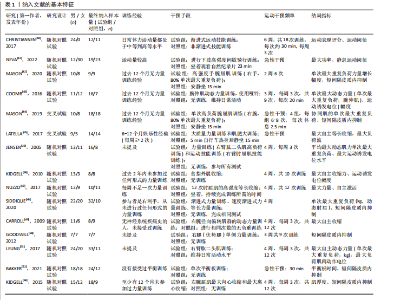
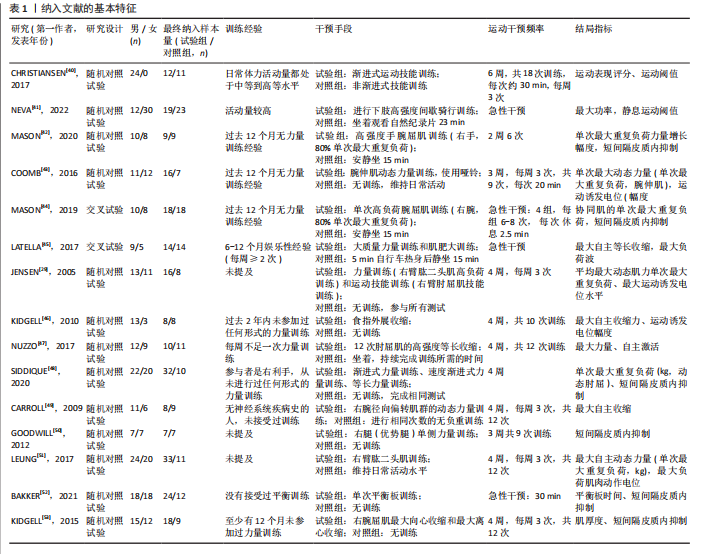
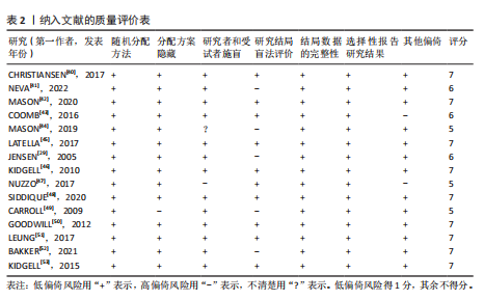
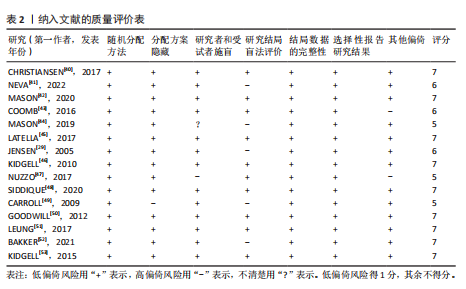
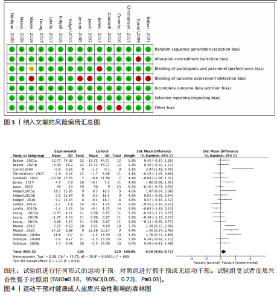
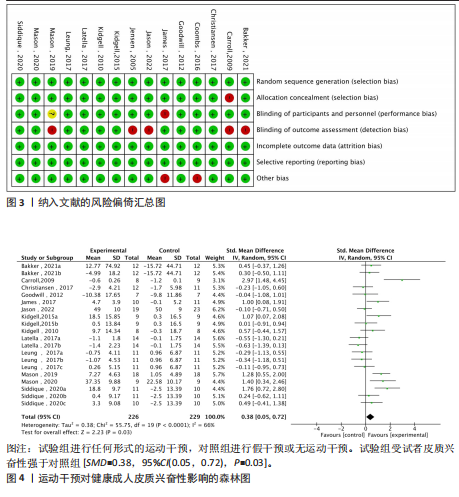
2.1 文献筛选结果 依据检索策略,初步共检索文献1 281篇(Web of Science数据库271 篇,PubMed数据库667篇,Embase数据库203篇,Cochrane Library数据库43篇,中国知网31篇,维普数据库48篇,万方数据库18篇),中文数据库检索的97篇文献,经严格筛选后未发现符合PICOS标准的合格研究(需同时报告经颅磁刺激皮质兴奋性指标和运动表现定量数据),故未纳入Meta分析。将所有文献导入EndNote 21软件,去除重复文献258篇后剩余1 023篇;随后,研究人员通过阅读标题初筛,剔除与研究主题无关及综述类文献510篇;经摘要筛选后,进一步排除文献327篇,剩余186篇;对剩余文献进一步阅读全文筛选,剔除非随机对照试验、无相关结局指标、非运动干预、非健康人群文献171篇,最终共纳入15篇文献用于Meta分析。具体文献筛选流程如图1 (PRISMA声明流程图)。 2.2 纳入文献的基本特征 所纳入文献的基本特征如表1所示。15篇文献包括13篇随机对照试验和2篇交叉随机对照试验,研究对象为健康成人,无神经或肌肉骨骼疾病;研究发表时间跨度为2005-2022年;总样本量为380,因部分文献存在受试者退出或随机交叉实验重复计入,表1中为实际纳入Meta分析的有效样本数,男性约占62%;试验组干预措施包括力量训练、运动技能训练、高强度间歇训练、平衡训练等,对照组通常为无训练、静坐、观看纪录片或维持日常活动;主要结局指标包括皮质兴奋性指标,如运动诱发电位幅度、短间隔皮质内抑制、运动阈值和最大复合肌肉动作电位,次要结局指标包括运动表现,如单次最大力量、最大自主等长收缩、最大力量、运动表现评分、平衡时间和肌肉厚度。 2.3 纳入文献的质量评价 采用Cochrane工具7项评估(总分7分),低偏倚风险用“+”表示(得1分),高偏倚风险用“-”表示(不得分),不清楚用“?”表示(不得分)。此次研究所纳入的15篇文献中,平均分数为6.4分,有9篇达到7分、3篇达到6分,见表2。图2所示,每个条目代表一个偏倚类型,颜色表示不同的风险等级:绿色(低风险)、黄色(不明确风险)、红色(高风险),从图中可以看出大多数研究在各个偏倚类别中均表现出低风险,但在研究结局盲法评价等方面仍然存在一定比例的高风险或不明确风险。图3所示,所纳入文献在各个偏倚类别下的具体评估情况。总体而言,纳入文献的质量较高。 2.4 Meta分析结果 2.4.1 大脑皮质兴奋性分析 在纳入的所有文献中,森林图(图4)呈现了运动干预对皮质兴奋性的总体效应分析,共纳入20项研究数据,其中标有a、b、c的研究来源于同一篇文章,但因试验设计将试验组分为3个亚组(分别接受不同类型的运动干预干预,如动态力量训练、速度渐进式训练和等长训练),在Meta分析中被视为独立研究处理。异质性检验显示研究间异质性较高(I2=66%,P < 0.000 1),选用随机效应模型进行分析,结果显示运动干预对"
"
"
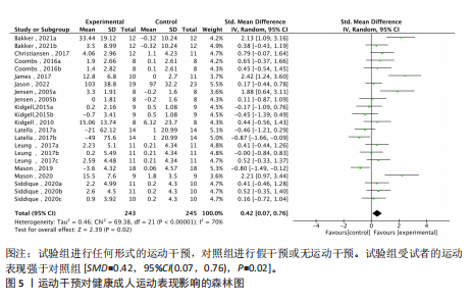
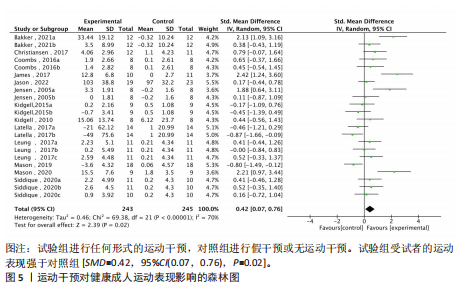
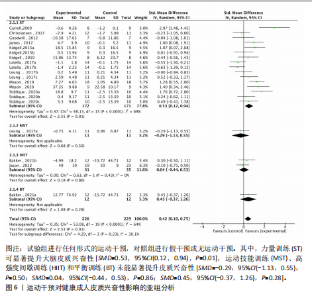
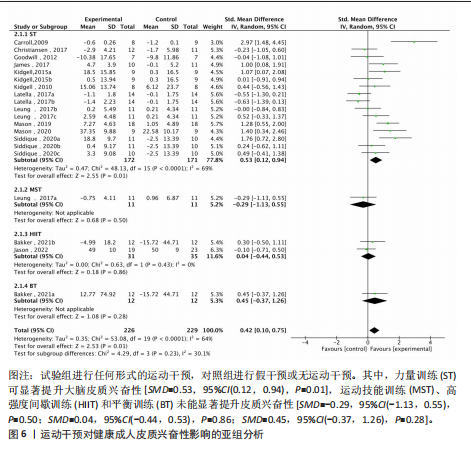
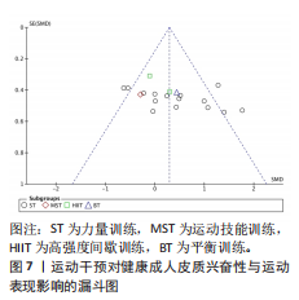
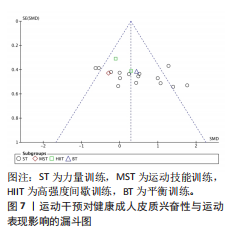
皮质兴奋性具有显著的正向效应[SMD=0.38,95%CI(0.05,0.72),P=0.03],效应量为小到中等。 2.4.2 运动表现分析 根据森林图(图5)的分析,纳入21项研究数据,系统评价了运动干预对运动表现的总体效应。异质性检验显示研究间异质性较高(I2=70%,P < 0.000 01),选用随机效应模型进行分析,结果显示试验组受试者的运动表现强于对照组[SMD=0.42,95%CI(0.07,0.76),P=0.02],效应量为中等。 2.4.3 亚组分析 如图所示(图6)展示了不同训练类型对皮质兴奋性影响的亚组分析结果,包括力量训练、运动技能训练、高强度间歇训练和平衡训练。总体而言,异质性检验显示研究间异质性较高(I2= 64%,P < 0.000 1),选用随机效应模型进行分析,结果显示运动干预显著提升了皮质兴奋性[SMD=0.42,95%CI(0.10,0.75),P=0.01]。其中,力量训练可显著提升皮质兴奋性[SMD=0.53,95%CI(0.12,0.94),P = 0.01],运动技能训练、高强度间歇训练和平衡训练未能显著提升皮质兴奋性[SMD=-0.29,95%CI(-1.13,0.55),P=0.50;SMD=0.04,95%CI(-0.44,0.53),P=0.86;SMD=0.45,95%CI(-0.37,1.26),P=0.28],表明力量训练可能是提升皮质兴奋性的最有效干预方式,而其他训练类型的效果尚需进一步验证。 2.5 发表偏倚风险分析 如图7所示,圆形代表力量训练亚组,红色菱形代表运动技能训练亚组,绿色方形代表高强度间歇训练亚组,蓝色三角形代表平衡训练亚组。从图形分布来看,各亚组数据点散布于图中不同区域,部分点靠近中心虚线,尽管数据点分布具有一定离散性,但未显示明显的集中趋势,表明各亚组数据分布较为均衡,未因亚组差异导致显著的分布异常。虽然少数数据点位于漏斗图边缘,可能存在小样本效应,但整体形态较为对称,提示此次Meta分析的发表偏倚风险较低。"
"
"
"
| [1] BARKER AT, JALINOUS R, Freeston IL. Non-invasive magnetic stimulation of human motor cortex. Lancet. 1985;1(8437):1106-1107. [2] TERGAU F, GEESE R, BAUER A, et al. Motor cortex fatigue in sports measured by transcranial magnetic double stimulation. Med Sci Sports Exerc. 2000;32(11):1942-1948. [3] GRALL-BRONNEC M, SAUVAGET A. The use of repetitive transcranial magnetic stimulation for modulating craving and addictive behaviours: a critical literature review of efficacy, technical and methodological considerations. Neurosci Biobehav Rev. 2014;47:592-613. [4] ZIEMANN U, REIS J, SCHWENKREIS P, et al. TMS and drugs revisited 2014. Clin Neurophysiol. 2015;126(10):1847-1868. [5] SPAMPINATO DA, IBANEZ J, ROCCHI L, et al. Motor potentials evoked by transcranial magnetic stimulation: interpreting a simple measure of a complex system. J Physiol. 2023; 601(14):2827-2851. [6] BÜTEFISCH CM, KHURANA V, KOPYLEV L, et al. Enhancing encoding of a motor memory in the primary motor cortex by cortical stimulation. J Neurophysiol. 2004;91(5):2110-2116. [7] FADIGA L, FOGASSI L, PAVESI G, et al. Motor facilitation during action observation: a magnetic stimulation study. J Neurophysiol. 1995;73(6):2608-2611. [8] CARROLL TJ, RIEK S, CARSON RG. Corticospinal responses to motor training revealed by transcranial magnetic stimulation. Exerc Sport Sci Rev. 2001;29(2):54-59. [9] CAO L, CHEN WZ, ZHANG LL. [Progress of transcranial magnetic stimulation-motor evoked potential and its forensic application]. Fa Yi Xue Za Zhi. 2011;27(2):139-141. [10] BARKER AT. An introduction to the basic principles of magnetic nerve stimulation. J Clin Neurophysiol. 1991;8(1):26-37. [11] MOSCATELLI F, MESSINA A, VALENZANO A, et al. Transcranial Magnetic Stimulation as a Tool to Investigate Motor Cortex Excitability in Sport. Brain Sci. 2021;11(4):432. [12] LIOUMIS P, ROINE T, GRANÖ I, et al. Optimization of TMS target engagement: current state and future perspectives. Front Neurosci. 2025;19: 1517228. [13] WANG Y, GAO H, QI M. Left dorsolateral prefrontal cortex activation can accelerate stress recovery: A repetitive transcranial stimulation study. Psychophysiology. 2023; 60(10): e14352. [14] AKPıNAR K, OĞUZHANOĞLU NK, UĞURLU TT. Efficacy of transcranial magnetic stimulation in treatment-resistant depression. Turk J Med Sci. 2022;52(4):1344-1354. [15] DELANEY K, NAKONEZNY PA, BUYUKTASKIN D, et al. Trajectories of Irritability Improvement in Depressed Adolescents Treated With 1 Hz and 10 Hz Transcranial Magnetic Stimulation. Clin Psychiatry. 2025;86(2):24m15684. [16] CARMI L, TENDLER A, BYSTRITSKY A, et al. Efficacy and Safety of Deep Transcranial Magnetic Stimulation for Obsessive-Compulsive Disorder: A Prospective Multicenter Randomized Double-Blind Placebo-Controlled Trial. Am J Psychiatry. 2019;176(11):931-938. [17] CHUNG CL, MAK MK, HALLETT M. Transcranial Magnetic Stimulation Promotes Gait Training in Parkinson Disease. Ann Neurol. 2020;88(5):933-945. [18] SABBAGH M, SADOWSKY C, TOUSI B, et al. Effects of a combined transcranial magnetic stimulation (TMS) and cognitive training intervention in patients with Alzheimer’s disease. Alzheimers Dement. 2020;16(4):641-650. [19] CARVALHO L, JUNIOR RM, BARREIRA J, et al. Muscle hypertrophy and strength gains after resistance training with different volume-matched loads: a systematic review and meta-analysis. Appl Physiol Nutr Metab. 2022;47(4):357-368. [20] ELIE D, BARBIER F, IDO G, et al. Corticomuscular Coherence and Motor Control Adaptations after Isometric Maximal Strength Training. Brain Sci. 2021;11(2):254. [21] WOODHEAD A, NORTH JS, HILL J, et al. Corticospinal and spinal adaptations following lower limb motor skill training: a meta-analysis with best evidence synthesis. Exp Brain Res. 2023;241(3):807-824. [22] COATES A M, JOYNER MJ, LITTLE JP, et al. A Perspective on High-Intensity Interval Training for Performance and Health. Sports Med. 2023; 53(Suppl 1):85-96. [23] 王悦同,彭亮,苏玉莹,等.平衡训练对慢性踝关节不稳影响效果的Meta分析[J].中国组织工程研究,2024,28(24):3930-3936. [24] ADKINS DL, BOYCHUK J, REMPLE MS, et al. Motor training induces experience-specific patterns of plasticity across motor cortex and spinal cord. J Appl Physiol (1985). 2006;101(6):1776-1782. [25] 路毅,邓文冲.不同运动方式对大脑结构及认知功能的调节作用及差异[J].中国组织工程研究,2021,25(20):3252-3258. [26] MOSCATELLI F, MESSINA G, VALENZANO A, et al. Functional Assessment of Corticospinal System Excitability in Karate Athletes. PLoS One. 2016;11(5):e0155998. [27] MOSCATELLI F, MESSINA G, VALENZANO A, et al. Differences in corticospinal system activity and reaction response between karate athletes and non-athletes. Neurol Sci. 2016;37(12):1947-1953. [28] MOSCATELLI F, VALENZANO A, PETITO A, et al. Relationship between blood lactate and cortical excitability between taekwondo athletes and non-athletes after hand-grip exercise. Somatosens Mot Res. 2016;33(2):137-144. [29] JENSEN JL, MARSTRAND PC, NIELSEN JB. Motor skill training and strength training are associated with different plastic changes in the central nervous system. J Appl Physiol (1985). 2005;99(4):1558-1568. [30] COCO M, PERCIAVALLE V, CAVALLARI P, et al. Effects of an Exhaustive Exercise on Motor Skill Learning and on the Excitability of Primary Motor Cortex and Supplementary Motor Area. Medicine (Baltimore). 2016;95(11):e2978. [31] PEARCE AJ, HENDY A, BOWEN WA, et al. Corticospinal adaptations and strength maintenance in the immobilized arm following 3 weeks unilateral strength training. Scand J Med Sci Sports. 2013;23(6):740-748. [32] MOSCATELLI F, MESSINA G, VALENZANO A, et al. Effects of twelve weeks’ aerobic training on motor cortex excitability. J Sports Med Phys Fitness. 2020;60(10):1383-1389. [33] MOHER D, LIBERATI A, TETZLAFF J, et al. Preferred Reporting Items for Systematic Reviews and Meta-Analyses: The PRISMA Statement. Ann Intern Med. 2009;151(4):264-269,W64. [34] MAEO S, BALSHAW TG, LANZA MB, et al. Corticospinal excitability and motor representation after long-term resistance training. Eur J Neurosci. 2021;53(10):3416-3432. [35] HORTOBÁGYI T, RICHARDSON SP, LOMAREV M, et al. Interhemispheric plasticity in humans. Med Sci Sports Exerc. 2011;43(7):1188-1199. [36] COLOMER-POVEDA D, ROMERO-ARENAS S, KELLER M, et al. Effects of acute and chronic unilateral resistance training variables on ipsilateral motor cortical excitability and cross-education: A systematic review. Phys Ther Sport. 2019:40:143-152. [37] COHEN J, COHEN P, WEST SG, et al. Applied multiple regression/correlation analysis for the behavioral sciences. New York:Routledge, 2013. [38] BARILI F, PAROLARI A, KAPPETEIN PA, et al. Statistical Primer: heterogeneity, random- or fixed-effects model analyses? Interact Cardiovasc Thorac Surg. 2018;27(3):317-321. [39] RENDINA-GOBIOFF G. Detecting publication bias in random effects meta -analysis: An empirical comparison of statistical methods. USF Tampa Graduate Theses and Dissertations, 2006. [40] CHRISTIANSEN L, LARSEN MN, GREY MJ, et al. Long-term progressive motor skill training enhances corticospinal excitability for the ipsilateral hemisphere and motor performance of the untrained hand. Eur J Neurosci. 2017;45(12): 1490-1500. [41] NEVA JL, GREELEY B, CHAU B, et al. Acute High-Intensity Interval Exercise Modulates Corticospinal Excitability in Older Adults. Med Sci Sports Exerc. 2022;54(4):673-682. [42] MASON J, FRAZER AK, AVELA J, et al. Tracking the corticospinal responses to strength training. Eur J Appl Physiol. 2020;120(4):783-798. [43] COOMBS TA, FRAZER AK, HORVATH DM, et al. Cross-education of wrist extensor strength is not influenced by non-dominant training in right-handers. Eur J Appl Physiol. 2016;116(9): 1757-1769. [44] MASON J, HOWATSON G, FRAZER AK, et al. Modulation of intracortical inhibition and excitation in agonist and antagonist muscles following acute strength training. Eur J Appl Physiol. 2019;119(10):2185-2199. [45] LATELLA C, TEO WP, HARRIS D, et al. Effects of acute resistance training modality on corticospinal excitability, intra-cortical and neuromuscular responses. Eur J Appl Physiol. 2017;117(11):2211-2224. [46] KIDGELL DJ, PEARCE AJ. Corticospinal properties following short-term strength training of an intrinsic hand muscle. Hum Mov Sci. 2010;29(5): 631-641. [47] NUZZO JL, BARRY BK, JONES MD, et al. Effects of Four Weeks of Strength Training on the Corticomotoneuronal Pathway. Med Sci Sports Exerc. 2017;49(11):2286-2296. [48] SIDDIQUE U, RAHMAN S, FRAZER A, et al. Task-dependent modulation of corticospinal excitability and inhibition following strength training. J Electromyogr Kinesiol. 2020;52: 102411. [49] CARROLL TJ, BARTON J, HSU M, et al. The effect of strength training on the force of twitches evoked by corticospinal stimulation in humans. Acta Physiol (Oxf). 2009;197(2):161-173. [50] GOODWILL AM, PEARCE AJ, KIDGELL DJ. Corticomotor plasticity following unilateral strength training. Muscle Nerve. 2012;46(3):384-393. [51] LEUNG M, RANTALAINEN T, TEO WP, et al. The corticospinal responses of metronome-paced, but not self-paced strength training are similar to motor skill training. Eur J Appl Physiol. 2017;117(12):2479-2192. [52] BAKKER LBM, NANDI T, LAMOTH CJC, et al. Task specificity and neural adaptations after balance learning in young adults. Hum Mov Sci. 2021;78:102833. [53] KIDGELL DJ, FRAZER AK, DALY RM, et al. Increased cross-education of muscle strength and reduced corticospinal inhibition following eccentric strength training. Neuroscience. 2015;300:566-575. [54] AAGAARD P, SIMONSEN EB, ANDERSEN J L, et al. Neural adaptation to resistance training: changes in evoked V-wave and H-reflex responses. J Appl Physiol (1985). 2002;92(6):2309-2318. [55] GREEN LA, GABRIEL DA. The cross education of strength and skill following unilateral strength training in the upper and lower limbs. J Neurophysiol. 2018;120(2):468-479. [56] WIEGEL P, LEUKEL C. Training of a discrete motor skill in humans is accompanied by increased excitability of the fastest corticospinal connections at movement onset. J Physiol. 2020;598(16): 3485-3500. [57] GóMEZ-FERIA J, MARTíN-RODRÍGUEZ JF, MIR P. Corticospinal adaptations following resistance training and its relationship with strength: A systematic review and multivariate meta-analysis. Neurosci Biobehav Rev. 2023;152:105289. [58] GORDON T, JEANFAVRE M, LEFF G. Effects of Tempo-Controlled Resistance Training on Corticospinal Tract Plasticity in Healthy Controls: A Systematic Review. Healthcare (Basel). 2024; 12(13):1325. [59] KIDGELL DJ, STOKES MA, PEARCE AJ. Strength Training of One Limb Increases Corticomotor Excitability Projecting to the Contralateral Homologous Limb. Motor Control. 2011;15(2): 247-266. [60] GÖKÇE E, ADIGÜZEL E, KOÇAK ÖK, et al. Impact of Acute High-intensity Interval Training on Cortical Excitability, M1-related Cognitive Functions, and Myokines: A Randomized Crossover Study. Neuroscience. 2024;551:290-298. [61] LIANG C, LIU H. Effects and mechanisms of resistance training on corticospinal adaptation. Front Physiol. 2025;16:1569639. [62] MASON J, FRAZER AK, JABERZADEH S, et al. Determining the Corticospinal Responses to Single Bouts of Skill and Strength Training. J Strength Cond Res. 2019;33(9):2299-2307. [63] RODRIGUES L, MONCION K, DE LAS HERAS B, et al. Modulating Brain Excitability with Cardiovascular Exercise in Chronic Stroke: A Randomized Controlled Trial. Neurorehabil Neural Repair. 2025;39(10):801-813. [64] MOUTHON A, TAUBE W. Intracortical Inhibition Increases during Postural Task Execution in Response to Balance Training. Neuroscience. 2019;401:35-42. [65] EGGER S, WÄLCHLI M, RÜEGER E, et al. Short-term balance consolidation relies on the primary motor cortex: a rTMS study. Sci Rep. 2023;13(1):5169. [66] CHRISTIANSEN L, LARSEN MN, MADSEN MJ, et al. Long-term motor skill training with individually adjusted progressive difficulty enhances learning and promotes corticospinal plasticity. Sci Rep. 2020;10(1):15588. |
| [1] | He Yixiang, Qiao Wanjia, Wang Wenji. Effectiveness and safety of tranexamic acid versus epsilon-aminocaproic acid in total hip and knee arthroplasties: a meta-analysis [J]. Chinese Journal of Tissue Engineering Research, 2026, 30(9): 2361-2369. |
| [2] | Liu Jinlong, Abuduwupuer·Haibier, Bai Zhen, Su Danyang, Miao Xin, Li Fei, Yang Xiaopeng. Efficacy of different nonsurgical treatments for adolescent idiopathic scoliosis: a systematic review and network meta-analysis [J]. Chinese Journal of Tissue Engineering Research, 2026, 30(9): 2370-2379. |
| [3] | Gao Feng, Zhang Jun, Yu Wenjun, Chanyu Yujing, Zhao Le, Hu Yuting, Wang Junhua, Liu Yongfu. Effects of wrist-hand orthosis on hand dysfunction in stroke patients: a meta-analysis [J]. Chinese Journal of Tissue Engineering Research, 2026, 30(8): 2124-2131. |
| [4] | Wang Zhenze, Liu Fende, Zhang Rui, Li Wujun. Mesenchymal stem cells in treatment of arteriosclerosis obliterans of lower extremities: systematic review and meta-analysis [J]. Chinese Journal of Tissue Engineering Research, 2026, 30(7): 1869-1876. |
| [5] | Sun Yaotian, Xu Kai, Wang Peiyun. Potential mechanisms by which exercise regulates iron metabolism in immune inflammatory diseases [J]. Chinese Journal of Tissue Engineering Research, 2026, 30(6): 1486-1498. |
| [6] | Cao Xinyan, Yu Zifu, Leng Xiaoxuan, Gao Shiai, Chen Jinhui, Liu Xihua. Effect of repetitive transcranial magnetic stimulation and transcranial direct current stimulation on motor function and gait in children with cerebral palsy: a network meta-analysis [J]. Chinese Journal of Tissue Engineering Research, 2026, 30(6): 1539-1548. |
| [7] | Zheng Yin, Wu Zhenhua, Zhang Cheng, Ruan Kexin, Gang Xiaolin, Ji Hong. Safety and efficacy of immunoadsorption therapy for rheumatoid arthritis: a network meta-analysis and systematic review [J]. Chinese Journal of Tissue Engineering Research, 2026, 30(5): 1260-1268. |
| [8] | Chen Qiang, Wu Wenjuan, Jiang Shuhua, Huang Da. Physical exercise improves physical function in burn patients: a systematic review and meta-analysis [J]. Chinese Journal of Tissue Engineering Research, 2026, 30(5): 1269-1281. |
| [9] | Leng Xiaoxuan, Zhao Yuxin, Liu Xihua. Effects of different neuromodulatory stimulation modalities on non-motor symptoms in Parkinson’s patients: a network meta-analysis [J]. Chinese Journal of Tissue Engineering Research, 2026, 30(5): 1282-1293. |
| [10] | Wen Xiaolong, Weng Xiquan, Feng Yao, Cao Wenyan, Liu Yuqian, Wang Haitao. Effects of inflammation on serum hepcidin and iron metabolism related parameters in patients with type 2 diabetes mellitus: a meta-analysis [J]. Chinese Journal of Tissue Engineering Research, 2026, 30(5): 1294-1301. |
| [11] | Yang Zeyu, Zhi Liang, Wang Jia, Zhang Jingyi, Zhang Qingfang, Wang Yulong, Long Jianjun. A visualized analysis of research hotspots in high-frequency repetitive transcranial magnetic stimulation from the macroscopic perspective [J]. Chinese Journal of Tissue Engineering Research, 2026, 30(5): 1320-1330. |
| [12] | Jiang Yang, Peng Hao, Song Yanping, Yao Na, Song Yueyu, Yin Xingxiao, Li Yanqi, Chen Qigang. Isometric exercise reduces resting blood pressure: a meta-analysis of moderating factors and dose effects [J]. Chinese Journal of Tissue Engineering Research, 2026, 30(4): 975-986. |
| [13] | Li Hanyue, Li Yini, Xiang Linmei, Li Sen. Effects of resistance exercise therapy on pain and function in patients with cervical spondylotic radiculopathy: a meta-analysis [J]. Chinese Journal of Tissue Engineering Research, 2026, 30(4): 987-996. |
| [14] | Sun Jiahe, Shi Jipeng, Zhu Tianrui, Quan Helong, Xu Hongqi. Effect of exercise intervention in elderly individuals with sarcopenia and its comorbidities: a meta-analysis [J]. Chinese Journal of Tissue Engineering Research, 2026, 30(4): 997-1007. |
| [15] | Yang Yuanyuan, Zhou Shanshan, Cheng Xiaofei, Feng Luye, Tang Jiqin. Network meta-analysis of non-invasive brain stimulation in the treatment of lower limb motor dysfunction after stroke [J]. Chinese Journal of Tissue Engineering Research, 2026, 30(4): 1008-1018. |
| Viewed | ||||||
|
Full text |
|
|||||
|
Abstract |
|
|||||