Chinese Journal of Tissue Engineering Research ›› 2026, Vol. 30 ›› Issue (35): 9217-9230.doi: 10.12307/2026.254
Previous Articles Next Articles
Regulatory effects of Yuping Shen’an Granules on neuronal autophagy in a mouse model of insomnia
Wang Yuhe1,2, Xie Tianyu1,2, Ma Shijia1,2, Wang Yujiao1,2, Li Mengting1,2, Xie Daojun2,3,*
- 1Anhui University of Chinese Medicine, Hefei 230038, Anhui Province, China; 2The First Clinical College of Anhui University of Chinese Medicine, Hefei 230031, Anhui Province, China; 3The First Affiliated Hospital of Anhui University of Chinese Medicine, Hefei 230031, Anhui Province, China
-
Received:2025-09-11Revised:2025-11-28Online:2026-12-18Published:2026-04-28 -
Contact:Xie Daojun, MD, Professor, Chief physician, Doctoral supervisor, The First Clinical College of Anhui University of Chinese Medicine, Hefei 230031, Anhui Province, China; The First Affiliated Hospital of Anhui University of Chinese Medicine, Hefei 230031, Anhui Province, China -
About author:Wang Yuhe, MS candidate, Anhui University of Chinese Medicine, Hefei 230038, Anhui Province, China; The First Clinical College of Anhui University of Chinese Medicine, Hefei 230031, Anhui Province, China -
Supported by:National Natural Science Foundation of China, No. 81874389 (to XDJ)

CLC Number:
Cite this article
Wang Yuhe, Xie Tianyu, Ma Shijia, Wang Yujiao, Li Mengting, Xie Daojun. Regulatory effects of Yuping Shen’an Granules on neuronal autophagy in a mouse model of insomnia[J]. Chinese Journal of Tissue Engineering Research, 2026, 30(35): 9217-9230.
share this article
Add to citation manager EndNote|Reference Manager|ProCite|BibTeX|RefWorks
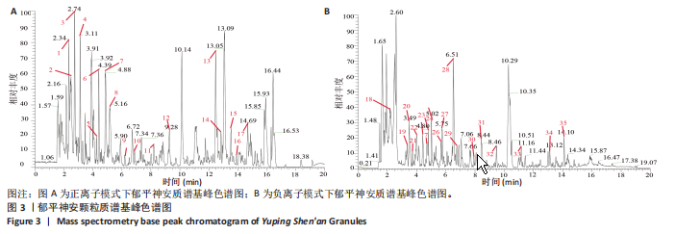
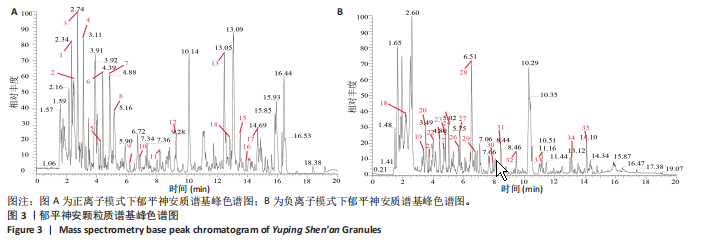
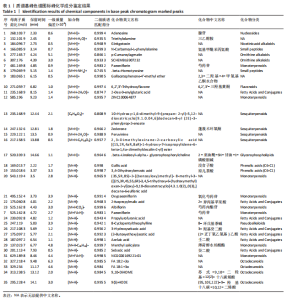
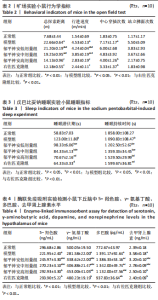
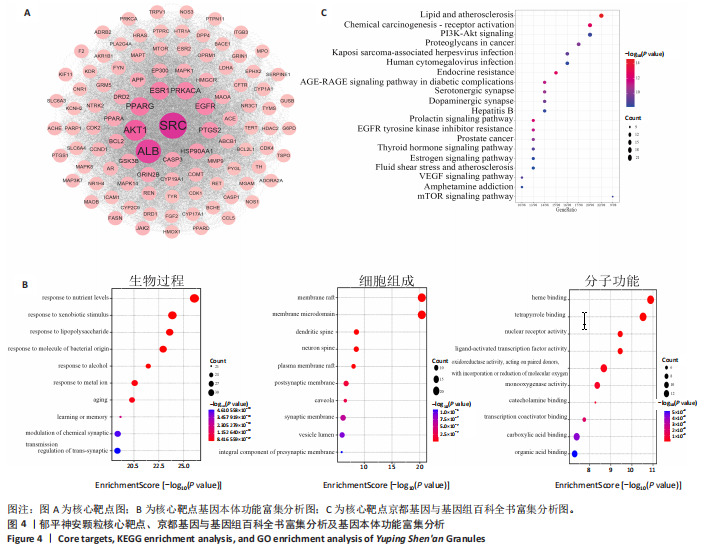
2.1 郁平神安的主要组成部分 通过超高效液相色谱-质谱联用技术及中药高分辨质谱数据库进行化合物鉴定,一级质量误差< 25×10-6,二级碎裂谱图匹配度score > 0.7,共鉴定出郁平神安颗粒中共有2 276种成分。在中药正、负离子基峰色谱图中,分别对丰度较高的色谱峰进行峰形确认、二级谱图检查,然后在正负离子图中依次按数字顺序标记色谱峰序号,共标记出35个色谱峰,总离子色谱图见图3,鉴定35个化合物信息见表1。 2.2 网络药理学分析结果 郁平神安和疾病相关的共有靶点400个。使用Cytoscape 3.10.3进行拓扑分析后,选择了介数中心数前100个作为核心靶点。使用R语言的org.Hs.eg.db和ClusterProfiler包对100个核心靶点进行基因本体功能、京都基因与基因组百科全书富集分析。蛋白互作结果显示郁平神安治疗失眠伴焦虑的核心靶点包括SRC、ALB、AKT1、PPARG、ESR1等见图4A)。核心靶点基因本体功能富集结果见图4B,主要涉及神经递质紊乱、自噬功能障碍、对外源性刺激的异常应答、突触可塑性紊乱及氧化应激反应。京都基因与基因组百科全书富集结果见图4C,郁平神安治疗失眠伴焦虑与自噬异常激活、炎症免疫反应、氧化应激过程、神经递质失衡、下丘脑-垂体-肾上腺轴功能紊乱、生物钟失调以及神经炎症反应等机制有关,参与神经递质信号传导、应激反应通路、昼夜节律相关通路、晚期糖基化终末产物-晚期糖基化终末产物受体信号通路、血管内皮生长因子信号通路、磷脂酰肌醇3激酶/蛋白激酶B/哺乳动物雷帕霉素靶蛋白等信号通路的调控。 2.3 郁平神安对失眠小鼠行为学的影响 在慢性不可预知温和刺激期间,小鼠异常行为显著增加,表现为攻击性增强、坐立不安、出现撕咬等异常现象。对氯苯丙氨酸作为色氨酸羟化酶的抑制剂,可选择性地减少啮齿类动物体内5-羟色胺的合成,导致失眠。对氯苯丙氨酸腹腔注射后,小鼠出现昼夜节律消失,白天持续活动,兴奋性和攻击性增加,毛发暗淡蓬乱。旷场实验结果显示(表2),与正常组相比,模型组总探索距离、行进速度以及中心穿插次数显著增加(P < 0.01)。给药治疗后,与模型组相比,郁平神安高剂量组以及右佐匹克隆组的总探索距离、行进速度、中心穿插次数均显著减少(P < 0.01,P < 0.05)。与右佐匹克隆组相比,郁平神安低、中剂量组总探索距离、行进速度显著增加(P < 0.01),郁平神安高剂量组总探索距离、行进速度无显著差异(P > 0.05),郁平神安低、中、高剂量组中心穿插次数无显著差异(P > 0.05)。站立拂面次数各组间均无统计学意义。戊巴比妥钠睡眠实验显示(表3),与正常组相比,模型组睡眠潜伏期延长、睡眠持续时间明显缩短(P < 0.01),给药治疗后,与模型组相比,郁平神安高剂量组以及右佐匹克隆组的睡眠潜伏期缩短、睡眠持续时间显著增加(P < 0.01)。与右佐匹克隆组相比,郁平神安低、中剂量组睡眠潜伏期延长、睡眠持续时间显著缩短(P < 0.01),郁平神安高剂量组睡眠潜伏期、睡眠持续时间无显著差异(P > 0.05)。根据行为学实验结果,郁平神安在改善失眠伴焦虑状态方面具有良好的应用价值。 2.4 酶联免疫吸附实验分析结果 酶联免疫吸附实验结果显示(表4),与正常组相比,模型组5-羟色胺、γ-氨基丁酸水平显"
"
"

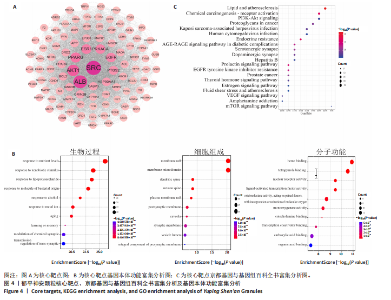
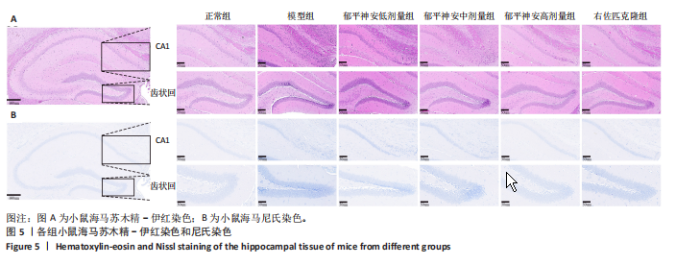
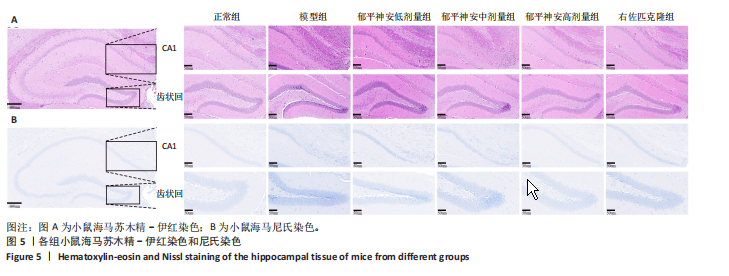
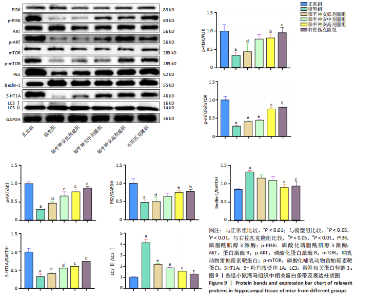
著降低,多巴胺、去甲肾上腺素水平显著升高(P < 0.01)。与模型组相比,郁平神安干预后可剂量依赖性地提高5-羟色胺、γ-氨基丁酸水平,降低多巴胺、去甲肾上腺素水平(P < 0.01)。与右佐匹克隆组相比,郁平神安低、中剂量组5-羟色胺、γ-氨基丁酸水平降低,多巴胺、去甲肾上腺素水平升高(P < 0.01),郁平神安高剂量组多巴胺水平升高(P < 0.01),郁平神安高剂量组5-羟色胺、γ-氨基丁酸、去甲肾上腺素水平无显著差异(P > 0.05),结果提示郁平神安可能通过降低兴奋性神经递质水平,提高抑制性神经递质水平,改善小鼠失眠伴焦虑状态。 2.5 苏木精-伊红染色和尼氏染色结果 正常组海马神经元排列整齐,分布均匀,胞质完整,染色深,核大而圆,尼氏染色可见丰富的尼氏囊泡,未见明显病理改变。苏木精-伊红染色显示(图5A),模型组海马组织的齿状回和CA1区域观察到神经元变性、细胞排列松散、暗染色和细胞萎缩;与模型组相比,郁平神安低、中、高剂量组及右佐匹克隆组海马神经元数量增多,细胞形态完整,排列整齐,部分细胞核饱满、核仁清晰、胞浆丰富;与右佐匹克隆组相比,郁平神安低、中剂量组海马神经元数量较少,神经元排列较紊乱间隙增宽、密度降低、损伤较为明显;郁平神安高剂量组与右佐匹克隆组比较无明显差异。尼氏染色显示(图5B),与正常组相比,模型组海马组织尼氏体数量明显减少,细胞结构受损,胞膜破裂,尼氏染色较深;与模型组相比,郁平神安高剂量组及右佐匹克隆组小鼠海马组织中尼氏体数量增加,细胞结构显著恢复,尼氏染色变浅;与右佐匹克隆组相比,郁平神安低、中剂量组尼氏体数量较少,细胞结构恢复缓慢,损伤较为明显;郁平神安高剂量组与右佐匹克隆组比较无明显差异。结果提示,郁平神安可减轻失眠引起的海马神经元病理损伤和尼氏体损伤。 2.6 免疫荧光实验结果 免疫荧光实验检测小鼠海马CA1区微管相关蛋白轻链3B表达(图6,7),与正常组相比,模型组海马组织中微管相关蛋白轻链3B表达显著上调(P < 0.01),提示睡眠剥夺可诱导海马区域自噬水平升高。与模型组相比,经郁平神安或右佐匹克隆治疗后,微管相关蛋白轻链3B表达水平明显下降(P < 0.01),并呈剂量依赖性改变,表明郁平神安具有抑制海马区异常自噬活性的作用。与右佐匹克隆组相比,郁平神安低、中剂量组微管相关蛋白轻链3B表达上调(P < 0.01),郁平神安高剂量组微管相关蛋白轻链3B表达无显著变化(P > 0.05)。结果显示,郁平神安可能通过抑制异常自噬过程,缓解焦虑引发的神经元损伤。 2.7 透射电镜观察结果 透射电镜观察结果显示(图8),正常组小鼠海马神经元结构完整,线粒体形态规则,自噬小体数量少。与正常组相比,模型组神经元明显损伤,线粒体肿胀、嵴断裂,伴大量自噬小体堆积,提示存在明显的过度自噬现象。与模型组相比,郁平神安低剂量组自噬小体数量较少,线粒体形态略有改善;郁平神安中剂量组自噬小体数量进一步减少,线粒体结构较为完整;郁平神安高剂量组和右佐匹克隆组神经元结构接近正常,自噬小体显著减少。与右佐匹克隆组相比,郁平神安低、中剂量组神经元损伤较为明显,自噬小体堆积较多,线粒体空泡化较严重,郁平神安高剂量组无明显差异。结果提示,郁平神安可在一定程度上缓解神经元过度自噬,并呈剂量依赖性趋势。 2.8 蛋白免疫印迹法检测结果 失眠伴焦虑模型小鼠海马组织中自噬相关蛋白的表达发生了显著变化(图9)。与正常组相比,模型组磷脂酰肌醇3激酶/蛋白激酶B/哺乳动物雷帕霉素靶蛋白的磷酸化水平显著下降,同时Beclin-1及微管相关蛋白轻链3B蛋白表达显著升高,而P62和5-羟色胺受体1A 蛋白表达明显下降(P < 0.01)。与模型组相比,高剂量郁平神安或右佐匹克隆在一定程度上逆转了上述变化,对失眠伴焦虑状态及自噬相关蛋白表达均表现出不同程度的调节作用,磷脂酰肌醇3激酶/蛋白激酶B/哺乳动物雷帕霉素靶蛋白的磷酸化水平显著升高,Beclin-1和微管相关蛋白轻链3B蛋白表达显著下降, P62和5-羟色胺受体1A 蛋白表达明显升高(P < 0.01)。与右佐匹克隆组相比,郁平神安低、中剂量组磷脂酰肌醇3激酶/蛋白激酶B/哺乳动物雷帕霉素靶蛋白的磷酸化水平下降,Beclin-1和微管相关"
"
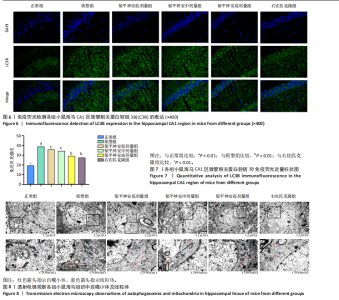
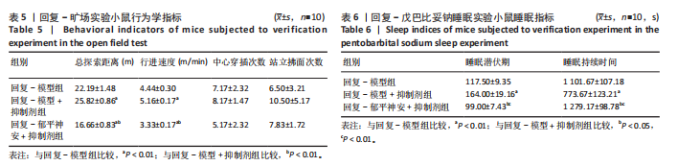
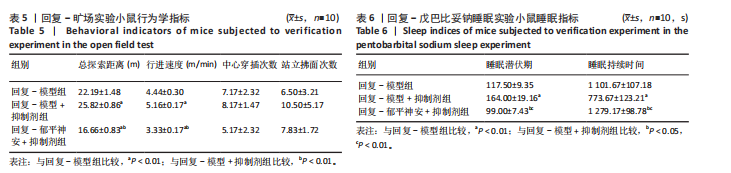
蛋白轻链3B蛋白表达升高,P62和5-羟色胺受体1A 蛋白表达下降(P < 0.05),郁平神安高剂量组无明显差异(P > 0.05)。结果提示,郁平神安可能通过激活磷脂酰肌醇3激酶/蛋白激酶B/哺乳动物雷帕霉素靶蛋白信号通路抑制过度自噬,从而发挥对失眠伴焦虑小鼠海马神经元的保护作用。 2.9 回复实验结果 与回复-模型组相比,回复-模型+抑制剂组明显表现出更高的活动量,行进距离和速度加快,异常行为显著增加;睡眠潜伏期更加延长,睡眠持续时间更加缩短(P < 0.01) (表5,6)。与回复-模型组相比,回复-模型+抑制剂组酶联免疫吸附实验结果显示,5-羟色胺、γ-氨基丁酸水平"

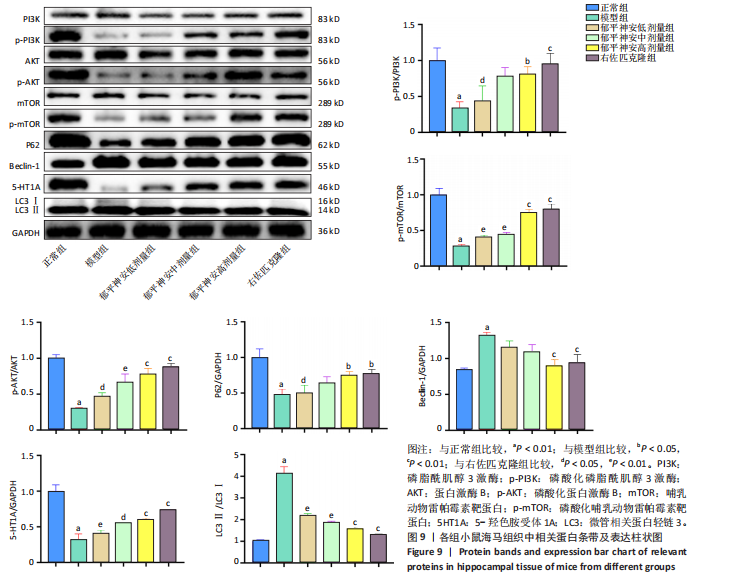
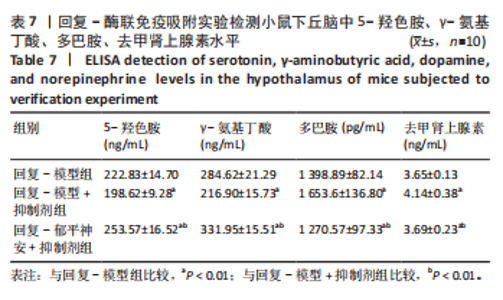
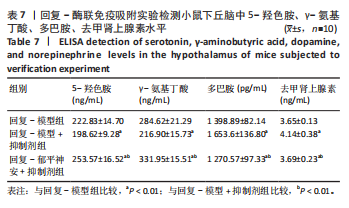
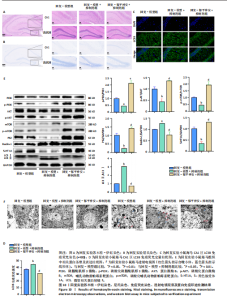
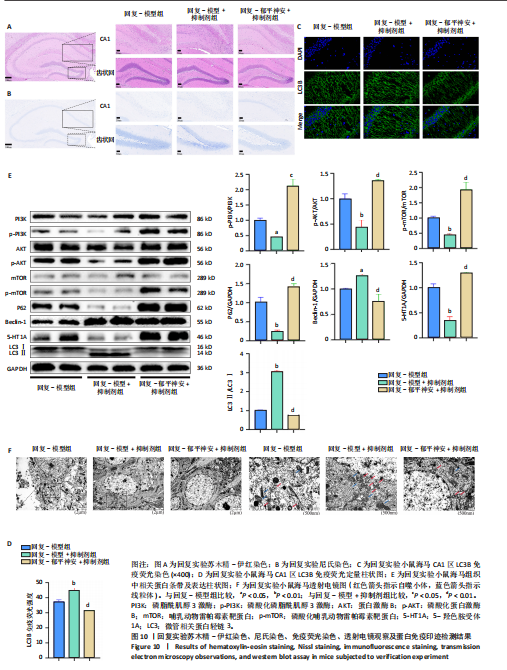
显著降低,而多巴胺、去甲肾上腺素水平显著升高(P < 0.01) (表7);苏木精-伊红染色和尼氏染色结果显示,神经元变性更广泛,细胞排列松散,出现暗染色和细胞萎缩,尼氏体数量严重减少(图10A,B);免疫荧光实验显示自噬活动增强(图10C,D) (P < 0.01);蛋白免疫印迹结果显示,磷脂酰肌醇3激酶/蛋白激酶B/哺乳动物雷帕霉素靶蛋白的磷酸化水平下降,Beclin-1和微管相关蛋白轻链3B蛋白表达上调,P62和5-羟色胺受体1A 蛋白表达下降(P < 0.01) (图10E);透射电镜观察到更多的自噬小体过度堆积,线粒体结构破坏更加严重,出现严重的线粒体肿胀、嵴断裂现象(图10F)。相比之下,回复-郁平神安+抑制剂组显著逆转了上述变化(P < 0.01)。"
"
"
"
| [1] SUTTON EL. Insomnia. Ann Intern Med. 2021;174(3):ITC33-ITC48. [2] PAUL AM, SALAS RE. Insomnia. Prim Care. 2024;51(2):299-310. [3] PENG C, WANG K, WANG J, et al. Neural correlates of insomnia with depression and anxiety from a neuroimaging perspective: A systematic review. Sleep Med Rev. 2025;81:102093. [4] 中华医学会神经病学分会,中华医学会神经病学分会睡眠障碍学组,中华医学会神经病学分会神经心理与行为神经病学学组.中国成人失眠伴抑郁焦虑诊治专家共识[J].中华神经科杂志,2020,53(8):564-574. [5] 中华医学会神经病学分会睡眠障碍学组.中国成人失眠诊断与治疗指南(2023版)[J].中华神经科杂志,2024,57(6):560-584. [6] BENJAFIELD AV, SERT KUNIYOSHI FH, MALHOTRA A, et al. Estimation of the global prevalence and burden of insomnia: a systematic literature review-based analysis. Sleep Med Rev. 2025;82:102121. [7] ROSENQVIST TW, WIUM-ANDERSEN MK, WIUM-ANDERSEN IK, et al. Long-Term Use of Benzodiazepines and Benzodiazepine-Related Drugs: A Register-Based Danish Cohort Study on Determinants and Risk of Dose Escalation. Am J Psychiatry. 2024;181(3):246-254. [8] 刘汇真,张旖旎,陈雨萌,等.安寐丹通过PI3K/Akt/mTOR信号通路调控细胞自噬改善睡眠剥夺小鼠学习记忆水平[J].中国实验方剂学杂志,2025, 31(14):1-9. [9] 何钰珺,闫鹏轩,谢道俊.谢道俊教授用“轻可去实、重可去怯”法治疗失眠伴焦虑抑郁状态经验[J].吉林中医药,2023,43(6):656-661. [10] 黄辰烨.郁平神安方治疗肝郁气滞型慢性失眠障碍合并焦虑抑郁状态的临床疗效观察与静息态功能磁共振研究[D].合肥:安徽中医药大学,2025. [11] LIN H, XU Y, XIONG H, et al. Mechanism of action of Panax ginseng alcohol extract based on orexin-mediated autophagy in the treatment of sleep and cognition in aged sleep-deprived rats. J Ethnopharmacol. 2025;337(Pt 2):118907. [12] MAO JQ, CHENG L, ZHANG YD, et al. Chinese formula Guben-Jiannao Ye alleviates the dysfunction of circadian and sleep rhythms in APP/PS1 mice implicated in activation of the PI3K/AKT/mTOR signaling pathway. J Ethnopharmacol. 2024;335:118696. [13] BAO Y, ZHOU H, FU Y, et al. Zhumian Granules improves PCPA-induced insomnia by regulating the expression level of neurotransmitters and reducing neuronal apoptosis. J Ethnopharmacol. 2024;327:118048. [14] ZHANG W, ZHANG X, YAN D, et al. Establishment of insomnia model of chronic unpredictable stress in rats. Heliyon. 2023;9(7):e18338. [15] 闫德祺,张星平,张文慧,等.桂枝加龙骨牡蛎汤对肺不藏魄型不寐模型大鼠睡眠情况、血清及脑组织5羟色胺水平的影响[J].中医杂志,2022,63(19): 1865-1871. [16] WANG Z, LI D, CHEN M, et al. A comprehensive study on the regulation of Compound Zaoren Granules on cAMP/CREB signaling pathway and metabolic disorder in CUMS-PCPA induced insomnia rats. J Ethnopharmacol. 2024;332: 118401. [17] DU L, YANG D, WU L, et al. Integration of Gut Microbiota, Serum Metabolomic, and Network Pharmacology to Reveal the Anti Insomnia Mechanism of Mongolian Medicine Sugemule-4 Decoction on Insomnia Model Rats. Drug Des Devel Ther. 2024;18:2617-2639. [18] WANG D, WU T, JIN J, et al. Periostracum Cicadae Extract and N-Acetyldopamine Regulate the Sleep-Related Neurotransmitters in PCPA-Induced Insomnia Rats. Molecules. 2024;29(15):3638. [19] FU X, YAN S, HU Z, et al. Guhan Yangsheng Jing mitigates hippocampal neuronal pyroptotic injury and manifies learning and memory capabilities in sleep deprived mice via the NLRP3/Caspase1/GSDMD signaling pathway. J Ethnopharmacol. 2024;326:117972. [20] WANG M, WANG G, ZHAO M, et al. Jujuboside A in ameliorating insomnia in mice via GABAergic modulation of the PVT. J Ethnopharmacol. 2025;349:119939. [21] GONG Z, LAO D, WU Y, et al. Inhibiting PI3K/Akt-Signaling Pathway Improves Neurobehavior Changes in Anti-NMDAR Encephalitis Mice by Ameliorating Blood-Brain Barrier Disruption and Neuronal Damage. Cell Mol Neurobiol. 2023; 43(7):3623-3637. [22] 田鸿芳,赵吉平.强弱刺激量针刺对肝郁化火型原发性失眠伴随抑郁焦虑情绪及生活质量影响的随机对照研究[J].中华中医药杂志,2022,37(2):1193-1197. [23] 王业群,方无杰,项尚,等.解郁清心配方颗粒联合远程交互式CBT-I治疗肝郁化火型慢性失眠的临床疗效[J].中国实验方剂学杂志,2024,30(20):120-126. [24] 徐金铭,王芳芳,曹迪,等.柴胡及其药对的药理研究进展[J/OL].中华中医药学刊,1-15[2025-07-30].https://link.cnki.net/urlid/21.1546.R.20250728.1644.012. [25] 卜俊文,邵明国,杨元丰,等.白芍研究进展及其质量标志物(Q-Marker)预测[J/OL].中华中医药学刊,1-21[2025-07-30].https://link.cnki.net/urlid/21.1546.R.20250718.1119.010. [26] HUANG Y, MIAO Q, CHEN N, et al. Tissue distribution of seven coptidis alkaloids in normal and insomnia rats affected by Cinnamomi cortex (Cinnamomum cassia) using liquid chromatography-tandem mass spectrometry. Fitoterapia. 2025;185:106723. [27] LAVENDER I, MCGREGOR IS, SURAEV A, et al. Cannabinoids, Insomnia, and Other Sleep Disorders. Chest. 2022;162(2):452-465. [28] KRAMER DJ, JOHNSON AA. Apigenin: a natural molecule at the intersection of sleep and aging. Front Nutr. 2024;11:1359176. [29] HU Y, HE X, WU Y, et al. Sedative-Hypnotic Effect and Mechanism of Carbon Nanofiber Loaded with Essential Oils of Ligusticum chuanxiong (Ligusticum chuanxiong Hort.) and Finger Citron (Citrus medica L. var. sarcodactylis) on Mice Models of Insomnia. Biomolecules. 2024;14(9):1102. [30] PRONIER É, MORICI JF, GIRARDEAU G. The role of the hippocampus in the consolidation of emotional memories during sleep. Trends Neurosci. 2023; 46(11):912-925. [31] OLSEN LC, GALLER M, WITTER MP, et al. Transcriptional development of the hippocampus and the dorsal-intermediate-ventral axis in rats. Hippocampus. 2023;33(9):1028-1047. [32] GIRI B, KINSKY N, KAYA U, et al. Sleep loss diminishes hippocampal reactivation and replay. Nature. 2024;630(8018):935-942. [33] BECKER LA, PENAGOS H, FLORES FJ, et al. Eszopiclone and Zolpidem Produce Opposite Effects on Hippocampal Ripple Density. Front Pharmacol. 2022;12:792148. [34] ZHANG K, WANG F, ZHAI M, et al. Hyperactive neuronal autophagy depletes BDNF and impairs adult hippocampal neurogenesis in a corticosterone-induced mouse model of depression. Theranostics. 2023;13(3):1059-1075. [35] LI H, SUN J, WU Y, et al. Honokiol relieves hippocampal neuronal damage in Alzheimer’s disease by activating the SIRT3-mediated mitochondrial autophagy. CNS Neurosci Ther. 2024;30(8):e14878. [36] LIU S, YAO S, YANG H, et al. Autophagy: Regulator of cell death. Cell Death Dis. 2023;14(10):648. [37] LI W, HE P, HUANG Y, et al. Selective autophagy of intracellular organelles: recent research advances. Theranostics. 2021;11(1):222-256. [38] HWANG HJ, HA H, LEE BS, et al. LC3B is an RNA-binding protein to trigger rapid mRNA degradation during autophagy. Nat Commun. 2022;13(1):1436. [39] LI J, WANG Y, LUO Y, et al. USP5-Beclin 1 axis overrides p53-dependent senescence and drives Kras-induced tumorigenicity. Nat Commun. 2022;13(1):7799. [40] RONG Y, FAN J, JI C, et al. USP11 regulates autophagy-dependent ferroptosis after spinal cord ischemia-reperfusion injury by deubiquitinating Beclin 1. Cell Death Differ. 2022;29(6):1164-1175. [41] HUANG X, YAO J, LIU L, et al. S-acylation of p62 promotes p62 droplet recruitment into autophagosomes in mammalian autophagy. Mol Cell. 2023;83(19):3485-3501.e11. [42] KUMAR AV, MILLS J, LAPIERRE LR. Selective Autophagy Receptor p62/SQSTM1, a Pivotal Player in Stress and Aging. Front Cell Dev Biol. 2022;10:793328. [43] LI R, PAN Y, JING N, et al. Flavonoids from mulberry leaves exhibit sleep-improving effects via regulating GABA and 5-HT receptors. J Ethnopharmacol. 2025;337(Pt 3):118734. [44] LIU YM, LI JC, GU YF, et al. Cannabidiol Exerts Sedative and Hypnotic Effects in Normal and Insomnia Model Mice Through Activation of 5-HT1A Receptor. Neurochem Res. 2024;49(5):1150-1165. [45] YU L, WEI J, LIU P. Attacking the PI3K/Akt/mTOR signaling pathway for targeted therapeutic treatment in human cancer. Semin Cancer Biol. 2022;85:69-94. [46] CAO F, XU Y, ZHANG M, et al. Baihui (DU20), Shenmen (HT7) and Sanyinjiao (SP6) target the cAMP/CREB/BDNF and PI3K/Akt pathways to reduce central nervous system apoptosis in rats with insomnia. Heliyon. 2022;8(12):e12574. [47] ZHU W, GONG A, ZHANG B, et al. The Chronobiological and Neuroprotective Mechanisms of Resveratrol in Improving Sleep. Mediators Inflamm. 2025; 2025:4954030. [48] LI R, ZHENG Y, ZHANG J, et al. Gomisin N attenuated cerebral ischemia-reperfusion injury through inhibition of autophagy by activating the PI3K/AKT/mTOR pathway. Phytomedicine. 2023;110:154644. [49] DING MR, QU YJ, HU B, et al. Signal pathways in the treatment of Alzheimer’s disease with traditional Chinese medicine. Biomed Pharmacother. 2022;152: 113208. [50] WANG L, TIAN S, RUAN S, et al. Neuroprotective effects of cordycepin on MPTP-induced Parkinson’s disease mice via suppressing PI3K/AKT/mTOR and MAPK-mediated neuroinflammation. Free Radic Biol Med. 2024;216:60-77. [51] SHI M, YANG J, LIU Y, et al. Huanglian Wendan Decoction Improves Insomnia in Rats by Regulating BDNF/TrkB Signaling Pathway Through Gut Microbiota-Mediated SCFAs and Affecting Microglia Polarization. Mol Neurobiol. 2025;62(1):1047-1066. [52] BAI G, QIAO Y, LO PC, et al. Anti-depressive effects of Jiao-Tai-Wan on CORT-induced depression in mice by inhibiting inflammation and microglia activation. J Ethnopharmacol. 2022;283:114717. [53] WU Y, YAO C, ZHANG L, et al. Sophora flavescens alcohol extract ameliorates insomnia and promotes PI3K/AKT/BDNF signaling transduction in insomnia model rats. Neuroreport. 2024;35(5):275-282. |
| [1] | Zhou Sirui, Xu Yukun, Zhao Kewei. Ideas and methods of anti-melanogenesis of Angelica dahurica extracellular vesicles [J]. Chinese Journal of Tissue Engineering Research, 2026, 30(7): 1747-1754. |
| [2] | Chen Yulin, He Yingying, Hu Kai, Chen Zhifan, Nie Sha Meng Yanhui, Li Runzhen, Zhang Xiaoduo , Li Yuxi, Tang Yaoping. Effect and mechanism of exosome-like vesicles derived from Trichosanthes kirilowii Maxim. in preventing and treating atherosclerosis [J]. Chinese Journal of Tissue Engineering Research, 2026, 30(7): 1768-1781. |
| [3] | Peng Zhiwei, Chen Lei, Tong Lei. Luteolin promotes wound healing in diabetic mice: roles and mechanisms [J]. Chinese Journal of Tissue Engineering Research, 2026, 30(6): 1398-1406. |
| [4] | Chen Yixian, Chen Chen, Lu Liheng, Tang Jinpeng, Yu Xiaowei. Triptolide in the treatment of osteoarthritis: network pharmacology analysis and animal model validation [J]. Chinese Journal of Tissue Engineering Research, 2026, 30(4): 805-815. |
| [5] | Ma Runqiu, Yang Huixia, Li Xuer, Bai Zhigang, Li Guizhong, Hao Yinju, Ma Shengchao, Jiang Yideng. Mechanism of glucocorticoid-induced mitochondrial dysfunction in osteoblasts in steroid-induced osteonecrosis of the femoral head [J]. Chinese Journal of Tissue Engineering Research, 2026, 30(34): 8845-8851. |
| [6] | Zhao Canbin, Zeng Ping, Shi Weiqi, Liu Jinfu, Ding Qiang, Guo Liang, Wang Weiwei, Tao Hongcheng, Guo Yafeng, Qin Ying. Mechanism by which luteolin regulates macrophage polarization in the treatment of knee osteoarthritis [J]. Chinese Journal of Tissue Engineering Research, 2026, 30(34): 8868-8877. |
| [7] | Jing Kun, Wang Yulu, Liang Hao, Huo Yuhang, Cong Longxu, . Mechanisms by which mangiferin alleviates pain in osteoarthritis: integration of microarray data analysis, network pharmacology, and experimental validation in a rat model [J]. Chinese Journal of Tissue Engineering Research, 2026, 30(34): 8953- 8961. |
| [8] | Yuan Jingjing, Zhang Xiaomin, Du Pengyang, Wang Weifeng. Mazdutide improves cognitive function in APP/PS1/Tau triple transgenic mice [J]. Chinese Journal of Tissue Engineering Research, 2026, 30(34): 8962-8969. |
| [9] | Qi Yuxin, Dang Yifan, Dai Liming, Zhang Xiaoling. Function and molecular mechanism of physcion in regulating bone homeostasis [J]. Chinese Journal of Tissue Engineering Research, 2026, 30(28): 7237-7244. |
| [10] | Deng Qian, Peng Zining, Meng Fanyu, Huang Yuanbo, Liu Nian, Yan Weitian, Li Zhaofu, Peng Jiangyun. Molecular mechanisms of Toddalia asiatica against rheumatoid arthritis: bioinformatics and molecular dynamics simulation [J]. Chinese Journal of Tissue Engineering Research, 2026, 30(28): 7267-7279. |
| [11] | Chen Chaoqi, Liu Fei, Song Chao, Shen Baoxin, Huang Wutao, Chen Feng, Yang Lei. Yanggan Roujin Decoction delays intervertebral disc degeneration: network pharmacological analysis and experimental validation in rat models [J]. Chinese Journal of Tissue Engineering Research, 2026, 30(25): 6533-6543. |
| [12] | He Wenyang, Chen Weijian, Ran Qingzhi, Huang Yidie, Lin Xiaodong, Xu Xuemeng, Guo Meirong, Liu Wengang. Action mechanisms of Bushen Qiangjin capsule in regulating inflammatory signaling pathways and improving knee osteoarthritis [J]. Chinese Journal of Tissue Engineering Research, 2026, 30(25): 6632-6642. |
| [13] | Zhang Xiaomin, Du Pengyang, Zhang Xiuping, Xue Guofang. Potential targets of glucagon-like peptide 1 receptor agonist ticagrelor in the treatment of Alzheimer’s disease [J]. Chinese Journal of Tissue Engineering Research, 2026, 30(23): 6122-6133. |
| [14] | Mi Baolai, Liu Yufei, Yang Qiaoli, Kang Yanlan, Yuan Liang, Cao Jianchun. Limb lymphedema: network pharmacology and molecular docking analysis of core drug mechanisms in traditional Chinese medicine treatment [J]. Chinese Journal of Tissue Engineering Research, 2026, 30(18): 4814-4824. |
| [15] | Wu Xue, Zhang Linao, Luo Shifang, Liu Feifan, Wan Yan, Bai Yuanmei, Cao Julin, Xie Yuhuan, Guo Peixin. Dandeng Tongnao soft capsules against ischemic stroke: fingerprinting and network pharmacological analysis of efficacy and mechanism of action [J]. Chinese Journal of Tissue Engineering Research, 2026, 30(17): 4517-4528. |
| Viewed | ||||||
|
Full text |
|
|||||
|
Abstract |
|
|||||