Chinese Journal of Tissue Engineering Research ›› 2026, Vol. 30 ›› Issue (34): 8953- 8961.doi: 10.12307/2026.850
Previous Articles Next Articles
Mechanisms by which mangiferin alleviates pain in osteoarthritis: integration of microarray data analysis, network pharmacology, and experimental validation in a rat model
Jing Kun1, 2, Wang Yulu², Liang Hao1, 2, Huo Yuhang1, 2, Cong Longxu1, 2
- 1School of Medicine, Baotou Medical College, Inner Mongolia University of Science and Technology, Baotou 014040, Inner Mongolia Autonomous Region, China; 2The First Affiliated Hospital of Baotou Medical College, Inner Mongolia University of Science and Technology, Baotou 014017, Inner Mongolia Autonomous Region, China
-
Received:2025-09-17Revised:2026-01-17Online:2026-12-08Published:2026-04-13 -
Contact:Wang Yulu, PhD, Chief physician, The First Affiliated Hospital of Baotou Medical College, Inner Mongolia University of Science and Technology, Baotou 014017, Inner Mongolia Autonomous Region, China -
About author:Jing Kun, MS, School of Medicine, Baotou Medical College, Inner Mongolia University of Science and Technology, Baotou 014040, Inner Mongolia Autonomous Region, China; The First Affiliated Hospital of Baotou Medical College, Inner Mongolia University of Science and Technology, Baotou 014017, Inner Mongolia Autonomous Region, China -
Supported by:Natural Science Foundation Project of Inner Mongolia Autonomous Region, No. 2018MS08142 (to WYL); Baotou Medical College Scientific Research Fund Project, No. BYJJ-ZRQM202326 (to WYL)

CLC Number:
Cite this article
Jing Kun, Wang Yulu, Liang Hao, Huo Yuhang, Cong Longxu, . Mechanisms by which mangiferin alleviates pain in osteoarthritis: integration of microarray data analysis, network pharmacology, and experimental validation in a rat model[J]. Chinese Journal of Tissue Engineering Research, 2026, 30(34): 8953- 8961.
share this article
Add to citation manager EndNote|Reference Manager|ProCite|BibTeX|RefWorks
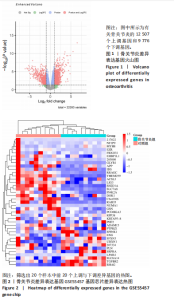
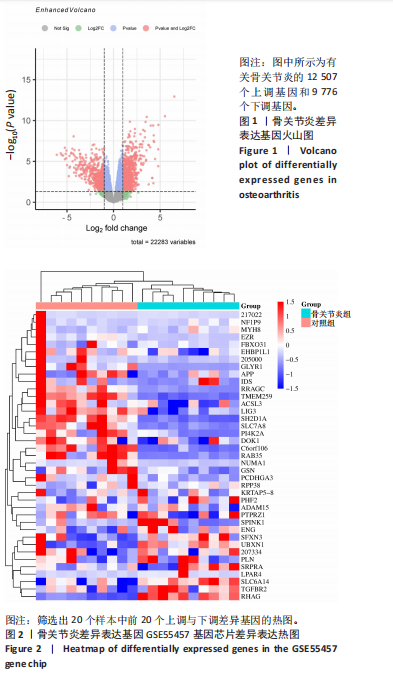
2.1 通过网络药理学分析所得结论以及分子对接的成果呈现 2.1.1 骨关节炎差异表达基因分析 自GEO数据库获取GSE55457芯片数据及其对应的GPL96平台信息,并从中筛选出20个样本。分析结果显示,共有22 283个基因表达差异显著,包括12 507个上调基因和9 776个下调基因。基于这些数据绘制了火山图(图1),并展示了前20个上调与下调差异基因的热图(图2)。"
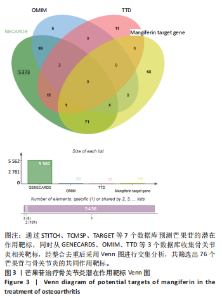
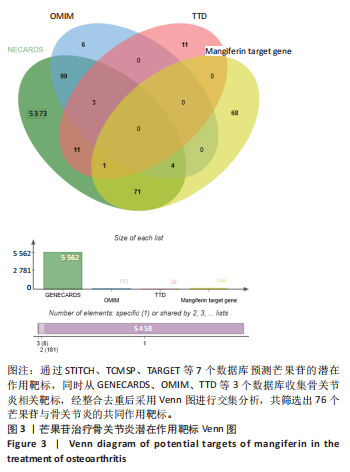
2.1.2 预测芒果苷对骨关节炎的潜在治疗靶标 利用STITCH、TCMSP、TARGET等7个数据库预测芒果苷的潜在作用靶标,合并及去重后,共得到144个靶标。同时,从GENECARDS、OMIM、TTD数据库中收集骨关节炎相关靶标,整合去重后,共获得5 579个疾病靶标。通过EVenn平台绘制了维恩图(图3),并从中筛选出了76个共同靶标。"
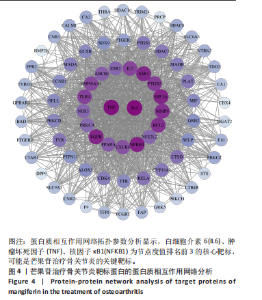
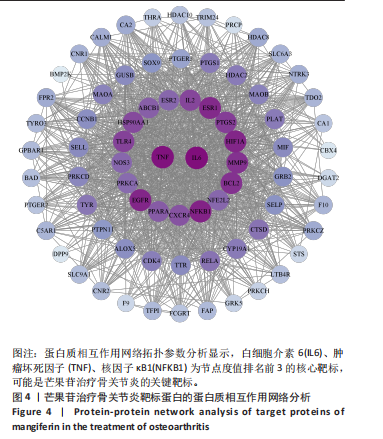
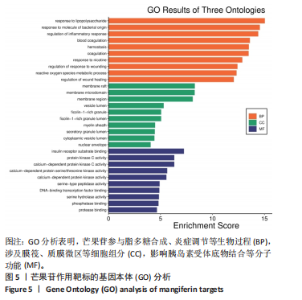
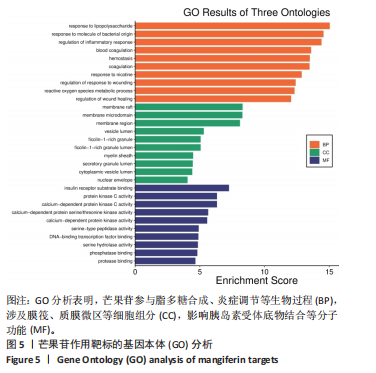
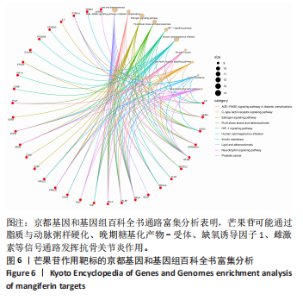
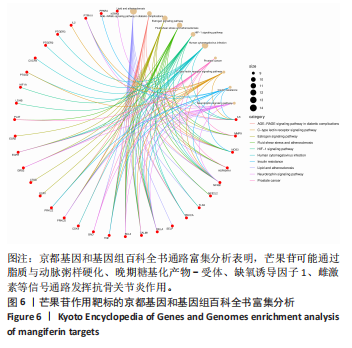
2.1.3 筛选芒果苷与骨关节炎的共同作用靶标 在 Metascape 数据库中,对药物与疾病交集靶点进行基因本体和京都基因和基因组百科全书富集分析,以 P≤0.05 筛选并可视化结果,获得3 274条生物过程、201条细胞组分、345条生物过程及235条京都基因和基因组百科全书信号通路数据。分析蛋白质相互作用网络拓扑参数,结果显示白细胞介素 6、肿瘤坏死因子、核因子κB1是节点度值排名前3的核心靶标(图 4),可能是芒果苷治疗骨关节炎的关键靶标。 2.1.4 基因本体功能注释与京都基因和基因组百科全书通路富集解析 在Metascape数据库中,对药物与疾病的共有靶点执行基因本体功能及京都基因和基因组百科全书通路富集分析,以 P≤0.05 筛选后可视化,得到 3 274条生物过程、201条细胞组分、345条结合活性及235条京都基因和基因组百科全书信号通路数据。基因本体分析表明,芒果苷参与脂多糖合成、炎症调节等生物过程,涉及膜筏、质膜微区等细胞组分,影响胰岛素受体底物结合等分子功能(图 5)。京都基因和基因组百科全书分析显示,芒果苷可能通过脂质与动脉粥样硬化、晚期糖基化产物-受体、缺氧诱导因子1、雌激素等信号通路发挥抗骨关节炎的作用(图 6)。 2.1.5 构建与剖析药物-靶标-信号通路-疾病的关联网络架构 通过整合分子功能、靶标、富集通路及骨关节炎相关数据,从"
"
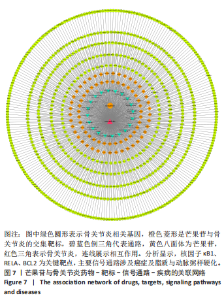
GENECARDS、OMIM、TTD等数据库中筛选出得分≥2的基因,构建药物-靶标-信号通路-疾病的关联网络(图7)。图中绿色圆形表示骨关节炎相关基因,橙色菱形是芒果苷与骨关节炎交集靶标,青蓝色倒三角代表通路,黄色八面体为芒果苷,红色三角表示骨关节炎,连线展示相互作用。分析结果显示,核因子κB1、RELA、BCL2 为关键靶点,主要信号通路涉及癌症及脂质与动脉粥样硬化。该网络图直观揭示了药物、靶标、通路"
"
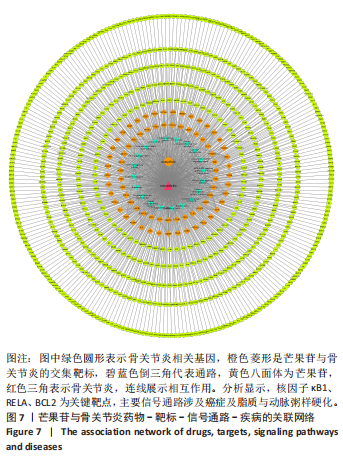
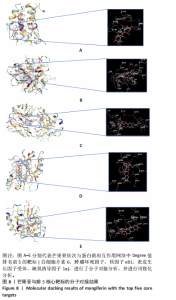
及疾病间的复杂联系,为理解药物治疗机制提供了重要线索。 2.1.6 分子对接可视化 运用分子对接手段,能够对具备已知三维结构的蛋白质与配体间的结合态势予以预估。针对蛋白质相互作用网络中Degree值排名前5的靶标(白细胞介素 6、肿瘤坏死因子、核因子κB1、表皮生长因子受体、缺氧诱导因子1α),进行了分子对接分析,计算了核心成分与这些靶点的结合能,并评估了它们的结合强度(图8)。结果显示,所有靶标的"
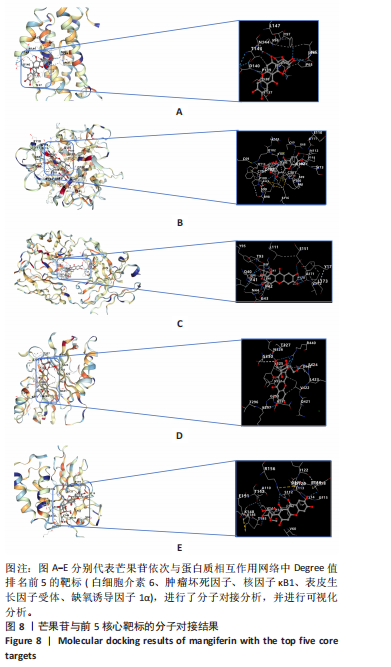
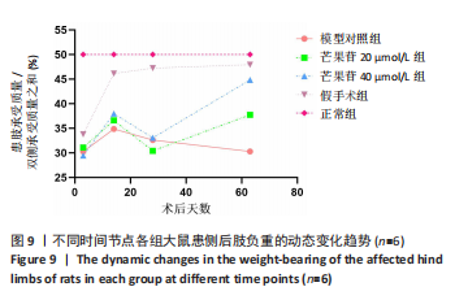
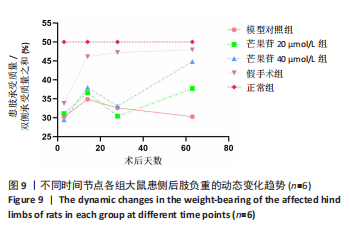
结合能均低于?20.9 kJ/mol,具体为?26.36,?45.61,?25.94,?30.96,?29.71 kJ/mol,这表明分子功能与这些靶标具有良好的亲和性,与网络药理学平台的预测结果一致。因此,推测芒果苷主要通过这些靶点发挥作用。 2.2 动物实验结果 2.2.1 各组大鼠疼痛变化评估结果 在整个实验周期内,纳入实验的24只大鼠均完成实验,无动物脱失的情况发生。实验中,检测不同时间点大鼠后肢质量分布,以此反映关节疼痛发展进程。术前各组大鼠后肢质量分布正常。术后第3天,因手术创伤,各实验组手术患肢质量分布显著下降,表明手术切口致患肢负重能力降低,且各实验组间无显著差异。术后2,4周,假手术组因无前交叉韧带损伤且伤口愈合,患肢负重趋于正常,无明显疼痛;实施前交叉韧带切断术的3组大鼠负重显著减少,表明关节炎发作致关节损伤加重,引发疼痛。治疗前,模型对照组平均患肢负重百分比低于假手术组。经4周芒果苷治疗,芒果苷20 μmol/L和芒果苷40 μmol/L 组大鼠后肢负重逐步回升,表明芒果苷有效缓解关节疼痛,使负重情况趋近假手术组。与之对比,模型对照组在研究周期内无类似改善。从图9可见,模型对照组平均患侧后肢负重较假手术组显著降低,凸显芒果苷治疗对改善大鼠关节疼痛和负重能力的积极作用。"
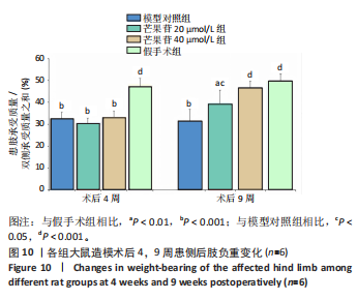
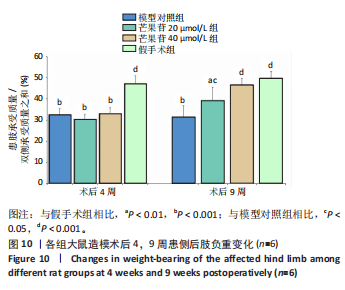
2.2.2 药物治疗前后后肢负重(疼痛情况)对比 术后4周及9周(药物治疗4周后)各组大鼠的负重对比见图10。治疗前,除假手术组外,3个实验组(模型对照组、芒果苷20 μmol/L组、芒果苷40 μmol/L组)大鼠后肢负重显著下降(假手术组与术前对比,P > 0.05;3个实验组与术前相比,P均< 0.001),表明造模成功诱导骨关节炎,导致关节疼痛并影响后肢负重。经4周药物治疗后,模型对照组、芒果苷20 μmol/L组及芒果苷40 μmol/L组与假手术组相比,P 均 < 0.001;但3个实验组间比较,无明显差异(P均> 0.05)。经9周药物治疗后,情况改变。芒果苷20 μmol/L组及芒果苷40 μmol/L组中,大鼠后肢负重(反映疼痛程度)较模型对照组显著改善(芒果苷20 μmol/L组与模型对照组相比,P < 0.05;芒果苷40 μmol/L组与模型对照组相比,P < 0.001)。尤其芒果苷40 μmol/L组与假手术组相比,负重几无差异(P > 0.05),显示该剂量芒果苷在缓解大鼠关节疼痛、恢复后肢负重能力方面效果显著。"
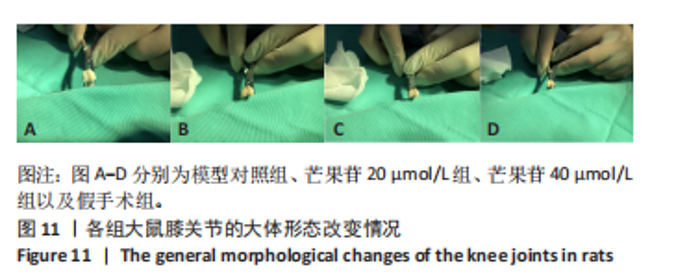
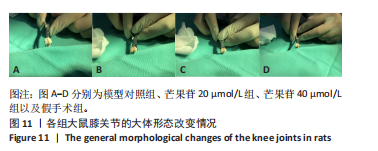
2.2.3 大鼠关节炎大体观察结果 如图11所示,模型对照组大鼠仅接受了关节腔二甲基亚砜溶剂注射,其股骨远端显现出典型的骨关节炎特点,股骨髁的关节面变得粗糙,尤其是内侧髁更为显著,外侧髁也出现了退变的情况;内侧髁的透明软骨表面颜色暗沉、毫无光泽,遭受了严重的损伤,在负重区域,软骨出现了剥脱现象,部分区域已被纤维组织所取代,髁边缘有大量的骨赘形成;髌股关节内、外侧面磨损退变突出,内侧面更严重,这可能是前交叉韧带切除破坏关节生物力学稳定,加上髌骨脱位术后髌股关节不匹配,导致股骨前侧关节面及髌骨严重磨损。通过对比可以看到,在芒果苷20 μmol/L组大鼠中,其股骨髁软骨的磨损程度相对较轻,大部分软骨面较为平整,色泽略显光亮,骨质增生的情况并不突出,仅仅是部分区域的颜色略显暗沉,表面不够光滑。而在芒果苷40 μmol/L组中,大鼠股骨髁软骨的形态和完整性几乎与正常状态无异,和假手术组的情况相近。从图中能够观察到各治疗组的软骨面比较完整,股骨髁间窝前交叉韧带的断端被增生的软骨或者纤维组织所覆盖,然而假手术组却残留着新鲜切断的前交叉韧带残。"
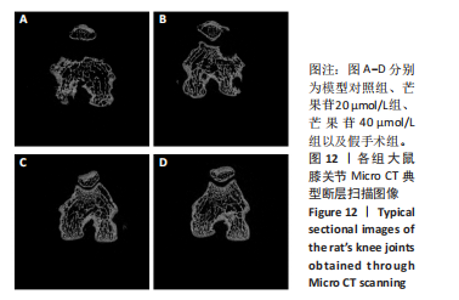
2.2.4 Micro CT 结果 治疗完毕后,为了深入探究不同组别的SD大鼠软骨退变状况,在此次研究中运用 Micro CT 扫描仪对大鼠的膝关节进行了CT扫描,并进一步完成了三维重建工作,具有代表性的成像结果如图12所示。术后4周,接受前交叉韧带切断术的模型对照组大鼠膝关节呈现典型骨关节炎特征,股骨内、外侧关节表面粗糙不规则。相较而言,假手术组与芒果苷40 μmol/L组的关节面平整光滑,无显著异常。芒果苷20 μmol/L组的股骨内侧区软骨表面存在损伤,不过损伤程度低于模型对照组,处于假手术组和模型对照组之间。断层及三维重建图像与大体观察结果高度一致,有力验证了芒果苷治疗骨关节炎的积极疗效,显示其在改善关节软骨退变、减轻症状上的效果突出。"
| [1] National Clinical Guideline Centre (UK). Osteoarthritis: care and management in adults. 2014. [2] BRUMAT P, KUNŠIČ O, NOVAK S, et al. The surgical treatment of osteoarthritis. Life. 2022;12(7):982. [3] RICHARD MJ, DRIBAN JB, MCALINDON TE. Pharmaceutical treatment of osteoarthritis. Osteoarthritis Cartilage. 2023;31(4):458-466. [4] WANG L, ZHANG XF, ZHANG X, et al. Evaluation of the Therapeutic Effect of Traditional Chinese Medicine on Osteoarthritis: A Systematic Review and Meta‐Analysis. Pain Res Manag. 2020;2020(1):5712187. [5] TONG X, WANG Y, DONG B, et al. Effects of genus Epimedium in the treatment of osteoarthritis and relevant signaling pathways. Chin Med. 2023;18(1):92. [6] DUTTA T, DAS T, GOPALAKRISHNAN AV, et al. Mangiferin: the miraculous xanthone with diverse pharmacological properties. Naunyn Schmiedebergs Arch Pharmacol. 2023;396(5):851-863. [7] GARRIDO‐SUÁREZ BB, GARRIDO G, PIÑEROS O, et al. Mangiferin: Possible uses in the prevention and treatment of mixed osteoarthritic pain. Phytother Res. 2020;34(3):505-525. [8] LIU Y, YANG X, GAN J, et al. CB-Dock2: Improved protein–ligand blind docking by integrating cavity detection, docking and homologous template fitting. Nucleic Acids Res. 2022;50(W1): W159-W164. [9] 潘生才,李晓峰,唐毓金,等.芒果苷对大鼠成骨细胞增殖作用的影响[J].中国组织工程研究,2012,16(50):9316-9320. [10] 孙伟翔,秦枫,袁亚梅,等.芒果苷抗DHAV-1致鸭胚肝细胞炎性损伤的研究[J].中国畜牧兽医,2022,49(11):4485-4494. [11] O’NEILL TW, FELSON DT. Mechanisms of osteoarthritis (OA) pain. Current osteoporosis reports. 2018;16:611-616. [12] WANG M, LIU L, ZHANG CS, et al. Mechanism of traditional Chinese medicine in treating knee osteoarthritis. J Pain Res. 2020;13:1421-1429. [13] LI L, LIU H, SHI W, et al. Insights into the action mechanisms of traditional Chinese medicine in osteoarthritis. Evid Based Complement Alternat Med. 2017;2017:5190986. [14] SAHA S, SADHUKHAN P, SIL PC. Mangiferin: A xanthonoid with multipotent anti‐inflammatory potential. Biofactors. 2016;42(5):459-474. [15] GREBENCIUCOVA E, VANHAERENTS S. Interleukin 6: at the interface of human health and disease. Front Immunol. 2023;14:1255533. [16] VAN LOO G, BERTRAND MJM. Death by TNF: a road to inflammation. Nat Rev Immunol. 2023; 23(5):289-303. [17] ANSARI MY, AHMAD N, HAQQI TM. Oxidative stress and inflammation in osteoarthritis pathogenesis: Role of polyphenols. Biomed Pharmacother. 2020;129:110452. [18] CARTWRIGHT T, PERKINS ND. WILSON LC. NFKB1: a suppressor of inflammation, ageing and cancer. FEBS J. 2016;283(10):1812-1822. [19] YANG S, XIE JJ, PAN ZJ, et al. Advanced glycation end products promote meniscal calcification by activating the mTOR-ATF4 positive feedback loop. Exp Mol Med. 2024;56(3):630-645. [20] HU S, ZHANG C, NI L, et al. Stabilization of HIF-1α alleviates osteoarthritis via enhancing mitophagy. Cell Death Dis. 2020;11(6):481. [21] MASOUD GN, LI W. HIF-1α pathway: role, regulation and intervention for cancer therapy. Acta Pharmaceutica Sinica B. 2015;5(5):378-389. [22] SEMENZA GL. Hypoxia-inducible factor 1 (HIF-1) pathway. Science’s STKE. 2007;2007(407):cm8. [23] CHEN W, WU P, YU F, et al. HIF-1α regulates bone homeostasis and angiogenesis, participating in the occurrence of bone metabolic diseases. Cells. 2022;11(22):3552. [24] PANG H, CHEN S, KLYNE DM, et al. Low back pain and osteoarthritis pain: a perspective of estrogen. Bone Res. 2023;11(1):42. [25] PATEL S, HOMAEI A, RAJU AB, et al. Estrogen: the necessary evil for human health, and ways to tame it. Biomed Pharmacother. 2018;102:403-411. [26] PELLEGRINO A, TIIDUS PM, VANDENBOOM R. Mechanisms of estrogen influence on skeletal muscle: mass, regeneration, and mitochondrial function. Sports Med. 2022;52(12):2853-2869. [27] ALAD M, YOUSEF F, EPURE LM, et al. Unraveling Osteoarthritis: Mechanistic Insights and Emerging Therapies Targeting Pain and Inflammation. Biomolecules. 2025;15(6):874. [28] MA J, ZHANG H, WANG Z, et al. Lycopodium japonicum Thunb. inhibits chondrocyte apoptosis, senescence and inflammation in osteoarthritis through STING/NF-κB signaling pathway. J Ethnopharmacol. 2024;335:118660. [29] XU M, CHEN X, DU S, et al. Isoginkgetin protects chondrocytes and inhibits osteoarthritis through NF-κB and P21 signaling pathway. Mol Med. 2025;31(1):246. [30] WANG L, CHEN S, ZHANG H, et al. Serine protease inhibitor E2 protects against cartilage tissue destruction and inflammation in osteoarthritis by targeting NF-κB signalling. Rheumatology. 2024;63(11):3172-3183. [31] YANG SY, FANG CJ, CHEN YW, et al. Hericium erinaceus mycelium ameliorates in vivo progression of osteoarthritis. Nutrients. 2022;14(13):2605. [32] SONG X, LIU Y, CHEN S, et al. Knee osteoarthritis: A review of animal models and intervention of traditional Chinese medicine. Animal Models and Experimental Medicine. 2024;7(2):114-126. [33] SHUMNALIEVA R, KOTOV G, ERMENCHEVA P, et al. Pathogenic mechanisms and therapeutic approaches in obesity-related knee osteoarthritis. Biomedicines. 2023;12(1):9. [34] SHUMNALIEVA R, KOTOV G, MONOV S. Obesity-related knee osteoarthritis—current concepts. Life. 2023;13(8):1650. [35] WALIA V, CHAUDHARY SK, SETHIYA NK. Therapeutic potential of mangiferin in the treatment of various neuropsychiatric and neurodegenerative disorders. Neurochemistry international. 2021;143:104939. [36] ZIVKOVIĆ J, KUMAR KA, RUSHENDRAN R, et al. Pharmacological properties of mangiferin: bioavailability, mechanisms of action and clinical perspectives. Naunyn Schmiedebergs Arch Pharmacol. 2024;397(2):763-781. [37] MEI S, PERUMAL M, BATTINO M, et al. Mangiferin: a review of dietary sources, absorption, metabolism, bioavailability, and safety. Crit Rev Food Sci Nutr. 2023;63(18):3046-3064. |
| [1] | Yu Cenqi, Liu Yang, Yu Jiangfeng, Kang Kang, Deng Yaoge, Xia Xiaowei, Zhang Yijian, Zhu Xuesong. Biomimetic Black Phosphorus Nanosystem Regulates Synovial Macrophage Polarization for Osteoarthritis Treatment [J]. Chinese Journal of Tissue Engineering Research, 2026, 30(在线): 1-13. |
| [2] | Zhang Nan, Meng Qinghua, Bao Chunyu. Characteristics and clinical application of ankle joint finite element models [J]. Chinese Journal of Tissue Engineering Research, 2026, 30(9): 2343-2349. |
| [3] | Chen Qiuhan, Yang Long, Yuan Daizhu, Wu Zhanyu, Zou Zihao, Ye Chuan. Peri-knee osteotomy for treatment of knee osteoarthritis: optimization of treatment strategies [J]. Chinese Journal of Tissue Engineering Research, 2026, 30(9): 2303-2312. |
| [4] | Zhang Zizheng, Luo Wang, Liu Changlu. Application value of finite element analysis on unicompartmental knee arthroplasty for medial knee compartmental osteoarthritis [J]. Chinese Journal of Tissue Engineering Research, 2026, 30(9): 2313-2322. |
| [5] | Li Qingbin, Lin Jianhui, Huang Wenjie, Wang Mingshuang, Du Jiankai, Lao Yongqiang. Bone cement filling after enlarged curettage of giant cell tumor around the knee joint: a comparison of subchondral bone grafting and non-grafting [J]. Chinese Journal of Tissue Engineering Research, 2026, 30(8): 1896-1902. |
| [6] | Zhou Sirui, Xu Yukun, Zhao Kewei. Ideas and methods of anti-melanogenesis of Angelica dahurica extracellular vesicles [J]. Chinese Journal of Tissue Engineering Research, 2026, 30(7): 1747-1754. |
| [7] | Chen Yulin, He Yingying, Hu Kai, Chen Zhifan, Nie Sha Meng Yanhui, Li Runzhen, Zhang Xiaoduo , Li Yuxi, Tang Yaoping. Effect and mechanism of exosome-like vesicles derived from Trichosanthes kirilowii Maxim. in preventing and treating atherosclerosis [J]. Chinese Journal of Tissue Engineering Research, 2026, 30(7): 1768-1781. |
| [8] | Peng Zhiwei, Chen Lei, Tong Lei. Luteolin promotes wound healing in diabetic mice: roles and mechanisms [J]. Chinese Journal of Tissue Engineering Research, 2026, 30(6): 1398-1406. |
| [9] | Li Hao, Tao Hongcheng, Zeng Ping, Liu Jinfu, Ding Qiang, Niu Chicheng, Huang Kai, Kang Hongyu. Mitogen-activated protein kinase signaling pathway regulates the development of osteoarthritis: guiding targeted therapy with traditional Chinese medicine [J]. Chinese Journal of Tissue Engineering Research, 2026, 30(6): 1476-1485. |
| [10] | Li Linzhen, Jiao Hongzhuo, Chen Weinan, Zhang Mingzhe, Wang Jianlong, Zhang Juntao. Effect of icariin-containing serum on lipopolysaccharide-induced inflammatory damage in human chondrocytes [J]. Chinese Journal of Tissue Engineering Research, 2026, 30(6): 1368-1374. |
| [11] | Chen Ju, Zheng Jinchang, Liang Zhen, Huang Chengshuo, Lin Hao, Zeng Li. Effect and mechanism of beta-caryophyllene in mice with osteoarthritis [J]. Chinese Journal of Tissue Engineering Research, 2026, 30(6): 1341-1347. |
| [12] | Lyu Guoqing, Aizimaitijiang·Rouzi, Xiong Daohai. Irisin inhibits ferroptosis in human articular chondrocytes: roles and mechanisms [J]. Chinese Journal of Tissue Engineering Research, 2026, 30(6): 1359-1367. |
| [13] | Zhang Qian, Huang Dongfeng. Weighted gene co-expression network analysis combined with machine learning to screen and validate biomarkers for osteoarthritis [J]. Chinese Journal of Tissue Engineering Research, 2026, 30(5): 1096-1105. |
| [14] | Li Haojing, Wang Xin, Song Chenglin, Zhang Shengnan, Chen Yunxin. Therapeutic efficacy of extracorporeal shock wave therapy in the upper trapezius muscle area combined with exercise control training in patients with chronic non-specific neck pain [J]. Chinese Journal of Tissue Engineering Research, 2026, 30(5): 1162-1170. |
| [15] | Bu Yangyang, Ning Xinli, Zhao Chen. Intra-articular injections for the treatment of osteoarthritis of the temporomandibular joint: different drugs with multiple combined treatment options [J]. Chinese Journal of Tissue Engineering Research, 2026, 30(5): 1215-1224. |
| Viewed | ||||||
|
Full text |
|
|||||
|
Abstract |
|
|||||